 FlashBoards Learn
- Learn
- Film Industry
- Billing Block
Film Industry · Film language
Billing Block
Also called: billing, top billing, credit block
Billing is the contractual order and size of names in a film's credits and advertising. The billing block is the dense strip of tall, narrow type at the bottom of a movie poster listing key cast and crew — every position, word and letter height in it was negotiated in someone's contract.
- What it does
- Puts the negotiated credits of cast, key crew and companies into every poster and paid ad in a fixed order and size.
- Use it when
- Designing key art, a one-sheet or a festival poster, or drafting the credit clauses in cast and crew deals.
- Watch out
- Every name, word and size must match the signed contracts — a poster that breaks a credit clause gets reprinted.
- Try this prompt
Movie one-sheet, bottom billing block in tall ultra-condensed white capitals, three tight lines, credits a quarter of the title's height
What is a billing block?
Below the image on a theatrical poster, a compressed paragraph of thin, tall capitals sits above the studio logos and rating box. That is the billing block: the credit the film owes its makers, packed into the smallest space the contracts allow.
A typical block runs in a conventional order:
- distributor and production companies ("… presents", "a … production")
- principal cast
- the film's title, repeated inside the block
- key crew: casting, music, costumes, editing, production design, director of photography
- producers, source material and writers
- the director, almost always last
The same deals that fix a name's place in the block also govern the on-screen credits, trailers and online ads — the whole of a film's film marketing. In the film industry, that whole rulebook is called billing.
What does top billing mean?
Top billing is the first name among the cast — the most prominent actor credit. It usually goes to the lead actor, but billing follows negotiating power, not screen time. In Superman (1978), Marlon Brando and Gene Hackman were billed ahead of Christopher Reeve, the newcomer in the title role.
Other positions carry weight too:
- Above the title — the name appears above the film's title in the key art.
- "And" and "with" credits — the last cast slot, set apart from the list.
- Staggered billing — when two stars both demand first place. On The Towering Inferno (1974), Steve McQueen's name sits on the left and Paul Newman's sits higher on the right, so each can claim to be read first.
A client's last position becomes the floor for the next deal, so position is fought over as hard as the fee in above-the-line contracts.
How billing is negotiated
Credit is a standard clause in every cast and key crew film contract. It usually covers:
- Position — first, last, or "no less than third".
- Placement — above or below the title, a separate card on screen, which paid ads must carry it.
- Size — a percentage of the title's height, such as 50% or 100%. Because size is measured in height, billing blocks use extremely condensed type: every requirement is met and the list still fits across the poster.
- Favored nations — no credit in the same group may be larger or more prominent.
- Excluded ads — small teasers or award ads where the full block is not required.
Guild agreements set floors that individual deals cannot go below. Writing credits have their own code: an ampersand ("Written by A & B") means a team, while "and" means the writers worked separately. The possessory "A film by…" credit is negotiated separately and has long divided directors and writers — see film unions.
How to lay out a billing block for your film
Festival posters, sales one-sheets and streaming key art all need a block. A workable process:
- Start from a credit sheet that quotes each signed clause: every name owed a paid-ad credit, in contract order, with its size.
- Set the title size inside the block first — every percentage is calculated from it.
- Use a tall, ultra-condensed sans serif in capitals, with small words like "music by" set smaller and lighter than the names.
- Keep the block to two to four centered lines near the bottom edge, logos and legal line beneath.
- Keep the title treatment and tagline in the image area, so the block stays purely informational.
In FlashBoards, pin the credit sheet, reference posters and generated mockups on one board, so producer, designer and lawyer compare drafts side by side.
Billing block vs. opening and end credits
On-screen credits and the billing block share the same contracts. On screen, credits appear one card at a time, and rank is expressed by order and by whether a name gets its own card. End credits are the complete record.
The billing block is the condensed print version: only the credits owed in paid advertising, usually a few dozen names, meeting every size clause at once in a strip a few inches tall.
How to create a billing block with AI
3 promptsA billing block can be shown in a frame: a poster in a lobby case, or a one-sheet mockup for a pitch. Image models get the layout right when the prompt says where the block sits, how tall the type is and what it says.
Medium close shot of a backlit movie poster in a glass display case outside a small cinema at night, camera at chest height, 50mm lens. The poster shows a woman with cropped silver hair and freckles in a yellow raincoat looking over a grey sea, title SALT HARBOR in large white serif letters. At the bottom, a dense billing block: three tight lines of tall, ultra-condensed thin white capitals, much smaller than the title. Rain drops on the glass, wet pavement reflecting red neon, shallow depth of field.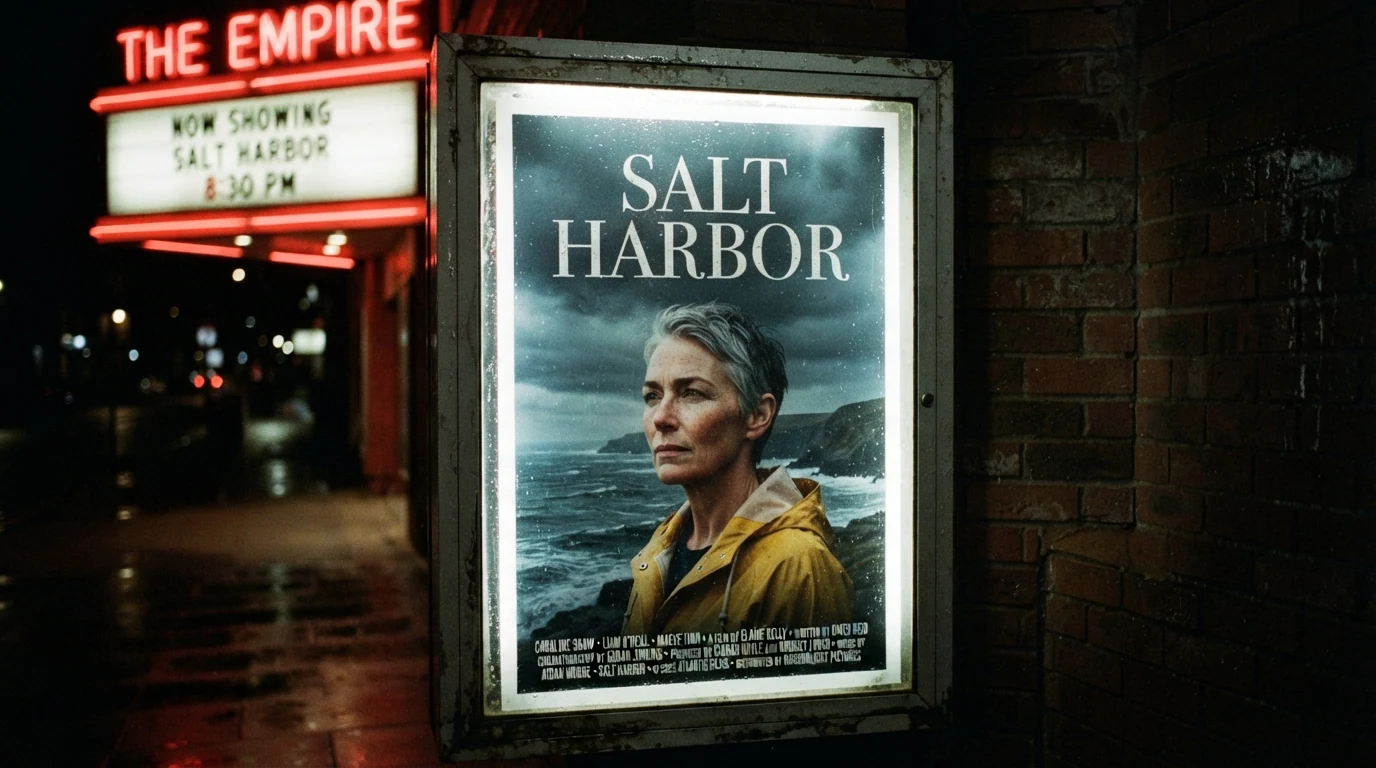
"Dense billing block", "three tight lines" and "ultra-condensed thin capitals, much smaller than the title" make the model draw a credit strip instead of a caption. The display case puts the poster in a real place, so this is a shot, not a flat graphic.
Open FlashBoardsFlat wide theatrical banner poster, horizontal cinema-lobby format. Top center, two actor names in medium white capitals: MARA VELLACOTT TEO DRAVEN. Middle: seen from above, a man with a grey beard and a red knit cap rowing a small boat across a wide black lake at dawn. Title THE LONG ROW in large cream serif capitals across the center. Bottom: billing block in tall ultra-condensed white capitals, two centered lines spanning the width, a quarter of the title's height: LANTERN FILMS PRESENTS MARA VELLACOTT TEO DRAVEN THE LONG ROW MUSIC BY ELI SORENSTAD PRODUCED BY RUTH ABERNATHY WRITTEN AND DIRECTED BY SAMIR HOLLOWAY.
This take produces the artifact itself, as a wide lobby banner. Quoting the exact text and its size relative to the title keeps the hierarchy right; invented names keep the mockup from passing for a real release.
Open FlashBoardsCamera: slow, steady push-in from the whole poster toward its lower third, ending on the billing block. Action: from the first frame, rain streaks run down the glass of the display case and red neon reflections shimmer on the wet pavement. Midway, headlights sweep across the case from left to right, briefly brightening the poster, then the glow fades as the rain keeps running over the credits.Rain and moving reflections make the clip alive from the first frame; the slow push-in makes the block the subject.
Open FlashBoardsCommon mistakes
- Small type turns into invented letters: keep the block short, quote the exact words and state its size relative to the title.
- Credits come out bold and wide unless "thin", "tall" and "ultra-condensed" appear together.
- Use invented names and titles only; real performers or studios make a mockup read as a fake release.
- Fast moves warp lettering; keep the push-in slow.
Keep the reference frames, prompts and every generated take side by side — images and video in one canvas.
FAQ
4 questionsWhat is a billing block on a movie poster?
It is the compact strip of credits at the bottom of a movie poster or paid ad: presenting companies, principal cast, title, key crew, producers, writers and director, set in tall, narrow capitals. Its content, order and letter sizes come from the cast and crew contracts, not the designer.
What does top billing mean?
Top billing means an actor's name appears first among the cast in credits and advertising. It usually goes to the biggest star or the lead, but it is negotiated, so a famous supporting actor can be billed above the lead. Billing above the title and the last "and" position are related prizes.
Who decides the order of names in movie poster credits?
Contracts decide. Each actor's and key crew member's deal states their position, placement and size relative to the title, and guild agreements add minimums for directors and writers. The studio's legal team assembles the block, and the designer lays it out without changing any name, word or ranking.
What does "and" before an actor's name mean in the credits?
An "and" or "with" credit places an actor last in the cast list, set apart from the others — a prestige slot often negotiated by established actors in smaller roles. In writing credits, "and" joins writers who worked separately, while an ampersand joins a writing team.
Related terms
2- Above the LineFilmmaking Process & Crew
Above-the-line costs are the budget lines for the key creative talent — writers, director, producers, principal cast and rights — negotiated before production; everything else is below the line.
- Film MarketingFilm Industry
Film marketing builds awareness and want-to-see before release — trailers, posters, taglines, press, festivals, social media and paid media (P&A) — targeted at the audience the film can realistically reach.
Further reading
Directors Guild of America and Writers Guild of America — basic agreements and screen credits manual (credit rules for directors and writers).