 FlashBoards Learn
- Learn
- Film Industry
- Tagline
Film Industry · Film language
Tagline
Also called: movie tagline, poster tagline
A movie tagline is the short, memorable line on a poster or in a trailer that sells a film's mood or hook — Alien's “In space no one can hear you scream.” Unlike a logline, it doesn't summarize the plot. It makes a stranger feel what the film will be like in a handful of words.
- What it does
- Sells a film's mood or hook in one short line on the poster or trailer, without summarizing the plot.
- Use it when
- Designing the poster, the trailer end card, a festival one-sheet or the first social posts for a film.
- Watch out
- A line that retells the plot is a logline; a line that only restates the image is wasted space.
- Try this prompt
Vertical movie poster, lone figure small in fog, large empty sky, tagline at the top in quotes: “The tide keeps what it takes.”
What is a movie tagline?
A tagline is marketing copy, not story writing. It sits on the one-sheet poster above or below the title, on billboards, as a title card near the end of a movie trailer and in social posts. With the key art and the billing block, it is a basic tool of film marketing in the film industry.
Studio-era posters carried several lines of breathless copy; modern campaigns settle on one short line, or none when title and image say everything. A film can have several, from teaser to final poster.
Best movie taglines and why they work
Great taglines rarely describe the story. Each picks one angle and commits to it:
- Promise the experience. Superman (1978): “You'll believe a man can fly.” A guarantee.
- Plant a dread. Alien (1979): “In space no one can hear you scream.” The Thing (1982): “Man is the warmest place to hide.” Each turns the premise into a threat.
- Twist a familiar phrase. Jaws 2 (1978): “Just when you thought it was safe to go back in the water…” It leans on the first film.
- Play with sound. The Truman Show (1998): “On the air. Unaware.” Two beats and a rhyme.
- Ask a question. The Texas Chain Saw Massacre (1974): “Who will survive and what will be left of them?”
- Frame the character. Taxi Driver (1976): “On every street in every city, there's a nobody who dreams of being a somebody.”
- Use irony. The Social Network (2010): “You don't get to 500 million friends without making a few enemies.”
- Be blunt. Office Space (1999): “Work sucks.”
The common threads: one idea, a spoken rhythm, the genre's tone, and a gap only the film fills.
How to write a tagline
- Start from the feeling, not the plot. Name the one emotion the audience should buy a ticket for.
- Find what only this film has — an image, a rule of the world, an irony in the premise.
- Write many. Thirty variants: promises, warnings, questions, wordplay.
- Cut hard. Three to eight words; read each aloud.
- Test it against the key art. Line and image should do different jobs: if the poster shows the monster, the tagline shouldn't name it.
- No spoilers, no clichés like “One man. One mission.”
In FlashBoards, keep candidate lines as notes beside poster mockups on the film's board, generate the key art with each line and compare them at thumbnail size — how most people first see a poster, on a phone.
Tagline vs. logline: what's the difference?
Both are one short piece of text about a film, but they have different readers:
| | Tagline | Logline | |---|---|---| | Reader | The audience | Producers, agents, festival readers | | Job | Sell a mood or hook | Summarize the premise | | Content | Tone, promise, irony | Protagonist, goal, obstacle, stakes | | Length | Usually under 10 words | One or two sentences | | When | Marketing, once the film exists | Development |
A logline for Alien might read: When a commercial spaceship crew answers a distress call, a lethal creature gets on board and hunts them one by one. The tagline skips all of that and gives you the silence of space.
Tagline, slogan and catchphrase
A slogan belongs to a brand and can run for decades; a tagline belongs to one film's campaign (British usage often says strapline). A catchphrase is spoken by a character inside the film and sticks through repetition. Most taglines are never heard in the film at all.
How to create a tagline with AI
3 promptsA tagline lives or dies next to the key art, so test it on a poster: key art for an original folk-horror film, Salt Marsh, a second take with a different line, and a motion poster. Keep every draft line and its poster on one FlashBoards board to compare them.
Vertical movie poster key art for a fictional folk-horror thriller. A woman in her fifties with a gray buzz cut, weathered face and a yellow oilskin coat stands alone at the end of a narrow wooden boardwalk in a flat tidal salt marsh, small in the lower third of the frame, seen from behind at eye level. Dense low fog, pale gray dawn light, dark water between the reeds. Large empty sky fills the upper half. Title at the bottom in tall condensed white sans-serif capitals: “SALT MARSH”. Tagline centered in the upper third in small, widely spaced white serif letters: “The tide keeps what it takes.” The only text on the poster is these two lines.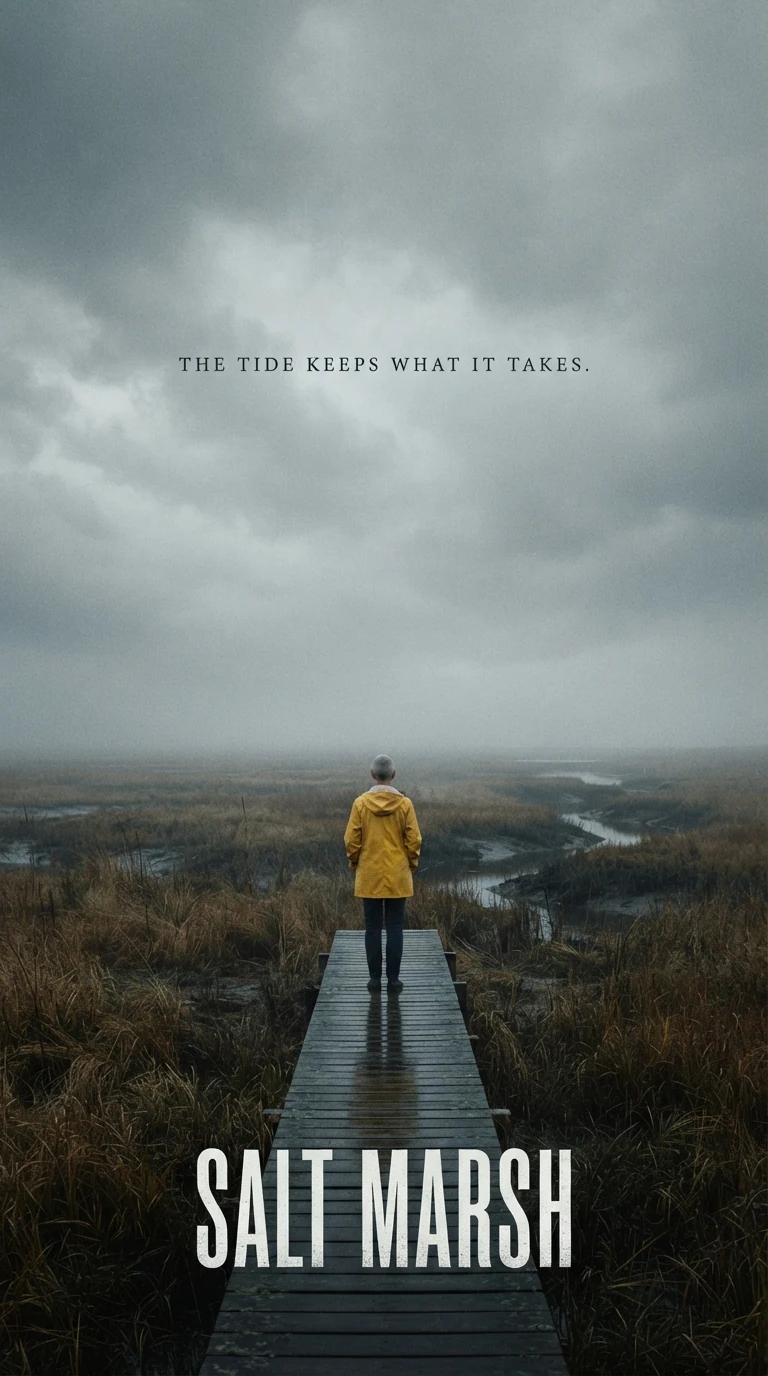
Exact words in quotes, with position and type style, give the model a layout. “Small in the lower third” and “large empty sky” reserve space for the line; the last sentence stops invented credits.
Open FlashBoardsWide billboard-format movie poster for a fictional thriller. Top-down close-up of the weathered hand of a woman in her fifties, a thin silver ring on the index finger, pressed flat into wet black mud while seawater creeps in between the fingers, dark mud stretching across the frame. Cold overcast light, desaturated green-gray palette, fine film grain. Tagline across the top in bold white condensed capitals: “LOW TIDE. NO WAY BACK.” Title at the bottom in thin white serif capitals: “SALT MARSH”. The only text on the poster is these two lines.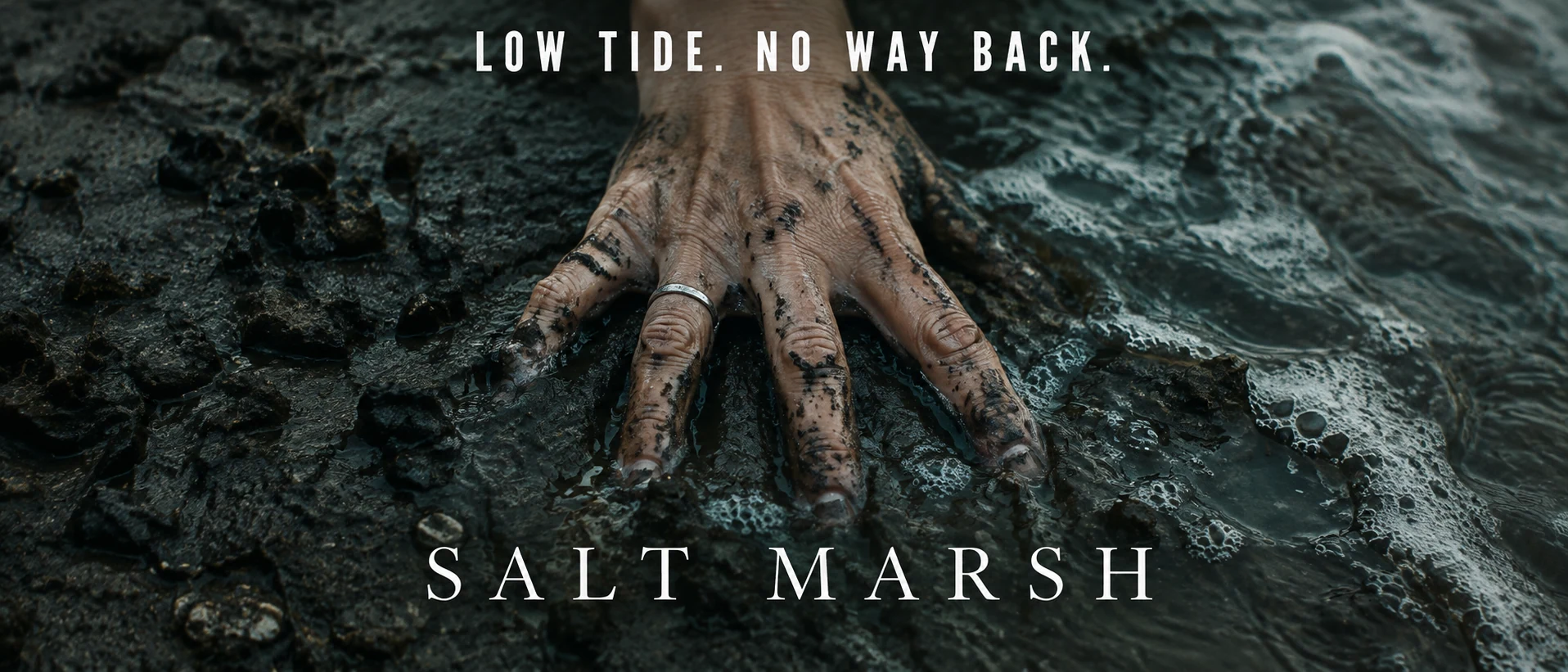
Same title, a different tagline mode — a two-beat warning — on a wide billboard with a tighter image. Side by side, the posters show whether the dread comes from the line or the picture.
Open FlashBoardsCamera: static, locked-off frame for the whole shot. Action: fog is already drifting across the marsh from left to right as the shot begins, and the hem of the yellow coat moves in the wind. Dark water rises between the reeds and starts to lap over the far planks of the boardwalk. The title and tagline stay fixed and sharp in their places.A motion poster for social feeds. The locked-off camera keeps the type in place; motion is stated first so the shot is alive from frame one, and only elements already in frame move.
Open FlashBoardsCommon mistakes
- Misspelled or extra words. Keep the line short, quote it, state font and position, and say it is the only text. Treat generated type as a layout draft.
- Text over the subject. Say where the empty space is (“large empty sky in the upper half”).
- Warping letters in video. Lock the camera; if letters still shimmer, animate a text-free version and add the tagline in the edit.
Keep the reference frames, prompts and every generated take side by side — images and video in one canvas.
FAQ
5 questionsWhat is a tagline in a movie?
A movie tagline is the short promotional line on the poster or in the trailer, such as Alien's “In space no one can hear you scream.” The marketing campaign writes it to sell the film's mood or hook in a few words, usually without describing the plot.
What are the best movie taglines of all time?
Lists vary, but some lines keep coming up: Alien's “In space no one can hear you scream,” Jaws 2's “Just when you thought it was safe to go back in the water” and The Fly (1986): “Be afraid. Be very afraid.” Each is short and built on one idea.
How long should a movie tagline be?
Most strong taglines run three to eight words, because the line must be read in a second on a billboard or phone screen next to a title and an image. Longer lines can work with a clear rhythm, like Taxi Driver's nobody-and-somebody line, but short is the safer default.
What is the difference between a tagline and a logline?
A logline is for the industry: one or two sentences summarizing the premise — protagonist, goal, obstacle, stakes — for producers and festival readers. A tagline is for the audience: a short poster line that sells tone or a hook and often says nothing about the plot. Indie filmmakers usually need both.
Does an independent short film need a tagline?
It helps. A tagline gives your festival one-sheet, crowdfunding page and social posts one line to repeat. Write it after the edit, when you know how the film feels, and test it on the poster: if title and image already say everything, skip it rather than use a weak one.
Related terms
3- LoglineScreenwriting
A logline sums up a film in one or two sentences: the protagonist, their goal, the obstacle and what's at stake — the hook that sells the script and, today, the seed for an AI storyboard.
- Film MarketingFilm Industry
Film marketing builds awareness and want-to-see before release — trailers, posters, taglines, press, festivals, social media and paid media (P&A) — targeted at the audience the film can realistically reach.
- Movie TrailerEditing
A trailer is a 1–3 minute promotional cut of a film's best moments — usually a three-act mini-structure of setup, escalation and a button — built from picture, music and sound design to sell the film without spoiling it.