 FlashBoards Learn
- Learn
- Film Industry
- Film Marketing
Film Industry · Film language
Film Marketing
Also called: movie marketing, film promotion, P&A
Film marketing is everything that builds awareness and want-to-see before a movie opens: trailers, posters, taglines, press, festivals, social media and paid advertising, known in the business as P&A. A good campaign doesn't talk to everyone. It finds the audience the film can realistically reach and gives it one clear reason to show up.
- What it does
- Turns a finished film into an event a specific audience knows about, understands in seconds and wants to see on a specific date.
- Use it when
- Planning a release, building festival and sales materials, or deciding which images, lines and moments will represent the film in public.
- Watch out
- Marketing can't fix a promise the film doesn't keep: a trailer that sells the wrong genre wins the opening and loses the word of mouth.
- Try this prompt
Vertical key art, a lone figure on an empty foggy highway at blue hour under one streetlight, low angle, large empty sky above
What is film marketing?
Film marketing is the part of the film industry between a finished cut and a ticket, a stream or a rental. It answers three questions for a stranger: what is this film, who is it for, and why watch it now?
The money behind it is called P&A, prints and advertising. Prints are mostly digital files now, but the term stuck for the whole release budget: trailers and spots, posters, social media, publicity and premieres. On a studio picture the distributor pays for it, which is why marketing is inseparable from film distribution: release date, screen count and campaign size are decided together.
The film marketing toolkit
Every campaign mixes the same assets.
- Key art. The one image that stands for the film on posters, streaming tiles and ads. It must read at thumbnail size: one figure, one strong shape, a clear genre signal.
- Title treatment and tagline. A good tagline sells a feeling, not the plot.
- Teaser and trailer. The movie trailer is still the key paid asset, now cut in several lengths and vertical versions.
- Stills and the press kit. Unit photography and frame grabs (film stills), plus interviews and behind-the-scenes footage.
- Publicity and festivals. Reviews, interviews, premieres; a film festival can launch reviews, buzz and the sale at once.
- Social and paid media. Short clips, targeted ads, creator partnerships, brand tie-ins.
How a movie marketing strategy is timed
Marketing starts long before the release date. A typical campaign moves in stages:
- Production: a set photographer shoots publicity stills; the team gathers behind-the-scenes material.
- Positioning: marketers fix the genre, the audience and the single promise. Test screenings can shape both cut and pitch; Smile (2022) moved from streaming to theaters after strong test audiences.
- Teaser, then trailer: the teaser sets the mood months ahead, the trailer shows story and stars.
- Final weeks: spots, outdoor ads, press tour, early reviews, premiere.
- Opening and after: the opening weekend is the most expensive moment; then word of mouth takes over.
Film marketing campaigns that changed the playbook
- ***The Blair Witch Project* (1999)** treated its fictional story as a real missing-persons case online, one of the first campaigns to live mainly on the web.
- ***Paranormal Activity* (2007)** asked fans to "Demand It" in their own cities, and its trailers showed night-vision footage of audiences screaming instead of scenes from the film.
- ***Avatar* (2009)** offered a free preview day of 3D footage in theaters months ahead, because its selling point was an experience a laptop trailer couldn't show.
- ***Smile* (2022)** placed grinning actors behind home plate at televised baseball games, turning the film's central image into a shared stunt.
Each sold the one thing that made its film different.
How to market an indie film
Without a studio budget, an independent film wins on precision, not volume.
- Define the audience first: communities you can actually reach, like a genre's fans, a subject, a region.
- Plan assets during prep: book a stills photographer and shoot a few frames designed as key art.
- Build a following early by sharing the making-of.
- Use festivals for reviews, laurels and sales agents.
- Match the release to the audience: event screenings with Q&As, a limited run or a direct digital release.
In FlashBoards, keep reference posters, the logline, tagline drafts, unit stills and generated key art concepts on one board, and compare poster directions side by side before you commit to a shoot or a designer.
Film marketing vs. film distribution
Distribution gets the film to audiences: rights, territories, windows and screens. Marketing gets audiences to the film. The distributor usually owns both, but distribution decides where and when the film is available, while marketing decides who hears about it and what they're promised. A great campaign for a film on ten screens is wasted, and so is a wide release nobody knows about.
How to create a film marketing with AI
3 promptsFilm marketing lives on images, so the most useful AI job here is exploring key art before money is spent: test compositions and moods, then animate the strongest into a vertical teaser loop. Keep every draft on one FlashBoards board next to reference posters.
Vertical key art for an indie horror film: a fictional woman in her thirties with a cropped silver-blond pixie cut and a thin scar through her left eyebrow stands alone on an empty two-lane highway at blue hour, a tiny figure in the lower third, looking back over her shoulder at the camera, camera at road level looking slightly up, one sodium streetlight above her, dark pine forest on both sides, low fog on the asphalt, top third is plain deep-blue sky, no text or lettering, high contrast, 35mm grain
One small figure, one light source and one strong shape keep it readable at thumbnail size. "Top third is plain sky" with "no text" reserves room for the title; the vertical frame fits phone ads.
Open FlashBoardsHorizontal key art banner for a fictional indie drama titled "LOW TIDE": a fictional old fisherman with a long white beard tied in one braid and a faded red wool cap sits on an upturned wooden boat on a vast dry tidal flat, a lighthouse stranded on the sand behind him, wide shot, overcast soft light, muted grey-green palette, the title "LOW TIDE" in thin white condensed capitals in the lower third, the tagline "The sea left. He stayed." small beneath it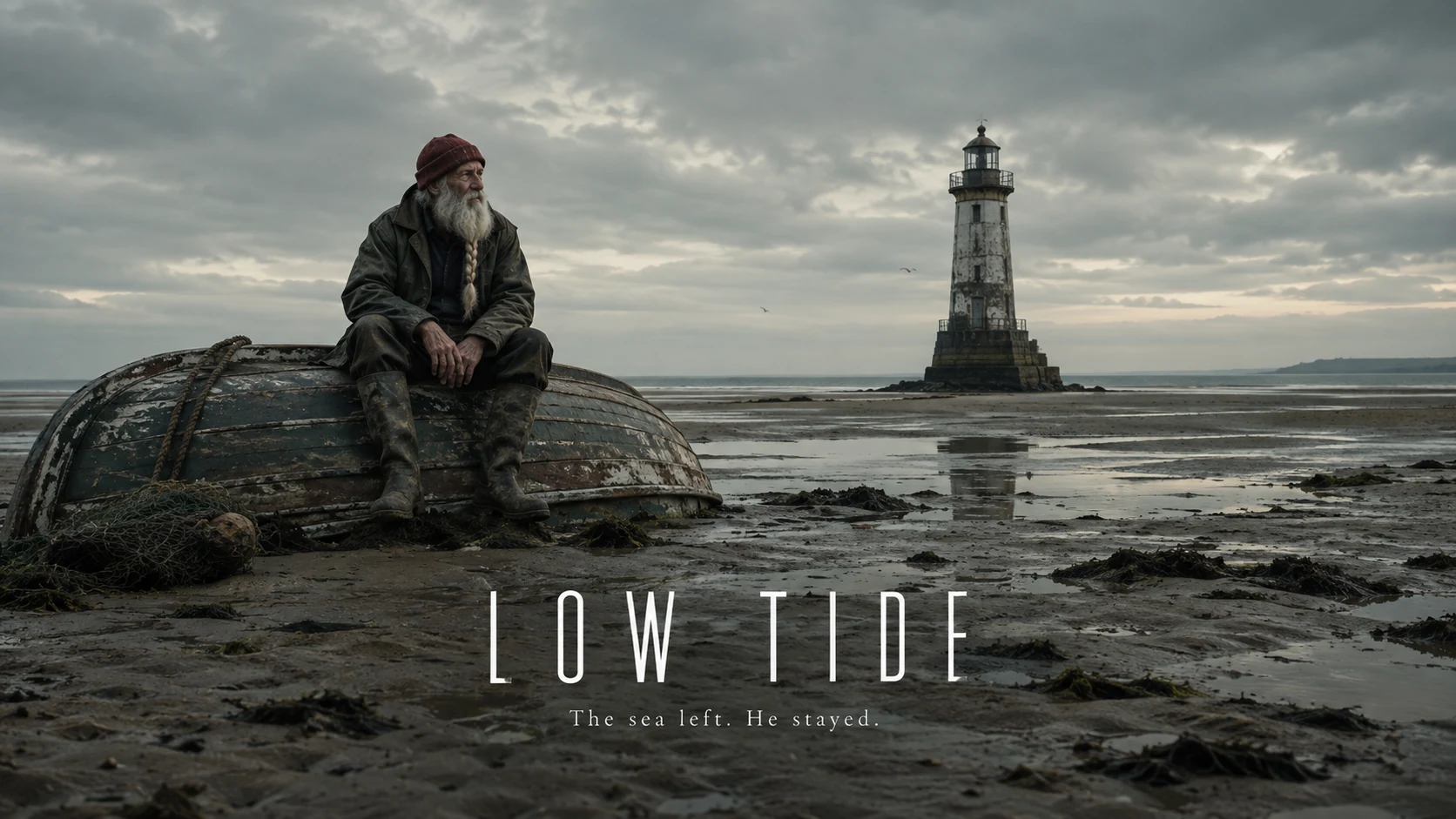
A second take in the wide banner format. Exact title and tagline in quotes, with size and position, give the model a layout; keep lettering to two short lines.
Open FlashBoardsCamera: a slow, steady push-in along the road toward the woman, ending on a full shot of her under the streetlight. Action: fog is already rolling across the asphalt and the streetlight flickers. The woman turns her head fully toward the lens and holds still. The streetlight goes dark, leaving her silhouette against the blue sky.Moving fog and a flickering light make it alive from the first frame; the light cutting out gives the teaser its button. Everything named is already in recipe 1's frame.
Open FlashBoardsCommon mistakes
- Models fill the frame edge to edge; say where the empty title space goes.
- Long titles and taglines come out garbled; generate a title and one short line at most, set final type in a design tool.
- If a character drifts between drafts, repeat the same specific features in every prompt.
Keep the reference frames, prompts and every generated take side by side — images and video in one canvas.
FAQ
5 questionsWhat is P&A in film marketing?
P&A stands for prints and advertising, the budget for releasing and promoting a film. Physical prints are largely gone, but the term still covers delivery plus trailers, ads, posters, publicity and premieres. Distributors usually fund it, and on wide releases it is a very large share of a film's total cost.
How do you market an indie film with no budget?
Define an audience you can reach directly, then plan assets during prep: stills, a key art image, behind-the-scenes clips. Build a mailing list and social following during production, premiere at festivals for reviews and laurels, and use event screenings or a targeted digital release where your audience already gathers.
What is a movie marketing strategy?
A movie marketing strategy defines who the film is for, the single promise that sells it, and the order in which assets reach that audience: teaser and trailer dates, key art, publicity, festivals, paid media and the opening-weekend push, all aligned with the release date and screen count.
When does film marketing start?
For studio films, marketing starts during production with publicity stills and behind-the-scenes footage, and teasers can appear a year before release. Independent filmmakers should start earlier still, building an audience and planning key art, stills and festival strategy before cameras roll.
Who pays for film marketing?
Usually the distributor, which recoups the marketing spend from the film's revenue before profits are shared with producers. On self-distributed indie films the producers pay, often through crowdfunding. Sales agents may also fund festival trailers and key art to help sell the film to buyers.
Related terms
5- Movie TrailerEditing
A trailer is a 1–3 minute promotional cut of a film's best moments — usually a three-act mini-structure of setup, escalation and a button — built from picture, music and sound design to sell the film without spoiling it.
- TaglineFilm Industry
A tagline is the short, catchy line on a poster or trailer that sells a film's mood or hook — Alien's 'In space no one can hear you scream'; unlike a logline, it doesn't summarize the plot.
- Film StillFormats & Exhibition
A film still is a single image representing a film — either a frame grab taken from the footage or a production still shot by the set photographer for publicity; stills are the raw material of lookbooks and mood boards.
- Film DistributionFilm Industry
Film distribution is the business of getting a finished film to audiences: a distributor licenses the rights for territories and windows (theatrical, streaming, TV), sets the release strategy and pays for marketing.
- Test ScreeningFilm Industry
A test screening shows an unfinished cut to a recruited audience who fill out response cards; studios use the scores to recut scenes, change endings or plan reshoots.
Further reading
Justin Wyatt, High Concept: Movies and Marketing in Hollywood (University of Texas Press) · Jon Reiss, Think Outside the Box Office