 FlashBoards Learn
- Learn
- Film Industry
- Bollywood
Film Industry · Film language
Bollywood
Also called: Hindi cinema, Hindi film industry
Bollywood is the Hindi-language film industry based in Mumbai, known for long star-driven films that mix romance, action, comedy and melodrama with song-and-dance numbers. It is India's best-known film industry but not the only one: Telugu, Tamil, Malayalam, Kannada and Bengali cinema are separate industries with their own stars.
- What it does
- Builds a film around stars, emotion and songs, so the audience gets romance, drama, action and music in one ticket.
- Use it when
- Talking about Hindi-language films from Mumbai, or referencing their musical, color-saturated, star-centered style.
- Watch out
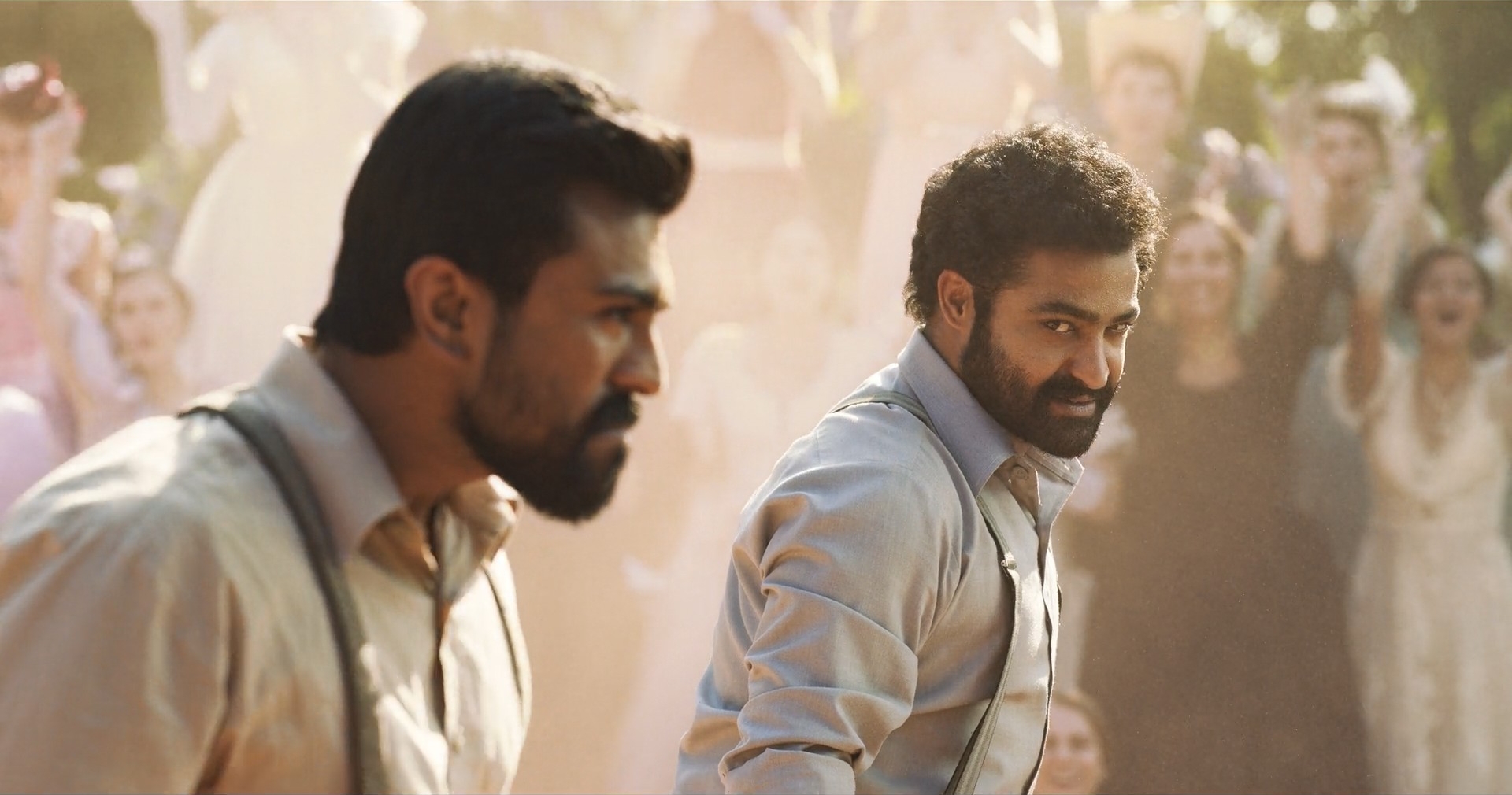
- Not every Indian film is Bollywood: RRR and Baahubali are Telugu productions, and calling them Bollywood is a common mistake.
- Try this prompt
Wide shot of a Hindi film song sequence, heroine in a saffron chiffon sari spinning on an alpine meadow, saturated color
What is Bollywood?
The word is a blend of Bombay, the old name of Mumbai, and Hollywood. It was coined in the 1970s, and many filmmakers still prefer Hindi cinema. The films are made mostly in Hindi, often with the Urdu vocabulary of classic film dialogue, and produced out of Mumbai.
Bollywood is defined by language and base, not genre: a Hindi thriller without a single song is still Bollywood. What most viewers mean by "Bollywood style" is the mainstream formula: close to three hours, a star at the center, several songs and emotion played at full volume. It is one part of India's film industry, which releases more feature films a year than any other country.
A short history of Hindi cinema
Indian feature filmmaking starts with Dadasaheb Phalke's silent Raja Harishchandra (1913). Sound arrived with Alam Ara (1931), and songs came with it. In the 1930s, studios such as Bombay Talkies worked much like the Hollywood studio system, but by the 1950s power had shifted to independent producers and stars.
The 1950s are the classic period: Guru Dutt's Pyaasa (1957), Mehboob Khan's Mother India (1957) and K. Asif's lavish Mughal-E-Azam (1960). The 1970s brought Amitabh Bachchan's "angry young man" in Deewar (1975) and the action epic Sholay (1975). The 1990s brought glossy family romance with Dilwale Dulhania Le Jayenge (1995), and the multiplex era tighter hits like Lagaan (2001), 3 Idiots (2009) and Dangal (2016).
What makes a film look and feel like Bollywood?
The core of mainstream Hindi cinema is the masala film: several genres in one story, the way a spice blend mixes flavors. A family melodrama can hold a comedy subplot, a fight and a love story, with songs moving between them.
- Playback singing. Professional singers record the songs first, and actors lip-sync on set. Lata Mangeshkar, Mohammed Rafi and Kishore Kumar became as famous as the stars.
- The picturized song. Each number is a short film with its own locations, costume changes and dance choreography, often in a fantasy space outside the plot.
- The interval. Films are built in two halves around a planned intermission, with a twist at the interval point.
- The star entry. A hero's first appearance is an event: low angle, slow motion, a sting from the film score.
How is a Bollywood song sequence shot?
The song is locked before the camera rolls. On set, the track plays back through speakers and every take is synced to it, so dancers hit marks on musical counts and the editor can cut between days, locations and costumes without losing rhythm. A choreographer (Saroj Khan and Farah Khan are famous names) often directs the song unit.
The camera grammar is built for spectacle: wide lenses and top shots for group formations, cranes rising over the crowd, low angles and slow motion for the star, fast pushes on the beat. Color is pushed hard in costume and set, and foreign locations, Switzerland above all in Yash Chopra's films, serve as dream landscapes. On a FlashBoards board, plan the song by section: a column per verse and chorus with its location, costume and key frames, so costume changes and the shot list stay in sync.
Bollywood vs. Tollywood, Kollywood and other Indian industries
India's large film industries are divided by language. Telugu cinema from Hyderabad is called Tollywood, Tamil cinema from Chennai Kollywood, and Malayalam and Kannada cinema have their own centers and stars. Baahubali and RRR (2022) are Telugu productions and K.G.F is Kannada, even though all were dubbed into Hindi and played nationwide.
The industries share songs, stars and the interval, and trade talent and remakes. The difference is language, base and audience. Since the late 2010s, "pan-Indian" releases from the south have competed directly with Mumbai at the Hindi box office.
Bollywood examples in film
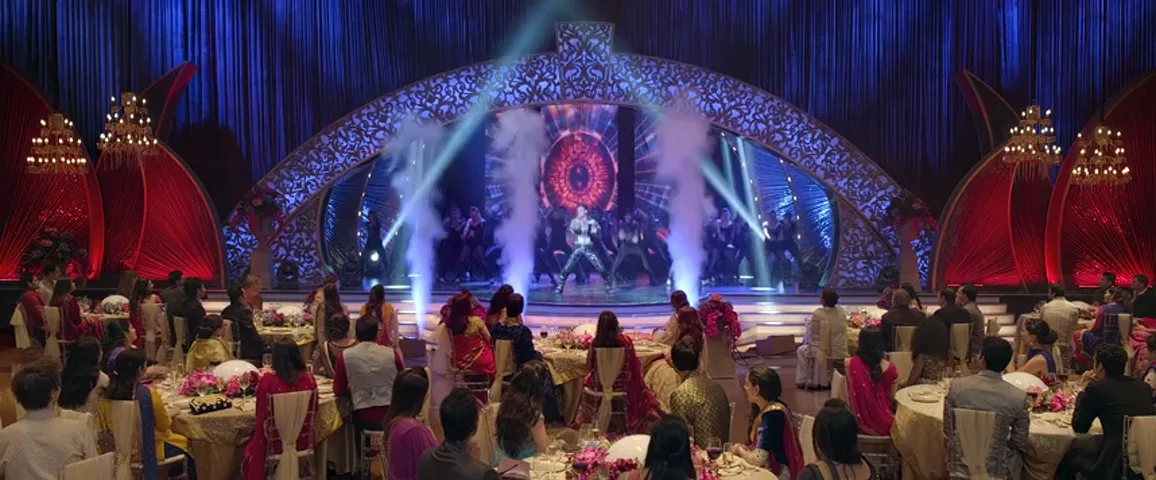
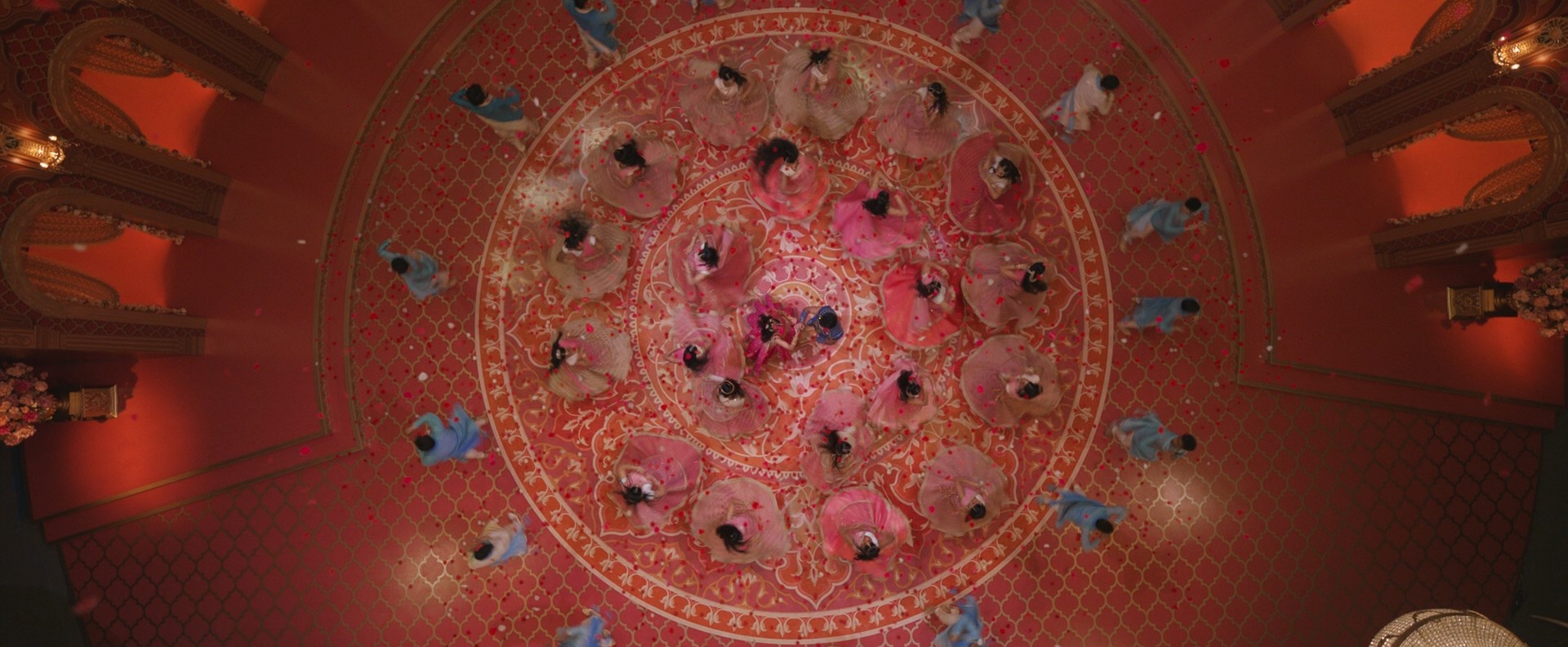
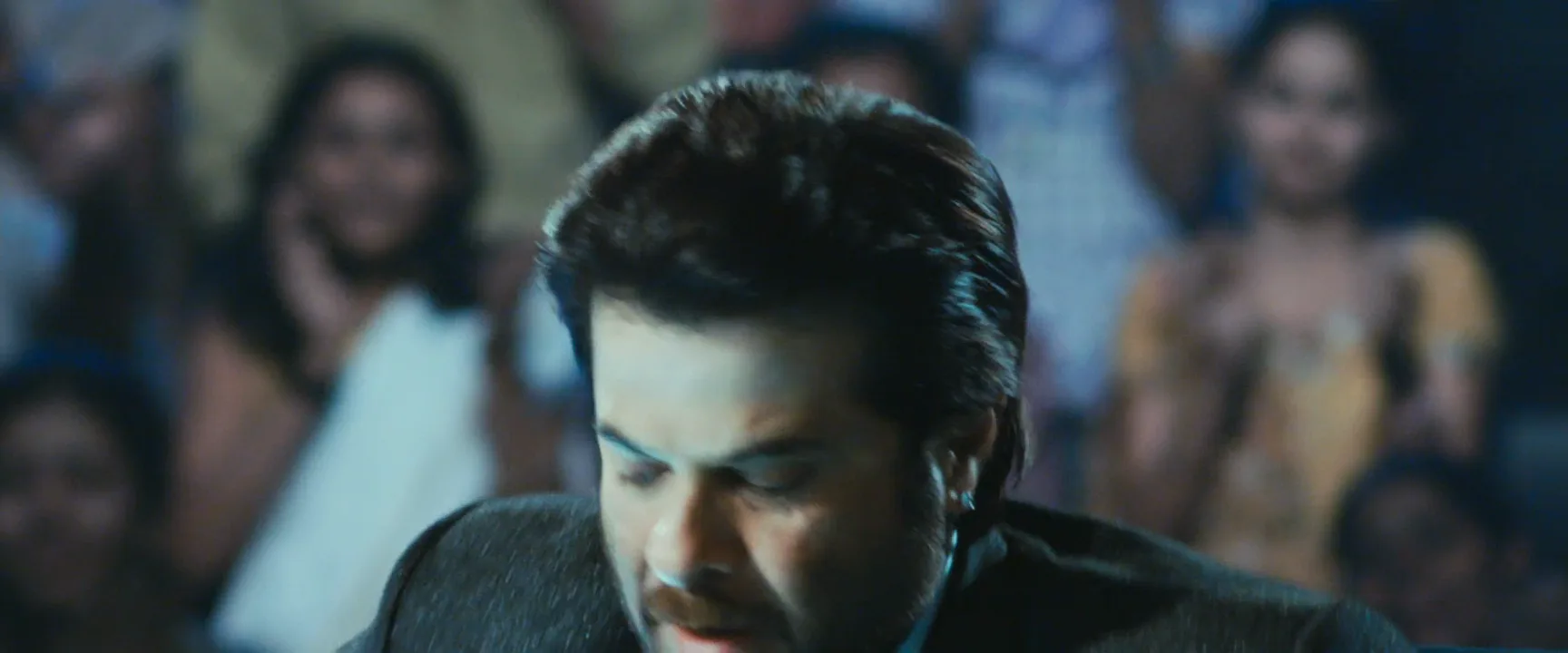
4 framesFrames from a Hindi film, a Telugu hit, and two Western films that borrow the Bollywood vocabulary.
How to create a bollywood with AI
4 promptsA song picturization is the most visual part of Bollywood, so it is what to generate: a start frame, a group-formation variation and a moving shot. Put them on one FlashBoards board next to your reference frames and the song's structure, and compare takes side by side. The fourth prompt re-shoots a real film shot from a text description alone, and the original plays next to the result so you can compare.
Wide shot of a Hindi film song sequence on a green alpine meadow with snowy peaks behind. A plump woman in her twenties with a round freckled face, a gap between her front teeth and a long single braid, wearing a flowing saffron chiffon sari, spins with her arms open, the sari fanning out. A stocky man with a shaved head, a short grey-flecked beard and round wire glasses, in a bottle-green sweater, kneels a few steps away, singing to her. Bright afternoon sun, saturated colors, wide lens at waist height, romantic, joyful.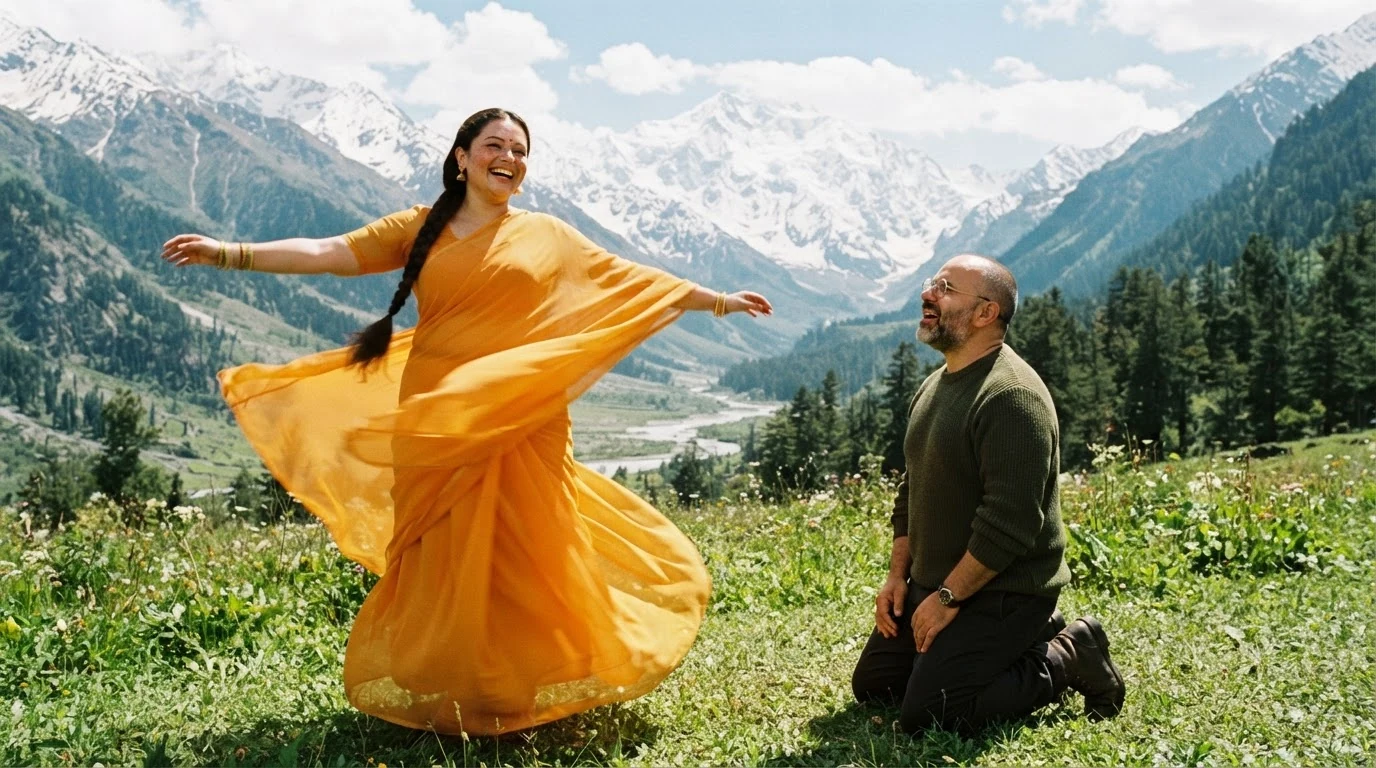
Hindi film song sequence, alpine meadow and saffron chiffon sari set the classic romantic number. Spins with her arms open and singing to her give a performance pose rather than a fashion shoot.
Open FlashBoardsTop shot looking straight down on a wedding dance number in a palace courtyard. Thirty dancers in red and gold mirror-work skirts form three concentric rings on a white marble floor inlaid with a lotus pattern, arms raised. In the center, a young woman with short curly hair in an emerald lehenga dances alone. Marigold garlands frame the edges, warm evening lamplight, rich saturated color, symmetrical composition.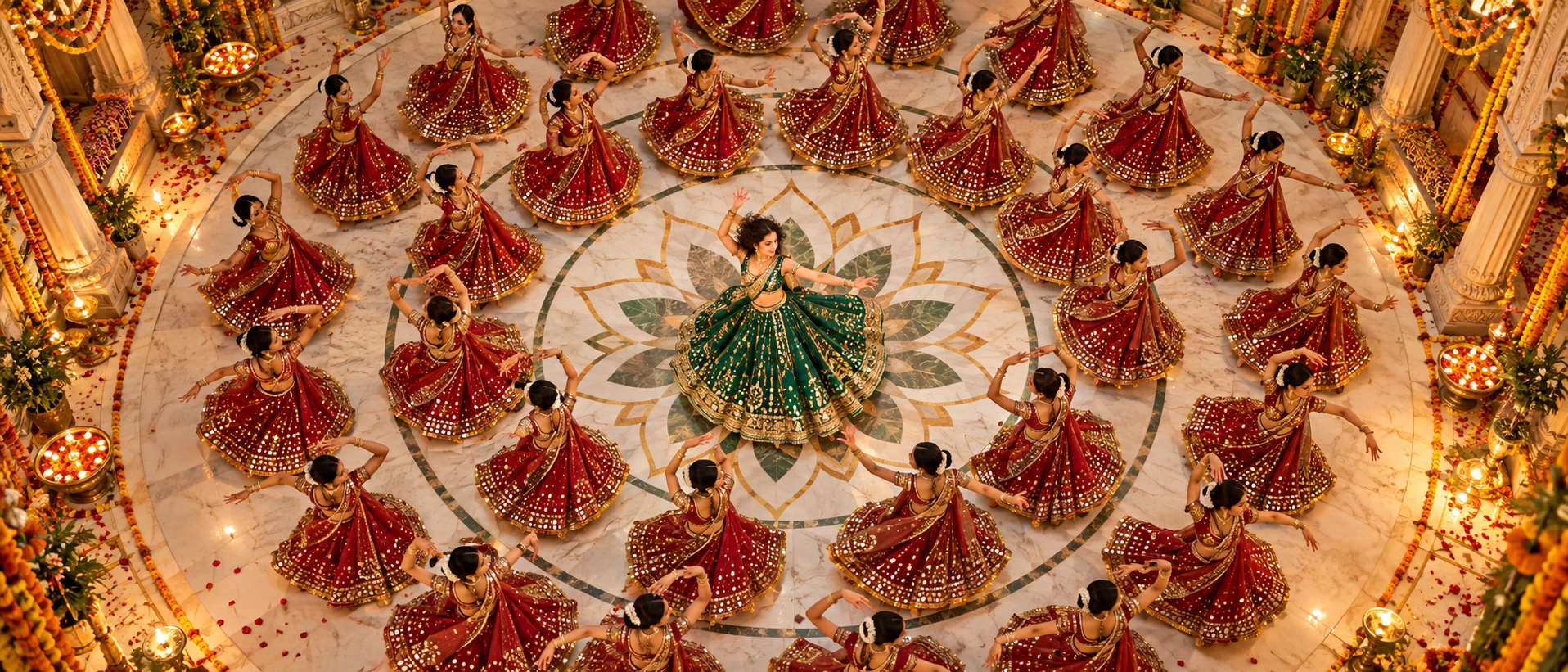
Top shot looking straight down and three concentric rings produce the formation choreographers design for the overhead camera; one dancer in a contrasting color gives the eye a center.
Open FlashBoardsCamera: arcs slowly around the woman from left to right while rising, ending in a higher wide view of the meadow and peaks. Action: she is already spinning, the sari fanning out and the braid swinging. She stops and turns toward the man, laughing. He rises from his knee, singing, and reaches out his hand.The spin is under way from the first frame, so the clip starts alive. Arcs and rising give the circling crane move of a song, and every element is already in recipe 1's frame.
Open FlashBoards{
"output": "Full-screen live-action scene from Fan (2016) from its very first frame: four shots joined by three hard cuts. A glossy 2010s Hindi-film look, anamorphic scope frame, rich saturated color: a superstar's live song-and-dance show at a lavish wedding banquet in a grand hall, warm amber candle and lamp light over the tables, cold white and blue stage beams, jets of white stage smoke, magenta flowers, red and gold silk.",
"characters": {
"S1": {
"name": "the superstar on stage, played by Shah Rukh Khan",
"look": "slim man, tousled dark hair, fitted black leather jacket with a glittering silver embroidered front, black leather trousers, silver knee boots",
"voice": "silent: he dances, never speaks"
},
"S2": {
"name": "a young guest in a black suit",
"look": "slim young man, short neat dark hair, black suit and black shirt",
"voice": "silent"
},
"S3": {
"name": "the show manager in the control booth",
"look": "woman in her thirties, short dark curly hair, beige tailored jacket over a red top, a black walkie-talkie in her right hand",
"voice": "brisk, clipped, in charge, a Mumbai mix of English and Hindi"
},
"S4": {
"name": "the lighting operator",
"look": "stocky man, short spiky brown hair, dark shirt, an ID badge on a lanyard",
"voice": "silent"
},
"S5": {
"name": "the stage producer",
"look": "bald man in rimless glasses, dark suit, a black phone handset at his ear",
"voice": "silent"
}
},
"shots": [
{
"shot": 1,
"camera": "static, high angle from a balcony looking down on the banquet floor, long lens; a dark out-of-focus pillar edge fills the right third of the frame, soft and blurred",
"action": [
"BEGINNING: alive from the first frame, round banquet tables with white cloths, glowing white dome lamps and pink flower centrepieces fill the floor; guests in red, pink and gold saris and dark suits sit with their backs to the camera, heads turned up toward the stage steps at the top of the frame; crystal lamp shades glow in the lower left corner.",
"THEN: S2 walks slowly between the tables in the left-centre of the frame, from the back toward the camera, his hands low at his sides, his head turned down toward frame right, scanning the seated guests.",
"END: S2 is still walking, a step nearer the camera; the seated guests stay still, watching the stage."
],
"voice": "silence: nobody speaks in this shot, no voice at all",
"dialogue": []
},
{
"shot": 2,
"cut_at": "00:00.830",
"camera": "static, low angle from the front edge of the stage, medium-wide; a thick white smoke jet blasts upward in the right foreground, soft and bright, covering the right third of the frame",
"action": [
"BEGINNING: right after the cut, S1 dances in the centre-right of the frame in a wide stance, his right arm (screen left) thrown up high, his face lifted toward the lights; behind him two rows of backup dancers in black hit the same move in unison, arms raised.",
"THEN: dozens of narrow white beam lights criss-cross over his head and flick on and off to the beat; tall LED screens behind the dancers glow with orange flame graphics.",
"THEN: S1 pulls his raised arm down across his chest and bends his knees, shoulders pumping; the dancers behind him drop low with him in unison.",
"END: S1 plants his silver boots wide, weight low, his right hand sweeping across his body, looking toward frame left; the smoke keeps rising on the right."
],
"voice": "silence: nobody speaks in this shot, no voice at all",
"dialogue": []
},
{
"shot": 3,
"cut_at": "00:01.960",
"camera": "static, eye level, extreme wide from behind the last banquet tables, symmetrical, the whole stage centred",
"action": [
"BEGINNING: right after the cut, a huge illuminated arch of carved white lace pattern frames the stage in the centre; inside it S1 in silver dances at centre front of more than twenty dancers in black; a giant red-orange circular mandala glows on the LED wall behind them.",
"THEN: two white smoke jets shoot straight up on either side of S1, and blue-white beams sweep outward from the stage into the hall in a wide V.",
"THEN: the dancers move in unison with him, arms swinging; on both sides of the arch tall red sail-shaped silk panels hang under glittering gold chandeliers, deep blue curtains behind.",
"END: in the foreground the guests at round tables with pink flowers and white dome lamps sit still with their backs to the camera, women in red, pink and gold saris, all faces turned to the stage."
],
"voice": "silence: nobody speaks in this shot, no voice at all",
"dialogue": []
},
{
"shot": 4,
"cut_at": "00:03.040",
"camera": "static, straight top-down view from the ceiling onto a dark control booth, cold blue light, a long curved lighting desk full of glowing yellow and white buttons across the lower half of the frame",
"action": [
"BEGINNING: right after the cut, three people behind the desk look up toward the camera: S4 on the left with both hands on the lighting console, S3 standing in the centre with the walkie-talkie raised to her mouth in her right hand and her left hand resting on the desk, S5 on the right holding the phone handset to his ear.",
"THEN: S3 speaks into the walkie-talkie, her lips moving, her eyes up toward the stage; S4 keeps his fingers on the faders; S5 listens on the phone, head tipped.",
"END: all three hold still at the desk, faces lit blue by the monitors, eyes up."
],
"dialogue": [
{
"speaker": "S3",
"on_screen": true,
"when": "right after the cut to the control booth, never before the cut",
"delivery": "brisk, clipped instruction into the radio",
"line": "<d>[Hindi] Come on, entry और exit पे भी ध्यान रखो</d>"
}
]
}
],
"sound": {
"ambience": "a large banquet hall, the crowd murmuring, the hiss of the smoke jets, the soft electronic hum of the booth",
"speech": "exactly this one spoken phrase, said once, only in the control booth shot",
"never_spoken": "no narration and no voice-over: the descriptions, performance notes and step words of this prompt are never spoken aloud",
"music": "a film score under the scene, always below the voices: a loud pounding Bollywood dance track with dhol drums, synth bass and brass stabs, the beat the dancers move to",
"subtitles": "none"
}
}Remakes the star-show sequence from Fan (2016), dir. Maneesh Sharma, DP Manu Anand: the four static shots, their cut points, the arched stage with smoke jets and dancers, the top-down booth and the radio line carried over.
Four shots with the original's cut_at times rebuild the rhythm of a star-show number: guests, the star and his dancers, the whole arched stage, the crew in the booth. Named lights, smoke jets and saris carry the spectacle, and the film's one Hinglish radio line lands in the booth shot.
Common mistakes
- Without song sequence or singing to her, models make a fashion editorial. Name the performance.
- Formation shots collapse into crowds. Give a count, a pattern (three concentric rings) and the camera position.
- Generic "Indian" prompts drift into tourist clichés. Name specific fabrics, colors and settings.
Keep the reference frames, prompts and every generated take side by side — images and video in one canvas.
FAQ
4 questionsWhat does Bollywood mean?
Bollywood blends Bombay, the former name of Mumbai, with Hollywood. It names the Hindi-language film industry based in Mumbai. Many people in the industry prefer "Hindi cinema", and the term does not cover films in other Indian languages.
Is RRR a Bollywood movie?
No. RRR (2022), directed by S. S. Rajamouli, is a Telugu film from the industry often called Tollywood. It was dubbed into Hindi and other languages, which is why it is often mislabeled. Baahubali is also Telugu; K.G.F is Kannada.
Why do Bollywood movies have so many songs?
Songs have been part of Indian sound films since Alam Ara (1931), drawing on theater and folk traditions. They carry romance, celebration and grief, sell the film before release, and become hits through playback singers. Many recent Hindi films use fewer songs or keep them in the background.
Why are Bollywood films so long?
Mainstream Hindi films were built as a full evening out: several songs, mixed genres and a planned interval splitting the story in two halves. Classics often run close to three hours; multiplex-era films are frequently shorter.
Related terms
3- MelodramaGenres
Melodrama heightens emotion above realism: clear-cut virtue and villainy, coincidences, big musical cues and expressive color push the audience toward tears — Douglas Sirk's 1950s films are the reference point.
- Film IndustryFilm Industry
The film industry is the network of companies and people that finance, produce, distribute and exhibit films — studios, independents, unions, distributors, festivals, cinemas and streamers.
- Film ScoreSound & Music
A film score is original music written by a composer for a specific film, timed to picture to shape emotion, pace and theme; it differs from a soundtrack of pre-existing songs.
Further reading
Tejaswini Ganti, Bollywood: A Guidebook to Popular Hindi Cinema (Routledge). Ashish Rajadhyaksha and Paul Willemen, Encyclopedia of Indian Cinema (BFI).