 FlashBoards Learn
- Learn
- Directing & Staging
- Dance Choreography
Directing & Staging · Film language
Dance Choreography
Also called: choreography, dance sequence, choreo
Dance choreography in film is movement designed together with the camera and the cut. Steps, framing, lens and editing are planned as one piece, so the viewer reads the whole body, feels the rhythm and understands what the dance means for the characters. On screen, a great routine can still fail if the shots cut off the feet.
- What it does
- Turns music and bodies into story beats the audience feels physically.
- Use it when
- A character's emotion, desire or transformation is bigger than dialogue can carry.
- Watch out
- Tight framing and fast cutting hide the steps. Keep the full body on the key moves.
- Try this prompt
Full body shot, dancer mid-spin in a hazy warehouse, single hard top light, camera at hip height, 35mm lens
What is dance choreography in film?
On stage, the audience sits still. On film, the camera decides where the viewer stands, how much of the body they see and when the angle changes. Screen choreography is a double design: the steps, and the path of the lens through them.
In practice it is blocking set to music. The choreographer builds eight-count phrases; the director and DP decide which phrases play wide, which play close, and where the camera travels with the dancers. That makes it part of directing and staging as much as dance.
Why do dance scenes work so well in movies?
Dance lets a film skip words. A character who can't say what they want can move it: shyness breaking into confidence, two people falling into one rhythm, a crowd becoming one body.
Three classic approaches:
- The full figure. Fred Astaire's 1930s routines were famously shot in full shots with few cuts, so the audience could see the dance was real and continuous.
- The pattern. Busby Berkeley put the camera high overhead and turned rows of dancers into moving geometry.
- The cut. Chicago (2002) plays its numbers as imagined stage acts intercut with the real story, so the editing carries the meaning.
Modern films mix all three: La La Land (2016) opens with a freeway number staged to read as one continuous take.
How to film a dance scene
Start from the music. Lock the track and play it back on set, so every take lands the same move on the same beat.
Shoot the full body first. Record the whole routine in a wide or full shot as your spine, then add coverage: feet, hands, faces.
Lower the camera. Hip to waist height, about 0.8–1.1 m, makes legs long and jumps high.
Pick the lens by distance. 24–35 mm lets the camera move among dancers and still hold the whole body; 50–85 mm from farther back compresses a line of dancers.
Move on counts. A tracking shot or Steadicam circling the dancers adds its own rhythm; a crane rising over the floor reveals the pattern.
Light for shape. Backlight and haze outline limbs; hard top light isolates a soloist.
How should you cut a dance sequence?
Cut on the move, not only on the beat. A cut in the middle of a turn, with the motion matched across both shots, feels invisible; a cut on a hard beat between moves feels like punctuation.
Return to the full body for the moves that matter.
The song or film score sets the structure: verses in coverage, the chorus wide, the final hit held on the full formation. When the dance compresses weeks of rehearsal into two minutes, it becomes a montage and the cutting follows the story.
Dance choreography vs. fight choreography
Both are rehearsed movement designed for the lens, built on counts and phrases. A fight scene needs readable action, reaction and geography, and it cheats contact with angle and lens. A dance needs readable form and timing, so cheating shows: a cut can hide a missed blow, but cuts that hide the steps feel like a trick.
Dance Choreography in motion
6 clipsWatch the feet and the edges of the frame. The strongest clips keep whole bodies in view on the big moves and let the camera or the cut arrive with the motion; when the shot goes close, notice what the dance loses and what the face gains.

How to create a dance choreography with AI
4 promptsModels draw a dancer easily but lose the choreography: feet get cropped, ensembles fall out of unison, movement turns floaty. Lock the full-body pose in the start frame, then describe one short phrase in the video prompt. Keep references, takes and music notes on one FlashBoards board to compare takes side by side. The fourth prompt re-shoots a real film shot from a text description alone, and the original plays next to the result so you can compare.
Cinematic film still, full body shot head to toe: a woman in her late twenties with a shaved head, a silver hoop in her left eyebrow and freckled brown skin, in a loose rust linen shirt and black wide-leg trousers, barefoot, caught mid-spin in an empty concrete warehouse. Shirt flaring, one arm extended, both feet visible on the floor. Camera at hip height, 35mm lens. Single hard top light, light haze, dark walls. 35mm film grain.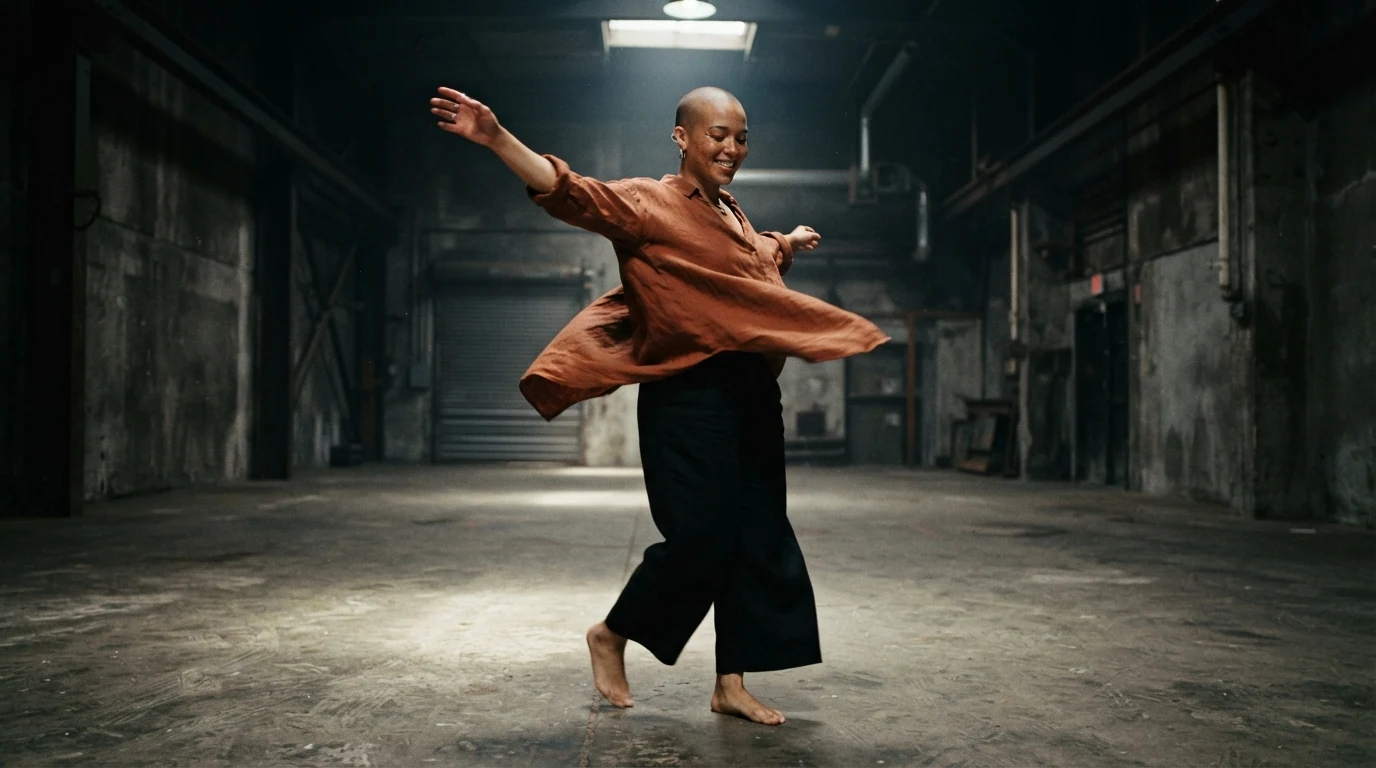
Full body shot head to toe and both feet visible stop the model cropping at the knees; camera at hip height lengthens the legs; mid-spin puts motion into the still for the video to continue.
Open FlashBoardsCinematic film still, high angle from about four meters up: eight dancers in matching mustard-yellow jumpsuits and white sneakers on a wet basketball court at night, in a staggered V formation, all in the exact same pose, left arm thrown up, right knee lifted. The lead dancer is a tall man with a gray-streaked beard and round wire glasses. Sodium-orange floodlights, wet reflections, all eight full bodies in frame. 50mm lens.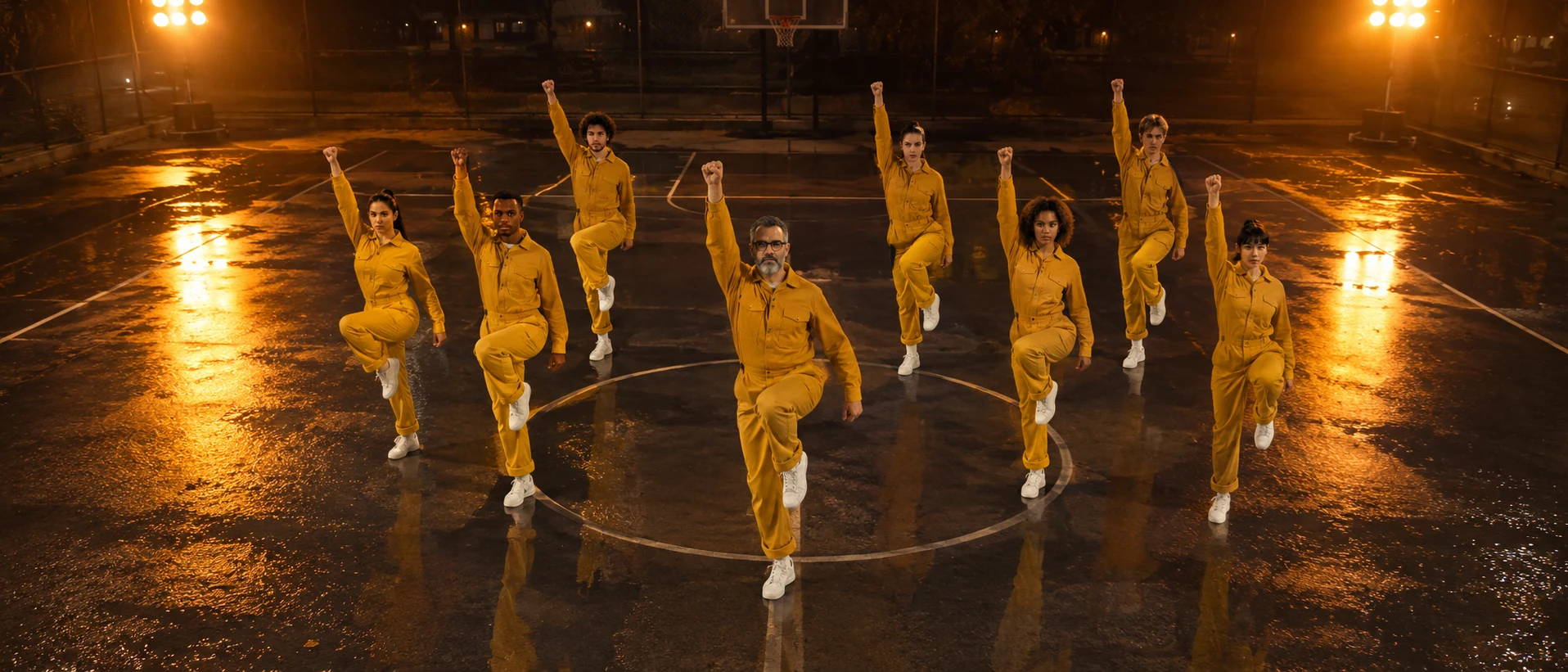
The Berkeley direction: the formation is the subject. All in the exact same pose forces unison, and the high angle opens space between bodies so the V reads.
Open FlashBoardsCamera: a slow, steady arc around her at hip height, from her front-left to her right side, keeping her full body head to toe in frame. Action: she is already spinning fast as the shot begins, shirt flaring. She lands the spin sharply and drops into a deep lunge, one arm sweeping low across the floor. Then she rises onto the balls of her feet and reaches both arms up into the top light, holding the pose.She moves from the first frame, so the shot is alive at once. One phrase of three moves stays coherent, and fast and sharply keep it from drifting into slow motion.
Open FlashBoards{
"output": "Full-screen live-action dance number from Funny Face (1957), from its very first frame: one continuous shot, no cuts. 1950s Technicolor 35mm, a smoky Paris cellar jazz club, deep red plaster walls and a low red back wall, small red spot lamps in a row along the back, one cyan-green spot high at the upper right, thick drifting haze, the dancers lit pale against the red.",
"characters": {
"S1": {
"name": "Jo Stockton, played by Audrey Hepburn",
"look": "slim young woman, short dark hair pulled back, black turtleneck sweater, black cropped trousers, white socks, black flat loafers",
"voice": "silent, only breath"
},
"S2": {
"name": "a cellar-club dancer, uncredited",
"look": "tall bald man, pale grey long-sleeved shirt and pale grey trousers, athletic",
"voice": "silent"
},
"S3": {
"name": "a second cellar-club dancer, uncredited",
"look": "dark-haired man with a short beard, navy-and-white striped sailor shirt, white trousers, dark belt",
"voice": "silent"
}
},
"shots": [
{
"shot": 1,
"camera": "static tripod at eye level from the back of the room, wide full shot of the whole floor and the raised platform at the left; a slow steady zoom in all through the shot with a slight drift to the right, ending on a medium-wide of the three dancers, their feet still on the floor at the bottom of the frame; seated patrons stay as dark silhouettes at the lower left and in white shirts at small tables along the right edge",
"action": [
"BEGINNING: alive from the first frame, the dance already at full speed: S1 stands on top of the raised platform at the upper left, knees bent to spring; S3 is in mid-air at the centre-right, legs tucked, and lands running toward the left; S2 strides in from the lower left toward the platform.",
"THEN: S2 plants himself below the platform facing left, both arms raised; S1 leaps off the platform to screen right, arms flung up, straight into his arms.",
"THEN: S2 catches her round the waist and swings her in a full circle, her legs flying out straight; S3 dives in low from the right in a deep lunge under her legs.",
"THEN: S2 sets her down; the three run back upstage and form a line facing the camera: S3 at left, S1 in the centre, S2 at right.",
"THEN: all three drop into the same crouched jazz step, knees deep and turned out, shoulders forward, arms low and loose, bouncing on the beat in unison while the zoom closes in.",
"THEN: S1 sinks into a deep lunge to screen left, then springs up with both arms straight overhead; the two men lunge wide to either side of her and kick.",
"THEN: S1 spins low in a crouch and rises; the men twist and hop, arms swinging.",
"END: all three bounce in high jumps side by side, arms thrown straight up, S1 in the centre, both men grinning, feet still in frame."
],
"dialogue": [],
"voice": "silence: nobody speaks in this shot, no voice at all"
}
],
"sound": {
"ambience": "shoes slapping and scuffing the wooden floor on every step and landing, the dancers' breathing, low murmur of the seated club patrons",
"speech": "no words in this video; the only human sounds are breaths and movement",
"never_spoken": "no narration and no voice-over: the descriptions, performance notes and step words of this prompt are never spoken aloud",
"music": "a film score under the scene, always below the voices: a fast cool-jazz combo, driving brushed drums, walking bass and a sharp muted trumpet on a hard swing beat",
"subtitles": "none"
}
}Remakes the one-take cellar-club number from Funny Face (1957): the slow zoom in, Jo Stockton leaping from a platform into a partner's swing, then three dancers in a crouched unison jazz step ending in jumps.
One continuous shot with a slow steady zoom in that ends with feet still on the floor keeps full bodies readable, the way the 1950s musical did. Each move is a timed beat (leap, catch and swing, line of three, crouched jazz step in unison, jumps), so the dance never goes floaty. Silence and a jazz score keep it wordless.
Open FlashBoardsCommon mistakes
- Cropped feet. Write full body shot, head to toe, feet visible on the floor.
- Broken unison. Name one exact pose and add all in the exact same pose.
- Floaty motion. Give the tempo: fast, sharp, snaps into.
- Too many moves. Keep two or three moves per clip and join clips in the edit.
- Merged bodies. For partner work, start from a pose with visible space between dancers.
- No beat. Clips don't know your track; cut them to the music afterwards.
Keep the reference frames, prompts and every generated take side by side — images and video in one canvas.
FAQ
4 questionsHow do you film a dance scene?
Lock the music and play it back on set so every take hits the same beats. Shoot the whole routine in a full or wide shot as the master, then add coverage of feet, hands and faces. Keep the camera near hip height, use 24–35 mm lenses up close, and backlight through haze.
What makes a good dance scene in a movie?
Something changes for the characters between the first step and the last, and the audience can actually see the choreography. That means full-body framing on the key moves, camera movement planned on counts, and cuts that land on the motion or the beat instead of hiding the steps.
Should dance scenes be shot in one take?
Not necessarily. Long takes prove the dance is real and suit virtuoso solos, which is why 1930s musicals favored them. Fast cutting adds energy and combines the best moments of several takes. Most modern sequences mix both: long wides for the big phrases, short coverage for accents.
Can AI generate a dance video?
Yes, for short phrases. Build a start frame with a clear full-body pose, then ask the video model for two or three moves with a stated tempo and a simple camera move. Generate several short clips and cut them to your music, the way a live sequence is assembled from takes.
Related terms
5- BlockingDirecting & Staging
Blocking is the planned choreography of actors and camera within a scene — where people stand, when they move, how they relate in space — so that movement itself tells the story and gives the editor usable shots.
- Film ScoreSound & Music
A film score is original music written by a composer for a specific film, timed to picture to shape emotion, pace and theme; it differs from a soundtrack of pre-existing songs.
- Fight SceneDirecting & Staging
A fight scene is staged as choreography, camera and editing working together: clear geography, readable action–reaction beats and a rhythm of blows and pauses that tells who is winning.
- Tracking ShotCamera Movement
A tracking shot moves the camera through space with a moving subject — on a dolly, Steadicam, vehicle or drone — following, leading or flanking it so the audience travels with the action.
- MontageEditing
A montage is a sequence of short shots, usually set to music, that compresses time or builds an idea — weeks of training, a relationship, a city waking up — in a minute or two.
Further reading
Arlene Croce, The Fred Astaire and Ginger Rogers Book (1972). Jerome Delamater, Dance in the Hollywood Musical (1981).