 FlashBoards Learn
- Learn
- Sound & Music
- Lavalier Microphone
Sound & Music · Film language
Lavalier Microphone
Also called: lav mic, lapel mic, lav
A lavalier microphone (lav mic, lapel mic) is a tiny microphone clipped to or hidden in an actor's clothing, usually sending its signal wirelessly to the sound cart. It records dialogue a few inches from the mouth, so voices stay clear in wide shots, cars and noisy locations where a boom cannot reach.
- What it does
- Records close, clean dialogue from a mic worn on the body, independent of the frame size.
- Use it when
- The shot is too wide or the space too tight for a boom, or the location is loud.
- Watch out
- Clothing rustle and wireless dropouts; always record a boom track alongside when you can.
- Try this prompt
documentary interview medium close-up, tiny black lapel microphone clipped to the shirt placket, soft window light, 50mm, eye level
What is a lavalier microphone?
A lavalier is a miniature microphone, the capsule often smaller than a pencil eraser, worn on the talent's body. The name comes from a pendant necklace: early lavs hung on a cord around the neck. On set a lav runs one of three ways:
- Wired straight into a camera or recorder, common for sit-down interviews.
- Wireless: a bodypack transmitter on the actor sends the signal to a receiver at the sound cart. The standard for drama.
- Into a bodypack recorder that records locally with timecode. No radio dropouts, but nobody hears it live.
Most film lavs are omnidirectional: an omni capsule does not care which way the head turns and handles breath noise better (see microphone polar patterns). A lav is one part of location sound, not a replacement for it.
When do filmmakers use a lav mic instead of a boom?
The boom remains the first choice for fiction dialogue, because a mic above the frame hears the voice with the space and matches the camera's perspective. The lav takes over when the boom cannot do the job:
- Wide shots. In a full shot the boom sits so high the voice thins out; the lav stays at the same distance whatever the frame.
- Walk-and-talks and cars. No room for a pole.
- Loud locations. A mic a few inches from the mouth beats traffic and wind.
- Documentary and interviews. One operator can wire a subject in a minute, and a visible lav is accepted.
- Overlapping dialogue. Robert Altman's Nashville (1975) is the famous early case of radio mics on a large ensemble, each on its own track.
On most drama sets the mixer records every actor's lav plus the boom on separate tracks, and the dialogue editor chooses per line. Good lav tracks save many scenes from ADR.
How to hide a lav mic
The goal is a capsule that sits still, faces the mouth and never touches moving cloth.
- Placement. Center of the chest, about a hand's width (6 to 8 inches) below the chin. Lower sounds muffled; higher catches collar noise.
- Mounting. Tape the capsule inside the shirt with a triangle of double-sided tape under a strip of cloth tape, or use a molded mount that holds it off the fabric. Between placket buttons or behind a tie knot are classic spots.
- Strain relief. Tape a small loop of cable just below the mic so a tug does not pull the capsule.
- Fabric. Cotton and wool are quiet; silk, nylon and stiff jackets crackle. Bring in costume design early.
- Hair and hats. With open necklines or period costume, the lav can sit in the hairline or a hat band. It sounds brighter and needs matching in the mix.
- Transmitter. On the belt at the back, the thigh or the ankle, antenna straight.
Then listen while the actor walks the full blocking: rustle appears on the move, not in the static check.
Recording clean lav tracks on set
- Set gain for the loudest line. A shout clips fast on a capsule this close, so leave generous headroom.
- Watch the radio. Coordinate frequencies before the shoot and use the pack's backup recording if it has one.
- Use a small furry windscreen on visible lavs outdoors.
- Record room tone with the lavs still on, so the editor has each mic's exact background.
- Name each track after the character in the sound report.
Lavalier vs. boom microphone
The boom, held by the boom operator, hears the voice from outside the frame with a little of the room, so close shots sound close and wide shots slightly further away. The lav hears the voice from the chest: dry, constant, with some body resonance and no sense of space.
| | Boom | Lav | |---|---|---| | Sound | Natural, with perspective | Close, dry, constant | | Best for | Medium and close shots | Wide shots, movement, noise | | Risks | Shadows, mic in frame | Rustle, dropouts, visible mic |
They are partners: boom first for tone, lavs for everything the pole cannot reach.
Planning lavs in pre-production
Mic choices depend on frames and costumes, so plan them in prep. On a FlashBoards board, keep the storyboard next to costume references with a note on each shot: who is wired, where the pack goes, which frames are too wide for the boom. More craft in the sound hub.
How to create a lavalier microphone with AI
3 promptsModels draw no audio, but a visible lapel mic is one of the strongest documentary cues in an interview frame. Use these recipes to test interview looks and rigging shots, and compare the takes side by side on one FlashBoards board.
Documentary interview medium close-up of a woman in her fifties with cropped grey curls, a small scar through her left eyebrow and a mustard-yellow cotton shirt, seated slightly off center and looking just past the camera, a tiny black lapel microphone clipped to the shirt placket at mid-chest, thin black cable disappearing under the collar, soft window light from the left, dim workshop background out of focus, 50mm lens at eye level, natural color
"Tiny black lapel microphone clipped to the shirt placket" names size, color and position, so the model does not draw a handheld mic. "Looking just past the camera" is the classic interview eyeline.
Open FlashBoardsBehind-the-scenes close-up on a film set: the hands of a sound mixer with a silver thumb ring taping a tiny black lavalier microphone inside the open placket of a young man's white linen shirt, a small loop of thin cable taped just below the capsule, a strip of beige cloth tape on the fingertips, the man's collarbone and a thin chain visible, practical tungsten work light, 85mm, shallow depth of field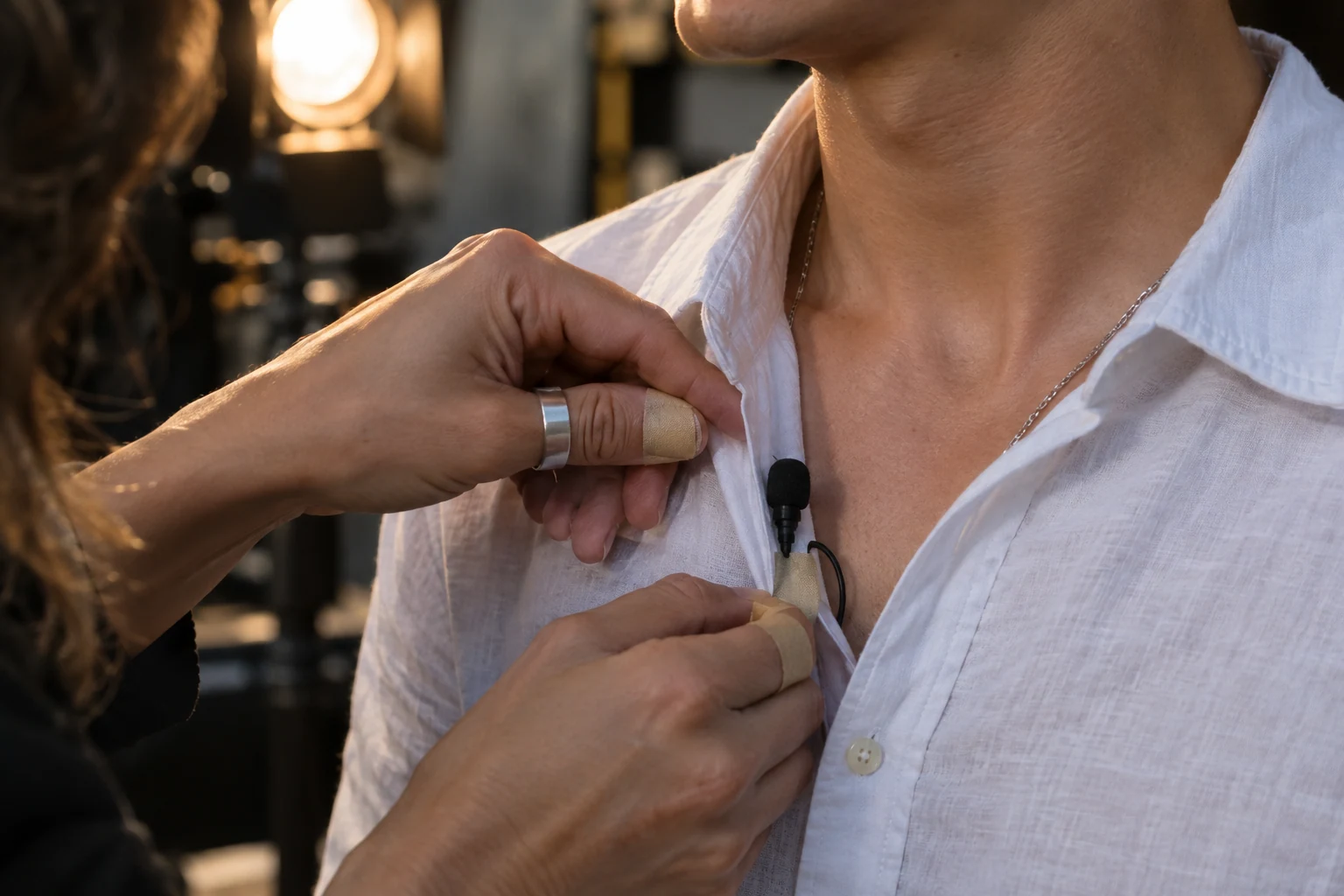
The same idea from the crew side. The cable loop and cloth tape are details a sound person expects, and they keep the mic mounted.
Open FlashBoardsCamera: locked-off tripod shot with a very slow push in toward her face. Action: The woman is already speaking, her lips moving as she answers a question. She lifts her right hand to shoulder height to make a point, then lowers it and nods once. The small black lapel microphone stays clipped to her shirt placket throughout. At the end she pauses and looks down, thinking."Already speaking" makes the clip alive from the first frame; restating that the mic stays clipped keeps it from drifting as she gestures.
Open FlashBoardsCommon mistakes
- "Microphone" alone brings a handheld, a studio mic or a headset. Say "tiny lapel microphone" and where it is clipped.
- Cables dangle across the chest unless you write "under the collar".
- In video the mic can slide during gestures; mention it again in the Action and keep hands away from the chest.
Keep the reference frames, prompts and every generated take side by side — images and video in one canvas.
FAQ
4 questionsWhat is a lav mic used for in film?
A lav mic records dialogue from a tiny microphone worn on the actor's body, usually hidden and wireless. It is used when a boom cannot get close enough: wide shots, walk-and-talks, car scenes and loud locations. Most sets record it alongside the boom so the editor can pick the best track for each line.
How do you hide a lav mic under clothing?
Tape the capsule inside the shirt at mid-chest, about a hand's width below the chin, with double-sided tape under a strip of cloth tape. Add a small taped cable loop for strain relief, avoid silk and nylon, and check for rustle while the actor walks the full blocking.
Is a lapel mic the same as a lavalier?
Yes. Lapel mic, lav mic, lav and lavalier all name the same small body-worn microphone. "Lapel" comes from clipping it to a jacket lapel; "lavalier" comes from a pendant necklace, because early models hung around the neck. On film sets, "lav" is the everyday word.
Is a lav mic better than a boom mic?
Neither is better in general. A boom sounds more natural because it hears some of the room and matches the camera's perspective, so mixers prefer it. A lav wins in very wide frames, tight spaces, movement and noise. Recording both on separate tracks gives the editor the most options.
Related terms
3- Location SoundSound & Music
Location sound is everything recorded on set during the shoot — dialogue, ambience, room tone, wild lines — by the production sound mixer and boom operator, in sync with picture.
- Microphone Polar PatternsSound & Music
A polar pattern shows how sensitive a microphone is from each direction — omni, cardioid, supercardioid, shotgun — and decides how much of the room you record along with the voice.
- Room ToneSound & Music
Room tone is a recording of a location's 'silence' — its hum, air and acoustics — captured on set so editors can fill gaps and smooth cuts in dialogue.
Further reading
Ric Viers, The Location Sound Bible (Michael Wiese Productions). Jay Rose, Producing Great Sound for Film and Video (Focal Press).