 FlashBoards Learn
- Learn
- Acting & Casting
- Voice Acting
Acting & Casting · Film language
Voice Acting
Also called: voice actor, character voice
Voice acting is performing a character with the voice alone — for animation, video games, dubbing, audio drama or narration. With no face or body on screen to help, timing, pitch, breath and texture carry the entire performance, and the audience builds the character in their head from what they hear.
- What it does
- Gives a drawn, digital or unseen character a personality, age, mood and history through sound alone.
- Use it when
- The character on screen isn't a live actor's face — animation, games, creatures, machines, dubbed versions, audio-only roles.
- Watch out
- A 'cartoon voice' pasted on top of a line; the character still needs an objective, a subtext and a reason to speak.
- Try this prompt
Voice actress in a padded recording booth, mid-line, leaning into a studio microphone with a pop filter, eyebrows raised, 85mm close-up.
What is voice acting?
Voice acting is character work where the voice is the whole instrument. The audience hears the actor but never sees them: Woody in Toy Story (1995), voiced by Tom Hanks; Bugs Bunny, Daffy Duck and Porky Pig, all voiced by Mel Blanc; HAL 9000 in 2001: A Space Odyssey (1968), voiced by Douglas Rain.
The work spans:
- Animation — features, series and shorts.
- Video games — thousands of lines, branching dialogue, efforts and screams, usually recorded solo.
- Dubbing — a translated performance fitted to someone else's mouth.
- Live-action characters without a face — James Earl Jones as the voice of Darth Vader while another actor wore the suit, or Scarlett Johansson as the operating system Samantha in Her (2013).
- Narration and audio drama — audiobooks, radio plays, podcasts.
Nothing visual helps the actor. Every choice has to be audible.
Why does voice acting matter so much?
In animation the voice is the first layer of the character. Animators study the recording — often video of the actor in the booth too — for rhythm, attitude and hesitations they can turn into gesture. Robin Williams' fast-shifting Genie in Aladdin (1992) is the classic case: the animation follows the voice's energy.
For the audience, the voice sets three things instantly:
- Age and body — pitch, resonance and breath say small or huge, young or old, before you've read the drawing.
- Status and intent — pace and volume show who controls the scene. HAL's calm delivery frightens because it never rises.
- Warmth or distance — how close the voice sits to the mic decides whether the character whispers to you or addresses a room.
A strong voice performance does what characterization does on the page: it makes a figure specific.
How a voice performance is recorded
Most voice acting happens in a treated booth: condenser mic, pop filter, script stand, headphones, with the director and engineer behind glass.
Mic technique. Actors usually work 15–30 cm (6–12 in) from the capsule, closing in for intimate lines and backing off or turning off-axis for shouts. Closer means warmer, breathier, more secret.
Pre-lay vs. post-sync. In animation the voice is usually recorded first (pre-lay) and the picture is built to the track. In dubbing and ADR, the picture exists and the actor must fit length, rhythm and mouth shapes — that's where lip sync becomes the main constraint.
The session. The director supplies what the actor can't see — where the character is, who they're talking to, what just happened. Notes are concrete: you're out of breath, you just lied to him. Actors give several reads per line with different intentions, plus efforts (grunts, laughs, gasps) and breaths for the editors.
Physicality. Good voice actors stand, gesture, hunch for an old man. The body changes the sound even though no camera sees it.
What makes a great voice actor?
Range helps, but the job is acting — objectives, subtext, listening — through a narrower channel. The tools:
- Pitch and placement — where the sound sits (chest, throat, nose, head) changes size and personality more than pitch alone.
- Texture — rasp, air, an accent, held consistently across hundreds of lines.
- Timing — the pause before a punchline, the overlap of an interruption, a breath that shows fear before the words do.
- Repeatability — matching a voice across sessions months apart.
Famous voice actors took different paths. Mel Blanc voiced most of Warner Bros.' cartoon stars. Nancy Cartwright (Bart Simpson) and Dan Castellaneta (Homer Simpson) are specialists; Tom Hanks and Robin Williams are screen stars whose personalities became the character. Like a character actor, the best voice specialists disappear into the role — you know the voice, not the face.
Voice acting vs. voice-over
- Voice acting is a kind of performance: playing a character with the voice only.
- Voice-over is a placement of sound: speech over the picture from someone not speaking on screen at that moment — a narrator, inner thoughts, a commentator.
A live-action star narrating their own film is doing voice-over, not voice acting — their face carries the performance elsewhere. A cartoon character talking in a two-shot is voice acting, not voice-over — it's sync dialogue. Dubbing is voice acting that serves a performance someone else gave on camera. More craft notes live in the acting & casting hub.
How to create a voice acting with AI
3 promptsImage and video models don't record the performance — the voice track comes from a real actor. They can show the booth, the visible side of voice acting, for a behind-the-scenes sequence or a pitch deck. Keep character designs, booth frames and script pages on one FlashBoards board so the voice director and animators share references.
Close-up of a voice actress in a padded recording booth, mid-performance: a woman in her forties with a silver-streaked black bob and a small scar through her left eyebrow, leaning into a large studio condenser microphone behind a round pop filter, one hand raised, mouth open on a line, eyebrows lifted in surprise. Over-ear headphones, script on a music stand in the soft foreground. Grey acoustic foam behind, warm lamp from the left, cool monitor glow from the right. 85mm lens at eye level, shallow depth of field.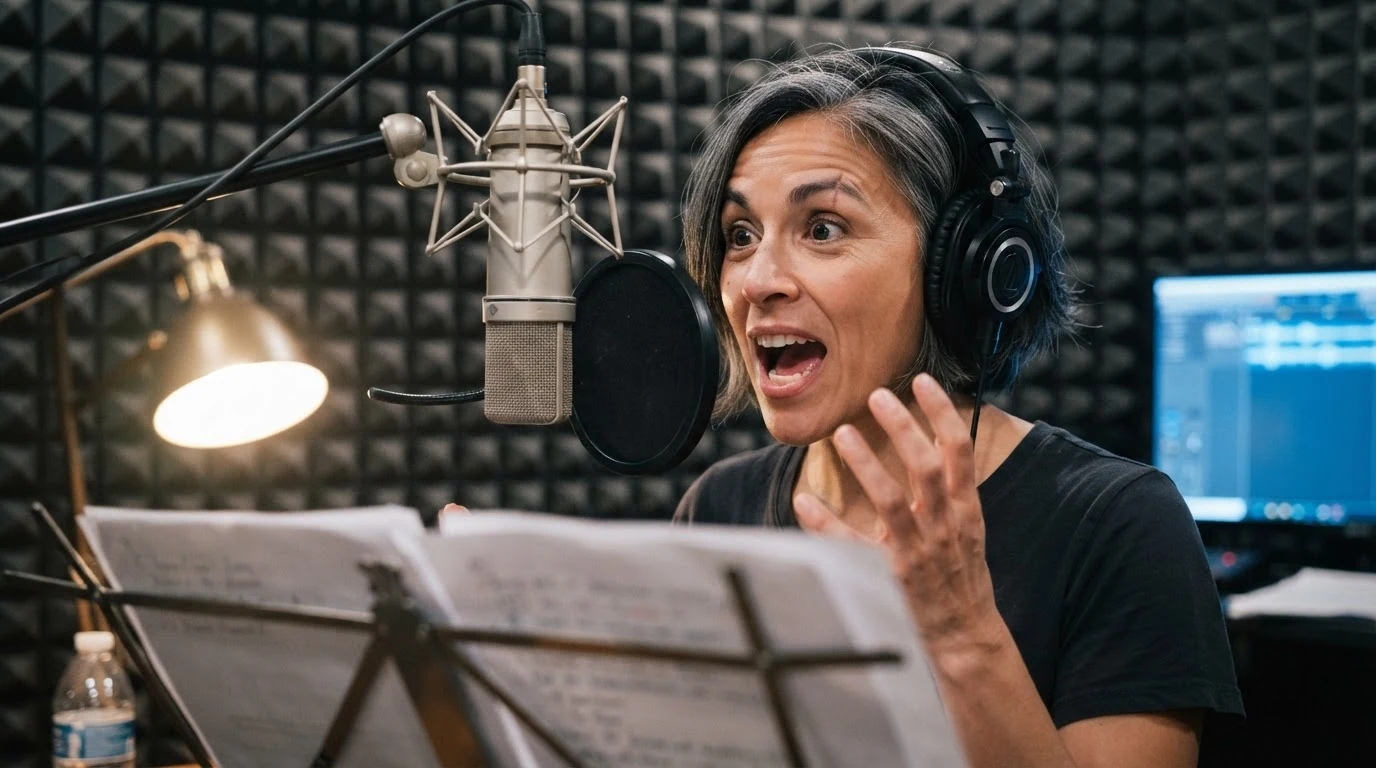
"Mid-performance", "mouth open on a line" and the raised hand read as acting, not a portrait next to a mic. Pop filter, headphones and foam place it in a real booth.
Open FlashBoardsWide shot through control-room glass into a recording booth: a tall, bald voice actor in his sixties with a thick white handlebar mustache and a burgundy cardigan hunches forward like an old creature, one fist clenched at his chest, growling into a studio microphone. Foreground, out of focus: a director in a grey beanie pressing a talkback button on a mixing console with glowing meters. Warm booth, dim blue control room, faint reflections on the glass. 35mm lens, widescreen film still.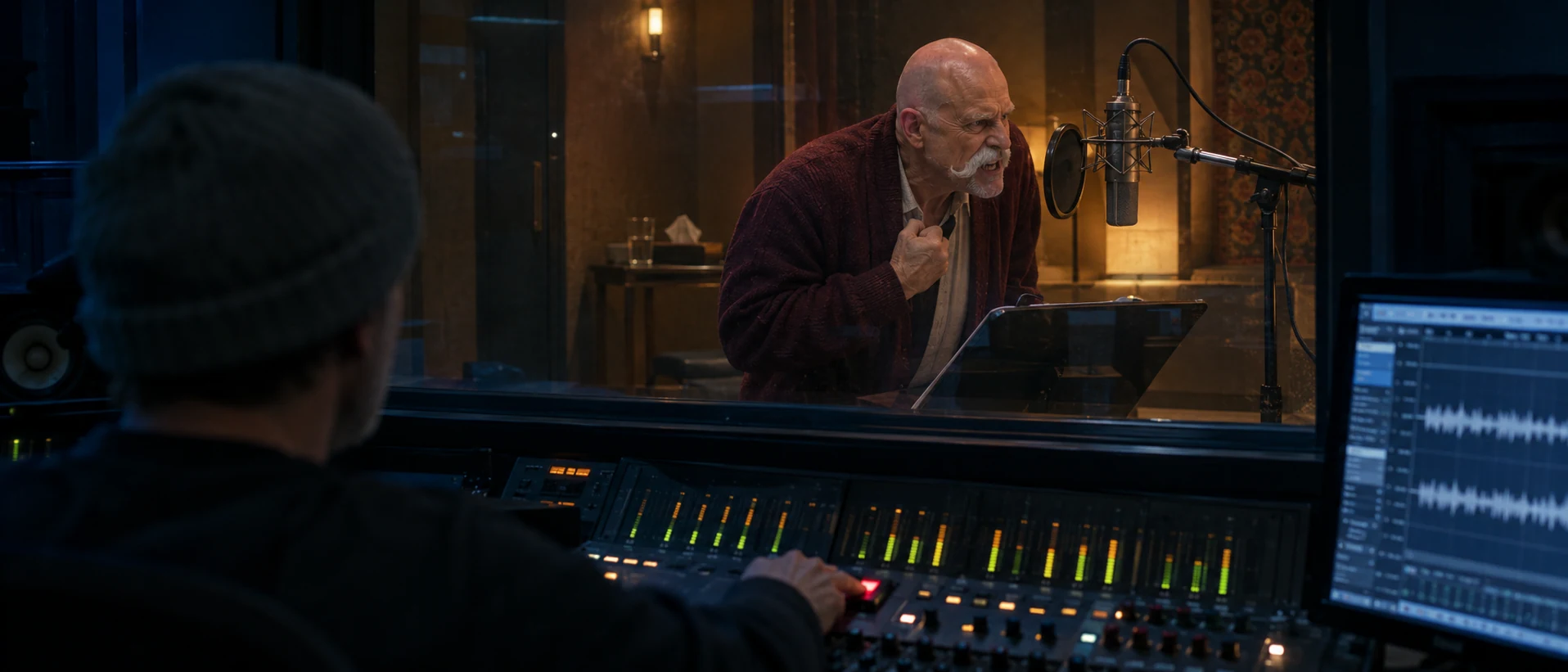
A second take from the director's side of the glass. "Hunches forward like an old creature" shows the physical transformation; the talkback button frames it as a directed session.
Open FlashBoardsCamera: static close-up, a very slow push-in across the whole shot. Action: she is already speaking into the microphone, raised hand moving with the words. She pulls back half a step and laughs, then leans in close to the pop filter and drops to a whisper, eyes narrowing. At the end she glances down at the script and nods once."Already speaking" makes the shot alive from frame one. Backing off for a laugh and closing in for a whisper is visible mic technique. Lay the real voice track in the edit.
Open FlashBoardsCommon mistakes
- Handheld mic. Models draw a singer with a handheld mic. Say "large studio condenser microphone on a stand behind a round pop filter".
- Neutral faces. Name the line's feeling ("eyebrows lifted in surprise", "growling") and a gesture.
- Karaoke look. Use "recording booth", "acoustic foam", "script on a music stand" rather than "singing".
- Lip movement. Generated mouths won't match a real recording; keep booth shots wider.
Keep the reference frames, prompts and every generated take side by side — images and video in one canvas.
FAQ
5 questionsWhat is voice acting?
Voice acting is performing a character using only the voice — in animation, video games, dubbing, audio drama or narration. The actor has no face or body on screen, so pitch, pace, breath, texture and timing carry the whole character. It is acting in the full sense, delivered through a microphone.
What does a voice actor do?
A voice actor builds a voice for the character and records it in a booth under a voice director, giving several takes of each line with different intentions, plus efforts, breaths and reactions. In dubbing and ADR they match existing picture; in animation they usually record first and the animators draw to their track.
Who are some famous voice actors?
Mel Blanc voiced Bugs Bunny, Daffy Duck and Porky Pig. Nancy Cartwright (Bart Simpson) and Dan Castellaneta (Homer Simpson) are celebrated specialists. On-camera stars have also given famous voice performances: Tom Hanks as Woody in Toy Story, Robin Williams as the Genie in Aladdin and James Earl Jones as the voice of Darth Vader.
Is voice acting the same as voice-over?
No. Voice acting is a type of performance — playing a character with the voice alone. Voice-over is a placement of sound — speech over the picture from someone not on screen at that moment, like a narrator. A cartoon character talking on screen is voice acting but not voice-over; a live actor narrating their own film is voice-over.
How far from the microphone should a voice actor stand?
A common working distance is about 15–30 cm (6–12 inches) from a studio condenser microphone, with a pop filter in between. Actors move closer for quiet, intimate lines and back off or turn slightly off-axis for shouts so loud reads don't distort. Consistent distance across takes makes editing easier.
Related terms
4- Voice-OverSound & Music
Voice-over is speech heard over the picture from someone not speaking on screen at that moment — a narrator, a character's inner thoughts, a documentary commentary.
- DubbingSound & Music
Dubbing replaces a film's original dialogue with a new recording — usually a translation performed by voice actors and fitted to the lip movements on screen.
- ADRSound & Music
ADR (automated dialogue replacement, once called looping) is re-recording an actor's lines in a studio after the shoot, in sync with picture, to fix noise, change a line or improve a performance.
- Lip SyncSound & Music
Lip sync is the match between mouth movements on screen and the voice we hear — essential in dubbing, ADR, music performance and AI-generated talking characters.
Further reading
Frank Thomas & Ollie Johnston, The Illusion of Life: Disney Animation (Disney Editions) — on animating to recorded dialogue.