 FlashBoards Learn
- Learn
- Film History & Theory
- Diegesis
Film History & Theory · Film language
Diegesis
Also called: diegetic world, story world
Diegesis is the story world of a film: everything that exists for the characters, from the room they stand in to the radio they can hear. Anything inside that world is diegetic. Anything that only the audience receives, like the score, the opening titles or an outside narrator, is non-diegetic.
- What it does
- Draws the line between what the characters can see and hear and what only the audience gets.
- Use it when
- You decide where a music cue, a piece of text or a narrator lives, or you want to cross that line on purpose.
- Watch out
- An unclear source confuses the viewer. If characters should hear a song, show or establish where it comes from.
- Try this prompt
Warm kitchen at night, a woman with a silver braid lowers a needle onto a spinning record while her husband looks up from the table, 35mm, film still.
What is diegesis in film?
Diegesis is the world the story takes place in, treated as if it really exists: the characters, places, objects and sounds. The simplest test is whether a character could, in principle, perceive it. A radio playing in a diner passes. The orchestra swelling over the same scene does not.
In Plato's Republic, diegesis meant telling a story in the poet's own voice, as opposed to mimesis, imitating it through characters' speech. In the 1950s the French aesthetician Étienne Souriau used diégèse for the fictional world a film builds, and Gérard Genette later made it central to narratology.
For filmmakers, it's less a film theory term than a working question for every element of a narrative: does this belong to the characters' world, or is it laid over that world for the audience?
Diegetic vs. non-diegetic elements
The distinction is usually taught through sound, but it applies to the whole film.
Diegetic (inside the story world):
- Dialogue, footsteps, a song on a car stereo. See diegetic sound for this side in depth.
- Text the characters can read: a letter, a phone screen, a neon sign.
- Light with a source in the world: a lamp, a TV glow, passing headlights.
- Everything dressed into the frame, which is why diegesis and mise-en-scène overlap.
Non-diegetic (for the audience only):
- The film score.
- Credits, title cards, subtitles, captions giving a date or place.
- A narrator outside the story.
- Formal devices like a freeze-frame or a split screen.
Star Wars (1977) shows both sides. The opening crawl and John Williams's score exist only for us. The band in the Mos Eisley cantina is music the characters hear.
Why the line matters to filmmakers
Knowing where the line sits lets you use it.
Diegetic elements root the scene. In Reservoir Dogs (1992), the upbeat radio song during the torture scene is part of the room, which makes the violence feel casual and harder to watch.
Non-diegetic elements steer the viewer. The score tells us how to feel before the characters know anything.
Crossing the line creates a jolt. In Blazing Saddles (1974), the swing score in the desert turns out to be Count Basie's band, playing on the prairie. Baby Driver (2017) nearly erases the line: the music comes from the hero's earbuds and the cutting follows it. Breaking the fourth wall is the reverse move, a character stepping out of the diegesis to address an audience that shouldn't exist for them.
Diegetic levels: stories inside stories
Genette's model separates the levels a story can be told from:
- Extradiegetic: the outermost telling, from outside the story world.
- Intradiegetic: the story world itself.
- Metadiegetic: a story told inside the story, which the film then shows.
In The Princess Bride (1987), a grandfather reads a book to his sick grandson, and the adventure we watch is the story in that book. The boy's interruptions pull us back up a level.
That's also why a voice-over isn't automatically non-diegetic. A character narrating their own story in hindsight, like the dead screenwriter in Sunset Boulevard (1950), belongs to the story world even though no one else in it can hear him.
How to plan diegesis on set and on the board
Most diegesis decisions are made in prep, not in the mix.
- Mark every cue. Tag each music cue, text insert and narration line in the script as diegetic or non-diegetic. Source music then needs a source: a jukebox, a car radio, a band to cast.
- Establish the source early. Show the radio before the song matters. Once the audience knows where the sound comes from, you can cut away and it stays diegetic.
- Let characters react. A character turning toward a sound or switching it off proves it's diegetic.
- Keep in-world text in the world. Signs and screens follow the world's language and era. Titles follow the film's graphic design.
In FlashBoards, this fits on one board: reference frames of the world's props and signage next to the storyboard panels, with a note on each panel about which cues the characters hear and which are score.
How to create a diegesis with AI
3 promptsAn image can't play a song, but it can show where a sound or text lives: the source sits in the frame and the characters react to it. Build the start frame with Nano Banana 2 Lite, a second take with GPT Image 2.5, and animate it with MiniMax H3 Max Turbo on one FlashBoards board.
Medium wide shot of a warm kitchen at night. On the left, a woman in her sixties with a long silver braid and a faded red cardigan lowers a turntable needle onto a spinning vinyl record. On the right, a bald man with a short white beard sits at a wooden table with a cup of tea and looks up toward the record player. Warm pendant lamp, 35mm lens at seated eye height, deep focus, cinematic film still.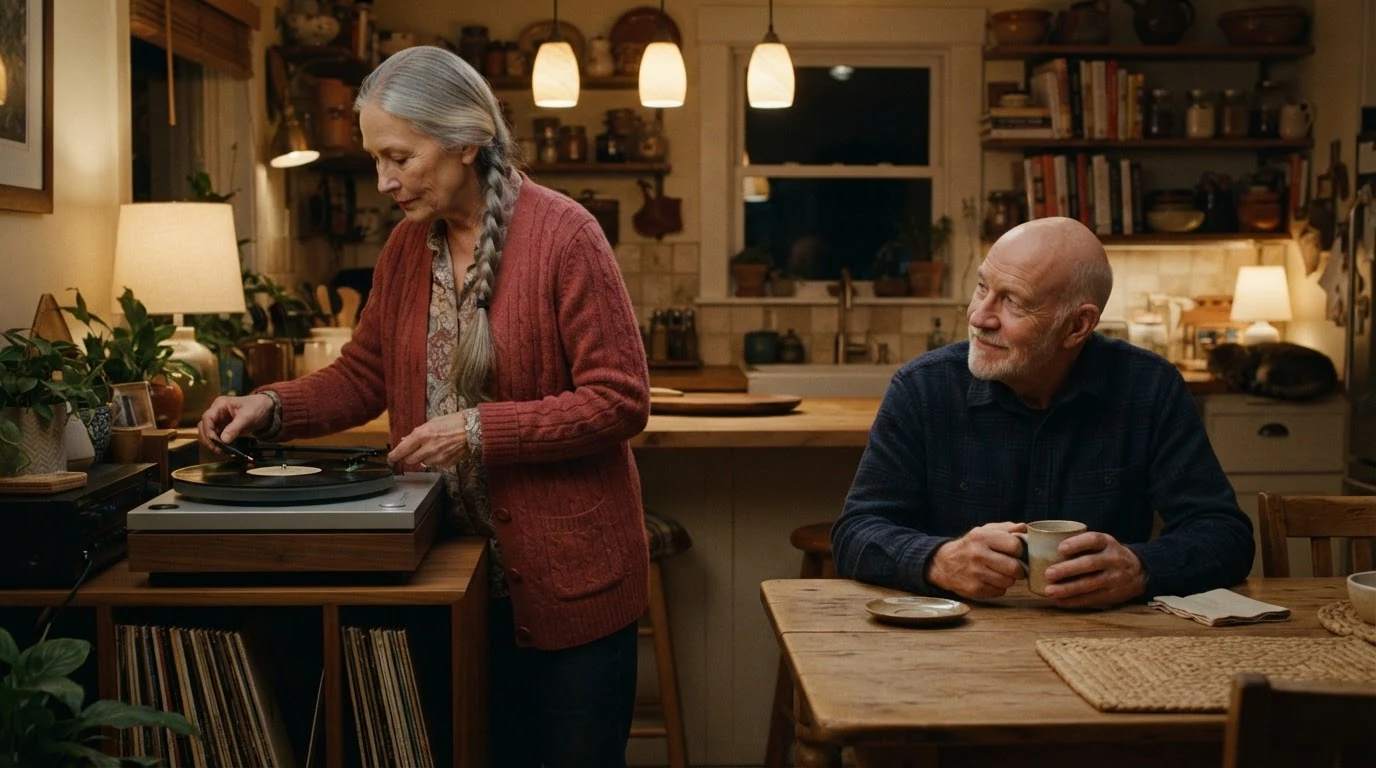
The turntable is named first and "deep focus" keeps it sharp beside both faces. "Looks up toward the record player" shows the characters hear this music.
Open FlashBoardsWide shot of a rainy night street in a harbor town. A young man with a shaved head, a scar through one eyebrow and a yellow rain jacket stops on the wet sidewalk and reads a flickering pink neon sign that says OPEN LATE above a closed bar. Neon reflections on the pavement, drizzle in the glow. Camera at shoulder height behind him, 28mm lens, sign and raised face in focus, anamorphic film still.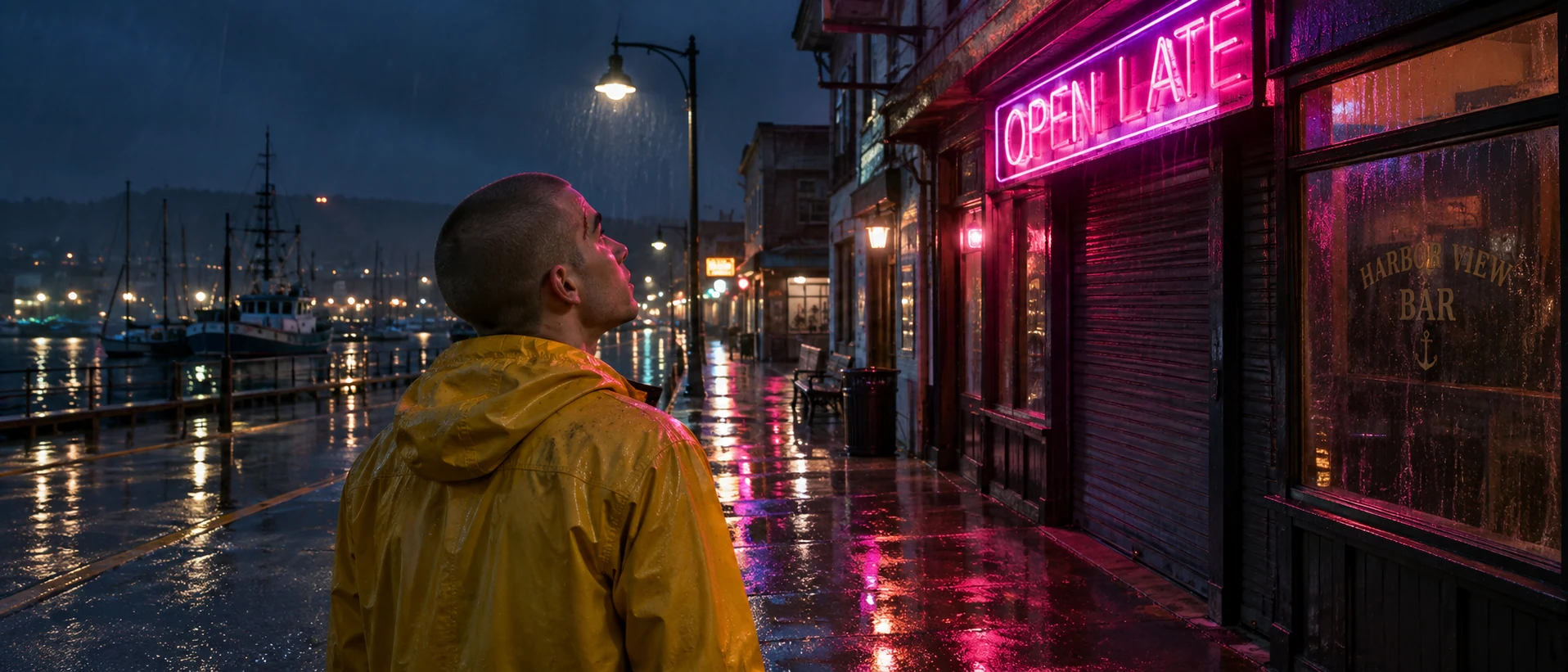
This take moves diegesis from sound to text: "reads" and "raised face" make the sign something the character perceives, not a title card. Keep in-world text to a few words.
Open FlashBoardsCamera: static at seated eye height, then a slow push-in toward the table. Action: the record is already spinning as the woman lifts her hand from the needle arm and starts to sway her shoulders. The man sets down his cup, smiles and taps his fingers on the table in rhythm. She holds out her hand to him, and he begins to rise from his chair.The spinning record makes the shot alive from the first frame. Swaying and tapping are the diegesis: both characters move to the same music. Add the track in the edit with a slightly boxy tone.
Open FlashBoardsCommon mistakes
- Models often push the source into a blurred background. Name the source object first and ask for deep focus.
- Characters pose for the camera instead of reacting. Give them a verb aimed at the source: looks up toward, reads, sings along with.
- Clips come out silent. Note on the board which cue goes over which take.
Keep the reference frames, prompts and every generated take side by side — images and video in one canvas.
FAQ
4 questionsWhat is diegesis in simple terms?
Diegesis is the world of the story as the characters experience it. If a character could see, hear or touch it, it's diegetic: a room, a phone call, a song on the radio. If it exists only for the audience, like the score, opening titles or subtitles, it's non-diegetic. The term describes where each element of a film lives.
What is the difference between diegetic and non-diegetic?
Diegetic elements belong to the story world, so the characters can perceive them: dialogue, a street musician, a text message on a screen. Non-diegetic elements are added for the audience only: the score, an outside narrator, credits and captions. The same song can be either, diegetic on a character's stereo and non-diegetic over a montage.
Is voice-over diegetic or non-diegetic?
It depends on who speaks. A narrator standing outside the story is non-diegetic. A character narrating their own experience belongs to the story world, even though the other characters can't hear the narration. That kind of voice-over is often called internal or intradiegetic narration.
Are subtitles and title cards diegetic?
Usually not. Subtitles that translate dialogue, captions giving a date or place, and chapter titles are added for the viewer, so they are non-diegetic. Text the characters can read, like a letter, a sign or a phone screen, is diegetic, even when a film styles text messages as floating graphics.
Related terms
6- Diegetic SoundSound & Music
Diegetic sound comes from inside the story world — dialogue, footsteps, a radio the characters can hear — while non-diegetic sound, like the score or a narrator, exists only for the audience.
- Film ScoreSound & Music
A film score is original music written by a composer for a specific film, timed to picture to shape emotion, pace and theme; it differs from a soundtrack of pre-existing songs.
- Voice-OverSound & Music
Voice-over is speech heard over the picture from someone not speaking on screen at that moment — a narrator, a character's inner thoughts, a documentary commentary.
- Breaking the Fourth WallStorytelling
The fourth wall is the invisible barrier between the story and the audience; a character breaks it by looking into the lens and speaking to the viewer, or by acknowledging that they're in a film.
- NarrativeStorytelling
A narrative is a chain of events connected by cause and effect and told from a chosen point of view; in film, it's the story as organized by plot, image and sound.
- Film TheoryFilm History & Theory
Film theory is the body of ideas about what cinema is and how it produces meaning and pleasure — from Soviet montage and Bazin's realism to auteur theory, psychoanalytic and feminist criticism.
Further reading
Gérard Genette, Narrative Discourse: An Essay in Method (1972; English translation 1980). David Bordwell and Kristin Thompson, Film Art: An Introduction, chapter on sound in the cinema. Claudia Gorbman, Unheard Melodies: Narrative Film Music (1987).