 FlashBoards Learn
- Learn
- Film History & Theory
- Mise-en-Scène
Film History & Theory · Film language
Mise-en-Scène
Also called: mise en scene, staging, what's in the frame
Mise-en-scène is everything placed in front of the camera and arranged in the frame: setting, props, costume, makeup, lighting, and where the actors stand and move. Together these choices tell the audience who the characters are, what they feel and what matters in the scene, often before a single line is spoken.
- What it does
- Turns a room, a coat, a lamp and a person's position into meaning the audience reads at a glance.
- Use it when
- Planning any scene: decide what the frame should say, then choose set, costume, light and staging to say it.
- Watch out
- Detail without intent is clutter. If an element doesn't support the scene's idea, it competes with it.
- Try this prompt
Wide film still, a young woman in an oversized gray suit alone at a huge desk at night, one desk lamp, cold city lights behind, unpacked box on the floor, 28mm.
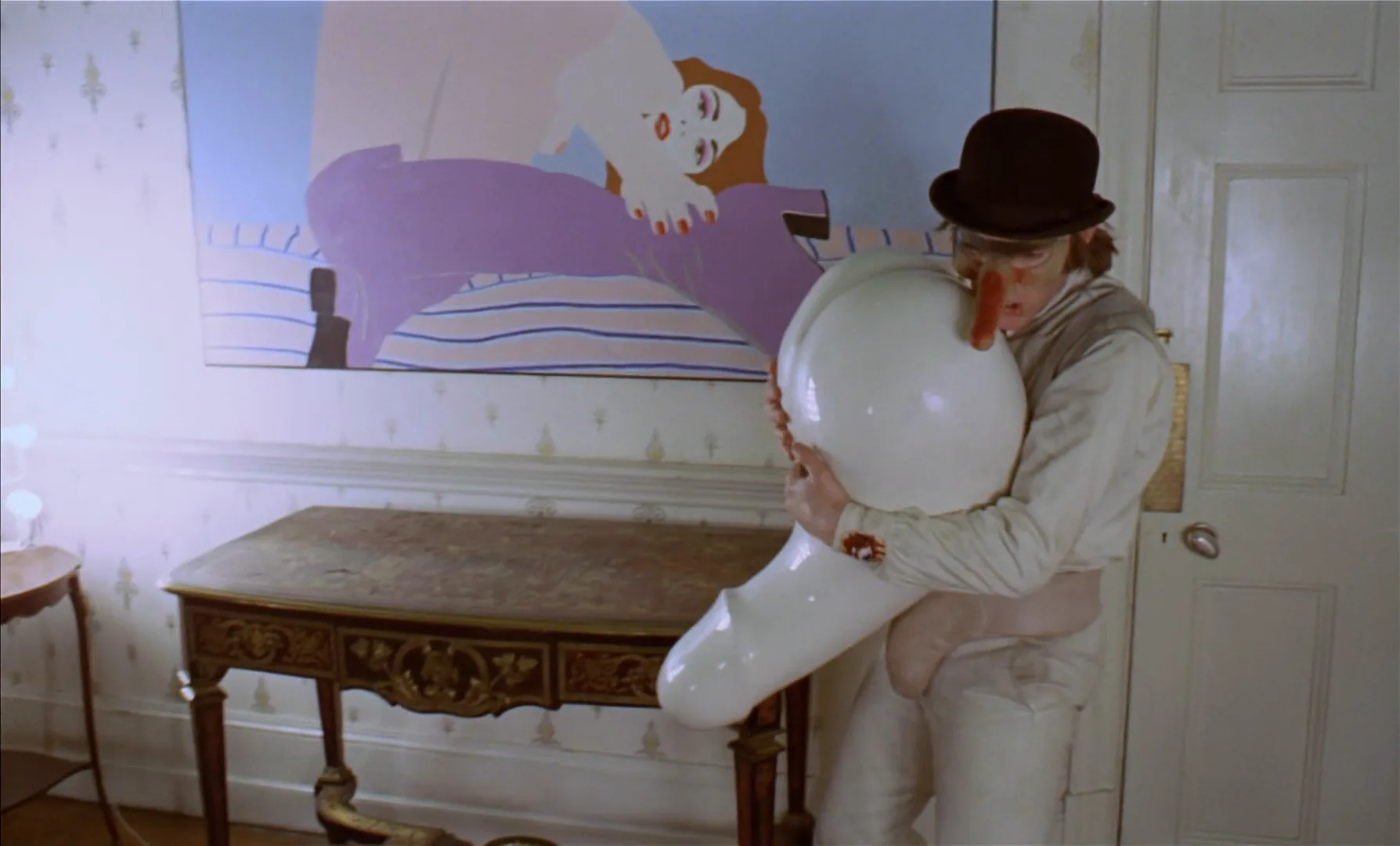
What is mise-en-scène?
The term is French and comes from the theater, where mettre en scène means to put on stage: to stage a play. Film borrowed it for everything the director and crew arrange for the camera to record. A common mistake is to reduce it to scenery and props. In cinema, mise-en-scène covers the whole physical content of the shot: the location or set, what is in it, what the actors wear, how they are lit, and how they are placed and move.
The standard film-studies breakdown, popularized by David Bordwell and Kristin Thompson's Film Art, groups it into four areas:
- Setting and props, the world of the scene.
- Costume and makeup, the surface of each character.
- Lighting, what we see, how clearly, and in what mood.
- Staging, the performance and movement of the actors.
Some critics also count framing and color, since the frame decides what the arrangement looks like. Either way, the idea is the same: nothing in a well-made shot is there by accident.
The term took on a second life in the 1950s, when French critics writing for Cahiers du cinéma used it to describe a director's personal style. A studio filmmaker might not control the script, but the way they staged a scene carried their signature. That argument grew into auteur theory, one of the central ideas of film theory.
What are the elements of mise-en-scène?
Setting and props
The setting is the first thing an audience reads: era, class, climate, order or neglect. Set design and set dressing fill a space with a history, and a single prop can carry a whole relationship. In Citizen Kane (1941), a boy plays in the snow outside a window while, inside, the adults sign away his childhood; the room and the window do the storytelling.
Costume and makeup
Costume design tells us status, taste and inner state. In The Royal Tenenbaums (2001), Chas and his two sons wear matching red tracksuits, a uniform of his fear for them. Makeup ages, wounds or exaggerates a face, and hair signals change as clearly as a line of dialogue.
Lighting
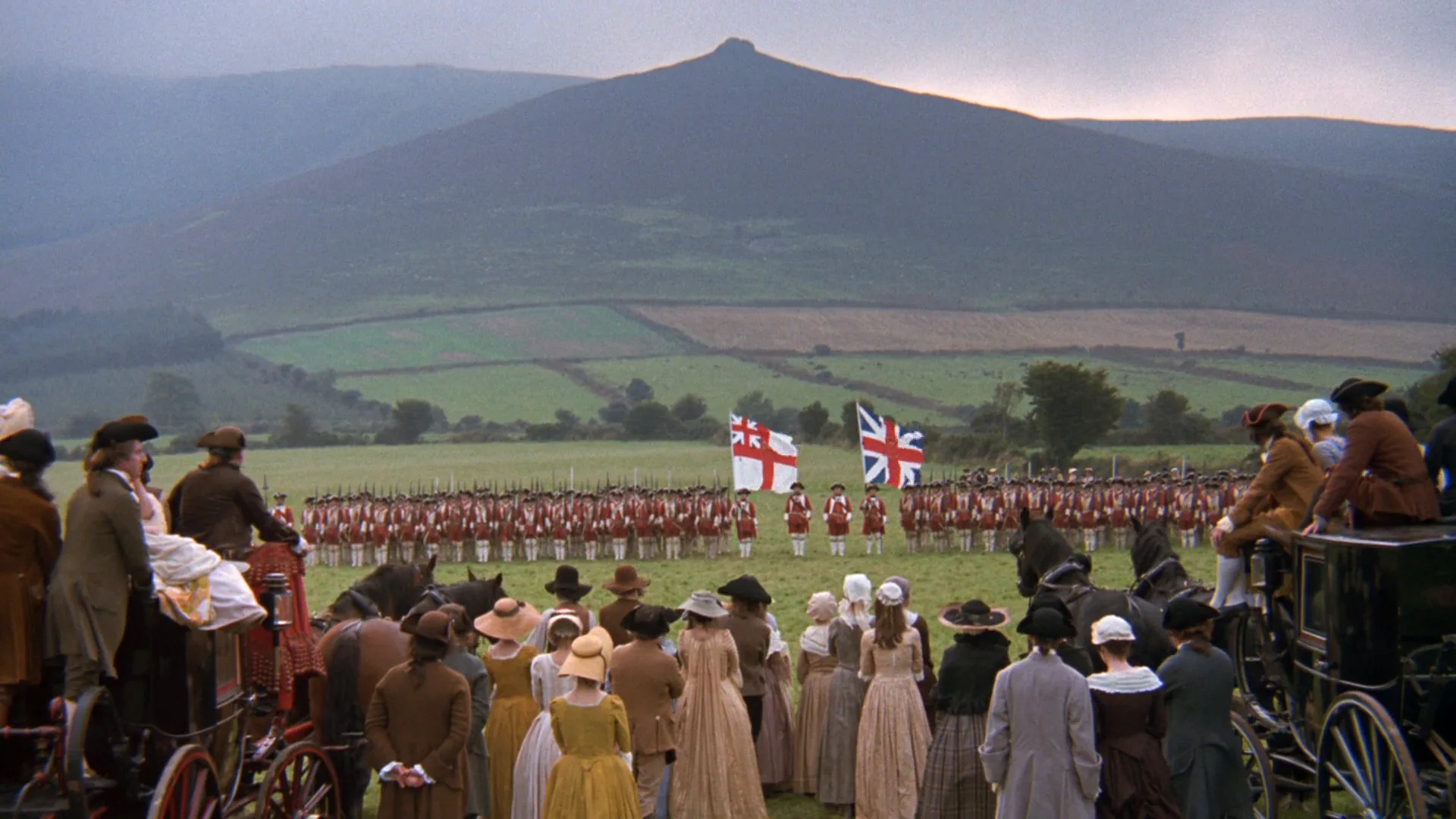
Light decides what the audience sees first and how the scene feels: hard or soft, bright or low-key, warm or cold. Practical lighting, the lamps and candles visible in the set, ties the light to the story world. Barry Lyndon (1975) lit some interiors by candlelight alone, and the flicker became part of the period look.
Staging and performance
Where an actor stands, whether they face us or turn away, who is higher or closer to the lens: staging turns relationships into geometry. It overlaps with blocking, the choreography of movement through a scene.
Color and composition
Color runs through all four areas. A deliberate color palette links set, wardrobe and light into one idea: The Wizard of Oz (1939) moves from sepia Kansas to saturated Oz, and Schindler's List (1993) gives one girl a red coat in a black-and-white film. The arrangement itself belongs to film composition: balance, depth and where the eye lands.
How mise-en-scène creates meaning
A viewer reads a frame the way they read a room they walk into: quickly, and mostly without noticing. Mise-en-scène uses that habit in a few recurring ways.
- Character without exposition. An unmade bed, a neatly pressed uniform or a closet full of identical shirts tells us who someone is faster than a monologue.
- Power and relationships. A figure at the head of the table under the only lamp holds the scene; a figure at the edge of frame, half in shadow, does not.
- Mood and genre. Fog, deep shadow and wet streets set up a thriller before anything happens. Pastels and symmetry, as in Wes Anderson's films, promise a fable.
- Contrast inside a scene. The Godfather (1972) opens in a dark, shuttered office where favors are granted, while a bright wedding plays outside. The two spaces are the two sides of the family.
- Change over time. When the same room is later bare, lit differently or rearranged, the audience feels the story moved. This is how symbolism works on screen: an object gathers meaning each time the film returns to it.
The opposite approach to meaning is montage, which builds ideas from the collision of shots in the edit. André Bazin and many realist critics preferred mise-en-scène: long takes and deep focus let the viewer's eye explore one continuous space, as in real life. Most films use both.
How to plan and shoot mise-en-scène
- Start from the idea, not the objects. Write one sentence for what the frame must say: she has won the job and has never been more alone. Every choice below should serve that sentence.
- Design the space in layers. Plan foreground, midground and background so each holds something useful. Depth layering lets a set tell two things at once, such as a character in front and the consequence behind them.
- Pick a palette for set, wardrobe and light together. Limit it to two or three main colors and one accent. The accent is where the eye goes, so give it to the thing that matters.
- Light from the world. Put a lamp, window or screen in the frame and build the key from it. Contrast ratio sets the mood: a 2:1 ratio feels open, 8:1 feels secretive.
- Stage for the lens. A 24–32mm lens shows the room and makes distance between people read strongly; a 75–100mm lens compresses space and isolates a face from its surroundings. Choose the lens before you finalize the dressing, because it decides how much of the set is seen.
- Clear what doesn't serve. Remove anything that competes: logos, bright objects in the wrong corner, a second color accent.
- Check the frame on a monitor, not by eye. The camera sees a flat rectangle; what looks balanced in the room can read cluttered on screen.
In FlashBoards, collect reference frames for the set, wardrobe and light next to your storyboard panels, generate test frames of the scene, and keep notes on palette and props on the same board, so the art department, the DP and the director plan from one picture.
How to analyze mise-en-scène in a scene
For film analysis, pause on a frame and ask five questions:
- Where are we? What do the setting and props say about time, place and the people who live here?
- Who are they? What do costume, hair and makeup reveal, and does anything change later?
- What does the light do? Where is it coming from, what is hidden, and what is the mood?
- Who holds the frame? Look at position, height, distance from the lens and who faces the camera.
- Where does the eye go first, and why? Usually a combination of the brightest area, the strongest color and the sharpest focus.
Then connect the answers to the scene's meaning. A good analysis doesn't list details; it explains what they add up to.
Mise-en-scène vs. blocking vs. production design
The three overlap, but they sit at different levels.
- Mise-en-scène is the analytic umbrella: everything in front of the camera and how it is arranged in the frame. It is a way of reading or planning a shot as a whole.
- Blocking is one part of it: the planned movement and positions of actors, and often the camera, through a scene. It is a directing and rehearsal tool.
- Production design is the department that builds the physical world, sets, props, dressing and the overall color scheme, led by the production designer.
So production design supplies the room, costume supplies the clothes, the DP supplies the light, blocking places the actors, and mise-en-scène is what all of it becomes once it is framed and filmed.
Mise-en-Scène examples in film
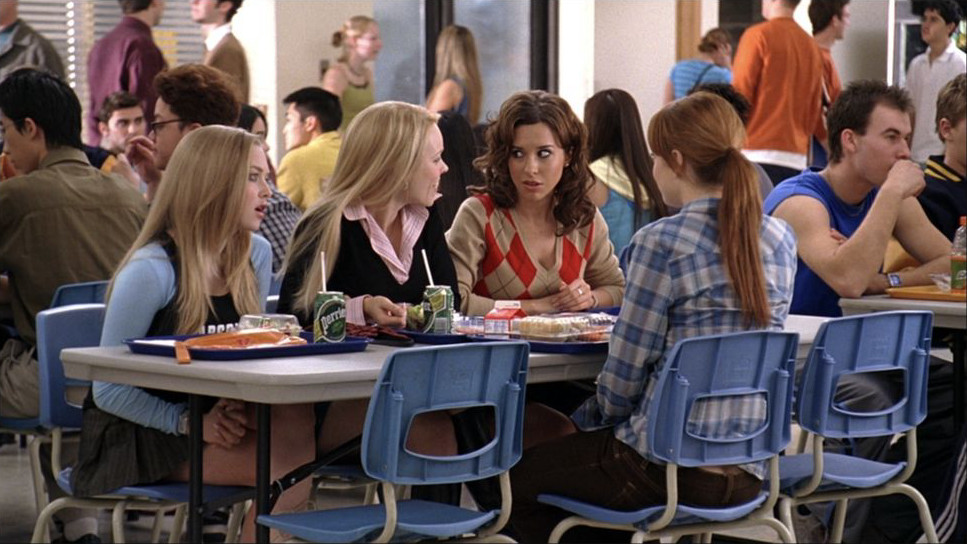
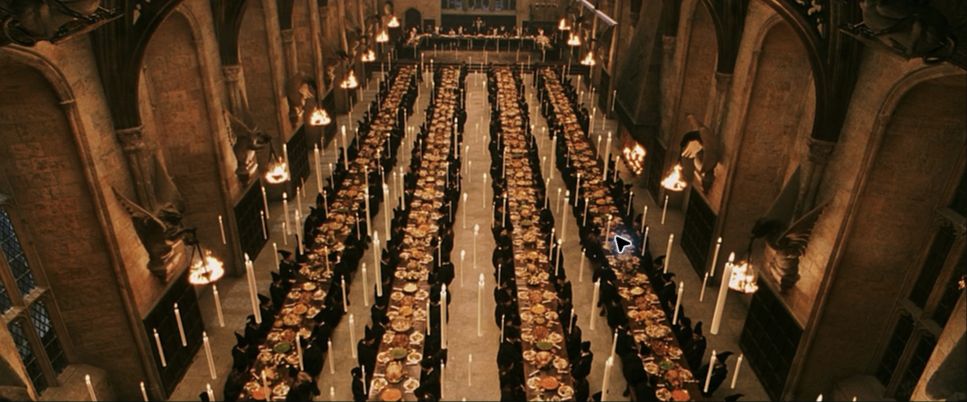
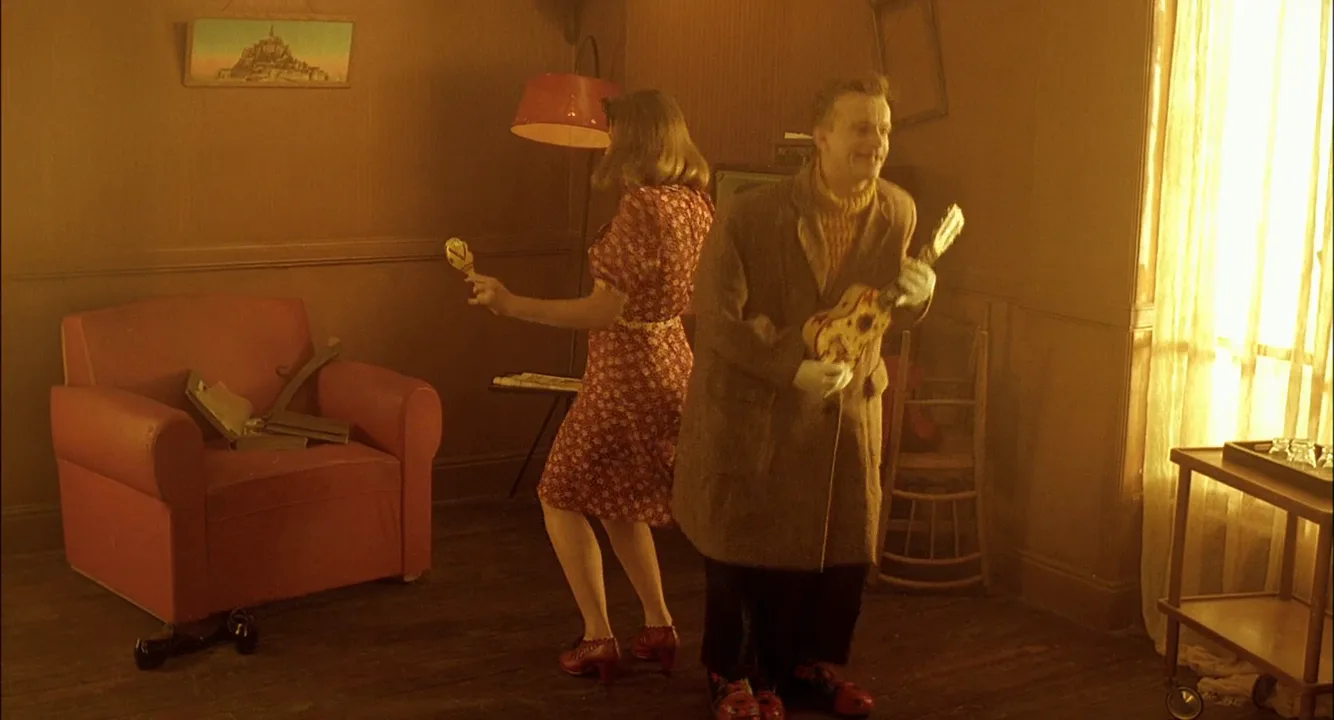
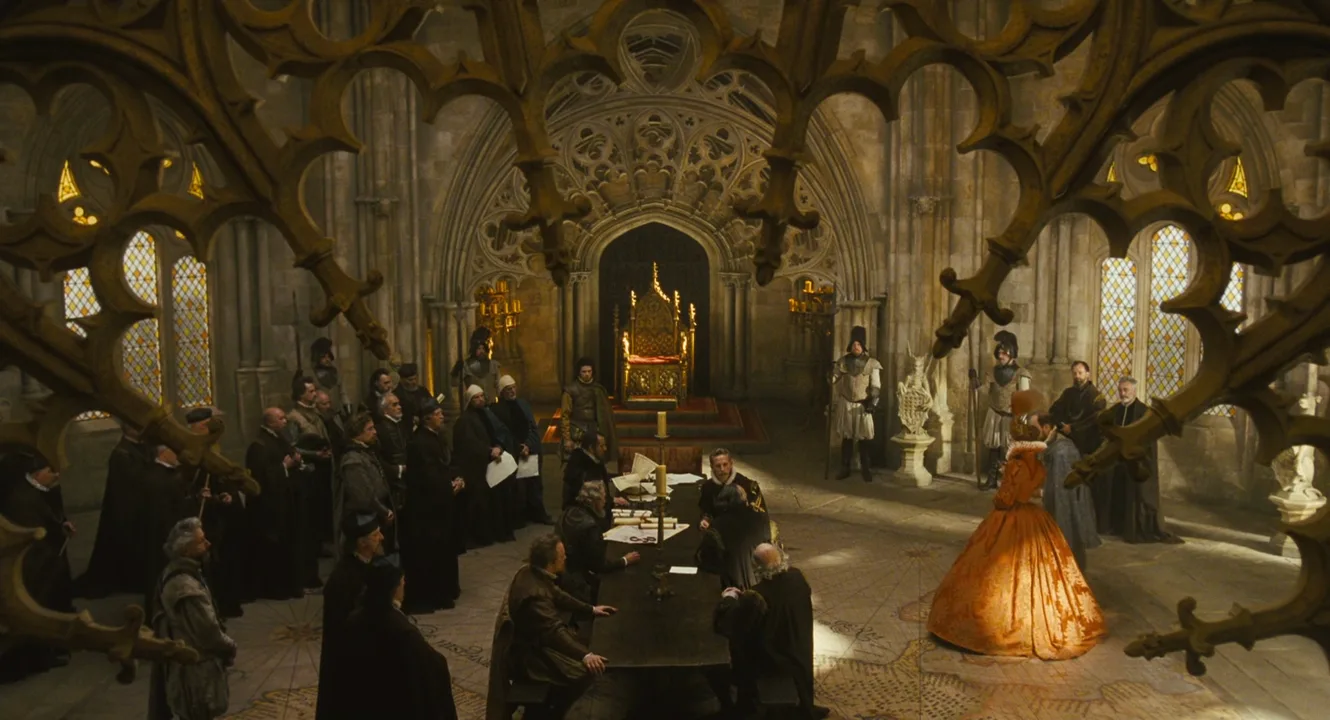
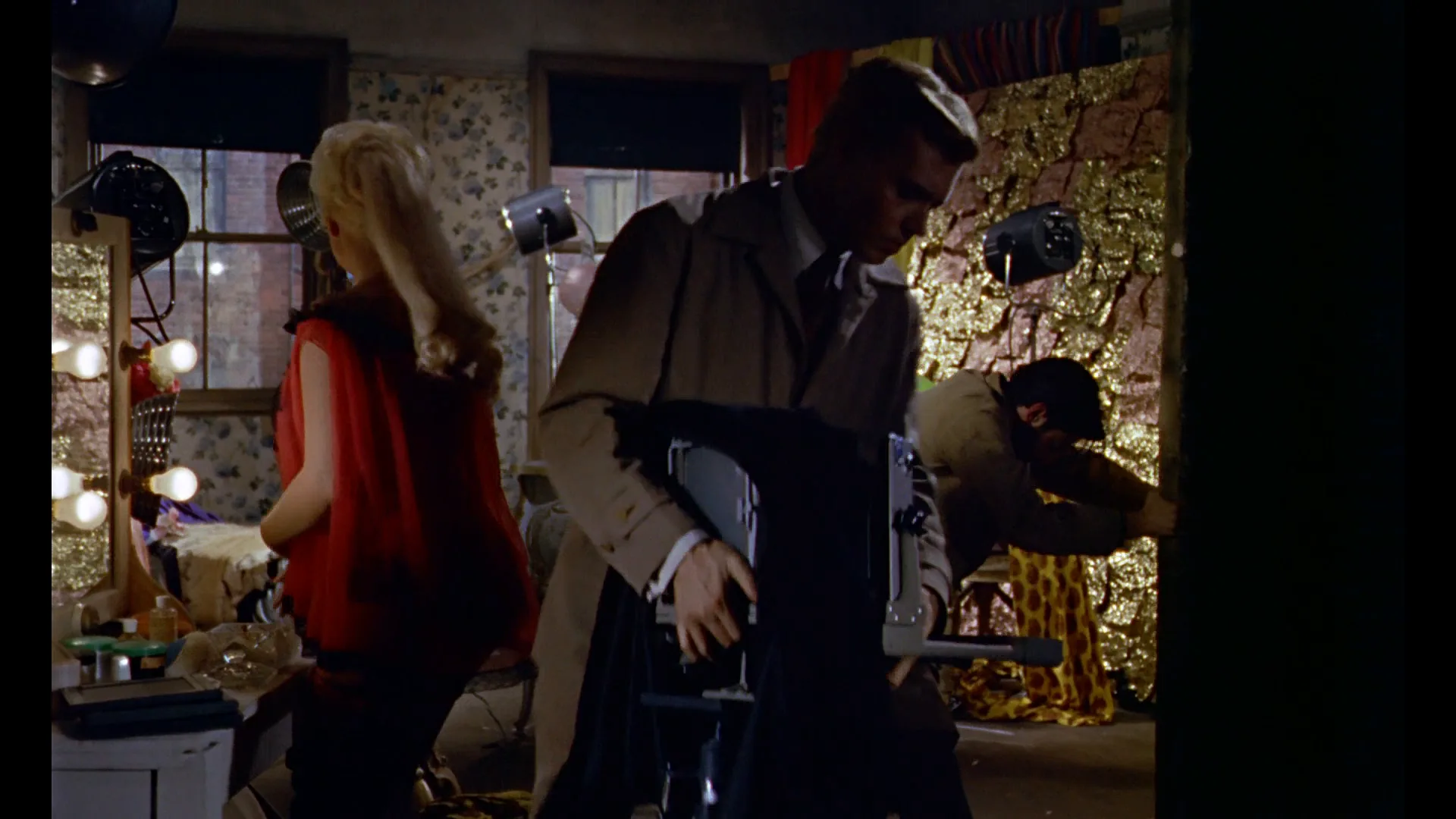
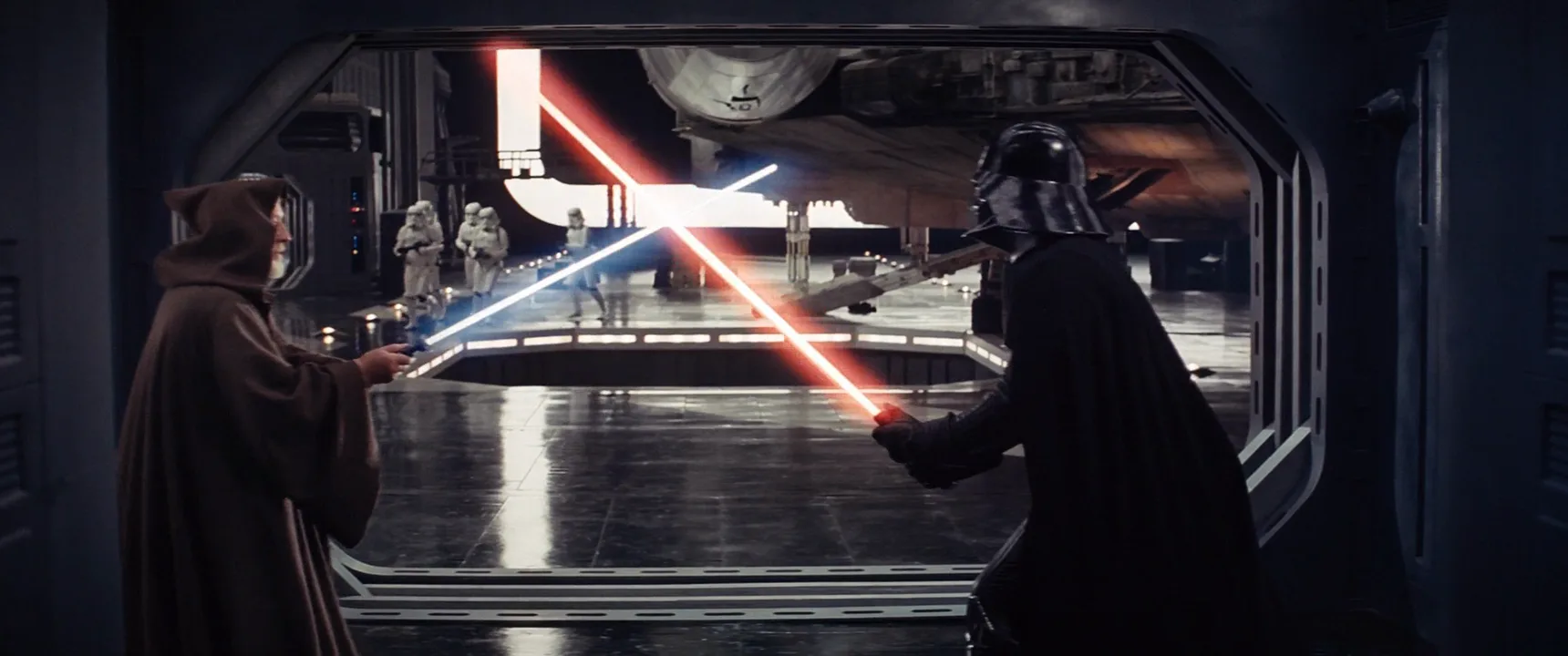
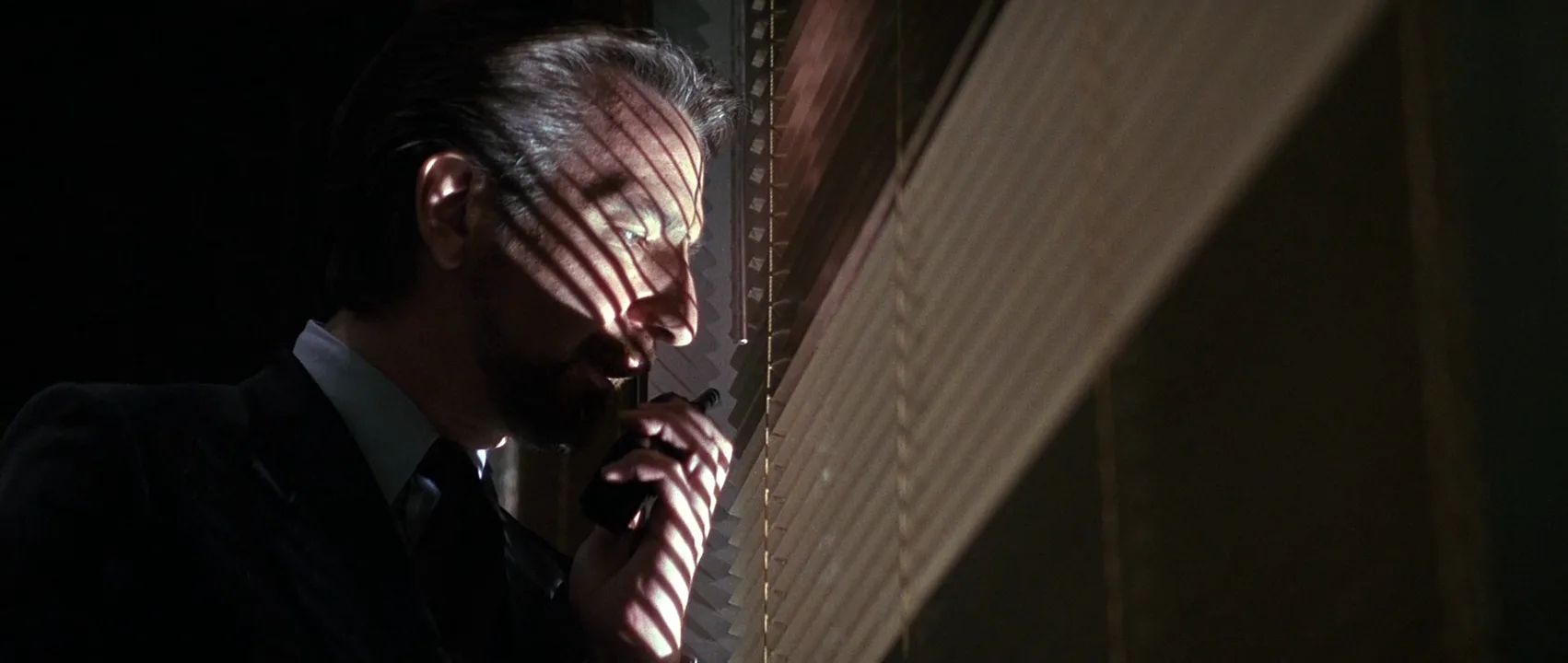
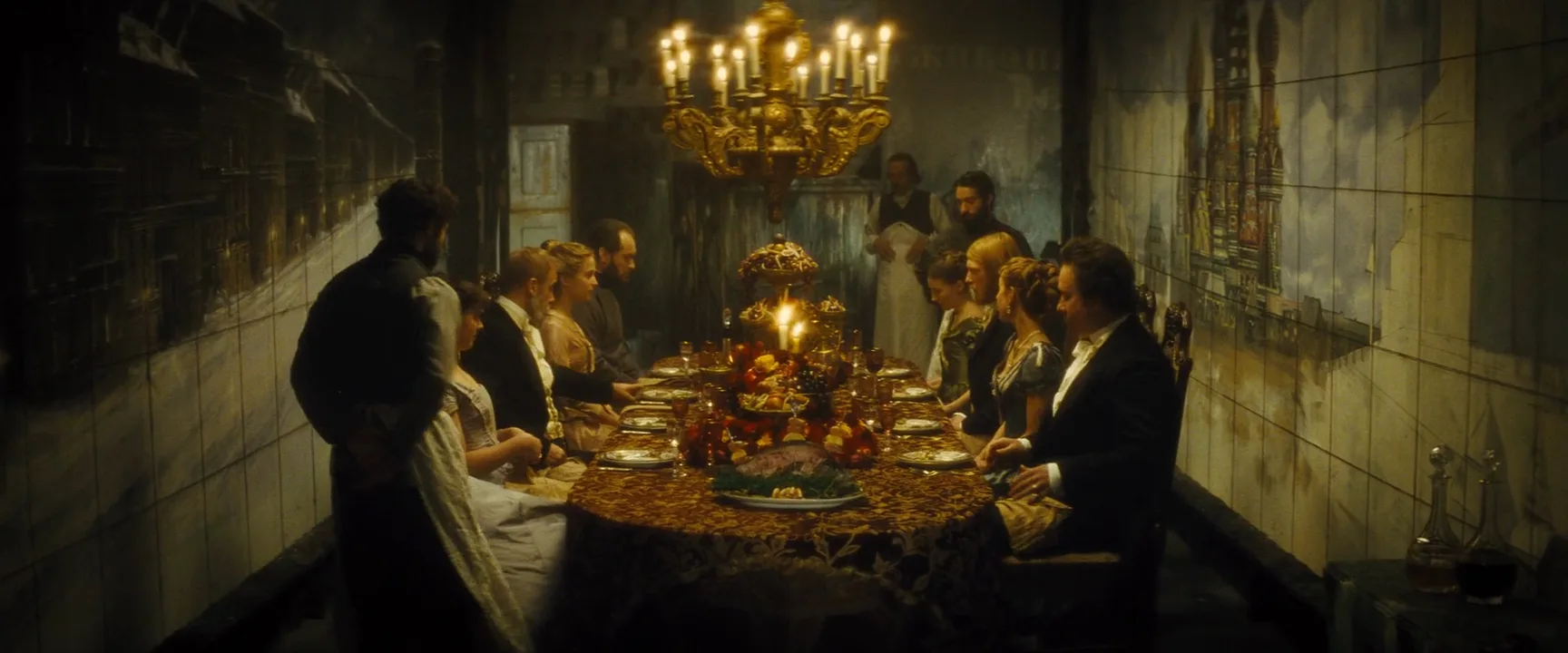
11 framesFrames where set, costume, light and staging are clearly working together. Look at what each element tells you before anyone moves.
How to create a mise-en-scène with AI
4 promptsWith image models, mise-en-scène is the prompt itself: set, props, wardrobe, light and position each need their own words, or the model fills the gaps with generic stock detail. Write the idea first, then one concrete choice per element. In FlashBoards, keep reference frames and your takes on one board and compare them side by side. The fourth prompt re-shoots a real film shot from a text description alone, and the original plays next to the result so you can compare.
Cinematic film still, wide shot, 28mm lens at seated eye height. A newly promoted young woman sits alone at the far end of a huge, nearly empty corner office at night. She is a fictional character: early 30s, short black curly hair, round tortoiseshell glasses, an oversized charcoal suit with sleeves past her wrists. Setting: a long glass desk, one green-shaded desk lamp making a small warm pool of light, an unopened cardboard box on the carpet, a potted plant still in its plastic nursery pot. Behind her, floor-to-ceiling windows full of cold blue city lights. She sits small in the lower right of frame, hands around a paper coffee cup. Low-key light, teal and amber palette, quiet and lonely.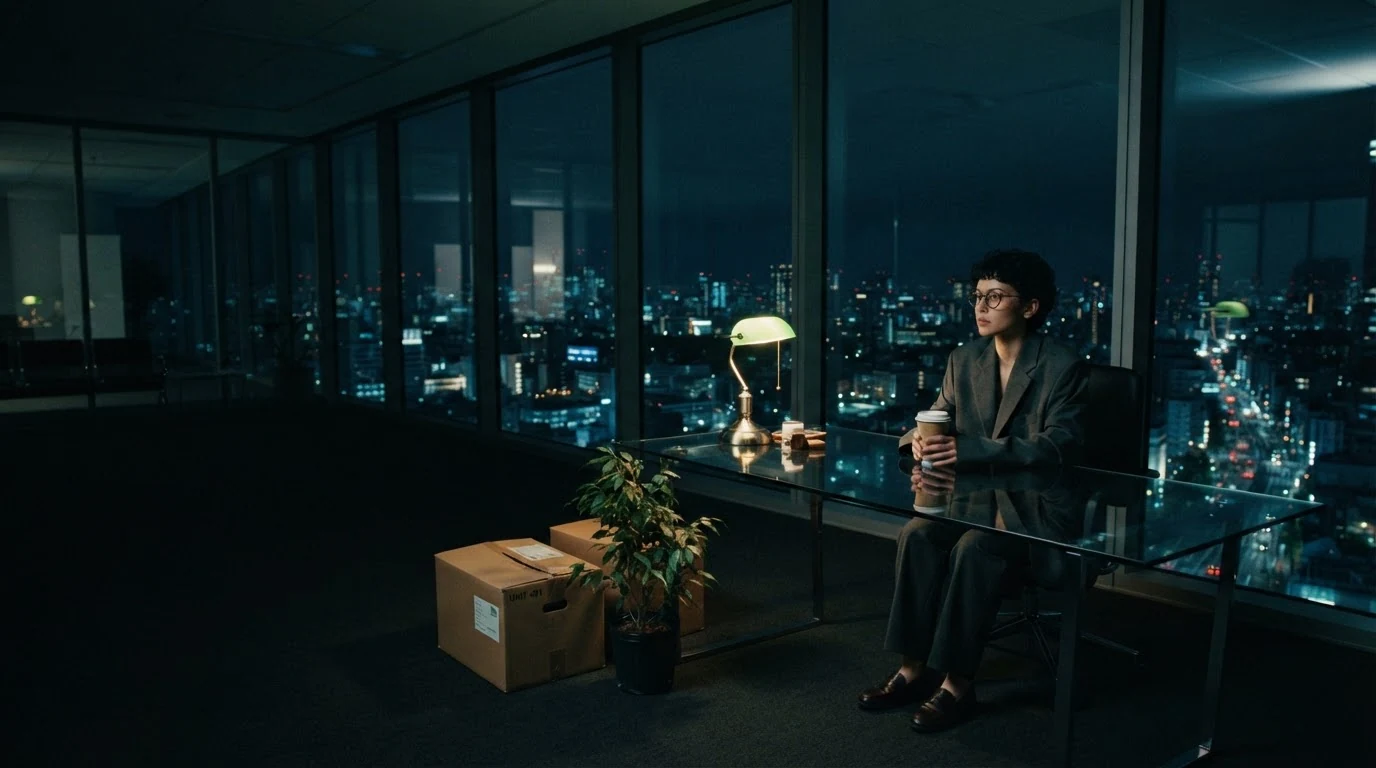
Each element carries the same idea: the oversized suit and unopened box say she is new, the huge, nearly empty office and her small in the lower right of frame position say she is alone, and the one desk lamp against cold blue city lights sets the mood. The 28mm lens keeps the empty room in the frame.
Open FlashBoardsAnamorphic film still, frontal wide shot, 40mm lens, camera at seated eye height, deep focus. A 1970s suburban dining room staged as a power portrait. At the head of the table, under the only hanging lamp, a heavyset fictional father with a gray crew cut and a brown cardigan carves a roast. The mother, a thin woman with a red headscarf, stands behind her chair holding a gravy boat. Two teenage boys sit on one side in matching blue sweaters; a girl with long braids sits alone on the other side, half in shadow, her plate empty. Mustard wallpaper, dark wood paneling, a clock on the wall. Warm tungsten key from the lamp, deep shadows at the frame edges.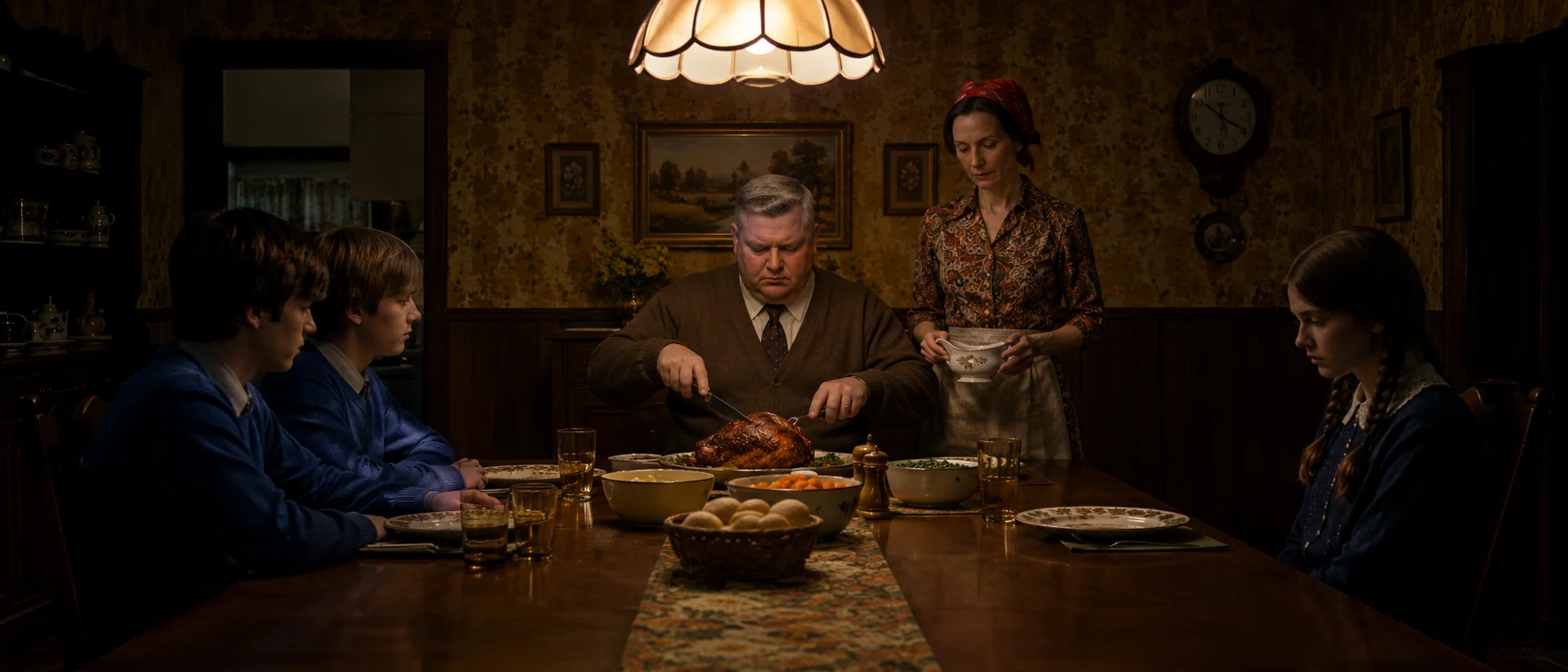
Staging does the work here: head of the table, under the only hanging lamp gives the father the power, stands behind her chair places the mother, and alone on the other side, half in shadow isolates the girl. Deep focus keeps every figure readable, so the relationships read as one picture.
Open FlashBoardsCamera: a very slow dolly in from the wide frame, straight toward the woman at the desk, ending on a medium-wide shot of her and the lamp. Action: From the first moment she is turning the paper cup slowly in her hands and the city lights twinkle in the windows behind her. She sets the cup down, glances at the cardboard box on the floor, then looks out at the city. At the end she sits still, small against the glowing windows, the lamp light on her face.The very slow dolly in keeps the empty room visible for most of the shot, so the set stays part of the meaning. Starting with turning the paper cup keeps the clip alive from frame one, and the action only uses objects already in recipe 1's frame.
Open FlashBoards{
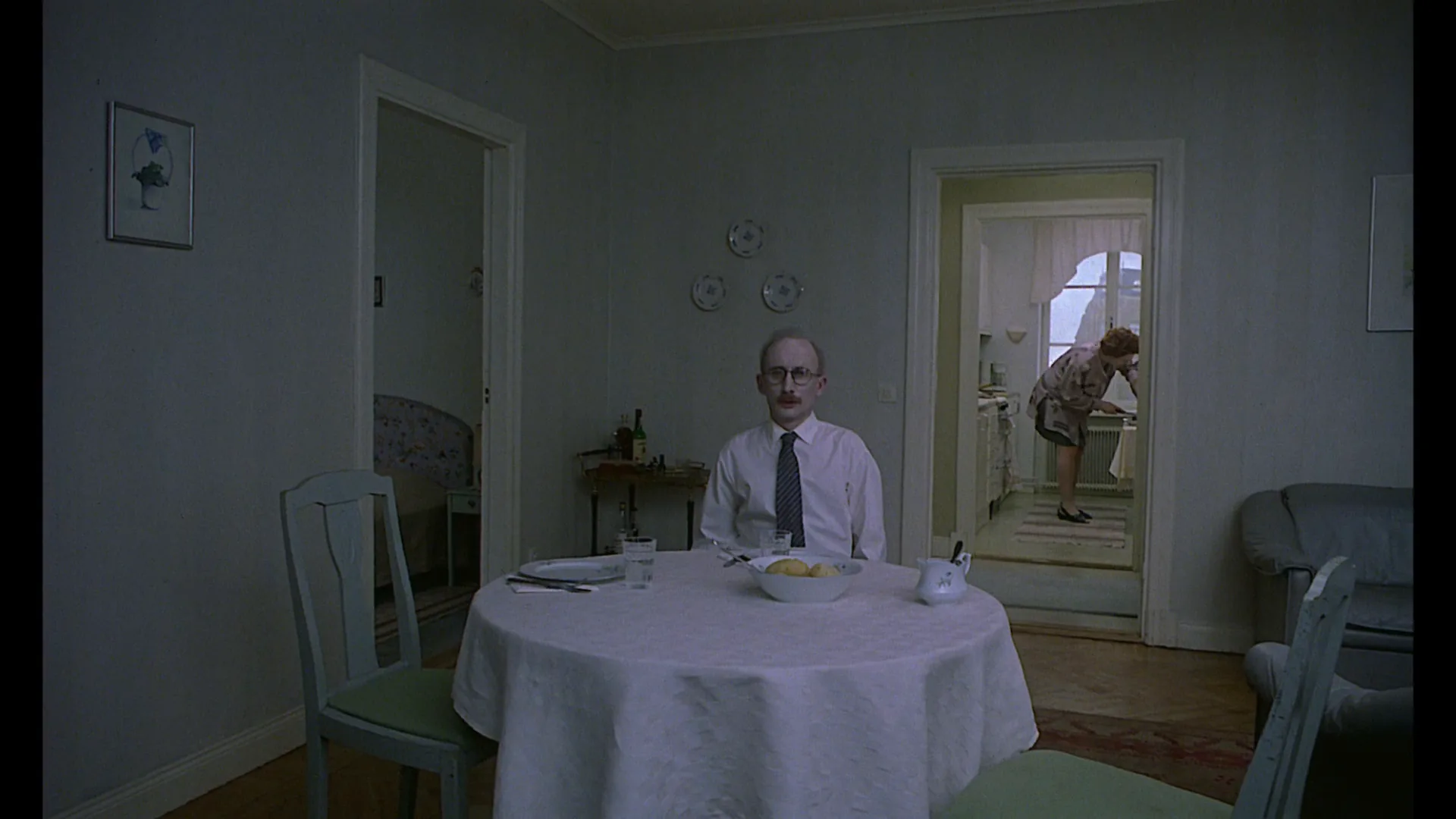
"output": "Full-screen live-action scene from Songs from the Second Floor (2000) by Roy Andersson, alive from its very first frame: one continuous locked-off shot, no cuts. Muted 35mm film look, flat cold blue-gray daylight in a pale gray-green Swedish apartment dining room, a much brighter warm-white kitchen seen through a far doorway, chalk-white and sage palette, staged still like a tableau.",
"characters": {
"S1": {
"name": "the waiting man (an uncredited role in this scene)",
"look": "thin, pale man in his fifties, bald crown with thin sandy hair at the sides, thin metal-rimmed glasses, white shirt, narrow dark tie",
"voice": "silence: he never speaks"
},
"S2": {
"name": "the woman who serves (an uncredited role in this scene)",
"look": "stout woman in her sixties, short dark-brown curly hair, long loose lilac blouse with a dark geometric pattern, dark knee-length skirt, dark flat shoes",
"voice": "silence: she never speaks"
}
},
"shots": [
{
"shot": 1,
"camera": "locked-off tripod, frontal, at seated eye height, wide-angle lens, deep focus so everything is sharp from the tablecloth to the far kitchen window; a wide shot of the whole dining room that stays exactly the same from start to end, static camera",
"action": [
"BEGINNING: alive from the first frame, S1 sits dead centre behind a round table under a white damask cloth, upright, facing the camera, both hands below the table edge out of sight, looking straight into the lens; S2 stands just right of him and one step behind, her back half to us, already turning away toward an open doorway in the back wall right of centre.",
"THEN: S2 walks away from the camera in a straight line into the doorway, arms loose at her sides; S1 does not turn his head and does not follow her with his eyes, he keeps staring into the lens.",
"THEN: S2 crosses the doorstep into a small bright kitchen with a white arched window and lace curtain, her back to us, and steps to the right side of the kitchen.",
"THEN: in the kitchen S2 turns to screen right in profile and bends forward at the waist over a low counter on the right, both hands reaching down into it; S1 only blinks once and tilts his head a hair, hands still hidden.",
"END: far away inside the bright kitchen S2 stays bent over the counter, small and framed by the door; in the foreground S1 still sits motionless and upright at the laid table, gaze fixed on the lens, waiting."
],
"dialogue": [],
"voice": "silence: nobody speaks in this shot, no voice at all",
"set": "left wall with a small framed flower print and a second open door showing a bedroom with a patterned headboard; decorative white plates hung on the back wall behind S1; a small dark side table with bottles behind his left shoulder; pale sage chairs with tall slatted backs at the left and right edges of the frame; a gray-blue upholstered sofa at the right edge; on the table a white bowl of boiled potatoes in the centre, a plate, a drinking glass and cutlery on the left, a small white lidded jug on the right."
}
],
"sound": {
"ambience": "hushed room tone, a faint clock tick, soft footsteps on the wooden floor, a quiet clink of crockery from the kitchen at the back",
"speech": "no words in this video; the only human sounds are breaths and movement",
"never_spoken": "no narration and no voice-over: the descriptions, performance notes and step words of this prompt are never spoken aloud",
"music": "a film score under the scene, always below the voices: a slow, sparse, melancholy brass chord held low and soft, like a distant brass band",
"subtitles": "none"
}
}Remakes the dining-room tableau from Songs from the Second Floor (2000), dir. Roy Andersson, keeping the frontal locked-off frame, the man motionless at the laid round table, the pale green room and the woman walking off to bend over the kitchen counter.
The prompt is structured JSON, and most of it is mise-en-scène: a separate set list places every prop, the looks fix wardrobe and palette, and the camera stays locked-off with deep focus, so the staging carries the meaning. The man waits dead centre, still, while the woman walks off into the bright kitchen; the explicit silence and a low score keep the tableau quiet.
Open FlashBoardsCommon mistakes
- Generic set. Models default to a tidy, anonymous room. Name three or four specific props that carry the idea.
- Wardrobe drifts. Describe fit, color and condition (oversized, faded, freshly pressed), not just the garment.
- Everyone lit evenly. Name the source and what stays dark: one desk lamp, deep shadows at the frame edges.
- Staging collapses to the center. State positions and relationships: small in the lower right, head of the table, half in shadow.
- Invented extras in video. Describe only objects already in the first frame, or the model adds new ones.
Keep the reference frames, prompts and every generated take side by side — images and video in one canvas.
FAQ
5 questionsWhat does mise-en-scène mean in film?
Mise-en-scène means everything placed in front of the camera and arranged in the frame: setting, props, costume, makeup, lighting and the actors' positions and movement. The French term originally meant staging a play. In film analysis it describes how these visible choices work together to show character, mood and meaning, often without any dialogue.
What are the elements of mise-en-scène?
The four standard elements are setting and props, costume and makeup, lighting, and staging, which covers actor performance and movement. Many teachers add color and composition, since they tie the other elements together in the frame. When you analyze a shot, look at each element separately, then ask what they say together about the scene.
How do you pronounce mise-en-scène?
In English it is usually pronounced meez-ahn-SEN, close to the French. The first word sounds like "meez," the middle is a nasal "ahn," and the stress falls on the last syllable, "sen." You will see it written with or without hyphens and the accent: mise-en-scène, mise en scène and mise en scene all refer to the same idea.
Is camera work part of mise-en-scène?
Strictly, no. Most film scholars keep mise-en-scène to what is in front of the camera and treat framing, lenses and camera movement as cinematography. In practice the line blurs, because the frame decides how the arrangement is seen, so many writers include framing and composition when they discuss a scene's mise-en-scène.
What is an example of mise-en-scène?
The opening of The Godfather (1972) is a classic example: a dark, shuttered office where Vito Corleone hears requests, cut against a bright, crowded wedding outside. Set, light and costume split the family business from the family celebration. The Kansas and Oz sequences of The Wizard of Oz (1939) are another, built on set and color.
Related terms
7- BlockingDirecting & Staging
Blocking is the planned choreography of actors and camera within a scene — where people stand, when they move, how they relate in space — so that movement itself tells the story and gives the editor usable shots.
- Production DesignProduction Design
Production design is the creation of the entire physical world of a film — locations, sets, props, colors and textures — led by the production designer together with the director and cinematographer.
- Film CompositionComposition & Framing
Composition is the arrangement of everything inside the frame — subjects, lines, shapes, light, color and empty space — to direct attention and express the meaning of a shot.
- Film LightingLighting
Film lighting is the craft of shaping light for the camera — its direction, quality, color and contrast — to model faces, build space, set the time of day and carry the mood of a scene.
- Costume DesignProduction Design
Costume design is the creation of everything a character wears, from silhouette and fabric to color and wear-and-tear; the costume designer uses clothing to tell us who a character is, what era they live in and how they change.
- Depth LayeringComposition & Framing
Depth layering builds a shot in distinct planes — foreground, midground and background — each holding something meaningful, so the flat screen gains volume and several actions or ideas can be read at once.
- Film TheoryFilm History & Theory
Film theory is the body of ideas about what cinema is and how it produces meaning and pleasure — from Soviet montage and Bazin's realism to auteur theory, psychoanalytic and feminist criticism.
Further reading
David Bordwell and Kristin Thompson, Film Art: An Introduction (McGraw-Hill). John Gibbs, Mise-en-scène: Film Style and Interpretation (Wallflower Press).