 FlashBoards Learn
- Learn
- Storytelling
- Breaking the Fourth Wall
Storytelling · Film language
Breaking the Fourth Wall
Also called: fourth wall break, talking to the camera, direct address
Breaking the fourth wall is when a character acknowledges the audience, usually by looking into the lens and talking to the viewer, or admits that they are inside a film. It turns the viewer from a hidden observer into someone the story knows is there, which can create complicity, comedy or discomfort in a single glance.
- What it does
- Makes the viewer a participant. The character is now speaking to us, not just in front of us.
- Use it when
- You want a confiding narrator, a comic beat, a shortcut through dense exposition, or a moment that points back at the audience.
- Watch out
- Every break costs a little immersion. Set the rule early and keep it consistent, or the first look to camera plays like a mistake.
- Try this prompt
Medium close-up, a bearded man at a candlelit dinner table turns and looks straight into the camera lens with a dry half-smile while the guests beside him keep talking, 50mm, eye level, film still.
What does breaking the fourth wall mean?
The term comes from the theater. A box set has three walls: the back and two sides. The fourth wall is the open side facing the house. Realist staging asks actors to behave as if that side were solid, so the audience watches a private world that doesn't know it is being watched. Denis Diderot described this idea in the 18th century, advising actors to imagine a wall between themselves and the audience.
Cinema inherited the convention and made it stronger. The camera replaces the audience, and the actors' first rule on set is don't look at the lens. When a character breaks that rule and meets the lens, the illusion of an unobserved world is gone.
The break can be tiny or total. A half-second glance counts. So does a full monologue to camera, a character who says they're in a movie, or a crew member stepping into shot. What they share is that the film admits the audience exists. That's why breaking the fourth wall is one of the core narrative techniques: it changes who the story is told to, not just what it shows.
Types of fourth wall breaks
The look
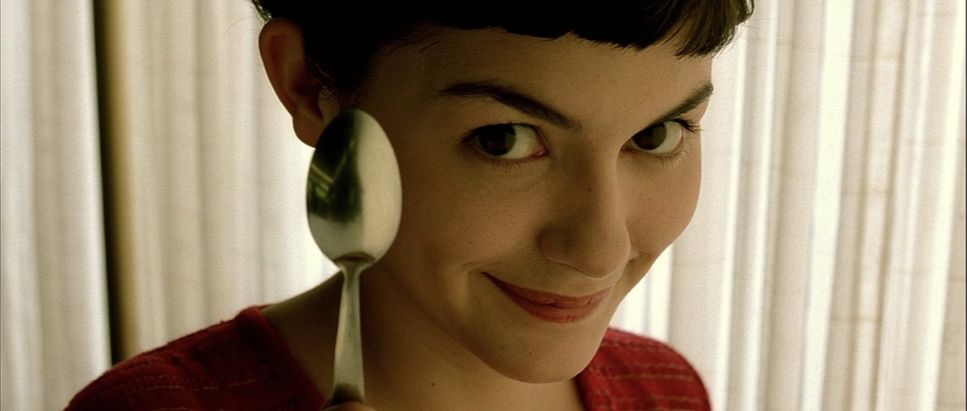
The smallest break has no words. A character reacts to something and then glances at the lens, sharing the reaction with us. Oliver Hardy's weary stares at the camera in the Laurel and Hardy shorts are the classic comic version. The 400 Blows (1959) ends on a freeze-frame of Antoine turning to the camera on the beach.
The aside
An aside is a quick remark to the audience that the other characters in the scene don't hear. It comes straight from the stage, where Shakespeare's Richard III confides his plans to the house. Groucho Marx's wisecracks to the audience in the Marx Brothers comedies work the same way, and so do Frank Underwood's comments in House of Cards (2013).
The narrator on screen
Here a character runs the story from inside the frame and talks to us at length. Ferris explains how to fake being sick in Ferris Bueller's Day Off (1986). Jordan Belfort interrupts his own trading-floor scenes in The Wolf of Wall Street (2013) to decide how much detail we need. Unlike a voice-over, the narrator is visible in the scene.
The full rupture
The film admits it is a film. At the end of Monty Python and the Holy Grail (1975), police arrive and a hand covers the lens. The finale of Blazing Saddles (1974) spills off its own set onto the studio lot. In Funny Games (1997), one of the killers winks at the camera and later rewinds the film with a remote. These breaks can overlap with breaking the third wall, where characters comment on the medium itself.
Why do filmmakers break the fourth wall?
Complicity. A character who confides in us makes us their accomplice. Frank Underwood's asides and Jordan Belfort's direct address both let us enjoy someone we shouldn't like. It's also a natural partner to an unreliable narrator: the more intimate the address, the easier it is to steer what we believe.
Comedy. A look to camera is the fastest punchline in film grammar. Most of the tradition comes from comedy, from silent shorts to Deadpool (2016), whose hero treats the audience as a constant companion.
Exposition. The Big Short (2015) stops its story so that celebrities playing themselves can explain mortgage bonds directly to the viewer.
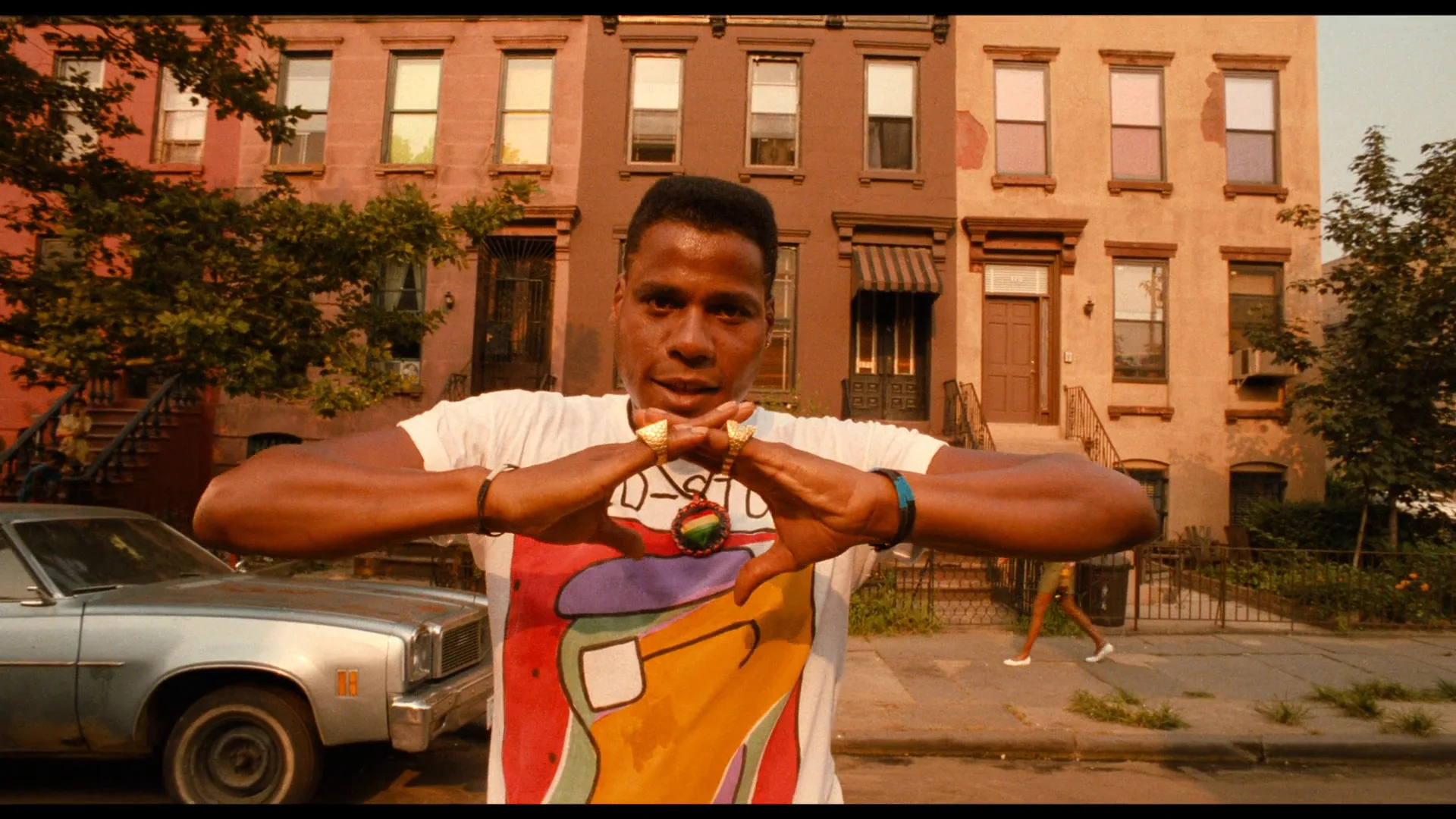
Accusation. Some breaks turn the gaze back on the audience. Do the Right Thing (1989) cuts together characters hurling slurs straight into the lens, so the ugliness lands on us instead of on another character. Funny Games uses the wink to make viewers feel complicit for wanting the violence to continue.
Intimacy. A character who tells us something they won't tell anyone in the room gives us private access. In Amélie (2001), Amélie turns to us in a cinema and describes what she likes to watch. Fleabag (2016) builds a whole series on glances to the lens, then lets another character notice them.
Direct to camera: how to stage and shoot it
Direct to camera is the visual form of the break: the actor looks into the lens and speaks to the audience itself. The mechanics are simple, but small errors read as mistakes rather than choices.
- Eyeline to the lens. The actor looks into the center of the glass, not at the matte box or the operator's eye. For a quick glance, a small piece of tape on the lens hood gives them a precise mark. A few degrees off reads as looking at someone beside the camera.
- Height. Put the lens at the actor's eye height. Above or below, the address picks up a power relationship a low or high angle brings with it.
- Lens and distance. A medium close-up on a 40–50mm lens at about 1.5–2 m feels like conversation. A wide lens pushed close (24–28mm at under a meter) makes the address confrontational and comic.
- Framing. Frontal, centered compositions make the address formal. A character turning from an off-center profile to the lens makes it feel stolen from the middle of a scene.
- The rest of the scene. Decide what the other actors do. They can carry on talking, freeze, or simply not notice. Their reaction defines whether this is a private aside or a full break.
- Timing in the cut. The look needs a beat to land. Hold the shot a moment after the eyes meet the lens, then cut or let the character turn back into the scene.
In the script, a break is usually flagged in action lines ("She turns to us.") or with a parenthetical (to camera) before the dialogue. Actors trained never to look at the lens can overcorrect and stare. If you're directing actors through a break, ask for the thought first and the look second.
For planning, it helps to see every break in the film at once. On a FlashBoards board you can pin the reference frames you're matching next to generated test frames of each look to camera. You can then check that the eyeline, lens and frame size stay consistent before the shoot.
Fourth wall vs. direct address, POV and the third wall
Eyes on the lens don't automatically break the fourth wall. What matters is who is being addressed.
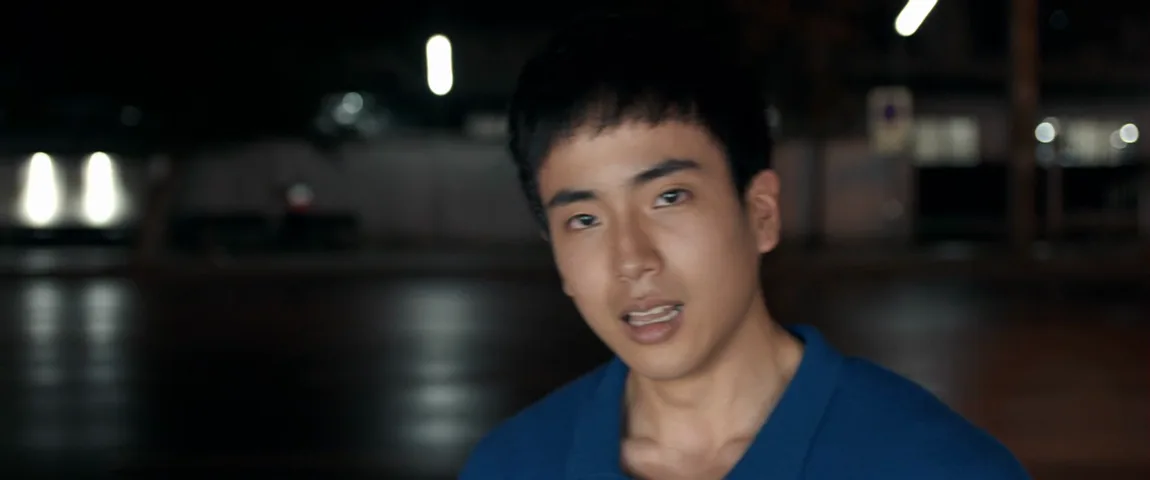
Direct address is the shot itself: a character looks and speaks into the lens. When the listener is the audience, it breaks the fourth wall. When the listener is another character, it is a POV shot. The Silence of the Lambs (1991) frames Lecter and Clarice looking almost into the lens as they talk to each other, and the audience takes each character's place, but the fourth wall stays intact.
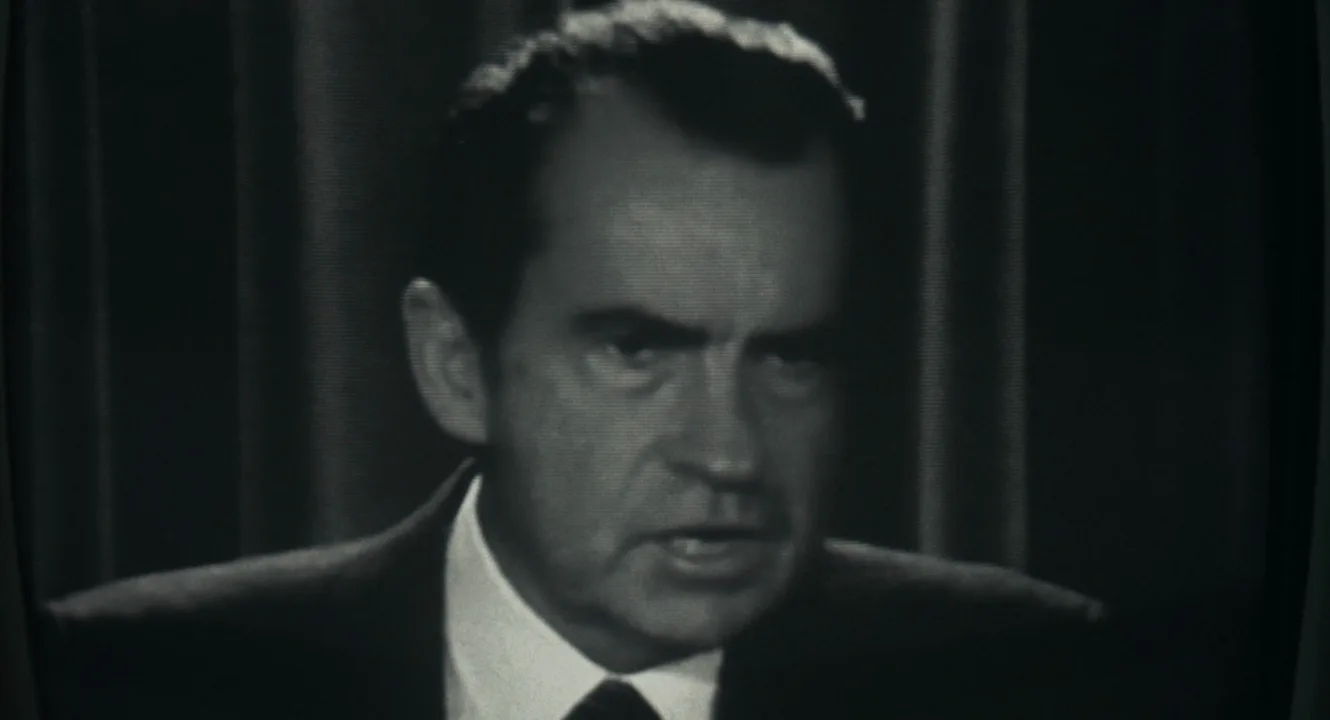
In-world cameras. A newsreader, a character filming a video diary or an interview subject in a mockumentary looks at a camera that exists inside the story. That gaze is diegetic, part of the story world in the sense of diegesis. A glance at the crew in a mockumentary sits right on the line: it acknowledges a camera the characters know about.
The third wall. Breaking the third wall means acknowledging that the story is a story. Characters talk about genre rules, plot structure or being in a movie, but don't necessarily speak to us. A character who says "this is the part where the villain explains his plan" to another character breaks the third wall. If they say it to the lens, they break both.
Voice-over and monologue. A narrator heard over the picture addresses the audience but doesn't breach the frame, and a monologue is spoken to other characters or to oneself. Neither is a fourth-wall break unless the speaker turns to face us.
Breaking the Fourth Wall in motion
1 clipsThese loops show breaking the fourth wall in motion, where a still frame can't: watch how the effect plays out over a few seconds.

Breaking the Fourth Wall stills
7 framesFrom a knowing glance to a film that shows its own stage, plus two frames where the eyes meet the lens but the wall may hold.
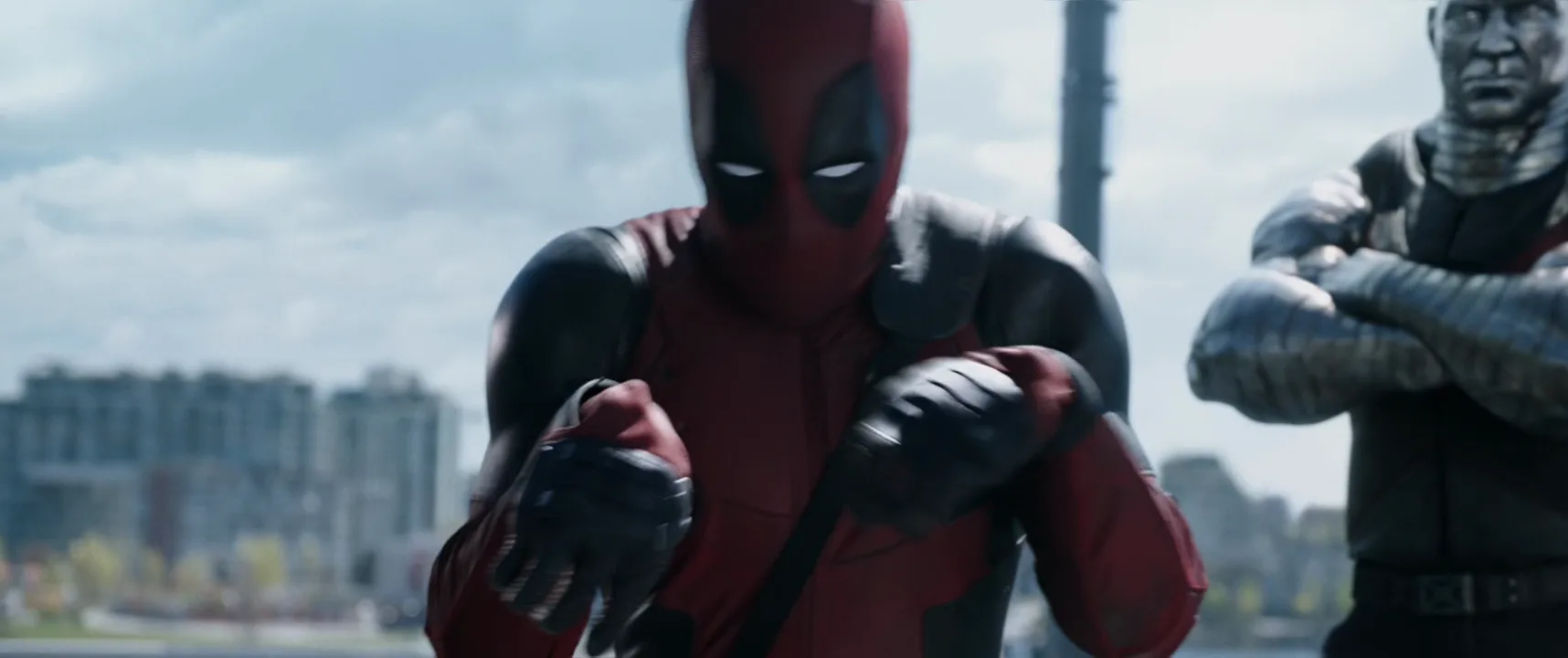
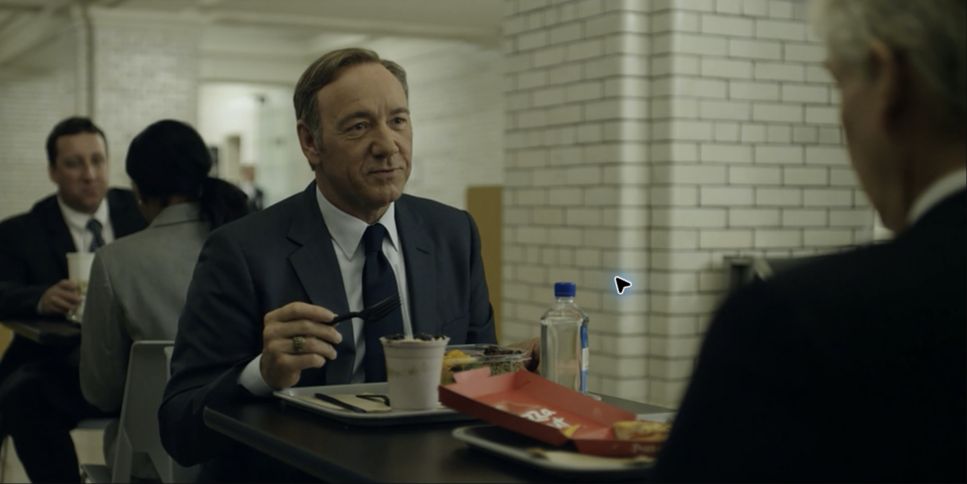
How to create a breaking the fourth wall with AI
4 promptsA look to camera is one of the easier techniques to generate, as long as you name the eyeline precisely and tell the model what everyone else in the frame is doing. Build the start frame with Nano Banana 2 Lite, try a second staging with GPT Image 2.5, then animate the glance with MiniMax H3 Max Turbo so the break happens in time. Keep the takes side by side on one FlashBoards board with your reference frames to compare how direct each eyeline really is. The fourth prompt re-shoots a real film shot from a text description alone, and the original plays next to the result so you can compare.
Medium close-up of a man in his fifties with a shaved head, a thick salt-and-pepper beard, round tortoiseshell glasses and a mustard corduroy blazer, seated at a long dinner table in a candlelit dining room, holding a glass of red wine. Two guests beside him are deep in conversation, facing each other, soft and out of focus. He has turned his head and looks directly into the camera lens, making eye contact with the viewer, eyebrows slightly raised, a dry half-smile, as if sharing a private joke. Camera at his eye height, straight in front of him, 50mm lens, shallow depth of field, warm tungsten candlelight, cinematic film still.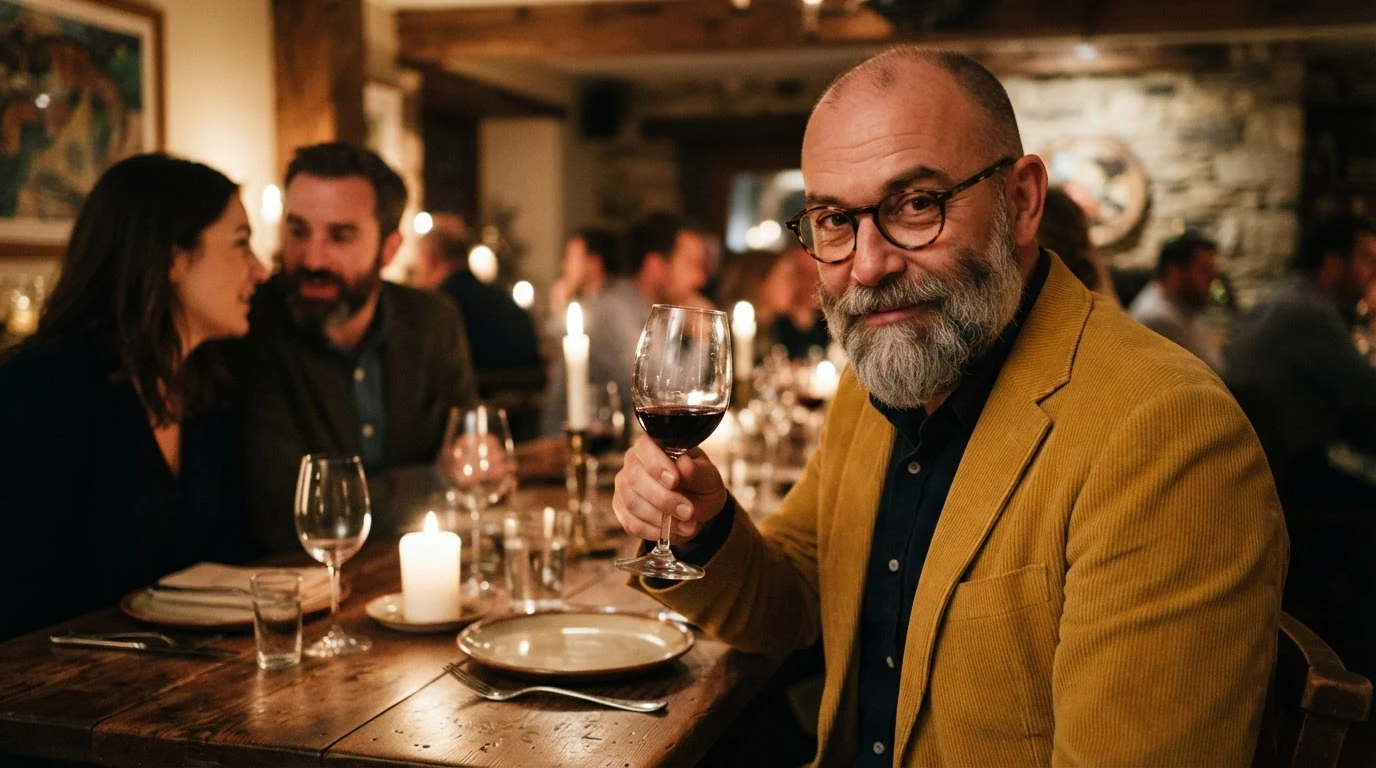
"Looks directly into the camera lens, making eye contact with the viewer" fixes the eyeline on the glass. Models otherwise drift the gaze slightly off-lens, which reads as looking at someone. "Facing each other" and "deep in conversation" keep the guests unaware, so the image reads as an aside rather than a group photo. This frame is the start of the video recipe.
Open FlashBoardsSymmetrical frontal wide shot of a busy open-plan office in soft overcast daylight. A woman in her thirties with a cropped platinum pixie cut, a small gold nose ring and a dark green boiler suit stands dead center between two rows of desks, facing the camera and speaking straight into the lens with one hand raised mid-explanation. All the coworkers around her keep their eyes on their screens, heads down, typing. Camera at her eye height, 28mm lens, deep focus, cool neutral grade, anamorphic widescreen film still.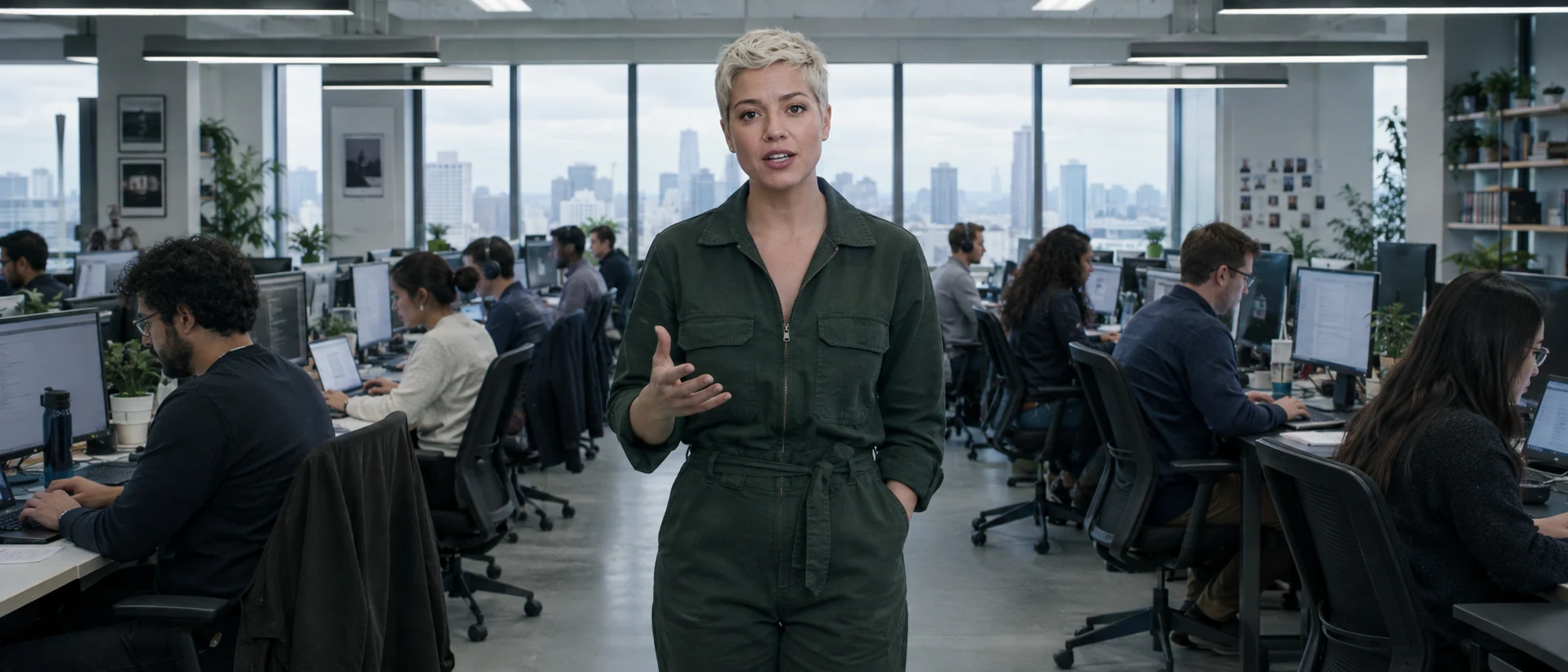
This take stages the narrator version of the break. "Speaking straight into the lens" plus a mid-gesture hand suggests an ongoing explanation, not a portrait. "Symmetrical frontal" and "dead center" give the formal, presentation-like address. The coworkers "keep their eyes on their screens" so the model doesn't turn every face toward camera.
Open FlashBoardsCamera: static on a tripod at the man's eye height for most of the shot, then a very slow push-in toward his face over the last two seconds. Action: from the first frame the two guests are already talking and gesturing with their hands, candle flames flickering. The bearded man keeps eye contact with the lens, raises his wine glass slightly toward the camera and gives a small knowing nod. At the end he turns his head back to the table and laughs along with the guests, as if nothing happened.The guests are "already talking" so the shot is alive from the first frame. The man's action runs in three beats (eye contact, toast and nod, return to the scene), and that return is what makes it an aside and not a stare. Every object named is already in recipe 1's frame.
Open FlashBoards{
"output": "Full-screen live-action scene from Do the Right Thing (1989), from its very first frame: one continuous shot. Warm late-1980s 35mm film stock, hot hazy summer late afternoon on a Brooklyn residential street, soft golden-orange light, saturated reds, ochres and brick oranges, pale hazy sky, visible grain.",
"characters": {
"S1": {
"name": "Radio Raheem, played by Bill Nunn",
"look": "tall, broad-shouldered young man, very short dark hair; loose white T-shirt with a large abstract print in red, orange, yellow and purple; a round red, yellow and green medallion on a cord around his neck; a green band on one wrist and thin bracelets on the other; a wide gold four-finger ring across the knuckles of each hand",
"voice": "deep, slow, deliberate preacher's cadence, pausing between phrases"
}
},
"shots": [
{
"shot": 1,
"camera": "static handheld with a faint breathing drift, a little below his chin height angled slightly up, wide-angle lens close to him, frontal and dead centre, medium shot from the waist up; behind him a row of three-story red and tan brownstones with stoops and awnings fills the frame, a silver 1970s sedan parked at frame left, leafy trees at both edges; the framing stays the same from start to end, he comes a little closer to the lens at the end",
"action": [
"BEGINNING: alive from the first frame, S1 stands dead centre looking straight into the lens, full eye contact with the viewer; one hand is thrust flat toward the lens, fingers spread, the gold ring looming large in the wide lens, the other hand low at his waist.",
"THEN: he pulls the hand back to his chest and holds both hands open in front of his stomach, fingers spread and curling toward each other, eyes still on the lens, mouth moving as he speaks.",
"THEN: he laces the fingers of both hands together in front of his chest so the two gold rings sit side by side, and lifts the locked hands up under his chin, face still and serious, eyes on the lens.",
"THEN: he pushes both elbows out wide to the sides so his forearms form a flat horizontal triangle across his chest, the locked hands pressing against each other, arm muscles tense, the rings facing the lens.",
"THEN: the locked hands strain and tremble, twisting a little toward screen left and back, as if one hand is wrestling the other, while he keeps talking straight to the viewer; far behind him a passerby in a white shirt and shorts walks slowly along the sidewalk on screen right, heading left, paying him no attention.",
"END: his hands spring apart and drop to his waist as loose fists, the rings still showing, and he leans a little toward the lens, brow lowered, speaking his last words straight into the camera, eyes locked on the viewer."
],
"dialogue": [
{
"speaker": "S1",
"on_screen": true,
"when": "from the first frame, while his ringed hand is thrust toward the lens",
"delivery": "slow, weighty, confiding",
"line": "<d>[English] The story of life is this.</d>"
},
{
"speaker": "S1",
"on_screen": true,
"when": "as he laces his fingers and lifts the locked hands under his chin",
"delivery": "one hard, clipped word",
"line": "<d>[English] Static.</d>"
},
{
"speaker": "S1",
"on_screen": true,
"when": "while his elbows are spread wide and the locked hands strain against each other, finishing as the hands spring apart",
"delivery": "rhythmic, building, eyes on the viewer",
"line": "<d>[English] One hand is always fighting the other hand, and the left hand is kicking much ass.</d>"
}
]
}
],
"sound": {
"ambience": "quiet summer street heard from far off: distant traffic, faint voices down the block, a soft click of the gold rings as his hands lock together",
"speech": "exactly these spoken phrases, each said once, in this order",
"never_spoken": "no narration and no voice-over: the descriptions, performance notes and step words of this prompt are never spoken aloud",
"music": "a film score under the scene, always below the voices: slow, brooding jazz with a muted trumpet over upright bass and soft brushed drums",
"subtitles": "none"
}
}This remakes Radio Raheem's direct-address monologue from Do the Right Thing (1989), keeping the frontal wide-lens framing, the brownstone backdrop, the ringed hand pushed at the lens, the wrestling hands and his exact lines.
Every action beat repeats where his eyes go, from "full eye contact with the viewer" at the start to "eyes locked on the viewer" at the end, so the gaze never drifts to anyone off frame. A wide lens close to him, dead centre and slightly low, makes the speech feel aimed at us. The passerby who ignores him shows that only the audience is being addressed. The lines are Radio Raheem's own, word for word from the film, and a quiet jazz score sits under them.
Open FlashBoardsCommon mistakes
- Writing only "breaking the fourth wall." Models may take it literally and draw a cracked wall. Describe the eyeline instead: "looks directly into the camera lens, eye contact with the viewer."
- Gaze drifts off-lens. "Looking at the camera" often lands just beside it. Add "eye contact with the viewer" and put the camera straight in front at eye height.
- Everyone looks at camera. One face to the lens tends to pull every face in the frame toward it. Say what the others are doing, such as talking to each other or watching their screens.
- The video loses the eyeline. In a longer clip the character may start looking around. Restate "keeps eye contact with the lens" in the action and give the look a clear end beat.
- Frozen performance. A five-second stare reads as a portrait. Give the break a small action and a return to the scene.
Keep the reference frames, prompts and every generated take side by side — images and video in one canvas.
FAQ
5 questionsWhat does breaking the fourth wall mean?
Breaking the fourth wall means a character acknowledges the audience. Usually they look into the camera and talk to the viewer, or they openly admit they're in a film. The "fourth wall" is the imaginary barrier between the story and the audience, borrowed from theater, where a set has three walls and the fourth is the open side facing the seats.
What are famous examples of breaking the fourth wall in movies?
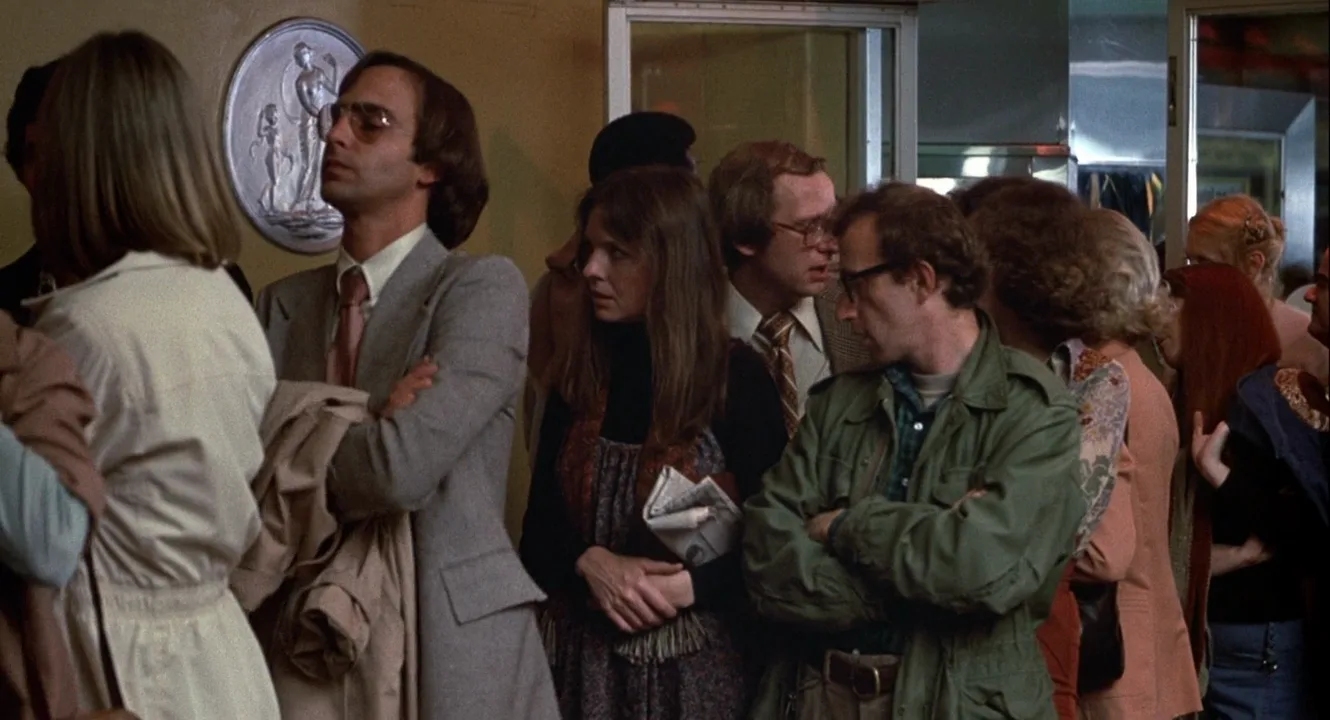
Classic examples include Alvy stepping out of a cinema line to talk to the audience in Annie Hall (1977), Ferris talking to camera in Ferris Bueller's Day Off (1986), and Jordan Belfort narrating to the lens in The Wolf of Wall Street (2013). Others are the celebrity explainers in The Big Short (2015), Deadpool's running commentary in Deadpool (2016) and Frank Underwood's asides in House of Cards.
Is talking to the camera always breaking the fourth wall?
No. It depends on who is being addressed. If a character speaks into the lens to the audience, the fourth wall breaks. If the camera stands in for another character, as in a POV shot, the wall holds. So does a look at a camera that exists in the story, like a news broadcast, a video diary or the crew in a mockumentary interview.
Why is it called the fourth wall?
The name comes from proscenium theater. A realistic room on stage has three walls: the back and two sides. The fourth wall is the invisible one where the audience sits. Actors perform as if it were solid, so the audience watches a private world. Film kept the idea, with the camera lens taking the place of that missing wall.
Does a voice-over narrator break the fourth wall?
Usually not. A voice-over narrator speaks to the audience from outside the picture, which is a long-accepted convention rather than a breach. It becomes a fourth-wall break when the narrator appears on screen and addresses us, or when the voice-over reacts to the film itself, for example by commenting on the editing or talking back to what's on screen.
Related terms
4- Voice-OverSound & Music
Voice-over is speech heard over the picture from someone not speaking on screen at that moment — a narrator, a character's inner thoughts, a documentary commentary.
- POV ShotCamera Angles
A POV shot shows exactly what a character sees by placing the camera at their eyes — usually right after a shot of them looking — so the audience shares their perspective, including movement, obstruction or distortion.
- DiegesisFilm History & Theory
Diegesis is the story world of a film — everything that exists for the characters; elements inside it are diegetic (a radio playing in the room), elements outside it are non-diegetic (the score, titles, narration).
- Narrative TechniquesStorytelling
Narrative techniques are the tools a storyteller uses to control what the audience knows and when — flashbacks, nonlinear order, point of view, foreshadowing, unreliable narrators, twists.
Further reading
Tom Brown, Breaking the Fourth Wall: Direct Address in the Cinema (Edinburgh University Press) · Bertolt Brecht, Brecht on Theatre, ed. John Willett (Methuen) · Denis Diderot, Discourse on Dramatic Poetry (1758)