 FlashBoards Learn
- Learn
- Storytelling
- Narrative
Storytelling · Film language
Narrative
Also called: story, narrative structure
A narrative is a chain of events linked by cause and effect, told from a chosen point of view. In film, the narrative is the story as the audience actually receives it: shaped by plot order, framing, sound and cuts that decide what we know, when we learn it and whose eyes we share.
- What it does
- Turns a list of events into a story the audience can follow, predict and care about.
- Use it when
- Deciding what happens, in what order, and through whose eyes before you write a scene or plan a shot.
- Watch out
- Events joined by "and then" are a chronicle, not a narrative; each scene has to cause the next.
- Try this prompt
Film still, dusk rooftop, a 17-year-old girl with cropped copper hair and freckles reads a letter, her packed duffel bag at her feet, 35mm
What is a narrative?
A narrative needs three things: events, a causal link between them, and a teller who picks what to show. "The king died, and then the queen died" is a sequence. Add "of grief" and it becomes a narrative, because the second event now happens because of the first.
Film theory splits the idea in two. The story (fabula) is every event in chronological order. The plot (syuzhet) is the selection and order the film actually presents. Citizen Kane (1941) opens with Kane's death and rebuilds his life through the flashbacks of people who knew him. Narration connects the two: the film's moment-by-moment control over information, and the core tool of storytelling on screen.
Narrative elements: the building blocks of a story
Most definitions list six elements:
- Character (who?): someone who wants something and makes choices to get it.
- Setting (where and when?): the period, place and social world that limit the choices.
- Plot (what happens?): the ordered events, driven by cause and effect.
- Conflict (what's in the way?): another person, society, nature or the character's own flaw. Without it nothing escalates.
- Point of view (through whose eyes?): whether we know only what one character knows, or more than any of them.
- Theme (what does it mean?): the idea the consequences add up to.
Change one element and the rest shift. Rashomon (1950) tells one crime through four contradictory accounts, and point of view alone turns a simple plot into an unsolvable one.
What is a narrative film?
A narrative film tells a cause-and-effect story about characters, usually fictional and played by actors. It is set apart from documentary (which records or argues about the real world) and experimental film (which organizes images by rhythm, form or association).
In practice the term means the classical model of a clear protagonist, a goal, obstacles, a climax and a resolution. Star Wars (1977) and Titanic (1997) are textbook cases, each built on a goal the audience grasps in the first act.
How film tells a narrative: image, sound and order
Film narrates through three channels at once.
The image. Framing decides what information exists. A close-up on a letter says it matters; a wide shot with an intruder in the background gives us knowledge the character lacks.
Sound. Voice-over can frame a film as memory, as the elderly Rose's telling frames Titanic. The line between diegetic and non-diegetic sound matters too: a song the characters hear belongs to their world, the score speaks over their heads.
Order. Editing controls sequence. Greta Gerwig's Little Women (2019) cuts between two timelines seven years apart; Memento (2000) runs its main line backward to share the hero's amnesia. That family of techniques has its own page: nonlinear narrative.
How to build a narrative for your film
- Write the spine in one sentence: who wants what, what stands in the way, what it costs.
- Link scenes with "but" and "therefore", not "and then".
- Choose the point of view scene by scene. Staying with the protagonist or showing the audience more changes the coverage.
- Plan the order separately from the events. List them chronologically, then decide the order of telling.
- Put an image on every beat: the one frame that makes each turn readable without dialogue.
On a FlashBoards board this becomes a map: one card per beat in cause-and-effect order, reference frames and generated keyframes beside each card, and a note on what the audience knows. Rearranging the cards is how you test a different plot order before anything is shot.
Narrative vs. story structure
Narrative is the whole act of telling: the events, their causes, and the choices of point of view, order and emphasis. Story structure is the architecture of the events: where the setup ends, where the midpoint turns, where the climax sits. Three acts or the hero's journey are maps of structure. Two films can share a structure and tell very different narratives: a revenge story told chronologically plays as a thriller, the same acts told backward become a mystery.
How to create a narrative with AI
3 promptsA narrative lives between frames, so the AI job is an image that implies a before and an after. Nano Banana 2 Lite builds a start frame charged with a cause, GPT Image 2.5 lays the beat out as a storyboard strip, and MiniMax H3 Max Turbo plays the effect forward. Keep all three next to your beat cards on one FlashBoards board.
Film still, medium wide shot, 35mm lens at eye height, the tar roof of a brick apartment building at dusk. A 17-year-old girl with cropped copper hair, heavy freckles and an olive army-surplus jacket reads a handwritten letter, a torn envelope in her other hand. A packed canvas duffel bag sits at her feet. Low orange sunlight from the right, cool blue sky, tense expression, film grain.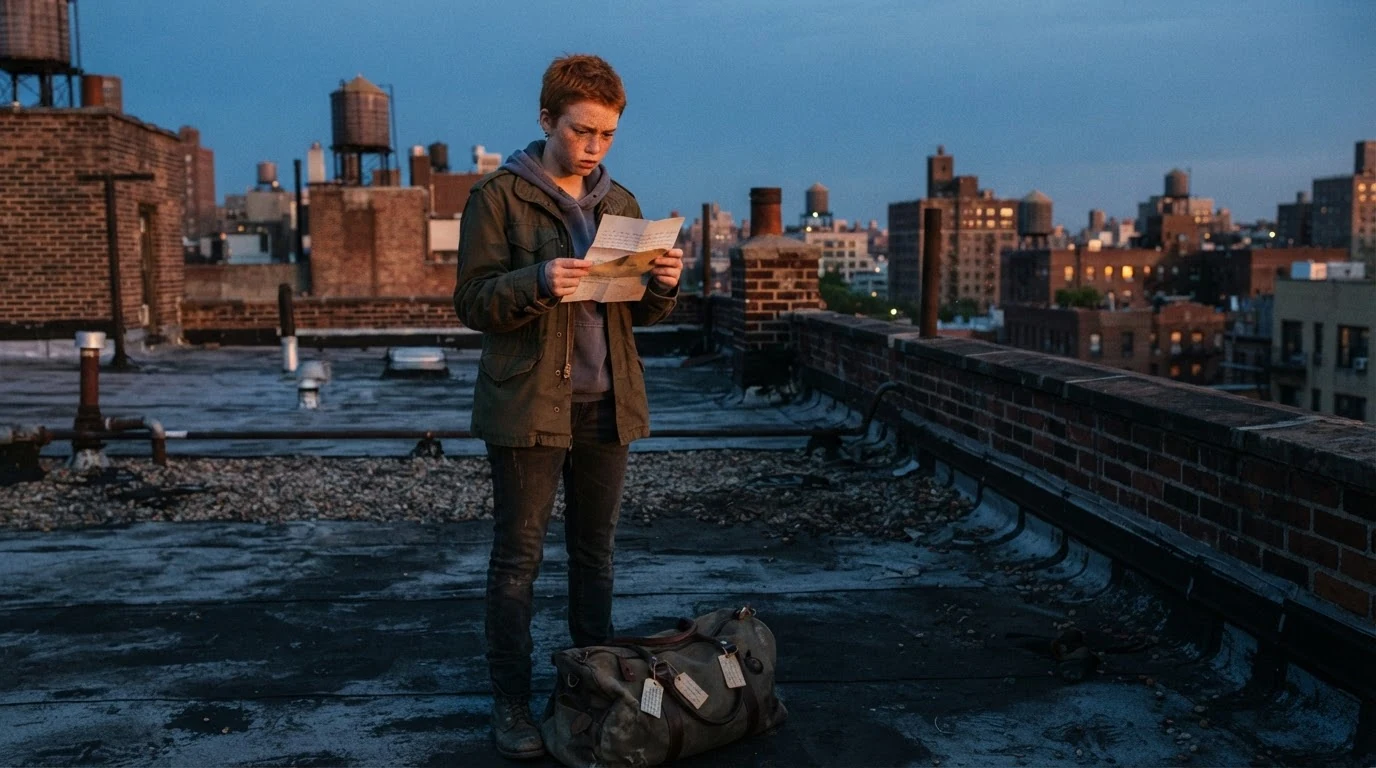
Reading a handwritten letter is the cause; the packed duffel bag at her feet says a decision is half made. Tense expression and dusk make it a turning point, so the viewer starts guessing what comes next.
Open FlashBoardsStoryboard strip, three numbered panels side by side, gray pencil and marker style. Panel 1: close-up, a teenage girl with cropped hair and freckles opens an envelope on a rooftop at dusk. Panel 2: medium shot, she crushes the letter in her fist and looks down at the street. Panel 3: wide shot, she runs through a stairwell door with a canvas duffel bag on her shoulder, arrows showing her direction.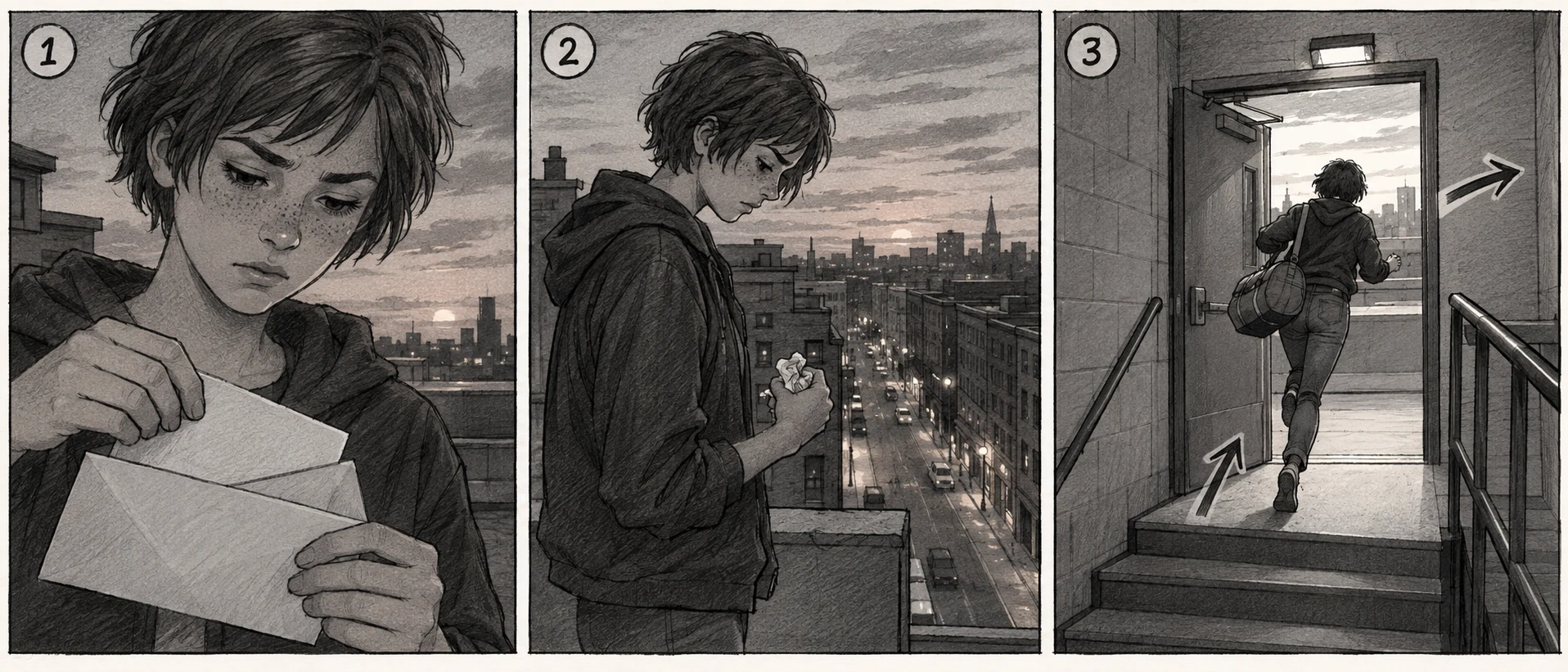
Three numbered panels force cause, reaction and consequence into order: the narrative chain in its simplest form. Widening from close-up to wide matches how coverage opens up as a character commits to action.
Open FlashBoardsCamera: handheld, slowly pushing in from the medium wide to a medium shot over the whole shot. Action: The girl is already reading, her eyes moving along the lines. She stops, lowers the letter and crushes it in her fist. She looks down at the street, then swings the duffel bag onto her shoulder and walks quickly out of frame to the left. Orange dusk light stays steady.Motion starts at once (already reading), so the model doesn't drift on a still. Crushes the letter, swings the bag, walks out of frame is a visible cause-to-effect beat, and the exit gives the next shot a reason to exist.
Open FlashBoardsCommon mistakes
- "A dramatic turning point" produces a pose. Name the object that causes the turn (the letter) and the sign of the decision (the bag).
- Storyboard strips lose continuity: repeat the character's hair, freckles and bag in every panel.
- Video models add events. Describe only what is in the first frame and the one action that follows.
Keep the reference frames, prompts and every generated take side by side — images and video in one canvas.
FAQ
4 questionsWhat is a narrative in simple terms?
A narrative is a story told in a particular way: connected events where each one causes or shapes the next, presented from a chosen point of view. The telling matters as much as the events. The same events in a different order, or through a different character, make a different narrative.
What does narrative mean in film?
In film, narrative is the story as the film organizes it for the viewer. Plot order, framing, sound and editing decide what the audience knows at each moment and whose experience it shares, including what is withheld and when it is revealed. Narrative film is also the name for fiction features built on this cause-and-effect storytelling.
What are the elements of a narrative?
The six elements usually listed are character, setting, plot, conflict, point of view and theme. Characters want something, conflict blocks them, the plot is the chain of their attempts and consequences, setting defines what is possible, point of view controls what we know, and theme is the meaning the outcome suggests.
Is a documentary a narrative film?
Not in the standard sense. Narrative film usually means fiction with actors, while documentary works with real people and events. Many documentaries still borrow narrative techniques, such as a subject with a goal, rising stakes and a reveal held for the end, so a documentary can have a strong narrative without being a narrative film.
Related terms
6- Story StructureStorytelling
Story structure is the order and shape of the events that carry a story from setup to resolution; models like the three-act structure, Freytag's pyramid, the hero's journey or Save the Cat are different maps of it.
- Narrative TechniquesStorytelling
Narrative techniques are the tools a storyteller uses to control what the audience knows and when — flashbacks, nonlinear order, point of view, foreshadowing, unreliable narrators, twists.
- ThemeStorytelling
Theme is the idea a story explores — what it says about love, power, guilt or freedom — expressed not as a slogan but through the protagonist's choices and their consequences.
- SettingStorytelling
Setting is where and when a story takes place — period, location, social world — and in film it's made concrete by locations, production design and light.
- DiegesisFilm History & Theory
Diegesis is the story world of a film — everything that exists for the characters; elements inside it are diegetic (a radio playing in the room), elements outside it are non-diegetic (the score, titles, narration).
- Voice-OverSound & Music
Voice-over is speech heard over the picture from someone not speaking on screen at that moment — a narrator, a character's inner thoughts, a documentary commentary.
Further reading
David Bordwell, Narration in the Fiction Film (University of Wisconsin Press). David Bordwell and Kristin Thompson, Film Art: An Introduction (McGraw-Hill). Robert McKee, Story (HarperCollins).