 FlashBoards Learn
- Learn
- Film History & Theory
- Video Essay
Film History & Theory · Film language
Video Essay
Also called: film video essay, visual essay
A video essay is film criticism made out of film: an argument about a movie, a director or an idea, built from edited clips, narration, on-screen text and graphics. Instead of describing a cut or a composition in words, it shows the evidence and lets the viewer see the point being made.
- What it does
- Turns an analysis into a short film, where clips work as quotations and the edit carries the argument.
- Use it when
- You have one clear question about how a film works and footage that can prove the answer.
- Watch out
- A pile of clips with a plot summary is not an essay. Without a thesis, the viewer is just rewatching the movie.
- Try this prompt
Clean demonstration film still, symmetrical hotel corridor, one-point perspective, a woman in a mustard coat centered at the far end, soft even light, 16:9.
What is a video essay?
An essay on paper quotes its sources. A video essay quotes its sources on screen: a shot, a scene, two frames side by side. The essayist adds a voice-over or on-screen text that frames the question, points at the details, and builds toward a conclusion.
What separates it from a trailer, a recap or a highlight reel is the argument. A good video essay answers something specific: why a comedy director cuts on movement, or what a recurring color means across a career. It is film analysis in the medium it studies, a popular branch of film theory and criticism.
The term covers several shapes:
- Narrated analysis. The most common form: a script read over clips, often 8–20 minutes long.
- Supercut. No narration. Dozens of similar shots cut together so the pattern speaks for itself, as in Kogonada's Wes Anderson // Centered.
- Comparison essay. Built around a split screen, setting two films, a script page against the scene, or a remake against the original.
- Personal essay. Memory woven into the analysis.
Where the video essay comes from
The roots are in the essay film, a tradition of personal, argumentative cinema. Chris Marker's Sans Soleil (1983) mixes travel footage with letters read in voice-over. Jean-Luc Godard's Histoire(s) du cinéma (1988–1998) rebuilds film history from fragments of other films, and Thom Andersen's Los Angeles Plays Itself (2003) assembles a city's portrait from the movies shot in it.
Cheap editing software and online video turned this into a mass form in the 2010s. Tony Zhou and Taylor Ramos's channel Every Frame a Painting (2014–2016) set the template many followed: short, tightly scripted episodes such as Edgar Wright: How to Do Visual Comedy, where every claim is proven by the next clip.
What makes a good video essay?
- One thesis, stated early. The first minute should say what the essay asks and why it matters.
- Clips as evidence, not wallpaper. Each clip should prove the sentence it sits under. If the narration says "the camera never moves," the shot on screen must be locked off.
- The edit makes the point. A freeze frame, a match cut between two films or a clip replayed with an annotation can argue faster than a paragraph.
- Specific language. Name the lens, the cut, the blocking. Vague praise ("beautiful," "iconic") is what a quick film review can get away with; an essay cannot.
How to make a video essay
- Pick a question, not a topic. "Fincher" is a topic. "Why do Fincher's camera moves feel invisible?" is a question you can answer in ten minutes.
- Rewatch and log. Write timecodes for every moment that supports or contradicts your idea.
- Write the script first. Draft it like a short essay: hook, thesis, three or four points, conclusion. About 130–150 words make a minute of narration.
- Record the voice-over. A quiet room and a close microphone beat an expensive one.
- Cut picture to the argument. Lay the narration on the timeline, then place clips under the sentences they prove. Add graphics only where they help.
- Keep quotations short and transformative. Use only as much footage as the point needs, and always talk over it or alter it with analysis. In the US this is where fair use comes in.
In FlashBoards you can pin logged frames next to each paragraph of the script, group them by argument, and generate original demonstration shots on the same canvas when a principle is clearer staged than quoted.
Video essay vs. film review
A review answers "should I watch this?" for someone who hasn't seen the film: a short setup, a judgment and a verdict, without spoilers. A video essay usually assumes the viewer has seen it and asks "how does this work?" Its value is the explanation, not the verdict, so a good essay about a 1950s film can find its audience decades later.
How to create a video essay with AI
3 promptsVideo essays usually quote real footage, but some points are clearer with an example you control: a clean demonstration of a composition rule, a lens comparison, a neutral shot under narration. Generate those on the same board as your logged frames and script notes.
Clean demonstration film still for a video essay about symmetry: a long hotel corridor in strict one-point perspective, pale green walls, identical doors on both sides, a tall woman in her thirties with a short silver bob and a mustard wool coat standing dead center at the far end, facing camera, camera at eye height in the middle of the corridor, 32mm lens, soft even overhead light, calm and slightly uncanny mood.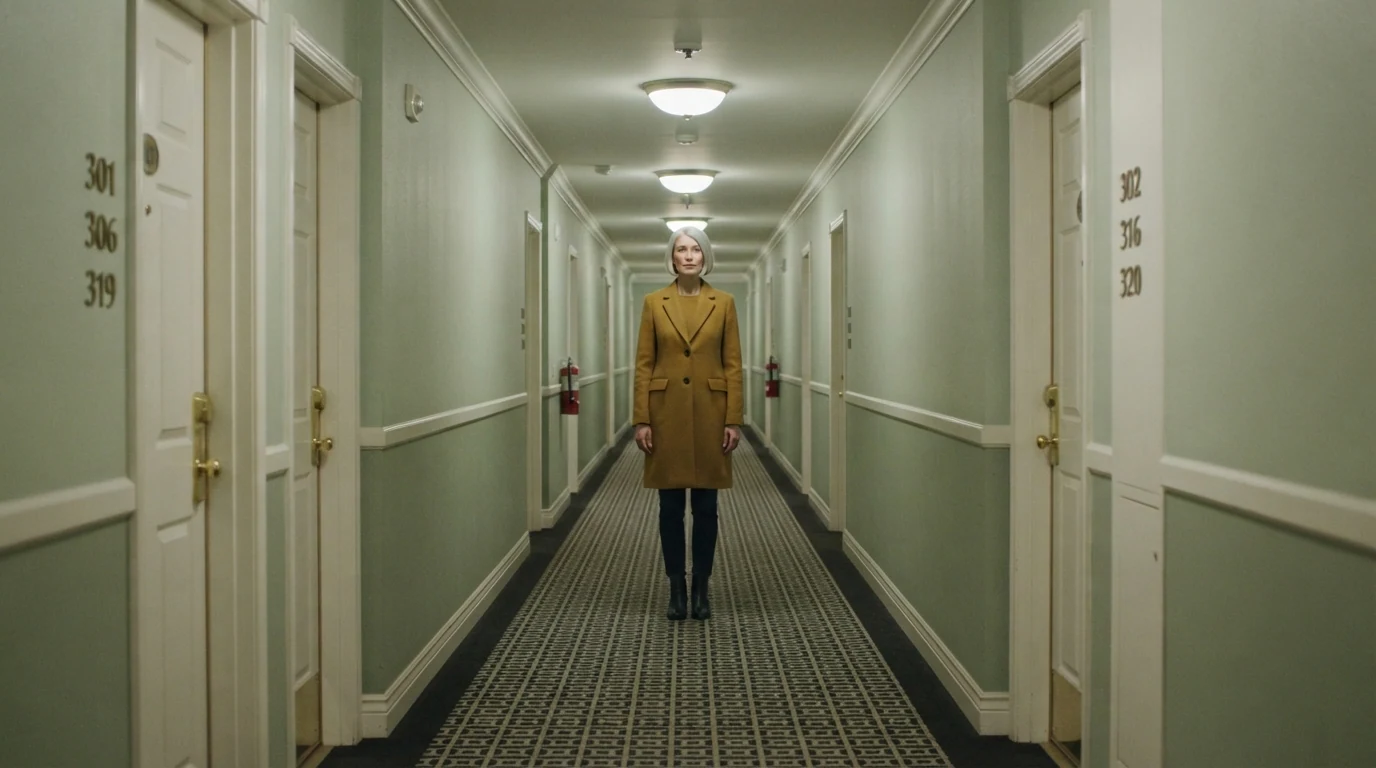
"Strict one-point perspective" and "dead center" lock the symmetry being demonstrated; the invented character keeps the shot original.
Open FlashBoardsVideo essay comparison card, split screen with a thin white vertical divider: left panel a man in his fifties with a red beard and round glasses at a kitchen table shot on a 24mm lens, room stretched wide behind him; right panel the same man and table shot on an 85mm lens, background compressed and soft. Small clean white labels in the lower corners reading "24mm" and "85mm". Neutral daylight, matte dark gray border.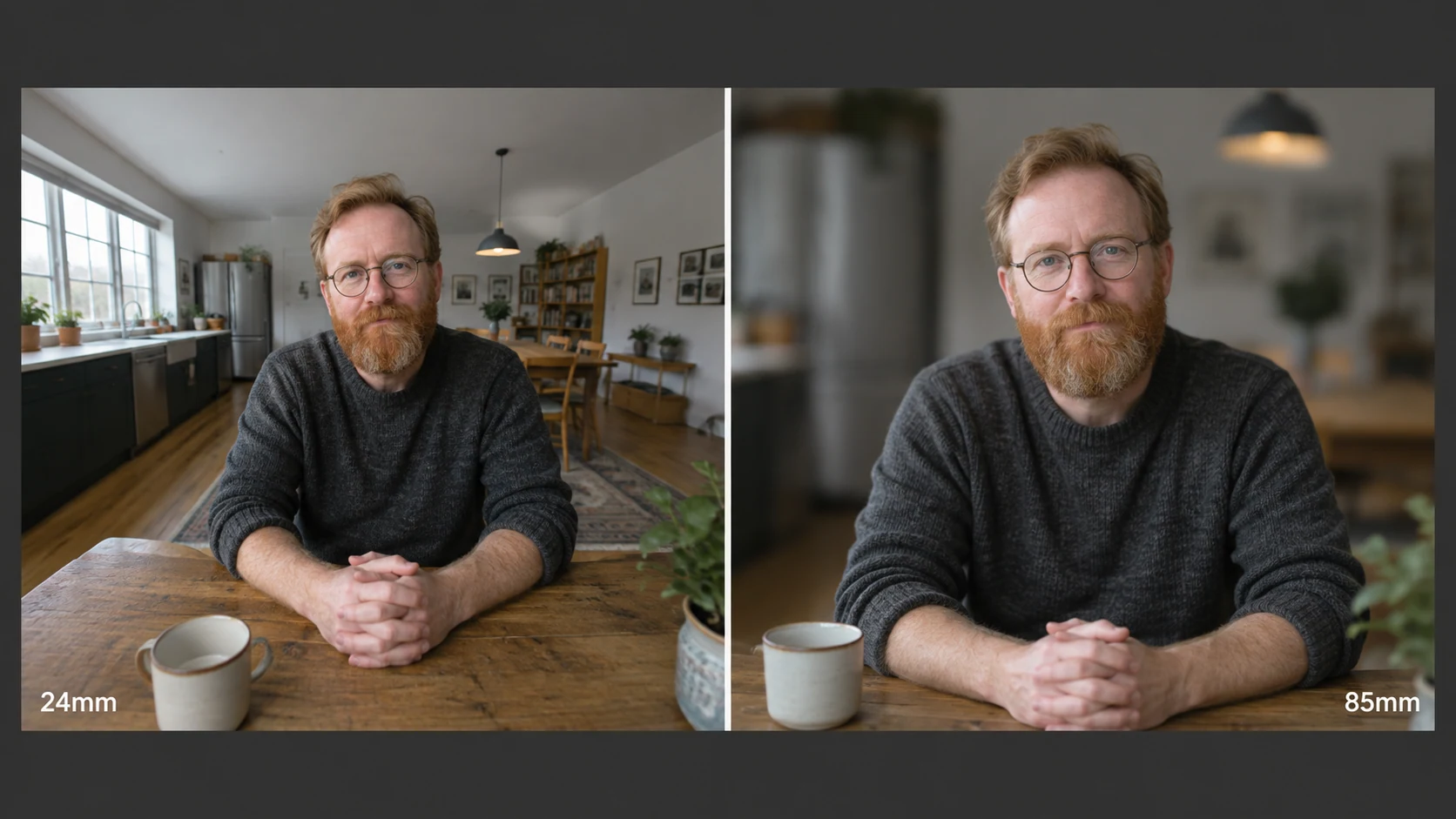
Naming both focal lengths and their effect on the background gives the model a visible difference to draw; short quoted labels render cleanly.
Open FlashBoardsCamera: a slow, steady push forward down the center of the corridor from the first frame, keeping perfect symmetry. Action: the woman in the mustard coat starts walking toward the camera at once with even steps, her coat swinging slightly; the doors pass evenly on both sides; she stops a few meters from the lens, still centered.Motion starts at once, so the shot is alive under narration, and "keeping perfect symmetry" protects the point being demonstrated.
Open FlashBoardsCommon mistakes
- Models drift off-center. Repeat the rule in plain words ("dead center") rather than only naming a style.
- Split screens can merge into one image. Ask for "a thin white vertical divider" and describe each panel separately.
- Long on-screen text breaks. Keep labels to a word or two and add titles in your editor.
- Don't prompt for a real film's scene or a real actor's likeness: generated shots demonstrate a principle, they don't replace the footage you analyze.
Keep the reference frames, prompts and every generated take side by side — images and video in one canvas.
FAQ
5 questionsWhat is a video essay?
A video essay is an analysis of a film, filmmaker or idea told through edited clips, narration, on-screen text and graphics. It works like a written essay, with a thesis and evidence, except the evidence is shown on screen. Common forms include narrated analysis, wordless supercuts, split-screen comparisons and personal essays that mix memory with criticism.
How do you make a video essay?
Start with one specific question about how a film works. Rewatch the films and log timecodes for every supporting moment. Write a script with a clear thesis, record the narration, then edit clips under the sentences they prove. Keep each clip short and cut examples that repeat a point.
How long should a video essay be?
Long enough to prove one argument and no longer. Many strong online video essays run 5 to 15 minutes, supercuts are often under five, and feature-length essay films exist too. At 130 to 150 words a minute, a 1,200-word script runs about nine minutes.
Can you use movie clips in a video essay?
In the US, short clips used for criticism and commentary can qualify as fair use, weighed on purpose, the nature of the work, the amount used and market effect. Using only what you need and analyzing it on screen strengthens the case. It is not a guarantee, and platforms may still flag videos automatically, so be ready to dispute claims.
What are good film video essay examples?
Tony Zhou and Taylor Ramos's Every Frame a Painting is the usual starting point, especially the episode on Edgar Wright's visual comedy. Kogonada's supercuts show how much a wordless edit can say. For longer forms, watch Los Angeles Plays Itself (2003) and the essay films of Chris Marker and Harun Farocki.
Related terms
4- Film AnalysisFilm History & Theory
Film analysis is the close study of how a film makes meaning — through mise-en-scène, cinematography, editing, sound and narrative — moving from what happens to how and why it is shown that way.
- Fair UseFilm Industry
Fair use is the US legal doctrine that permits limited use of copyrighted material without permission — for criticism, commentary, parody, news or teaching — judged on four factors: purpose, nature, amount and market effect.
- Voice-OverSound & Music
Voice-over is speech heard over the picture from someone not speaking on screen at that moment — a narrator, a character's inner thoughts, a documentary commentary.
- Film ReviewFilm History & Theory
A film review is a critic's evaluation of a film for readers who may not have seen it — a short plot setup, judgement of craft and performances, and a verdict, without spoiling the ending.
Further reading
Timothy Corrigan, The Essay Film: From Montaigne, After Marker (Oxford University Press, 2011). Tony Zhou and Taylor Ramos, "Postmortem: Every Frame a Painting" (2017). David Bordwell and Kristin Thompson, Film Art: An Introduction.