 FlashBoards Learn
Filmmaking Process & Crew · Film language
Grip
Also called: key grip, dolly grip, grip department
A grip is the film crew member who builds and moves everything that supports the camera or shapes light without being electrical: dollies, track, cranes, car rigs, flags, silks and C-stands. The grip department is led by the key grip, works for the cinematographer and sits right beside the gaffer's electricians.
- What it does
- Rigs, moves and secures the camera, and cuts, softens or blocks light with non-electrical gear.
- Use it when
- Any shot needs a dolly move, a crane, a car mount, a flag, an overhead silk or a safe rig above people's heads.
- Watch out
- Grips do not set or power lamps; that is the electric department under the gaffer.
- Try this prompt
Behind-the-scenes photo of a dolly grip pushing a camera dolly along steel track on a film set, black flags on C-stands, work lights
What is a grip in film?
A grip is a rigging and camera-support technician. In the American system the job has two halves: camera support (dollies, track, cranes, car mounts, rigs that hang a camera off a wall) and non-electrical light control (flags, nets, silks and the stands that hold them). The set rule: if it plugs in, it belongs to the electricians; if it holds, moves or shapes something without power, it belongs to grip.
Grips report to the director of photography through the key grip and are one of the biggest below-the-line departments in film production. The origin of the word is disputed, so treat it as old industry slang rather than a known etymology.
What does a grip do on set?
- Laying track. Dolly track has to be dead flat, so grips shim it with wedges and apple boxes until a level reads true along the run. A bump in the track is a bump in the frame.
- Moving the camera. The dolly grip pushes the camera on a dolly shot, hitting the same marks at the same speed every take. Cranes and jibs are grip territory too.
- Shaping light. Electricians set the lamp; grips cut it. A flag keeps light off a wall or out of the lens, a net drops one side of a face by a fraction of a stop, an overhead silk softens hard sun, black solids add negative fill.
- Rigging and safety. Anything hung above people, clamped to a car or placed on a rooftop is rigged, sandbagged and checked by grips.
Most of it lives on a C-stand with a sandbag on the leg, the unofficial symbol of the department.
Key grip, best boy grip and dolly grip
- Key grip heads the department: plans rigs with the DP and gaffer in prep, scouts where track, cranes and overheads can go, and runs the crew on the day.
- Best boy grip is the key's second. The best boy handles crew calls, equipment orders, the grip truck and paperwork.
- Dolly grip pushes the dolly or swings the crane arm, judged like a musician: smooth starts and stops, landing the move on the same line of dialogue every take.
- Company grips carry, build, flag and sandbag.
- Rigging grips pre-rig stages and locations days ahead on bigger shows.
The split is not universal: in the UK and much of Europe, grips focus on camera support, and flags and diffusion belong to the lighting crew.
Grip vs. gaffer: what's the difference?
The gaffer heads the electric department: lamps, cable, generators, power. The key grip heads everything that supports, moves or rigs, plus the non-electrical tools that control light.
On a setup they work as one team. The DP asks for a soft key from camera left with the background falling off. Electricians place and power the fixture; grips put a diffusion frame in front of it, a flag to keep it off the wall and a black solid opposite for contrast.
How directors and DPs plan grip work
Grip work costs time: a long track run with a turn, or an overhead silk in wind, can take longer to build than the shot takes to film. The key grip needs the shot list and storyboard early, with the moves marked.
In FlashBoards you can keep the storyboard frames, a reference still for each move and a generated picture of the rig on one board, so the key grip, gaffer and DP read the same plan in prep.
How to create a grip with AI
3 promptsYou can't prompt a grip, but you can show one: a behind-the-scenes frame of the rig explains a dolly move or an overhead silk to a crew fast. Name the gear precisely; film crew alone gets a generic set. On a FlashBoards board these rig pictures sit next to the storyboard panel they serve.
Behind-the-scenes photo inside an old warehouse film set: a fictional dolly grip, a broad-shouldered man in his forties with a shaved head, gray beard and black work shirt, pushes a camera dolly along straight steel track laid on the concrete floor, wooden wedges under the joints. A camera operator in a knit cap sits behind the cinema camera on the dolly. Two black flags on C-stands with sandbags stand beside the track. Wide shot, 28mm lens at shoulder height, cool daylight from high windows.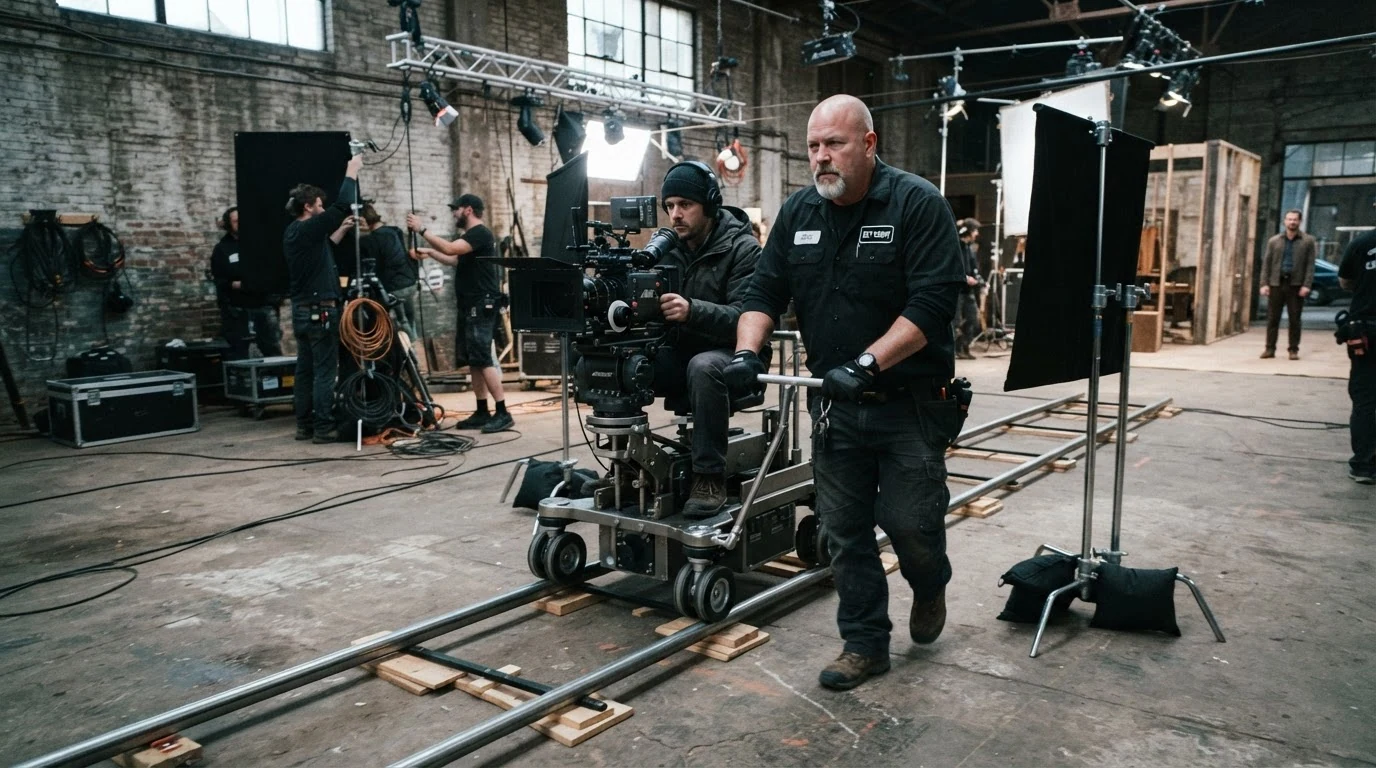
Straight steel track … wooden wedges and black flags on C-stands with sandbags name real grip gear, so the model draws a working rig, not a generic crew. The wide 28mm framing keeps the whole rig readable.
Open FlashBoardsBehind-the-scenes photo of an exterior shoot on a beach boardwalk at noon: a large white overhead silk on a square frame is held above two seated actors by two tall stands weighted with sandbags. A fictional key grip, a wiry woman in her thirties with a red bandana, steadies one stand; a second grip ties a rope to the frame's corner. Under the silk the actors sit in soft, even shade; outside it the boards are hard-lit and bright. Wide shot, 24mm lens, eye level.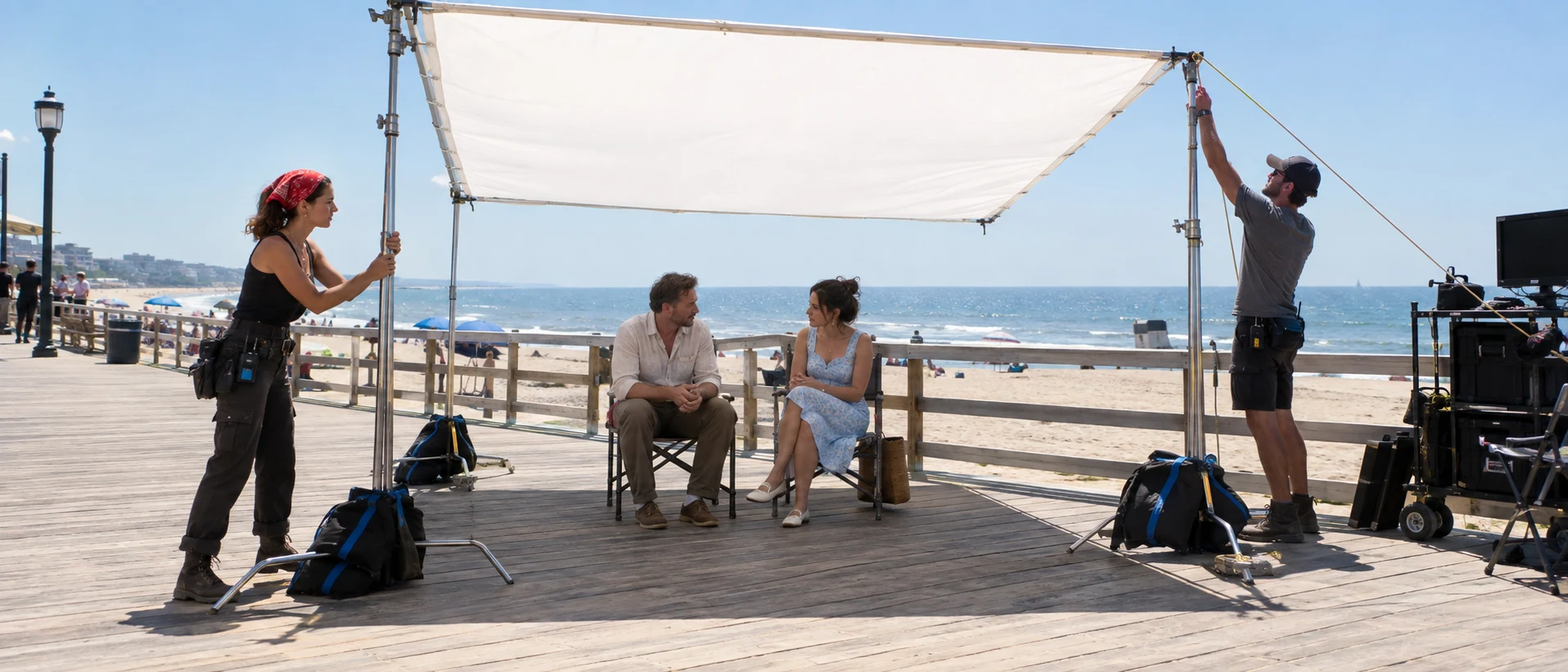
The contrast between soft, even shade under the silk and hard-lit boards outside shows what an overhead does. Sandbags and ties a rope add the safety side of the job.
Open FlashBoardsCamera: wide tracking shot at shoulder height that glides alongside the track, keeping pace with the dolly. Action: the dolly is already rolling as the shot begins, the dolly grip leaning into the push bar. He pushes it smoothly along the straight track at walking pace while the operator stays steady behind the camera, and the flags on their C-stands pass by. Near the end of the track he slows gently and stops on a mark, then rests his hands on the bar, and the camera settles with him.Already rolling as the shot begins keeps the clip alive from the first frame. A camera that keeps pace with the dolly holds the grip's push in frame the whole way, and slows gently and stops on a mark is the core dolly grip skill.
Open FlashBoardsCommon mistakes
- Film crew gives a crowd holding random gear; name one piece of grip equipment and the person operating it.
- Models often turn a flag into a light; write black flag on a C-stand and keep lamps out of the prompt.
- Track tends to curve or float; write straight steel track laid on the floor.
Keep the reference frames, prompts and every generated take side by side — images and video in one canvas.
FAQ
5 questionsWhat does a grip do on a film set?
A grip builds, moves and secures everything that supports the camera or shapes light without electricity: laying and leveling dolly track, pushing the dolly, rigging cranes and car mounts, and setting flags, nets, silks and C-stands to cut or soften light. Grips are also responsible for rigging safety, from overhead frames to cameras clamped on vehicles.
What is a key grip?
The key grip heads the grip department. In prep they plan rigs, track runs, cranes and overheads with the director of photography and the gaffer, and scout where the gear can go. On set they run the grip crew, with the best boy grip as second in command handling orders, paperwork and the truck.
What is the difference between a grip and a gaffer?
The gaffer runs the electric department: lamps, cable and power. The key grip runs camera support, rigging and the non-electrical tools that shape light, such as flags, silks and nets. On a lighting setup, electricians place and power the fixture while grips cut, diffuse and block its light and make every stand safe.
What does a dolly grip do?
A dolly grip pushes the camera dolly or operates a crane arm during the shot. The skill is precision: smooth starts and stops, steady speed and landing on the same mark at the same moment every take, so the operator and focus puller can repeat their work. Dolly grips also help lay and level the track.
Do grips set up lights?
Not in the American system. Setting and powering lamps is the job of the electricians under the gaffer. Grips work around the lights: flags, nets, diffusion frames and bounce, plus the stands and overheads that hold them, all sandbagged. In the UK and much of Europe, flags and diffusion usually belong to the lighting crew as well.
Related terms
4- GafferFilmmaking Process & Crew
The gaffer is the chief lighting technician: head of the electric department who builds the lighting plan with the cinematographer and runs the electricians, power distribution and lamps on set.
- Best BoyFilmmaking Process & Crew
The best boy is the second-in-command of the electric or grip department — best boy electric under the gaffer, best boy grip under the key grip — handling crew, gear orders, paperwork and truck logistics.
- Dolly ShotCamera Movement
A dolly shot is filmed with the camera on a wheeled dolly, usually on track, so it can glide smoothly toward, away from or alongside the action; unlike a zoom, the camera really moves, so perspective and parallax change.
- CinematographerFilmmaking Process & Crew
The cinematographer, or director of photography (DP), designs the film's image with the director — framing, lenses, lighting, exposure, camera movement and look — and leads the camera, grip and electric departments.
Further reading
Blain Brown, Motion Picture and Video Lighting (Routledge) · Michael G. Uva, The Grip Book (Routledge) · American Cinematographer magazine (ASC)