 FlashBoards Learn
- Learn
- Camera Movement
- Dolly Shot
Camera Movement · Film language
Dolly Shot
Also called: dolly move, push in, pull back, dolly in
A dolly shot moves the camera itself on a wheeled dolly, usually riding on track, toward, away from or alongside the action. Because the lens travels through space, foreground and background slide against each other: a dolly in draws the viewer into a character's head, a dolly out leaves them behind.
- What it does
- Physically carries the camera toward or away from the action, so perspective and parallax change during the shot.
- Use it when
- A moment needs to tighten on a realization, or widen to reveal where a character really stands.
- Watch out
- A zoom is not a dolly: without parallax the move reads flat and mechanical.
- Try this prompt
Slow dolly in over 6 seconds from a medium shot to a close-up on a man at a diner counter, the camera travels forward on a track, a foreground cup slides out of frame, 35mm lens
What is a dolly shot?
A dolly is a wheeled platform that carries the camera and operator, pushed by a dolly grip along track or across a smooth plywood "dance floor". The word names both the rig and the move it makes, and it is one of the foundational camera movements.
On set, "dolly in" and "dolly out" (also called push in and pull back) mean moving the whole camera toward or away from the subject. A sideways move on the same dolly is usually called a truck shot. What defines all of them is that the camera changes position, not focal length. That is the difference from a zoom shot, and it is what makes the dolly zoom possible at all.
A dolly shot does not have to follow anyone. The subject can sit perfectly still; the move is about distance and perspective, not about keeping up with action.
Why do filmmakers use dolly shots?
Distance is emotion. Camera-to-face distance sets intimacy, and a dolly changes it inside one shot, without a cut.
- It sells depth. As the lens travels, near objects pass faster than far ones. That parallax makes a set feel three-dimensional in a way a locked-off frame or a zoom cannot.
- It reads as a decision. A smooth dolly move feels authored and deliberate, where a handheld shot feels reactive and caught. It says "this matters" without music or dialogue.
- It guides attention. Moving in isolates; moving out adds context.
- It creates style. Wes Anderson builds whole sequences from straight-line track moves, like the room-to-room opening of Moonrise Kingdom (2012). Spike Lee made the double dolly, with actor and camera riding together, his signature; in Malcolm X (1992) Denzel Washington seems to float down the street toward his fate.
The most famous dolly effect is a hybrid: in Vertigo (1958) and again on the beach in Jaws (1975), a dolly move combined with an opposite zoom makes the background stretch while the subject holds size.
How to shoot a dolly shot
Choose the support. For moves of 1–4 feet, a slider is enough. For longer moves, or when the camera must rise as it travels, use a dolly with a hydraulic arm on leveled straight or curved track; any bump shows in the frame.
Pick the lens for the amount of parallax you want. A wide-angle lens of 18–35mm exaggerates the move: a two-foot push feels big, and foreground objects rush past. A 50–85mm lens compresses space and needs more track to register.
Set speed by emotion. A slow push in covers roughly 1–3 feet over 6–10 seconds. Ease in and out; an abrupt start or stop looks like a mistake.
Design the start and end frames. Know where the move lands and tape the mark on the track; the focus puller marks the same positions on the lens.
Give the eye something to measure. Put a doorframe, a lamp or a shoulder in the near foreground. Without objects at different depths, a dolly move and a zoom look almost identical.
Motivate it. The best moves start on an actor's cross, a line of dialogue or a look. Watch for the dolly's shadow and for stands the moving frame will discover.
Dolly in (push in): moving toward the subject
A dolly in, or push in, moves the camera physically toward a character or detail. The frame tightens, the background drops away, and the audience is drawn from observing a person to sharing what is going on inside them. It is the standard grammar for a realization or a line that lands: the camera leans in when the viewer does.
Speed changes the meaning. A barely perceptible push over a long take builds pressure; a steady medium push says "pay attention to this"; a violent one becomes a crash dolly. It need not stay at floor level: in Hitchcock's Notorious (1946), a crane shot descends from a wide view of a party to a key hidden in Ingrid Bergman's hand.
Start wider than you think, end on the eyes or the object that carries the story, and cut only after the move settles.
Dolly out (pull back): revealing the world
A dolly out, also called a pull back, moves the camera physically away from the subject. The character shrinks while the surroundings pour in, so the move often means isolation or a new understanding of the situation. It is also the classic reveal.
In Gone with the Wind (1939) the camera pulls back and rises over the Atlanta depot until the wounded soldiers fill the whole screen, turning one woman's search into a lost war.
To shoot one, block the reveal so the new information enters in the final third of the move, and use a lens wide enough that the end frame really opens up. When the camera pulls back ahead of an actor who walks toward it, the dolly out becomes a leading shot and doubles as a tracking shot.
Crash dolly: the violent push
A crash dolly is a push in taken to the extreme: the camera rushes toward the subject in half a second to a second and stops hard, usually in a close-up or an extreme close-up. It is the physical cousin of the crash zoom. Because the camera really travels, walls streak past with parallax and motion blur, so the hit feels bodily rather than optical.
Use it for shock, comic punctuation or sudden recognition, and sparingly. Like a whip pan, it is a high-energy accent.
On set it is done on a short run of track with a fast grip and a firm stop mark, or on a gimbal carried at a run. Rehearse so the camera does not overshoot the actor, and preset the focus end mark; there is no time to find it mid-move.
Dolly vs. zoom: what's the difference?
Both make the subject grow or shrink in frame, but the eye reads them differently.
- Dolly: the camera moves. Perspective changes, foreground passes faster than background, and the viewer feels transported.
- Zoom: the lens changes focal length while the camera stays put. The whole image is simply magnified, perspective stays fixed, and the effect reads as observational.
A zoom is faster and covers distances no track could, but when the story is about getting closer to a person, the dolly feels more human. Run both in opposite directions and you get the dolly zoom.
Dolly shot vs. tracking shot
- A dolly shot is named after the support and, in everyday use, the move toward or away from the subject. The subject can be completely still.
- A tracking shot is named after the relationship: the camera moves because the subject moves, following, leading or flanking it. It can be done on a dolly, a Steadicam, a car or a drone.
So one shot can be both. In Paths of Glory (1957), Kubrick's camera rolls backward on a dolly ahead of Kirk Douglas as he walks the trench: a tracking shot executed on a dolly. A slow push in on a seated character is a dolly shot, never a tracking shot.
The test: if the camera moves because the subject moves, it is tracking; if the move changes distance to the subject, it is a dolly in or out. And if the camera only rotates on its head without traveling, it is a pan, not either one.
Dolly Shot in motion

9 clipsWatch the edges of the frame, not the actor. In a real dolly move, foreground objects slide out faster than the background, door frames widen and walls change angle; a zoom would scale everything together. The clips run from slow pushes in and pull backs that reveal a room to moves that travel in behind an actor or retreat ahead of one.
How to create a dolly shot with AI
3 promptsVideo models know the words dolly in and dolly out but often swap the move for a zoom or a slow drift. Give them a start frame with clear depth layers (a foreground object, the subject, a deep background) so the camera has something to travel past. Below, Nano Banana 2 Lite builds that start frame, GPT Image 2.5 draws the wide end of a pull back, and MiniMax H3 Max Turbo animates the first frame with a slow push in. On a FlashBoards board, keep the film references, takes and notes together and compare the parallax side by side.
Cinematic film still, medium shot at seated eye height on a 35mm lens: a tired man in his fifties with a gray buzz cut, a crooked nose and a faded green work jacket sits alone at a long diner counter at night, both hands around a white coffee mug with steam rising from it. A chrome napkin dispenser sits soft and out of focus in the near foreground left; the counter, a row of red stools and a neon-lit window recede behind him. Warm tungsten practicals, cool blue spill from the street, light haze, 35mm film grain.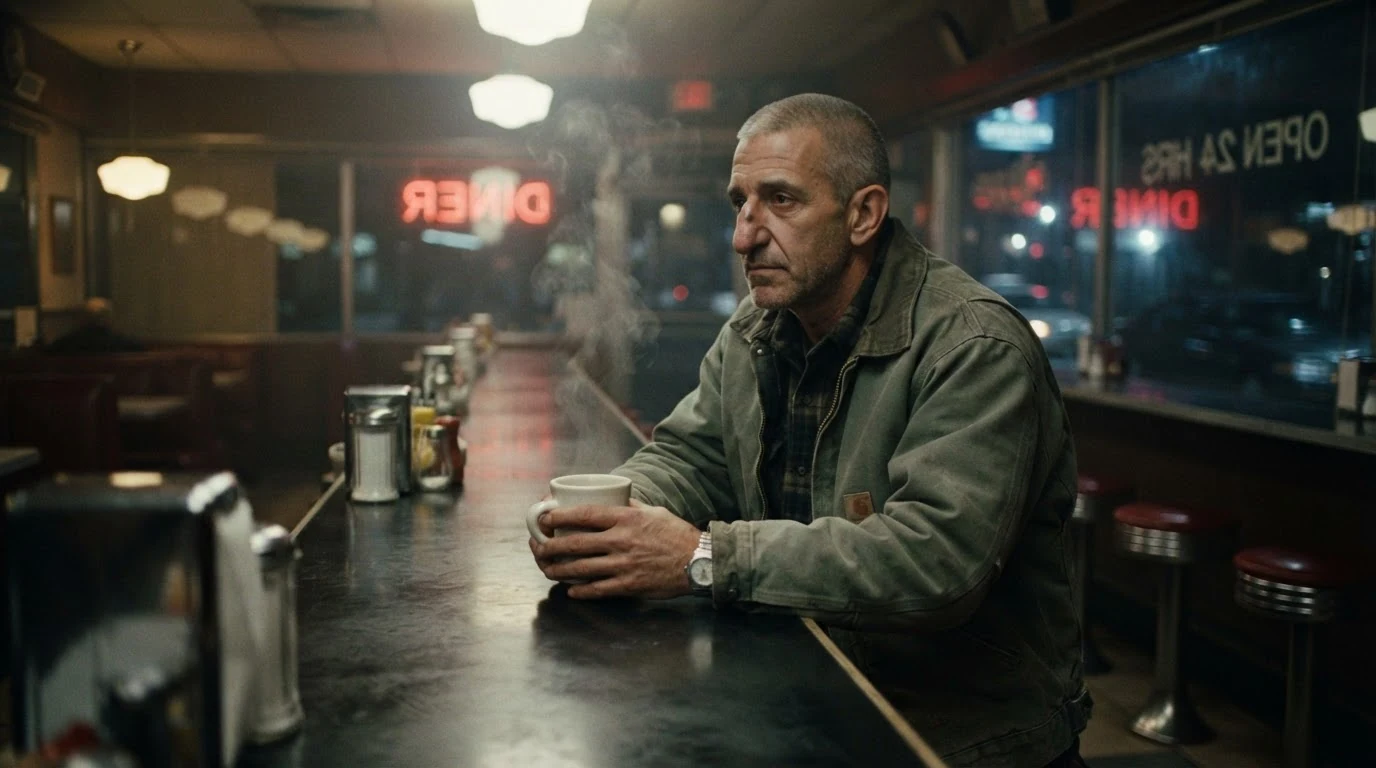
The foreground dispenser and the receding counter give the video model three depth layers to move past, so the push in shows real parallax instead of flat magnification. Seated eye height keeps the dolly level with him; the steaming mug is already moving.
Open FlashBoardsWide cinematic film still, camera at eye height on a 32mm lens: a woman in her thirties with a short black bob, freckles and a long rust-red wool coat stands small in the center of an empty, fog-covered shoreline, facing the camera. Bleached driftwood logs lie across the wet sand in the near foreground; far behind her a rusted fishing trawler sits stranded on the beach. Overcast soft light, muted blue-gray palette, level horizon, 35mm film grain.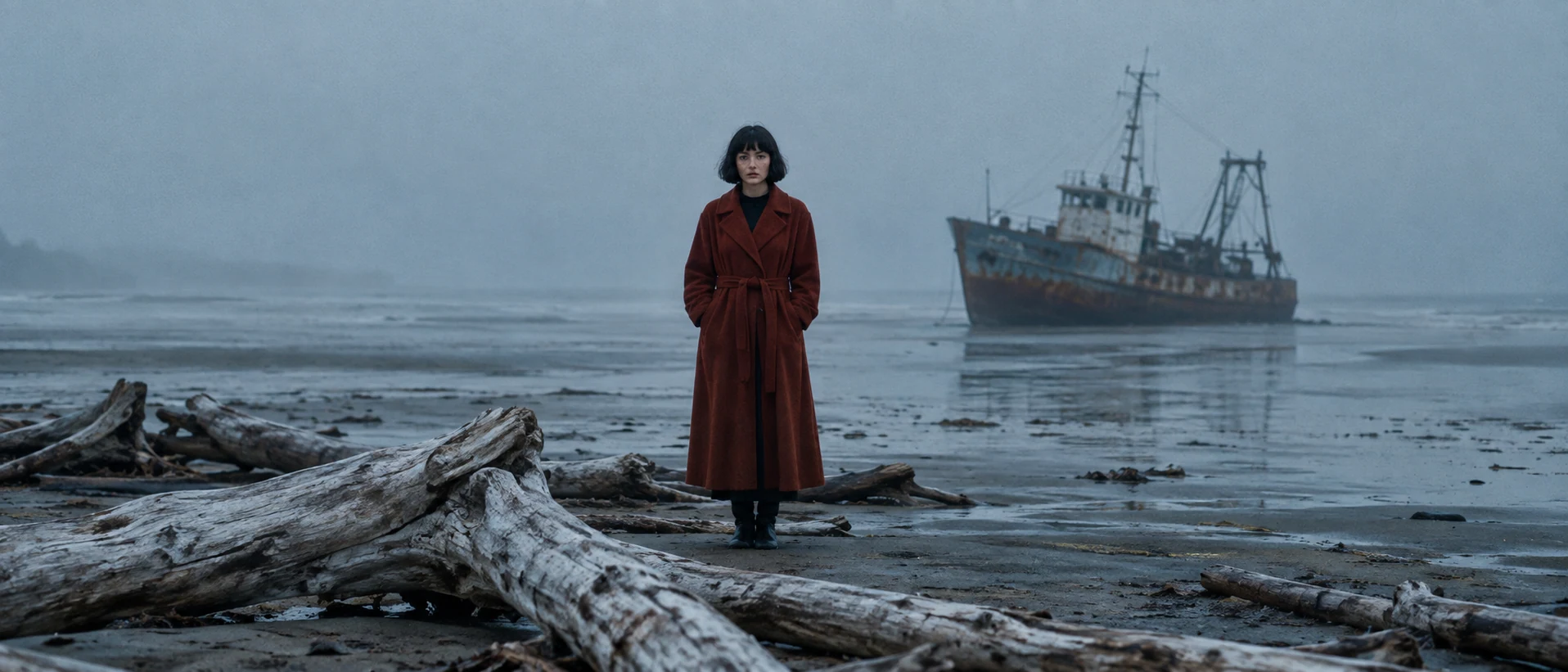
A second take in the opposite direction: this is where a dolly out lands. The trawler and the empty beach only make sense once the frame is wide, which is what a pull back is for, and the driftwood in the foreground is what would slide past the lens on the way out. Level horizon keeps the reveal steady.
Open FlashBoardsCamera: a slow, steady dolly in on a straight track at seated eye height, moving forward from the first frame to the last, starting on the medium shot and ending on a close-up of the man's eyes above the rim of the mug. The chrome napkin dispenser in the foreground slides out of the left edge of frame as the camera passes it, and the neon window behind him shifts with parallax. Action: the man is already slowly turning the mug in his hands as the shot begins, steam curling up from the coffee. In the middle he stops turning it and his eyes lift to a point just past the camera. At the end he holds that stare, his jaw tightening, as the camera settles on his eyes.Moving forward from the first frame to the last and the dispenser leaving frame force a true dolly rather than a zoom; straight track stops it curving into an orbit. The turning mug and steam make the shot alive at once, his look motivates the push, and everything named is already in the start frame.
Open FlashBoardsCommon mistakes
- Zoom instead of dolly. Models often magnify the frame without parallax. Say the camera travels forward on a track and name a foreground object that slides out of frame as it passes; a zoom cannot do that.
- Drift and arcs. A push in turns into a slow orbit. Add straight line, level horizon.
- The subject moves instead of the camera. Give the actor small actions in place and say only the camera travels.
- A frozen start. With only a camera move in the prompt, MiniMax H3 Max Turbo tends to creep toward a still image. Start
Action:with something already moving: steam, hands, a flickering sign. - Invented scenery. Details named in the video prompt but absent from the start frame get drawn in. Describe only what the first frame shows.
- Wrong speed. Give seconds and adjectives (barely perceptible, very fast with a hard stop), one move per generation.
Keep the reference frames, prompts and every generated take side by side — images and video in one canvas.
FAQ
5 questionsWhat is a dolly shot in film?
A dolly shot is a shot in which the camera rides on a wheeled dolly, usually on track, and physically moves toward, away from or alongside the action. Because the camera travels, perspective changes and foreground objects pass faster than the background; that parallax separates it from a zoom, which only magnifies the image.
What is the difference between dolly in and dolly out?
A dolly in moves the camera toward the subject, tightening the frame and drawing the audience into the character's thoughts. A dolly out moves the camera away, shrinking the character and revealing the surroundings, which often expresses isolation or reveals new information. Both use the same rig; only the direction, and therefore the emotional effect, is reversed.
Is a push in the same as a dolly in?
Yes. Push in and dolly in describe the same move: the camera physically travels toward the subject. "Push in" is common for slow, subtle moves and for pushes done on a slider, gimbal or crane. Likewise, "pull back" is the everyday name for a dolly out.
Can you do a dolly shot without a dolly?
Yes. Short moves of up to a few feet work well on a slider. Low-budget crews use wheelchairs or skateboard dollies on smooth floors, and a gimbal carried at a steady walk can imitate a push in. What matters is a smooth, straight, controlled move with foreground objects to show parallax.
What is the difference between a dolly shot and a tracking shot?
A dolly shot is defined by the support and by the move toward or away from the subject; the subject can be completely still. A tracking shot is defined by following a moving subject, whether from behind, ahead or alongside, on any rig. A dolly moving backward ahead of a walking actor is both, while a slow push in on a seated character is only a dolly shot.
Related terms
8- Zoom ShotCamera Movement
A zoom shot changes the lens's focal length during the take, so the image grows or shrinks from a fixed camera position; because the camera doesn't move, perspective stays the same — the key difference from a dolly.
- Tracking ShotCamera Movement
A tracking shot moves the camera through space with a moving subject — on a dolly, Steadicam, vehicle or drone — following, leading or flanking it so the audience travels with the action.
- Truck ShotCamera Movement
A truck shot slides the whole camera sideways, parallel to the scene, on a dolly, slider or vehicle; nearby objects sweep past faster than distant ones, giving strong parallax and a sense of travelling along the action.
- Dolly ZoomCamera Movement
A dolly zoom moves the camera toward or away from the subject while zooming the opposite way, so the subject keeps the same size but the background seems to stretch away or rush in — a jolt of dread or sudden realisation made famous by Hitchcock's Vertigo (1958).
- Double DollyCamera Movement
In a double dolly the actor stands on a dolly that travels together with the camera dolly, so the character floats through the location without walking — a dreamlike, unsettling move that is Spike Lee's signature.
- Steadicam ShotCamera Movement
A Steadicam shot is filmed with a body-worn stabiliser — vest, spring-loaded arm and balanced sled — that lets the operator walk, run and climb stairs while the camera glides; it made long moving takes like Rocky's steps run and The Shining's corridors possible.
- Crane ShotCamera Movement
A crane shot is filmed from a camera on a crane or jib arm that can rise, descend and sweep through the air — often lifting away from an intimate moment to a wide view of the whole place, or swooping down to open a scene.
- Camera MovementCamera Movement
Camera movement is any change of the camera's position or direction during a shot — pans, tilts, dollies, cranes, handheld and more — used to guide attention, reveal space and set the emotional rhythm of a scene.
Further reading
Blain Brown, Cinematography: Theory and Practice (Focal Press). Steven D. Katz, Film Directing Shot by Shot (Michael Wiese Productions).