 FlashBoards Learn
- Learn
- Filmmaking Process & Crew
- Cinematographer (Director of Photography)
Filmmaking Process & Crew · Film language
Cinematographer (Director of Photography)
Also called: director of photography, DP, DoP, DOP
A cinematographer, or director of photography (DP), designs the image of a film together with the director: framing, lenses, lighting, exposure, camera movement and the overall look. The DP also leads the camera, grip and electric departments, turning a script's intentions into shots that can be lit, rigged and repeated take after take.
- What it does
- Turns the director's vision into a photographic plan and runs the crews that execute it: camera, grip and electric.
- Use it when
- Any production that needs a consistent, intentional look, from a short film to a feature, a series or a commercial.
- Watch out
- The DP designs the image; the director owns the story. Unclear boundaries between the two cost time on set.
- Try this prompt
Medium close-up, 40mm lens at eye level, f/2, hard overhead fluorescent key, warm streetlight rim through the window, exposed for highlights, fine grain
What is a cinematographer?
The cinematographer is the head of the photography of a film. The job title on the credits reads either Cinematography by or Director of Photography, and the two mean the same person; on set everyone just says DP (in Britain and much of Europe, DoP). Older British credits sometimes used lighting cameraman, which says a lot about where the job's weight sits.
The DP is responsible for how every frame looks: what the camera sees, through which lens, from what height, how it moves, where the light comes from, how bright or dark the picture is, and how the colors and contrast feel in the final grade. In short, the DP practices cinematography; this article is about the person and the job rather than the art itself.
In the film crew hierarchy the DP is a head of department who reports to the director creatively and to the producers on schedule and budget. Three departments answer to the DP: camera, grip and electric. That makes the cinematographer one of the largest employers on a set and one of the few people involved from early prep through the final color session.
A useful way to think about it: the director decides what the audience should feel in a scene and what they need to see; the DP decides how the picture delivers it.
What does a cinematographer do?
The work splits into three phases, and on most films the first and last take as much thought as the shoot itself.
Pre-production. The DP reads the script for images: day or night, interior or exterior, how many characters share the frame, where the emotional turns are. With the director they build a visual approach, often summarized in a lookbook of reference frames, and break scenes into a shot list or storyboard. Then come the practical choices: camera body and recording format, lens series, aspect ratio, whether to shoot film or digital. The DP runs camera and lens tests, checks makeup and costume colors on camera, scouts locations at the hours they'll be filmed and draws lighting diagrams with the gaffer and key grip, so the rigging crew can pre-light big sets before the actors arrive.
Production. A typical setup runs block, light, rehearse, shoot. The director and actors block the scene; the DP watches the rehearsal, picks the camera positions with the director and calls the lighting. While the crew lights, stand-ins hold the marks. The DP sets exposure (stop, ISO, shutter, filtration), approves the operator's framing, watches focus and continuity of the light across angles, and keeps an eye on the clock: a scene lit for the master must still work for the close-ups two hours later when the sun has moved.
Post-production. The DP reviews dailies during the shoot to catch problems while they can still be fixed, and at the end sits with the colorist for the final grade, where the look that was lit on set is finished: contrast, saturation, skin tones, the density of the blacks. A DP who planned the look carefully spends the grade refining it; one who didn't spends it rescuing shots.
Who works for the director of photography?
The DP rarely touches a lamp or a C-stand. The picture is executed by three teams:
- Camera department. The camera operator frames and moves the camera during takes. The first assistant camera (1st AC, or focus puller) keeps the image sharp and manages lenses; the second AC slates, marks actors and keeps camera reports. On digital shoots a DIT (digital imaging technician) monitors signal and exposure, applies the viewing LUT and manages the footage.
- Electric department. The gaffer is the DP's chief lighting technician. The DP describes the light (a soft, cold dawn through the east windows, a single hard source overhead) and the gaffer designs how to build it: which fixtures, where the power comes from, how many electricians. The best boy electric runs the crew and the equipment.
- Grip department. The key grip rigs camera supports and shapes light: dollies, cranes, car mounts, flags, frames of diffusion, overheads that cut the sun. The dolly grip executes moves in sync with the operator.
On a large feature this is dozens of people; on a micro-budget short the DP may operate, pull their own focus and carry the lights. The responsibilities stay the same; only the number of hands changes.
How does a cinematographer design a look?
A film's look is a system of rules, not a collection of pretty shots. Great DPs decide early what stays constant and what changes with the story, then hold that line for months.
A few canonical examples show how different those rules can be:
- Gordon Willis lit The Godfather (1972) from overhead and let the eyes fall into shadow, so the Corleones' power reads as something hidden. It was darker than studio photography of the time, and it defined the film.
- Gregg Toland pushed deep focus on Citizen Kane (1941), keeping foreground and background sharp at once so Orson Welles could stage whole scenes in depth instead of cutting.
- Néstor Almendros shot much of Days of Heaven (1978) in the short window of dusk light, giving the prairie its soft, shadowless glow.
- Emmanuel Lubezki shot The Revenant (2015) largely with natural light and wide lenses close to the actors, making the wilderness feel physical rather than scenic.
- Roger Deakins and director Sam Mendes designed 1917 (2019) to play as one continuous shot, which meant lighting and moving through entire environments instead of individual setups.
In each case the look answers a story question: power, space, memory, survival, real time. The practical levers are always the same: choice of focal length and camera distance, depth of field, the direction and quality of the key light, contrast, color palette, and how and when the camera moves. The DP writes these down so every scene, shot on different days and sometimes by a second unit, cuts together as one film.
Where FlashBoards fits. Put the director's reference frames, the lighting diagrams, the shot list and test generations of key scenes on one FlashBoards board, and the look becomes something the whole team can see and argue about in prep rather than on the day. Generating a frame with the exact lens, height and light you intend is a fast way to find out whether a rule works before you rent the gear to test it.
Cinematographer vs. director: who decides what?
The director is responsible for the whole film: story, performance, pacing, sound, and the final say on every image. The cinematographer is responsible for the photography inside that vision. In practice the line is a conversation, and the best director-DP partnerships run for years, some for decades: Steven Spielberg and Janusz Kamiński, the Coen brothers and Roger Deakins, Christopher Nolan and Hoyte van Hoytema, Wes Anderson and Robert Yeoman, Wong Kar-wai and Christopher Doyle.
A rough division of labor:
| Decision | Director | Cinematographer | |---|---|---| | What the scene is about | Decides | Asks, interprets | | Staging and performance | Leads | Advises on camera and light | | Shot selection and coverage | Decides, often co-designs | Co-designs, proposes | | Lens, height, exact framing | Approves | Proposes, executes | | Lighting and exposure | Approves the mood | Designs and controls | | Camera, format, crew size | Agrees on budget | Chooses | | Final color grade | Approves | Leads with the colorist |
Some directors arrive with every frame boarded; others describe a feeling and let the DP find the shots. Either works as long as both know where the handoff is. The fastest way to lose a day is a DP lighting for one idea while the director is staging another, which is why the shared shot list and blocking rehearsal matter so much.
Cinematographer vs. camera operator
The camera operator physically runs the camera during the take: frames, pans, tilts, follows the actors and hits the marks of a move. The DP designs those frames and moves and is watching the monitor, the light and the exposure while the operator executes them.
On union features in the US the jobs are usually split, which frees the DP to watch the whole picture, especially on multi-camera days. Many cinematographers still operate their own camera when they can; Roger Deakins is known for doing so on most of his films. On independent, documentary and European productions the DP-operator is common, and on small shoots it's the norm.
If you see Director of Photography and Camera Operator credited separately, the first person designed the image and the second person's hands made the moves.
How do you become a cinematographer?
There are two traditional routes, and most working DPs mix them.
Up through the camera department. Start as a camera trainee or loader, move to second AC, then first AC, operator and finally DP. It's slow, but you learn how a professional set works, how to pull focus, and how dozens of DPs solve problems.
Shoot your way up. Film school, shorts, music videos, commercials and documentaries give you a reel. Many feature DPs broke through on a low-budget film that got noticed at festivals, then moved to larger productions with the same director.
Whatever the route, the skills are the same: a deep understanding of film lighting, lenses and exposure; the ability to read a script for images; leadership of a large crew under time pressure; and a trained eye built by studying paintings, photographs and films frame by frame. Professional societies such as the ASC (American Society of Cinematographers, founded in 1919) and the BSC let members add their letters after their names, and their publications are some of the best free education in the craft. For how the DP's role fits into the rest of the shoot, see the filmmaking process hub.
How to create a cinematographer (director of photography) with AI
3 promptsThe best way to direct an image model is to write the prompt the way a DP briefs a crew: shot size, lens and camera height, where the key light comes from and what motivates it, color temperature, exposure and texture. Vague words like cinematic give you a generic average; a DP's decisions give you a specific frame. In FlashBoards you can put two takes of the same scene lit by different plans side by side, then animate the one that tells the story.
Medium close-up of a fictional woman in her fifties with a gray buzz cut and a thin scar through her left eyebrow, sitting alone on a bench in an empty laundromat at night, rows of front-loading washers behind her. 40mm lens at eye level, f/2, background softly out of focus. Hard cool key from the fluorescent tubes overhead, warm orange streetlight coming through the window on the left as a rim on her cheek. Exposed for the highlights, deep shadows under the brows, light haze, muted teal and amber palette, fine film grain.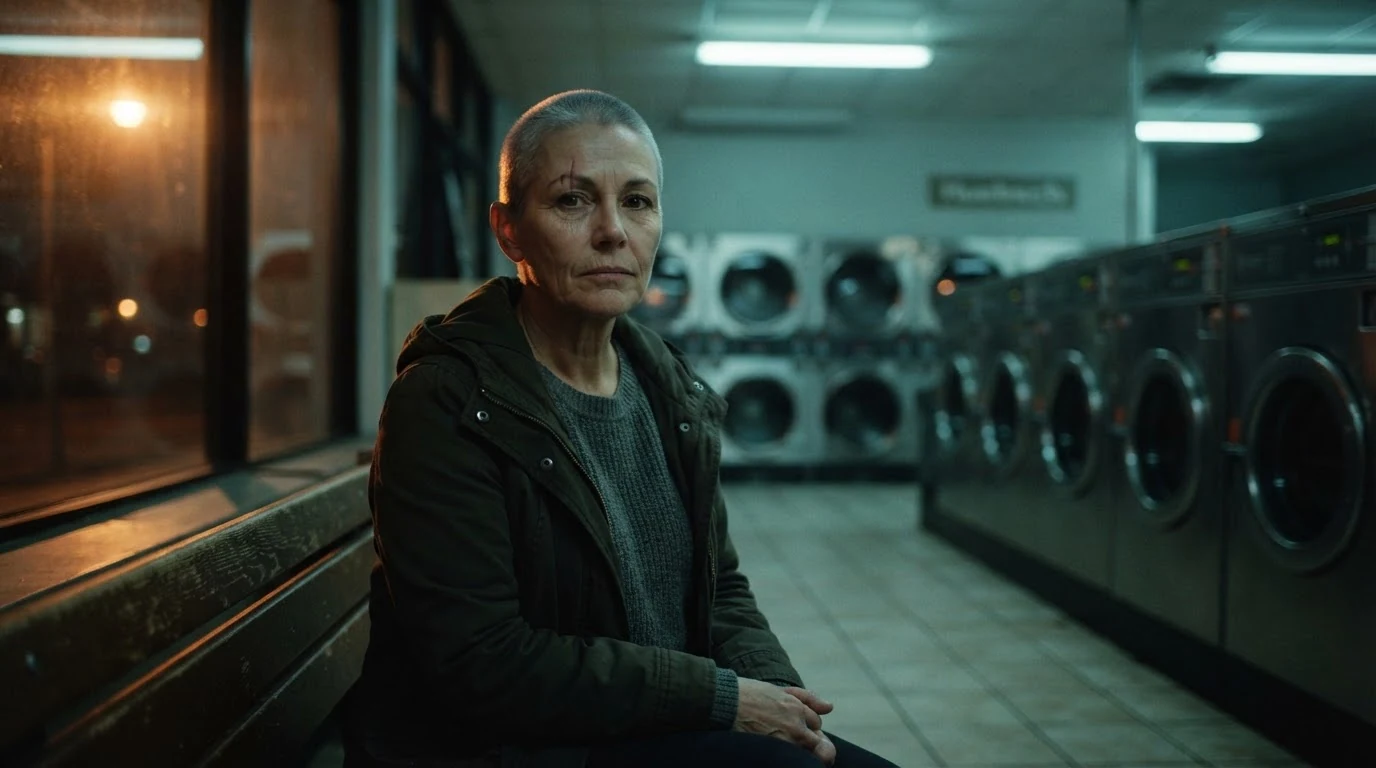
This is a DP's lighting brief compressed into a prompt. 40mm at eye level, f/2 sets perspective and depth of field; hard cool key from the fluorescent tubes overhead gives the light a direction and a motivated source; warm streetlight through the window on the left adds a second color temperature and separates her from the background; exposed for the highlights keeps the model from lifting the shadows into a flat, even image.
Open FlashBoardsWide shot from across a wet night street, looking through the large front window of a small laundromat: a fictional woman in her fifties with a gray buzz cut, in a mustard raincoat, sits alone on a bench inside, small in the frame. 24mm lens at standing height, deep focus. The laundromat interior glows green-white from overhead fluorescent tubes, the street in the foreground is dark and lit only by one sodium streetlight, reflections of the window on the wet asphalt. Low-key, high contrast, 2.39:1 widescreen composition, fine film grain.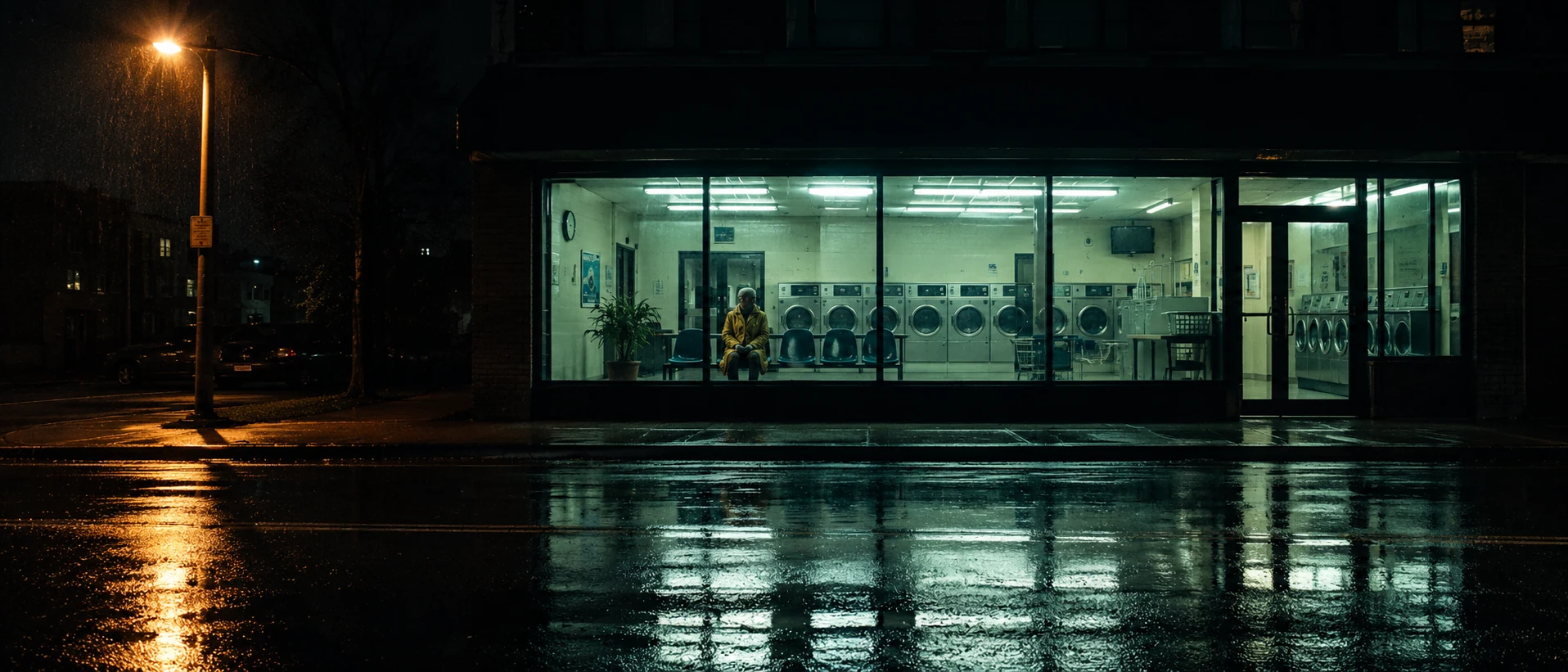
The same scene, a different photographic plan: instead of intimacy, isolation. Wide shot from across the street, looking through the window changes the point of view; 24mm, deep focus keeps the street and the room both readable; small in the frame and the low-key, high-contrast exterior make the lit window the only safe place in the image. Comparing this with recipe 1 is exactly the conversation a director and DP have about coverage.
Open FlashBoardsCamera: slow, steady dolly-in at eye level from the medium close-up to a close-up of her face over the whole shot, no change in lens. Action: the washers behind her are already spinning and the fluorescent light flickers faintly. She sits still, staring at the floor. Warm light from the window slides across her cheek as a car passes outside. She lifts her eyes toward the window and holds the look.Slow, steady dolly-in … over the whole shot defines the move, its speed and where it ends, so the model doesn't invent its own drift. The washers are already spinning line makes the shot alive from the first frame. Restating the light (fluorescent, warm light from the window) keeps the DP's lighting consistent with the start frame, and the action stays inside what's already in it: her, the washers, the window.
Open FlashBoardsCommon mistakes
- Cinematic as the only style word. Models answer with a generic orange-and-teal look. Name the lens, height, key direction and exposure instead.
- Unmotivated light. Without a source (window, overhead tube, fire) models light faces from the front and flatten them. Tell the model what the light is and where it comes from.
- Too many lights. Listing key, fill, rim, background and practicals at once produces contradictions. Two or three sources, clearly placed, read better.
- Lens numbers ignored. A focal length alone may not change much; pair it with the shot size and camera distance (a 24mm wide from across the street, a 40mm medium close-up).
- Look drifts in video. If the video prompt doesn't restate the light, the clip can brighten or shift color. Repeat the key sources in the video prompt.
Keep the reference frames, prompts and every generated take side by side — images and video in one canvas.
FAQ
5 questionsWhat does a cinematographer do?
A cinematographer designs and controls the image of a film. In prep they choose the camera, lenses and format, plan shots with the director and design lighting with the gaffer. On set they set up each shot, light it, control exposure and supervise the camera, grip and electric crews. In post they review dailies and lead the final color grade with the colorist.
Is a cinematographer the same as a director of photography?
Yes. Cinematographer and director of photography (DP or DoP) are two names for the same job, and credits use either one. Some people use cinematographer for the artistic side and DP for the department head role, but on a real production it is one person responsible for the photography of the film and the crews that produce it.
What is the difference between a cinematographer and a director?
The director is responsible for the whole film: story, performances, pacing, sound and final approval of every image. The cinematographer is responsible for the photography within that vision: lenses, framing, lighting, exposure, camera movement and the look. They design shots together, but when opinions differ, the director has the final say on what serves the story.
Does the cinematographer operate the camera?
Sometimes. On large union productions a separate camera operator usually frames and moves the camera while the DP watches the monitor, the lighting and the exposure. Many DPs prefer to operate themselves, and on independent films, documentaries and small crews the DP operating is common. Either way, the DP decides what the frame should be.
How do you become a cinematographer?
Most cinematographers either rise through the camera department, from loader or second assistant to first assistant, operator and then DP, or build a reel by shooting shorts, music videos, commercials and documentaries. Both routes demand a strong grasp of lighting, lenses and exposure, the ability to lead a crew, and years of studying how films and photographs are lit.
Related terms
7- Camera OperatorFilmmaking Process & Crew
The camera operator physically runs the camera during takes — framing, panning, tilting and executing moves — to the design set by the cinematographer, working with the focus puller and dolly grip.
- CinematographyCameras & Capture
Cinematography is the art of creating the moving image: the choices of camera, lens, framing, movement, light and exposure through which the director of photography turns a script into pictures.
- GafferFilmmaking Process & Crew
The gaffer is the chief lighting technician: head of the electric department who builds the lighting plan with the cinematographer and runs the electricians, power distribution and lamps on set.
- Film DirectorDirecting & Staging
The film director is the creative lead who turns the script into a film — shaping performances, staging and coverage, and approving every visual and sound decision from prep through the final cut.
- Film LightingLighting
Film lighting is the craft of shaping light for the camera — its direction, quality, color and contrast — to model faces, build space, set the time of day and carry the mood of a scene.
- Camera LensesLenses, Focus & Exposure
A lens gathers light and focuses it onto film or a sensor; its focal length, maximum aperture and optical character decide the field of view, perspective, depth of field and texture of the image.
- Film CrewFilmmaking Process & Crew
A film crew is everyone who makes the film behind the camera, organized into departments — directing, camera, grip, electric, art, costume, makeup, sound, production, post — each with a head and a chain of assistants.
Further reading
Kris Malkiewicz, Cinematography (Simon & Schuster) · Blain Brown, Cinematography: Theory and Practice (Routledge) · American Cinematographer magazine (ASC)