 FlashBoards Learn
Filmmaking Process & Crew · Film language
Gaffer
Also called: chief lighting technician, head electric, gaffer electrician
A gaffer is the chief lighting technician on a film set: the head of the electric department who turns the cinematographer's idea of the light into a working plan, then runs the electricians, the power and every lamp that builds it. The DP decides what the light should feel like; the gaffer decides how to make it.
- What it does
- Designs and executes the lighting plan with the DP; leads the electricians and the power distribution.
- Use it when
- Any shoot with more light than a camera and a window: the gaffer is hired as soon as lamps, generators or tie-ins are needed.
- Watch out
- The gaffer runs electric, not grip: flags, silks and dollies belong to the key grip's department.
- Try this prompt
Behind-the-scenes wide shot of a night film set, a gaffer aiming a large Fresnel lamp at a wet street, cables and stands everywhere
What is a gaffer?
The gaffer is the head electrician of a film or TV production, often credited as chief lighting technician. The job sits inside the camera team led by the cinematographer: the DP owns the look of the picture, the gaffer owns the light that creates it and all the electricity on set.
In British English a gaffer is simply the boss or foreman; another story ties the word to the gaff, a hooked pole once used to adjust theater lamps. Neither origin is proven. The name also gave us gaffer tape, the matte cloth tape that holds cables down on every set.
The creative intent comes from the director and DP; the gaffer brings the engineering, the gear and a crew that builds it safely, the same way on every take.
What does a gaffer do?
- Prep and scouts. The gaffer walks every location with the DP: where the sun will be and when, which way the windows face, how much power the building gives, where a generator can park.
- The lighting plan. From the DP's brief the gaffer draws a plot for each setup (fixtures, positions, color temperature, gels, diffusion, dimmer channels), and from it the equipment order, power calculation and crew size.
- Power. Generators, tie-ins, distribution boxes and cable, with balanced loads and safe connections.
- On the day. The DP asks for more contrast on her side or warmer through the window; the gaffer calls it on the radio and the electricians move, dim or gel the lamps. During takes the gaffer runs any lighting cue.
- Consistency. Keeping the key light matching from the wide to the last close-up while the real sun moves.
Who works for the gaffer?
- Best boy electric, second in command: crew, equipment orders, paperwork, the truck.
- Electricians (lamp operators, sparks in the UK) set and focus lamps, run cable and make the adjustments called over the radio.
- Generator operator keeps the generator running and quiet enough for sound.
- Rigging gaffer and crew pre-light big sets days ahead.
- Dimmer board operator runs the console for LED fixtures and lighting cues.
On a low-budget short this shrinks to a gaffer and one electrician with a van of LED panels. The responsibilities stay; only the number of hands changes, as across the whole film crew.
How does a gaffer work with the cinematographer?
DP–gaffer pairs often work together for years. A DP asks for late afternoon sun raking across the kitchen, soft cool fill from the other side. The gaffer translates it into hardware: a large HMI outside the window through a warming gel, high enough to throw window shadows onto the floor, a big soft source on the shadow side, dimmers on the practicals so they sit just under the key. Many choices in film lighting, from practical lighting to mixed color temperature, are settled in this conversation.
A good gaffer also protects the schedule, proposing plans that relight fast for the reverse and fit the location's power.
In FlashBoards the DP and gaffer can keep reference frames, location photos, a lighting diagram and AI tests of the look on one board, with the lamp list next to the frame it serves.
Gaffer vs. key grip
Both are department heads under the DP, but they lead different crews.
- The gaffer leads electric: anything that makes light or carries power.
- The key grip leads grip: camera supports (dollies, cranes, car rigs) and non-electrical light shaping (C-stands, flags, silks, overheads).
The electricians place and power a lamp; the grips cut and soften what it throws. Grips report to the key grip, not to the gaffer. The split varies by country: in the UK grips mostly handle camera support, and the electrical crew does much of the light shaping.
How to create a gaffer with AI
3 promptsA gaffer's craft can't be generated, but it can be previsualized: a behind-the-scenes frame of the rig, then the image that rig should produce. Name each source, its position and color, and the picture becomes a plan the crew can read. Keep both takes on one FlashBoards board next to the lamp list.
Behind-the-scenes wide shot of a night exterior film set on a wet cobblestone street. In the foreground a fictional gaffer, a stocky man in his fifties with a gray braided beard, black knit cap and leather work gloves, a radio on his vest, tilts a large tungsten Fresnel on a tall stand toward a doorway. Behind him a lamp gelled blue, black cables across the wet stones, a white balloon light over the street. Warm pools of light against deep blue night, light mist, 28mm lens, eye level.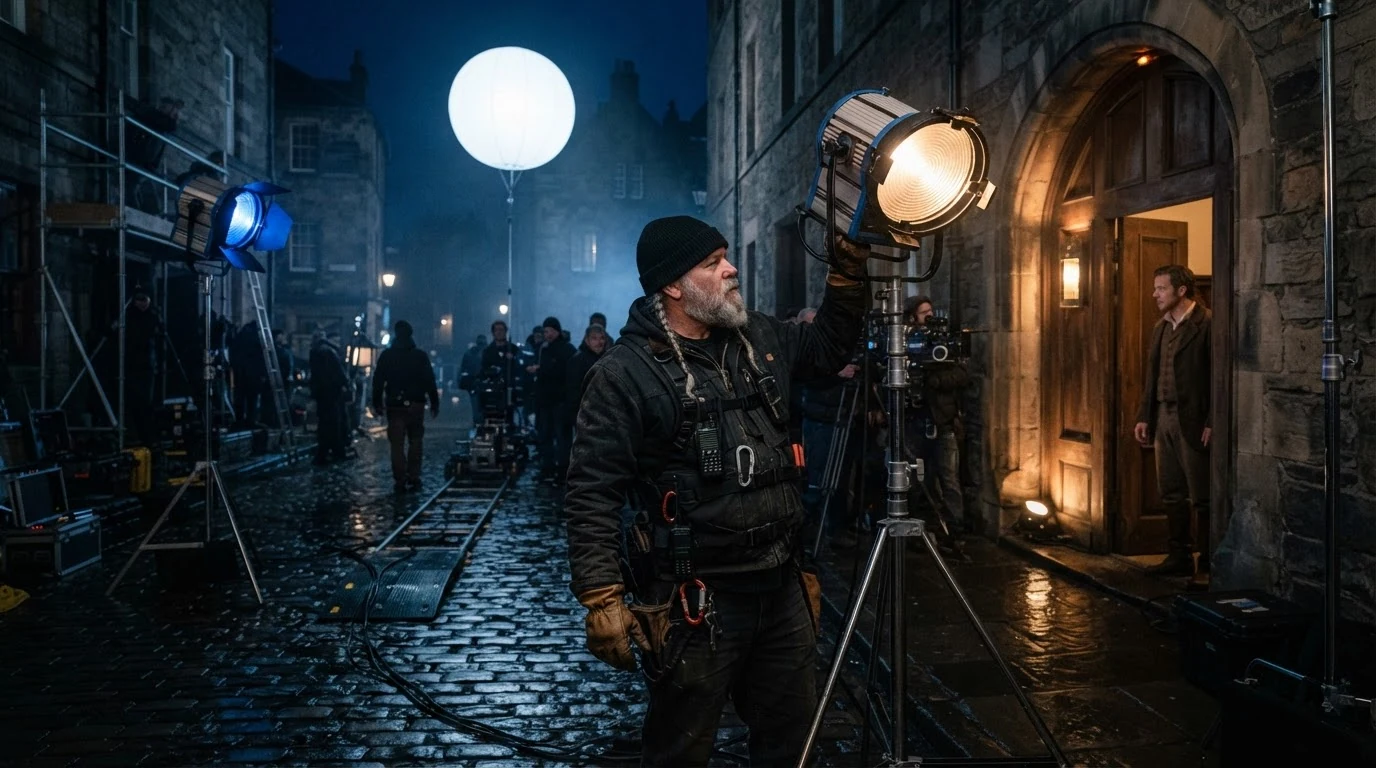
Behind-the-scenes wide shot makes the model show the gear. Naming real fixtures (tungsten Fresnel, gelled blue, balloon light, cables) gives a plausible electric setup instead of random studio lights, and warm pools against deep blue night keeps two color temperatures readable.
Open FlashBoardsNight shot on a wet cobblestone street from the camera's position: a fictional young woman with a shaved head and a long green coat stands in a stone doorway. Hard warm tungsten key from frame left makes a sharp pool of light on her; cool blue moonlight from high behind rims her shoulders and glints on the stones; one amber practical lamp above the door. Everything else falls to black. 50mm lens, eye level, light mist, 2.39:1 widescreen, film grain.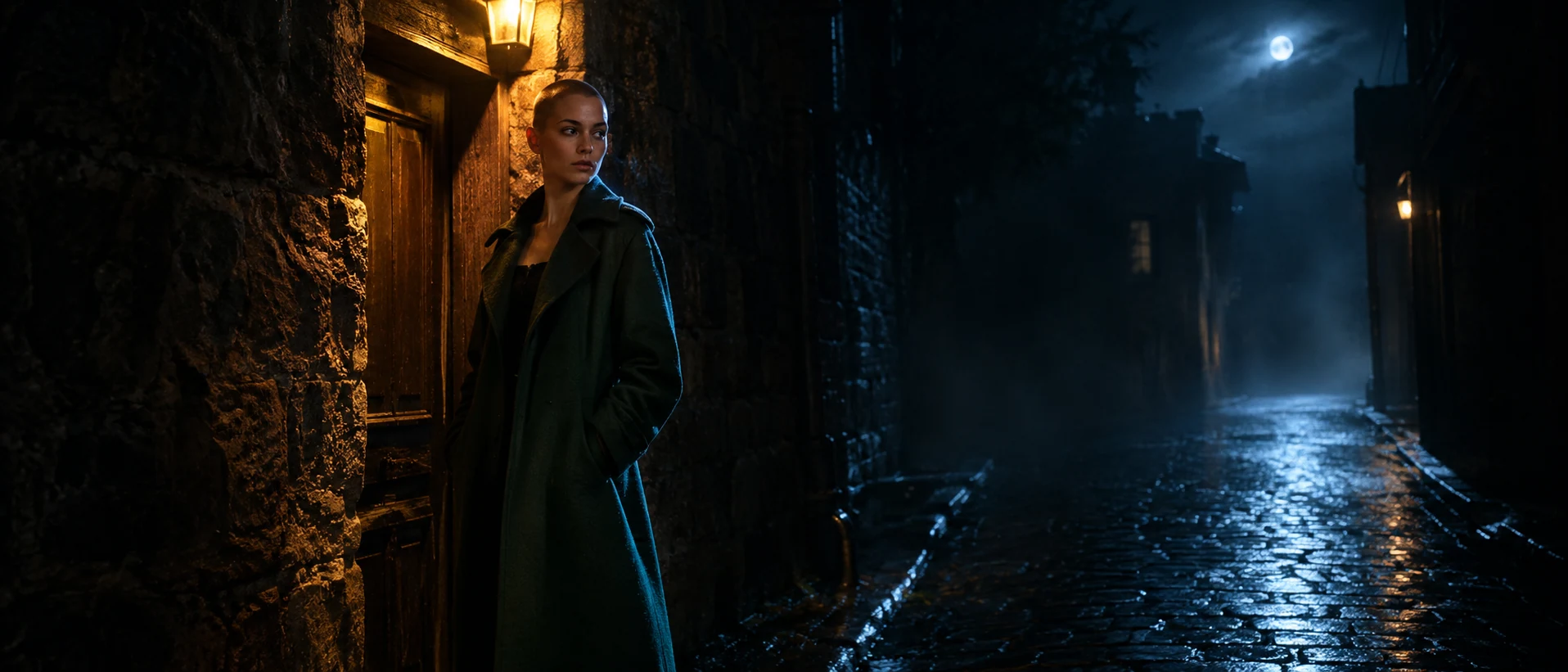
The frame the rig in recipe 1 is built for. Each source has a type, direction and color, and everything else falls to black stops the model from filling the street with light no lamp would make. Side by side, the two images show what the crew sees versus what the camera records.
Open FlashBoardsCamera: slow handheld drift to the right at eye level, keeping the gaffer in the foreground. Action: mist is already moving through the light and the balloon light sways. The gaffer tilts the Fresnel down toward the doorway, and its warm pool of light slides across the wet stones. He lifts his radio, speaks a short sentence, and steps back to watch.Slow handheld drift to the right sets a speed the model can follow; mist is already moving makes the shot alive from the first frame. The action uses only what is in the start frame, so the model moves the light instead of inventing new crew.
Open FlashBoardsCommon mistakes
- Studio instead of a set. Photoshoot or studio lights produce softboxes on seamless paper. Say film set, night exterior and name real fixtures.
- Light with no source. Give every source a position and color, and say what falls to black.
- Crowds of crew. One or two described people read better than a whole team.
- Drifting lamps in video. Restate the key source in the video prompt.
Keep the reference frames, prompts and every generated take side by side — images and video in one canvas.
FAQ
4 questionsWhat does a gaffer do on a film set?
The gaffer is the chief lighting technician. They design the lighting plan with the cinematographer, choose the lamps, calculate the power and run the electricians who build it. On the day they light each setup with the DP, call adjustments over the radio, keep the light matching between shots and answer for electrical safety.
What is the difference between a gaffer and a key grip?
The gaffer leads the electric department: lamps, cable, generators, anything powered. The key grip leads the grip department: camera supports such as dollies and cranes, plus non-electrical light shaping like flags, silks and overheads. Both work under the cinematographer, each with their own crew and best boy.
Is a gaffer an electrician?
Yes. The gaffer is the senior electrician on a production, responsible for generators, tie-ins and safe cabling as well as the light itself. Most gaffers come up as set electricians and then best boys, learning fixtures and power on the job. What makes a good gaffer is a photographer's eye for how light reads on camera.
Who does the gaffer report to?
The gaffer reports to the cinematographer, who sets the look and describes the light each scene needs. Under the gaffer are the best boy electric, the electricians, the generator operator and, on big shows, a rigging crew. The key grip is a separate department head, also working for the DP.
Related terms
5- GripFilmmaking Process & Crew
Grips build and move everything that supports the camera and shapes light without being electrical — dollies, cranes, rigs, flags, silks and C-stands; the department is led by the key grip.
- Best BoyFilmmaking Process & Crew
The best boy is the second-in-command of the electric or grip department — best boy electric under the gaffer, best boy grip under the key grip — handling crew, gear orders, paperwork and truck logistics.
- Film LightingLighting
Film lighting is the craft of shaping light for the camera — its direction, quality, color and contrast — to model faces, build space, set the time of day and carry the mood of a scene.
- Key LightLighting
The key light is the main light on a subject: it sets the direction, hardness and color of the illumination, and every other source — fill, back, practicals — is balanced against it.
- CinematographerFilmmaking Process & Crew
The cinematographer, or director of photography (DP), designs the film's image with the director — framing, lenses, lighting, exposure, camera movement and look — and leads the camera, grip and electric departments.
Further reading
Harry C. Box, Set Lighting Technician's Handbook: Film Lighting Equipment, Practice, and Electrical Distribution (Focal Press).