 FlashBoards Learn
- Learn
- Formats & Exhibition
- Anthology Film
Formats & Exhibition · Film language
Anthology Film
Also called: omnibus film, portmanteau film, anthology movie
An anthology film is a feature built from several self-contained short stories, or segments, often made by different directors and tied together by a theme, a place, an object or a framing story. Paris, je t'aime (2006), Wild Tales (2014) and New York Stories (1989) are classic examples. Also called an omnibus or portmanteau film.
- What it does
- Delivers several complete stories in one feature, so the audience compares them and the shared theme emerges from the contrast.
- Use it when
- You have ideas too short for a feature but strong enough to stand alone, or several directors who want to answer one prompt.
- Watch out
- Uneven segments sink the whole film. The weakest story sets the audience's memory of it, so order and cut ruthlessly.
- Try this prompt
Five strangers in wet coats sit around a single oil lamp in a roadside diner at night during a storm, one leaning in to tell a story, wide shot, 35mm film still.
What is an anthology film?
An anthology film runs several short narratives, each with its own beginning, middle and end, one after another inside a single feature. Among the formats a feature can take, it is the closest to a short-story collection: remove any segment and the rest still make sense.
Three names describe the same form:
- Anthology film is the general English term.
- Omnibus film is common for European multi-director projects such as Boccaccio '70 (1962), with segments by Fellini, Visconti, De Sica and Monicelli.
- Portmanteau film is British usage, tied above all to horror: Dead of Night (1945) and the Amicus anthologies such as Dr. Terror's House of Horrors (1965).
The modular logic goes back to the silent era, when one reel could carry two unrelated shorts as a split reel. The anthology turns it into one film with one idea.
How are the segments linked?
The link between parts is what makes an anthology a film rather than a playlist:
- A framing device. An outer story opens, interrupts and closes the film. In Dead of Night, guests at a country house each tell a strange story; in Black Sabbath (1963), Boris Karloff introduces Mario Bava's three tales on camera; Creepshow (1982) stages its segments as pages of a horror comic. The frame works like bookends around the collection.
- A place. Paris, je t'aime gives each short a different Paris neighborhood; Night on Earth (1991) follows five taxi rides in five cities on the same night.
- An object or character. In Tales of Manhattan (1942) a tailcoat passes from owner to owner; in Four Rooms (1995) one bellhop walks through four segments by four directors.
- A theme. Wild Tales has no frame and no recurring characters, only six stories of people pushed past their limit, all by Damián Szifron.
Multi-director anthologies like New York Stories, with segments by Martin Scorsese, Francis Ford Coppola and Woody Allen, trade unity for distinct voices side by side.
Why do filmmakers make anthology films?
- Short ideas, feature release. Premises that last fifteen minutes reach cinemas, where a lone short rarely plays.
- Contrast as meaning. Side by side, stories comment on each other, and the audience assembles the theme from repetition and difference.
- Genre fit. Horror loves the form: each segment builds to its own twist, like a campfire story. Kwaidan (1964), Trick 'r Treat (2007) and V/H/S (2012) are examples.
- Showcasing directors. Omnibus projects present several filmmakers at once.
The risk is unevenness: a weak middle story can stall the whole film.
How to structure and shoot an anthology film
- Pick the link first. Frame story, place, object or theme.
- Give each segment one clear turn. A short has room for a premise and one reversal, not a subplot. Three to six stories of 10–25 minutes fit a 90–120 minute feature.
- Order for rhythm. Open strong, put the quietest story in the middle and save the biggest payoff for last. Returns to the frame story act as breathers, like an interlude.
- Vary the look, keep one constant. Shift lens, palette or aspect ratio per story, but hold one element steady (title-card design, a location, the composer) so it plays as one film.
In FlashBoards, give each segment its own area of the board with its references, frames and notes, put the frame story in the middle, and zoom out to check that the looks differ and the constant holds.
Anthology film vs. vignette
A vignette is a short, mood-driven slice of a moment with little plot; an anthology segment is a complete story with a setup and a resolution. Jim Jarmusch's Coffee and Cigarettes (2003), a string of brief table conversations, is closer to a vignette film.
It also differs from the ensemble or hyperlink film. Short Cuts (1993) and Pulp Fiction (1994) intercut or overlap their storylines as a nonlinear narrative. An anthology runs its stories in sequence, one finishing before the next begins.
How to create a anthology film with AI
3 promptsAn anthology's most visual parts are its framing device and the shift between segments. Generate the frame story's master shot, a segment title card and the moment the storyteller starts talking, then compare them side by side on a FlashBoards board.
Frame story of an anthology film: five strangers in wet coats sit at one small table in an empty roadside diner on a stormy night. At the center, a thin elderly woman with a silver braid, a hooked nose and a green wool shawl leans toward a single oil lamp, about to tell a story. The others listen: a young mail carrier in a yellow slicker, a bald trucker with a red beard, a teenage girl in a denim jacket, a priest with round wire glasses. Rain streaks the window behind them. Warm lamplight, deep shadows at the edges. Wide shot at seated eye height, 35mm lens, 35mm film grain, cinematic film still.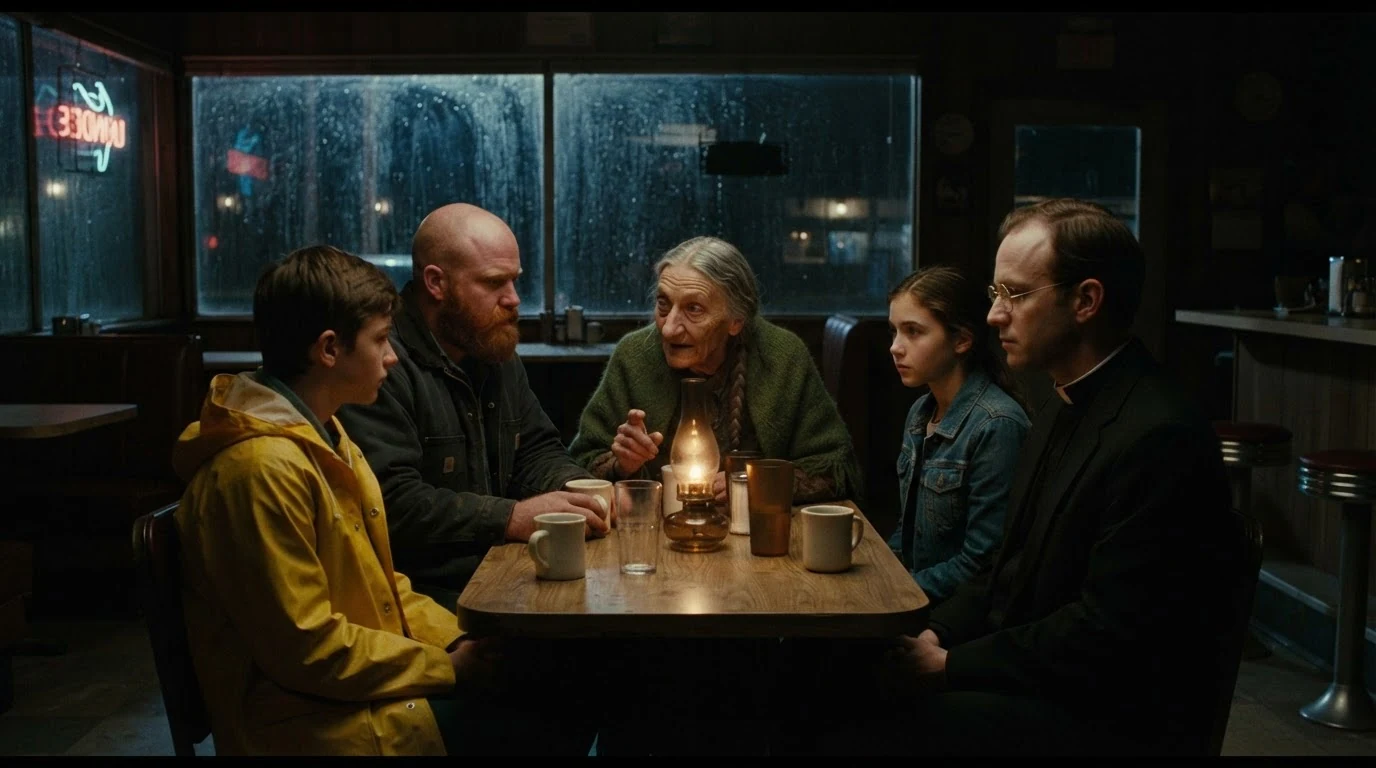
"Frame story" and "about to tell a story" set up the convention; one lamp gives the circle a focal point and campfire light. Distinct features make each listener a fictional character who could own a segment.
Open FlashBoardsSegment title card for an anthology film: a hand-painted page in an old storybook, lying open on dark wood, with the words "III. The Lighthouse Keeper" in large serif letters. Below the title, a small ink-and-watercolor illustration of a lighthouse on black rocks under a grey sky with one lit window. Soft top light, slight paper texture, visible page edges. Centered composition, 35mm film still.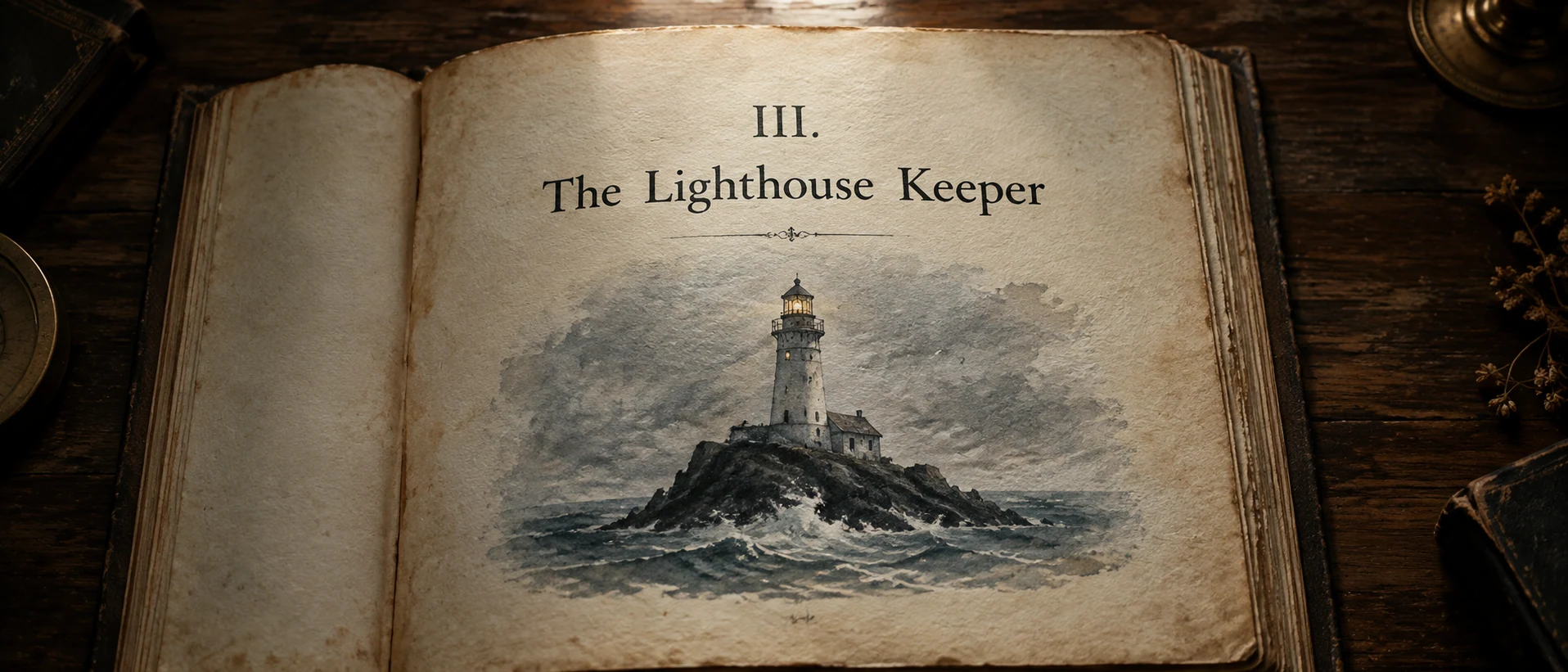
A numbered title tells the audience a new story begins, and the storybook page is a device you can repeat for every segment, changing only number, title and illustration.
Open FlashBoardsCamera: slow, steady push-in from the wide shot toward the elderly woman with the silver braid, ending on a medium close-up of her face in the lamplight. Action: from the first frame, rain runs down the window and the lamp flame flickers. The woman lifts her hand and starts to speak; the listeners lean closer one by one. At the end she looks straight across the table, eyes wide, as the lamp flares brighter on her face.A push-in onto the storyteller is the classic cue that the film is leaving the frame story. Rain and flicker keep the shot alive from the first frame.
Open FlashBoardsCommon mistakes
- Models drift toward a generic dinner party. Name the storyteller, the listening pose and the single light source.
- Crowded frames merge faces. Give each person one distinct feature and a costume color.
- Title cards garble long text. Keep titles to a few words in quotation marks.
Keep the reference frames, prompts and every generated take side by side — images and video in one canvas.
FAQ
4 questionsWhat is an anthology film?
An anthology film is a feature made of several self-contained short stories that play in sequence, from one director or several, linked by a theme, a location, a recurring object or a framing story. Well-known examples include Dead of Night (1945), New York Stories (1989), Paris, je t'aime (2006) and Wild Tales (2014).
What is the difference between an anthology, omnibus and portmanteau film?
They mean essentially the same thing: one feature built from separate stories. "Anthology" is the general term. "Omnibus" is often used for multi-director European projects like Boccaccio '70 (1962). "Portmanteau" is British usage, most associated with horror collections such as Dead of Night (1945) and the Amicus films of the 1960s and 70s.
What are some good anthology movie examples?
Horror: Dead of Night (1945), Black Sabbath (1963), Kwaidan (1964), Creepshow (1982), Trick 'r Treat (2007). Drama and comedy: New York Stories (1989), Night on Earth (1991), Paris, je t'aime (2006), Wild Tales (2014) and The Ballad of Buster Scruggs (2018), whose six westerns are framed as pages of a storybook.
Is Pulp Fiction an anthology film?
Not strictly. Pulp Fiction (1994) is divided into chapters, but its storylines share characters, overlap in time and are told out of order, so it works as one interwoven story. In a true anthology each segment is self-contained and the stories run one after another, as in Four Rooms (1995), with segments by four directors.
Related terms
2- Nonlinear NarrativeStorytelling
A nonlinear narrative tells events out of chronological order — through flashbacks, parallel timelines or reshuffled chapters — so meaning comes from how the pieces are arranged.
- Film GenresGenres
A film genre is a category of films that share recognizable conventions of story, setting, character and style — western, horror, musical, noir — letting audiences know what to expect and filmmakers play with it.
Further reading
David Bordwell and Kristin Thompson, Film Art: An Introduction — on narrative form and alternatives to single-plot structure.