 FlashBoards Learn
- Learn
- Storytelling
- Nonlinear Narrative
Storytelling · Film language
Nonlinear Narrative
Also called: nonlinear plot, non-chronological storytelling, fractured narrative
A nonlinear narrative tells a story's events out of chronological order, through flashbacks, parallel timelines, reversed or reshuffled chapters. The audience rebuilds the timeline in their head, and the order of the pieces becomes part of the meaning: it decides what we know, when we learn it and how an ending lands.
- What it does
- Moves the order of scenes away from the order of events, so suspense, irony and meaning come from arrangement.
- Use it when
- The most interesting question in your story is why or how, not what happens next.
- Watch out
- Every jump costs the audience effort; if they can't tell where and when they are, they stop caring.
- Try this prompt
Same roadside diner in two timelines: 1994 night in warm sodium orange, 16mm grain, 4:3; the same counter in 2024 daylight, cold and crisp, 2.39:1
What is a nonlinear narrative?
Every story has two orders. The story is what happened, in the order it happened. The plot is the order in which the film shows it (the Russian formalists' fabula and syuzhet). In a nonlinear narrative the two no longer match.
It is one of the core narrative techniques and a branch of story structure. A single flashback in an otherwise chronological film doesn't make it nonlinear. The label fits when the reordering is the structure and the film's effect depends on scenes arriving out of sequence. Nonlinear doesn't mean random: the writer tracks two timelines at once, the one on screen and the one in the viewer's head.
Types of nonlinear narrative, with film examples
Frame story with flashbacks
Citizen Kane (1941) opens with Kane's death, then a reporter interviews people who knew him; each account is a flashback, and they overlap.
Opening at the end or in the middle
A late moment comes first, then the film goes back to explain it: in medias res, or a flash-forward cold open, like the aftermath fragments that open episodes of Breaking Bad's second season.
Reverse chronology
Memento (2000) runs its color scenes backward while black-and-white scenes move forward; the strands meet at the end, sharing the hero's missing memory with the audience.
Parallel timelines
The Godfather Part II (1974) alternates young Vito's rise with Michael's reign decades later. Dunkirk (2017) intercuts a week on the mole, a day at sea and an hour in the air.
Shuffled chapters
Pulp Fiction (1994) arranges its episodes out of order, so a character killed mid-film walks out of the final scene alive.
Repetition and memory
Rashomon (1950) replays one crime through conflicting testimonies, close kin to the unreliable narrator. Eternal Sunshine of the Spotless Mind (2004) travels backward through a relationship as it is erased from memory.
Why do filmmakers use nonlinear storytelling?
- To change the question. Once the audience knows the ending, they ask how and why instead of what next.
- To create irony. Knowing a fate before the character does makes ordinary scenes heavy.
- To put the audience inside a mind. Memory and trauma aren't chronological; Memento makes the viewer feel the hero's condition.
- To compare. Parallel periods comment on each other, as father and son do in The Godfather Part II.
- To hide a reveal. A plot twist can sit in a scene already watched with the wrong assumptions.
How to write and cut a nonlinear story
Write it chronologically first. Build the story timeline, then decide the screen order. Reshuffling won't fix a broken story.
Give every timeline a signature. Viewers need to know when they are within a second of each cut. Use grade, color temperature, grain, aspect ratio, camera style, costume and props.
Anchor with repeated places and objects. A location or prop seen in two timelines lets the viewer measure the gap: same diner, different decade.
Design the transitions. A match cut, a sound bridge, a title card or a counter says the jump is deliberate. When strands run simultaneously, cross-cutting sets the rhythm.
In FlashBoards, lay the film out twice on one board, one row in story order and one in screen order, with each timeline's reference frames and grade notes beside it, so the jumps are visible before anything is shot.
Nonlinear vs. linear narrative
A linear narrative shows events in the order they happen; plot and story timeline are the same.
The test: could you re-edit the film into chronological order without losing its meaning? A linear film survives it. Memento or Pulp Fiction in chronological order would be different films, with different suspense and a different ending. Choose nonlinear only when the order does work the story needs.
How to create a nonlinear narrative with AI
4 promptsA nonlinear structure lives in the edit, but it only reads if each timeline has its own look. Design those looks before the shoot, then animate one plate to test a cut. On a FlashBoards board, keep the timeline plates next to your reference frames. The fourth prompt re-shoots a real film shot from a text description alone, and the original plays next to the result so you can compare.
Timeline one, 1994: a roadside diner at night. A waitress in her twenties with a tall auburn ponytail, a small mole above her upper lip and a mint-green uniform leans on the counter, sliding a brass motel key with a red plastic tag toward a customer out of frame. Medium shot, 35mm lens, camera at counter height. Warm sodium-orange light through the window, neon reflections on chrome, 16mm film texture with visible grain, soft halation, slightly faded colors. Cinematic film still.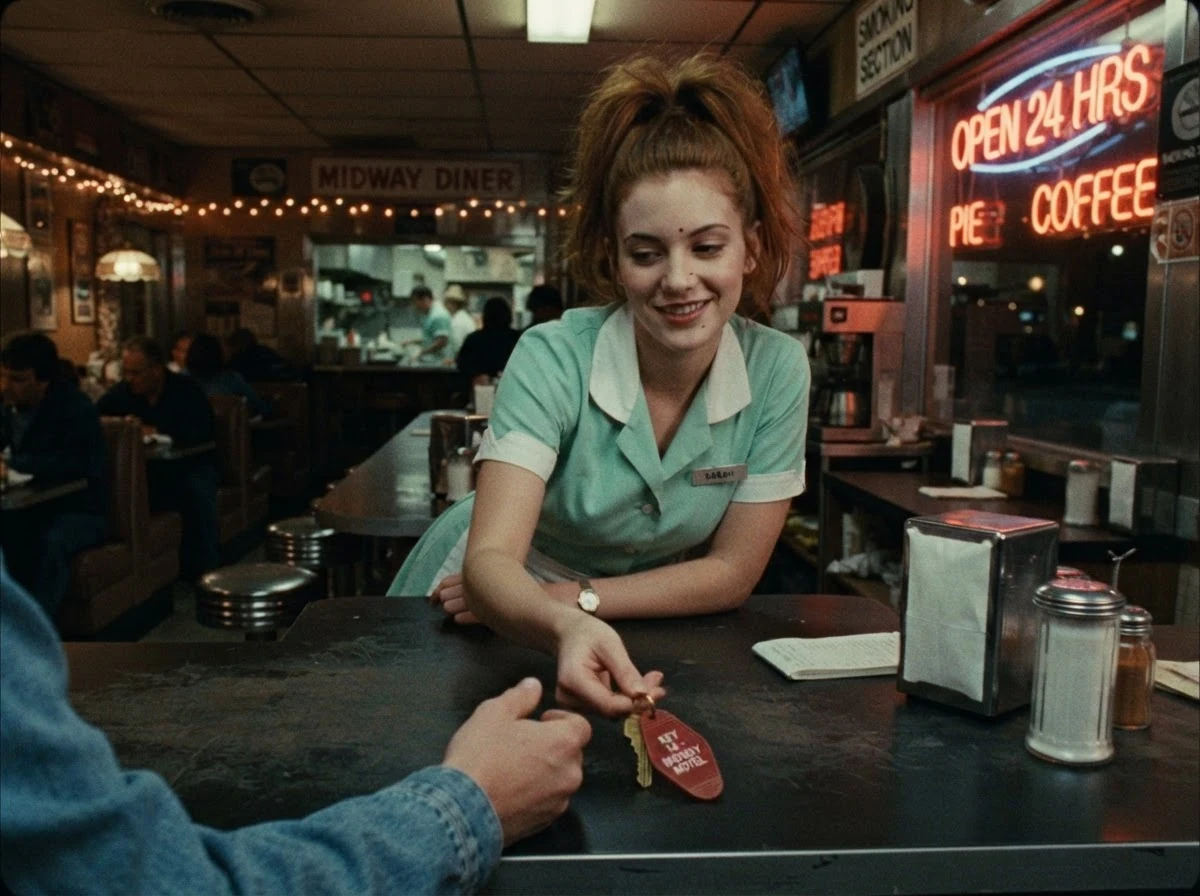
The period lives in texture and color, not the date: "16mm film texture," "halation," "sodium-orange light" and the 4:3 frame are this timeline's signature. The key with a red tag is the anchor prop for timeline two; the auburn ponytail and mole make her a specific invented person.
Open FlashBoardsTimeline two, 2024: the same roadside diner in flat morning daylight, now half-closed, chairs stacked on tables. A woman in her late fifties with grey-streaked auburn hair cut short, a small mole above her upper lip and reading glasses pushed up on her head stands alone behind the chrome counter, holding a brass motel key with a red plastic tag in her open palm and looking at it. Wide shot, 40mm anamorphic lens, eye level. Cool blue-grey grade, crisp clean digital image, deep focus. Cinematic film still, widescreen.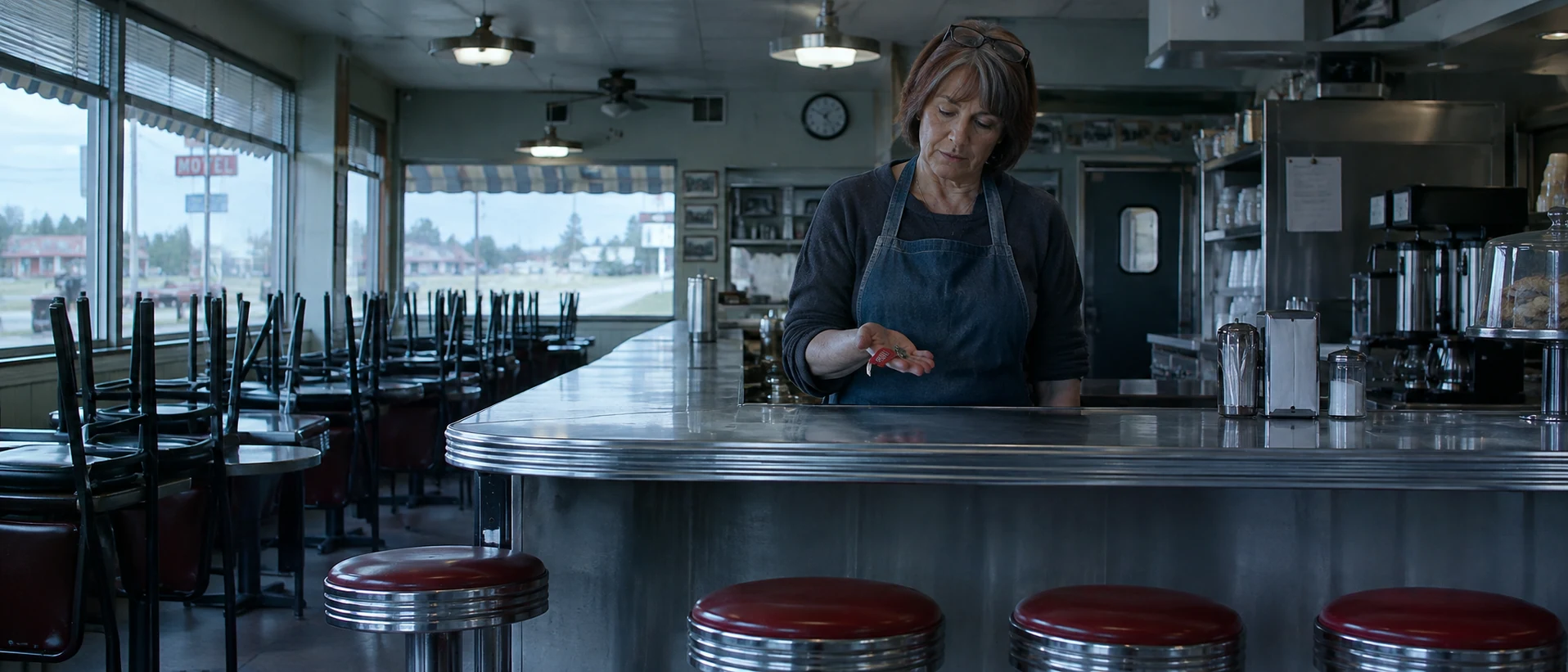
Every cue flips: day against night, cold against warm, digital against grain, 21:9 against 4:3. Only the place, the mole, the hair color and the key carry over, which is what lets viewers connect the timelines without a title card.
Open FlashBoardsCamera: slow push-in along the counter toward the waitress, steady, covering about a meter over the whole shot. Action: from the first frame her hand is already sliding the brass key with the red tag across the counter, and the neon sign outside flickers orange on the chrome. In the middle she lifts her hand off the key and looks up toward the customer out of frame. At the end she smiles slightly and glances down at the key on the counter, while the orange light keeps flickering across her face."Already sliding" starts motion on frame one. Ending on a look down at the key matches recipe 2's eyeline and object, giving you a ready match cut from 1994 to 2024.
Open FlashBoards{
"output": "Full-screen live-action scene from Eternal Sunshine of the Spotless Mind (2004), from its very first frame: one single continuous shot. Grainy 35mm night footage, 1.85:1 frame, the camera looking straight down onto a frozen river at night: a wide sheet of gray-blue ice with frosted white patches, a star-shaped web of thin white cracks radiating from one point in the left third of the frame, soft cold blue light, deep navy shadows, very dark and desaturated except the woman's blue hair.",
"characters": {
"S1": {
"name": "Clementine, played by Kate Winslet",
"look": "slim woman, bright electric-blue hair fanned out on the ice, long quilted mauve-brown puffer coat reaching her shins, blue mittens, tan fur-lined boots",
"voice": "soft, husky, curious"
},
"S2": {
"name": "Joel, played by Jim Carrey",
"look": "man in a black knit beanie pulled low, black wool coat, dark trousers and dark shoes, bare hands",
"voice": "quiet, gentle, a little shy"
}
},
"shots": [
{
"shot": 1,
"camera": "locked-off static top-down shot from high directly above, wide lens, the camera looking straight down at the ice; the couple lies in the centre-right of the frame, small, surrounded by open ice; the framing never changes, no movement, no zoom",
"action": [
"BEGINNING: alive from the first frame, S1 and S2 lie flat on their backs side by side on the ice, bodies on a diagonal with their heads toward the upper right of the frame and their boots toward the lower left; S1 on the screen-left side, her blue hair spread on the ice, her head tilted over onto S2's shoulder, her blue mitten resting on the ice at her screen-left side; S2 on the screen-right side, face turned up toward the camera, both his hands resting on his stomach.",
"THEN: S2's bare hand on the screen-left side, the one between them, slides across his stomach, then rises straight up toward the camera, index finger pointing at the sky above; his lips move with his line; S1's eyes follow his finger.",
"THEN: S2 lowers the hand back onto his stomach; S1, head still on his shoulder, looks up and asks her question, her lips moving; S2 stays still, gazing up.",
"THEN: S2 raises the same hand again, pointing up and slightly toward the upper left, arm stretched past S1's face, and answers her.",
"END: S2's fingertip draws a small curve and a cross in the air while he explains; S1 keeps her head on his shoulder, eyes on the sky; nobody sits up, their legs and boots stay still on the ice the whole time."
],
"dialogue": [
{
"speaker": "S1",
"on_screen": true,
"when": "from the first frame, the tail of a sentence",
"delivery": "soft, settling in",
"line": "<d>[English] Okay.</d>"
},
{
"speaker": "S2",
"on_screen": true,
"when": "as his hand rises to point up for the first time",
"delivery": "quiet, pleased",
"line": "<d>[English] Here's Osidius.</d>"
},
{
"speaker": "S1",
"on_screen": true,
"when": "after he lowers his hand, in the middle of the shot",
"delivery": "curious, half whisper",
"line": "<d>[English] Where?</d>"
},
{
"speaker": "S2",
"on_screen": true,
"when": "as he raises his hand the second time",
"delivery": "gentle, patient",
"line": "<d>[English] Right there. See?</d>"
},
{
"speaker": "S2",
"on_screen": true,
"when": "at the very end, while his finger traces the shape",
"delivery": "soft, explaining",
"line": "<d>[English] Sort of a swoop and a cross.</d>"
}
]
}
],
"sound": {
"ambience": "near-silent winter night, a faint wind across open ice, a low creak of ice heard from far away, the rustle of her quilted coat",
"speech": "exactly these spoken phrases, each said once, in this order",
"never_spoken": "no narration and no voice-over: the descriptions, performance notes and step words of this prompt are never spoken aloud",
"music": "a film score under the scene, always below the voices: a sparse, tender piano figure with a faint shimmering pad, wistful and quiet",
"subtitles": "none"
}
}Remakes the frozen-river shot from the pre-credits opening of Eternal Sunshine of the Spotless Mind (2004), dir. Michel Gondry, DP Ellen Kuras, a scene the viewer later learns comes after the erasure: the prompt keeps the overhead static frame, the cracked ice, Clementine's head on Joel's shoulder and his hand pointing up twice.
A single shot can't be nonlinear, so the prompt rebuilds the shot whose place is the trick: the overhead wide that looks like a first date and is really near the end of the story. It keeps the locked top-down camera, the pair's diagonal, his two points at the sky and the exact lines in order.
Open FlashBoardsCommon mistakes
- Models blend periods: a 1994 scene gets modern signage. Name the era's light and texture ("sodium-orange," "16mm grain"), not just the year.
- Separately generated timelines drift in character design. Repeat the fixed features and prop word for word in both prompts.
- A video model can't jump in time inside one shot; generate each timeline as its own clip and cut.
Keep the reference frames, prompts and every generated take side by side — images and video in one canvas.
FAQ
4 questionsWhat is a nonlinear narrative in film?
A nonlinear narrative presents a film's events out of chronological order, using flashbacks, flash-forwards, parallel timelines, reverse chronology or shuffled chapters. The audience reconstructs the real sequence while watching, and the chosen order shapes suspense and meaning. Memento, Pulp Fiction and Citizen Kane each reorder time in a different way.
What are some famous nonlinear movies?
Citizen Kane (1941) tells a life through overlapping flashbacks. Rashomon (1950) replays one event from several accounts. Pulp Fiction (1994) shuffles its chapters, Memento (2000) runs backward, and Dunkirk (2017) intercuts three timelines of different lengths. Eternal Sunshine of the Spotless Mind (2004) moves backward through erased memories.
Is a flashback the same as a nonlinear plot?
No. A flashback is one device: a past scene inserted into the present story. A film is nonlinear when reordering time is its organizing principle and its meaning depends on scenes arriving out of sequence. A chronological film with one or two flashbacks is still linear; Citizen Kane, built from flashback after flashback, is not.
How do you keep a nonlinear story from confusing the audience?
Give each timeline a distinct signature: grade, grain, aspect ratio, camera style, costume and music. Anchor jumps with repeated locations or props, and use deliberate transitions such as match cuts, title cards or counters. Then test the cut on viewers who haven't read the script.
Related terms
6- FlashbackStorytelling
A flashback interrupts the present story to show an earlier event, usually signalled by a dissolve, a change of color or grade, or a sound cue, to reveal backstory or motive.
- Flash-ForwardStorytelling
A flash-forward jumps ahead to show events that will happen later, creating suspense about how the story will get there.
- In Medias ResStorytelling
In medias res (Latin for 'into the middle of things') opens the story mid-action, then fills in how we got there through dialogue or flashback.
- Cross-CuttingEditing
Cross-cutting alternates between two or more lines of action happening in different places, usually at the same time, so each strand builds tension or meaning against the other.
- Unreliable NarratorStorytelling
An unreliable narrator is a storyteller — through voice-over or a point-of-view protagonist — whose account the audience can't fully trust because they lie, misremember or misread what happens.
- Story StructureStorytelling
Story structure is the order and shape of the events that carry a story from setup to resolution; models like the three-act structure, Freytag's pyramid, the hero's journey or Save the Cat are different maps of it.
Further reading
David Bordwell and Kristin Thompson, Film Art: An Introduction (story vs. plot). David Bordwell, Narration in the Fiction Film (1985).