 FlashBoards Learn
- Learn
- Storytelling
- Bookends
Storytelling · Film language
Bookends
Also called: bookend structure, framing device, mirrored opening and ending
Bookending is a structure in which a film's opening and closing scenes mirror each other: the same place, image, composition, line or sound returns at the end. Because the frame repeats while the context has changed, the ending becomes a measuring stick for how far the characters, or the world, have moved.
- What it does
- Makes the ending rhyme with the opening so the audience feels the story close and sees exactly what changed.
- Use it when
- The film is about transformation, return or loss, and one image can hold the before and the after.
- Watch out
- A mirror with nothing changed is just repetition. Keep the frame, change one meaningful thing.
- Try this prompt
Opening image: a ten-year-old boy in a red knitted hat sits alone at the end of a wooden pier in dawn fog, centered wide shot, 35mm film still.
What is bookending in film?
Like two bookends holding a shelf of books, a pair of matching scenes holds the story between them. Among the tools of storytelling, bookends are a decision about the edges of the story structure: the first image the audience sees and the last one they carry out are designed as a pair.
The term covers two related things:
- Mirrored scenes. The ending repeats a composition, location, action or line from the opening. Forrest Gump (1994) opens with a white feather drifting down to Forrest's feet and ends with a feather lifting back into the sky.
- A framing device. An outer story opens and closes the film around the main one: the grandfather reading to his sick grandson in The Princess Bride (1987).
Why do filmmakers use bookends?
Bookends turn change into something you can see. A character arc stays abstract until the same frame shows a different person in it.
- To measure change. The Godfather (1972) opens in Vito Corleone's dark office, where a supplicant asks for a favor on a wedding day, and ends with Michael receiving the kiss on the hand as a door closes on Kay. Same ritual, new man.
- To close a circle. The Searchers (1956) opens as a cabin door swings open onto the desert and ends as a door closes on Ethan, who stays outside. He brings the family home but can't enter it.
- To recast the opening. Arrival (2016) returns to images from its first minutes and makes the audience read them differently.
Types of bookends
Visual rhyme. The last shot repeats the first shot's framing. Citizen Kane (1941) opens at the "No Trespassing" sign on the fence of Xanadu and, after the burning sled, pulls back out to the same fence and sign.
Frame story. An outer narrator opens and closes the film. Saving Private Ryan (1998) begins and ends with an elderly veteran at a military cemetery in Normandy, which turns the war story into a memory. This overlaps with the prologue and the epilogue, but a true bookend makes the two ends answer each other.
Circular structure. Pulp Fiction (1994) opens and closes in the same diner robbery, which works because its nonlinear narrative has reshuffled everything between.
Sound bookends. A narrator or song returns at the end, like the same song under the first and last scenes of The Graduate (1967).
How to plan and shoot bookend scenes
Bookends are planned in prep, not found in the edit.
- Write both ends together. Decide what the ending must prove, then design the opening so it can be repeated with that one difference.
- Lock the camera position. Record height, lens, distance and the floor mark for the first shot, and repeat them exactly. A changed lens reads as a changed world.
- Change one variable. Age, time of day, season, who shares the frame, a door open or closed. The fewer differences, the louder each one is.
- Consider reversing the move. A slow push-in at the start and a pull-back at the end reads as the film breathing in and out.
- Let a motif carry it. An object or line that recurs mid-film makes the final return feel earned.
In FlashBoards, pin the opening and closing frames side by side on one board, with notes on camera height, lens and what must differ. Any drift in the rhyme shows at a glance.
Bookends vs. callback
A callback repeats any earlier moment, a joke from act two or a line from the midpoint, and can happen many times.
Bookends tie the two outer edges of the work together, and there is only one pair. A callback becomes a bookend only when it closes the film on the image or scene that opened it.
An in medias res opening that the story later catches up to is a structural loop; it becomes a bookend only if the ending also mirrors the opening in meaning, not just in chronology.
How to create a bookends with AI
3 promptsA bookend is two images, so generate both: the opening frame first, then the closing frame from the same camera sentence with one thing changed. Put them side by side on a FlashBoards board to check that the rhyme holds.
Opening image: a ten-year-old boy with a bright red knitted hat and a too-big green raincoat sits alone at the end of a narrow wooden pier on a still lake, seen in three-quarter back view, holding a bamboo fishing rod. Dawn, thick pale fog, cool blue light. Symmetrical centered wide shot from the shore end of the pier, camera at standing eye height, 35mm lens. Muted colors, 35mm film grain, cinematic film still.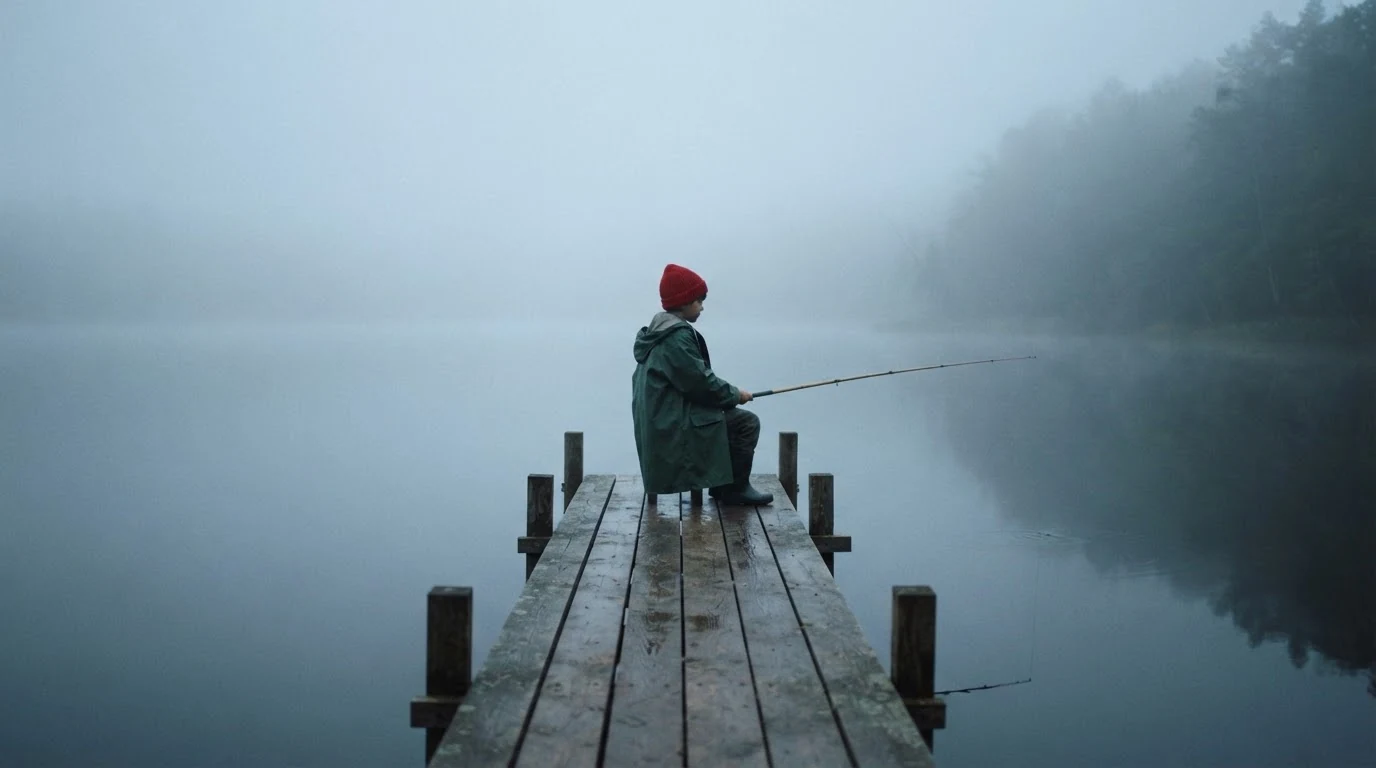
"Symmetrical centered wide shot", "from the shore end of the pier" and "35mm lens" fix a composition you can repeat word for word. The red hat is the detail that will survive into the second frame.
Open FlashBoardsClosing image: a broad-shouldered man of about fifty with a grey beard, a faded red knitted hat and a faded green raincoat sits at the end of a narrow wooden pier on a still lake, seen in three-quarter back view, beside a seven-year-old girl with two dark braids holding a bamboo fishing rod. Some planks are newer, lighter wood. Late sunset, warm amber light, clear air. Symmetrical centered wide shot from the shore end of the pier, camera at standing eye height, 35mm lens. 35mm film grain, cinematic film still.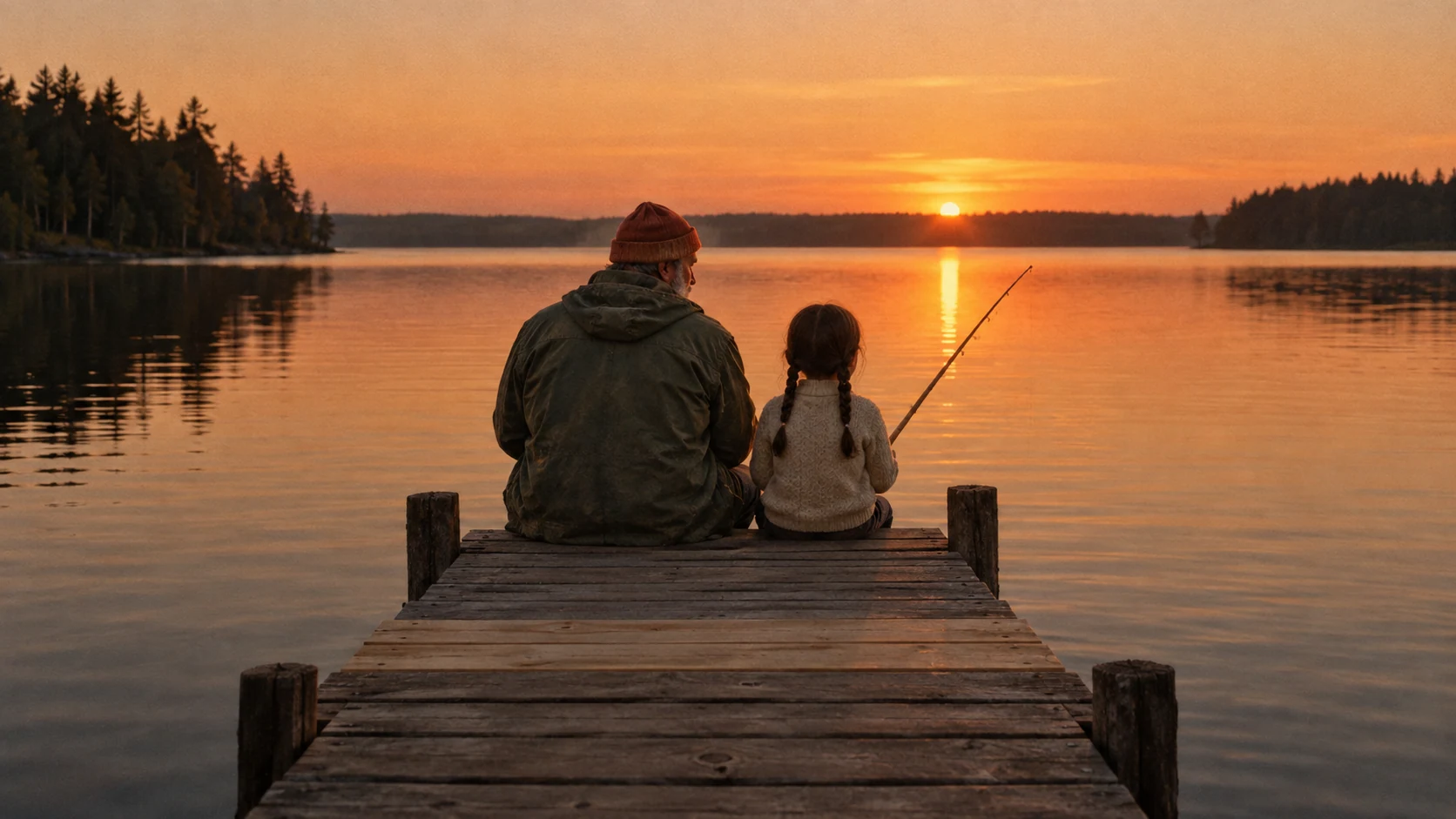
The camera sentence is copied from recipe 1; only age, a second person, repaired planks and the light change. Same frame, a different life.
Open FlashBoardsCamera: slow, steady push-in along the pier toward the boy over eight seconds, starting wide and ending on a medium-wide shot of him from behind. Action: from the first frame, fog drifts left to right across the water and the boy swings his legs over the edge. Midway he flicks the rod and the line lands with small rings spreading on the water. At the end he sits still, watching the float in the fog.The push-in draws the audience into the film; plan the closing shot as the reverse, a pull-back from the man and the girl. Drifting fog and swinging legs keep the shot alive from the first frame.
Open FlashBoardsCommon mistakes
- The two frames drift apart in angle or lens. Copy the camera sentence verbatim and change only subject and light.
- The aged character doesn't read as the same person. State the age and keep one specific costume detail visible from the camera: the same hat, the same coat.
- Too many changes blur the point. Pick one or two differences the story is about.
Keep the reference frames, prompts and every generated take side by side — images and video in one canvas.
FAQ
4 questionsWhat is bookending in film?
Bookending is a structure in which a film's opening and closing scenes mirror each other through the same location, image, composition, line or sound. Because the frame repeats while the characters have changed, the final scene measures the story's journey and gives the film a strong sense of closure.
What are examples of bookend scenes in movies?
Classic examples include the doorway shots that open and close The Searchers (1956), the "No Trespassing" sign in Citizen Kane (1941), the feather in Forrest Gump (1994), the cemetery scenes framing Saving Private Ryan (1998) and the diner robbery that opens and closes Pulp Fiction (1994).
What is the difference between bookends and a callback?
A callback repeats any earlier moment, a line, joke or image, and can appear anywhere in a film. Bookends specifically connect the very beginning and the very end. A callback turns into a bookend only when the film closes on the image or scene it opened with, so the two edges of the story read as a pair.
How do you mirror an opening and closing shot?
Plan both shots in prep. Record the first shot's camera height, lens, distance and position, then repeat them exactly for the last shot and change one meaningful variable: the character's age, the time of day, who shares the frame or whether a door is open. Reversing the camera move strengthens the rhyme.
Related terms
6- PrologueStorytelling
A prologue is an opening section set apart from the main story — often in another time or place — that establishes backstory, tone or a mystery the film will pay off.
- EpilogueStorytelling
An epilogue (or coda) is a short final section after the main story is resolved, often jumping ahead in time to show where the characters ended up.
- MotifStorytelling
A motif is an image, sound, object or line that recurs through a film and gathers meaning with each return, supporting the theme.
- Match CutEditing
A match cut joins two different shots through a shared shape, movement, composition or sound — the bone that becomes a satellite in 2001 — so the cut draws a link between them.
- Nonlinear NarrativeStorytelling
A nonlinear narrative tells events out of chronological order — through flashbacks, parallel timelines or reshuffled chapters — so meaning comes from how the pieces are arranged.
- Story StructureStorytelling
Story structure is the order and shape of the events that carry a story from setup to resolution; models like the three-act structure, Freytag's pyramid, the hero's journey or Save the Cat are different maps of it.
Further reading
Robert McKee, Story (1997) — on the relationship between opening and ending. Blake Snyder, Save the Cat! (2005) — the Opening Image and Final Image beats.