 FlashBoards Learn
- Learn
- Formats & Exhibition
- Captions and Subtitles
Formats & Exhibition · Film language
Captions and Subtitles
Also called: caption, subtitles, closed captions, SDH
Subtitles are on-screen text that translates or transcribes the dialogue. Captions go further: they also describe sounds, music and who is speaking, for viewers who are deaf or hard of hearing. Closed captions can be switched off, open captions are burned into the image, and in silent cinema a caption meant an intertitle card.
- What it does
- Puts the soundtrack into words on screen, as a translation (subtitles) or a full account of dialogue and sound (captions).
- Use it when
- Your film crosses a language border, plays on muted feeds, or has to be accessible to deaf and hard-of-hearing audiences.
- Watch out
- Busy, bright lower thirds and fast cutting make text unreadable; frame and pace with the subtitle band in mind.
- Try this prompt
Cinematic two-shot, faces in the upper two-thirds, bottom fifth of the frame dark and empty, ready for subtitles
What are captions and subtitles?
Both are timed text laid over the picture and synced to the soundtrack. The difference is who they are written for.
Subtitles assume the viewer can hear. They carry the words of the dialogue, usually as a translation, and nothing else: no sound effects, no music cues, no speaker labels.
Captions assume the viewer cannot hear. They transcribe the dialogue in the same language and add what the ear would catch: [door creaks], ♪ slow piano ♪, MARA: (whispering) Stay down.
Usage varies. In the UK "subtitles" covers both, and the accessible version is subtitles for the deaf and hard of hearing (SDH). In the US, captions are the accessibility track and subtitles are translation. Both are part of how a film reaches its audience, which is why they sit in formats and exhibition.
Captions vs. subtitles: closed, open, SDH and forced
The labels on a streaming menu or a delivery spec map onto four tracks:
- Closed captions (CC) live in a separate track the viewer switches on. Broadcast encodes them in the signal; streaming platforms deliver sidecar files (SRT, WebVTT, TTML).
- Open captions are burned into the picture and always visible, which is why muted social feeds rely on them.
- SDH is styled like subtitles but carries sound descriptions and speaker IDs, so one file serves every device.
- Forced subtitles appear even with subtitles off: a scene in another language inside an English film, or a sign the audience must read.
Rule of thumb: subtitles translate speech, captions translate sound.
Intertitles: the original film caption
Before synchronized sound, a caption was something else. In silent film, dialogue and narration were printed on cards and cut between shots as full-screen intertitles. Nosferatu (1922) uses ornate cards to set time and place and to quote letters and books, making the text part of the film's design.
Intertitles stop the picture, so the editor budgets screen time for reading and every card breaks the flow of images. With sound, the cards mostly vanished and caption came to mean text under the image, not between shots.
How filmmakers use subtitles on purpose
Most subtitles are added by a distributor and meant to be invisible. A few directors make them part of the frame.
- Annie Hall (1977) runs subtitles under a polite balcony conversation to reveal what Alvy and Annie are really thinking; the joke lives in the gap.
- Man on Fire (2004) throws its subtitles around the frame, changing size and stressing single words, in step with its jittery cutting.
- John Wick (2014) sets its Russian dialogue in stylized, colored type, so the subtitles carry attitude as well as meaning.
When Bong Joon-ho accepted a Golden Globe for Parasite in 2020, he called subtitles a one-inch barrier worth getting over.
How to shoot and cut a film that subtitles well
Subtitles are added in post, but readable subtitles start on set.
- Keep the lower band clean. Text lives in the bottom fifth of a 16:9 frame. Keep eyes, mouths and key props in the upper two-thirds, and watch for bright skies or white tablecloths where white text must read.
- Know your format. For scope films on 16:9 screens, home-video subtitles sometimes sit in the black bars of the letterboxing, off the image.
- Cut for reading time. Style guides cap a subtitle at two lines of about 40 characters, held from a little over a second to about seven. Fast overlapping dialogue gets condensed into paraphrase.
- Avoid text bridging a cut. A subtitle hanging across a shot change makes the eye re-read it.
- Deliver clean. Keep a textless master and separate timed text files for every territory.
On a FlashBoards board you can lay out subtitle-heavy scenes with the text band marked, keep the translated script beside the frames and see which shots leave room before you lock the edit.
Subtitles vs. dubbing
There are two ways across a language border: translate in text or replace the voices. Dubbing keeps the eyes on the image but loses the original performances; subtitles keep the actors' voices but pull the eye down to read. Streaming now offers both on the same title.
How to create a captions and subtitles with AI
3 promptsSubtitles belong in the edit, not inside a generated image, so the AI work is composing shots that leave room for them and building text cards for intertitle sequences. Keep the takes, script and text files together on one FlashBoards board.
Cinematic medium two-shot at a street food stall in a rain-damp alley at night. A woman in her fifties with a silver bob, round tortoiseshell glasses and a green raincoat leans across the counter toward a lanky young cook with a shaved head and a white apron. Both faces sit in the upper two-thirds of the frame; the bottom fifth is dark, empty wooden counter. 35mm lens at eye level, warm tungsten bulbs, teal shadows, shallow depth of field.
"Upper two-thirds" and "bottom fifth is dark, empty wooden counter" build the subtitle band into the composition, so white text will read against it.
Open FlashBoardsA 1920s silent film intertitle card in a 4:3 frame: black background, thin white double-line border with art nouveau corner ornaments, centered hand-lettered white serif text reading "The tide came in, and she did not return." Black-and-white, nitrate grain, faint scratches, soft vignette.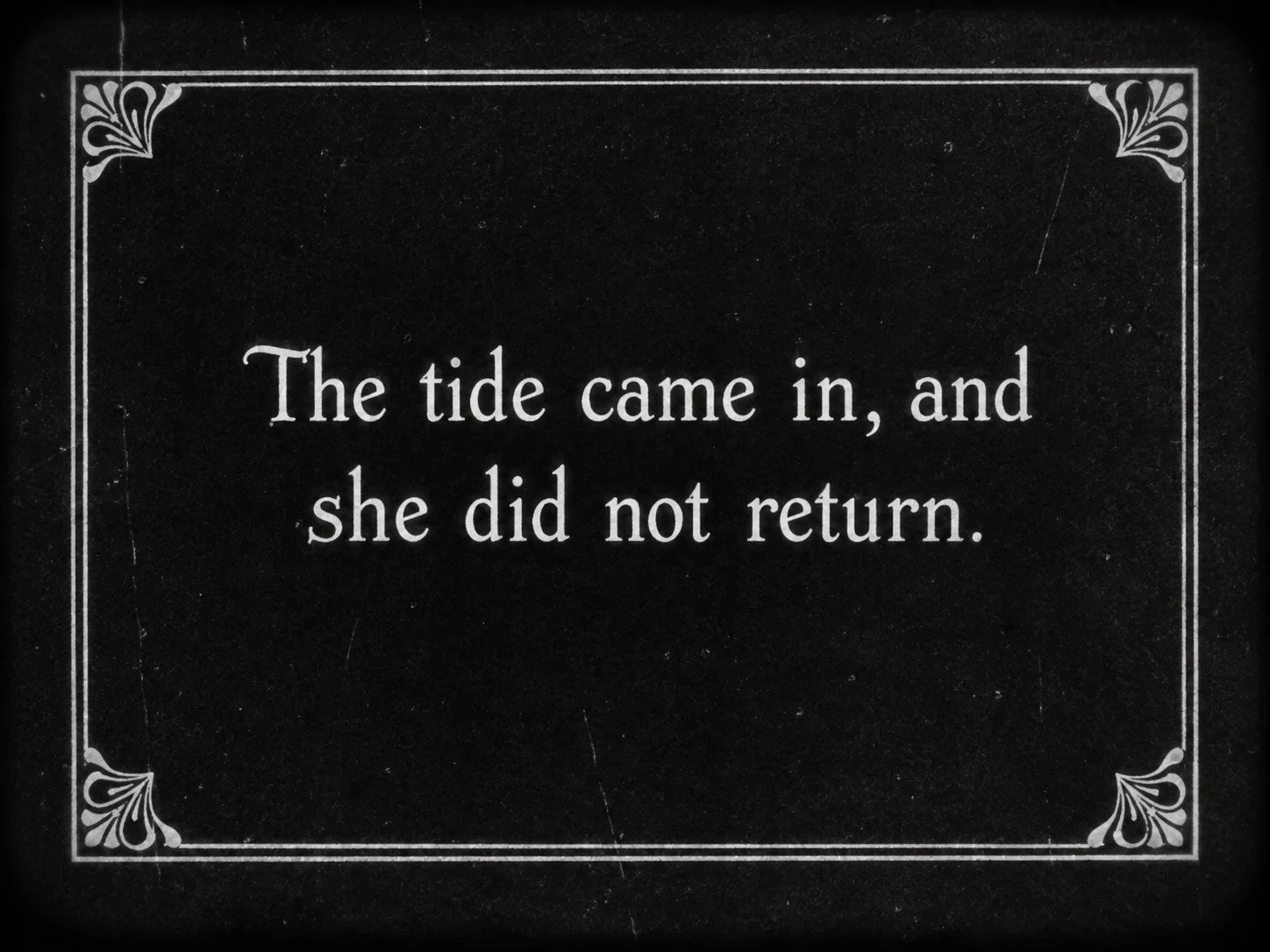
The second take shows the older meaning of caption. Quoting the exact line gives the model text to letter; "nitrate grain" and "scratches" age the card.
Open FlashBoardsCamera: locked on a tripod at eye level, drifting very slowly left across the whole shot. Action: The woman in the green raincoat is already talking as the shot begins, tapping the counter with two fingers. The cook looks up at her and answers with a short shrug. Steam rises between them and rain drips from the awning. The dark counter along the bottom of the frame stays still and empty."Already talking as the shot begins" makes the clip alive from the first frame; restating that the counter "stays still and empty" protects the subtitle band.
Open FlashBoardsCommon mistakes
- Models fill the bottom of the frame with props or crop faces low. Name what fills the empty band ("dark, empty counter").
- Asking for subtitles inside the image bakes in misspelled text. Add real subtitles in the edit.
- In video, say what characters do while speaking; a vague "they talk" gives frozen faces.
Keep the reference frames, prompts and every generated take side by side — images and video in one canvas.
FAQ
5 questionsWhat is the difference between subtitles and captions?
Subtitles assume the viewer can hear and carry only the dialogue, usually translated. Captions assume the viewer cannot hear, so they transcribe the dialogue in the same language and add speaker names, sound effects and music cues. If the text says a door slams or a phone buzzes, it is a caption, not a subtitle.
What is the difference between closed captions and open captions?
Closed captions live in a separate track the viewer turns on or off, like the CC button on a TV or streaming player. Open captions are burned into the picture and always visible, common on social video that autoplays muted and on some festival screening copies.
What does SDH mean on subtitles?
SDH stands for subtitles for the deaf and hard of hearing. It looks like a regular subtitle track but adds what captions carry: who is speaking, sound effects in brackets and music descriptions. Streaming services often offer SDH in place of traditional closed captions.
What is a caption in silent film?
In silent cinema, a caption was an intertitle: a card of printed dialogue or narration cut between shots and shown full screen. Films like Nosferatu (1922) used them to quote lines, name places and move the plot. With sound, caption came to mean text running under the image.
What are forced subtitles?
Forced subtitles appear even when the viewer has subtitles off. They translate passages the audience must understand, such as a scene in another language inside an English film, or on-screen text like a sign or a message. They belong to the intended version of the film.
Related terms
4- DubbingSound & Music
Dubbing replaces a film's original dialogue with a new recording — usually a translation performed by voice actors and fitted to the lip movements on screen.
- Silent FilmFilm History & Theory
Silent film is cinema without synchronized recorded dialogue, dominant until the late 1920s: stories were told through pantomime, intertitles, expressive lighting and live music in the theater.
- Location SoundSound & Music
Location sound is everything recorded on set during the shoot — dialogue, ambience, room tone, wild lines — by the production sound mixer and boom operator, in sync with picture.
- DialogueScreenwriting
Dialogue is the spoken exchange between characters; good screen dialogue reveals character and conflict while leaving the most important things unsaid.
Further reading
Jan Ivarsson and Mary Carroll, Subtitling (TransEdit, 1998).