 FlashBoards Learn
- Learn
- Film History & Theory
- Silent Film
Film History & Theory · Film language
Silent Film
Also called: silent movie, silent era, silent cinema
A silent film is a movie with no synchronized recorded dialogue. From the 1890s to the late 1920s, filmmakers told stories through performance, intertitle cards, lighting, editing and set design, while a pianist, organist or full orchestra played live in the theater. The films were silent; the screenings almost never were.
- What it does
- Carries the whole story in images, with intertitles only where a picture cannot say it and music supplied live in the theater.
- Use it when
- You study film grammar at its purest, make a period piece or pastiche, or want a scene that plays without a word.
- Watch out
- Sepia, scratches and sped-up motion are surface; the real silent style is staging and editing that make every beat visible.
- Try this prompt
1920s silent film still, orthochromatic black and white, 4:3 frame, soft iris vignette, painted set, hard studio light, fine grain
What is a silent film?
A silent film is a motion picture made without a synchronized soundtrack of dialogue. The actors spoke on set, but no one recorded them. What the audience needed to know about speech reached them in two ways: through faces and bodies, and through printed cards cut between the shots.
The word silent is a later label. At the time these were simply pictures, and a screening was a live event. Small theaters had a pianist improvising or playing from cue sheets; picture palaces had a theater organ with built-in drums, bells and bird whistles, or a pit orchestra playing a compiled or original film score. In Japan, a benshi stood beside the screen and narrated, voiced the characters and commented on the action, and the most popular benshi drew audiences as stars.
Three technical facts shape every silent film:
- No fixed speed. Cameras were hand-cranked, usually somewhere between 16 and 22 frames per second, and projectionists adjusted speed by scene. The 24 fps standard arrived with sound, because a soundtrack needs a constant speed (see frame rate).
- A nearly square frame. Silent 35mm used the full width of the film between the perforations, about 1.33:1.
- Orthochromatic stock for most of the era: film sensitive to blue and green but blind to red, which is why lips look black and skies burn white in so many silent images.
Silent film is not a genre. It covers comedy, melodrama, westerns, horror, documentary and the avant-garde, the whole first three decades of the medium, which is why it anchors any history of film.
When was the silent film era?
The silent era runs from the first commercial projections in the mid-1890s to the conversion to sound around 1927–1930. Roughly:
- 1890s–1900s: attractions. The Lumière brothers projected short actualities to a paying audience in Paris in December 1895. Georges Méliès turned the camera into a magic box with the stop trick and multiple exposures, as in A Trip to the Moon (1902). Edwin S. Porter's The Great Train Robbery (1903) cut between locations to tell a continuous story.
- 1910s: the language settles. Films grew from one reel to feature length. D. W. Griffith and others refined cross-cutting between parallel actions, the close-up as a dramatic tool and the chase as a structure. Hollywood's studio system took shape.
- 1920s: the high silent era. German films such as The Cabinet of Dr. Caligari (1920), Nosferatu (1922) and Metropolis (1927) built German Expressionism from painted sets and shadow. Soviet filmmakers made editing the core of the art in Battleship Potemkin (1925). Chaplin, Buster Keaton and Harold Lloyd made slapstick comedy into feature-length storytelling in The Kid (1921), Safety Last! (1923) and The General (1926). F. W. Murnau's Sunrise (1927) and Carl Theodor Dreyer's The Passion of Joan of Arc (1928) pushed camera movement and the close-up further than most sound films would for years.
The Jazz Singer (1927) used synchronized songs and a few ad-libbed lines, and within about two years the Hollywood studios had converted. The end was not uniform. Japan kept making silents into the mid-1930s, Ozu's I Was Born, But... (1932) among them, and Chaplin held out longest: City Lights (1931) has a synchronized score and effects but no dialogue. Modern Times (1936) is often listed as his last silent, but it is a hybrid: it has a recorded score and sound effects, voices come through machines and a radio, and Chaplin sings a nonsense song on screen, the first time audiences heard his voice.
How did silent films tell stories without dialogue?
Take away speech and every other tool has to work harder. The best silent filmmakers treated that as a design brief.
Performance. Silent acting is often remembered as waving arms and rolling eyes, and early melodrama did play broad for the back row. By the 1920s screen acting was frequently restrained, because the close-up let a glance carry a scene. Comedians built routines on precise physical timing: Keaton's stillness in the middle of chaos is the opposite of mugging.
Intertitles. Printed cards gave dialogue lines, narration, time and place, and letters or newspaper headlines. Editors timed them for reading speed, and every card stops the picture, so skilled directors used as few as possible. Murnau's The Last Laugh (1924) is famous for telling its story with almost none. In the period these cards were also called titles or captions.
Editing. Without dialogue, meaning comes from the order of shots. Griffith's last-minute rescues cut faster and faster between victim and rescuer. Soviet directors built montage theory on the idea that two shots cut together make a third meaning, and Lev Kuleshov's experiments, later named the Kuleshov effect, claimed that the audience reads an actor's face through what is cut next to it.
The image itself. Lighting, sets and costume had to tell the audience who is good, who is dangerous and what the room feels like. Hard key light and deep shadow, forced-perspective sets and silhouettes did the work that a line of dialogue does later.
Framing devices. The iris, a circular mask that opens or closes on a detail, pointed the eye the way a close-up does, and a soft vignette framed faces and romantic moments.
Color. Most release prints were not plain black and white. Tinting dyed the base (blue for night, amber for lamplight, red for fire) and toning replaced the silver image with a colored compound, often the warm brown that survives as sepia tone.
The silent film look: what makes a shot read as silent
If you are recreating the period, these are the visual cues that tell a viewer, within a second, that a shot is from the silent era. Use them deliberately, not all at once.
- Frame: 1.33:1 or 4:3. Not 1.37:1, which is the sound-era Academy ratio, and never letterboxed widescreen. The squarer aspect ratio also changes composition: more headroom, more vertical staging, figures often shown full length.
- Orthochromatic tonality. Red goes dark, blue goes pale. Lips and red fabric turn near black, blue eyes look pale and glassy, skies go white. In a digital grade, convert to monochrome with a mix weighted toward the blue and green channels and pull the red channel down. Actors wore heavy pale makeup to hold their faces on this stock.
- Hard, frontal light. Early studios used diffused daylight through glass roofs and banks of mercury-vapor tubes; by the 1920s, carbon arcs and spotlights gave hard key light and crisp shadows. Expressionist films pushed this into sharp chiaroscuro.
- Motion and speed. Shot at 16–20 fps and shown today at 24, silent footage looks fast and jerky. That look is a projection error, not the original intent. If you want it, shoot at 18 fps and play at 24 for about 33 percent faster action; comedy chases went further with deliberate undercranking. Otherwise shoot at 24 and let performance carry the period feel.
- Texture. Visible grain, light flicker from uneven exposure, gate weave and, for age, dust and scratches. Scratches mark a worn print, not a new 1925 film, so use them sparingly.
- Staging. Many shots are fixed tableaux with action in depth, played in long takes and wider shots than modern coverage, with inserts and close-ups saved for key beats. The camera did move, especially in late-1920s German and American films such as Sunrise, but the move is always motivated and readable.
The mistake to avoid is treating silent film as one filter. A 1905 comedy, a 1922 horror film and a 1928 drama look different from each other, so decide which year and which country you are imitating.
How to make a silent film today
Directors still choose silence: The Artist (2011) won Best Picture as a silent comedy-drama in black and white at 1.33:1, and Blancanieves (2012) set a Snow White story in 1920s Spain.
- Write for picture. Each story beat needs a visible action. If a beat only works as a line, find the object, gesture or reaction that shows it, or give it a title card.
- Budget the intertitles. Draft the cards with the script and cut them hard. A card should do what no image can: a name, a date, a line the plot turns on. Hold each one long enough to read twice.
- Stage for the silhouette. Block so the key action reads as a shape: who enters, who backs away, where the object is. Test by watching the scene with the sound off.
- Plan the close-ups. Silent grammar leans on the close-up and the insert. Save them for the moments the audience must not miss.
- Score early. The music is the voice of the film. Cut to a temp track.
FlashBoards fits this workflow. Put reference frames from Metropolis, Sunrise or the comedies of the period on one board, storyboard each beat under them, draft intertitle cards as images in the same sequence, and pin temp-score links next to the panels so the rhythm of image, card and music can be judged together before anyone shoots.
Silent film vs. sound film: what changed with the talkies?
Sound did not only add voices. It changed how films were shot.
- The camera stopped moving, for a while. Early sound cameras were noisy and had to sit inside soundproof booths or heavy blimps, so the first talkies often look static and stagey next to the fluid late silents.
- Actors were locked to microphones. Hidden mics dictated where people could stand, and lip sync became a technical requirement. Some silent stars' voices or theatrical styles did not suit the new medium; Singin' in the Rain (1952) turns that upheaval into comedy.
- Speed became fixed at 24 fps, and the soundtrack took part of the frame, which led to the 1.37:1 Academy ratio.
- Music moved from the pit to the soundtrack. Every screening now played the same score, the same way.
- Intertitles vanished and dialogue took over exposition, which made films faster to write but let many lean on talk.
Within a few years, blimped cameras, boom microphones and rerecording freed the camera again, and the studio system entered its golden age. The silent lesson stayed: a scene that works with the sound off will work better with it on. For more on how that lesson carries through film history, browse film history and theory.
How to create a silent film with AI
3 promptsImage models know the silent era mostly as a sepia filter. Name the stock, the frame and the light: orthochromatic black and white, 4:3, hard studio key, and a painted set, and give the actor a pose that tells the story without words. Build the start frame, a matching intertitle card and a moving take on one FlashBoards board so you can cut them together.
1920s silent film still, orthochromatic black and white, 4:3 frame with a soft dark iris vignette at the corners. Medium full shot of a broad-shouldered woman in her forties with thick curly hair streaked with grey pinned up high, heavy dark eyebrows, a strong square jaw and a small mole on her left cheek, pale stage makeup and dark lips, wrapped in a knitted shawl. She stands at a tall window in a painted studio set of a fisherman's cottage, one hand pressed flat against the glass, staring out at a storm. Hard arc key light from the right, deep black shadow on the wall behind her, white sky in the window. Normal lens at chest height, fine film grain, slight gate flicker.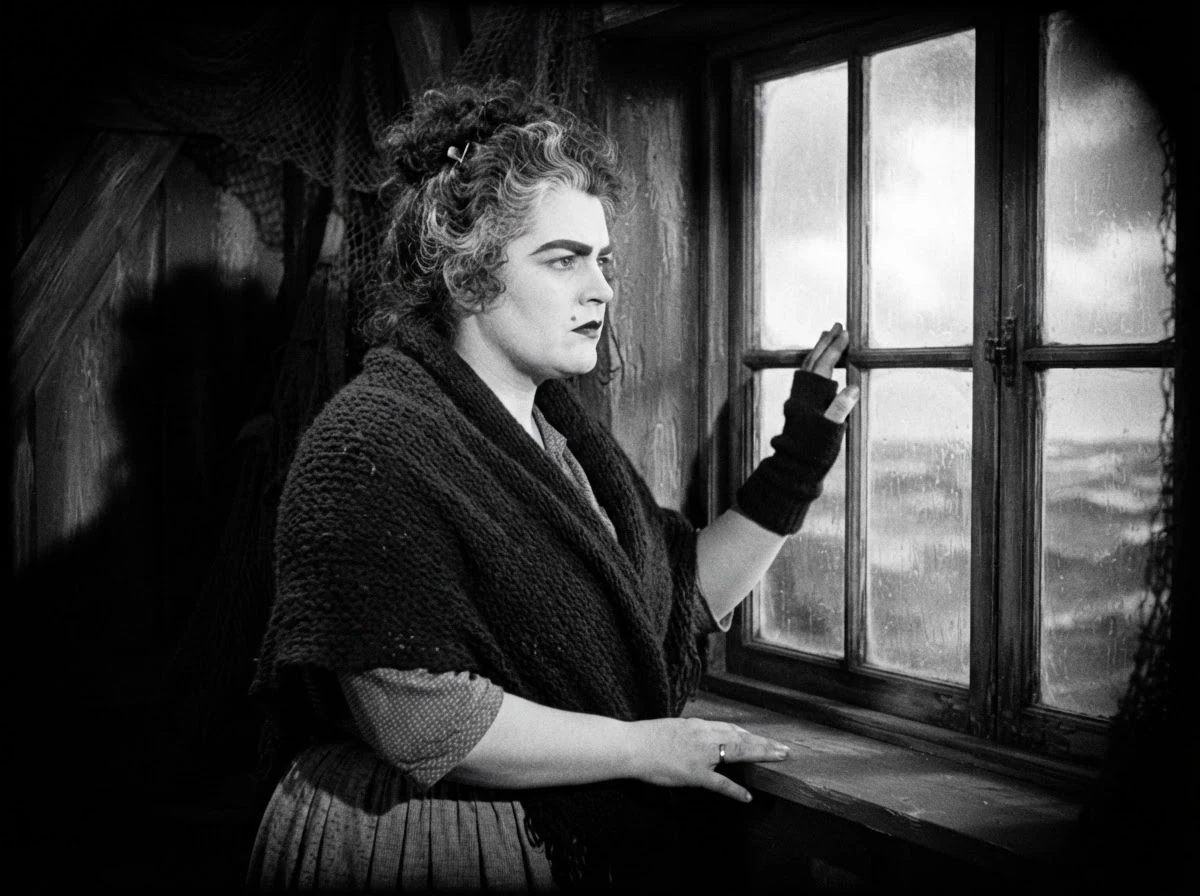
"Orthochromatic" plus "dark lips" and "white sky" push the tonality of the period instead of a modern monochrome conversion. "Painted studio set" and "hard arc key light" set the 1920s stage look, and the pose (hand on the glass, staring out) tells the story with no dialogue.
Open FlashBoardsA silent film intertitle card, full-frame, 4:3. Black background with a thin white art deco border and small ornamental corners. Centered white serif text in two lines: "The storm did not wait for morning." Slightly uneven exposure, faint flicker, fine film grain and a few specks of dust, as if photographed from a 1920s release print. No other objects in the frame.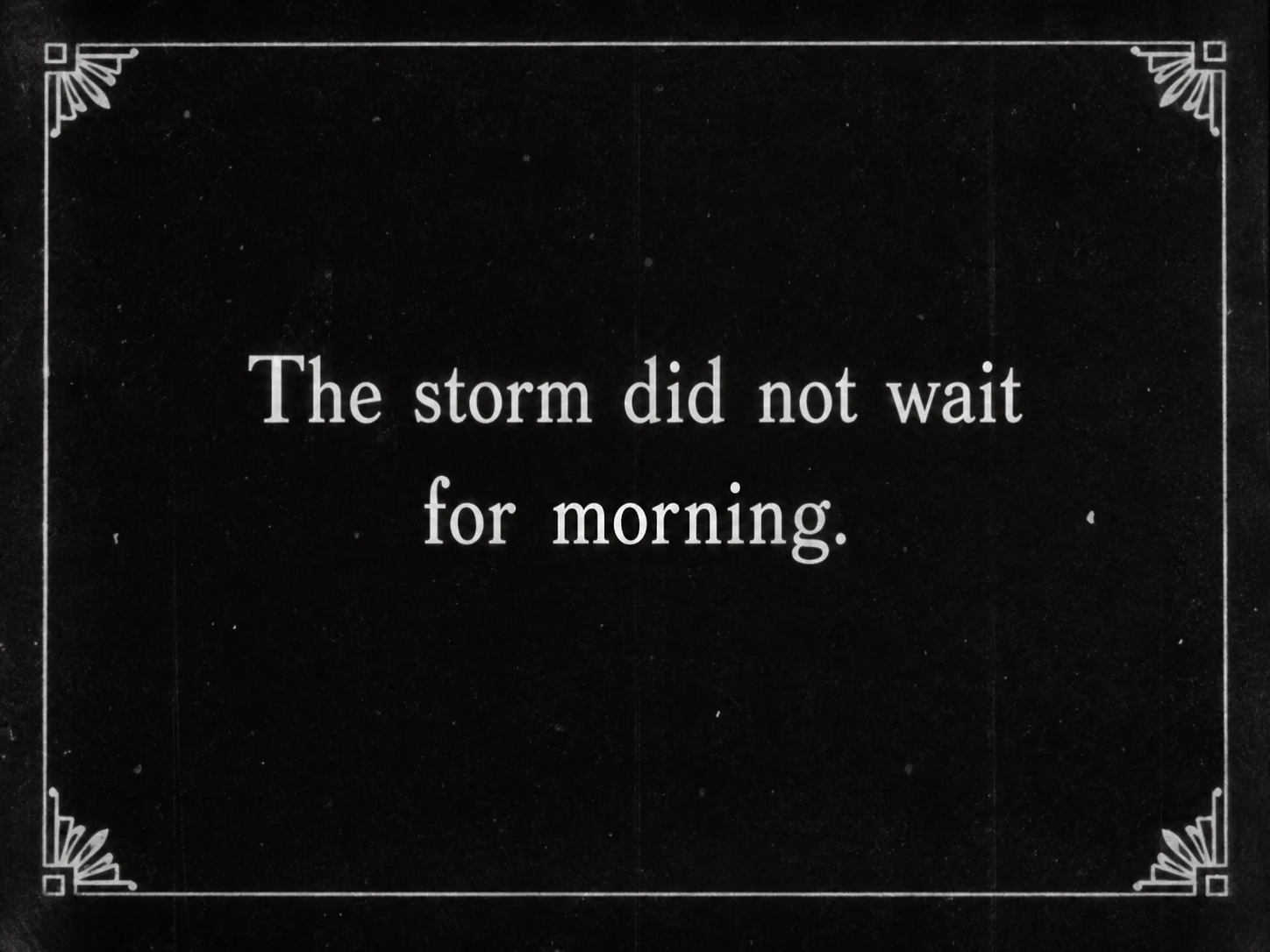
This is the second half of a silent scene: the card that sits between shots. Quoting the exact line in the prompt keeps the text clean, and "white art deco border" with "photographed from a 1920s release print" matches the grain and flicker of recipe 1, so image and card cut together.
Open FlashBoardsOrthochromatic black and white silent film, fine grain and light flicker throughout. Camera: locked off on a tripod at chest height, completely still for the whole shot. Action: The woman's shawl is already fluttering in a draft and the window glass shudders under the rain. She presses both hands to the glass and leans closer, eyes wide. She turns sharply toward the camera, clutches the shawl at her throat and takes two fast steps forward, her mouth open as if calling a name.The fluttering shawl and shuddering glass move from the first frame, so the clip does not stall into a slow push-in. A locked-off tripod is the period's default camera, and the broad, readable action (hands on glass, sharp turn, open mouth) is silent acting: the audience understands the beat without hearing it.
Open FlashBoardsCommon mistakes
- Sepia by default. Models equate old film with brown. Say "orthochromatic black and white" and, if you want tint, name it: "blue night tint" or "amber tint".
- Modern lighting. Soft, wraparound light reads as today's digital. Ask for a "hard arc key light" and "deep black shadow".
- Widescreen framing. Without an aspect ratio in the prompt, you may get 16:9 with black bars painted in. Set 4:3 in the generator and write "4:3 frame".
- Garbled intertitles. Put the card text in quotes, keep it under ten words and ask for one font style.
- Dialogue mouthing in video. Long lip movement reads as a sound film with the audio off. Give the actor gestures and one short called line, not a speech.
Keep the reference frames, prompts and every generated take side by side — images and video in one canvas.
FAQ
5 questionsWere silent films really silent?
Almost never. The films had no recorded dialogue, but screenings came with live music: a pianist in small theaters, a theater organ or a full orchestra in big ones, sometimes with sound effects performed behind the screen. In Japan, benshi narrators voiced the characters live.
When did silent films end?
In Hollywood, the switch ran from The Jazz Singer in 1927 to about 1929, and by 1930 nearly every American studio feature had sound. Other countries converted later: Japan made silent features into the mid-1930s. Chaplin kept dialogue out of City Lights (1931), and Modern Times (1936) is a hybrid with synchronized music, sound effects and a song.
Why do silent movies look sped up?
Most silent films were shot by hand-cranked cameras at roughly 16 to 20 frames per second. When they are played on equipment running at the sound-era standard of 24 fps, everything moves faster and jerkier than it did in the theater. Restorations that play the film at its intended speed look far more natural. Some comedies were also deliberately undercranked to speed up chases and stunts.
What was the first silent film?
There is no single answer, since every film before sound was silent. Louis Le Prince's Roundhay Garden Scene (1888) is often cited as the oldest surviving motion picture, Edison's company made short Kinetoscope films in the early 1890s, and the Lumière brothers held the first paid public projection in Paris in December 1895. Early films ran under a minute.
Are silent films still made today?
Yes, though rarely as features. The Artist (2011), a black-and-white silent at 1.33:1, won the Academy Award for Best Picture, and Blancanieves (2012) retold Snow White as a Spanish silent melodrama. Short films, music videos and student projects use the form often, and many sound films contain long passages without dialogue that follow the same silent rules.
Related terms
5- History of FilmFilm History & Theory
The history of film runs from 1890s motion studies and the Lumières' projections through silent cinema, the coming of sound and color, the studio era, national new waves and widescreen to digital production and streaming.
- Slapstick ComedyGenres
Slapstick is physical comedy of exaggerated violence without real harm — pratfalls, chases, pies in the face — perfected in silent films by Chaplin, Keaton and Lloyd.
- German ExpressionismFilm Movements & Styles
German Expressionism is the 1920s Weimar cinema movement that externalized inner states through distorted painted sets, slanted lines, stark chiaroscuro and stylized acting — The Cabinet of Dr. Caligari, Nosferatu, Metropolis.
- Captions and SubtitlesFormats & Exhibition
Subtitles are on-screen text translating or transcribing dialogue; captions (closed or open) also describe sounds and music for deaf and hard-of-hearing viewers. In silent film, 'caption' also meant an intertitle card.
- UndercrankingCameras & Capture
Undercranking shoots at a lower frame rate than playback — for example 12 fps played at 24 — so action runs faster than life on screen, used for slapstick, frantic chases and punchier action.
Further reading
Kevin Brownlow, The Parade's Gone By... (1968), interviews with the filmmakers of the silent era. Paolo Cherchi Usai, Silent Cinema: An Introduction (BFI), on speeds, stocks, tinting and exhibition. Kristin Thompson and David Bordwell, Film History: An Introduction, chapters on early and 1920s cinema.