 FlashBoards Learn
- Learn
- Production Design
- Art Director
Production Design · Film language
Art Director
Also called: supervising art director, film art director
In film, the art director runs the art department under the production designer. The designer decides what the world of the film looks like; the art director turns that concept into construction drawings, budgets and build schedules, and manages the set designers, carpenters, painters and set decorators who make it real on stage and on location.
- What it does
- Converts the production designer's concept into drawings, costed builds and a schedule, and runs the art department that delivers the sets.
- Use it when
- A film needs sets built, locations altered or more art-department crew than the designer can manage alone.
- Watch out
- In film the art director is not the top creative on the look: that is the production designer. Advertising uses the title differently.
- Try this prompt
Wide shot of a 1960s radio repair shop film set, warm tungsten practicals, aged wood counter, shelves of radios
What does an art director do in film?
The art director is the manager and technical lead of the art department. The production designer, working with the director and the cinematographer, sets the visual concept: palette, architecture, period, how rich or bare each space feels. The art director answers the practical questions. What gets built and what gets found? How big is the set, what is it made of, how long will it take, and what does it cost?
In practice that means supervising construction drawings, getting bids from the construction coordinator, tracking the art budget, scheduling each build so it is dressed before its shoot day, and solving problems when a location falls through. The art director is also the department's link to the ADs, the locations team, and the camera and electric crews.
Who does the art director manage?
On a mid-size feature the art director's team typically includes:
- Set designers and draftspeople who turn sketches into scaled plans and elevations, usually 1/4 or 1/2 inch to the foot in the US, 1:50 or 1:25 in metric countries. This is the drafting side of set design.
- Illustrators who paint key views before anything is built.
- The construction coordinator with carpenters, plasterers and scenic painters.
- The set decorator and set dressers, who furnish the space. Set dressing is its own craft, and the decorator often answers to the designer as well.
- The graphic designer for signs, labels, newspapers and screens.
The prop master usually runs a separate department but works closely with the art director. On a small indie the art director may be the whole department.
How the art director works from prep to wrap
Prep. Work starts with a script breakdown of every set: interior or exterior, stage or location, how many scenes and days. The art director and designer decide which spaces are builds and which are locations that need alterations. A standing set used for twenty scenes deserves solid construction; a room seen in one shot can be two flats and a painted backing.
Building for the camera. Good art directors walk the drawings with the DP and gaffer: which walls are wild (removable, so the camera can pull back further than the room allows), where ceiling pieces go if the director wants low angles, how tall the walls stand so the lighting grid clears them, and what the lens sees through each window. The wider the lens, the bigger the backing.
Shoot and wrap. During principal photography the art director stays days or weeks ahead of the camera, signing off the next sets. After the last shot on a set, they organize the strike and close the budget.
Art director vs. production designer
The titles get confused because they once described one job. In the Hollywood studio era the head of the art department was credited as art director. The production designer credit spread after William Cameron Menzies received it on Gone with the Wind (1939) and became the standard title for the department head. The Academy's award was called Best Art Direction until 2012, when it was renamed Best Production Design.
- Production designer: owns the concept of production design and works directly with the director and DP. Head of department.
- Art director: owns execution: drawings, budget, schedule, crew. Reports to the designer.
Shorthand: the designer decides what the audience should feel in a room; the art director figures out how to build that feeling in six weeks with the money available.
Supervising art director and assistant art director
Large productions split the job. A supervising art director manages several art directors, each responsible for a group of sets, a location or a second unit. Assistant art directors handle specific sets, drawings and research. In the United States these crafts are represented by the Art Directors Guild (IATSE Local 800). Most people reach the title after years as assistants, set designers or draftspeople.
How to create a art director with AI
3 promptsImage models let an art department test a set before a flat is cut. Fix period, materials and palette in a concept frame, generate a second take showing the same space as a stage build, then animate the concept to see how it reads with a moving camera. Keep references, takes and notes on one FlashBoards board.
Wide shot, 24mm lens at eye height, interior of a cramped 1960s radio repair shop built as a film set. Scuffed oak counter on the left, shelves crowded with wooden-cased radios, green plaster walls with water stains, pressed-tin ceiling. Warm light from two brass desk lamps, cool daylight from a dusty front window. A woman in her sixties with a silver braid, round wire-rimmed glasses and a brown canvas apron works at a bench in the back. Palette of olive, amber and brown, film grain.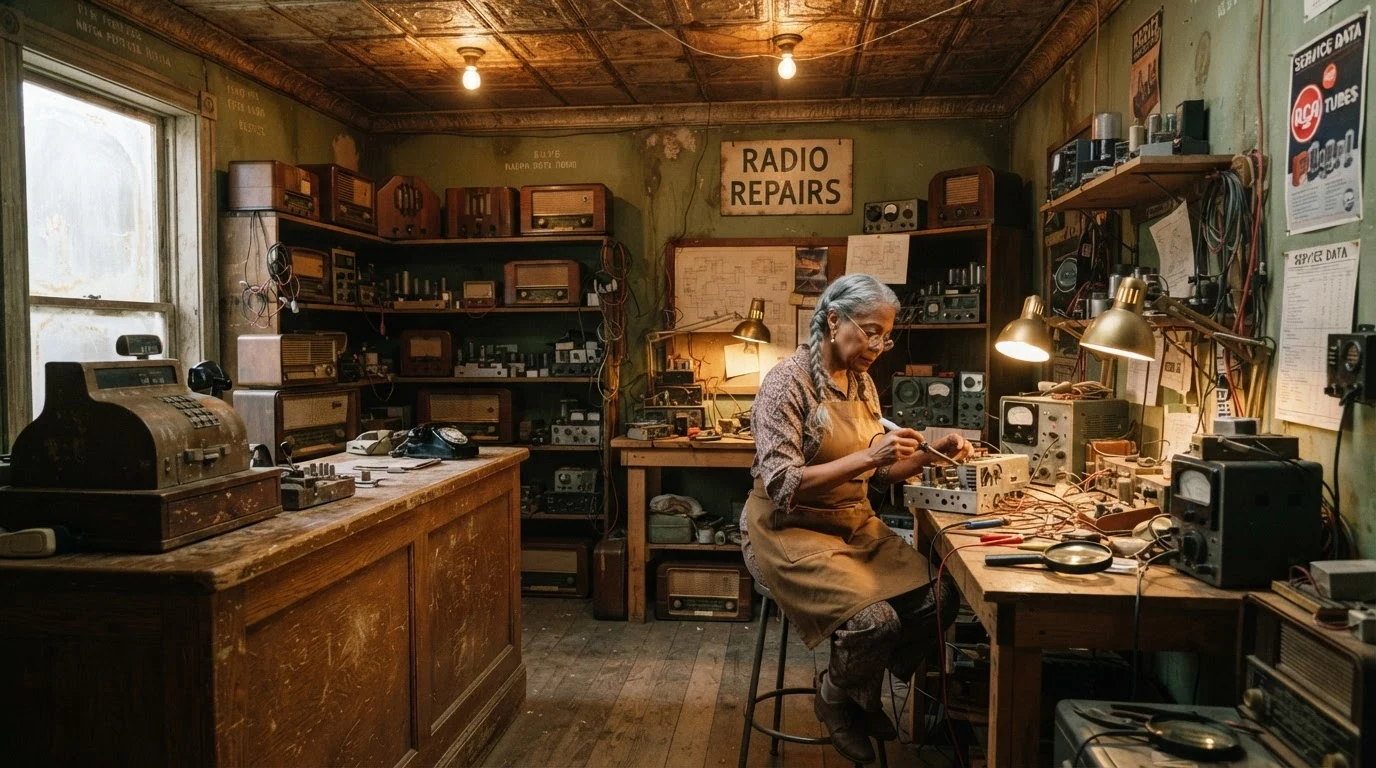
Written like an art department brief: period (1960s), materials (scuffed oak, water stains, pressed-tin ceiling), three named colors and specific practicals. Naming wear stops the model from drawing a clean showroom.
Open FlashBoardsWide behind-the-scenes view of the same 1960s radio repair shop built on a soundstage. The front wall is removed, showing the oak counter, shelves of wooden radios, green plaster walls and pressed-tin ceiling pieces. A black lighting grid hangs above the set. Behind the shop window, a painted backing of a rainy street. Raw plywood backs of the set walls with braces and sandbags on a concrete floor. Two carpenters in gray work shirts carry a flat. Neutral work light.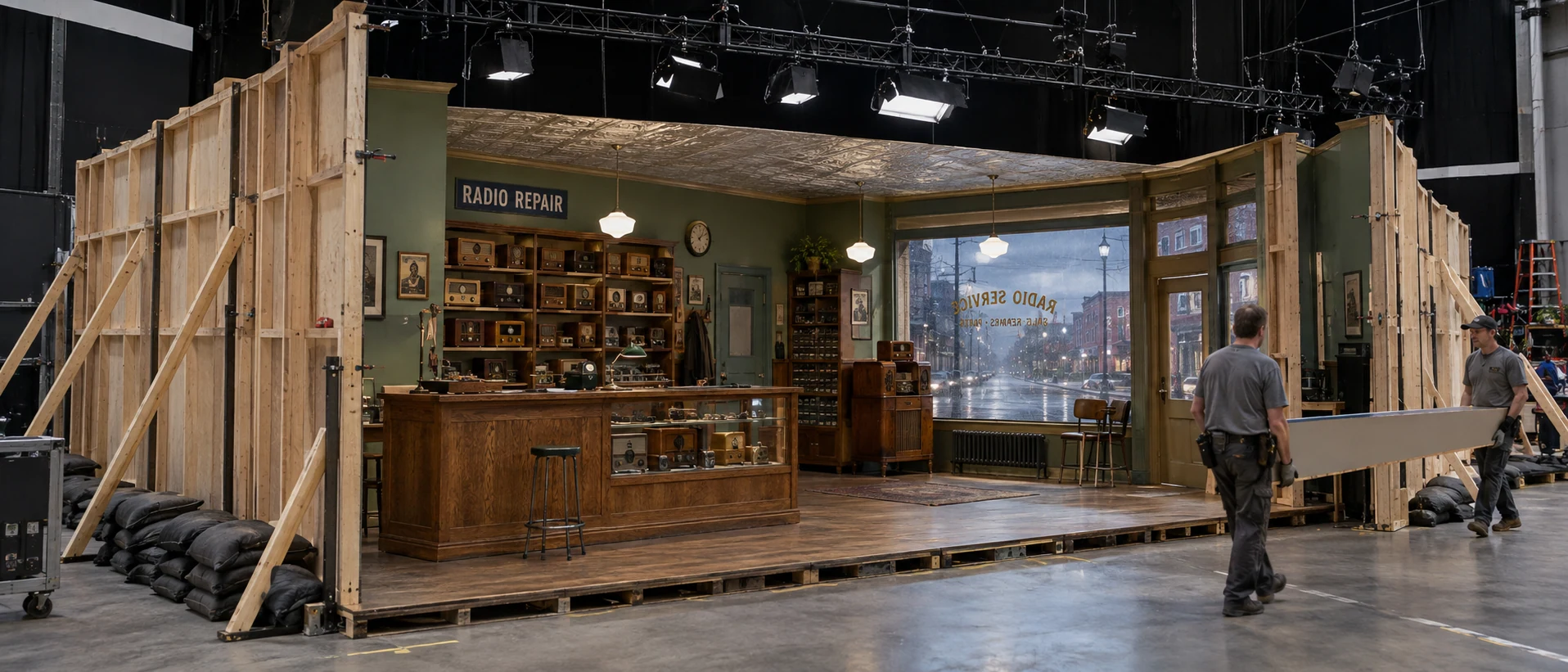
This take shows the space as an art director sees it: front wall removed, plywood backs with braces, painted backing, lighting grid. The 21:9 frame holds the whole footprint, handy for discussing wild walls and backing size with camera.
Open FlashBoardsCamera: slow dolly forward along the oak counter toward the workbench at the back, steady walking pace, ending on a medium-wide shot of the woman at the bench. Action: the woman is already turning the tuning knob of an open radio chassis. She lifts a glass vacuum tube toward the desk lamp and turns it in her fingers. She pushes the tube into the chassis and the radio dial glows amber. Dust drifts through the window light throughout.The move works like a camera rehearsal: does the counter lead the eye, do the shelves hold detail? Already turning keeps the shot alive from frame one, and the action uses only objects already in frame, so no new set pieces get invented.
Open FlashBoardsCommon mistakes
- Sets come out too new. Name the wear: scuffs, stains, faded paint, patina.
- Periods get mixed. A decade alone invites anachronisms; name three or four period objects.
- "Film set" ignored. List the stage elements: removed wall, braces, lighting grid, backing.
- Garbled signage. Keep signs to one or two short words.
- Palette drift. Repeat the same three color names in every prompt for one set.
Keep the reference frames, prompts and every generated take side by side — images and video in one canvas.
FAQ
5 questionsWhat does an art director do in film?
A film art director runs the art department under the production designer. They turn the designer's concept into construction drawings, budgets and build schedules, manage set designers and construction crews, and make sure every set is finished and dressed before its shoot day. The designer owns the look; the art director makes it buildable.
What is the difference between an art director and a production designer?
The production designer heads the art department and owns the film's visual concept, working directly with the director and cinematographer. The art director reports to the designer and owns execution: drawings, costs, schedule and crew. Historically the department head was called art director, which is why the titles still get mixed up.
What is a supervising art director?
On large films and series, a supervising art director manages several art directors, each handling a group of sets, a location or a second unit, and oversees the overall art budget and schedule with the production designer. Smaller productions have one art director, or none at all.
Is a film art director the same as an art director in advertising?
No. In advertising and publishing, an art director usually leads the visual concept of a campaign. In film and TV that concept belongs to the production designer, and the art director is the second in command who delivers it, working far more with drawings, construction, budgets and scheduling.
How do you become a film art director?
Most film art directors start as art department assistants, set designers, draftspeople or set dressers and move up over several years. Useful skills: technical drawing, CAD and 3D modeling, architecture or theater design, and budgeting. Short films and indie features are where most people earn their first art director credit.
Related terms
4- Production DesignProduction Design
Production design is the creation of the entire physical world of a film — locations, sets, props, colors and textures — led by the production designer together with the director and cinematographer.
- Set DesignProduction Design
Set design is the planning and construction of the physical spaces a scene is shot in — from a single room built on a stage to an entire street — so that architecture, scale and texture express the story.
- Set DressingProduction Design
Set dressing is everything that furnishes a set but is not handled by the actors — furniture, books, posters, clutter — the details that make a space feel lived-in and tell us about who lives there.
- Film CrewFilmmaking Process & Crew
A film crew is everyone who makes the film behind the camera, organized into departments — directing, camera, grip, electric, art, costume, makeup, sound, production, post — each with a head and a chain of assistants.
Further reading
Vincent LoBrutto, The Filmmaker's Guide to Production Design (Allworth Press). Art Directors Guild (IATSE Local 800), craft descriptions for art directors and production designers.