 FlashBoards Learn
- Learn
- Storytelling
- Plot Hole
Storytelling · Film language
Plot Hole
Also called: continuity gap, logic gap
A plot hole is a gap or contradiction in a story's logic: an event that breaks rules the film has already set, a character who ignores an obvious option, or a question the plot raises and never answers. The audience stops feeling the scene and starts auditing it, and belief in the story leaks out.
- What it does
- Pulls the viewer out of the story by making them question its logic instead of feeling it.
- Use it when
- Never on purpose; hunt for plot holes in every draft, table read and rough cut.
- Watch out
- One line of dialogue or one insert shot often closes a hole; a long explanation opens new ones.
- Try this prompt
Snowbound log cabin at dusk, snapped telephone wire hanging from a leaning pole, red pickup buried to its windows, 16:9
What is a plot hole?
Every story makes promises: what the characters know, what they can do, how long things take, how its magic or technology works. A plot hole is where the story breaks one of those promises without admitting it. It is a failure of narrative technique: the images can be flawless and the logic still broken.
Holes come in two strengths. Some hit during the scene, and the viewer mutters "why doesn't she just call the police?" Others surface on the drive home. Hitchcock is often credited with calling the second kind "icebox talk": the objection a viewer only thinks of later, standing at the fridge. The first costs you the scene; the second costs you the rewatch.
Not every unanswered question is a hole. A deliberately ambiguous ending is a decision; it becomes a hole when the story seems to forget the question existed.
Types of plot holes, with famous examples
Broken rules
The film sets a rule, then ignores it. In Signs (2002), invaders who are badly hurt by water come to a planet covered in it.
The obvious option nobody takes
The fan debate around The Lord of the Rings: The Return of the King (2003) asks why the eagles that rescue Frodo and Sam from Mount Doom didn't fly the Ring there. The film never answers, so the question sticks. Roger Ebert called the extreme version the "Idiot Plot": a story that works only because everyone acts like an idiot.
Missing steps
In The Dark Knight Rises (2012), Bruce Wayne climbs out of a prison half a world away and turns up inside a sealed-off Gotham with no hint of how he got in.
Timeline holes
Game of Thrones drew wide criticism for "Beyond the Wall" (2017), where a messenger, a raven and a dragon cover enormous distances while the heroes wait out a single standoff.
Time-travel contradictions
A change to the past that should erase the person who made it is the classic paradox. Looper (2012) sidesteps the argument openly: in a diner scene, the older hero refuses to discuss how time travel works.
How to find and fix a plot hole
Read as the most skeptical viewer. At every turn, ask what a smart character would do. If it's "call for help", the script has to show why they can't.
Use outside eyes. Writers fill gaps from memory. Script notes, table reads and test screenings catch what the writer can no longer see.
Plant the answer early. Most holes close with a setup, not a speech: a cut phone line, a car that won't start, a key pocketed in the background. That is foreshadowing doing repair work, and a planted escape route is the difference between a clever finale and a deus ex machina.
Name it and move on. Let a character voice the objection, then answer or dismiss it in one line, as the Looper diner scene does.
Cut or reshoot in post. An insert, a line of ADR over a back-turned actor, or cutting the scene that raises the question can fix a hole.
In FlashBoards, lay out each setup frame next to the scene that pays it off on one board, with a note on the question it answers. A payoff with nothing beside it is where the next hole will be.
Plot hole vs. continuity error
A continuity error is a physical mismatch between shots: a glass half full, then full again; a coffee cup left on a table in Game of Thrones "The Last of the Starks" (2019), later removed digitally. It breaks the illusion for a second. A plot hole breaks the story itself, and no paint-out fixes it.
A plot twist is sometimes mistaken for one. A good twist feels like a hole on first viewing, then fills itself in: the clues were there. A hole is a twist that never pays back.
How to create a plot hole with AI
3 promptsYou can't generate logic, but you can generate the shots that close a hole: the establishing frame that shows why nobody drives away, and the insert that plants the way out. Keep them next to the payoff scene on a FlashBoards board.
Wide establishing shot of an isolated log cabin in a snowstorm at dusk. Foreground left: a leaning wooden telephone pole with a snapped wire hanging down, its loose end coiled in the snow. Beside the cabin: an old red pickup truck buried in a drift up to its windows. One warm lit window. On the porch, a woman in her fifties with cropped white hair, a hooked nose and a long mustard parka holds up a brass lantern and looks toward the truck. Blue dusk light, falling snow, 28mm lens, camera at eye level, cinematic film still.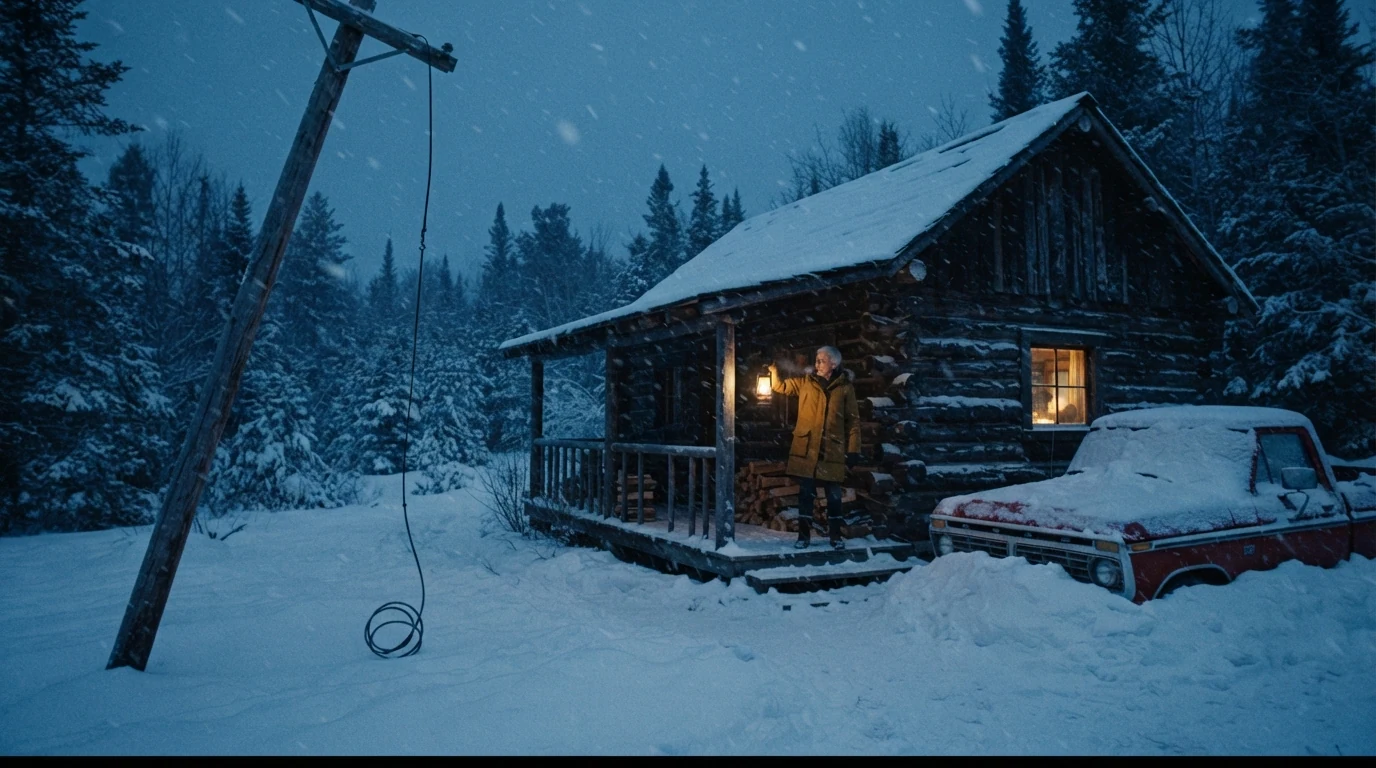
It answers "why don't they call for help or drive away?" before anyone asks. Snapped wire and buried up to its windows state the problems positively, so the model draws them; foreground left makes the wire read.
Open FlashBoardsMedium shot in a dim hotel corridor at night. A young woman with a shaved head, a gold hoop in her left ear and a paint-stained denim jacket slips a brass room key from a housekeeping cart into her sleeve. Beside her, a heavyset older housekeeper with a gray walrus mustache folds towels with his back to her. A narrow shaft of light from an open doorway falls across the key and her hand; the rest of the corridor sits in warm, low tungsten light. 40mm anamorphic lens, eye level, wide anamorphic frame, cinematic film still.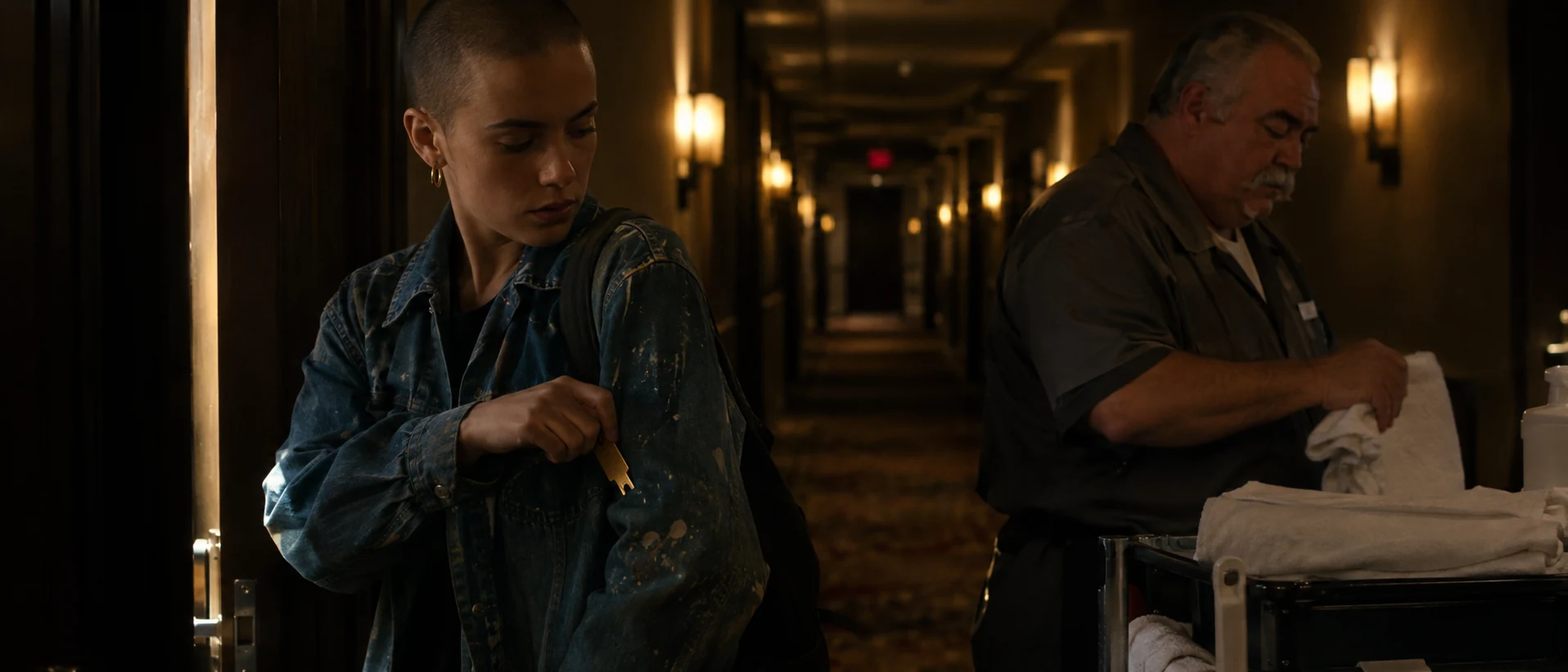
The plant that explains how she enters a locked room in act three. Shaft of light across the key makes it memorable; the housekeeper's back to her keeps the theft plausible.
Open FlashBoards{
"output": "Full-screen live-action film scene from its very first frame: one continuous wide shot of an isolated log cabin in a snowstorm at blue dusk, dark snow-laden pines behind it, one warm lit cabin window, heavy falling snow. A leaning wooden telephone pole stands in the left foreground with a snapped wire hanging down, its loose end coiled in the snow; an old red pickup truck is buried in a drift up to its windows at the right of the frame. Cold blue light, fine film grain.",
"characters": {
"S1": {
"name": "the cabin owner",
"look": "woman in her fifties with cropped white hair, a hooked nose and a long mustard parka, standing on the porch in the centre of the frame, a lit brass lantern raised in her right hand",
"voice": "silent"
}
},
"shots": [
{
"shot": 1,
"camera": "eye-level wide shot on a 28mm lens, a slow, steady push-in toward the porch and the pickup that starts at once and continues for the whole shot; the pole stays at the left edge and the truck stays in frame at the right",
"action": [
"BEGINNING: alive from the first frame, gusts blow snow across the frame and the loose end of the snapped wire swings in the wind beside the leaning pole",
"THEN: S1 steps down from the porch, the lantern still raised in her right hand, and wades through knee-deep snow toward the red pickup at the right of the frame",
"THEN: at the truck S1 sweeps the snow off its side window with her left hand, and the lantern light falls on the frosted glass",
"THEN: S1 stops, her left hand resting flat on the glass",
"END: S1 turns her head and looks back over her shoulder, across the frame to the leaning pole and the hanging wire at the left, and holds that look, standing still beside the buried truck with the lantern raised"
],
"dialogue": [],
"voice": "silence: nobody speaks in this shot, no voice at all"
}
],
"sound": {
"ambience": "howling wind, snow hissing against the logs, the creak of the porch step, boots pushing through deep snow, the loose wire ticking against the pole",
"speech": "no words in this video; the only human sounds are breaths and movement",
"never_spoken": "no narration and no voice-over: the descriptions, performance notes and step words of this prompt are never spoken aloud",
"music": "a film score under the scene, always below the voices: low sustained strings with a slow, uneasy pulse",
"subtitles": "none"
}
}Wind and the swinging wire make the shot alive from the first frame. The action links truck and wire, then ends on a look, so the audience does the math.
Open FlashBoardsCommon mistakes
- Models tidy up problems: the wire comes back intact, the truck only dusted. Keep snapped and buried up to its windows.
- A planted object vanishes in a busy frame. Give it its own light, as with the shaft on the key.
- Video models finish the escape and the woman drives off. End the prompt on a look, not an action.
Keep the reference frames, prompts and every generated take side by side — images and video in one canvas.
FAQ
4 questionsWhat are some famous movie plot holes?
Often cited: the aliens in Signs (2002), hurt by water yet invading Earth; the eagles in The Lord of the Rings, who rescue Frodo but never carry the Ring; Bruce Wayne's unexplained return to a sealed Gotham in The Dark Knight Rises (2012); and the compressed travel times in Game of Thrones' "Beyond the Wall" (2017).
Are the eagles in The Lord of the Rings a plot hole?
It's debated. Critics say the eagles could have flown the Ring to Mount Doom and saved three films of walking; defenders point to the Enemy's watch over the skies and the eagles' independence. Because the films never address it, a debatable choice feels like a plot hole.
Is a continuity error a plot hole?
No. A continuity error is a physical mismatch between shots, like a prop or costume that changes across a cut. A plot hole is a flaw in the story's logic and would survive a perfectly matched cut. Editing hides continuity errors; plot holes need rewriting, reshoots or cuts.
How do you fix a plot hole?
Find it early with table reads, script notes and test screenings. Then close it with the smallest possible change: plant a setup earlier (a cut phone line, a pocketed key), let a character voice the objection and answer it in one line, or cut the scene that raises the question. Long explanations usually create new holes.
Related terms
1Further reading
Roger Ebert, Ebert's Little Movie Glossary (1994).