 FlashBoards Learn
- Learn
- Storytelling
- Foreshadowing
Storytelling · Film language
Foreshadowing
Also called: setup and payoff, planting and payoff, Chekhov's gun
Foreshadowing is a storytelling technique that plants hints early in a film (an object, a line of dialogue, an image, a sound) that prepare the audience for something that happens later. Done well, the payoff lands as both a surprise and a certainty: the viewer didn't see it coming, yet it was there all along.
- What it does
- Prepares the audience for a later event so the payoff feels earned instead of convenient.
- Use it when
- A twist, a death, a skill or an object will matter in act three and the audience needs to have seen it first.
- Watch out
- A plant shot too loudly gives the ending away; one shot too quietly is forgotten before the payoff.
- Try this prompt
Warm family dinner in a log cabin, hunting rifle hanging above the fireplace in the background, deep focus, wide shot, candlelight
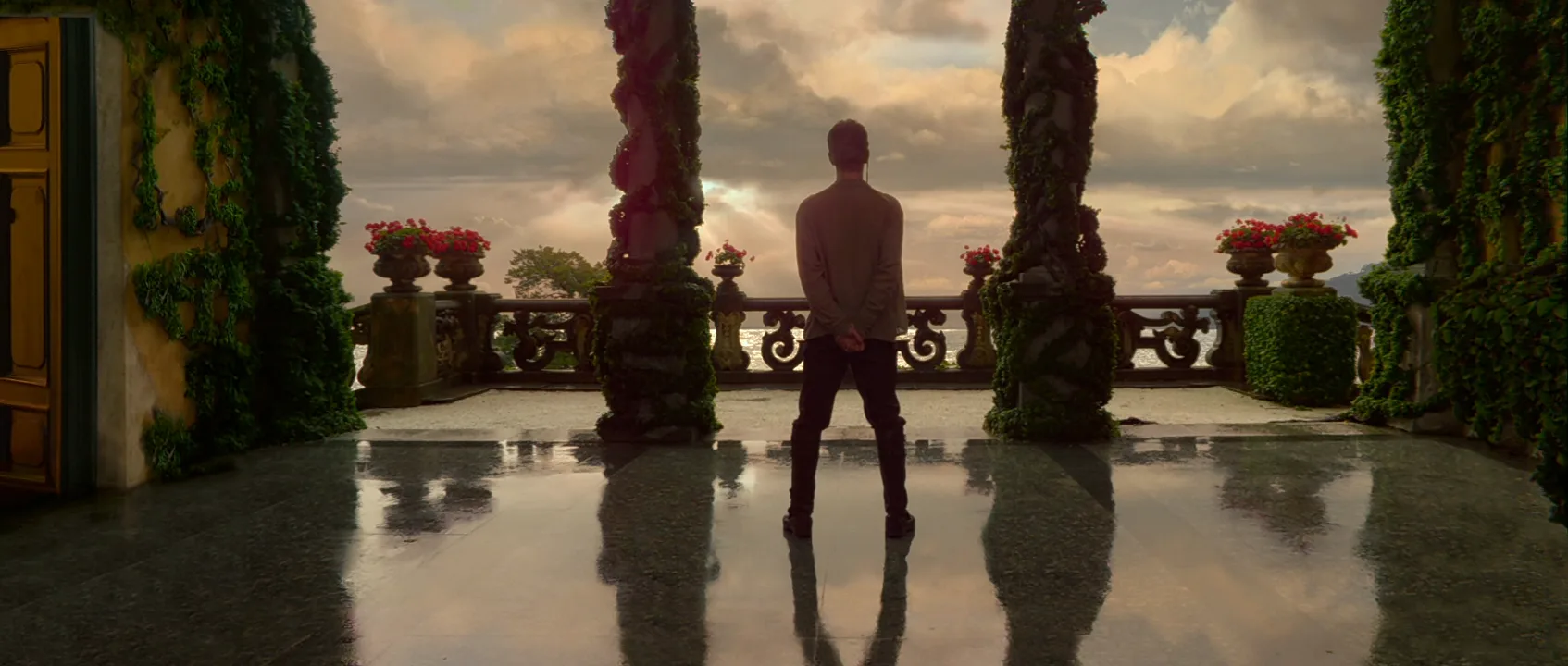
What is foreshadowing in film?
Foreshadowing is the practice of showing or saying something early that only reveals its full meaning later. Screenwriters usually call it setup and payoff or planting and payoff: the setup is the plant, the payoff is the moment it pays back. It is one of the core narrative techniques for controlling what the audience knows and when.
A plant can be almost anything:
- An object placed in the frame: a rock hammer, a key, a gun on a wall.
- A line of dialogue that sounds like small talk or a joke the first time.
- An image or composition that rhymes with a later shot: a character framed behind bars, a shadow falling across a face.
- A sound or music cue that returns when the event arrives.
- A skill or habit a character shows in act one and needs in act three.
The test is the second viewing. The first time, the plant reads as texture: setting, character or humor. The second time, it reads as a promise the film always meant to keep. The writer knows the ending and goes back to seed it.
Why filmmakers use foreshadowing
An ending that comes out of nowhere feels cheap: a hero saved by a tool we never saw, a villain with nothing pointing to them. A plant turns coincidence into consequence. It also does four jobs:
- It builds dread. A detail that clearly matters, but not yet how, makes every scene near it heavier. That is the engine of suspense: Hitchcock's bomb under the table is foreshadowing the audience is fully let in on.
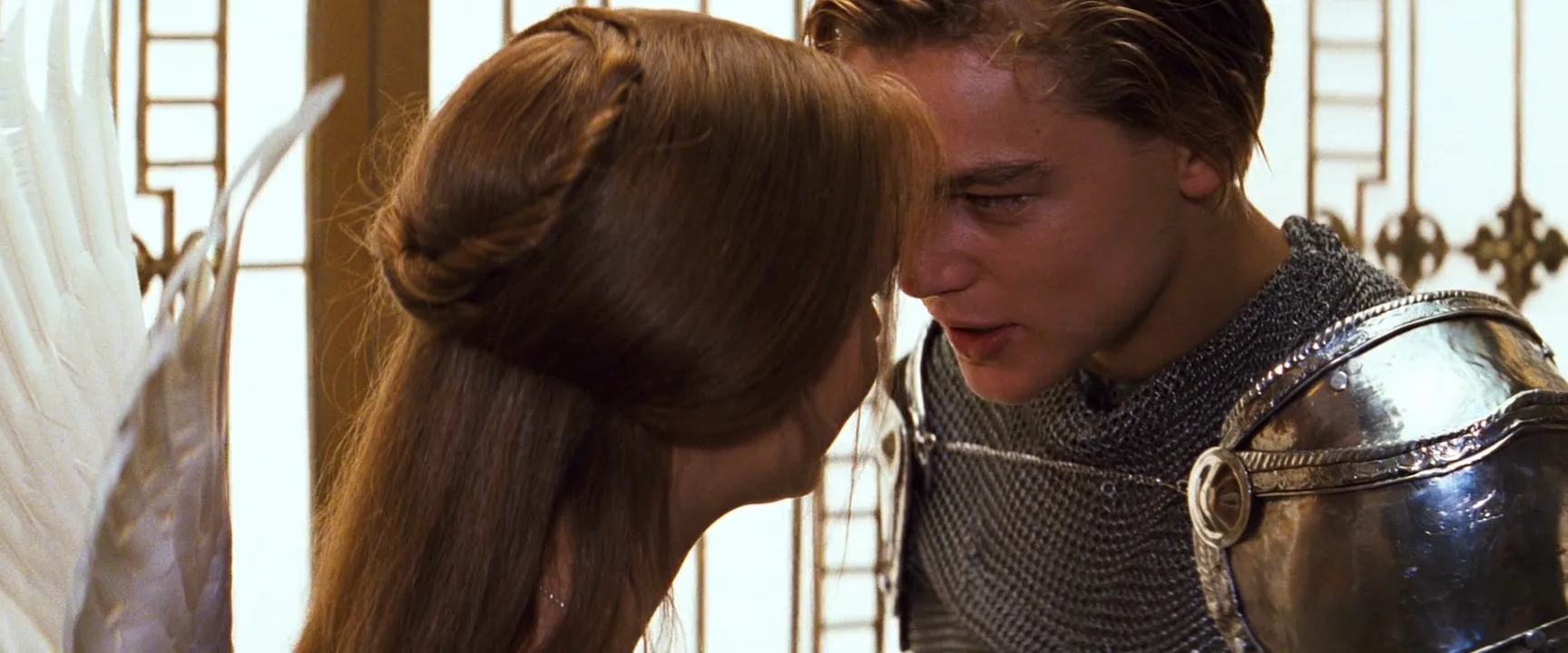
- It creates dramatic irony. Baz Luhrmann's Romeo + Juliet (1996) opens with a TV news anchor reading the prologue that tells us the lovers will die. Every kiss after that plays against knowledge the characters don't have, which is pure dramatic irony.
- It makes twists fair. A plot twist without plants is an arbitrary rule change. With plants, the audience replays the film and finds the clues were there.
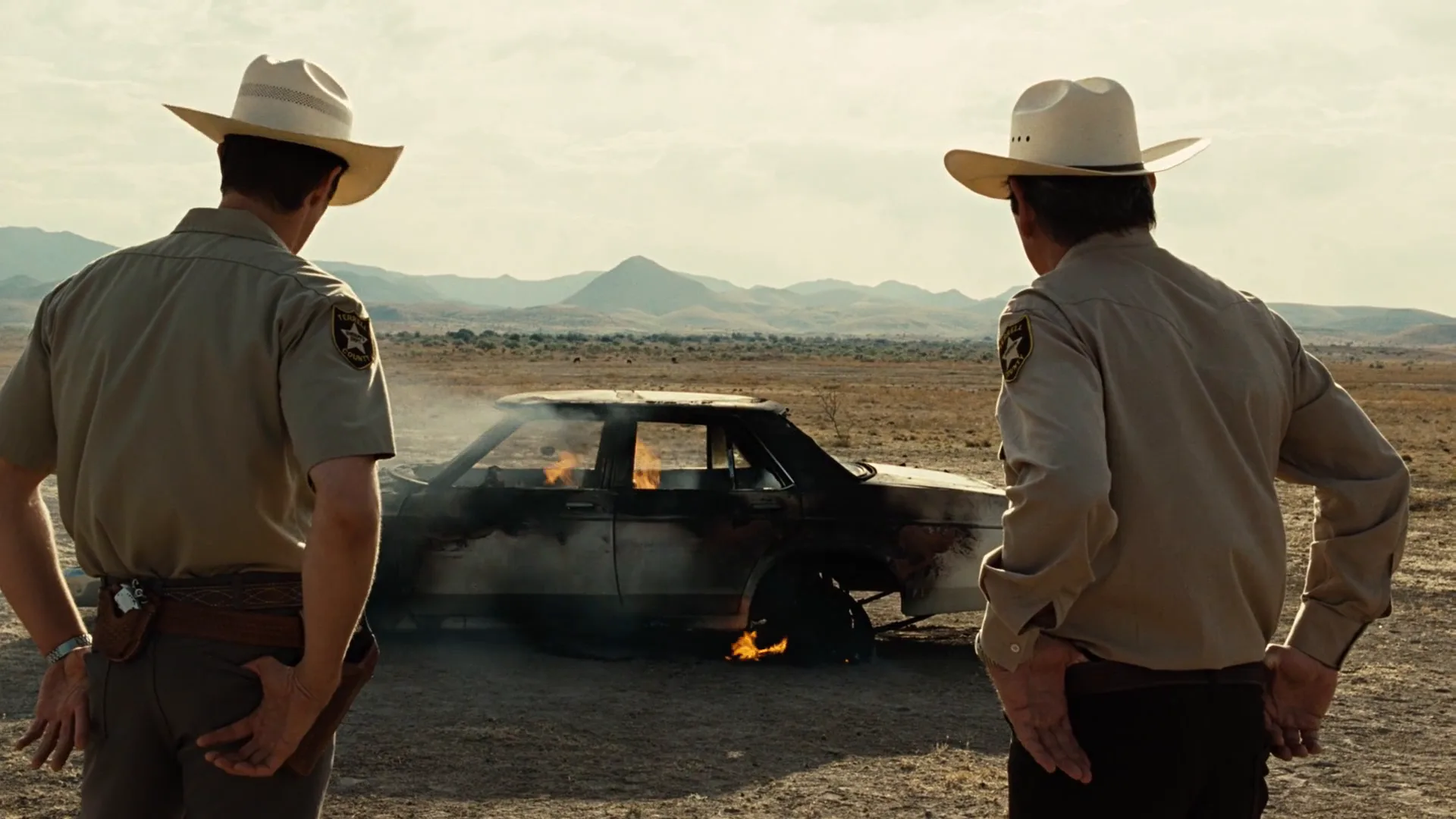
- It deepens theme. A recurring image, a kind of motif, that keeps predicting the same fate, such as Sheriff Bell always arriving after the violence in No Country for Old Men (2007), says something about the world of the film, not only about its plot.
Types of foreshadowing, with examples
These are the categories that matter when you write or shoot a scene.
Direct foreshadowing
The film tells you what will happen, and the interest shifts from what to how. A prologue, a prophecy, a narrator who announces the ending, or a flash-forward all work this way. Romeo + Juliet states the outcome in its first minutes.
Indirect foreshadowing
The hint is hidden in plain sight and only becomes readable in hindsight. In The Sixth Sense (1999), the fact that almost nobody but the boy responds to Malcolm is presented as ordinary tension, not as a clue. In Psycho (1960), Norman Bates talks with Marion in a parlor full of stuffed birds; it plays as an odd hobby until the final reveal of what else he has preserved.
Chekhov's gun: object setups
In The Shawshank Redemption (1994) the rock hammer and the pin-up posters in Andy's cell are small details of prison life until the escape shows what they were for. In Back to the Future (1985), the flyer about the clock tower struck by lightning gives Marty, and the audience, the exact time and place the finale depends on.
Dialogue foreshadowing
A line that sounds like philosophy, a joke or small talk later proves literal. In The Dark Knight (2008), Harvey Dent's remark about heroes living long enough to become villains predicts his own arc.
Visual and symbolic foreshadowing
Composition, color and props predict outcomes without a word. The Godfather (1972) is famous for oranges appearing near scenes of violence and death. Fight Club (1999) cuts single frames of Tyler Durden into scenes before he is introduced, subliminal plants that only register on a rewatch. This kind overlaps with symbolism; the difference is that foreshadowing points to a specific future event, not only to an idea.
Sound and music foreshadowing
A sound tied to a threat can announce it before it appears. In Jurassic Park (1993), ripples in a cup of water signal the approaching tyrannosaur. Short-range plants like this sit closer to suspense, but the principle is the same.
How to plant foreshadowing in a script and on set
Foreshadowing is written first but succeeds or fails in how it is shot and cut. The plant has to register without announcing itself.
In the script
- Write the payoff first. List every act-three event that needs preparation, then find the most natural place to show each one early.
- Give the plant a second job. The rock hammer in Shawshank is also a character beat about Andy's hobby; the stuffed birds in Psycho are also creepy set dressing. The cover story is what hides the plant.
- Space it out. A common pattern is plant in act one, a reminder near the midpoint or a plot point, payoff in act three. If the gap is too short, the audience connects the dots immediately; too long with no reminder, they forget.
- Plant, don't explain. Once a character says why an object matters, the payoff is spent.
On set and in the edit
- Framing decides how loud the plant is. A cutaway insert shot of the object is the loudest option; the audience knows it matters. Keeping the object inside a wide or medium shot, in focus but off-center, is quieter. For a buried plant, stage it in the background of a scene about something else and keep enough depth of field (f/5.6–f/8 on a 35mm lens) so it stays readable.
- Use focus and light, not only size. A slow rack focus to an object is a clear signal. A small practical light or a sliver of window light touching it is a subtle one.
- Hold a beat. An extra half-second on a detail is often enough.
- Rhyme the payoff visually. Shoot the payoff with the same lens, angle or composition as the plant so memory links the two images.
Planning plants in FlashBoards. Put each setup frame next to its payoff frame on the board, one pair per row, with a note on where each lands in the script. Side by side, it is obvious when a payoff has no plant or a plant is framed too loudly. The same board holds the storyboard panels and generated test frames for both halves.
Foreshadowing vs. red herring vs. flash-forward
All three manage what the audience expects, but they point in different directions.
| Device | What it does | Honest? | |---|---|---| | Foreshadowing | Hints at something that really happens later | Yes: the payoff comes | | Red herring | Plants a false clue toward the wrong answer | Deliberately misleading | | Flash-forward | Shows a future event outright, then returns to the present | Yes, and openly |
A red herring is technically built the same way as a plant: an object, a look, a suspicious line. The difference is the payoff. Foreshadowing is kept; a red herring is abandoned or explained away. Mysteries use both together: the real clue is framed quietly, the red herring loudly, so the audience's attention goes where the filmmaker wants.
A flash-forward is the most direct kind of foreshadowing. Instead of hinting, it shows. The suspense shifts to how the story gets there. A flash-forward is a structural choice in the edit; ordinary foreshadowing lives inside scenes.
A MacGuffin is different again: everyone chases it and its nature barely matters, while a foreshadowed object matters because of what it will do.
Is Chekhov's gun the same as foreshadowing?
Chekhov's gun is the strictest form of foreshadowing, and it is also a rule of economy. It comes from Anton Chekhov's advice to writers, usually paraphrased as: if a gun hangs on the wall in the first act, it must be fired by the last. Its point is also to cut anything planted and never used.
So the relationship runs one way:
- All Chekhov's guns are foreshadowing. Showing the object sets up its later use.
- Not all foreshadowing is a Chekhov's gun. A mood, a line of dialogue, a color motif or a prophecy can foreshadow without any object.
In practice, it is an editing test: list every object or detail the camera singles out with an insert, a push-in or a held beat. Each is a promise. If it never pays off, pay it off or stop singling it out. The opposite failure is a payoff with no plant, which the audience experiences as a cheat or a deus ex machina.
Foreshadowing examples in film
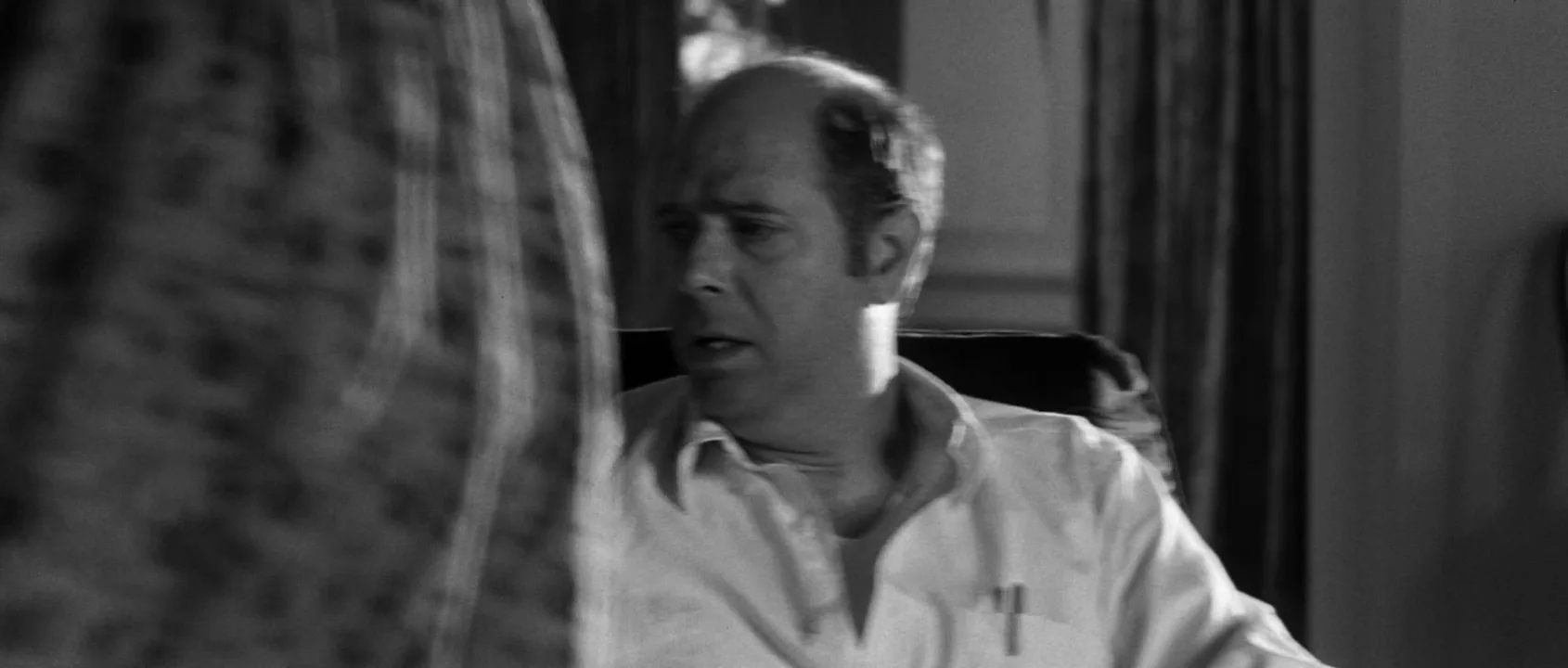
6 framesFrames where a film plants something it collects later.

How to create a foreshadowing with AI
4 promptsTo show foreshadowing in a single frame, you plant an object where the eye can find it without being told to look. Name the object, place it precisely and keep it in focus, while the scene's action is about something else. In FlashBoards, keep the plant frame and the payoff frame side by side on the board so you can judge whether the setup reads. The fourth prompt re-shoots a real film shot from a text description alone, and the original plays next to the result so you can compare.
Wide shot inside a warm log cabin at night, a family birthday dinner around a long wooden table: a broad-shouldered man in his fifties with a gray braided beard and a red flannel shirt laughs with his head thrown back, a teenage girl with a shaved undercut and silver hoop earrings blows out candles on a cake. On the log wall above the stone fireplace, in the upper right third of the frame, a bolt-action hunting rifle hangs untouched on two antler hooks, in sharp focus, caught by a thin edge of cool moonlight from a side window. Deep focus, 35mm lens at f/8, camera at seated eye level, warm candlelight in the foreground, cooler light on the back wall, film grain.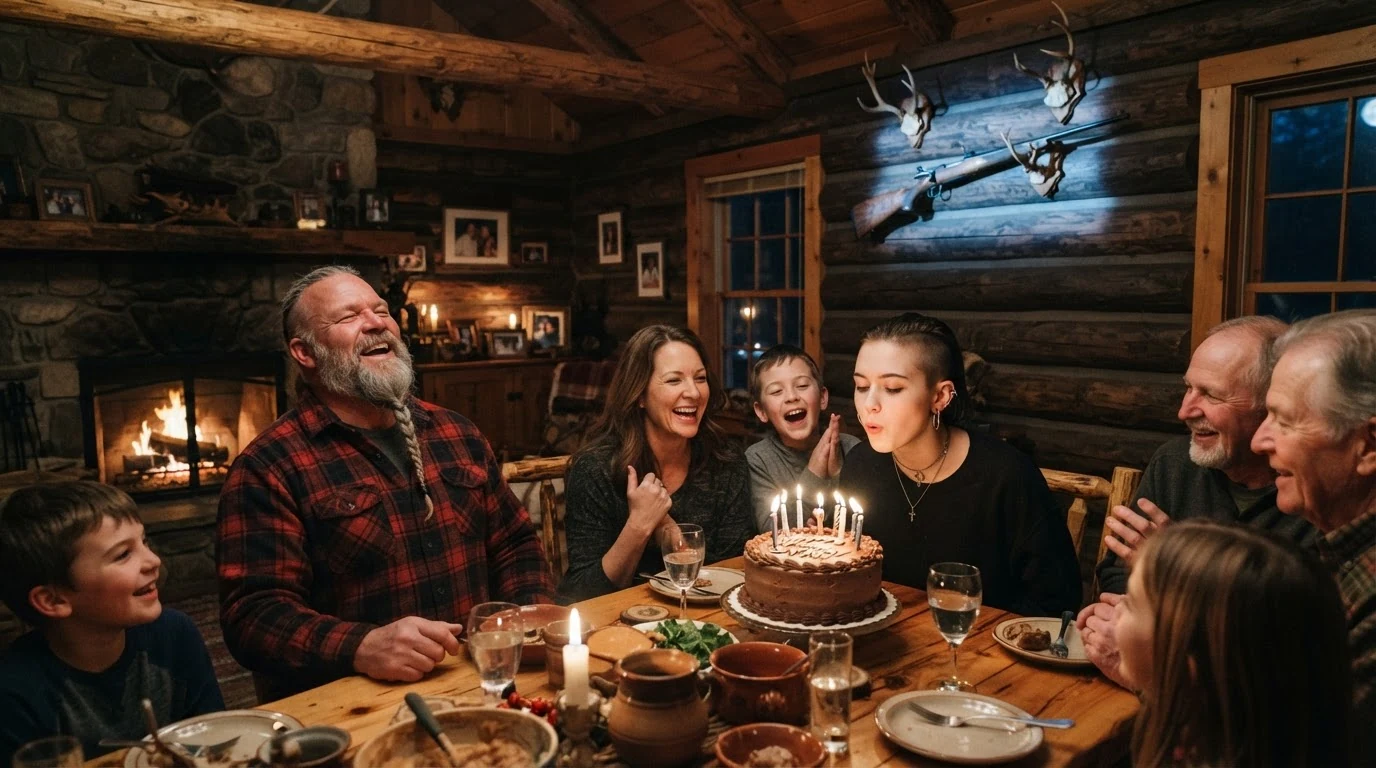
Upper right third, in sharp focus and deep focus, f/8 keep the rifle readable while the laughter and candles carry the scene: the object is planted, not presented. Cool moonlight separates it from the warm foreground, a quiet cue instead of an insert. Untouched on two antler hooks stops the model from putting the rifle in someone's hands.
Open FlashBoardsAnamorphic wide shot on a sunny summer afternoon at a mountain reservoir: in the foreground, a lanky young man with curly copper hair and a sunburned nose teaches an older woman with a white pixie cut and round tortoiseshell glasses to cast a fishing line from a wooden jetty, both smiling. Behind them, across the calm water, the concrete face of a dam fills the background, and a thin dark crack runs diagonally down its center with a narrow stream of water trickling from it, small but clearly visible. Deep focus, 40mm anamorphic lens, low sun from the left, bright saturated colors, peaceful mood, cinematic still.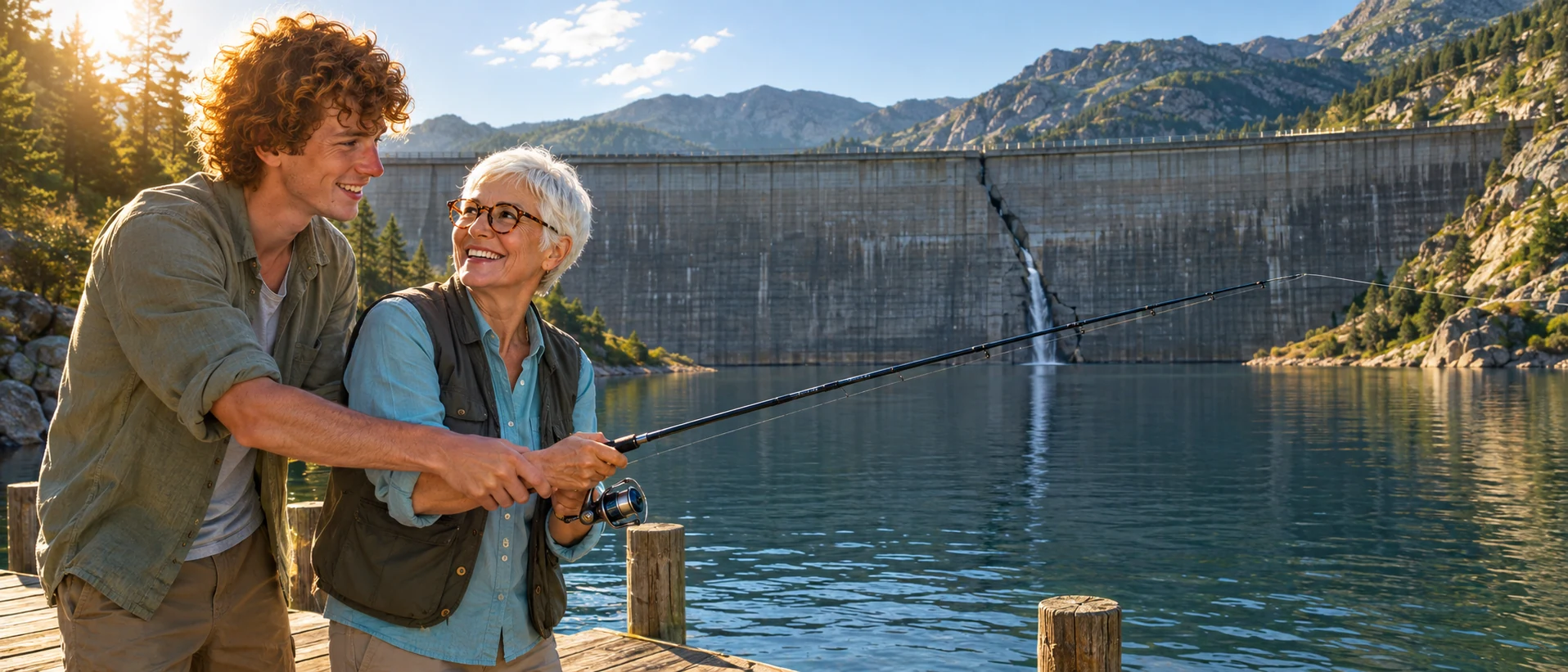
This take moves the plant from an object to the location itself, the most common way disaster films foreshadow. The cheerful foreground gives the plant its cover story, while thin dark crack, narrow stream of water and small but clearly visible set how loud it is.
Open FlashBoardsCamera: slow steady push-in from the end of the table, moving straight forward the whole shot and ending on a medium-wide frame of the father and daughter with the rifle on the wall between their heads. Action: the family is already laughing and clapping as the shot begins; the girl leans in and blows out the candles, smoke curls up from the wicks; the father raises his glass and everyone at the table raises theirs; the rifle hangs still on the wall in the background, lit by the cool moonlight, and nobody looks at it.Already laughing and clapping makes the shot alive from the first frame, so the model animates the scene instead of slowly zooming on a still. Ending on a medium-wide frame … with the rifle between their heads uses the camera move itself to bring the plant closer without a cut to an insert. Nobody looks at it keeps the setup quiet: if a character glances at the rifle, the foreshadowing turns into a signal.
Open FlashBoards{
"output": "Full-screen live-action scene from Hamlet (1996) from its very first frame: one continuous shot, a single unbroken take. Scope 2.2:1 frame, 1990s 70mm color film, fine grain; bright even daylight in a vast palace hall, cream and gold walls lined with tall mirrored doors in gilt frames, deep crimson drapes, a black-and-white checkered marble floor.",
"characters": {
"S1": {
"name": "Hamlet, played by Kenneth Branagh",
"look": "mid thirties, short bleached platinum-blond hair combed back, thin fair moustache and a small pointed chin beard, pale blue eyes; black high-collared coat with dark embroidery on the collar, white open-necked shirt",
"voice": "quiet, intimate, measured, a slight wry edge"
}
},
"shots": [
{
"shot": 1,
"camera": "very slow dolly in with a slight truck right and a gentle pan left, eye level, the camera placed where a wall mirror would be, 50mm lens; starts as a medium close-up of S1, head and chest, on the right half of the frame, with the ornate gilt edge of a mirror frame standing along the left edge; ends slightly tighter, his face a little nearer the centre, the fist and the dagger hilt always inside the bottom of the frame; the long hall stays soft behind him on the left",
"action": [
"BEGINNING: alive from the first frame, S1 faces the lens as if studying his own reflection, already speaking; his left hand, on the screen-right side, is a fist just under his chin gripping a slim steel dagger by its silver cross-guard, the blade standing upright in front of his left cheek, its point above his eyebrow; his eyes look straight into the lens.",
"THEN: on the word fardels his mouth opens wide and his eyebrows lift; the camera creeps in and the gilt mirror edge slides out of the left side of the frame.",
"THEN: he tilts his head slowly toward screen left while speaking, and the blade leans with it, crossing his cheek on a diagonal so the steel sits between the lens and his left eye; the fist stays pressed under his chin.",
"THEN: he finishes the question, lips closing, eyes still fixed on the lens, a long unblinking look over the steel.",
"END: silent now, a slow wry half-smile, eyebrows slightly raised, head still tilted, the dagger upright across his cheek catching a thin line of light along its edge."
],
"dialogue": [
{
"speaker": "S1",
"on_screen": true,
"when": "from the first frame, finished before his half-smile near the end",
"delivery": "quiet, thoughtful, almost conversational, to his own reflection",
"line": "<d>[English] Who would fardels bear to grunt and sweat under a weary life?</d>"
}
]
}
],
"sound": {
"ambience": "large quiet stone hall, faint echo, the soft rustle of his coat collar",
"speech": "exactly this spoken phrase, said once",
"never_spoken": "no narration and no voice-over: the descriptions, performance notes and step words of this prompt are never spoken aloud",
"music": "a film score under the scene, always below the voices: a very quiet sustained low string chord with a faint unresolved tension",
"subtitles": "none"
}
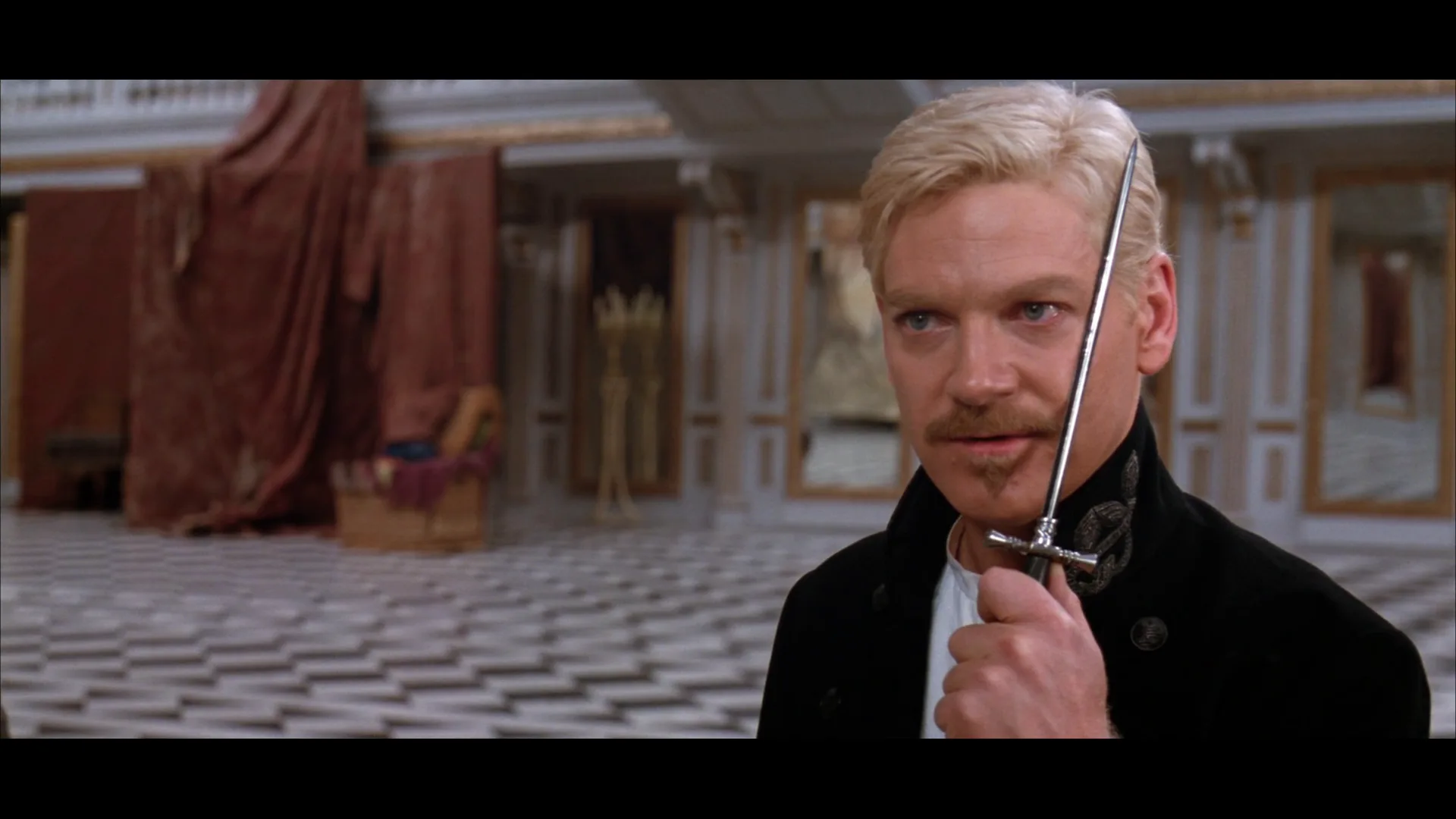
}Remakes the slow push-in on Hamlet (Kenneth Branagh) in Hamlet (1996), dir. Kenneth Branagh, DP Alex Thomson: the mirror hall, the gilt frame sliding out, the dagger held upright across his cheek and his spoken line carried over.
The plant lives in every action phase: the dagger stays upright in front of his left cheek while the line carries the scene. The fist pressed under his chin keeps the steel in frame as the dolly creeps in, and the one verbatim line leaves the blade to speak for the ending.
Common mistakes
- The plant disappears. Image models blur backgrounds by default. State deep focus and an f-stop like f/8, and put the object in a named part of the frame (upper right third).
- The plant takes over. Named first, the object gets centered and enlarged into an insert. Describe the main action first, the plant second.
- Characters interact with the object. Models like to put props in hands. Say where it rests and that it is untouched or hangs still.
- Everything gets ominous. Words like foreboding darken the whole image. Let only light or position mark the plant.
- The video camera heads straight for the object. Name where the move ends and keep the plant in the background of that final frame.
Keep the reference frames, prompts and every generated take side by side — images and video in one canvas.
FAQ
5 questionsWhat is foreshadowing in film?
Foreshadowing in film is a technique where the story plants a hint early, through an object, a line of dialogue, an image or a sound, that prepares the audience for an event later on. When the payoff arrives, it feels surprising in the moment but inevitable in hindsight, because the setup was on screen all along. Screenwriters often call it setup and payoff.
What are some famous examples of foreshadowing in movies?
Classic plants include the stuffed birds in Norman Bates's parlor in Psycho (1960), the rock hammer in The Shawshank Redemption (1994), the clock tower flyer in Back to the Future (1985), the oranges in The Godfather (1972), the vanishing birdcage trick in The Prestige (2006) and the subliminal flashes of Tyler Durden in Fight Club (1999).
What is the difference between Chekhov's gun and foreshadowing?
Chekhov's gun is a strict type of foreshadowing about objects: anything the story singles out early must be used later, and anything never used should be cut. Foreshadowing is broader. It includes dialogue, moods, prophecies, color and composition that hint at the future without any object. Every Chekhov's gun foreshadows, but not every piece of foreshadowing is a Chekhov's gun.
What is the difference between foreshadowing and a red herring?
Both plant clues, but they point in opposite directions. Foreshadowing hints at something that truly happens later, so the setup is honored by a payoff. A red herring points the audience toward a wrong suspect or explanation, and the story drops or explains it away.
How do you foreshadow without giving away the ending?
Give every plant a second job, such as a character trait, a joke or a piece of set dressing, so it reads as texture the first time. Keep it inside a wider shot instead of cutting to an insert, place it in act one and pay it off in act three, and never let a character explain why it matters.
Related terms
7- Red HerringStorytelling
A red herring is a false clue planted to point the audience toward the wrong suspect or explanation, so the real answer lands as a surprise.
- Flash-ForwardStorytelling
A flash-forward jumps ahead to show events that will happen later, creating suspense about how the story will get there.
- MacGuffinStorytelling
A MacGuffin is the object everyone in the story is chasing — a briefcase, a formula, a statue — whose exact nature barely matters; it exists to set the characters in motion. Hitchcock popularized the term.
- Plot TwistStorytelling
A plot twist is a revelation that overturns what the audience believed about the story or a character; a good one is prepared by fair clues and recolors everything seen before.
- SymbolismStorytelling
Symbolism is using a concrete object, color, place or action to stand for an abstract idea — a key, a staircase, rain, a red coat — so the image carries meaning beyond itself.
- MotifStorytelling
A motif is an image, sound, object or line that recurs through a film and gathers meaning with each return, supporting the theme.
- Narrative TechniquesStorytelling
Narrative techniques are the tools a storyteller uses to control what the audience knows and when — flashbacks, nonlinear order, point of view, foreshadowing, unreliable narrators, twists.
Further reading
Robert McKee, Story: Substance, Structure, Style and the Principles of Screenwriting (1997). François Truffaut, Hitchcock/Truffaut (1966).