 FlashBoards Learn
- Learn
- Filmmaking Process & Crew
- Continuity
Filmmaking Process & Crew · Film language
Continuity
Also called: film continuity, continuity errors, continuity editing
Continuity is the consistency of every visible and audible detail (props, costume, hair, eyelines, positions, light, weather) across shots filmed out of order, so the edited scene reads as one unbroken moment. When it holds, nobody notices the cuts; when it slips, a glass refills itself and the audience stops believing.
- What it does
- Makes dozens of setups shot over hours or weeks play as one continuous stretch of time and space.
- Use it when
- Every scene covered in more than one shot, and every sequence of AI generations meant to cut together.
- Watch out
- Chasing perfect continuity at the cost of the best take; editors pick performance over a moved cup.
- Try this prompt
Medium shot, man with shaved head and copper-red beard in a diner booth, mug half full at his right hand, pink neon from the left, rain on window
What is continuity in film?
Films are almost never shot in story order. A two-minute dialogue scene can take a full day: a wide master, then singles, over-the-shoulders and inserts, each relit and rehearsed. Continuity is the discipline that makes those fragments agree, so when the editor cuts from wide to close-up, the world has not changed in the gap.
It covers several layers at once:
- Physical continuity. Props and set dressing: the level of coffee in a mug, the length of a cigarette, which hand holds the phone, whether the drawer is open.
- Costume, hair and makeup. A buttoned collar, a sleeve rolled to the elbow, a bruise that heals at the right speed across story days.
- Action and performance. An actor who lifts the glass on a particular word in the wide has to lift it on the same word in the close-up, or the editor has no clean place to cut.
- Spatial continuity. Who stands where, which way people look and move. This is where the 180-degree rule, screen direction and eyelines live.
- Lighting, weather and time of day. The key light stays on the same side, the sun cannot jump between a shot and its reverse, and rain in the master must fall in the singles.
- Sound continuity. Room tone, traffic, a crowd's level: a sudden change across a cut jars like a moved prop.
Story continuity, the consistency of facts across the whole film, is related: when it breaks at plot level it is called a plot hole rather than a continuity error.
Why does continuity matter?
Classical narrative cinema asks the audience to feel they are watching events unfold, not shots being assembled. Continuity pays for that illusion. Every matched prop, eyeline and light direction removes a reason for the viewer to notice the edit, so attention stays on faces, stakes and story.
Breaks cost attention: a viewer who spots a cigarette growing longer is, for a moment, thinking about the production instead of the scene. Famous slips show how easily it happens even on large films: the croissant that turns into a pancake in Julia Roberts's hand at breakfast in Pretty Woman (1990), or the takeaway coffee cup left on a table in a 2019 episode of Game of Thrones. Both became more famous than their scenes.
Continuity also carries meaning when it is deliberately bent. In The Shining (1980), a chair behind Jack Torrance vanishes between shots of his job interview, and the hotel's layout does not add up across the film; viewers still argue whether Stanley Kubrick intended the unease.
Some films sidestep the problem by hiding cuts: Alfred Hitchcock's Rope (1948) joins long takes with concealed cuts, and 1917 (2019) is staged to look like a single continuous shot, broken only once by a cut to black. Every other film earns its seamlessness cut by cut.
How is continuity kept on set?
On a professional shoot the script supervisor owns continuity. They log every take: which lines were covered, what the actor did with their hands and on which word, where props ended up, which take the director liked. Those notes, together with a lined script showing which setups cover which lines, go to the film editor alongside the dailies.
The departments back them up. Costume, hair and makeup photograph each actor at the start of every scene and after any change, full length plus close details. Props and set dressing photograph the table before the first take and reset it to the photo between takes.
Practical habits that save the edit:
- Overlap the action. Actors repeat the same business at the same moments in every setup, and each close-up starts a few lines early, leaving room for a match on action.
- Keep business simple. Eating, drinking, smoking and paperwork are traps; agree where the fork is on each line.
- Watch the liquid and the burn. Top up glasses to a marked level and swap cigarettes to a matching length before each take.
- Plan for light. Shoot a scene's exterior coverage within the same few hours so the sun does not swing across the frame.
- Log the geography. Note the camera's side of the line, exits and off-screen looks, so later pickups still match.
The goal is matching material, not perfection. Walter Murch's often-quoted ranking puts emotion, story and rhythm well above spatial continuity when choosing a cut, and editors will use the best-acted take even if a cup has moved.
What is continuity editing?
Continuity editing is the set of cutting conventions that makes a scene assembled from separate shots read as one continuous space and time. Most were settled in Hollywood by the 1920s and remain the default grammar:
- Establish, then cut in. A wide shot shows the geography; closer shots follow.
- Stay on one side of the line. The 180-degree rule keeps characters on consistent sides of the frame, so a two-person conversation in shot reverse shot never flips.
- Match the looks. An eyeline match cuts from a character looking off-screen to what they see, with the gaze direction agreeing.
- Match the movement. Screen direction stays consistent, and cuts land mid-action so motion carries the eye.
- Change the angle enough. A cut between two shots of the same subject needs a clear change of size or angle (the common rule of thumb is at least 30 degrees) or it reads as a stutter.
All of it depends on shooting matching coverage, and on where the eye is at the cut. On Mad Max: Fury Road (2015), director George Miller and cinematographer John Seale kept the center of interest near the middle of the frame across very fast cutting, so the viewer never has to search for the action after a cut.
Continuity errors: why they happen and which ones matter
A continuity error is any mismatch across a cut that the story does not explain. The usual suspects:
- Props that drift. Drinks change level, food reappears on the plate, a phone moves hands.
- Costume and hair that reset. A tie loosened in the wide is neat in the close-up.
- Positions that jump. A hand on the table in one angle is in the lap in the next.
- Light and weather that change. Clouds come and go, shadows swing.
- Geography that flips. Crossing the line makes two people seem to swap places.
They happen because scenes are shot over hours or days, and because the editor's first loyalty is to performance. Many so-called errors are choices.
Which ones matter? Mismatches in the center of attention and during a cut on movement are the most visible. Mismatches at the frame edge or behind a charged close-up usually pass unseen. Geography errors do the most damage: they confuse the audience about where people are.
Continuity editing vs. jump cut
A jump cut is the deliberate opposite of continuity editing. It joins two shots of the same subject from nearly the same angle, so the missing time is visible: the person's position, the light or the cigarette changes abruptly, and the cut itself becomes the point.
Continuity editing hides the passage between shots; the jump cut shows it. Continuity asks for matching action, a real change of angle and consistent details; the jump cut keeps the angle and lets details jump.
So a continuity error can look like a failed jump cut: if the angle changes properly but a detail does not match, viewers read a mistake; if the angle stays and many details change, they read a style.
How to keep continuity across AI generations
In AI filmmaking, continuity is the central craft problem. Each generation starts from nothing unless you give it something to match, so a character can gain a scar or lose an earring between two shots seconds apart.
- Write a continuity list before you generate. For each character: age, hair, two or three distinctive features, every costume item with color and material. A character sheet is the natural home for it.
- Repeat the anchors word for word. Paraphrasing invites drift; the mustard-yellow corduroy jacket of shot one stays exactly that in shot twelve.
- Fix the light as a sentence. Name the key light's color and side (pink neon from the left) and reuse it for every shot of the scene.
- Pin the props and their state. Half-full mug at his right hand, map folded twice: state, not just presence.
- Use the previous frame as a reference. Shot one as a reference for shot two keeps far more than text alone.
On FlashBoards this becomes a visual continuity bible: the character sheet, the approved frames of each scene and the written anchor list sit on one board next to the storyboard and the shot list, and new takes land beside the shots they must cut with, so a drifting earring is caught before the edit. As everywhere in film production, continuity is planned, logged and checked.
How to create a continuity with AI
3 promptsTest continuity the way an editor would: make a shot, then the next shot of the same moment, and see whether the world survives the cut. Nano Banana 2 Lite builds the master with every anchor stated, GPT Image 2.5 makes the matching closer angle from the same description, and MiniMax H3 Max Turbo animates the master so you can check that the action itself stays consistent. Put all three side by side on a FlashBoards board.
Cinematic medium shot inside a late-night roadside diner. A man in his mid-thirties with a shaved head, a short copper-red beard, a small silver hoop in his left ear and a thin white plaster strip across the bridge of his nose sits alone in a red vinyl booth, facing frame right. He wears a mustard-yellow corduroy jacket over a navy hooded sweatshirt with the hood down. On the table: a white ceramic mug half full of black coffee just right of his right hand, and a paper road map folded into quarters near his left elbow. Behind him, a window streaked with rain and blurred amber streetlights outside. Pink neon light falls on him from the left side of frame, soft warm tungsten fill from the ceiling. Camera at seated eye height across the aisle, 50mm lens, shallow depth of field, muted film color, 35mm film grain.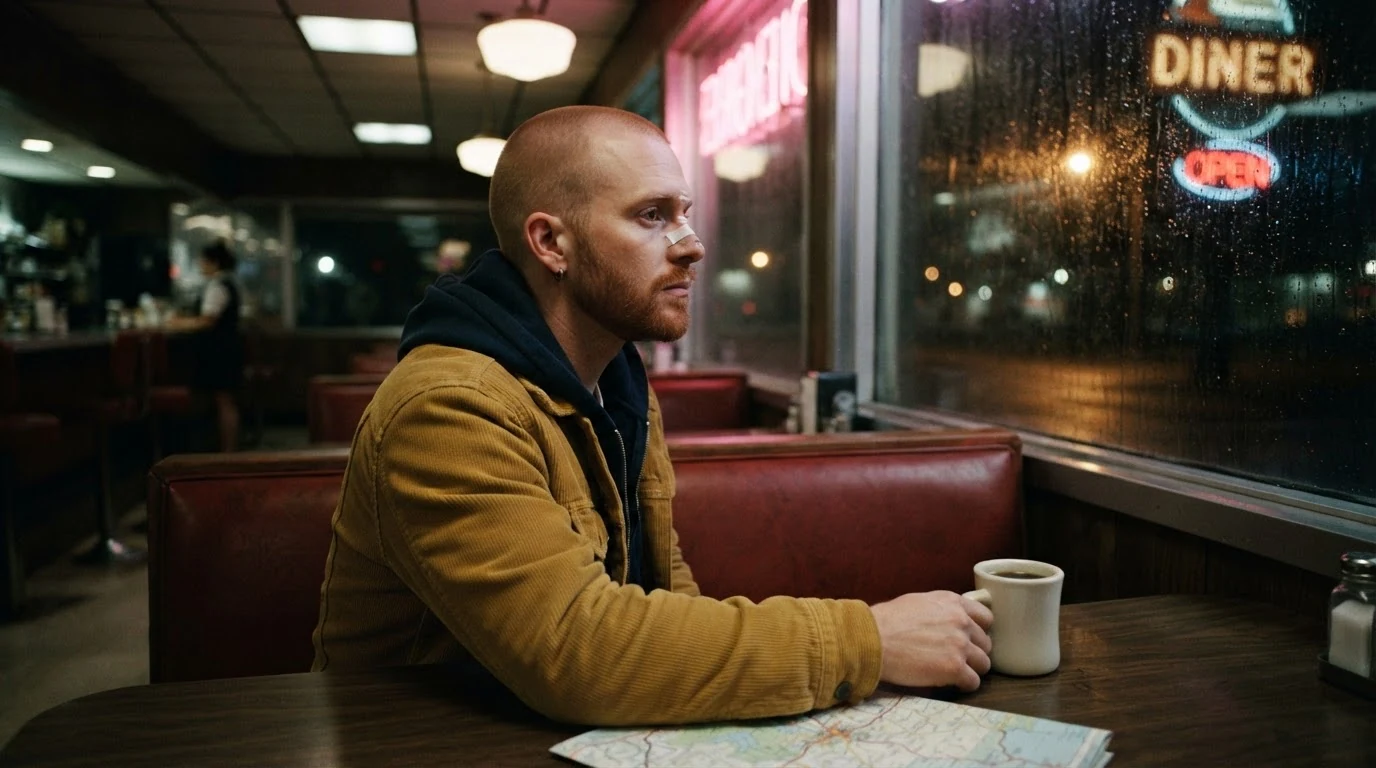
The silver hoop in his left ear, the plaster strip across the bridge of his nose and the mustard-yellow corduroy jacket over a navy hooded sweatshirt are the character anchors; half full, just right of his right hand and folded into quarters give the props a state, not just a presence. Facing frame right and pink neon from the left side of frame fix the geography and the key light, which are the two things the next angle must not flip.
Open FlashBoardsCinematic close-up, the matching closer angle of the same moment in a late-night diner. The same man in his mid-thirties with a shaved head, a short copper-red beard, a small silver hoop in his left ear and a thin white plaster strip across the bridge of his nose, framed from mid-chest up, facing frame right and looking off-screen right at someone across the table. The collar of his mustard-yellow corduroy jacket over a navy hooded sweatshirt, hood down. The rim of a white ceramic mug half full of black coffee at the lower right edge of frame, near his right hand. Behind him, out of focus, a rain-streaked window and blurred amber streetlights. Pink neon light from the left side of frame on his face, warm tungsten fill from above. Camera at seated eye height, 85mm lens, same side of the table as a wider shot, muted film color, 35mm film grain.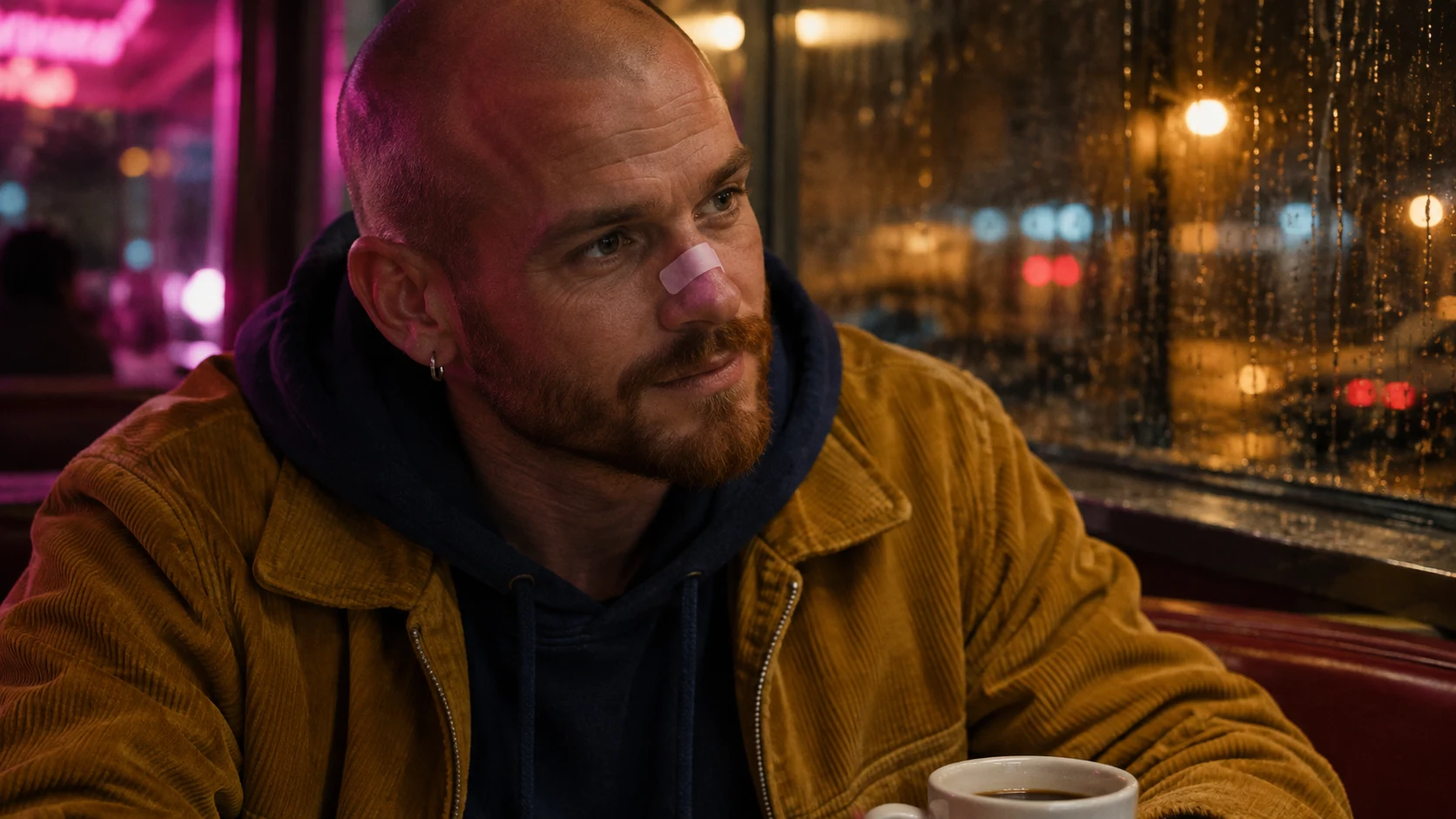
The prompt repeats every anchor word for word, keeps facing frame right and looking off-screen right so the eyeline agrees with the master, and restates pink neon light from the left side of frame so the key does not jump sides. Same side of the table as a wider shot keeps the camera on the same side of the line. The mug rim at the frame edge is a deliberate match point: its level must still read as half full.
Open FlashBoardsCamera: locked off at seated eye height, completely still for the whole shot, the man stays in the same position in frame. Action: he is already lifting the white mug with his right hand as the shot begins. He takes one slow sip of black coffee, then sets the mug back down in the same spot just right of his right hand. He rests his left hand flat on the folded road map and turns his head slightly toward frame right, looking at someone off-screen. Rain keeps running down the window behind him, the blurred amber streetlights flicker softly, the pink neon light on his face stays steady from the left.Already lifting the white mug puts motion in the first frame so the clip does not drift into a slow push-in. Sets the mug back down in the same spot and the pink neon light on his face stays steady from the left ask the model to end the action in a matching state, the way an actor resets for the next setup. The final head turn toward frame right gives a natural cut point to the close-up from recipe 2, matching action and eyeline.
Open FlashBoardsCommon mistakes
- Mirrored details. Earrings, scars, rings and partings jump sides between generations. Name the side from the character's own body (left ear) and repeat it in every prompt.
- Paraphrased costumes drift. Yellow jacket in one prompt and mustard corduroy jacket in the next can give two different garments. Copy the exact phrase from your continuity list.
- Light that flips. If the key side is not stated, each generation picks its own. Write the color and side of the key in every shot of the scene.
- Props that reset. Models draw objects in their default state: a full cup, a new cigarette, a closed book. State the level, length or position every time.
- Stories added in video. Vague video prompts invite invented action and background. Describe only what is in the frame and end in a clear resting state.
Keep the reference frames, prompts and every generated take side by side — images and video in one canvas.
FAQ
6 questionsWhat does continuity mean in film?
Continuity means every detail the audience can see or hear stays consistent across the shots of a scene: props, costume, hair, positions, eyelines, light and sound. Because scenes are filmed in separate setups, often out of order, continuity is what lets the edited scene play as one uninterrupted moment.
What is a continuity error in a movie?
A continuity error is a mismatch between shots that the story does not explain: a drink that refills, a jacket that is buttoned and then open, light that changes direction. Most come from shooting coverage at different times. Many survive because the editor preferred the better performance, knowing viewers rarely notice details outside the center of attention.
Who is responsible for continuity on a film set?
The script supervisor leads it, logging every take, the actors' business, prop positions and camera geography, and passing notes to the editor. Costume, hair and makeup, props and set dressing photograph and reset their own details between takes. The director and cinematographer protect spatial continuity; the editor decides which mismatches matter.
What is continuity editing?
Continuity editing is the standard way of cutting narrative film so that separate shots read as one continuous space and time. It relies on establishing shots, the 180-degree rule, matching eyelines and screen direction, cutting on action and changing the angle enough between shots, so viewers follow the scene without noticing the cuts.
What is the difference between continuity editing and a jump cut?
Continuity editing hides the cut by matching action, angle change and details, so time seems unbroken. A jump cut keeps nearly the same angle while the subject or time changes, so the cut becomes visible and the skipped time is felt. Continuity editing aims at invisibility; the jump cut is a deliberate break used for energy, compression of time or unease.
How do you keep a character consistent across AI-generated shots?
Write a fixed description of the character and costume with a few distinctive anchors, such as an earring on a named side or a specific jacket, and repeat it word for word in every prompt. State the key light's color and side, give props a state, and use earlier frames as references or first frames for video.
Related terms
8- Jump CutEditing
A jump cut joins two shots of the same subject from nearly the same angle, so time visibly skips forward and the cut itself becomes noticeable — used for energy, unease or elapsed time.
- 180-Degree RuleComposition & Framing
The 180-degree rule keeps the camera on one side of an imaginary line between two characters (or along a movement), so their left-right positions and eyelines stay consistent from shot to shot; crossing it flips the geography and disorients the viewer.
- Screen DirectionComposition & Framing
Screen direction is the left-to-right or right-to-left way characters move and look across the frame; keeping it consistent between shots tells the audience where people are heading and who is chasing whom.
- Match on ActionEditing
Match on action cuts in the middle of a movement — a door opening, a punch, a glass raised — and continues it in the next shot from another angle, so the cut hides inside the motion.
- Eyeline MatchEditing
An eyeline match cuts from a character looking off-screen to what they are looking at, with the gaze direction matched so the audience instantly reads the second shot as their view.
- CoverageDirecting & Staging
Coverage is the full set of shots filmed for one scene — master, singles, over-the-shoulders, inserts, reactions — that gives the editor choices of pace, emphasis and performance.
- Plot HoleStorytelling
A plot hole is a gap or contradiction in a story's logic — an event that breaks established rules or a question the plot never answers.
- Film ProductionFilmmaking Process & Crew
Film production is the whole process of making a film — development, pre-production, production (the shoot), post-production and distribution; in the narrow sense, 'production' is just the shooting phase.
Further reading
Walter Murch, In the Blink of an Eye (2nd ed., 2001). Karel Reisz, The Technique of Film Editing (1953; 2nd ed. with Gavin Millar, 1968). Avril Rowlands, The Continuity Supervisor (Focal Press).