 FlashBoards Learn
- Learn
- Storytelling
- Plot Twist
Storytelling · Film language
Plot Twist
Also called: twist ending, twist, reveal
A plot twist is a revelation that overturns what the audience believed about the story or a character. A good one is prepared by fair clues and recolors everything seen before: the moment it lands, the viewer replays the film in their head and finds that the truth was on screen all along.
- What it does
- Flips the audience's understanding of the story in one beat and makes earlier scenes mean something new.
- Use it when
- Your story has a hidden truth about identity, reality or motive that can be planted in plain sight and revealed late.
- Watch out
- A twist with no clues planted, or one that breaks the story's own logic, reads as a cheat rather than a surprise.
- Try this prompt
Hotel room at dusk, bearded man talking to a woman in an armchair, the wardrobe mirror behind him showing the armchair empty, 16:9 film still.
What is a plot twist?
A plot twist is a revelation that changes the meaning of what came before. It isn't just a surprising event like a car crash or a sudden death. A twist changes understanding: the hero was dead the whole time, the harmless witness was the mastermind. After the reveal the audience doesn't ask "what happens next?" but "what was I actually watching?"
The idea is older than cinema. Aristotle's Poetics describes peripeteia, a reversal of fortune, and anagnorisis, the moment a character recognizes the truth. In Oedipus Rex the two fuse: the king's investigation reveals that he is the man he is hunting. Film twists add a move Aristotle didn't need: the audience is deceived too.
A working twist has three parts:
- The false picture. A belief so natural nobody questions it: Malcolm in The Sixth Sense (1999) is a child psychologist treating a scared boy.
- Fair clues. Details that fit the false picture on first viewing and the true one on the second. Malcolm never speaks with anyone except Cole, and his wife never answers him directly.
- The reveal. One beat, often an image or a line, that forces the viewer to swap the pictures, usually followed by a quick replay of the clues.
It's one of the core narrative techniques for controlling what the audience knows and when. Foreshadowing supplies the clues, a red herring pulls attention away from them, and an unreliable narrator is often the channel for the false picture.
Types of plot twists, with examples
Most famous twist endings fall into a few patterns. Knowing which one you're writing tells you what clues you need.
Identity twist
A character is not who we think. In The Usual Suspects (1995) small-time con man Verbal Kint turns out to be Keyser Söze, and his story was assembled from objects in the office around him. Primal Fear (1996) ends with the lawyer realizing his client's split personality was an act. The Prestige (2006) doubles it: one magician is secretly twins, the other has a machine that copies him.
Reality twist
The world's rules differ from what we assumed. The Sixth Sense and The Others (2001) reveal that the point-of-view characters are ghosts. Planet of the Apes (1968) ends on the half-buried Statue of Liberty. Fight Club (1999) reveals that Tyler Durden is the narrator's other self.
Midpoint twist
The rug is pulled halfway and the film becomes a different film. Psycho (1960) kills its apparent lead in the shower. Gone Girl (2014) reveals at roughly the midpoint that Amy is alive and framed her husband. Parasite (2019) turns on a man living in the basement bunker.
Recognition twist
A revealed relationship changes the stakes rather than the plot's facts: Vader and Luke in The Empire Strikes Back (1980), Evelyn Mulwray's confession about her daughter in Chinatown (1974).
Structural twist
The time frame was misread. Arrival (2016) lets us assume Louise's memories of her daughter are the past; they are the future. This overlaps with nonlinear narrative: the twist is in when, not what.
Ambiguity twist
Some endings remove certainty. American Psycho (2000) closes with details suggesting the murders may not have happened as shown.
Why do plot twists work, and when do they fail?
A good twist gives the audience two films: the story, then the story of how they were fooled. That's why the best plot twists in movies drive rewatching. People go back to check whether the clues were really there.
The pleasure is retroactive coherence: the reveal must make more sense of the film than the false picture did. In The Sixth Sense, the cold Cole feels, the anniversary dinner where Anna never looks at her husband and the basement door Malcolm can't open all click into place.
Hitchcock drew the key distinction in his interviews with Truffaut: show the bomb under the table and you get minutes of suspense; hide it and you get seconds of surprise. A twist spends the suspense and dramatic irony you could have had, so it must change the meaning of the whole, not just the next scene.
Twists fail in predictable ways:
- The cheat. The truth was never on screen, or the film showed something false with no narrator to blame.
- Twist as rescue. A revelation that solves the hero's problem is a deus ex machina in disguise.
- Broken logic. A reveal that contradicts earlier scenes opens a plot hole.
- Guessable by marketing. Sold on its twist, a film gets hunted from frame one. Build a story gripping on its own terms.
- No aftermath. A reveal with no reaction beat leaves the audience stranded.
How to write a plot twist
Twists are written backward: start from the truth and design the lie on top of it.
- Write the true story first. One paragraph: what happened, who knew what, and when. If the truth doesn't hold together, no misdirection will save it.
- Define the false picture. Keep it to one assumption the audience makes on their own, like "the narrator is telling the truth" or "this is the past." Viewers defend beliefs they formed themselves.
- List clues that fit both pictures. Malcolm and Anna at dinner read as a strained marriage, later as a widow alone at a restaurant. Place each clue in a scene that is about something else.
- Direct attention elsewhere. Give the audience a better question to chase: a suspect, a romance, a deadline.
- Choose the point of view. A limited POV, or a narrator who lies knowingly or not, shows the false picture without cheating.
- Place the reveal. A midpoint twist needs a new goal after it; an ending twist needs a short replay and a final image. The reveal should come from inside the story, a found object or a discovery, not from the author stepping in.
- Test it cold. If a fresh viewer guesses it in act one, dull a clue; if they feel cheated, sharpen one.
A twist isn't the climax, but the strongest ones land close to it, changing what the final confrontation means.
How to shoot and cut a twist
On set, a twist is a problem of emphasis: the clue must be in frame, legible on a second viewing and underweighted on the first.
- Put the clue in the frame, not in the focus. Background, soft focus, frame edge or a reflection, while the foreground carries the scene's apparent point.
- Cover telling moments neutrally. If a character is secretly unseen by others, block scenes so no one has to respond to them. Every shot should survive both readings.
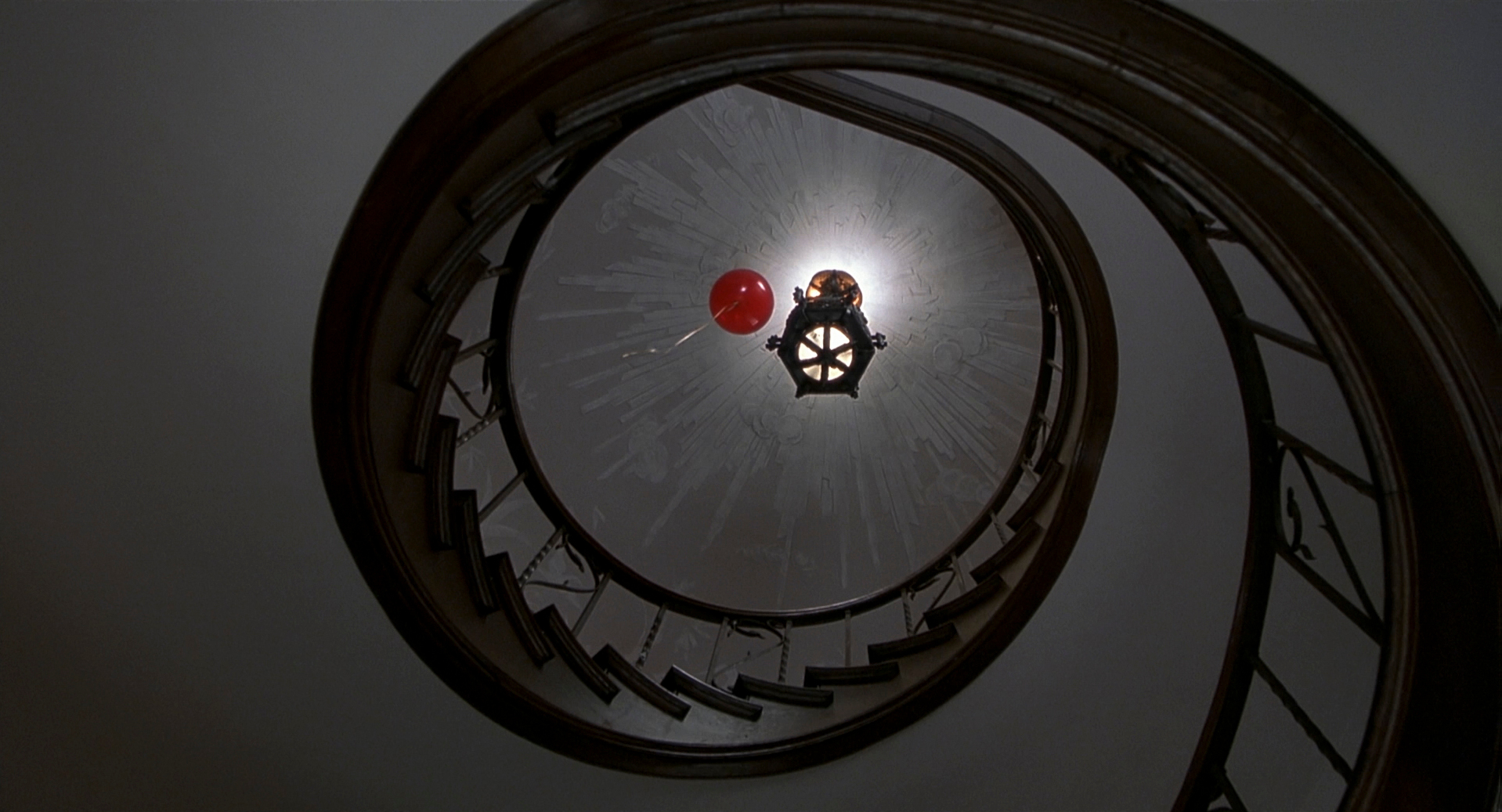
- Use a visual code. The Sixth Sense reserves saturated red for moments touched by the other world, a balloon or a tent among them. Audiences register such motifs without decoding them.
- Shoot the reveal plainly. The truth usually arrives in an insert shot or a close reaction: a ring falling from a sleeping hand, a coffee cup shattering to show a brand name.
- Plan the replay. Many ending twists cut a fast flashback montage of the clues. Shoot pickups so the replay can show them closer than the first time.
- Hold the reaction. Give the character, and the viewer, a beat of stillness.
In FlashBoards, lay out the twist in two lanes on one board: each scene as the audience first reads it, and the same scene under the truth, with clue frames, reference stills and notes on where every clue sits. When you build the storyboard for the reveal, the replay frames already sit next to their originals.
Plot twist vs. plot point (and peripeteia)
A plot point is a turning event that spins the story in a new direction; in the three-act model, plot points one and two close the first and second acts. A plot point changes what happens. A plot twist changes what the audience understands about what already happened.
They often coincide: the midpoint of Gone Girl turns the story and rewrites the first half. But a heist going wrong is a turn, not a revelation.
Peripeteia sits between them. Aristotle's reversal can happen in plain view; when a hidden truth coming to light triggers it, you have the ancestor of the modern twist. A quick test: if the scene plays the same on a second viewing, it's a plot point or a reversal. If the second viewing is a different experience, it's a twist.
Plot Twist examples in film
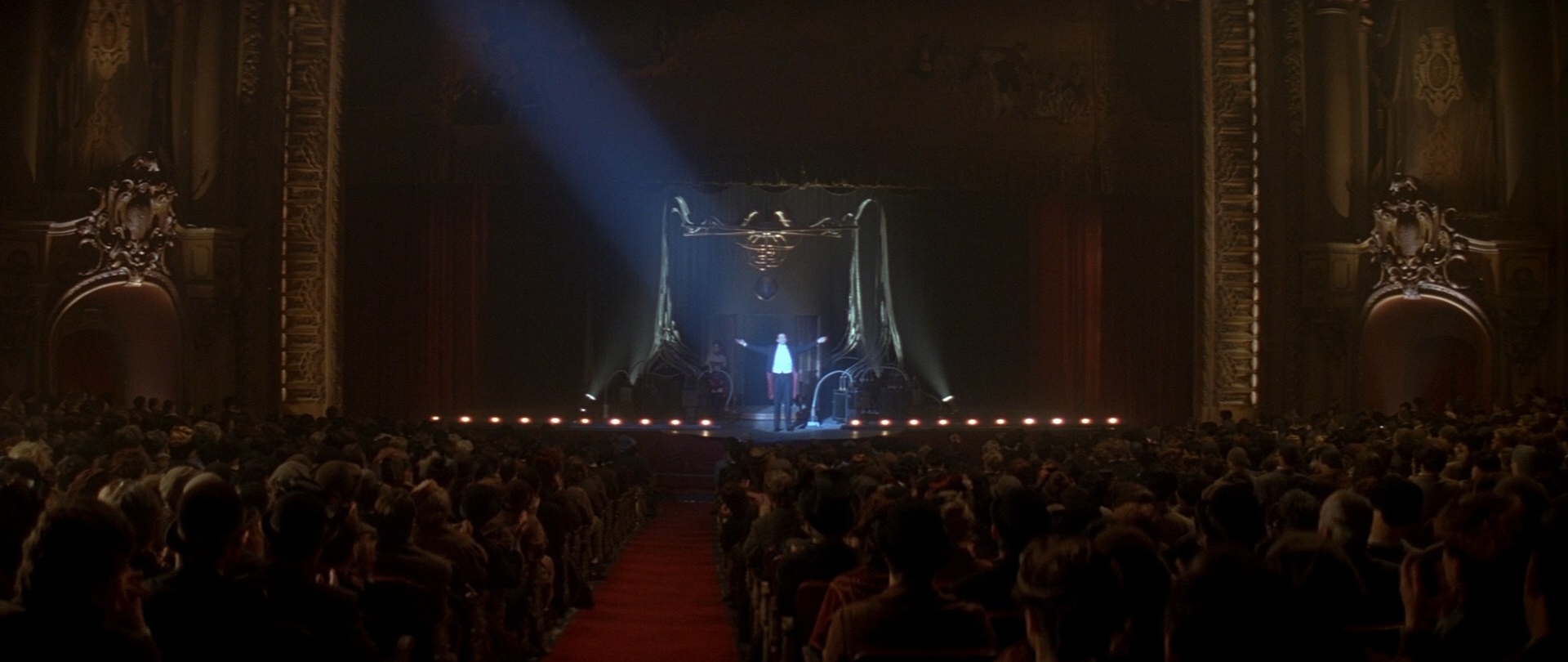
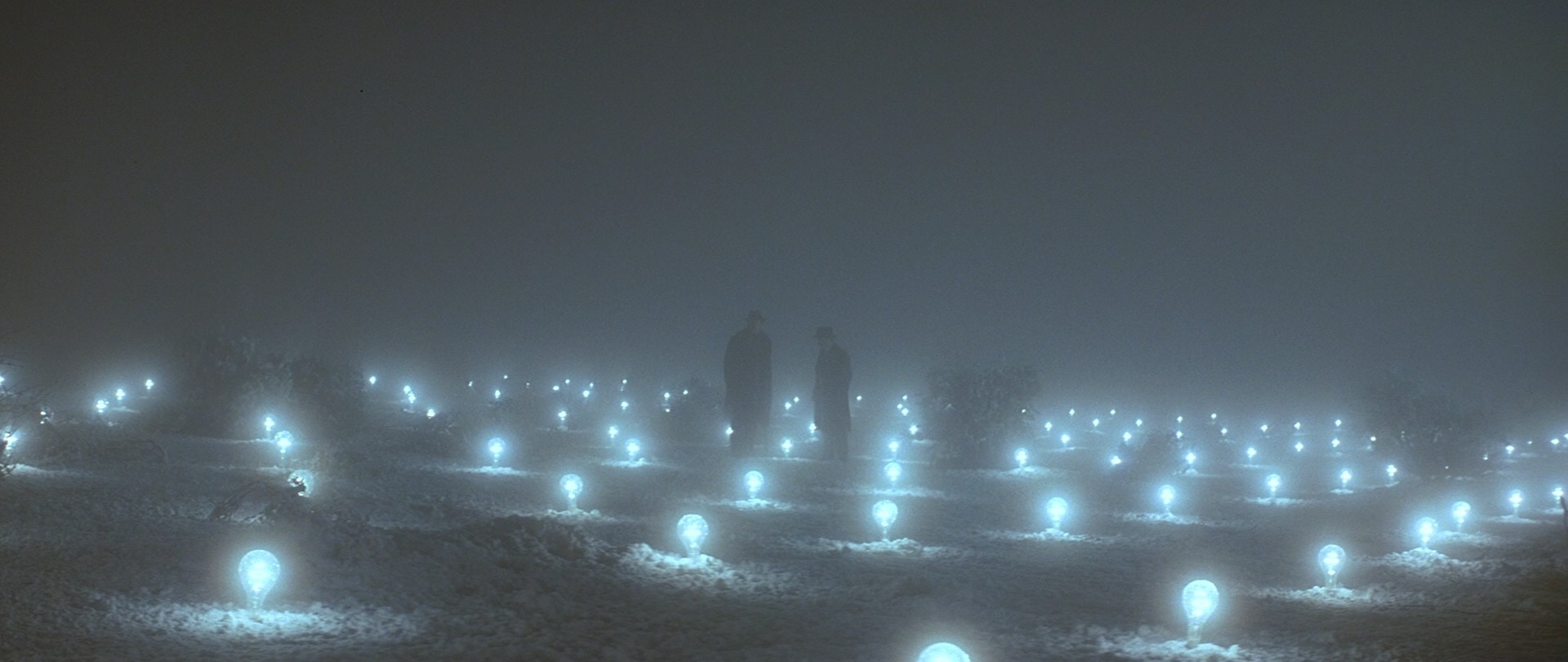
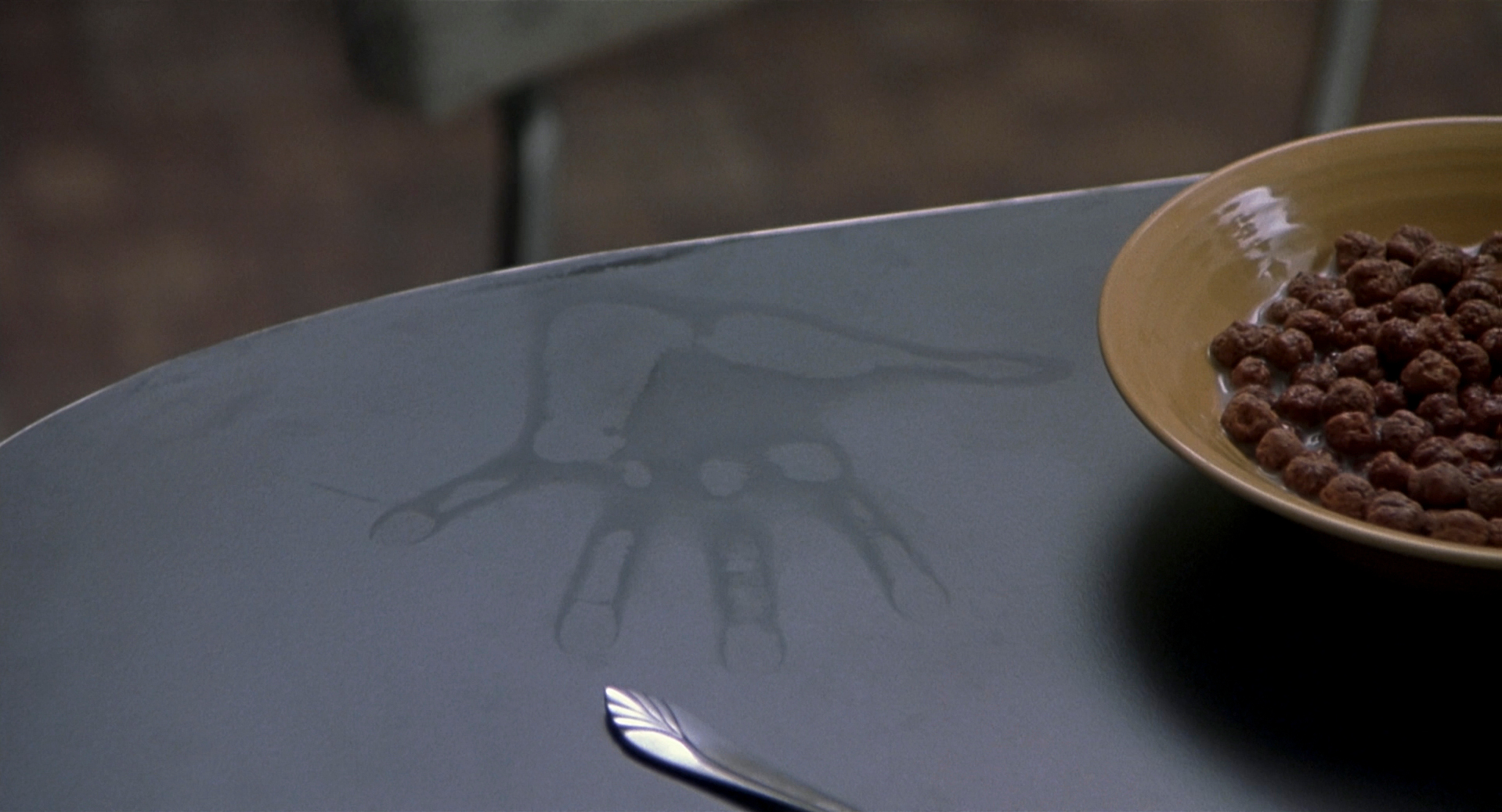
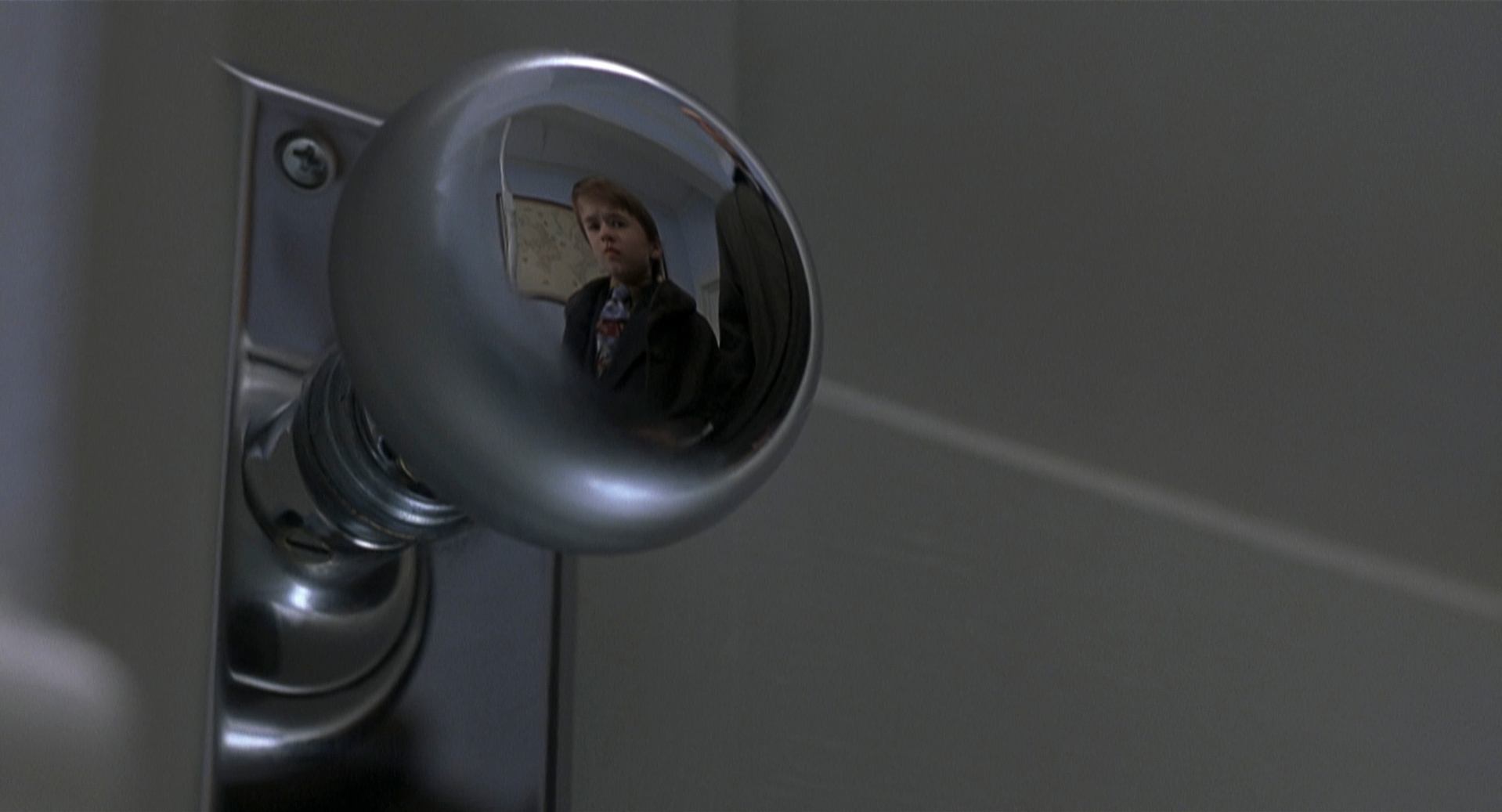
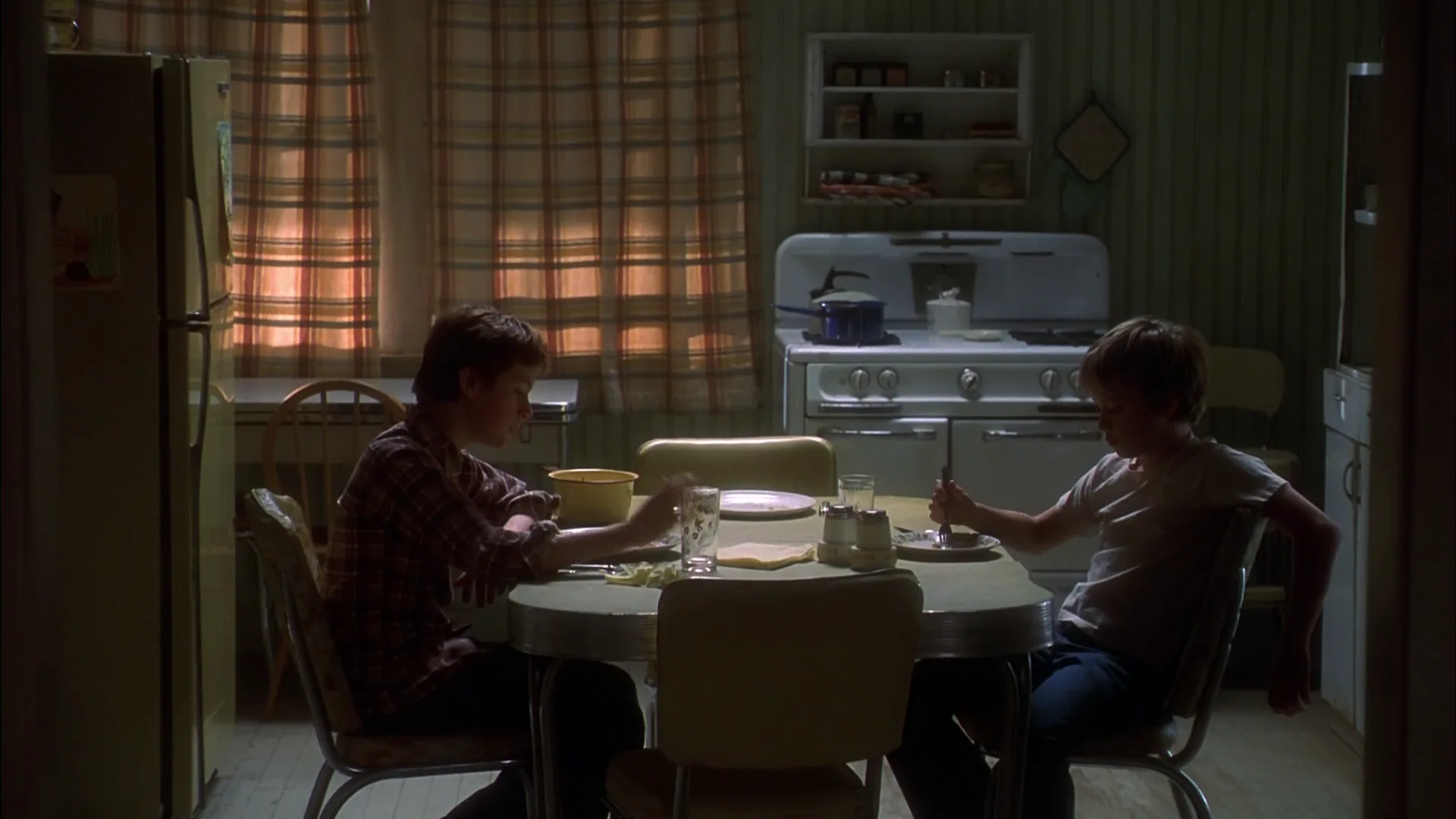
7 framesA twist rarely lives in one frame. These stills show its ingredients: the audience's point of view, the clue in plain sight and visual codes that make sense only afterward.
How to create a plot twist with AI
4 promptsYou can't generate a twist, but you can generate its two key shots: the plant, where the truth hides in plain sight, and the reveal insert. Models handle this when you say where the clue sits and how much weight it gets. In FlashBoards, keep the plant and the reveal side by side on one board and compare takes until the clue is visible but easy to miss. The fourth prompt re-shoots a real film shot from a text description alone, and the original plays next to the result so you can compare.
Psychological drama film still, small old hotel room at dusk. Foreground left, sharp focus: a man in his forties with a thick salt-and-pepper beard, round tortoiseshell glasses and a burgundy knit sweater, sitting on the edge of the bed, leaning forward and talking earnestly. Right side of the room, mid-ground: a woman in her thirties with short copper hair, freckles and a green raincoat, sitting in a worn velvet armchair, listening. Background behind the man, soft focus: a tall wardrobe mirror that reflects the back of the man's head and the velvet armchair, and in the reflection the armchair holds only a folded grey blanket. Warm tungsten bedside lamp, cool blue window light, 35mm lens, camera at seated eye height, muted palette, cinematic film still.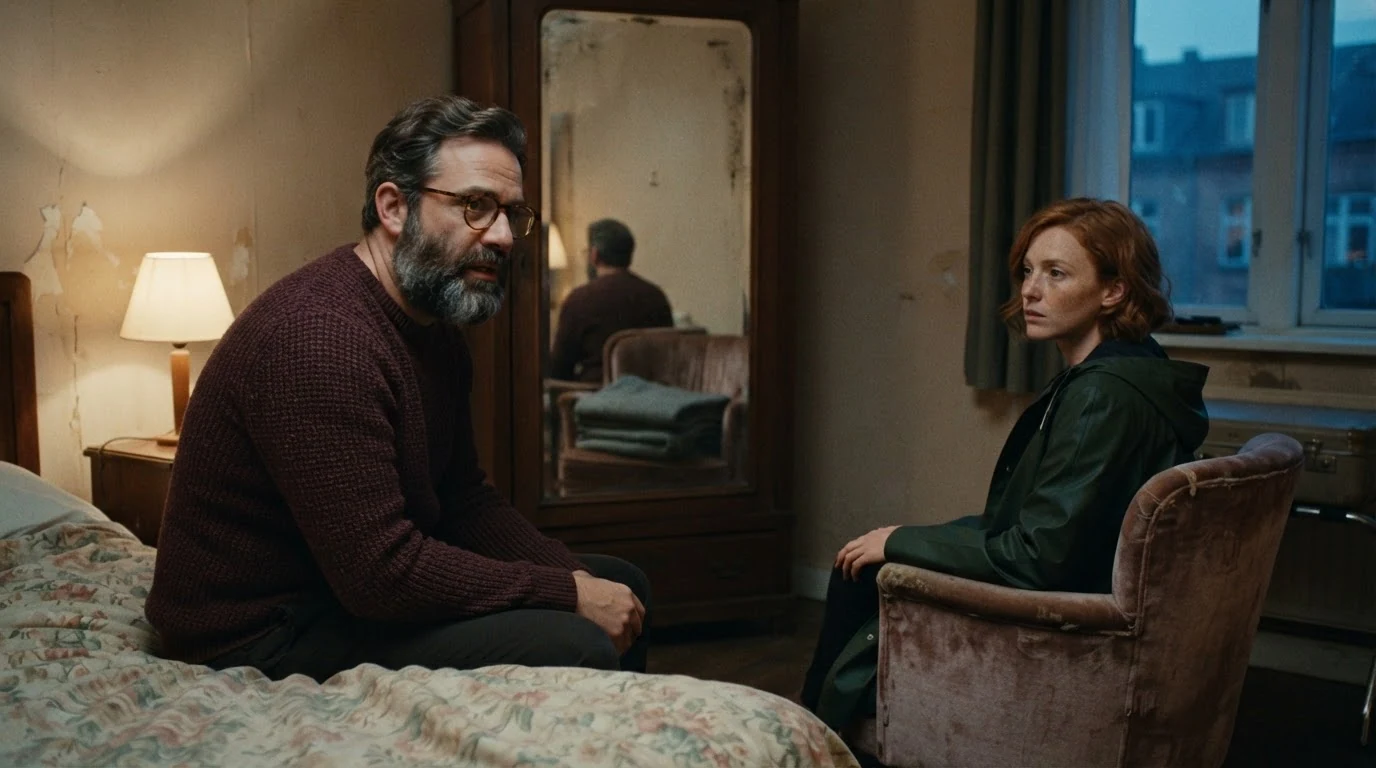
This is the plant. "Foreground left, sharp focus" and "talking earnestly" put the scene's apparent point on the man, while the mirror sits "behind the man, soft focus," where first-time viewers rarely look. The clue is stated positively ("holds only a folded grey blanket"), not as a negative. Specific features make both characters invented people.
Open FlashBoardsThriller film insert shot, anamorphic widescreen. Extreme close-up of a cork board covered in case notes, maps and index cards, lit by a single narrow beam from a desk lamp. Center of frame, sharp focus: an old faded color photograph pinned with a red pushpin, showing two young men in matching navy rowing club jackets smiling on a riverbank; the taller one has a crooked nose and a small scar through his left eyebrow. The edges of the board fall off into soft focus and deep shadow. 100mm macro lens, shallow depth of field, amber and teal palette, fine film grain, cinematic film still.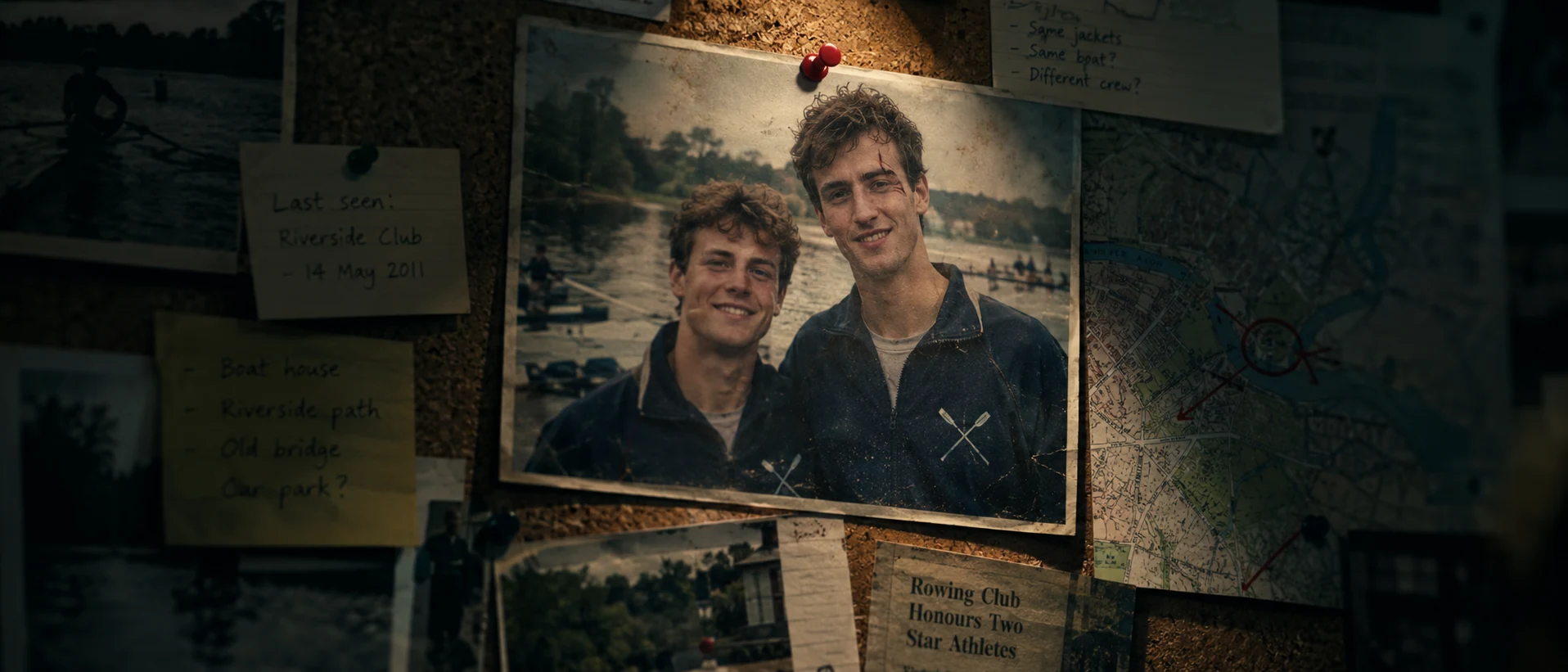
This is the reveal, the image that makes the audience rewind. "Extreme close-up," "single narrow beam" and "center of frame, sharp focus" give the photo total emphasis, the opposite of recipe 1. The "crooked nose" and "scar" matter because a reveal insert depends on recognizing a face seen before; match them to your own character sheet.
Open FlashBoardsCamera: slow, steady push-in toward the wardrobe mirror behind the man, focus slowly racking from the man to the mirror by the end of the shot. Action: from the first frame the bearded man is already talking, gesturing with one open hand toward the woman in the velvet armchair. In the middle the copper-haired woman nods, and the man pauses and smiles at her. The reflection stays fixed for the whole shot: the back of the man's head and the velvet armchair holding only the folded grey blanket. At the end the mirror is in sharp focus, the folded grey blanket on the reflected armchair clearly visible, while in the room the woman stays seated, still listening.The move turns the plant into a slow reveal. "Already talking, gesturing" keeps the shot alive from the first frame. The push-in and the rack focus "from the man to the mirror" shift emphasis to the clue gradually, and "the reflection stays fixed" spells out what the mirror holds so the model doesn't correct it. Everything named, including the blanket in the reflection, is already in recipe 1's frame, so the model invents nothing.
Open FlashBoards{
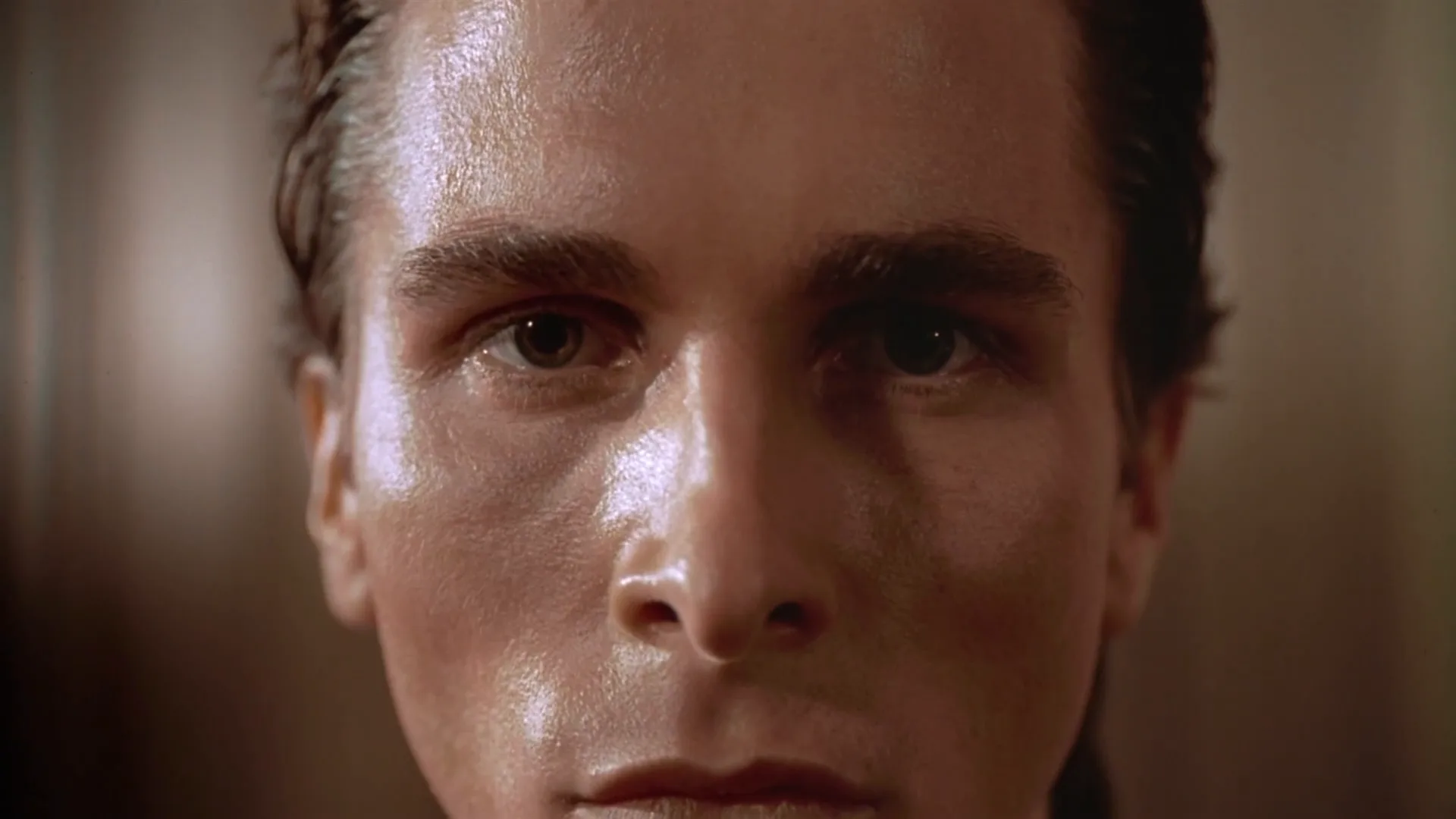
"output": "Full-screen live-action scene from American Psycho (2000), from its very first frame: one single continuous shot. 35mm film look with fine grain, 16:9 frame, a restaurant bar at night: behind him soft-focus polished wood panelling with blurred vertical strips of warm light and a dim brass wall lamp in the upper right corner; warm tungsten key light from screen left, the screen-right side of his face in soft shadow, a brown and amber palette.",
"characters": {
"S1": {
"name": "Patrick Bateman, played by Christian Bale",
"look": "man in his late twenties, dark brown hair slicked straight back with a few loose strands on the forehead, clean-shaven, a faint sheen of sweat on his skin, charcoal pinstripe suit, white shirt with fine blue stripes, deep red tie with a small white dot pattern",
"voice": "flat, calm, low inner-monologue narration, close and intimate, without emotion"
}
},
"shots": [
{
"shot": 1,
"camera": "eye level, dead-on frontal, one continuous slow and steady zoom in straight toward his eyes for the whole shot; it starts as a medium close-up from mid-chest up with S1 centred and the red tie knot at the bottom edge, and ends as an extreme close-up where only his eyes, brows and the bridge of his nose fill the frame; focus holds on his eyes throughout",
"action": [
"BEGINNING: alive from the first frame, the zoom is already creeping in; S1 sits perfectly still in the centre of the frame, shoulders square to the camera, staring straight into the lens with a blank, unreadable face, lips closed and relaxed, both hands out of frame.",
"THEN: the red tie and then the shirt collar slide out of the bottom of the frame; his eyes stay locked on the lens, his head stays exactly where it is, his lips stay closed.",
"THEN: his chin and then his closed mouth leave the bottom edge; the blurred amber background shrinks to thin strips at both sides; his face stays expressionless, jaw set, the sweat sheen catching the light on his forehead and on the screen-left cheek.",
"END: an extreme close-up of his eyes, brows and the bridge of his nose, the screen-left eye lit warm, the screen-right eye in shadow, both eyes wide open and still staring straight into the lens."
],
"dialogue": [
{
"speaker": "S1",
"on_screen": false,
"when": "shortly after the first frame, while the tie is still in view",
"delivery": "inner-monologue voice-over, flat and calm; his lips stay closed",
"line": "<d>[English] But even after admitting this, there is no catharsis.</d>"
},
{
"speaker": "S1",
"on_screen": false,
"when": "after a short pause, as his mouth leaves the bottom of the frame",
"delivery": "same voice-over, quiet, matter-of-fact",
"line": "<d>[English] My punishment continues to elude me.</d>"
},
{
"speaker": "S1",
"on_screen": false,
"when": "right after, as the frame closes in on his eyes",
"delivery": "same voice-over, even lower, final",
"line": "<d>[English] And I gain no deeper knowledge of myself.</d>"
}
]
}
],
"sound": {
"ambience": "a low, muffled murmur of a bar crowd far in the background, faint clink of glasses",
"speech": "exactly these spoken phrases, each said once, in this order, all as his voice-over while his lips stay closed",
"never_spoken": "no narration and no voice-over except Patrick Bateman's three lines above: the descriptions, performance notes and step words of this prompt are never spoken aloud",
"music": "a film score under the scene, always below the voices: a cold sustained synth drone over a faint low string pulse, slowly swelling as the camera closes in",
"subtitles": "none"
}
}Remakes the closing zoom on Patrick Bateman from American Psycho (2000), dir. Mary Harron, DP Andrzej Sekuła: the slow zoom from his red tie to his unblinking eyes, his stillness and the first three lines of his final voice-over.
The ambiguity sits in the camera field: one slow zoom from the red tie to the eyes, while every action step keeps him still, so the frame closes in and the face gives nothing back. His three lines from the film run as voice-over with his lips stay closed, keeping the confession inside the narrator's head, where the ending asks you to doubt it.
Common mistakes
- The mirror "fixes" itself. Models like consistent reflections and may put the woman in the mirror. Describe the reflection separately and concretely, and keep it in soft focus.
- The clue gets too much weight. Describe the decoy action first and put the clue in "background, soft focus" or "edge of frame."
- Negatives backfire. "No woman in the mirror" tends to draw one. Say what is there.
- Faces drift between shots. Reuse the exact feature list in every prompt so the reveal face is recognizable.
- Video invents extras. Describe only what recipe 1 already shows.
Keep the reference frames, prompts and every generated take side by side — images and video in one canvas.
FAQ
5 questionsWhat is a plot twist?
A plot twist is a revelation that overturns what the audience believed about the story or a character. Unlike a simple surprise, it changes the meaning of earlier scenes, not just what happens next. The best twists are prepared with fair clues, so on a second viewing the truth was visible all along, as in The Sixth Sense.
What are the best plot twists in movies?
Often cited: Psycho (1960), Planet of the Apes (1968), The Empire Strikes Back (1980), The Usual Suspects (1995), The Sixth Sense (1999), Fight Club (1999), The Prestige (2006) and Gone Girl (2014). They share fair play: the clues are on screen, and the reveal makes the whole film more coherent rather than less.
How do you write a good plot twist?
Start with the truth, then design the false picture the audience will believe. Plant clues that make sense under both readings, spread them through scenes about something else, and give viewers a better question to chase. Reveal the truth through a discovery inside the story, then give a short replay and a reaction beat.
What is a twist ending?
A twist ending is a plot twist at or near the final scene, so the revelation reframes the entire film at once, as in The Sixth Sense or Planet of the Apes. Because little follows it, a twist ending must be airtight: every earlier scene has to survive a second viewing under the new reading.
Is a plot twist the same as a plot point?
No. A plot point is a turning event that changes the story's direction, like the first-act break. A plot twist changes the audience's understanding of what already happened. A twist can also be a plot point, like the midpoint reveal in Gone Girl, but most plot points involve no hidden truth.
Related terms
5- Plot PointStorytelling
A plot point is a turning event that spins the story in a new direction; in the three-act model, plot point one and two close the first and second acts.
- ForeshadowingStorytelling
Foreshadowing plants hints — an object, a line, an image — that prepare the audience for what comes later, so the payoff feels both surprising and inevitable. Chekhov's gun is its strictest form.
- Red HerringStorytelling
A red herring is a false clue planted to point the audience toward the wrong suspect or explanation, so the real answer lands as a surprise.
- Unreliable NarratorStorytelling
An unreliable narrator is a storyteller — through voice-over or a point-of-view protagonist — whose account the audience can't fully trust because they lie, misremember or misread what happens.
- Narrative TechniquesStorytelling
Narrative techniques are the tools a storyteller uses to control what the audience knows and when — flashbacks, nonlinear order, point of view, foreshadowing, unreliable narrators, twists.
Further reading
Aristotle, Poetics (on peripeteia and anagnorisis). François Truffaut, Hitchcock/Truffaut (1966), on suspense versus surprise. Robert McKee, Story (1997).