 FlashBoards Learn
Acting & Casting · Film language
Cameo
Also called: cameo role, cameo appearance
A cameo is a brief, often uncredited appearance by someone the audience already knows — a star, the director, the author of the source — where the recognition itself is the point. The role barely matters to the plot; the flash of "is that…?" gives the viewer a wink, a tribute or a jolt of surprise.
- What it does
- Trades on recognition: a known face appears for seconds and the audience gets a wink, a tribute or a jolt.
- Use it when
- The person means something to your audience and a few seconds of screen time can carry that meaning.
- Watch out
- If the cameo stops the scene or needs a close-up to be noticed, it has turned into a distraction.
- Try this prompt
Busy sidewalk, two leads walking toward camera in soft focus, a silver-haired woman in a red coat standing still in sharp focus in the midground
What is a cameo in film?
The word comes from the cameo brooch, a small carved portrait. On screen it means a small role whose value comes from who plays it, not what the character does. It runs from one shot to one short scene and only works if the audience recognizes the person.
When Bill Murray turns up as himself in Zombieland (2009), the joke depends on knowing who Bill Murray is. Cameos are sometimes credited (often as "Himself"), sometimes left off the credits to protect the surprise.
Why do filmmakers use cameos?
A cameo reaches past the story to the audience, a lighter cousin of breaking the fourth wall. It does a few jobs:
- Signature. Alfred Hitchcock walked through most of his own films: he misses a bus in the opening credits of North by Northwest (1959), and in Lifeboat (1944) he appears in a newspaper ad.
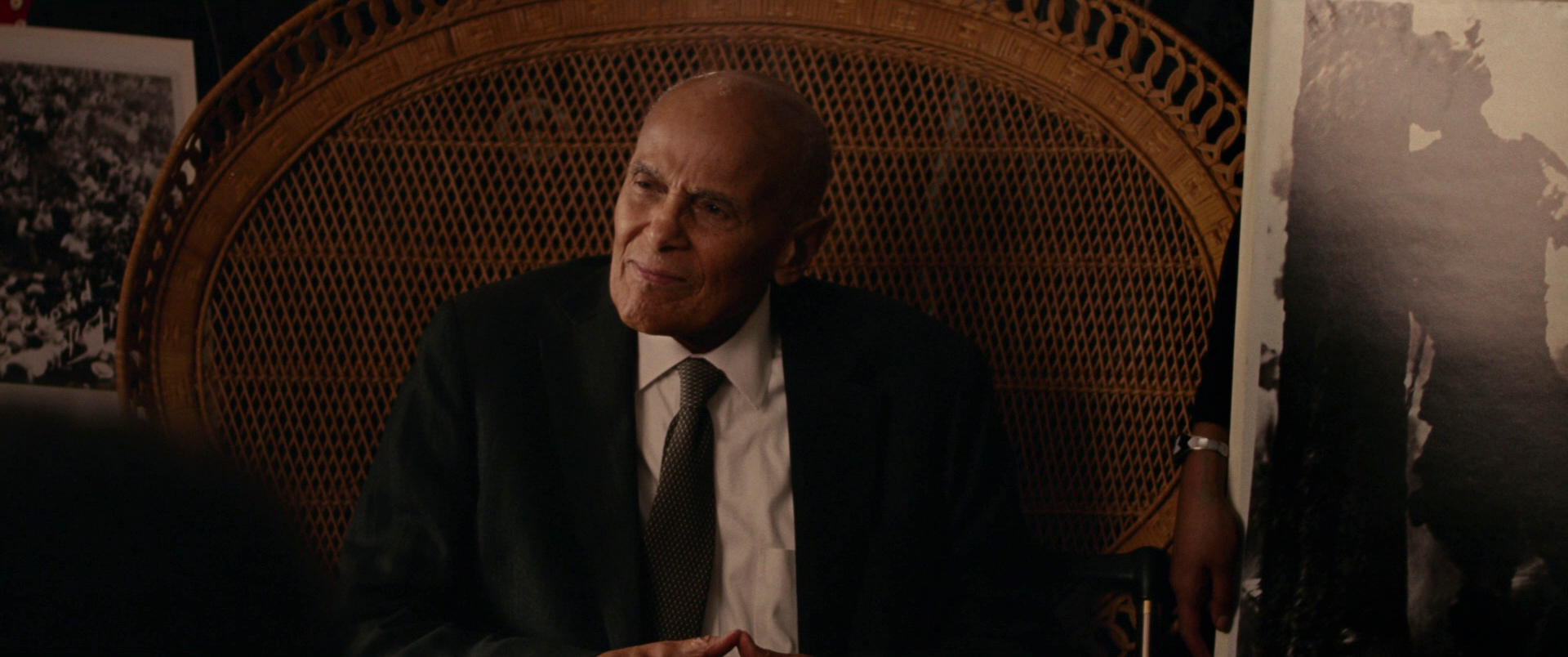
- Tribute. Casting a legend in a small part honors them, the way a homage honors an earlier film. Harry Belafonte's single scene in BlacKkKlansman (2018) draws weight from who's telling the story.
- Continuity with the source. Stan Lee turned up in Marvel adaptations for decades; remakes bring back original cast members for a moment.
- Comedy. A star mocking their own persona, as Bill Murray does, gets a laugh no invented character could.
Types of cameo appearances
Director cameos. Hitchcock is the model; Peter Jackson eats a carrot outside the inn at Bree in The Lord of the Rings: The Fellowship of the Ring (2001).
Author and creator cameos. Stephen King has appeared in adaptations of his novels; Stan Lee made the creator cameo a franchise ritual.
Legacy cameos. Original stars step into a remake for a scene, as Bill Murray does in Ghostbusters (2016).
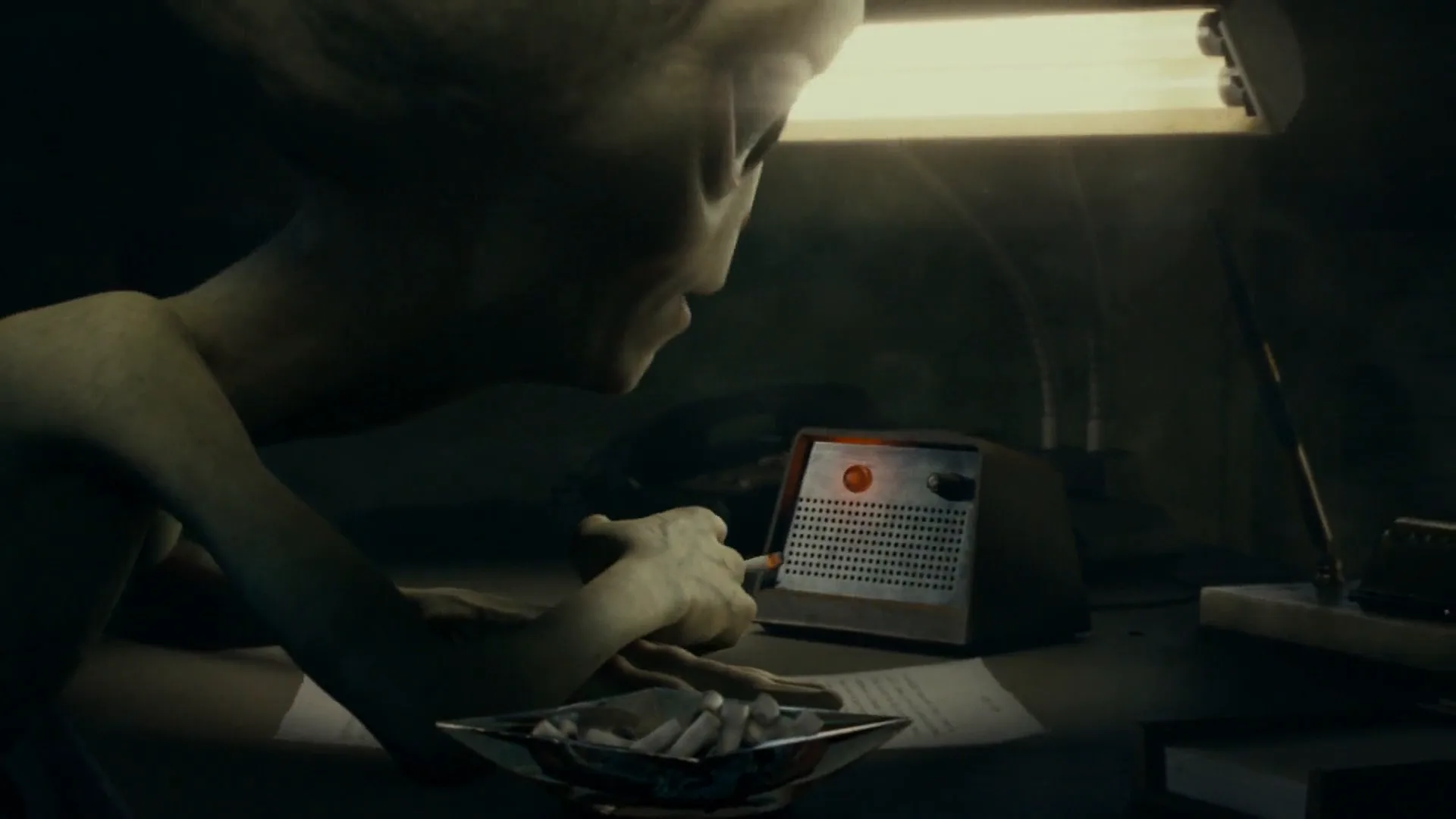
Voice cameos. Only the famous voice appears: in Paul (2011), Steven Spielberg is heard on the phone. It borrows the tools of voice acting.
How to stage and shoot a cameo
A cameo is a scheduling problem first. The recognizable person usually gives you hours, not days, so plan their shots as one block, shoot their coverage first.
Decide how loud it is. A foreground cameo gets a clean single: 50–85mm, eye level, face lit and unobstructed, held two to four seconds on screen. A background cameo hides in a wider shot: put the person in the midground on a third, in sharp focus, with one clear action (crossing, checking a watch).
Don't break the scene. The leads keep playing their objective; no "look who it is" reaction shot unless the characters should recognize the person too.
Settle the paperwork. Likeness releases and billing (credited, uncredited, "as himself") belong in the deal before the shoot day.
Cameo vs. bit part (and walk-on)
A bit part is a credited role with a few lines that any competent actor could play. A walk-on is smaller still: a crossing with little or no dialogue. A cameo can be the same size as either, but it exists because of who plays it.
The test: recast the part with an unknown. If nothing is lost, it's a bit part or walk-on; if the moment dies, it was a cameo. That's also why a famous character actor in a real supporting role isn't a cameo. Among acting and casting terms, the cameo is the one defined by the audience's memory, not screen time.
Cameo examples in film
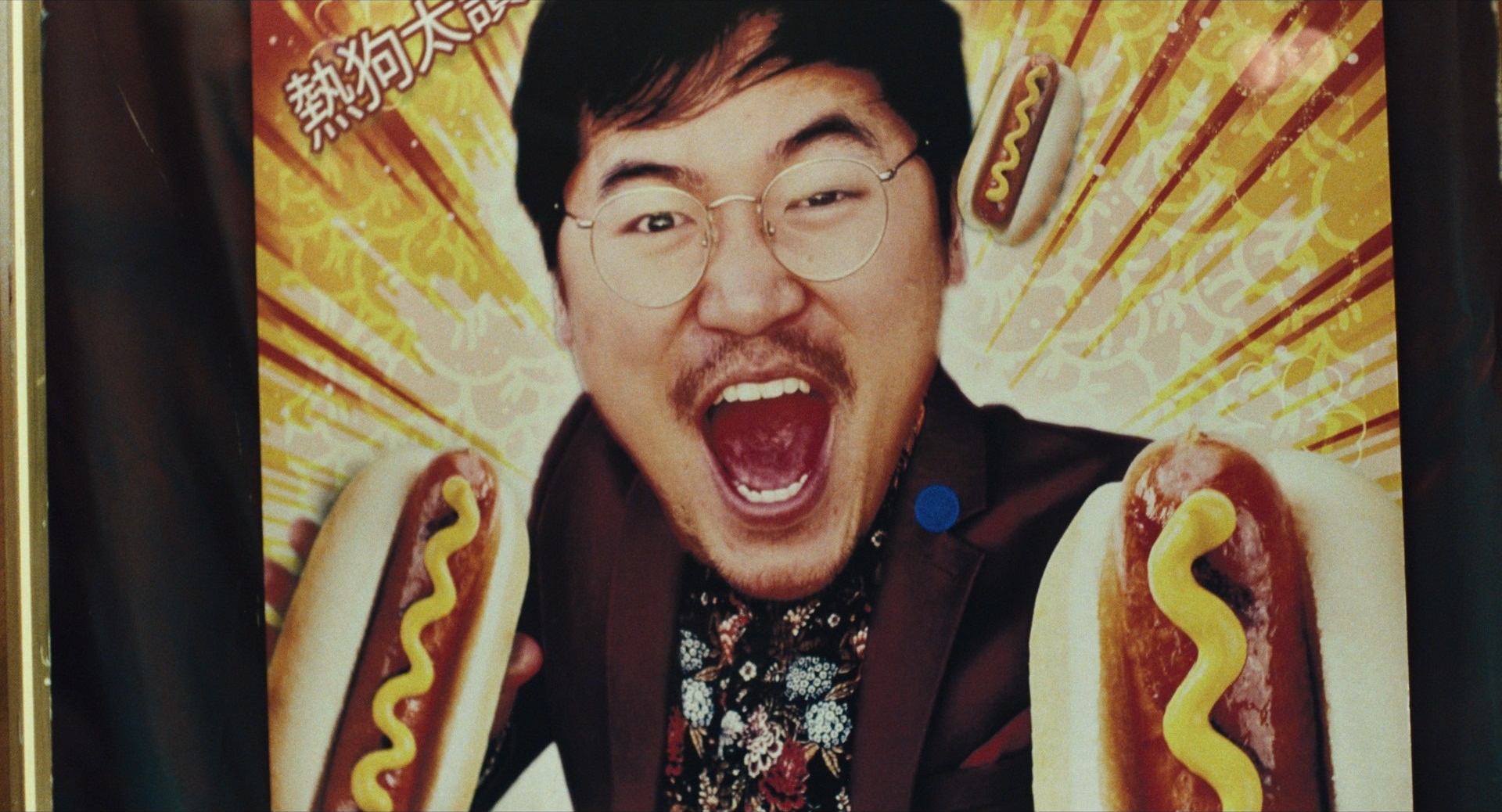
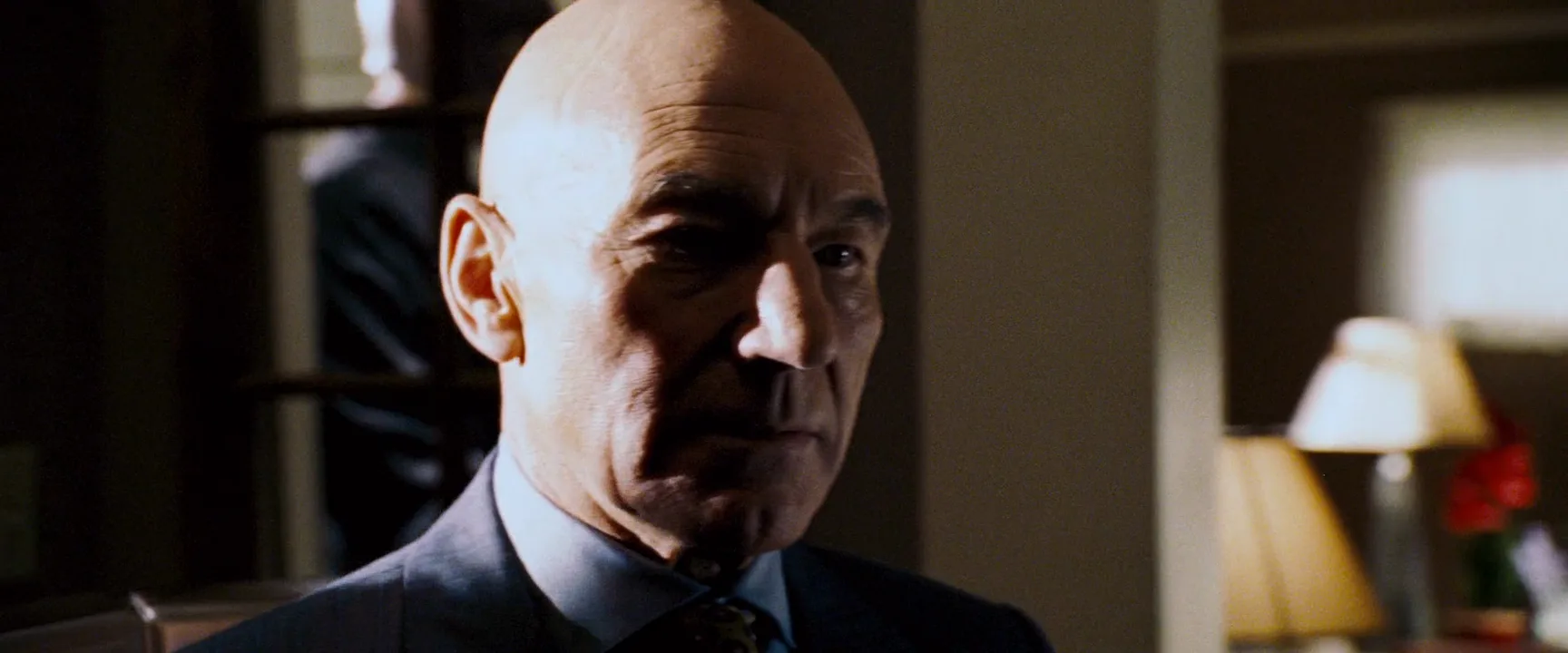
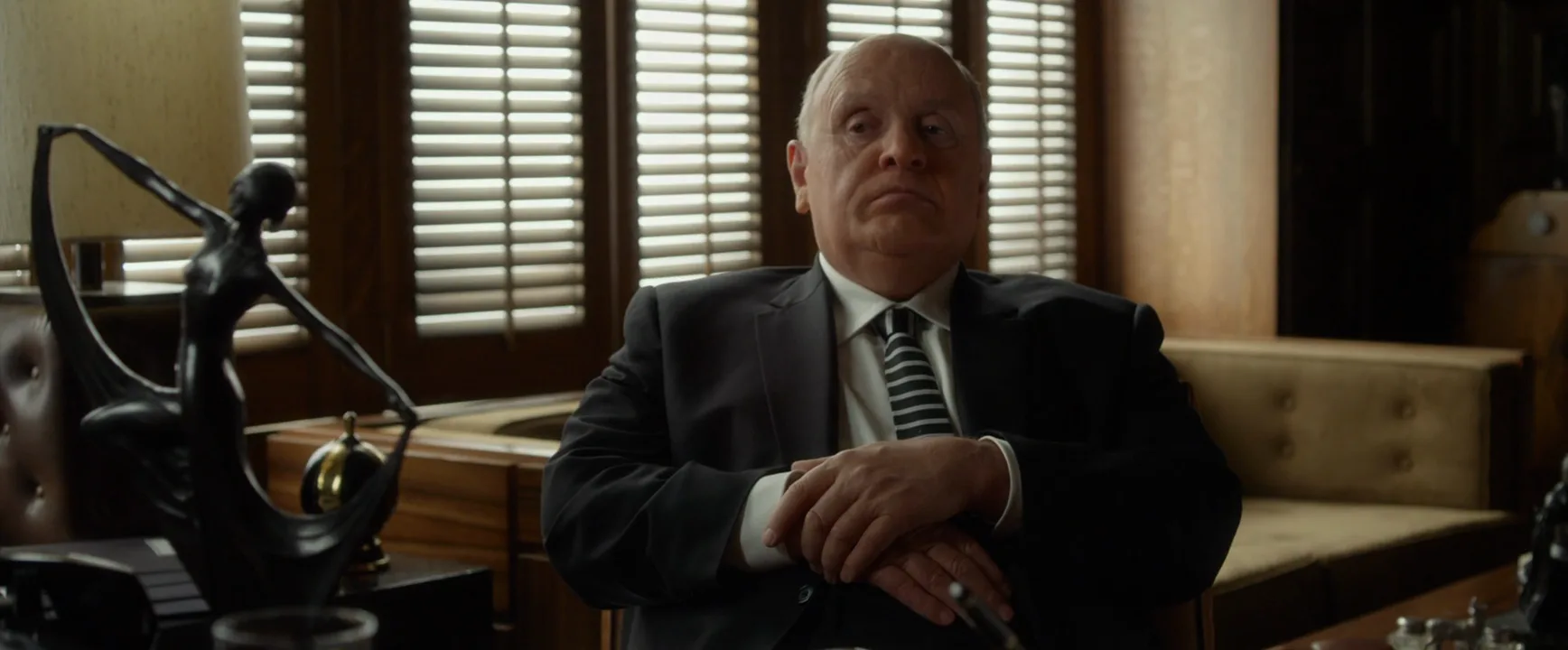
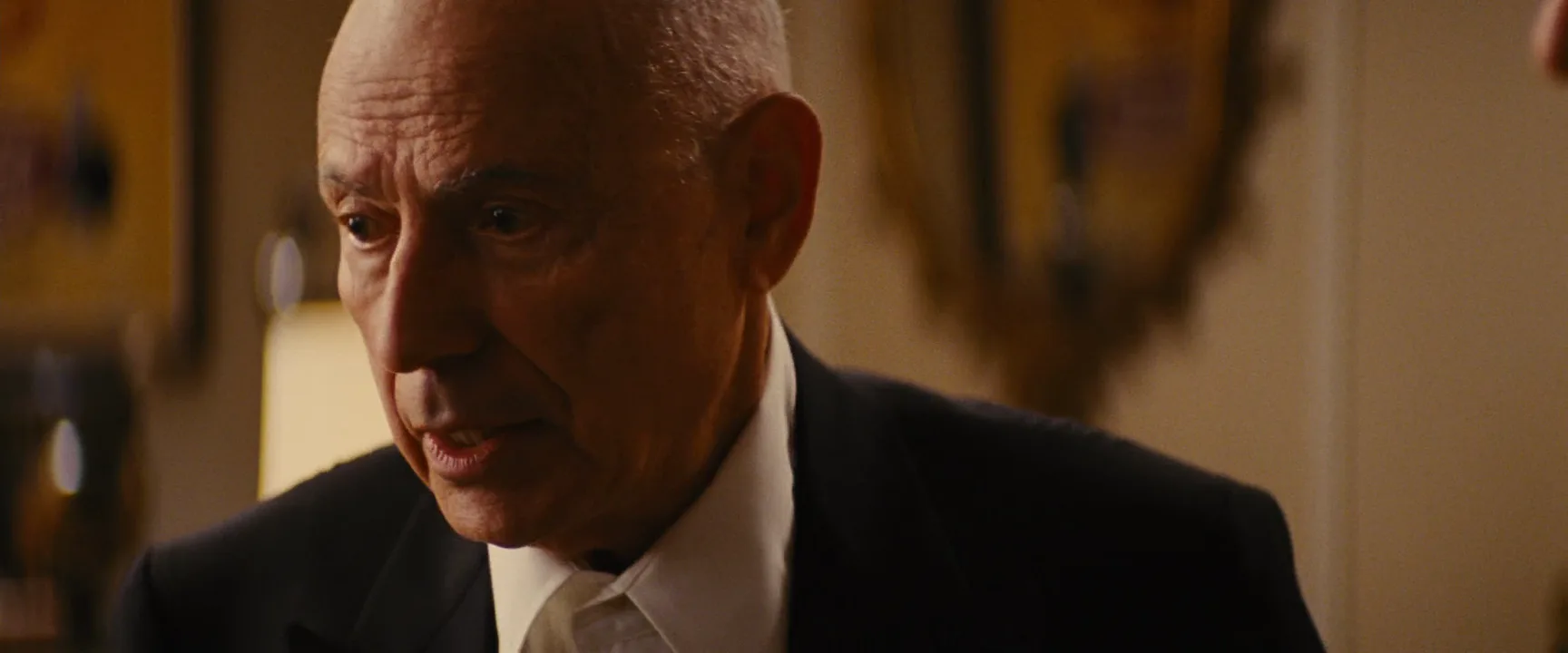
6 framesA cameo only shows in a still if you recognize the person, so these frames mix real cameo moments with the framing a brief appearance depends on.
How to create a cameo with AI
4 promptsDon't prompt real celebrities: models refuse or return an uncanny lookalike. Use AI to previs the staging of a cameo (where the face sits, how sharp, how long), or build a recurring character of your own and keep its reference frames on one FlashBoards board so every appearance matches. The fourth prompt re-shoots a real film shot from a text description alone, and the original plays next to the result so you can compare.
Cinematic wide shot of a busy downtown sidewalk, overcast afternoon. Soft-focus foreground: two young leads in dark jackets walk toward camera, talking. Midground on the right third, in sharp focus: a tall woman in her sixties with a silver buzz cut, round tortoiseshell glasses and a bright red wool coat stands still, feeding pigeons. Commuters in grey and navy blur past her. 35mm lens at eye level, muted palette, red coat the only saturated color, film grain.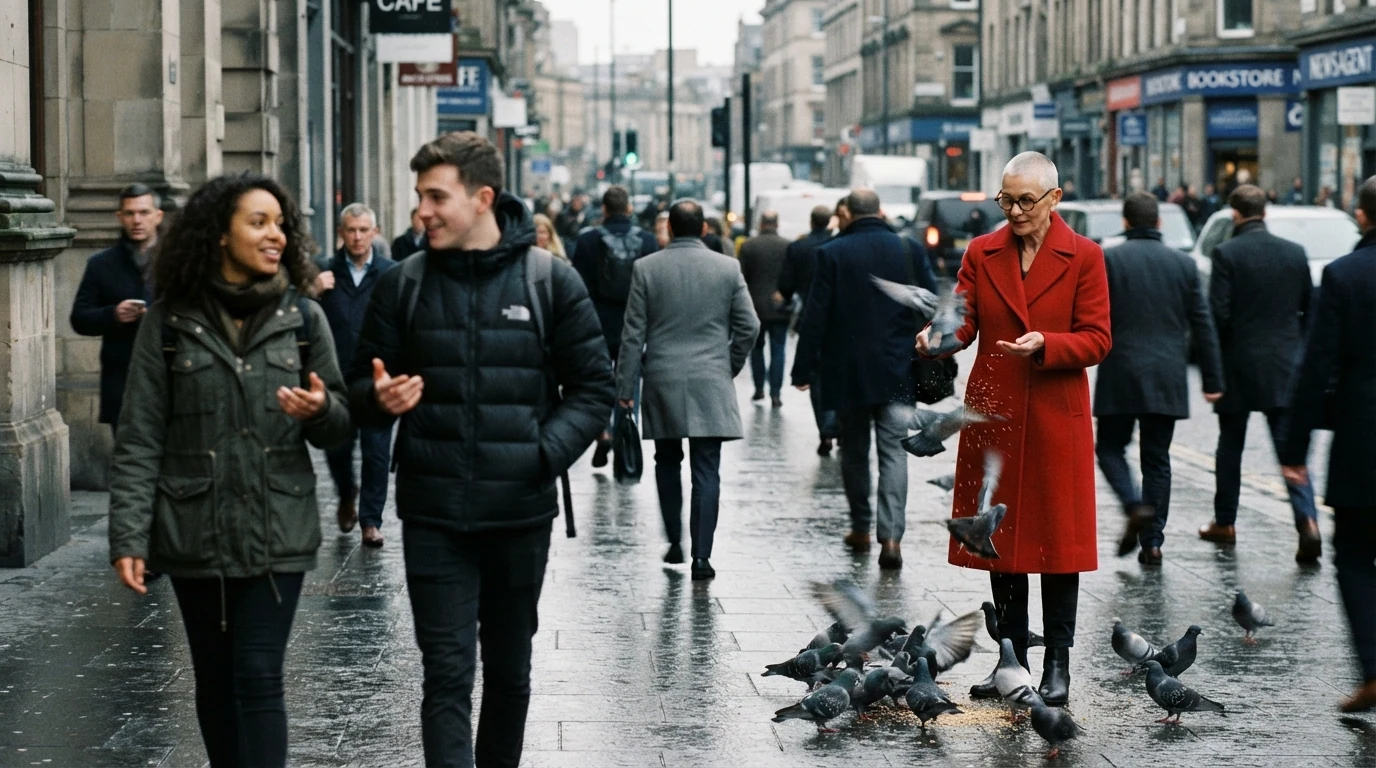
A Hitchcock-style background cameo. Midground on the right third, in sharp focus and stands still while commuters blur past make her the fixed point the eye finds; the only saturated color gives her a signature without a close-up.
Open FlashBoardsAnamorphic 21:9 film still, dim hotel bar at night. Left, in sharp focus: a heavyset man in his seventies with a snow-white handlebar mustache, bald freckled head and burgundy velvet dinner jacket, alone at the counter, raising a small glass with a knowing half-smile. Right foreground, out of focus: a young woman with braided hair turns toward him in surprise. Warm tungsten practicals, 50mm at seated eye level, clean single, shallow depth of field.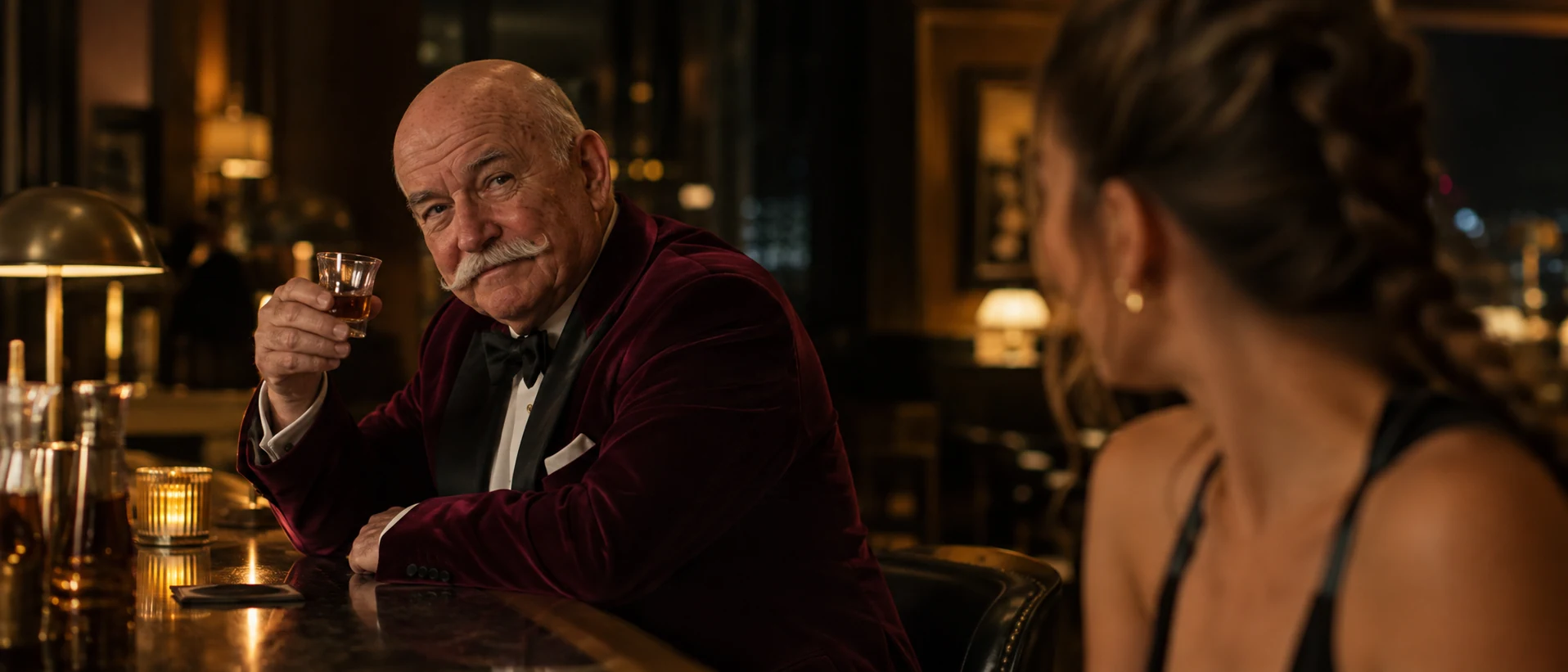
The foreground cameo, where a character recognizes the guest. Clean single and sharp focus against the out-of-focus woman put the weight on him; her surprise is the in-story cue.
Open FlashBoardsCamera: slow steady track backward at walking pace, the two leads centered in the foreground throughout. Action: the leads are already walking and talking, commuters streaming past on both sides. The woman in the red coat tosses crumbs and pigeons flutter up around her. As the leads pass, she glances briefly toward them, then goes back to the pigeons. The leads keep walking without noticing her.Already walking and streaming past make the shot alive from the first frame. The backward track keeps the leads as subject, so the cameo happens around the scene; keep walking without noticing her stops the model from turning the shot toward her.
Open FlashBoards{
"output": "Full-screen live-action scene from its very first frame: one continuous shot, a remake of a moment from Paul (2011). A 1980 flashback in a windowless underground office: dark curved concrete wall, one fluorescent desk lamp, greenish low-key light, heavy shadows, cigarette smoke hanging in the lamp beam, 35mm film grain, muted olive and brown palette.",
"characters": {
"S1": {
"name": "Paul, played by Seth Rogen",
"look": "a photoreal CG alien: slender grey-green body, bare skin, oversized bald head, huge dark almond eyes, long thin neck and long bony fingers",
"voice": "relaxed, dry, conversational American male"
},
"S2": {
"name": "Steven, played by Steven Spielberg (voice only, as himself)",
"look": "never seen: only a voice coming out of the speakerphone on the desk",
"voice": "soft, slightly tinny American male voice through a small speaker, puzzled"
}
},
"shots": [
{
"shot": 1,
"camera": "almost locked-off at seated eye level, normal lens: opens on a tight profile close-up of S1, then eases slowly back and a little to the right to a medium shot over the desk, and holds still for the rest of the shot",
"action": [
"BEGINNING: alive from the first frame, S1 in profile on the left of frame facing screen right, already talking, big eye glinting; a lit cigarette between the fingers of his hand in the lower right of frame, smoke curling up past his chin; the dark back of a leather chair at the far left edge.",
"THEN: as the frame widens, the fluorescent desk lamp comes into view in the upper right and a beige 1970s speakerphone with a round red light sits on the desk right of centre; S1 hunches forward over the desk toward it.",
"THEN: S1 lifts the cigarette hand in a loose, spread-fingered gesture in front of his face while his other hand lies flat on the desk beside a steel ashtray heaped with cigarette butts in the bottom-centre foreground.",
"THEN: the cigarette hand comes down and rests on the desk just in front of the speakerphone, cigarette pointing at its grille; S1 goes still and listens, head bowed toward the phone, eyes on it; the red light on the phone glows while the voice comes out of it.",
"END: S1 dips his head lower toward the speakerphone, the top of his head lit by the lamp and his face sinking into shadow, mouth opening as he answers; both hands stay on the desk, smoke drifting through the lamp light."
],
"dialogue": [
{
"speaker": "S1",
"on_screen": true,
"when": "from the first frame, during the close profile",
"delivery": "casual, pitching an idea",
"line": "<d>[English] Okay, Steven, how about cellular revivification?</d>"
},
{
"speaker": "S2",
"on_screen": false,
"when": "once S1's hand has come to rest by the speakerphone, heard from the phone's speaker",
"delivery": "puzzled, honest",
"line": "<d>[English] Yeah, I don't know what that is.</d>"
},
{
"speaker": "S1",
"on_screen": true,
"when": "right after the voice from the phone ends, as he leans in, to the end of the shot",
"delivery": "patient, quick, rattling off the explanation",
"line": "<d>[English] Oh. Restoration of damaged tissue through telepathic manipulation of intrinsic field memory.</d>"
}
]
}
],
"sound": {
"ambience": "low hum of the fluorescent tube, faint hiss of the phone line, a soft drag on the cigarette",
"speech": "exactly these spoken phrases, each said once, in this order",
"never_spoken": "no narration and no voice-over: the descriptions, performance notes and step words of this prompt are never spoken aloud",
"music": "a film score under the scene, always below the voices: a quiet, slightly mysterious synth pad with a light playful pulse",
"subtitles": "none"
}
}Remakes the speakerphone shot from Paul (2011): the prompt carries over the opening profile close-up, the ease back to the desk, the lamp, ashtray and phone, and the verbatim exchange with Steven Spielberg's off-screen voice.
A voice cameo lives in the staging, so the prompt spends its detail on the device: the speakerphone right of centre with its red light glowing while the voice comes out of it, and Paul's hand resting just in front of the speakerphone as he listens. Steven stays never seen, which keeps the guest off screen as in the film. The three lines come verbatim from the film, and the score line keeps the model from leaving the shot silent.
Open FlashBoardsCommon mistakes
- Real names fail. Describe a fictional face in concrete features and keep one reference image on the board.
- Everyone is sharp. State in sharp focus for the cameo and blurred for the crowd, or the guest gets lost.
- The cameo grows. Say midground, right third; models pull distinctive figures to center frame.
- Video turns toward the guest. Say what the leads keep doing (keep walking).
- Lens stares. Give the glance a target in frame, like toward the two leads.
Keep the reference frames, prompts and every generated take side by side — images and video in one canvas.
FAQ
4 questionsWhat is a cameo in a movie?
A cameo is a very small role played by someone the audience already recognizes: a famous actor, the director, or the author of the source. It is usually one shot or a short scene and barely affects the plot. Its value is the moment of recognition, which lands as a joke, a tribute or a surprise.
What is the difference between a cameo and a bit part?
A bit part is a small credited role, like a waiter with a few lines, that any capable actor could fill. A cameo can be just as small, but it exists because of who plays it. Recast it with an unknown: if nothing is lost, it's a bit part; if the moment dies, it's a cameo.
Who is famous for movie cameos?
Alfred Hitchcock set the standard, appearing briefly in most of his own films. Stan Lee made cameos in Marvel adaptations for decades, Peter Jackson appears in his Lord of the Rings films, and Bill Murray playing himself in Zombieland is a famous star cameo.
Are cameo appearances credited?
Sometimes. Many cameos are credited, often as "Himself" or "Herself." Others are deliberately left uncredited so the surprise survives trailers and cast lists. Credit, billing and likeness releases are part of the performer's deal and should be settled before the shoot day.
Related terms
2- HomageStorytelling
A homage openly recreates a shot, scene, line or style from another film as a sign of respect, trusting the audience to recognize the source.
- Breaking the Fourth WallStorytelling
The fourth wall is the invisible barrier between the story and the audience; a character breaks it by looking into the lens and speaking to the viewer, or by acknowledging that they're in a film.
Further reading
François Truffaut, Hitchcock/Truffaut (Simon & Schuster, 1967; revised 1984).