 FlashBoards Learn
- Learn
- Storytelling
- Homage
Storytelling · Film language
Homage
Also called: film homage, visual reference, shot recreation
A homage in film openly recreates a shot, scene, line or style from another film as a sign of respect, trusting the audience to recognize the source. Done well, it adds a second layer of meaning: the viewer sees the new scene and remembers the old one, and the gap between them becomes part of the story.
- What it does
- Borrows a recognizable image or moment from an earlier film so the new scene carries the old one's weight.
- Use it when
- The source shares your scene's emotion or stakes, and quoting it says something your own images can't say alone.
- Watch out
- A homage that only works for film buffs, or that stops the story to show off, reads as self-indulgence.
- Try this prompt
Dark ranch house interior, camera inside looking out through an open doorway at a blazing desert, lone figure in silhouette
What is a homage in film?
A homage (often pronounced oh-MAHZH, from the French for tribute) is a deliberate, visible borrowing. The director restages something the audience can recognize — a composition, a costume, a line, a whole set piece — close enough to the original that the reference is the point.
Three things separate it from ordinary influence: it is intended, it is specific (one shot or staging, not a general mood), and it is respectful in tone.
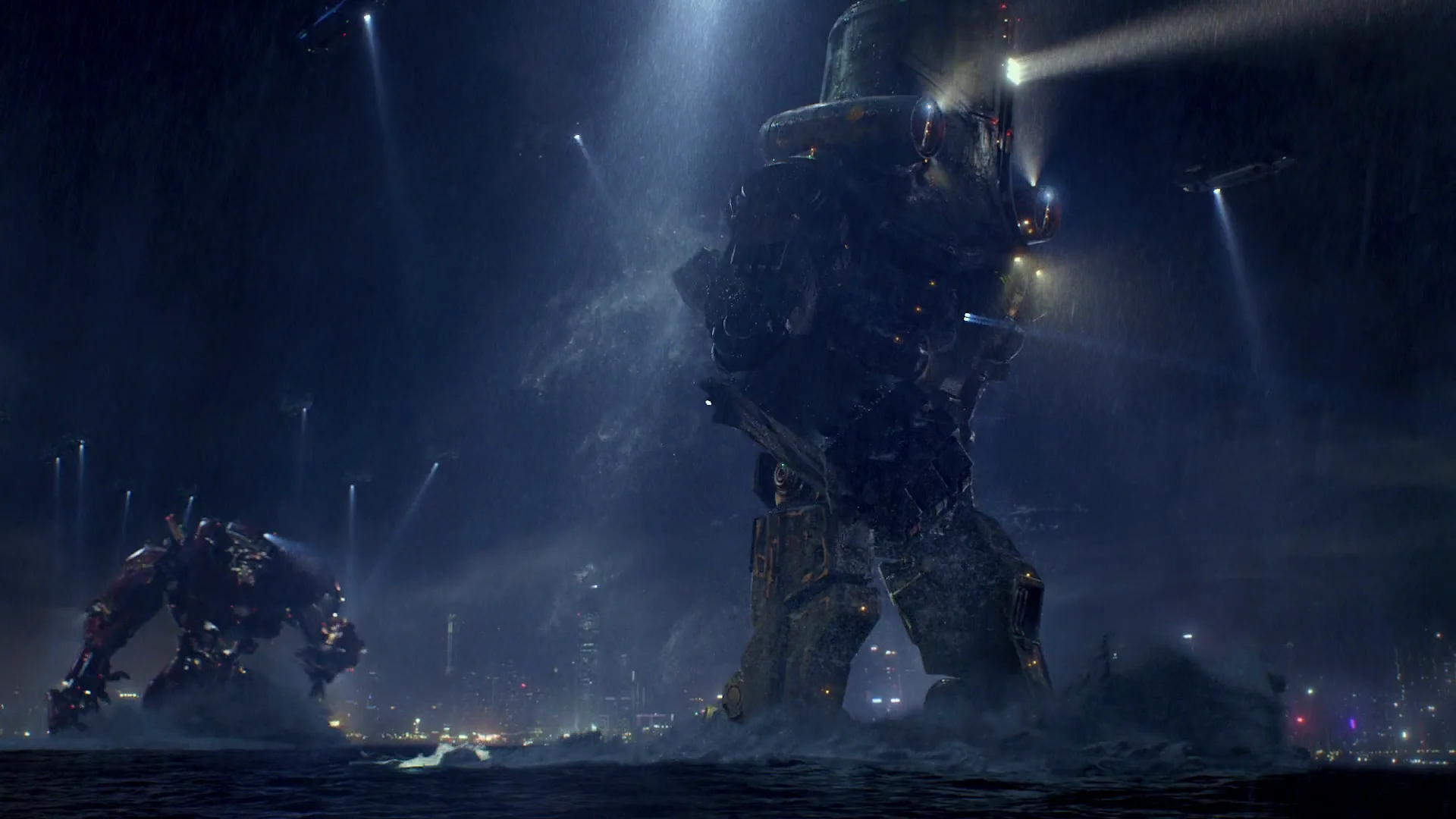
A homage can be one frame or a whole film's grammar. Pacific Rim (2013) is built as a tribute to Japanese kaiju cinema and ends with a dedication to Ray Harryhausen and Ishirō Honda. Open quotation became a signature of postmodern cinema; among storytelling devices, homage is the one that runs on the audience's memory.
Why do filmmakers pay homage?
The best homages are not trivia. They borrow meaning.
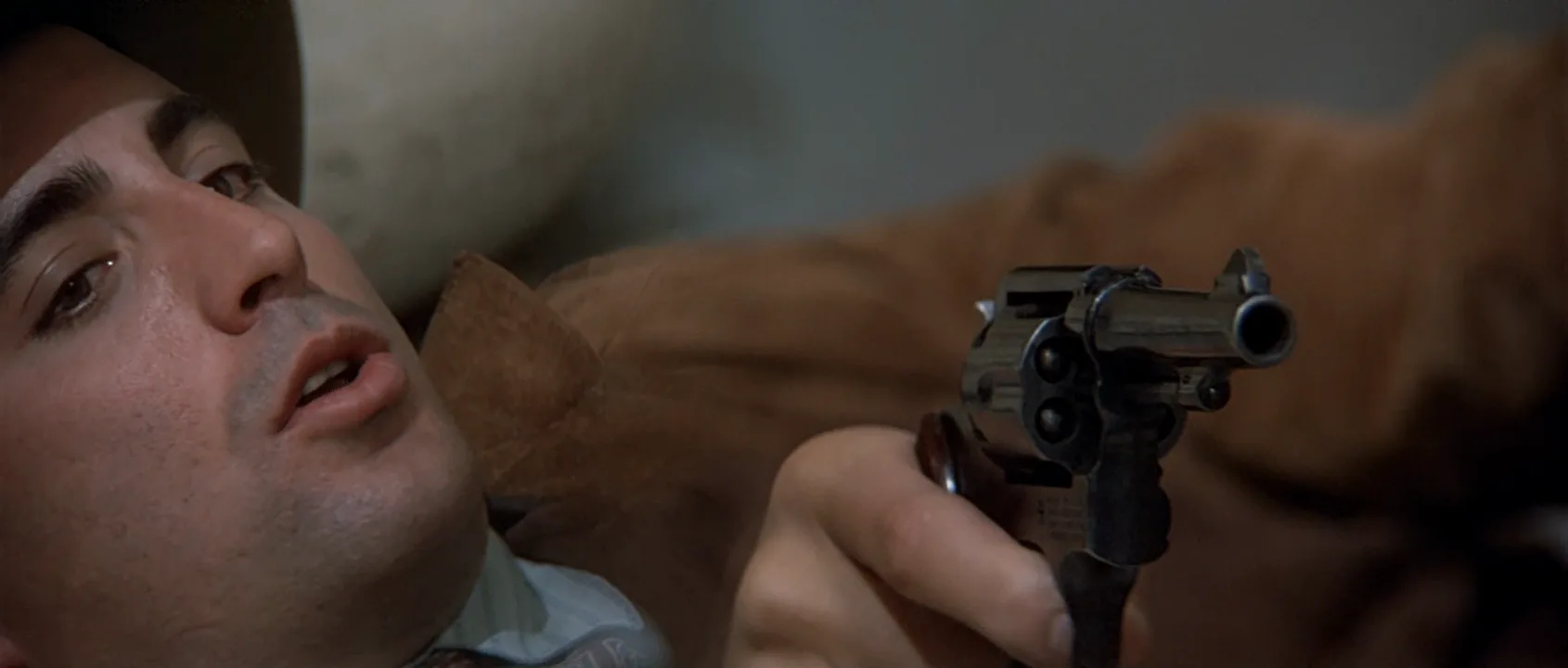
To inherit an emotion. The Union Station shootout in The Untouchables (1987) restages the Odessa Steps massacre from Battleship Potemkin (1925), baby carriage and all. Those who know Eisenstein feel the original's helplessness; everyone else still gets a superb suspense scene.
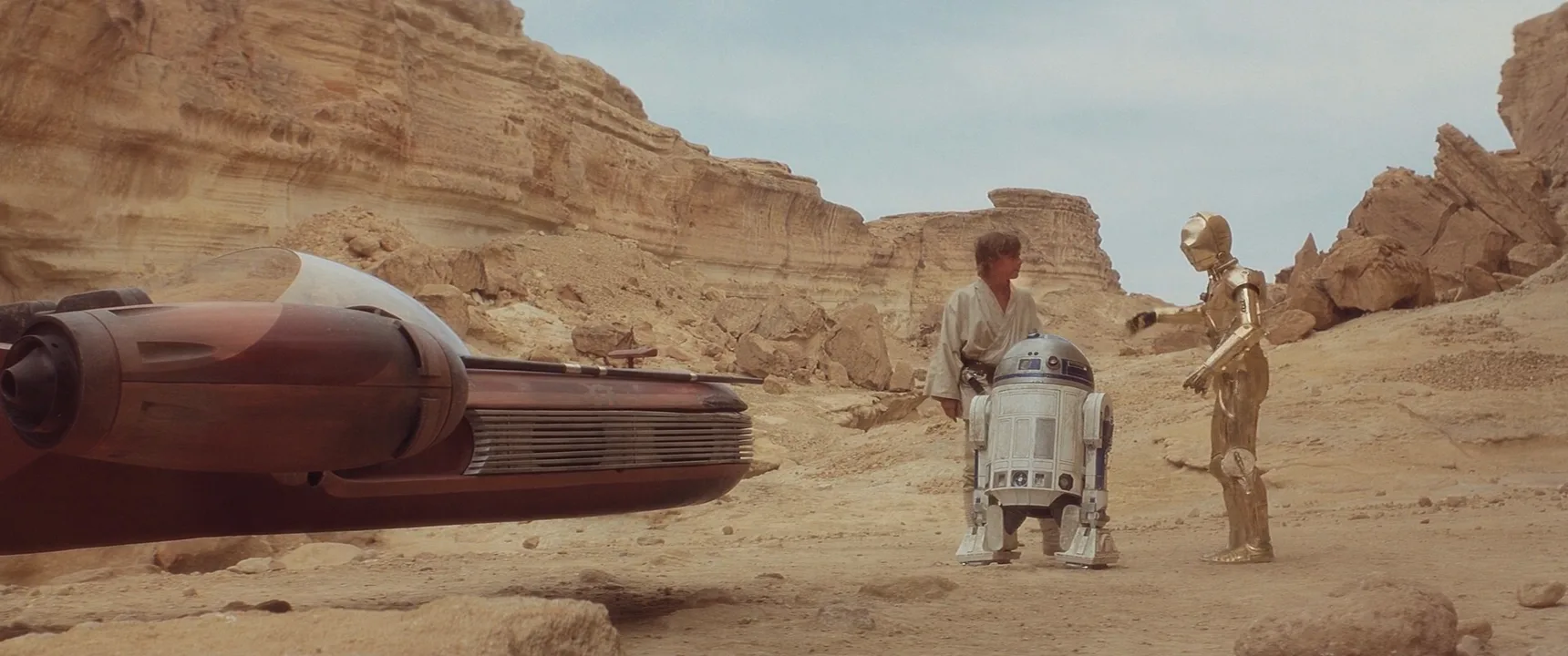
To place a film in a tradition. George Lucas modeled R2-D2 and C-3PO on the squabbling peasants of Kurosawa's The Hidden Fortress (1958). The Indiana Jones films rebuild the cliffhanger rhythm of 1930s–40s serials. Kill Bill: Vol. 1 (2003) puts its heroine in the yellow tracksuit Bruce Lee wears in Game of Death (1978).
To play with meaning. Everything Everywhere All at Once (2022) quotes 2001: A Space Odyssey, Ratatouille and Wong Kar-wai's In the Mood for Love; each quoted style becomes another universe of its heroine's life.
In auteur theory, the films a director keeps quoting become part of their fingerprint.
How to stage a homage
- Find the load-bearing element. What makes the source recognizable in one glance? For the doorway ending of The Searchers (1956), it's a dark interior framing a bright landscape and a lone silhouette. Keep that exact and let everything else change.
- Match the grammar, not the props. Lens, camera height, blocking and aspect ratio carry the reference. A 2.39:1 wide recreated at 16:9 on a longer lens won't read.
- Change one thing on purpose. A new character, a reversed outcome or a new genre around the same frame is what makes it homage rather than copy.
- Earn it in the story. The scene must work for someone who has never seen the source.
- Plan it visually. Put the source frame next to your storyboard panel. In FlashBoards, keep reference stills, generated versions and blocking notes on one board, so the crew sees exactly which shot you're quoting and what you're changing — a mood board that doubles as the DP's brief.
Homage vs. parody (and allusion)
The difference is mostly intent and tone.
- Homage recreates a source openly and plays it straight.
- Parody recreates a source to exaggerate it for laughs; Airplane! (1980) restages disaster-movie conventions so it can puncture them.
- Allusion is a brief, indirect nod that restages nothing.
A useful test: remove the reference. If the scene loses its joke, it was parody; if it loses a layer of meaning, homage; if it loses only a wink, allusion.
Homage examples in film
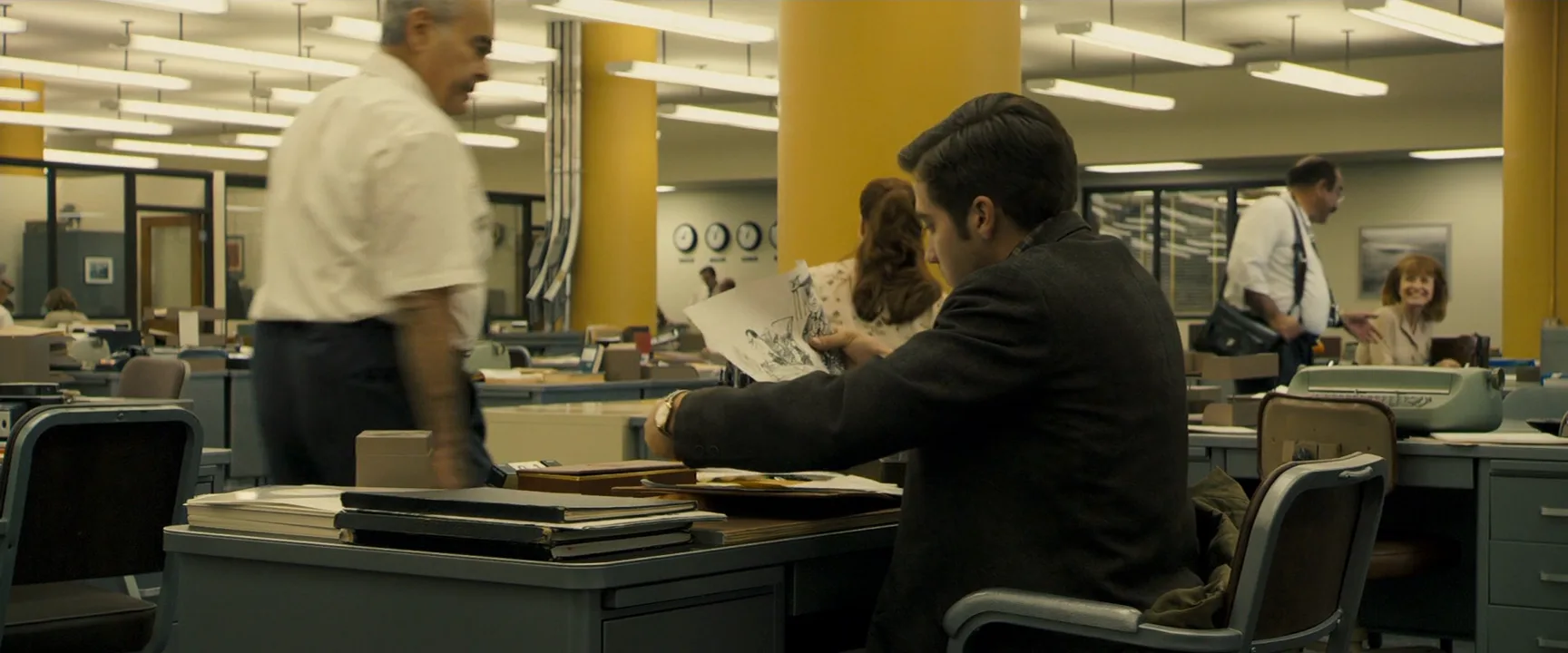
5 framesFrames from films that quote earlier cinema.
How to create a homage with AI
4 promptsA homage is a composition problem, so AI frames quickly test whether your version still reads as the source. Describe the framing grammar, never the title, and change the character. In FlashBoards, compare takes side by side with the original still. The fourth prompt re-shoots a real film shot from a text description alone, and the original plays next to the result so you can compare.
Wide shot from deep inside a dark wooden ranch house, camera at chest height, looking out through an open doorway at a blazing desert with red mesas under hard noon sun. In the doorway stands a woman in her fifties with a grey braid, a sun-weathered face and a long canvas duster coat, in near silhouette, one hand on the doorframe. The interior walls are almost black around the bright rectangle. 35mm lens, deep focus, classic western film still.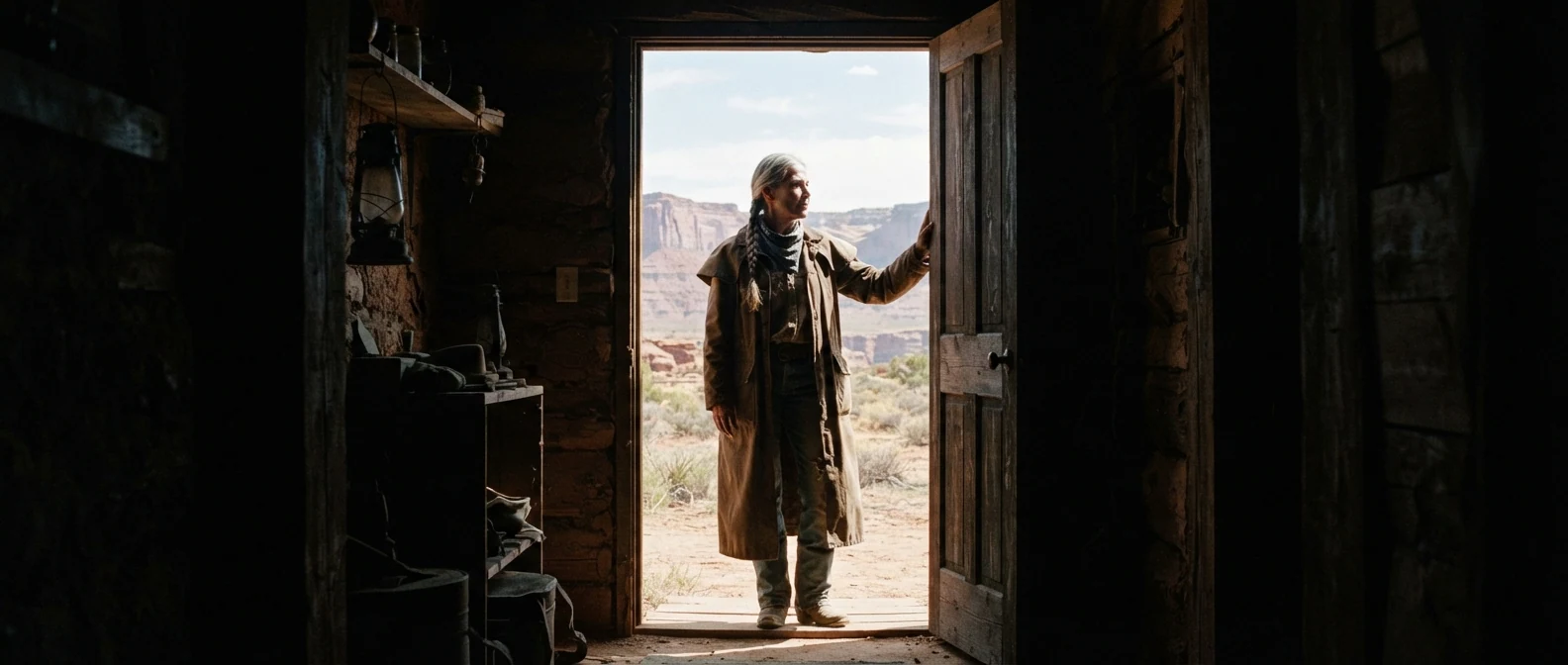
From deep inside, open doorway and walls almost black build the frame-within-a-frame of the classic western doorway ending. The new character is the deliberate change. Start frame for the video.
Open FlashBoardsExtreme wide shot of flat, empty prairie, a straight two-lane road to the horizon. A man in his thirties with a shaved head, round wire glasses and a rumpled navy suit stands alone at the roadside, small in the center of the frame, holding a briefcase. Far off over dry cornfields a small yellow crop-duster biplane flies low toward him. High noon, hard shadows, 1950s Technicolor thriller look, 40mm lens, eye level.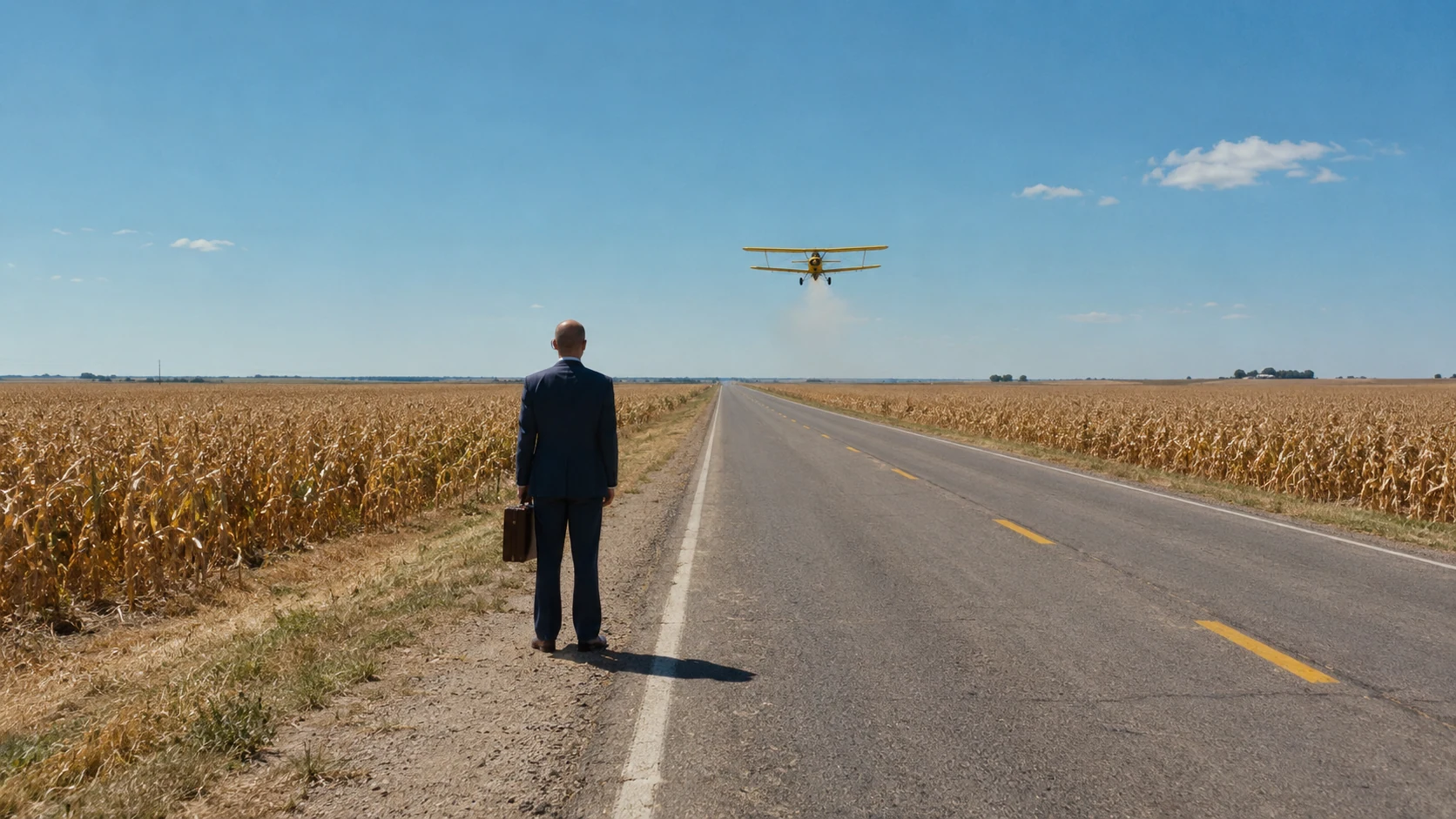
The crop-duster set piece reduced to grammar: extreme wide, empty prairie, small in the center and a distant plane. Space, not editing, isolates him.
Open FlashBoardsCamera: locked-off, static for the whole shot, holding the dark interior around the doorway. Action: from the first frame dust blows across the desert outside and the woman's coat stirs in the wind. She lets go of the doorframe, turns away and walks out into the sunlight, her silhouette shrinking as she crosses the yard toward the mesas.Dust and the stirring coat start motion at once; locked-off keeps the homage's static watching camera.
Open FlashBoards{
"output": "Full-screen live-action wide shot from Star Wars (1977), alive from its very first frame: one continuous locked-off shot with no cuts. 1970s 35mm anamorphic film look, soft grain, hard high desert sun from the upper right, pale washed-out blue sky, a narrow canyon of layered tan sandstone cliffs, a sandy rock floor, warm beige and rust palette.",
"characters": {
"S1": {
"name": "Luke, played by Mark Hamill",
"look": "young man with sandy hair, loose off-white wrap tunic with a belt, pale trousers, tall boots",
"voice": "young, exasperated, calling out while running"
},
"S2": {
"name": "Threepio (C-3PO), played by Anthony Daniels",
"look": "tall gold humanoid robot with a round head, stiff jointed limbs and a shiny metallic body",
"voice": "prim, fussy, precise English butler voice"
},
"S3": {
"name": "R2-D2, played by Kenny Baker",
"look": "short white-and-blue barrel robot with a domed silver head on two side legs",
"voice": "silent here"
}
},
"shots": [
{
"shot": 1,
"camera": "static zero: locked-off low camera at knee height, wide lens, no pan and no zoom for the whole shot; the long rust-red hull of a parked hover speeder fills the lower left foreground from the left edge to the middle, and the canyon floor leads back to the robots in the centre-right middle distance",
"action": [
"BEGINNING: alive from the first frame, S2 walks away from camera in the centre, back to us, stiff arms swinging, toward S3, who rolls away from camera just right of centre; at the same moment S1 vaults over the side of the red speeder on the left and lands running.",
"THEN: S1 runs from screen left to the right behind the speeder's nose, passes on the left of S2 and catches up with S3.",
"THEN: S1 grabs S3's dome with both hands and stops it; S3 now stands just left of S2, and S1 stays close behind S3.",
"THEN: S2 stops beside S3, turns his gold head and body toward S3 on his left, raises his screen-left arm and points down at S3 in a scolding gesture, then bends slightly toward it.",
"THEN: S1 leans over S3, both hands resting on the silver dome, head down, looking at S3; S3 stays still.",
"END: the three hold in the centre-right: S1 bent behind S3 with both hands on its dome, S2 on the right turned toward S3, arms lowered and a little apart, head tipped toward S3; the camera has never moved, and the three are small against the high canyon walls."
],
"dialogue": [
{
"speaker": "S1",
"on_screen": true,
"when": "as he lands from the speeder and runs toward S3, ending as he catches its dome",
"delivery": "breathless, annoyed shout",
"line": "<d>[English] Hey, whoa! Just where do you think you're going?</d>"
},
{
"speaker": "S2",
"on_screen": true,
"when": "right after S1 catches S3, as S2 turns toward S3 and points",
"delivery": "prim, scolding, pleased with himself",
"line": "<d>[English] Master Luke is your rightful owner now.</d>"
},
{
"speaker": "S2",
"on_screen": true,
"when": "straight after, while S1 leans over S3, to the end of the shot",
"delivery": "same fussy scolding, firmer",
"line": "<d>[English] We'll have no more of this Obi-Wan Kenobi gibberish.</d>"
}
]
}
],
"sound": {
"ambience": "dry desert wind through the canyon, footsteps crunching on sand and grit, soft metallic clanks of S2's joints, the whir of S3's wheels",
"speech": "exactly these spoken phrases, each said once, in this order",
"never_spoken": "no narration and no voice-over: the descriptions, performance notes and step words of this prompt are never spoken aloud",
"music": "a film score under the scene, always below the voices: light, playful woodwinds over soft desert strings",
"subtitles": "none"
}
}Remakes the canyon shot from Star Wars (1977): the prompt carries over the static low wide past the red speeder, Luke vaulting out to stop R2-D2, C-3PO's scolding turn, and Luke's (Mark Hamill) and C-3PO's (Anthony Daniels) lines from that moment.
The borrowed idea here is a pair, not a camera trick: Lucas took the bickering peasants of The Hidden Fortress and made them droids, so the prompt spends its detail on the pair's behaviour — Luke catching the runaway R2-D2 by the dome, C-3PO turning to scold it — and keeps the wide, locked-off canyon frame that makes all three small. The three lines come verbatim from the film, and the score line keeps the shot from going silent.
Open FlashBoardsCommon mistakes
- Naming the source film or actor yields a literal copy or a lookalike. Describe the grammar instead.
- Models brighten the interior until the doorway frame disappears. Say walls almost black and near silhouette.
- In video, the camera tends to push through the doorway. State locked-off, static for the whole shot.
Keep the reference frames, prompts and every generated take side by side — images and video in one canvas.
FAQ
5 questionsWhat does homage mean in film?
A homage is a deliberate recreation of a shot, scene, costume, line or style from an earlier film, made out of respect and meant to be recognized. The new film restages the source openly, like the Odessa Steps baby carriage in The Untouchables (1987), so the audience feels both the new scene and the memory of the original.
What is the difference between homage and parody?
Both recreate a recognizable source; the difference is tone. A homage plays the borrowed moment straight to honor it and add meaning. A parody exaggerates it to mock the original or its genre. If you're meant to laugh at the source, it's parody; if you're meant to feel it again, it's homage.
What are famous movie homages?
Classic examples: the Union Station stairs in The Untouchables (1987), after Battleship Potemkin; the droids of Star Wars (1977), after The Hidden Fortress; the yellow tracksuit in Kill Bill: Vol. 1, after Game of Death; Pacific Rim (2013) as a kaiju tribute; Indiana Jones as a tribute to adventure serials.
Is a homage the same as copying?
No. A homage is open about its source and changes the context: new characters, a new story purpose, often a different outcome. Copying hides the source or reproduces it without adding anything. Homage restages compositions and blocking with a new cast and camera.
How do you recreate a famous shot for a homage?
Write down the source frame's lens, camera height, aspect ratio, blocking and light. Keep the one element that makes it recognizable exact, then change the character or context. Test the composition with storyboards or AI frames next to the original before the shoot.
Related terms
3- ParodyGenres
A parody imitates the style, clichés and famous scenes of a specific work or genre and exaggerates them for comic effect — Airplane!, Young Frankenstein, Galaxy Quest.
- Postmodernism in FilmFilm Movements & Styles
Postmodern film mixes genres and high and low culture, quotes and remixes other films, breaks linear time and plays self-consciously with its own artifice — Pulp Fiction, Blade Runner, The Truman Show.
- Auteur TheoryFilm History & Theory
Auteur theory holds that the director is the true author of a film, whose personal style and themes recur across their work; it grew from Truffaut and Cahiers du cinéma's 'politique des auteurs' in the 1950s and was popularized in the US by Andrew Sarris.
Further reading
David Bordwell and Kristin Thompson, Film Art: An Introduction (McGraw-Hill). Noël Carroll, "The Future of Allusion: Hollywood in the Seventies (and Beyond)", October 20 (1982).