 FlashBoards Learn
- Learn
- Screenwriting
- Logline
Screenwriting · Film language
Logline
Also called: log line, one-line pitch
A logline is a one- or two-sentence summary of a film that names the protagonist, what they want, what stands in their way and what they stand to lose. It sells the premise, not the plot: a reader should see the movie, sense its genre and want the script, all in about thirty words.
- What it does
- Compresses a story into its engine: who wants what, who or what blocks them, and the cost of failure.
- Use it when
- Before outlining, in every query email and pitch, and whenever the draft starts to drift.
- Watch out
- Names, vague goals, theme statements and revealed endings turn a hook into a shrug.
- Try this prompt
Wide cinematic key frame, a small figure on a riverbank facing a flooded valley, a lit farmhouse across the water, a dam spilling in the distance, storm light
What is a logline?
A logline is the shortest honest description of a film: one sentence, sometimes two, usually 25–50 words, written in present tense. It states the premise — a specific character, a specific problem and the opposition they face — and stops before the ending. It is one of the first documents in screenwriting and often the only one a busy reader sees.
The name is usually traced to studio story departments, where readers logged incoming scripts with a one-line summary so executives could scan a stack without opening a single screenplay. The job hasn't changed. A logline opens the query email to an agent, the entry form of a contest, the first slide of a pitch and the top of a synopsis or treatment. If it doesn't make someone curious, nothing underneath gets read.
It is also a writing tool, not just a sales tool. A logline is a stress test of the story's engine: if you can't say who the protagonist is, what they are after and what opposes them in one sentence, the screenplay usually has the same problem on page 60. Many writers draft the logline before the outline, pin it above the desk and check every new scene against it.
What are the parts of a logline?
Almost every working logline carries the same five pieces of information, even when the sentence hides the machinery:
- A protagonist defined by a trait, not a name. "Clarice" means nothing to a reader; "a young FBI trainee" places her in a world and implies inexperience. Pick the one adjective that matters to this story.
- The inciting event. What knocks the character out of normal life — the inciting incident that makes the story start now rather than last year.
- A concrete goal. Something the audience could photograph: catch the killer, win the race, get the family out of the house. Inner goals like "find herself" belong in the script, not here.
- The obstacle. An antagonist, a force of nature, a system, a rival — whatever pushes back hardest. Without opposition there is no conflict and no film.
- The stakes. What happens if the protagonist fails. A deadline, a life, a marriage, a town. Stakes turn a situation into a story, and a clock makes them urgent.
The best loglines add one more thing: irony, a friction between the character and the task. A police chief who is afraid of the water has to hunt a shark. A teenager stranded in the past has to make his own parents fall in love. That built-in contradiction is what a reader remembers after the fortieth logline of the day, and it promises a character arc without having to spell one out.
Tone lives in the word choice. "Must outwit" reads as a thriller; "must somehow convince" leans toward comedy. A logline for a horror film should feel cold; one for a romantic comedy can wink.
How to write a logline: template and method
Start with a template, then break it. The most useful fill-in form is:
When [inciting event], a [flawed or ironic protagonist] must [concrete goal] before [stakes / deadline], despite [main obstacle].
A shorter variant works when the antagonist is a person: [Protagonist] must [goal], but [antagonist] wants [opposite goal]. Neither is a law; they are scaffolding that guarantees the five parts are present.
A working method:
- Find the end of act one. The logline describes the situation after the protagonist commits — the moment the three-act structure turns from setup to confrontation. Write from that point, not from page one.
- Choose the adjective. Try five descriptions of the hero and keep the one that creates the most friction with the goal.
- Use active, visual verbs. Steal, escape, protect, expose, survive. Avoid deal with, struggle with, come to terms with — they describe feelings, not scenes.
- Make the stakes specific. "Or everything will be lost" is filler. "Before the dam upstream gives way" is a picture.
- Cut. No character names, no subplots, no backstory, no dates unless the period is the hook. Aim for under 35 words and one sentence.
- Say it out loud. Tell it to someone who hasn't read the script and ask them to describe the movie back. If their version is a different film, the logline is wrong — or the script is.
- Write ten. The first version names the idea; the tenth usually sells it.
A logline written this way feeds everything downstream: the beat sheet (see Save the Cat), the outline, the title page of a spec script submission and the opening line of the pitch.
Logline examples from well-known films
The loglines below are our own summaries of famous films, written to show the structure at work — not official studio copy.
- ***Jaws* (1975):** A police chief who is afraid of the water must hunt down a great white shark that is killing swimmers off his island town, while the mayor keeps the beaches open for the summer season. Ironic hero, visual goal, a human obstacle stacked on top of the monster.
- ***The Godfather* (1972):** When an attempt on his father's life shakes the family, a war hero who wants nothing to do with the Mafia is drawn into the business he swore to stay out of. The irony is the gap between who he says he is and what he becomes — the whole arc is packed into one clause.
- ***Back to the Future* (1985):** A teenager accidentally sent thirty years into the past must make sure his teenage parents fall in love — or he will erase himself from existence. High concept, personal and absurd stakes, a comic premise in one breath.
- ***The Silence of the Lambs* (1991):** A young FBI trainee must win the trust of an imprisoned cannibal psychiatrist to catch a serial killer who skins his victims. The obstacle and the helper are the same terrifying person.
- ***Die Hard* (1988):** A New York cop visiting his estranged wife in Los Angeles is trapped in her office tower when armed thieves take the Christmas party hostage. A contained location does the work of the stakes; the marriage is the emotional hook.
- ***Titanic* (1997):** A young woman engaged to a wealthy man she doesn't love falls for a penniless artist on the maiden voyage of the Titanic, days before the ship hits an iceberg. History supplies the ticking clock; everyone knows how the ship ends, so the logline sells the couple.
- ***Napoleon Dynamite* (2004):** An awkward Idaho teenager with no obvious talents helps his new friend run for class president. Comedies can run on small stakes, as long as they are specific.
Notice what they leave out: character names (except the ship), the ending, the theme, and every secondary character who isn't an obstacle.
Common logline mistakes
- Names instead of descriptions. "Jake must save Emma" tells a stranger nothing. Replace each name with the trait that matters.
- A theme instead of a plot. "A story about grief and forgiveness" describes a feeling, not a film. The theme should be felt through the goal and the stakes, not announced.
- Vague goals. "Learns what really matters" can't be staged. Ask what the character is physically trying to do in act two.
- Too many people. A logline carries the protagonist, the main opposition and maybe one relationship. Every subplot you add dilutes the hook.
- Revealing the ending or the twist. The logline sells the setup and the question; the synopsis answers it.
- Rhetorical questions. "What if a man woke up as a dog?" is a pitch opener, not a logline. Write the statement.
- Genre mismatch. A thriller logline on a family drama makes readers feel cheated by page ten.
How is a TV logline different?
A feature logline describes one arc with an ending in sight. A series logline has to describe an engine — a situation that can generate dozens of episodes without resolving. Instead of a single goal, it states the premise, the recurring conflict and why it keeps coming back: a family running a failing business, a detective paired with a partner she can't trust, a town where one secret surfaces every week.
Writers often prepare two lines for a TV pitch: the series logline (the world and its engine) and the pilot logline (what happens in episode one to kick the engine into motion). The five parts still apply; the stakes are simply ongoing rather than final.
Logline vs. tagline vs. synopsis
The three are easy to mix up because all three are short text about a film, but they serve different readers:
- Logline — for the industry: agents, producers, contest readers. It summarizes the premise (protagonist, goal, obstacle, stakes) in one or two sentences and doesn't reveal the ending.
- Tagline — for the audience: the line on the poster or trailer. It sells mood and curiosity, not plot. Alien's "In space no one can hear you scream" tells you nothing about the crew, the ship or the story — and it doesn't need to.
- Synopsis — for someone who is already interested: a half page to a few pages of prose covering setup, turning points and the ending, so the reader can judge whether the story holds together.
A good workflow runs in that order of length: logline first, then synopsis, then treatment, then script. The tagline usually comes last, from marketing, once the film exists.
From logline to key frame: testing it visually
A logline that can't be pictured is usually missing a concrete element. A quick test: try to describe one image that shows the protagonist, the goal and the obstacle together. If the frame comes out empty — a person standing somewhere, looking thoughtful — the goal or the stakes are still abstract.
In FlashBoards, put the logline as a note at the top of the film's board, generate a key frame from it, and keep every rewrite of the sentence next to the image it produced, so you can see which version reads clearest at a glance. From there, the same character description branches into storyboard panels for the setup, the inciting event, the confrontation and the stakes, and the references you collect for tone sit beside them as a mood board. The logline stops being a sentence in a pitch document and becomes the caption for the whole board.
The recipes below use an original logline as a worked example: A retired bridge engineer with failing eyesight must cross a flooding valley to reach her granddaughter before the dam upstream gives way.
How to create a logline with AI
3 promptsAn image model can't read a logline, but it can stage one: translate each part into something visible — the protagonist's defining trait, the goal in the frame, the obstacle between them and a clue to the stakes. Nano Banana 2 Lite builds the key frame, GPT Image 2.5 lays the same logline out as four storyboard panels, and MiniMax H3 Max Turbo animates the key frame into a short pitch shot. Keep the logline, its rewrites and every take on one FlashBoards board.
Wide cinematic key frame, 28mm lens, eye level, film still. In the foreground left, seen from behind at three-quarter angle, a woman in her late sixties with cropped white hair, thick round glasses and a faded orange waterproof jacket grips a wooden walking stick at the edge of a muddy riverbank. Before her, fast brown floodwater fills a wide valley. Across the water on a low hill, a small white farmhouse with one lit window. Far in the background, a concrete dam with water spilling over its crest. Heavy gray storm clouds, cold late-afternoon light, rain streaks, muted greens and browns, film grain.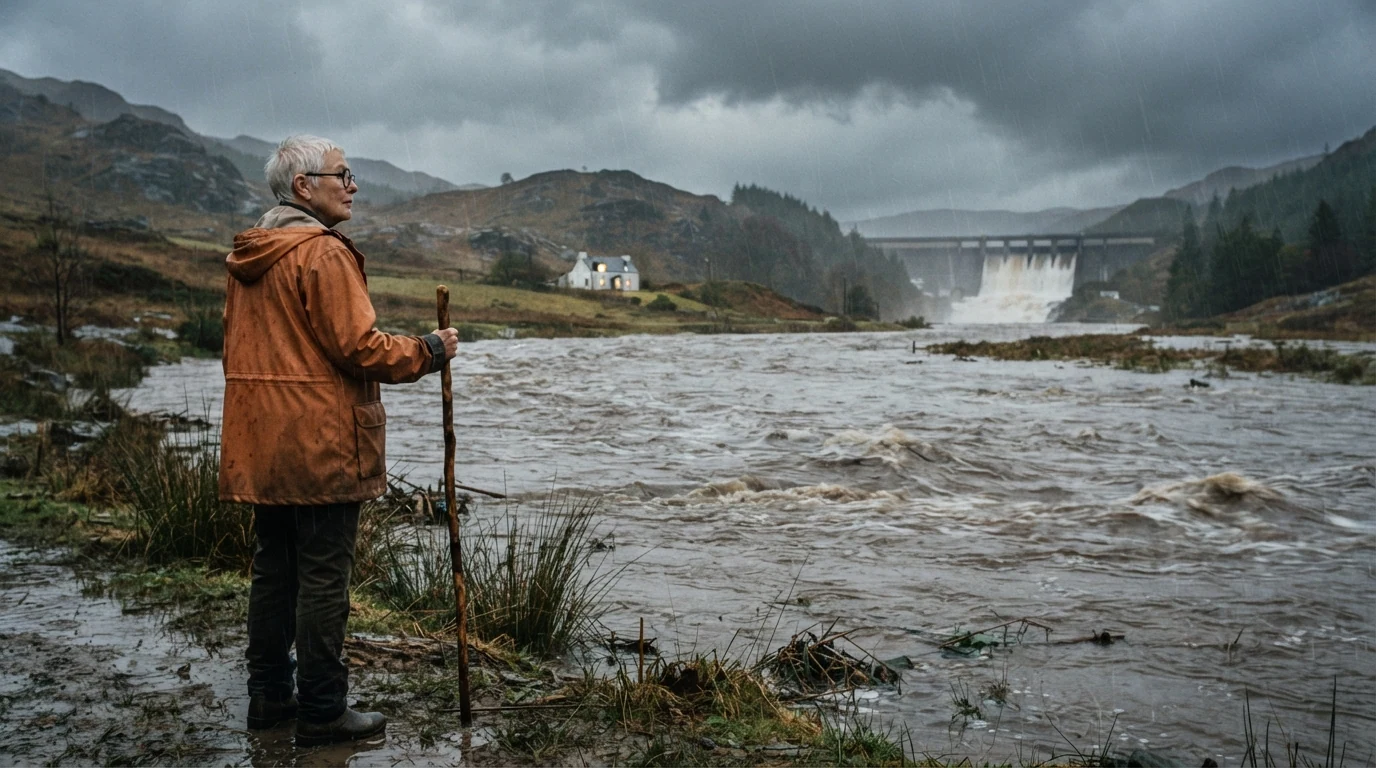
Each clause is one part of the logline made visible: thick round glasses and the walking stick carry the flaw, the lit window is the goal, the floodwater is the obstacle and the dam spilling over its crest is the stakes. Placing her in the foreground and the house across the water puts the whole conflict on one axis the eye can read.
Open FlashBoardsStoryboard sheet, four panels in a 2x2 grid with thin black borders, loose pencil and gray marker style, consistent character in every panel: a woman in her late sixties with cropped white hair, thick round glasses and an orange waterproof jacket, the only color accent. Panel 1: medium shot, she squints at a cracked phone screen in a dim kitchen, rain on the window. Panel 2: wide shot, she steps out onto a road that ends in brown floodwater. Panel 3: low angle, she wades waist-deep, holding a rope stretched between two fence posts. Panel 4: extreme long shot, a concrete dam in the distance with water pouring over it, a tiny orange figure in the valley below.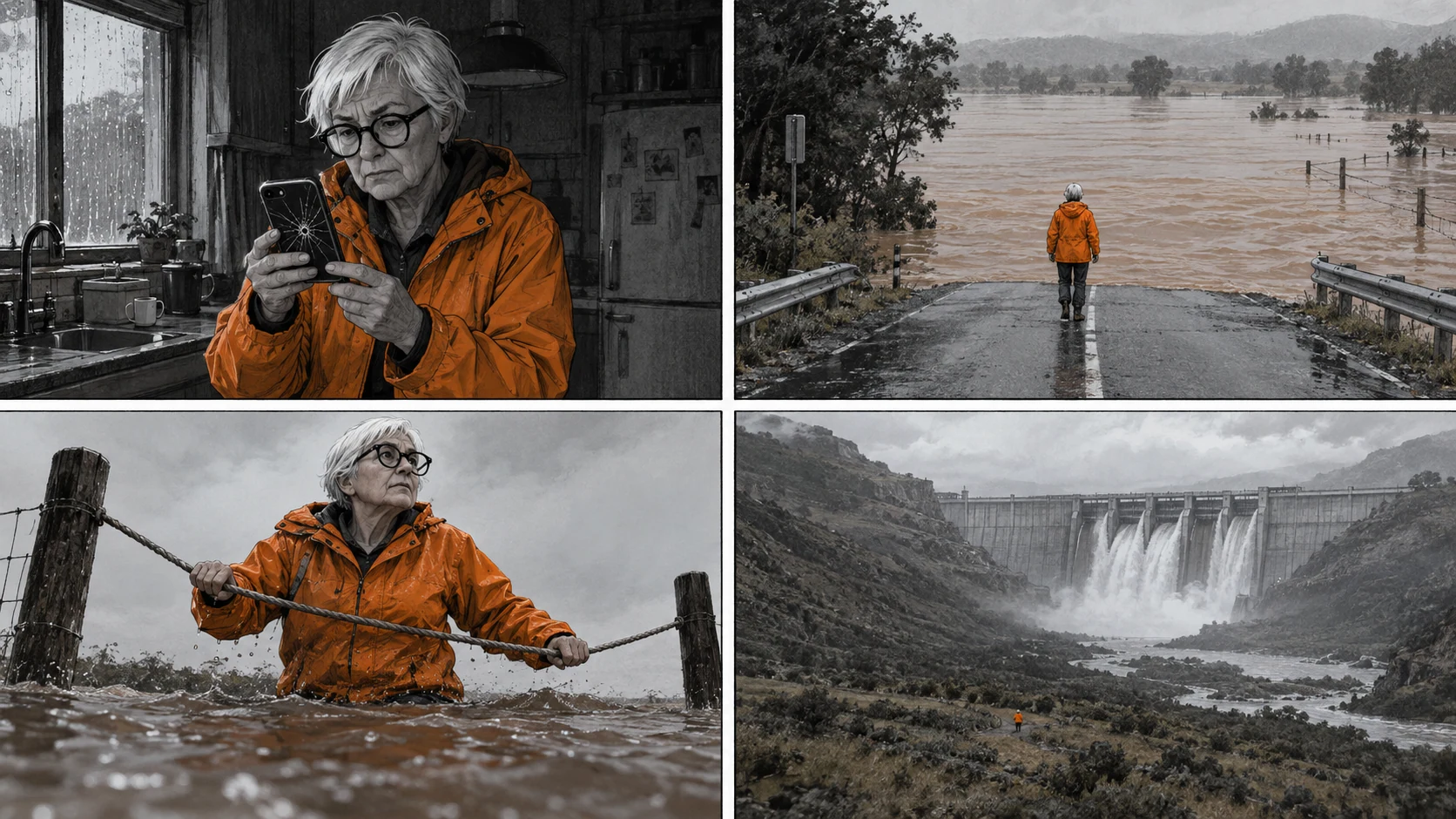
Storyboard sheet and 2x2 grid produce a planning document instead of a single picture; the four panels map to setup, inciting event, confrontation and stakes. Repeating the character's features and making the orange jacket the only color accent keeps her readable from panel to panel.
Open FlashBoardsCamera: slow, steady push forward from behind the woman's shoulder toward the flooded valley, moving about one meter over the whole shot, eye level. Action: rain is already falling and the brown water races left to right. She plants the walking stick in the mud and takes a first careful step down the bank. In the middle she stops, adjusts her glasses and looks toward the lit farmhouse across the water. At the end the water over the dam's crest in the distance surges higher, and she steps forward again.Rain and racing water in the first sentence make the shot alive from the first frame. The action stays with what is already in the key frame — the woman, the stick, the farmhouse, the dam — so the model has nothing to invent, and the surge at the dam restates the stakes as motion.
Open FlashBoardsCommon mistakes
- Pasting the logline as the prompt. Words like must, before it's too late or her last chance have no visual meaning. Translate each part into an object, a position or a light.
- The model writes text into the frame. Quoted sentences and words like poster invite lettering; ask for a film still or key frame instead.
- Goal and obstacle drift apart. If the house and the flood land in unrelated corners, state their spatial relation: across the water, between her and.
- The character changes between storyboard panels. Repeat the age, hair, glasses and jacket in the prompt, and keep one color accent for the protagonist.
- A still-looking video. Start the prompt with motion that is already happening, and describe only elements visible in the first frame.
Keep the reference frames, prompts and every generated take side by side — images and video in one canvas.
FAQ
5 questionsWhat is a logline in film?
A logline is a one- or two-sentence summary of a film's premise. It names the protagonist by a defining trait, their goal, the main obstacle and the stakes, without revealing the ending. Writers use it to pitch scripts to agents, producers and contests, and to check that the story has a clear engine before and during writing.
How long should a logline be?
Usually one sentence of 25 to 50 words; under 35 is a good target. Two sentences are acceptable when the premise needs a setup, but anything longer starts to read like a synopsis. If it can't be said comfortably in one breath, cut character names, backstory and subplots first.
What is a good logline template?
A reliable fill-in form is: When [inciting event], a [flawed protagonist] must [concrete goal] before [stakes or deadline], despite [main obstacle]. A shorter version: [Protagonist] must [goal], but [antagonist] wants the opposite. Use the template to make sure every part is present, then rewrite it into a natural sentence with vivid, active verbs.
Does a logline give away the ending?
No. A logline sells the setup and the central question — will the chief kill the shark, will the trainee catch the killer — and leaves the answer for the script. The ending belongs in the synopsis and the treatment, where readers need it to judge the story's structure.
Is a logline the same as a one-line pitch?
Mostly, yes. A one-line pitch is the logline spoken aloud, often opened with a title and genre: a thriller called X, about a character who must do Y. In a meeting it may be followed by comparable films or the tone. On paper, in queries and contest entries, the term logline is standard.
Related terms
6- TaglineFilm Industry
A tagline is the short, catchy line on a poster or trailer that sells a film's mood or hook — Alien's 'In space no one can hear you scream'; unlike a logline, it doesn't summarize the plot.
- SynopsisScreenwriting
A synopsis is a short prose summary of the whole film — setup, main characters, turning points and ending — written for producers, readers or grant committees.
- Film TreatmentScreenwriting
A treatment is a prose document, usually 2–10 pages written in present tense, that tells the whole story of a planned film scene by scene and conveys its tone before the screenplay is written.
- TV PitchFilmmaking Process & Crew
A TV pitch is a short verbal or deck presentation of a series idea — logline, world, characters, pilot story and season engines — aimed at getting producers or a network to buy or develop it.
- Spec ScriptScreenwriting
A spec script is a screenplay written without a contract, on the writer's own initiative, to be sold or used as a writing sample; it avoids camera directions and reads as cleanly as possible.
- ScreenwritingScreenwriting
Screenwriting is the craft of writing a film or series for the screen: turning an idea into structure, scenes and dialogue that can be shot, where everything the audience learns must be seen or heard.
Further reading
Blake Snyder, Save the Cat! (2005). Syd Field, Screenplay: The Foundations of Screenwriting (1979).