 FlashBoards Learn
- Learn
- Film History & Theory
- Hollywood Blacklist
Film History & Theory · Film language
Hollywood Blacklist
Also called: blacklisting, Hollywood Ten, HUAC blacklist
The Hollywood blacklist was the studios' refusal, from late 1947 to about 1960, to employ writers, directors and actors accused of Communist ties after the HUAC hearings. Hundreds lost their careers; some, like Dalton Trumbo, kept writing under fronts and pseudonyms until screen credits finally broke the list open.
- What it does
- Names a specific Cold War purge of the film industry, not blacklisting in general: an unwritten ban enforced by the studios themselves.
- Use it when
- Reading credits from 1947–1960, studying films like High Noon or On the Waterfront, or planning a period story set in the era.
- Watch out
- It started with the House committee in 1947, years before Senator McCarthy; 'McCarthyism' is the wider label, not the source of the Hollywood hearings.
- Try this prompt
1947 newsreel still, black and white 4:3: a gaunt screenwriter at a hearing table crowded with radio microphones, press flashbulbs firing
What was the Hollywood blacklist?
In film history the term names one campaign. In October 1947 the House Committee on Un-American Activities (HUAC) held public hearings on Communist influence in the movies. Ten writers and directors refused to say whether they were Party members and were cited for contempt of Congress.
Weeks later the studio heads met at the Waldorf-Astoria in New York and issued the Waldorf Statement: they would fire the Ten and not knowingly employ Communists. Under the studio system, a few companies controlled nearly all the work, so a promise not to hire was a sentence. No official list was ever published. The ban lived in studio legal departments, in pamphlets like Red Channels (1950), and in the demand that suspects "clear" themselves by testifying and naming others.
A second wave of hearings from 1951 widened the net. Estimates run to more than 300 people barred from film, radio and TV, plus a graylist of people never accused who simply stopped getting calls.
Who were the Hollywood Ten?
The Ten were screenwriters Alvah Bessie, Lester Cole, Ring Lardner Jr., John Howard Lawson, Albert Maltz, Samuel Ornitz and Dalton Trumbo, producer-writer Adrian Scott, and directors Herbert Biberman and Edward Dmytryk. They argued the First Amendment protected their beliefs; after the Supreme Court declined their appeals in 1950, they served six months to a year. Dmytryk testified again in 1951, named names and went back to directing.
How blacklisted writers kept working: fronts and pseudonyms
Directors and actors are seen on set, so for them the blacklist meant exile or silence. A screenwriter needs only a name on the title page, so a black market grew: blacklisted writers sold scripts through fronts (friends who signed the work) or under invented names, for a fraction of their old fees. The Academy Awards record the result:
- Roman Holiday (1953): Trumbo's story won the Oscar under his front's name, Ian McLellan Hunter. The Academy restored it to Trumbo in 1993, after his death.
- The Brave One (1956): the story Oscar went to "Robert Rich," a writer no one could find; a Writers Guild officer accepted it on his behalf. It was Trumbo.
- The Bridge on the River Kwai (1957): credited to novelist Pierre Boulle, written by blacklisted Carl Foreman and Michael Wilson, whose names were restored decades later.
The Writers Guild has since corrected many credits from the period.
How the blacklist shaped the films
High Noon (1952) was written by Carl Foreman, who was called before the committee during production and left for England; its marshal abandoned by a frightened town is widely read as an allegory of Hollywood in 1951. Elia Kazan, who named former Party colleagues in 1952, made On the Waterfront (1954), which treats testifying as conscience. Blacklisted filmmakers made Salt of the Earth (1954) independently, and it was kept out of most American theaters.
Later films looked back: The Front (1976), made by director Martin Ritt, writer Walter Bernstein and actor Zero Mostel, all once blacklisted; Guilty by Suspicion (1991); Trumbo (2015). With the Hays Code, the blacklist defines what the late Golden Age of Hollywood could not say, and it feeds the paranoia of late film noir. More in the film history and theory hub.
Planning a period piece in this world? Keep newsreel frames of the 1947 hearings, credit cards from these films and your generated tests of the hearing room on one FlashBoards board to check the look against the record.
How did the Hollywood blacklist end?
Nobody formally ended it; it lost force when credits went to real names again. In January 1960 Otto Preminger announced that Trumbo had written Exodus (1960) and would be credited, and Kirk Douglas, as producer, put Trumbo's name on Spartacus (1960). The studio system that enforced the ban was coming apart. Many careers never recovered.
HUAC vs. McCarthyism
HUAC was a House committee, and its Hollywood hearings began in 1947. Senator Joseph McCarthy rose to fame only in 1950 and ran his own Senate investigations, mostly into the government and the Army; he never led the Hollywood hearings. McCarthyism became the name for the whole climate of accusation and guilt by association, and the blacklist is its best-known product in entertainment.
How to create a hollywood blacklist with AI
3 promptsYou can't photograph a hiring ban, but you can stage its two defining images: the witness table under flashbulbs and the writer typing under someone else's name. Period accuracy lives in named props. Keep references and takes on one FlashBoards board and compare them side by side.
1947 newsreel-style film still, black and white, 4:3. Wide shot of a crowded congressional hearing room with dark wood paneling. At a witness table crowded with chunky 1940s radio microphones sits a fictional screenwriter in his forties: gaunt face, thick horn-rimmed glasses, receding sandy hair, bow tie, rumpled gray suit, gripping typed pages. Spectators in fedoras behind him; to his right, press photographers raising cameras with round flash reflectors. Hard white flash highlights, deep shadows, heavy grain, eye-level camera.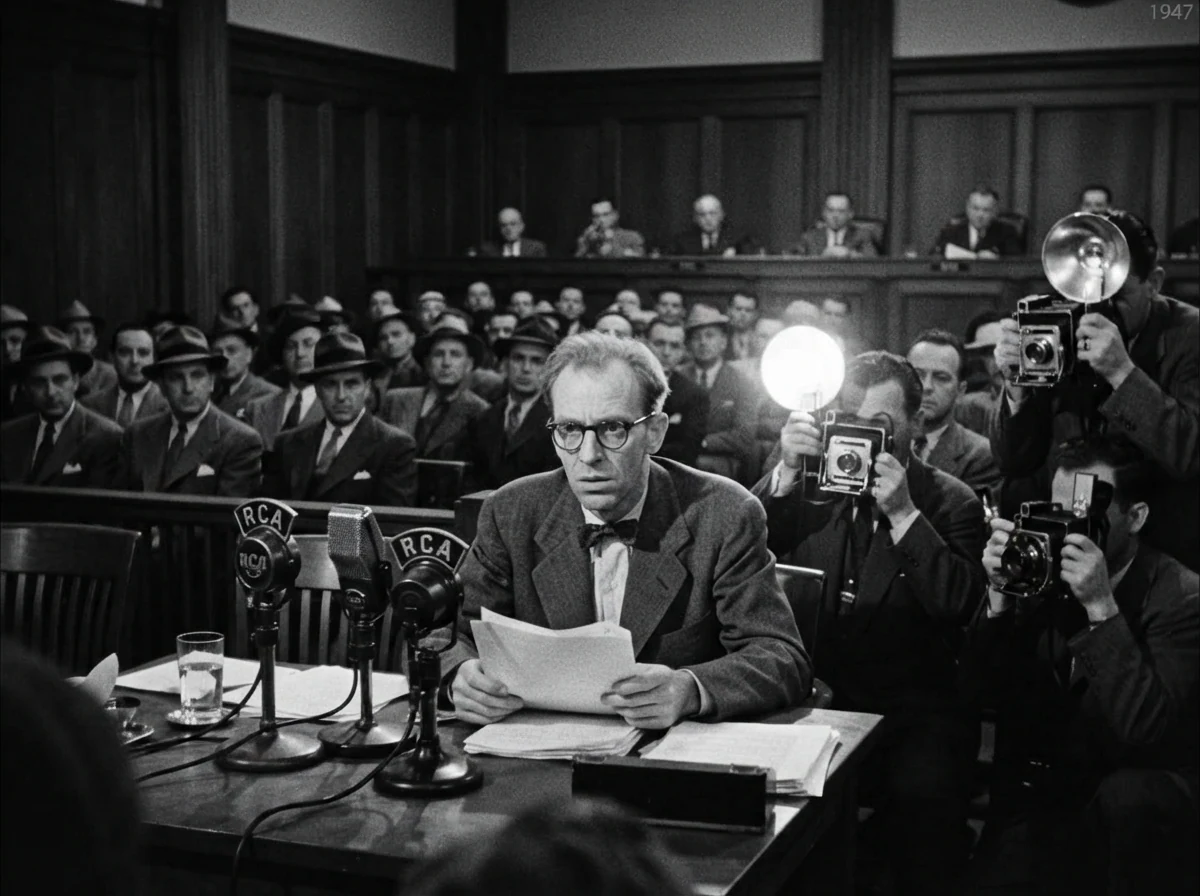
"1940s radio microphones" and "round flash reflectors" date the room; without them you get a modern courtroom. The specific face keeps the witness fictional.
Open FlashBoards1950s period film still, muted Eastmancolor, 16:9. Night, a small kitchen. Over-the-shoulder medium close-up of a fictional woman screenwriter in her fifties, silver hair in a tight bun, reading glasses on a beaded chain, moss-green cardigan, typing on a portable typewriter at an oilcloth table. Beside it a title page reads "THE LONG RIVER - Screenplay by Walter Crane", with an ashtray and cold coffee. Single hanging lamp, dark walls, 40mm lens, shallow depth of field.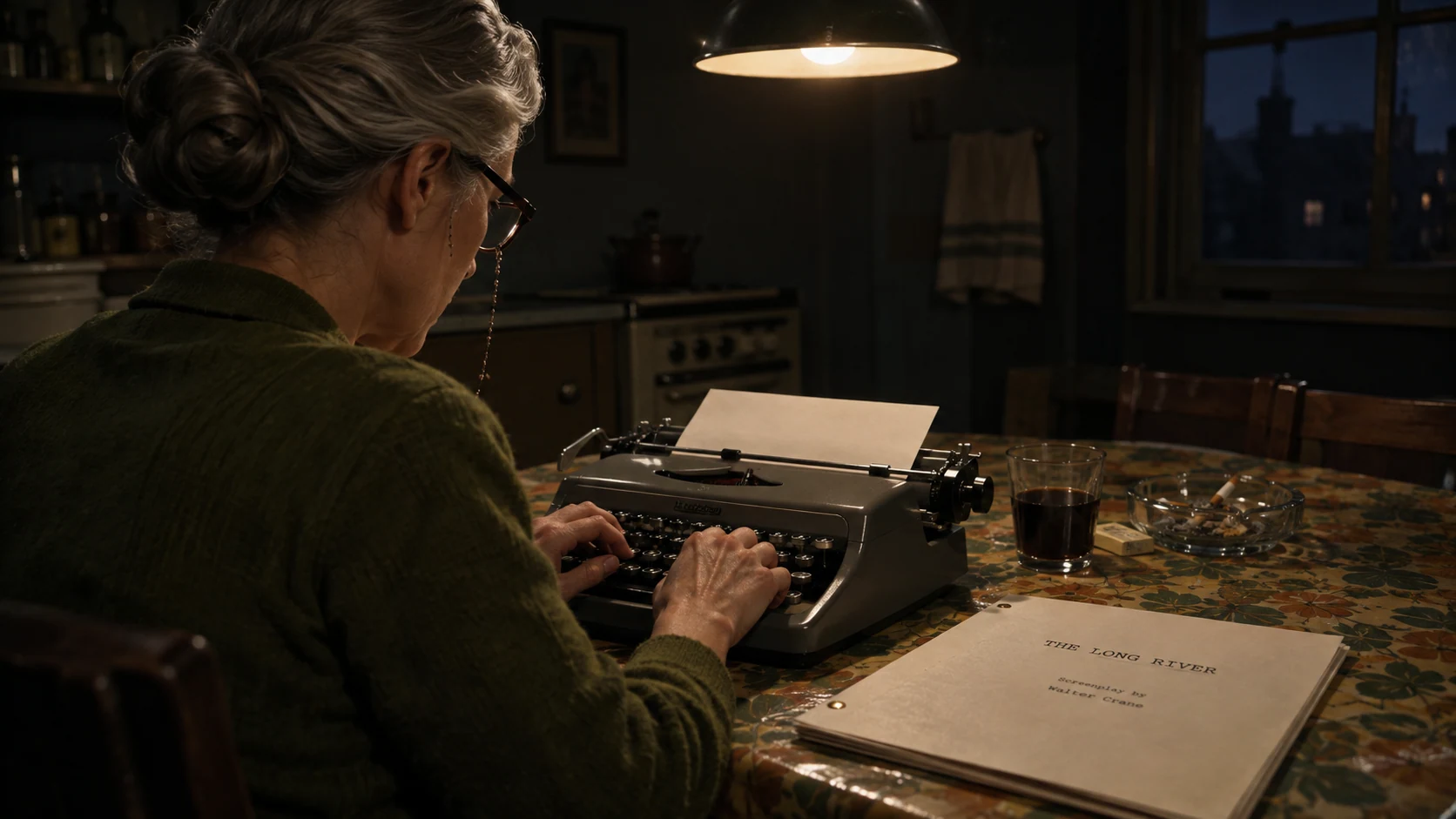
The front system in one frame: a man's name on the page she is typing. One short quoted line renders reliably; the lone lamp supplies the secrecy.
Open FlashBoards1947 black and white newsreel look, heavy grain. Camera: starts at once, a slow steady push in from the wide shot to a medium shot of the screenwriter. Action: Flashbulbs fire immediately. He leans toward the microphones and speaks, shaking his head, lifts his typed pages, then lowers them. The photographers step closer and fire again as he sits back, jaw set.Flashbulbs and push start in the first second, so the clip doesn't stall on the still, and every action uses only what recipe 1 shows.
Open FlashBoardsCommon mistakes
- Modern courtroom drift. "Hearing" alone gives a jury box and flat light; state the year, paneling, radio microphones and flash reflectors.
- Celebrity faces. Naming a real writer invites a likeness; describe a fictional face instead.
- Garbled text. Keep quoted title-page text to one short line.
- Sepia. "Old photo" gives brown tint; name the stock instead.
Keep the reference frames, prompts and every generated take side by side — images and video in one canvas.
FAQ
5 questionsWhat was the Hollywood blacklist?
The film industry's practice, from late 1947 to about 1960, of refusing to employ people accused of Communist ties or who would not cooperate with the House Committee on Un-American Activities. The studios enforced it, not the law, and no official list was published. More than 300 people in film, radio and television lost work.
Who were the Hollywood Ten?
Ten writers and directors who refused to answer HUAC's questions about Party membership in October 1947: Alvah Bessie, Herbert Biberman, Lester Cole, Edward Dmytryk, Ring Lardner Jr., John Howard Lawson, Albert Maltz, Samuel Ornitz, Adrian Scott and Dalton Trumbo. They were convicted of contempt of Congress and jailed.
How did blacklisted screenwriters keep working?
Under pseudonyms or through fronts, friends who signed the script and passed the money back, usually far below normal fees. Dalton Trumbo won two story Oscars this way: Roman Holiday under Ian McLellan Hunter's name and The Brave One as "Robert Rich." Many credits were corrected decades later.
When did the Hollywood blacklist end?
There was no official end. The turning point came in 1960, when Otto Preminger credited Dalton Trumbo on Exodus and Kirk Douglas put his name on Spartacus. Studios stopped enforcing the ban, though many blacklisted artists never got their careers back.
What movies are about the Hollywood blacklist?
The Front (1976), made by people who had been blacklisted, Guilty by Suspicion (1991) and Trumbo (2015). High Noon (1952) and On the Waterfront (1954) are classic films read as responses to the era from opposite sides.
Related terms
4- Hollywood Studio SystemFilm Industry
The Hollywood studio system (roughly 1920s–1950s) was the model in which a few major studios owned production, distribution and theaters, and kept stars, directors and crews under long-term contracts.
- ScreenwriterScreenwriting
A screenwriter writes the screenplay — story, structure, scenes and dialogue in screenplay format — either on spec or on assignment, and often through many rewrites before and during production.
- Golden Age of HollywoodFilm History & Theory
The Golden Age of Hollywood is the studio era from the arrival of sound (late 1920s) to the early 1960s, when a few studios controlled stars, production and theaters and perfected the invisible classical style — Casablanca, Citizen Kane, The Wizard of Oz.
- Hays CodeFilm History & Theory
The Hays Code was Hollywood's self-censorship rulebook, adopted in 1930 and strictly enforced from 1934 to the late 1960s: it limited sex, violence, profanity and 'immoral' endings until the MPAA rating system replaced it in 1968.
Further reading
Larry Ceplair and Steven Englund, The Inquisition in Hollywood: Politics in the Film Community, 1930–1960 (1980). Victor S. Navasky, Naming Names (1980). Patrick McGilligan and Paul Buhle, Tender Comrades: A Backstory of the Hollywood Blacklist (1997).