 FlashBoards Learn
- Learn
- Film History & Theory
- Hays Code
Film History & Theory · Film language
Hays Code
Also called: Production Code, Motion Picture Production Code
The Hays Code, officially the Motion Picture Production Code, was Hollywood's self-censorship rulebook. Adopted in 1930 and strictly enforced from 1934 until the late 1960s, it restricted sex, violence, crime, profanity and religion on screen and required that wrongdoing be punished, until the MPAA rating system replaced it in 1968.
- What it does
- Sets what a Hollywood film may show, say and imply, and demands that the story end on the side of law and marriage.
- Use it when
- You analyze or recreate a 1934–1968 studio film, or want to understand why classic movies suggest instead of show.
- Watch out
- Twin beds and the three-second kiss are enforcement habits and lore, not lines of the Code itself.
- Try this prompt
1940s black and white studio still, married couple in separate twin beds, lamp between them, soft Hollywood key light, 4:3
What was the Hays Code?
The Hays Code was a set of moral rules the major American studios agreed to follow in every film they released. It took its name from Will H. Hays, who from 1922 headed the studios' trade association, the Motion Picture Producers and Distributors of America (later the MPAA). Hays did not write it: Catholic publisher Martin Quigley and Jesuit priest Daniel A. Lord drafted it in 1929.
It was not a law. The studios wrote it to keep censors, churches and Congress from imposing something harsher. The Code governed the heart of the Golden Age of Hollywood: almost every classic American film from It Happened One Night (1934) to The Sound of Music (1965) was made under it.
When was the Hays Code enforced?
- 1922–1927. After star scandals, the studios hire Hays to clean up their image.
- 1930. The studios adopt the Production Code but enforce it loosely. The films of this gap are Pre-Code Hollywood.
- 1934. Under boycott pressure from the Catholic Legion of Decency, the association creates the Production Code Administration (PCA), run by Joseph I. Breen. From July 1934 no member studio may release a film without a PCA certificate, on pain of a $25,000 fine.
- 1948–1956. The Paramount antitrust decision forces studios to sell their theaters, and in 1952 the Supreme Court gives films First Amendment protection. Otto Preminger releases The Moon Is Blue (1953) without a seal and it does well.
- 1966–1968. Jack Valenti's MPAA swaps the Code for a short version. In November 1968 the film rating system takes over, and New Hollywood gets room the Code never allowed.
What were the Hays Code rules?
The Code opens with three principles: a film must not lower the audience's moral standards, must never make the viewer sympathize with crime or sin, and must not ridicule law. Then come the particular applications:
- Crime. No detailed methods of murder or safecracking, no drug trafficking; criminals may not be heroes and must pay by the end.
- Sex. Adultery may not be made attractive. "Excessive and lustful" kissing, suggestive postures and nudity are out. Homosexuality may not even be implied, and interracial romance is banned.
- Language. A list of forbidden words. A 1939 amendment allowed "damn" in historical or literary context, which is how Rhett Butler's last line in Gone with the Wind (1939) got through.
- Religion. Clergy may not be comic or villainous.
The Code sets no time limit on kisses and never mentions twin beds; those were enforcement habits and lore. In Notorious (1946), Hitchcock breaks one long embrace into a chain of short kisses and whispered lines.
How the Hays Code shaped film language
Filmmakers learned to suggest what they could not show, and much of classical style is that workaround:
- The ellipsis. In Casablanca (1942), Rick and Ilsa embrace, the film dissolves to the airport beacon, then returns to Rick at the window smoking.
- The cutaway and the fade. A door closes, waves hit the shore, the scene fades before the kiss ends.
- Violence off screen. A shadow on a wall, a gunshot over a reaction shot.
- Compensating moral values. Gangsters die or go to prison in the last reel, as in Angels with Dirty Faces (1938).
Film noir grew out of this pressure. Breen's office rejected James M. Cain's Double Indemnity in 1935; Billy Wilder filmed it in 1944 by keeping the adultery implied and making the lovers pay. Howard Hughes's fight with the PCA over The Outlaw (1943) is dramatized in The Aviator (2004).
For a period piece or pastiche, collect Code-era frames on a FlashBoards board, note what each scene implies instead of shows, and generate your staging beside them.
Pre-Code vs. Hays Code
Both terms name the same Code at different levels of enforcement. Between 1930 and mid-1934 studios could ignore it, so Baby Face (1933) and The Public Enemy (1931) show frank sex and criminals who enjoy themselves. After July 1934 the PCA seal made the rules binding. Pre-Code movies say things directly; Code-era movies say them through staging, cutting and innuendo.
The ratings that followed flip the logic: the Code decided what everyone could see, ratings decide who sees what. See more in film history and theory.
How to create a hays code with AI
3 promptsModels default to modern frankness, so recreating Code-era staging means saying what is covered, separated or off screen. Build the bedroom, the shadow and the fade-out on one FlashBoards board next to real 1940s reference frames.
1940s Hollywood studio film still, black and white, 4:3 frame. Wide shot of a married couple's bedroom with two separate twin beds and a nightstand with a lit lamp between them. On the left bed sits a lean man in his thirties with a pencil mustache and slicked-back dark hair, in striped pajamas and a buttoned robe, one foot on the floor. On the right bed a round-faced woman with short platinum waves, in a high-necked long-sleeved nightgown, reads a book under the covers. A window with sheer curtains behind them. Soft glamour key light, eye-level camera, fine grain.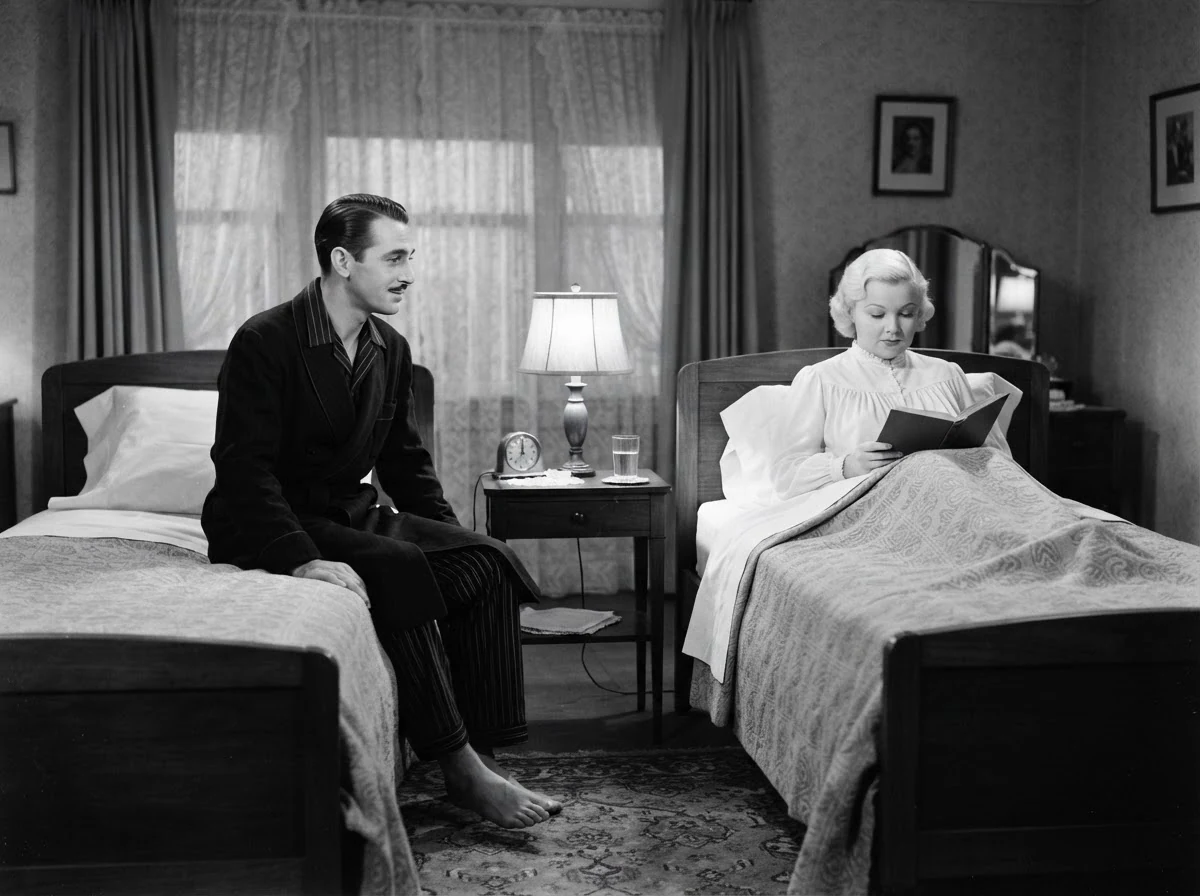
"Two separate twin beds", "one foot on the floor" and the high-necked nightgown are the conventions that got a bedroom past review; "4:3" and "glamour key light" set the era.
Open FlashBoards1940s film noir still, black and white, 4:3. Night, a wet brick alley lit by one hard street lamp from the left. On the wall, the sharp shadow of a man in a fedora raising a revolver; the man himself is outside the frame. In the foreground, a dropped fedora and a burning cigarette on the cobblestones. Low camera at knee height, 35mm lens, fine grain.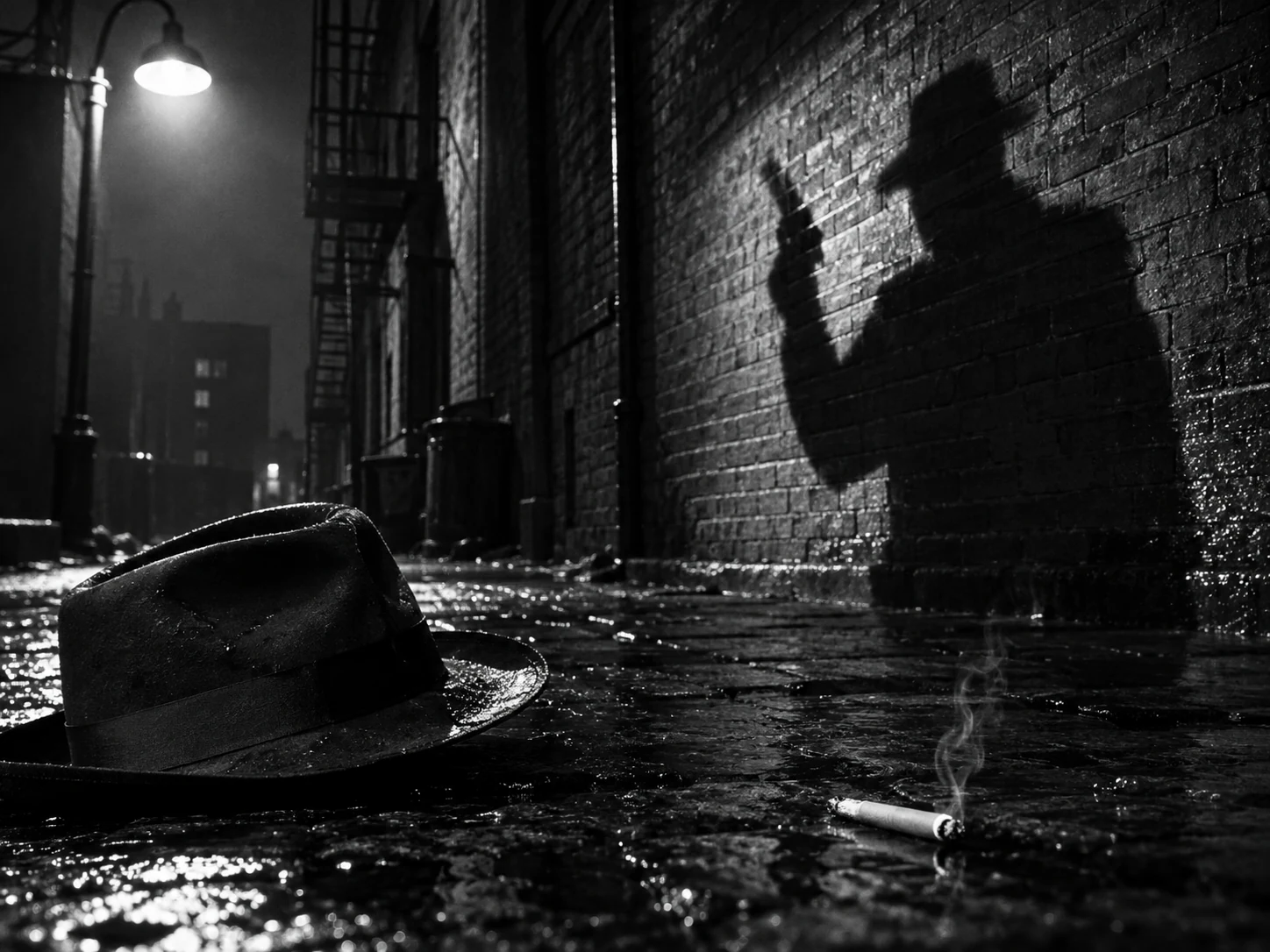
The Code's rule for violence as a picture: the threat is only a shadow. "The man himself is outside the frame" keeps the model from drawing him, and one hard source keeps the shadow readable.
Open FlashBoards1940s black and white studio film, fine grain. Camera: starts at once, a slow smooth pan right from the beds to the window, ending on the sheer curtains. Action: The woman is already closing her book. The man leans across the gap, one foot on the floor, and kisses her cheek briefly. He switches off the lamp; the room drops into soft moonlight as the camera settles on the curtains stirring. The image fades slowly to black.The book and the pan move from the first frame, so the clip is alive. A short kiss, lamp out, camera to the curtains, fade: the Code-era ellipsis, using only what recipe 1 already shows.
Open FlashBoardsCommon mistakes
- One double bed. Name "two separate twin beds" and put an object between them.
- The shooter appears. State that the figure is outside the frame and only his shadow is on the wall.
- Long kisses in video. Ask for a brief kiss and give the next action so the clip moves on.
Keep the reference frames, prompts and every generated take side by side — images and video in one canvas.
FAQ
4 questionsWhen did the Hays Code end?
It weakened through the 1950s and was effectively finished in 1966, when Jack Valenti's MPAA replaced it with a short set of standards. On November 1, 1968, the voluntary rating system with G, M, R and X categories took its place.
Was the Hays Code a law?
No. It was voluntary self-regulation by the studios' trade association. It had force because the major studios owned the main theater chains, which would not book a film without the Production Code seal. Several states and cities also ran their own censor boards.
What movies broke the Hays Code?
Howard Hughes fought the Code for years over The Outlaw (1943). Otto Preminger released The Moon Is Blue (1953) and The Man with the Golden Arm (1955) without a seal and still found audiences, proving the seal was no longer essential.
What replaced the Hays Code?
The MPAA film rating system, introduced in November 1968. Instead of deciding what no one could see, it classifies each film by audience: originally G, M, R and X, today G, PG, PG-13, R and NC-17. The fight moved from what a film may show to which rating it gets.
Related terms
5- Pre-Code HollywoodFilm History & Theory
Pre-Code Hollywood refers to sound films made between about 1929 and mid-1934, before the Production Code was enforced — frank about sex, crime and drugs, as in The Public Enemy, Baby Face or The Divorcee.
- Film Rating SystemFilm Industry
A film rating system classifies films by audience suitability — in the US the MPA's G, PG, PG-13, R and NC-17; in Russia age marks 0+ to 18+ — based on violence, sex, language and drug content.
- MPAAFilm Industry
The MPAA — renamed the Motion Picture Association (MPA) in 2019 — is the trade body of the major Hollywood studios; it lobbies for the industry, fights piracy and runs the voluntary G/PG/PG-13/R/NC-17 rating system.
- Golden Age of HollywoodFilm History & Theory
The Golden Age of Hollywood is the studio era from the arrival of sound (late 1920s) to the early 1960s, when a few studios controlled stars, production and theaters and perfected the invisible classical style — Casablanca, Citizen Kane, The Wizard of Oz.
- New HollywoodFilm Movements & Styles
New Hollywood (c. 1967–1980) was the era when young auteurs — Coppola, Scorsese, Altman, Friedkin — took control from a collapsing studio system and made darker, personal, formally freer films, from Bonnie and Clyde to Taxi Driver.
Further reading
Thomas Doherty, Hollywood's Censor: Joseph I. Breen and the Production Code Administration (Columbia University Press, 2007). Leonard J. Leff and Jerold L. Simmons, The Dame in the Kimono: Hollywood, Censorship, and the Production Code (2001). The Motion Picture Production Code of 1930 (full text).