 FlashBoards Learn
- Learn
- Film Movements & Styles
- Film Noir
Film Movements & Styles · Film language
Film Noir
Also called: noir, classic noir, noir style
Film noir is the cycle of American crime films of the 1940s and 1950s, named by French critics, built on fatalistic plots, compromised heroes, femmes fatales and hard-shadowed, low-key black-and-white images. It is a style that cuts across genres rather than a genre of its own, and it still shapes how crime looks on screen.
- What it does
- Turns the city and the frame into a trap: hard light, deep shadow and slanted compositions make every choice feel doomed.
- Use it when
- Crime, betrayal, obsession, confession, investigation — any story where the hero is guilty, hunted or already lost.
- Watch out
- Fedoras and venetian blinds alone read as parody; the look only works when the light, the angle and the story's fatalism agree.
- Try this prompt
black-and-white 1940s film noir still, detective at a desk at night, hard light through venetian blinds, bars of shadow across his face, deep blacks, no fill
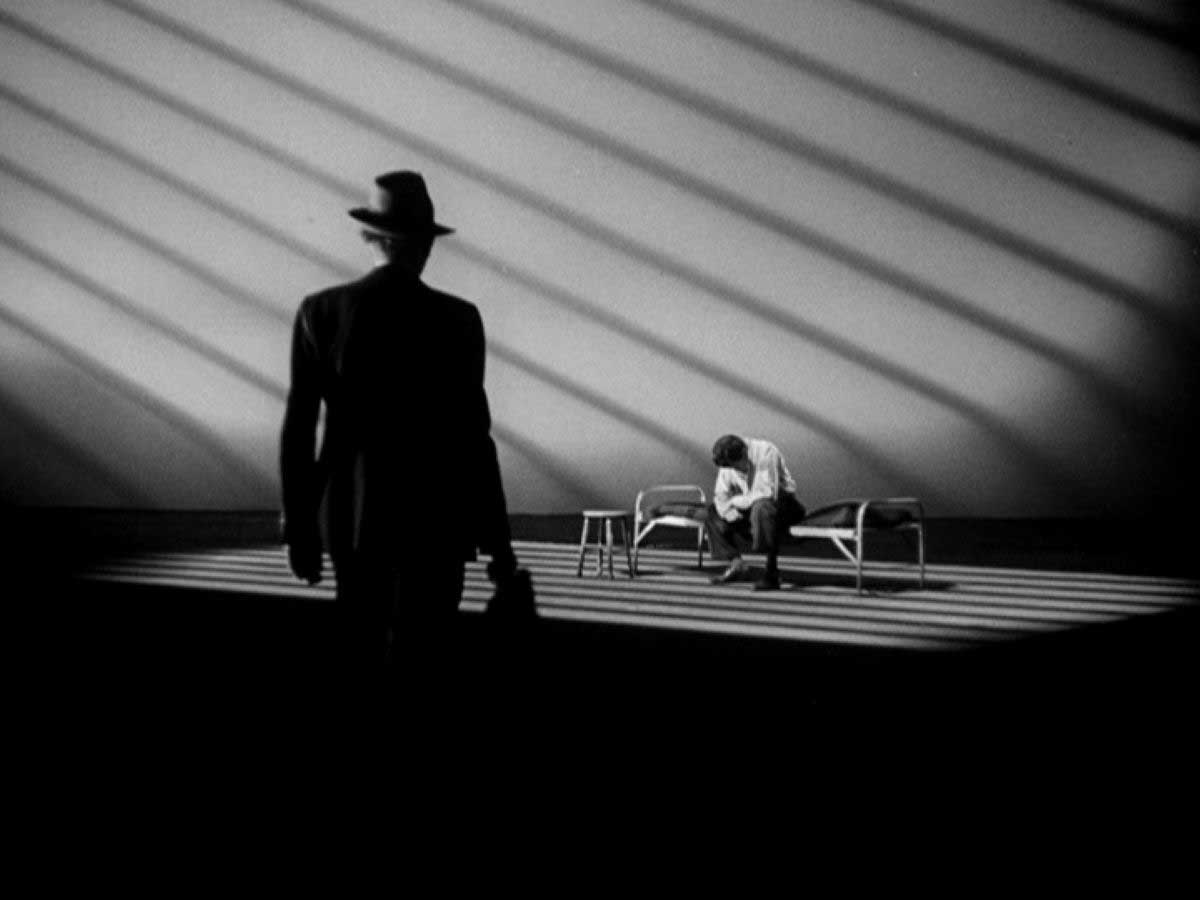
What is film noir?
Film noir — French for “black film” — is the label for a body of Hollywood crime pictures made roughly between The Maltese Falcon (1941) and Touch of Evil (1958). Nobody in Hollywood set out to make “film noir”; studios made detective stories and crime melodramas. The name came afterwards: in 1946 the French critic Nino Frank, catching up on American films that had been kept from French screens during the occupation, noticed how dark these new crime pictures were in look and in mood, and called them film noir, a phrase that echoed Gallimard's new Série noire crime novels. Raymond Borde and Étienne Chaumeton turned the idea into the first book-length study in 1955.
That history matters for one practical reason: film noir is not a genre. A genre is defined by its story material — a western by the frontier, a musical by song. Noir is a style and a sensibility that settled over several genres at once: the private-eye film (The Maltese Falcon, The Big Sleep), the crime melodrama (Mildred Pierce), the heist (The Asphalt Jungle), the boxing picture (The Set-Up), even the western. What unites them is a worldview and a way of lighting it.
The classic cycle drew on hard-boiled fiction by Dashiell Hammett, Raymond Chandler and James M. Cain, and on the talent that had fled Europe: Fritz Lang, Billy Wilder, Robert Siodmak, Otto Preminger, Edgar G. Ulmer. Many noirs were modest programmers or outright B-movies, which is partly why they could be so strange. It is one of the core styles in our guide to film movements.
What are the characteristics of film noir?
Noir is recognizable in a single frame, but the look is only half of it.
The visual language
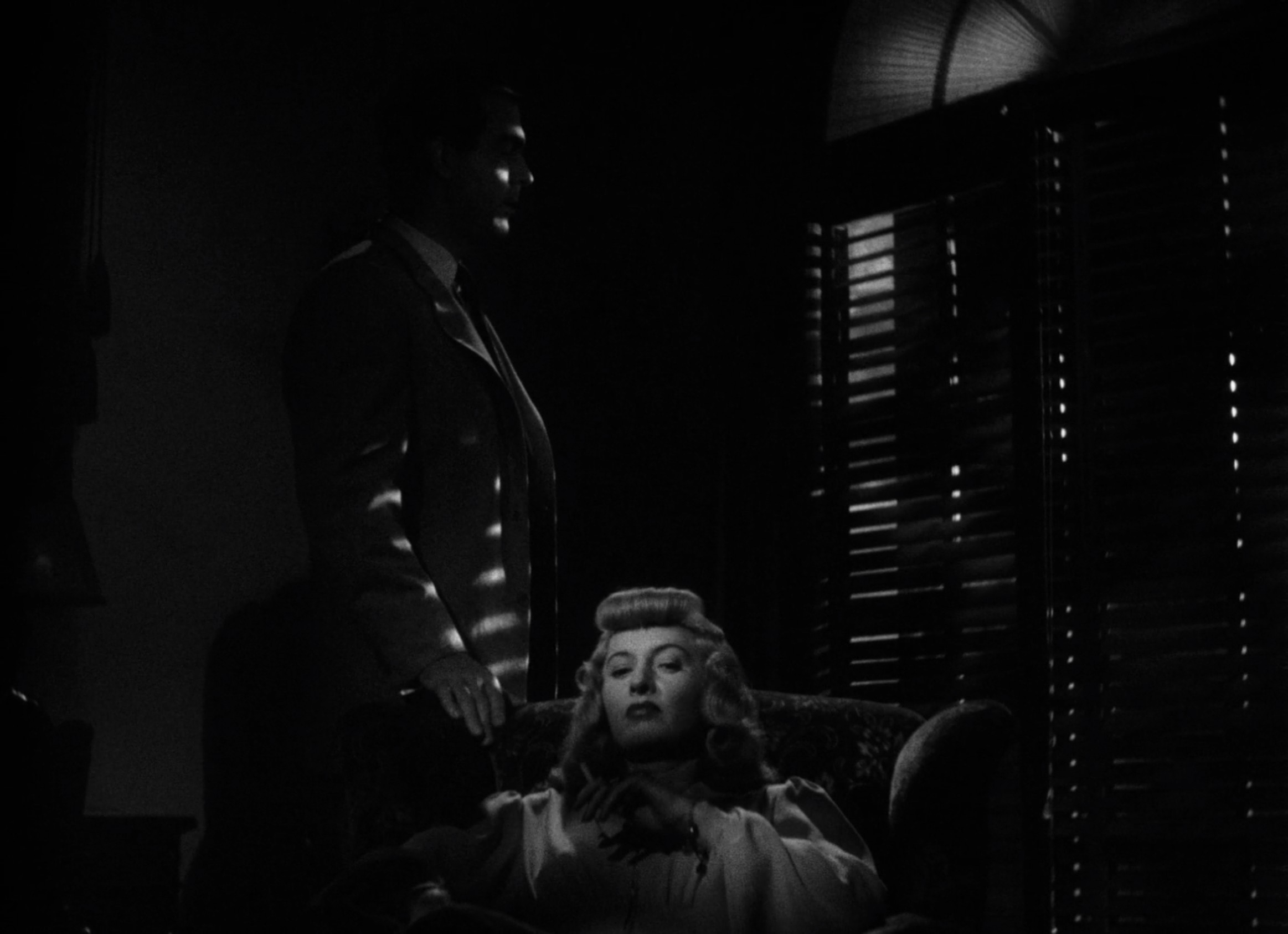
- Low-key light. Most of the frame sits in shadow; a strong key with little or no fill leaves faces half-carved out of the dark. This is low-key lighting at its most extreme, with lighting ratios far beyond anything a 1930s glamour portrait would allow.
- Hard, directional sources. Bare bulbs, streetlamps, desk lamps and car headlights throw hard light with crisp shadow edges, often motivated by a practical in the set.
- Cast shadows as design. Venetian blinds, window bars, stair railings and banisters print stripes of light across faces and walls — the prison cell the character hasn't noticed yet. On set these patterns often came from a flag or a cucoloris rather than from the real window.
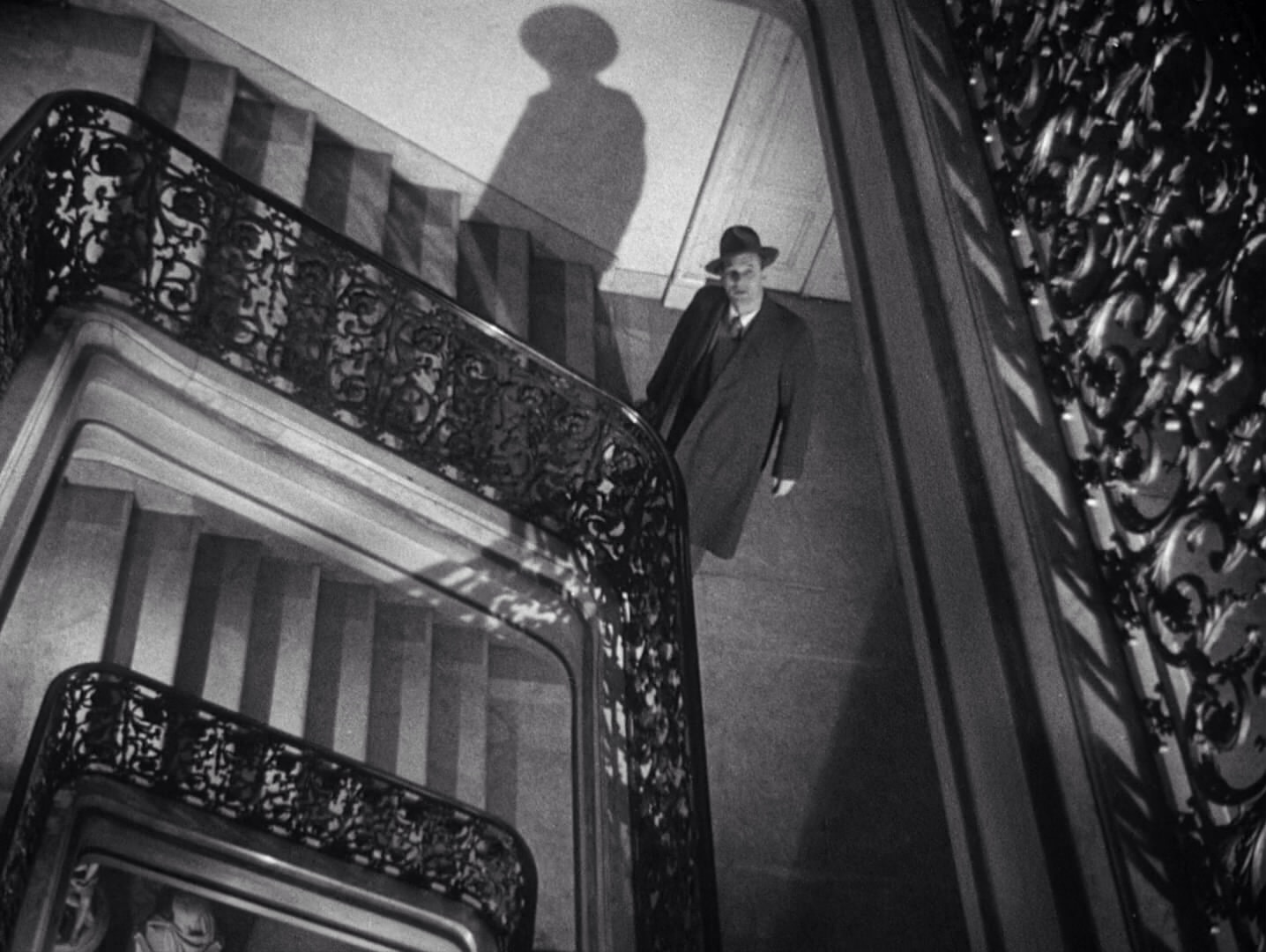
- Unstable geometry. Low angles and ceilings in frame, wide lenses close to faces, high angles down stairwells, and the occasional Dutch angle when the world tips over.
- Night and the city. Wet streets, neon signs, empty offices after hours, cheap hotel rooms and diners at 3 a.m.
The storytelling
- First-person confession. Heavy use of voice-over, often told by a man who already knows how it ends — Walter Neff dictating his confession in Double Indemnity (1944), or a dead man narrating Sunset Boulevard (1950).
- Broken time. Stories that start at the end and loop back through flashbacks, sometimes flashbacks within flashbacks, as in The Killers (1946); Out of the Past (1947) tells half its story in one long flashback.
- Compromised protagonists. The noir hero is an anti-hero: a detective who bends the law, an insurance man who plans a murder, a drifter who can't stop making the wrong turn.
- The femme fatale. A woman whose desire and ambition drive the plot and who is rarely what she first appears.
- Fatalism. The trap closes regardless of what the characters do. Chance, not heroism, decides the ending.
Why does film noir look so dark?
The noir look was not a manifesto; it came from several pressures at once.
German Expressionism in exile. Directors and cinematographers trained in 1920s Berlin brought German Expressionism with them: stylized shadows, oppressive architecture and the idea that light can show a character's inner state. Stranger on the Third Floor (1940), often named as the first true noir, stages its nightmare sequence almost like a Weimar set.
Money and censorship. Darkness is cheap. A set that is 70% shadow needs less building and dressing, and a single hard key is faster to rig than a full three-point setup. At the same time, the Hays Code kept sex and violence off screen, so noir learned to suggest them — a shadow on a wall, an off-screen shot, a cigarette passed between two people in the dark.
Cinematographers pushing the craft. DPs such as John Alton (T-Men, The Big Combo), Nicholas Musuraca (Out of the Past) and John F. Seitz (Double Indemnity) treated shadow as a compositional material. Alton's 1949 book Painting with Light still explains how one source builds a mood.
The postwar mood. Returning veterans and a new suspicion of institutions made audiences receptive to stories in which the system is corrupt and the individual is alone. Islands of chiaroscuro in a dark city are that worldview made visible.
How to light and shoot a noir scene
Noir is one of the few styles you can build from a single light. A starting kit:
- One hard key. An open fresnel (a 1K or 2K tungsten or a punchy LED fresnel with the lens in) set high and to the side, 45–90° off the lens axis. Keep it hard: no diffusion, no bounce.
- Fill low or off. Aim for key-to-fill ratios of 8:1 and higher. In black-and-white, a face that is half black reads as intentional; in color, add just enough fill to hold texture in the shadow side.
- Break the light. Put blinds, a window frame or a cookie in front of the key, 1.5–3 m from the subject, so the pattern stays sharp. Farther from the subject, harder shadows; closer, softer.
- Practicals in frame. A desk lamp, a streetlamp, a neon sign outside the window. They justify the key and give the eye a bright point in a dark composition.
- Wet the ground. Hosed-down streets turn one backlight into a field of reflections.
- Lens and height. A 25–35 mm lens close to the actor slightly distorts faces and stretches rooms; a camera at waist height or lower lets ceilings and lamps into frame. Touch of Evil is the textbook for wide-angle noir.
- Blocking. Stage people in doorways, on staircases, behind glass and in frames within frames. Let characters step out of the light when they lie.
For digital capture, expose for the highlights and let the shadows fall: check the face with false color, keep the key side near skin-tone exposure, and resist the urge to lift the blacks in the grade. If you convert to black-and-white later, light with a monochrome viewing LUT on the monitor so you judge contrast, not color.
What is neo-noir?
Neo-noir means later crime films that consciously reuse noir's themes and imagery. The shift to color and the end of the Production Code in the late 1960s meant noir could be more explicit, and the directors of the New Hollywood era were film-literate enough to quote it on purpose. Chinatown (1974) moves the private-eye story into sunlit 1930s Los Angeles; Taxi Driver (1976) turns the voice-over into a diary of alienation; Body Heat (1981) updates Double Indemnity into sweat and heat.
Neo-noir also drifted into other genres. Blade Runner (1982) made the noir detective a science-fiction figure in a city of rain, smoke and neon lighting; Se7en (1995) pushed urban decay to its limit; Memento (2000) broke the flashback structure into pieces; Mulholland Drive (2001) turned Hollywood itself into the noir trap.
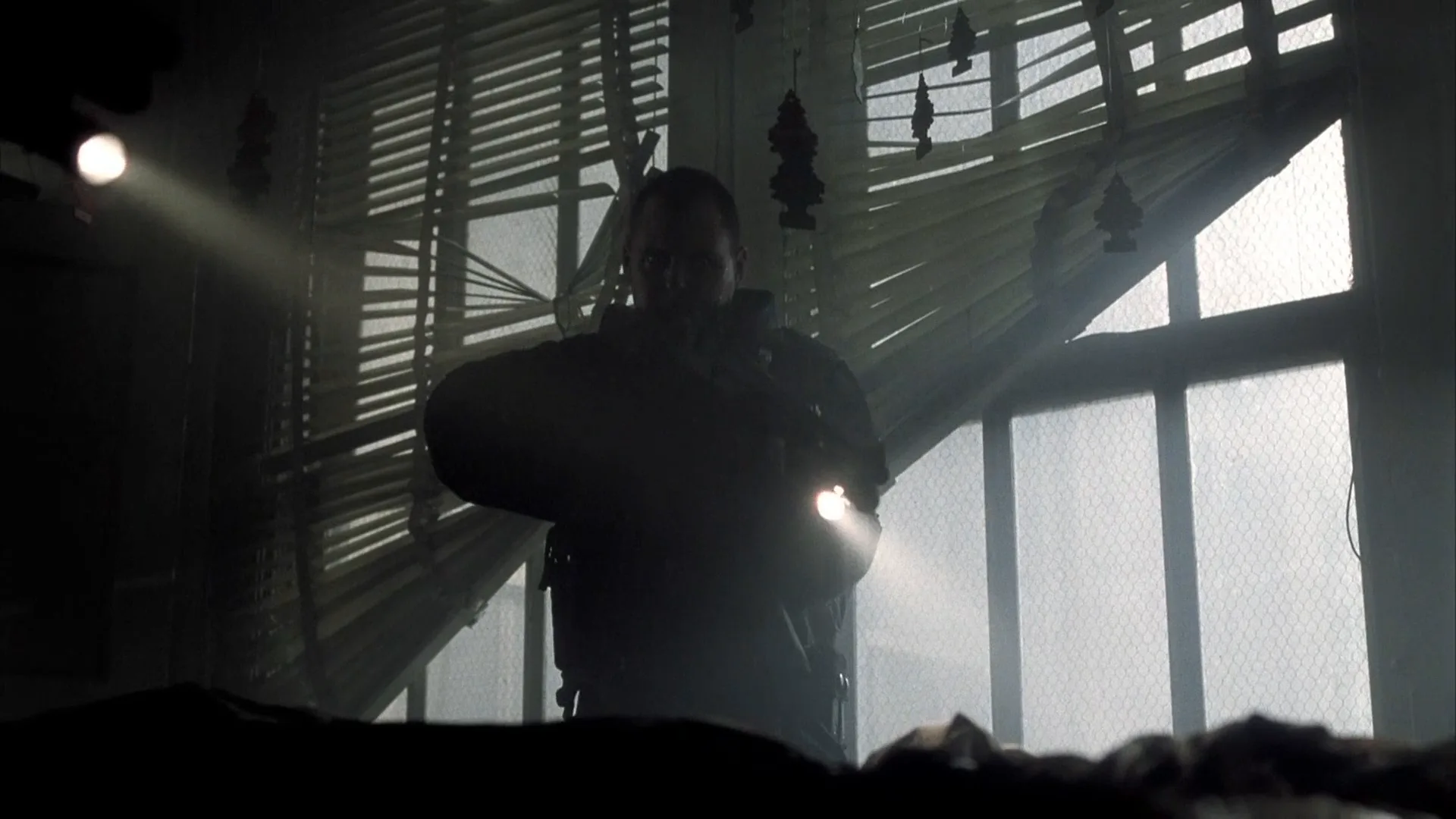
Visually, neo-noir trades black-and-white for controlled color — sodium-vapor orange against cyan fluorescents, saturated reds — but keeps the principles: a dominant hard source, deep shadow, a city closing in on the hero.
Film noir vs. German Expressionism
Related by blood, separated by twenty years and an ocean.
| | German Expressionism | Film noir | |---|---|---| | Time and place | Weimar Germany, roughly 1919–1931 | Hollywood, roughly 1941–1958 | | Sets | Painted, distorted, openly artificial | Mostly realistic studio sets and real city locations | | Shadows | Sometimes painted directly on the set | Created with light: hard keys, blinds, cookies | | Acting | Stylized, mask-like gestures | Naturalistic, clipped, understated | | Subject | Madness, tyranny, the supernatural | Crime, desire, money, betrayal | | Narration | Silent, intertitles | Voice-over, flashback, fast dialogue |
Expressionism distorts the world to show the mind; noir keeps the world recognizably real and lets the light alone tell you something is wrong. When a noir does go fully expressionist — the nightmare in Stranger on the Third Floor, the stairwells of The Third Man (1949) — it is usually marking a dream, a breakdown or a fall.
Film Noir examples in film
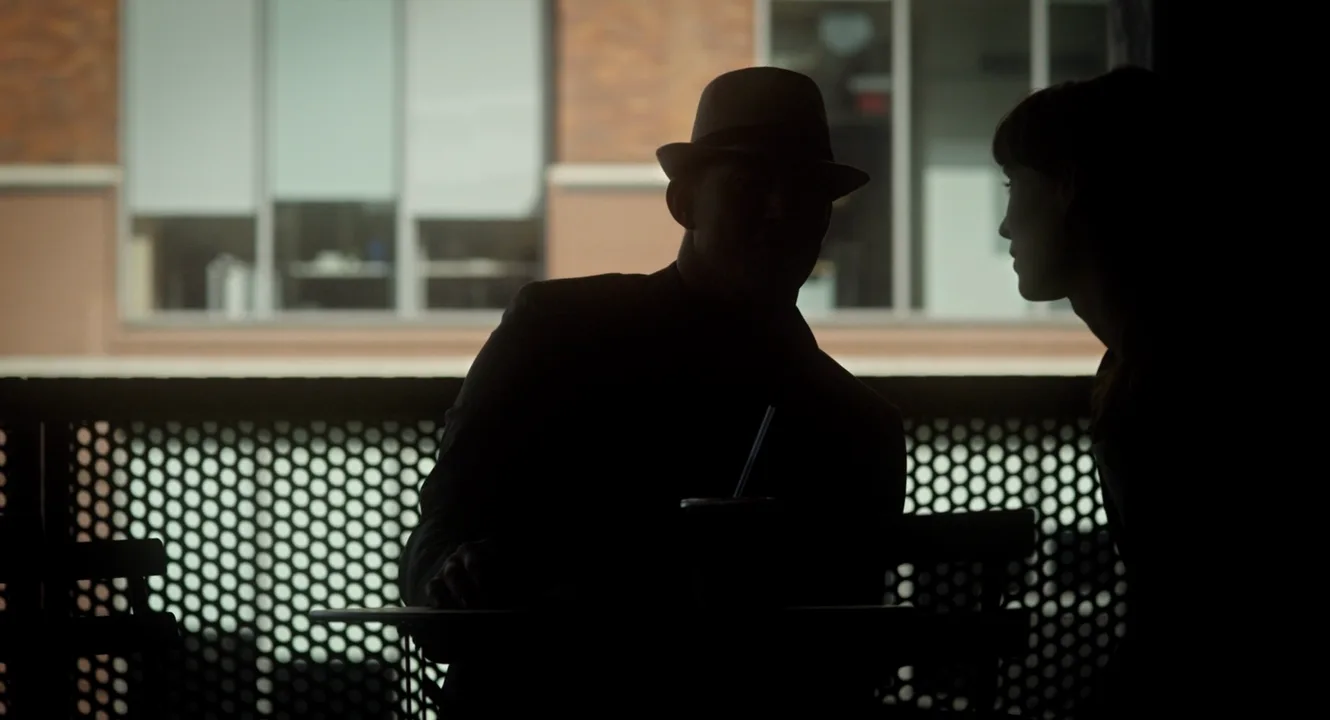
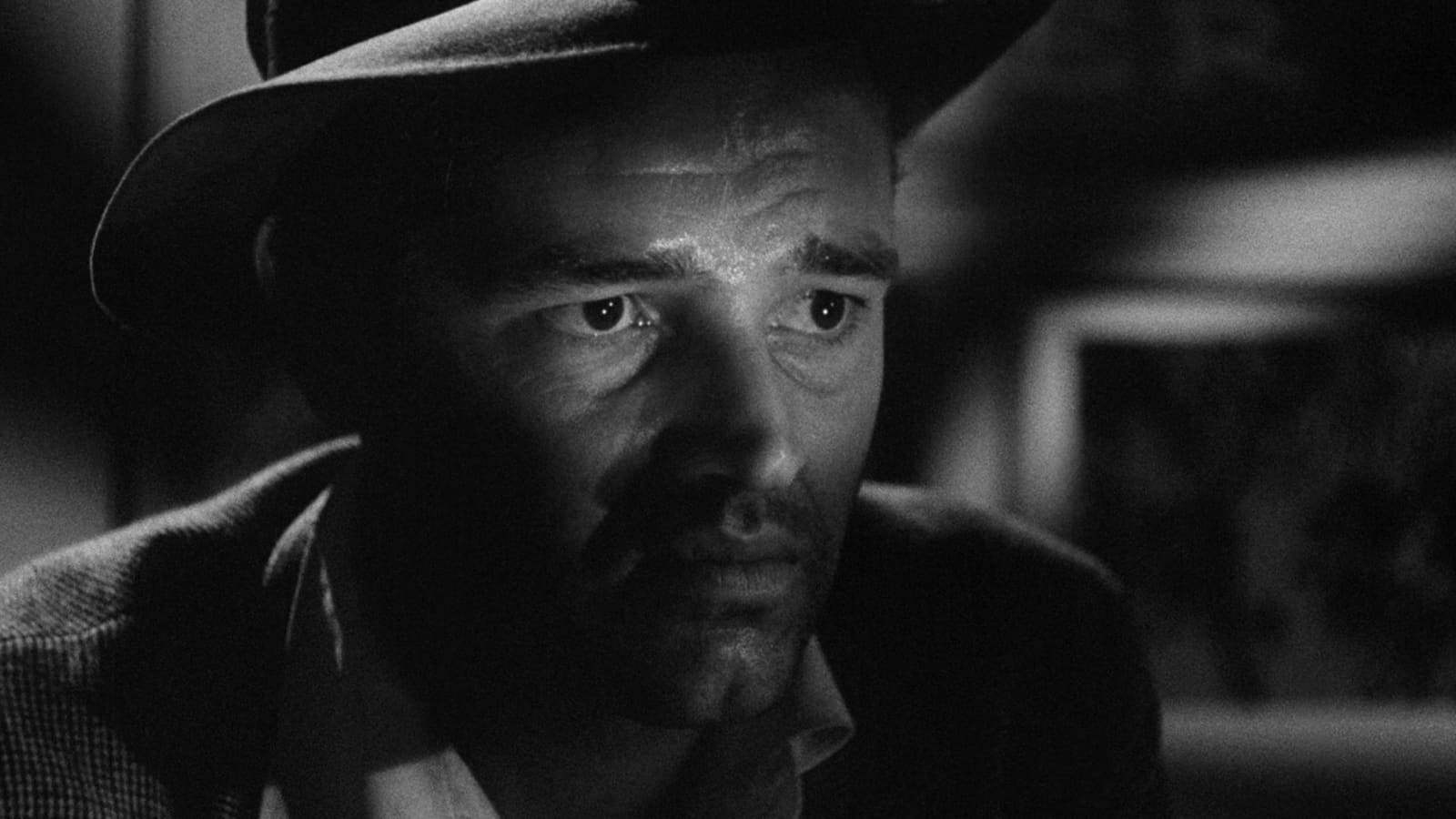
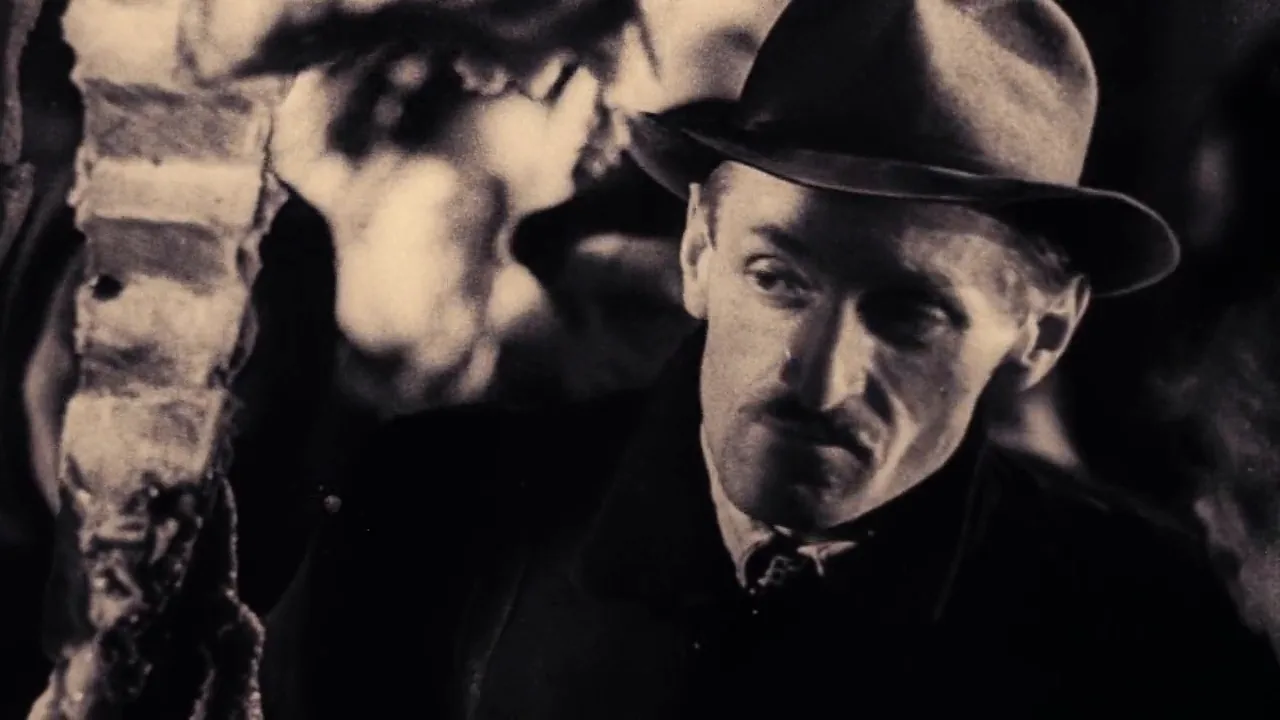
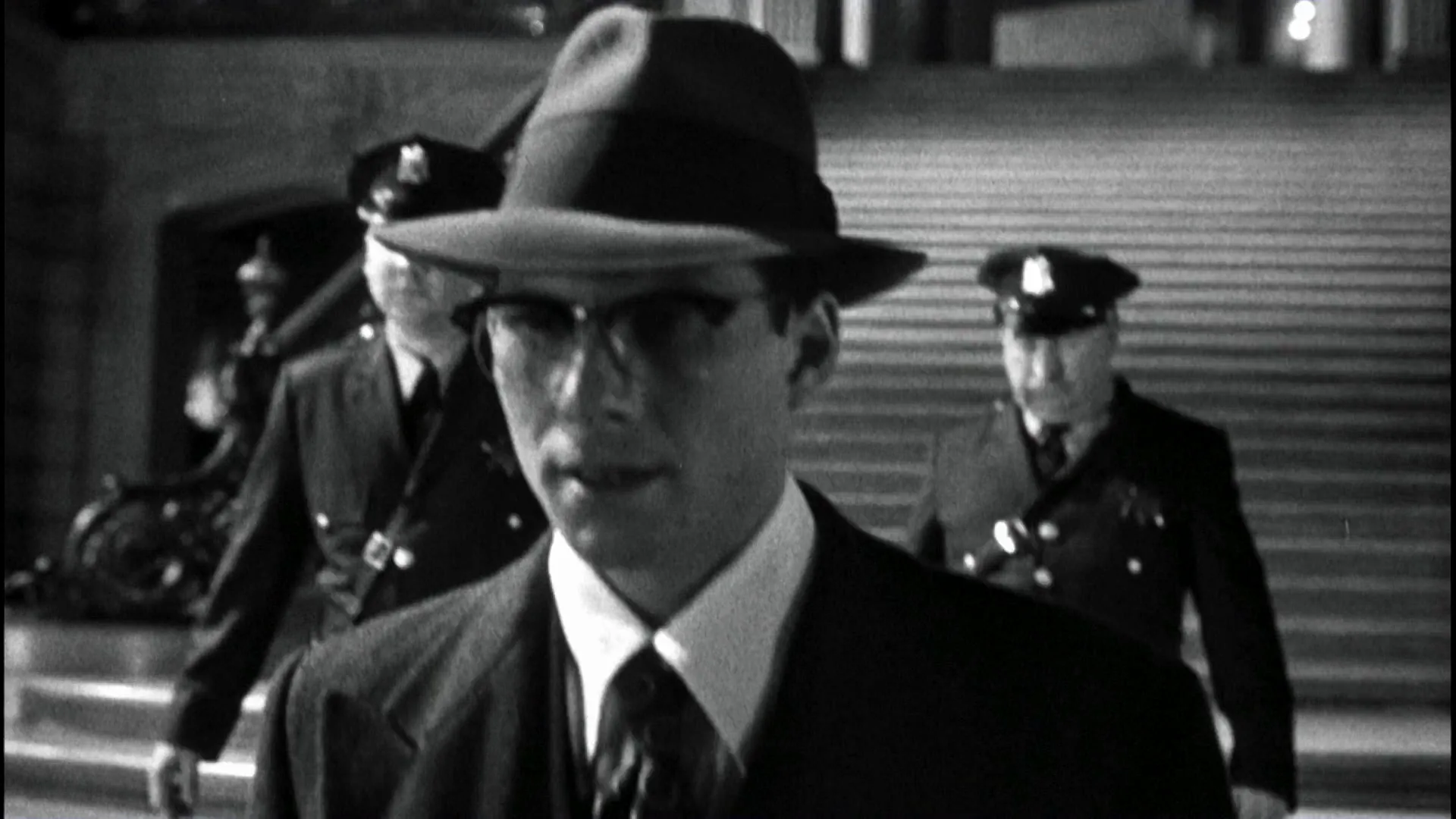
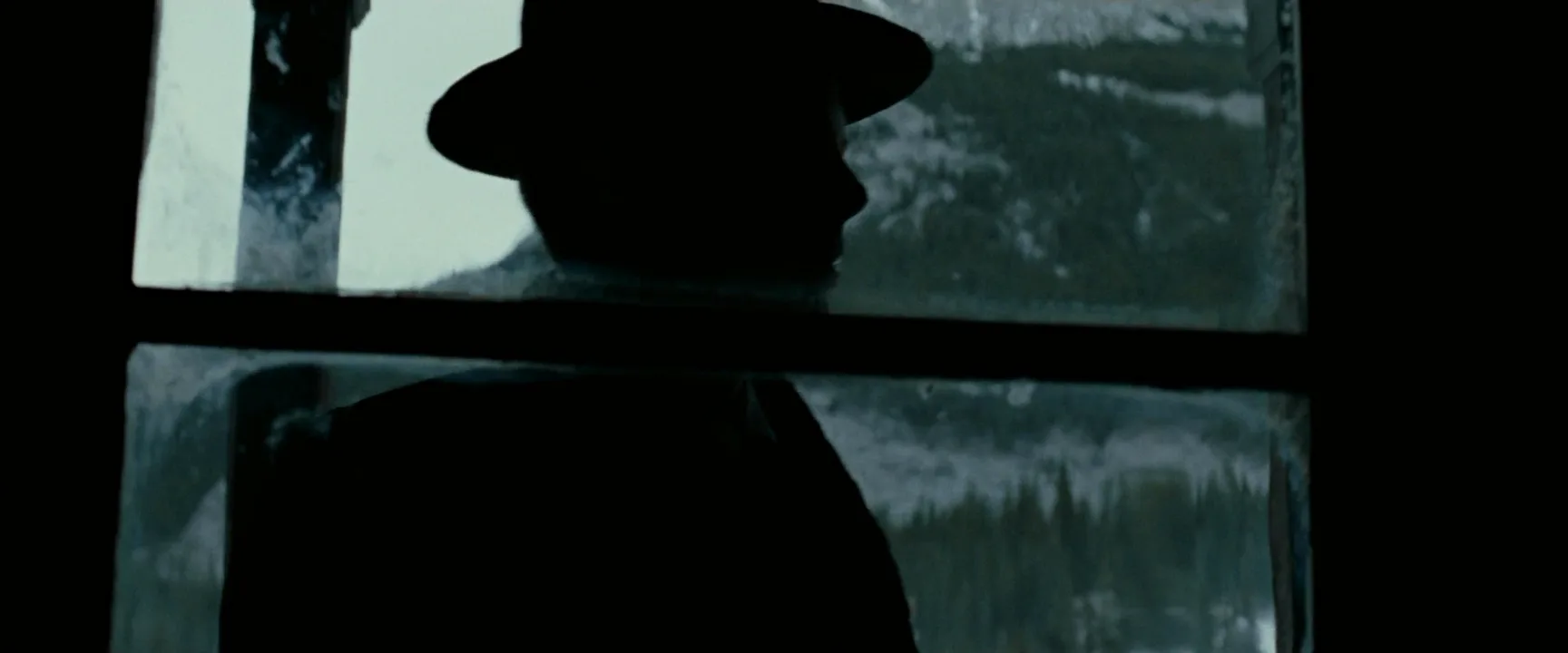
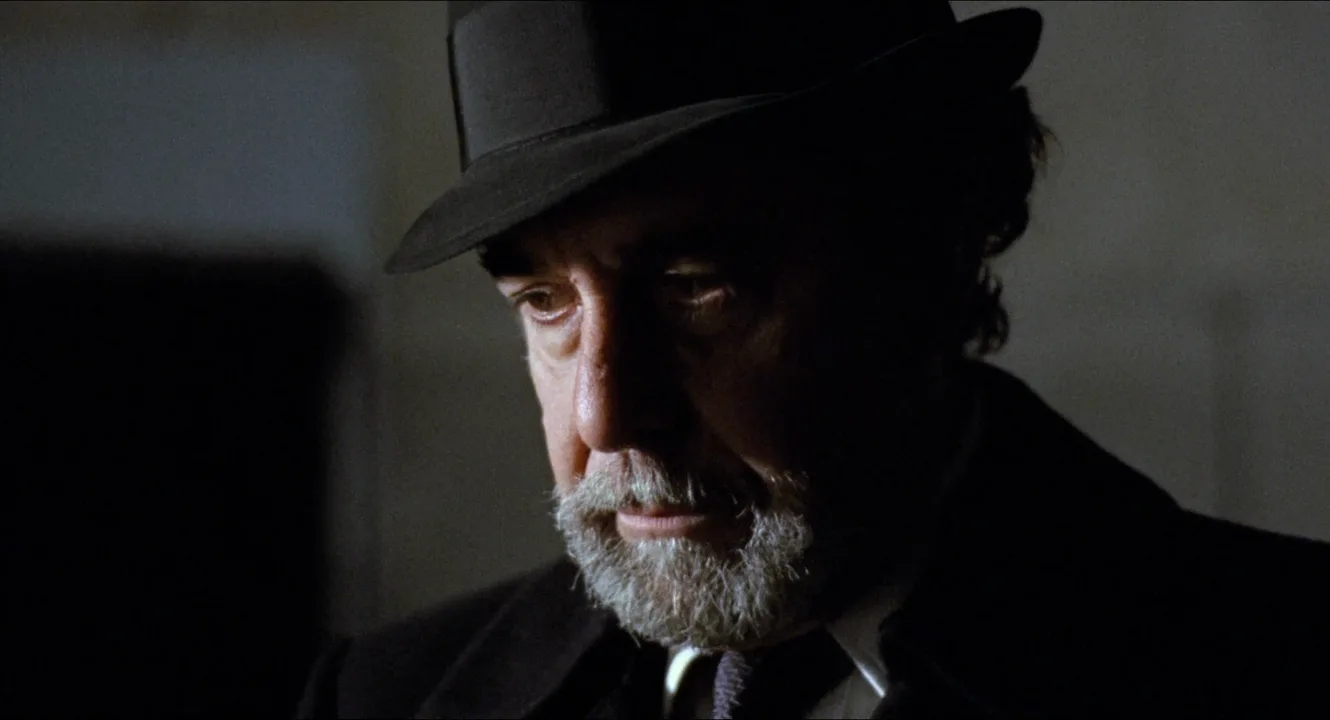
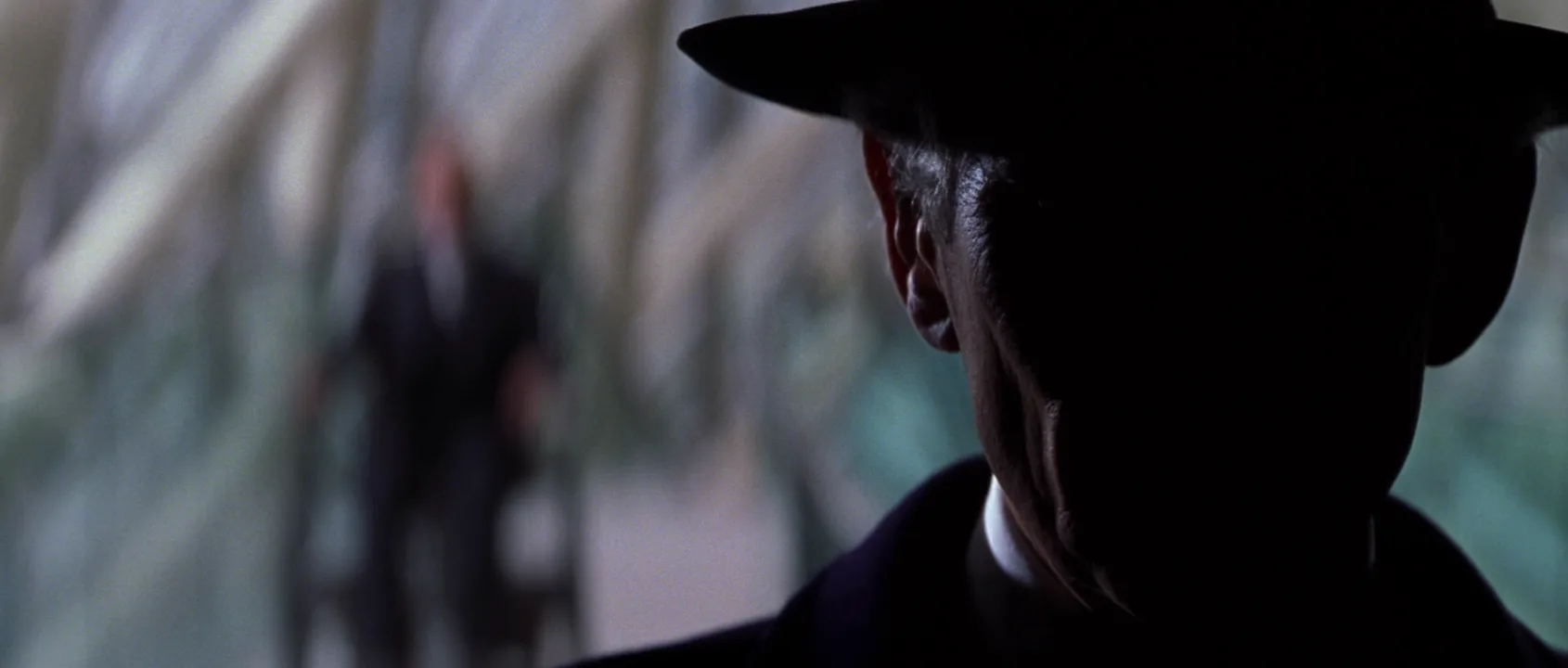
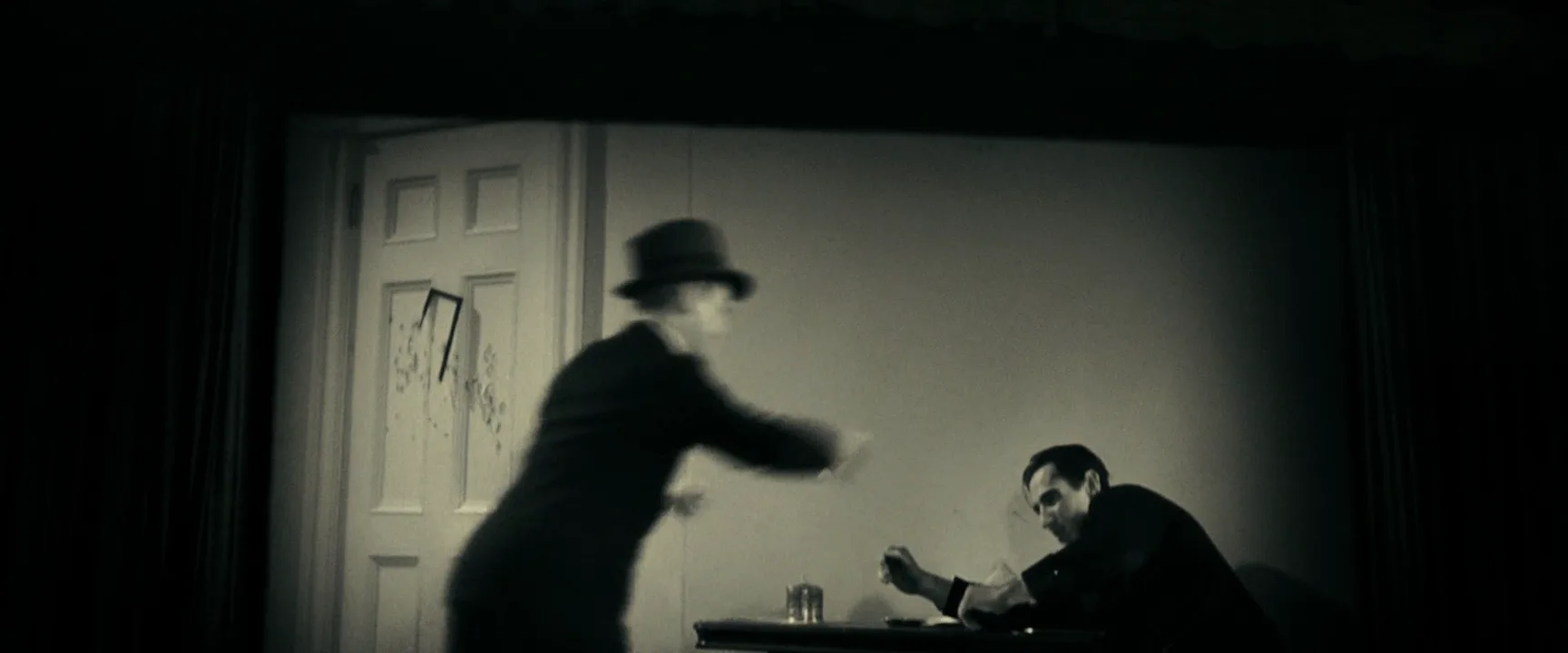
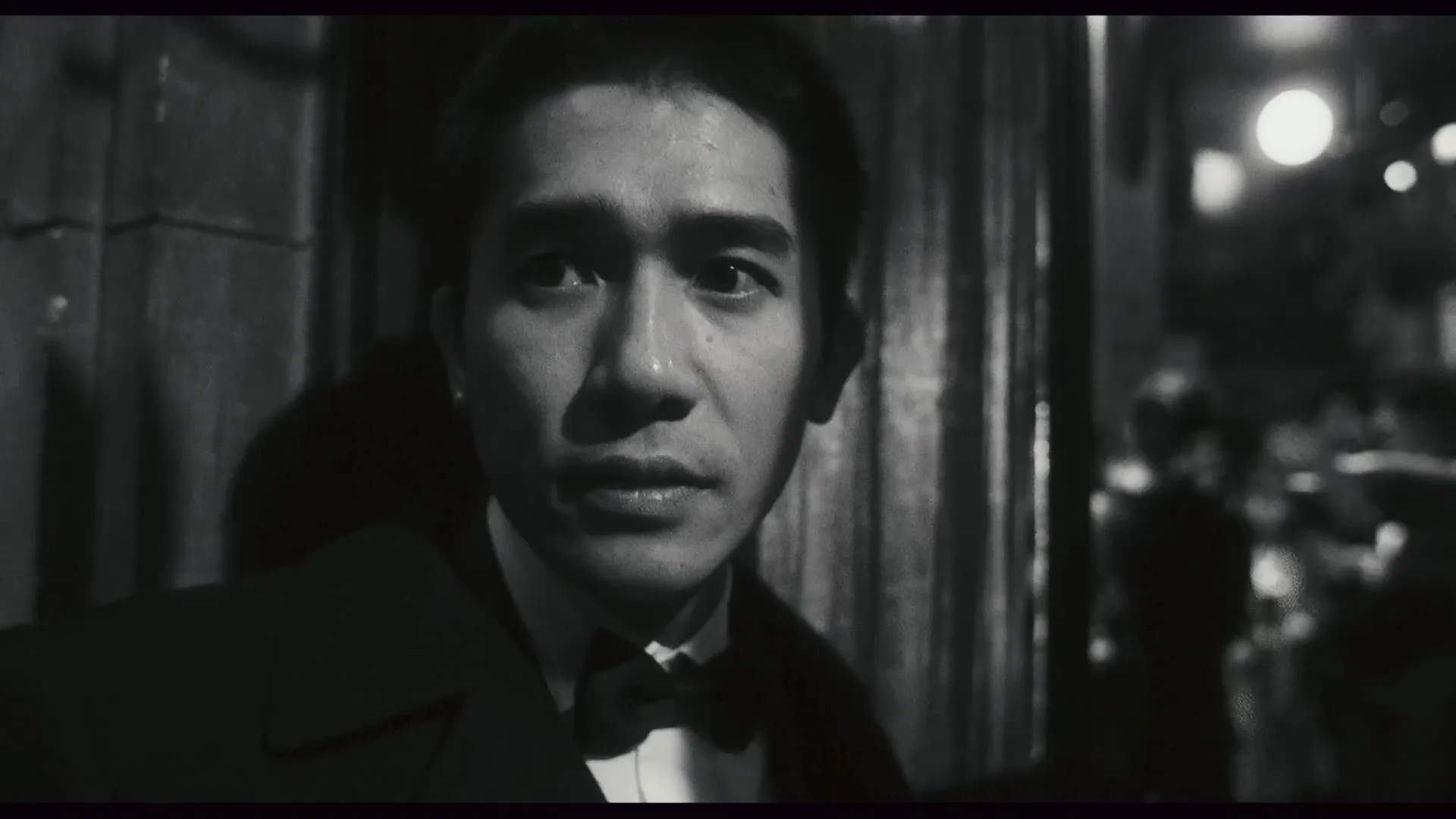
13 framesClassic noir frames next to later films that borrow its tools: the single hard source, the cast shadow, the hat brim that hides the eyes, the slanted stair.
How to create a film noir with AI
4 promptsImage models know the phrase “film noir”, but on its own it tends to return a costume picture: a fedora, a trench coat and flat grey light. The look comes from describing the setup: one hard source, what breaks it and what stays black. In FlashBoards, pin classic noir frames on the same board as your takes, build the start frame with Nano Banana 2 Lite, try a color neo-noir take with GPT Image 2.5, and animate the best frame with MiniMax H3 Max Turbo. The fourth prompt re-shoots a real film shot from a text description alone, and the original plays next to the result so you can compare.
Black-and-white 1940s film noir still. A fictional private investigator in his forties with a crooked nose, heavy dark eyebrows, a thin pencil mustache and a small scar on his chin, wearing a rumpled double-breasted suit and a fedora pushed back on his head, sits behind a cluttered wooden desk in a small office at night, a lit cigarette between his fingers. Medium shot, 28mm lens, camera at desk height looking slightly up so the ceiling shows. A tall window with venetian blinds on the left edge of the frame, rain streaks on the glass; a hard streetlamp outside shines through the blinds and throws sharp bars of light across his face, his shirt and the wall behind him. One eye in shadow. No fill, deep blacks, bright crisp highlights, high contrast, fine film grain.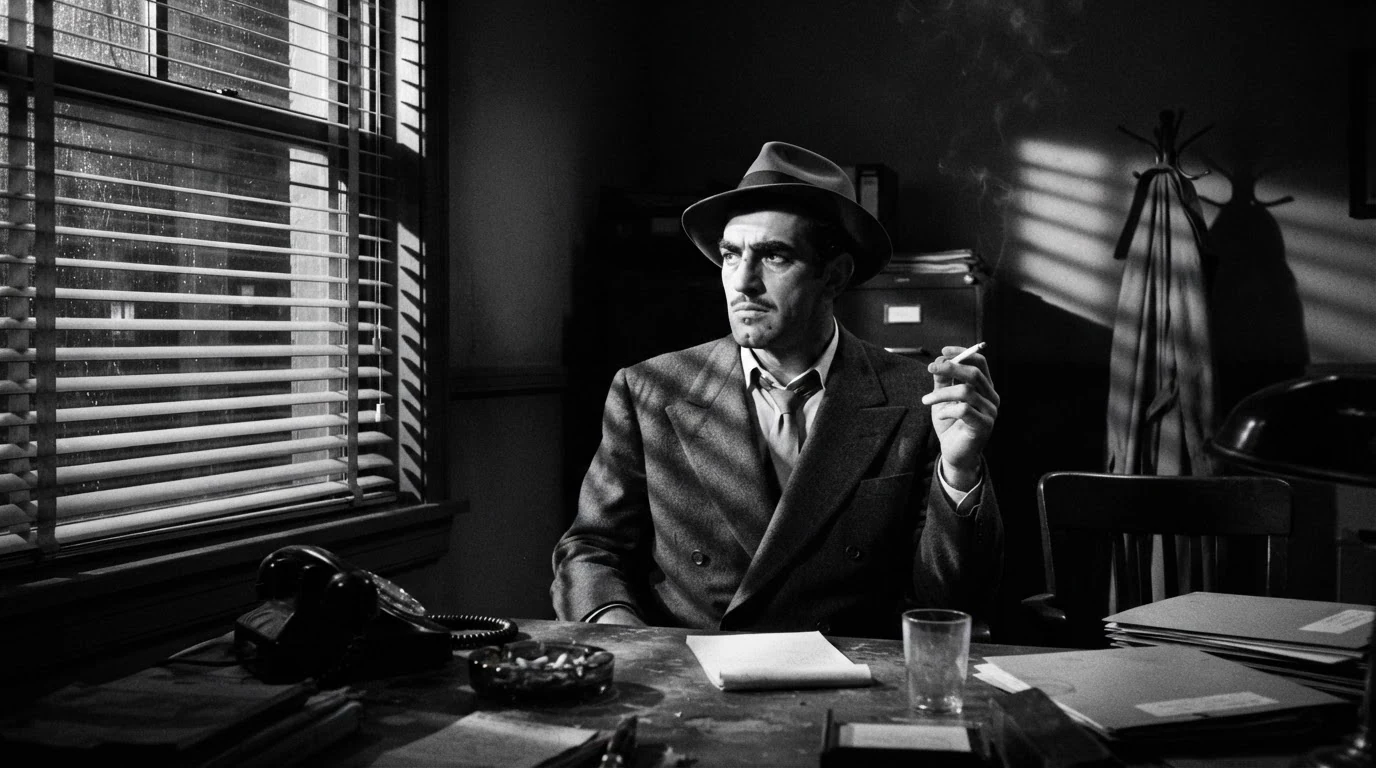
“Hard streetlamp outside shines through the blinds” gives the model a single motivated source and the object that breaks it, which is what produces the striped shadow. “No fill”, “deep blacks” and “one eye in shadow” set the lighting ratio. “28mm”, “desk height” and “ceiling shows” add noir's slightly oppressive low angle, and the window is placed inside the frame so the video can use it.
Open FlashBoardsColor neo-noir film still, night. A fictional woman in her thirties with a sharp platinum bob, dark arched eyebrows, a small mole above her upper lip and a long dark-red trench coat stands alone under a single streetlamp in a narrow, rain-soaked alley. Wide shot, 24mm lens, camera at knee height looking up at her. The streetlamp is a hard orange sodium-vapor source directly above her; her long shadow stretches toward the camera across wet cobblestones. A red neon sign on the brick wall reflects in the puddles, a cold green fluorescent glow spills from a doorway behind her. Everything outside these pools of light is black. High contrast, saturated reds and orange against deep shadow, anamorphic widescreen.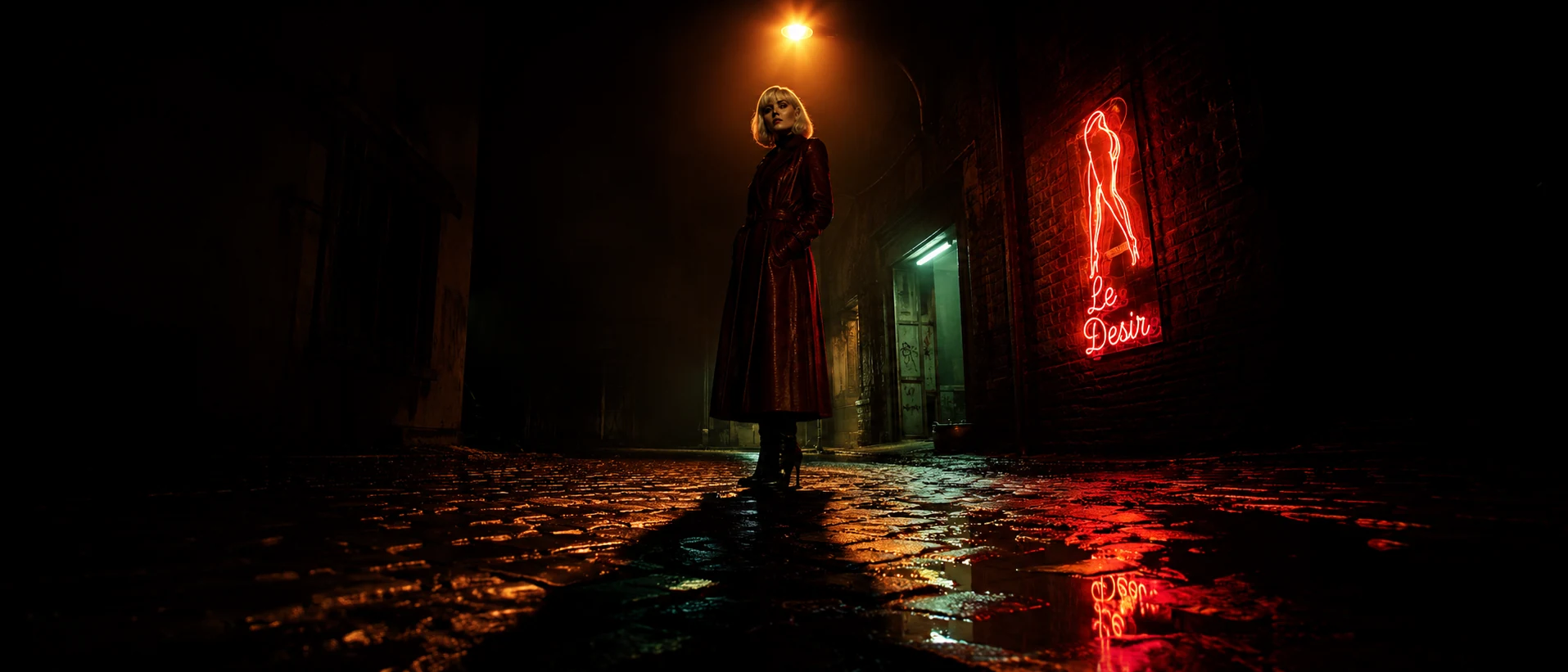
This take moves from classic black-and-white to neo-noir color. Naming each source and its color — “orange sodium-vapor”, “red neon”, “green fluorescent” — keeps the image in hard pools instead of an even night glow. “Camera at knee height looking up” and the shadow “toward the camera” give the scene depth and menace, and 21:9 leaves room for the empty alley.
Open FlashBoardsCamera: slow, steady push-in from medium shot toward a medium close-up across the whole shot, ending on the investigator's face. Action: Smoke is already rising from the cigarette in his fingers and drifting through the bars of light. He lifts the cigarette, takes a slow drag, and the tip glows bright. He exhales, and the smoke curls through the striped light in front of his face. Headlights from the street sweep across the rainy window, the bars of light slide across the wall and over his face, and he turns his head toward the window, one eye catching the light while the other stays in shadow.The action starts at once (“smoke is already rising”), so the shot is alive from the first frame instead of slowly zooming on a still. Every element — the cigarette, the window, the rain, the bars of light — is already in the start frame, so the model animates rather than invents. The passing headlights give the moving shadow a physical cause, which keeps the stripes from drifting randomly.
Open FlashBoards{
"output": "Full-screen live-action single continuous shot from its very first frame, from The Assassination of Jesse James by the Coward Robert Ford (2007). Dark interior at the edge of a snowbound frontier town, 1880s. Cold overcast daylight outside, the room itself pitch black: the man inside reads as a pure black silhouette against the bright window. Desaturated steel-blue and gray, fine 35mm grain, scope widescreen, high contrast.",
"characters": {
"S1": {
"name": "Robert Ford, played by Casey Affleck",
"look": "slim man in a long dark wool overcoat and a round-crowned felt hat with a short stiff brim; seen only as a black silhouette, his face a solid black shape with no features visible",
"voice": "silent: he never speaks and his lips never move"
},
"N1": {
"name": "The narrator, off screen",
"look": "never seen",
"voice": "calm, low, measured older male voice, reflective storyteller tone, close and dry"
}
},
"shots": [
{
"shot": 1,
"camera": "locked tripod inside the dark room, eye level, 40mm lens, framing a tall multi-pane window with thick black mullions; as the man arrives the camera tilts up slowly and drifts a little to the right, ending on a medium close-up of his head and shoulders in profile against the upper panes, with a strip of black wall filling the right edge of the frame",
"action": [
"BEGINNING: alive from the first frame, the room is empty; through the black window frame a bright snowy street, a large two-story wooden hotel with an outside staircase in the upper centre, small dark figures trudging across the snow far away, a dark forested mountain slope behind.",
"THEN: S1 walks in from the left edge close to the lens, his back to camera, a black shape rising over the left half of the frame, and moves right until he stands square in the centre of the window, both arms hanging at his sides.",
"THEN: the camera tilts up with him: the hotel sinks out of the bottom of the frame, a horizontal mullion crosses the frame at his shoulders and the pale gray-white mountain slope fills the panes behind his head.",
"THEN: he turns his head to screen right into full profile, gazing out through the glass toward the right side of the frame; the hat brim, nose and chin become a crisp black cut-out edged by the white snow light.",
"THEN: he holds perfectly still in profile, gaze fixed out of the window to the right, no nod, shoulders still, only the faint drift of the camera.",
"END: his shoulders begin to turn back toward the camera and his right arm starts to lift at the lower right of his silhouette, still a solid black shape against the snow."
],
"dialogue": [
{
"speaker": "N1",
"on_screen": false,
"when": "starting a moment after the first frame, while the window is still empty, and running through the whole shot to the last frame",
"delivery": "unhurried, even, a quiet voice-over that tells rather than performs",
"line": "<d>[English] That he truly regretted killing Jesse that he missed the man as much as anybody and wished his murder hadn't been necessary.</d>"
}
]
}
],
"sound": {
"ambience": "quiet room tone, a low winter wind heard from outside, the creak of floorboards and the soft rustle of a heavy coat as he walks in",
"speech": "exactly this one spoken phrase, said once, by the off-screen narrator; the man in the frame never speaks",
"never_spoken": "no other narration and no other voice-over: apart from the narrator's one line above, the descriptions, performance notes and step words of this prompt are never spoken aloud",
"music": "a film score under the scene, always below the voices: a sparse, slow melancholic piano over a low sustained string drone",
"subtitles": "none"
}
}Remakes the window shot from The Assassination of Jesse James by the Coward Robert Ford (2007): the prompt carries over the dark room, the snowy town beyond the panes, the tilt up as Robert Ford walks in, his turn into a black profile and the narrator's line.
The JSON keeps one continuous take and makes the silhouette a rule: the room is “pitch black” and the only light is the window behind Robert Ford, so his face stays solid black. The narrator's line from the film runs over the shot, and the tilt and the turn into profile are separate phases.
Open FlashBoardsCommon mistakes
- Grey mush instead of noir. Monochrome prompts often come back low-contrast. Ask for “deep blacks”, “bright crisp highlights” and “no fill”, and name one hard source.
- Blinds in front of the lens. Models sometimes draw real blinds over the face. Describe the shadow pattern: “bars of light cast across his face and the wall”.
- Costume party. “Film noir” plus fedora and trench coat reads as dress-up. Add a place, an hour and a specific action.
- Eye-level, evenly lit rooms. State the lens and the height (“24mm, camera at knee height looking up”) or the frame flattens into a plain medium shot.
- Moving shadows with no cause. In video, stripes that slide on their own look wrong. Give them a reason: passing headlights, a swinging lamp, a figure crossing the light.
- Familiar faces. Generic “1940s detective” prompts can drift toward famous stars. Describe specific, invented features — scars, eyebrows, hairline, a mole.
Keep the reference frames, prompts and every generated take side by side — images and video in one canvas.
FAQ
5 questionsIs film noir a genre?
Not strictly. Film noir is usually described as a style or a historical cycle rather than a genre. The films come from several genres — detective stories, crime melodramas, heist films, thrillers — and are grouped by their shared look (low-key, hard-shadowed black-and-white) and outlook (fatalism, corruption, compromised heroes). The label was applied afterwards by French critics, not by the studios that made the films.
What are the main characteristics of film noir?
Visually: low-key lighting with hard sources, deep shadows, venetian-blind and window-bar patterns, night city streets, wet pavements, low and tilted angles. In story: voice-over narration, flashback structures, a morally compromised protagonist, a femme fatale, crime as the engine of the plot and a fatalistic ending in which the hero is trapped by his own choices or by chance.
What is neo-noir?
Neo-noir covers crime films made after the classic 1940s–50s cycle that deliberately reuse its themes and imagery, usually in color. Examples include Chinatown (1974), Body Heat (1981), Blade Runner (1982), Se7en (1995) and Mulholland Drive (2001). Neo-noir keeps the hard light, the deep shadows and the doomed protagonist, but it swaps black-and-white for controlled color such as sodium-vapor orange, neon red and cold fluorescent green.
What was the first film noir?
There is no official answer, because nobody used the term while the films were being made. Stranger on the Third Floor (1940) is often named as the first true noir for its expressionist nightmare sequence and paranoid hero. The Maltese Falcon (1941) is the other common starting point, and Touch of Evil (1958) is usually treated as the end of the classic cycle.
How do you create film noir lighting?
Use one hard key light — an undiffused fresnel, a bare bulb or a practical — set high and to the side. Keep fill very low so the lighting ratio is 8:1 or more, and break the key with blinds, a window frame or a cookie to cast sharp patterns. Add a practical in frame to motivate the light, wet the ground for night exteriors, and don't lift the blacks in the grade.
Related terms
6- German ExpressionismFilm Movements & Styles
German Expressionism is the 1920s Weimar cinema movement that externalized inner states through distorted painted sets, slanted lines, stark chiaroscuro and stylized acting — The Cabinet of Dr. Caligari, Nosferatu, Metropolis.
- Low-Key LightingLighting
Low-key lighting keeps most of the frame in shadow, with a strong key, little or no fill and a high lighting ratio, so only fragments of faces and objects emerge from the dark — the language of noir, thrillers and horror.
- ChiaroscuroLighting
Chiaroscuro, borrowed from Renaissance and Baroque painting, is dramatic modelling with strong light and deep shadow — usually one hard side or top source carving faces out of darkness — the backbone of German Expressionism and film noir.
- Voice-OverSound & Music
Voice-over is speech heard over the picture from someone not speaking on screen at that moment — a narrator, a character's inner thoughts, a documentary commentary.
- Hard LightLighting
Hard light comes from a small or distant source — a bare bulb, an open fresnel, the midday sun — and throws crisp, sharp-edged shadows with an abrupt jump from light to dark.
- Dutch AngleCamera Angles
A Dutch angle tilts the camera sideways around the lens axis so the horizon and verticals run diagonally, making the world look off-balance — a classic signal of unease, madness, intoxication or danger.
Further reading
Raymond Borde and Étienne Chaumeton, A Panorama of American Film Noir, 1941–1953 (1955). Paul Schrader, “Notes on Film Noir”, Film Comment (1972). John Alton, Painting with Light (1949).