 FlashBoards Learn
- Learn
- Screenwriting
- Spec Script
Screenwriting · Film language
Spec Script
Also called: speculative screenplay, spec
A spec script is a screenplay written without a contract, on the writer's own initiative, either to sell or to serve as a writing sample. Because a stranger must want to keep reading, it follows standard format, skips camera directions and scene numbers, and reads as cleanly and quickly as possible.
- What it does
- Shows a buyer or agent what the writer can do, with no one's notes in the way.
- Use it when
- Breaking in, building a portfolio, or writing an original you want to sell or option.
- Watch out
- Camera directions, scene numbers and bloated action lines mark it as an amateur draft.
- Try this prompt
Night film still, a tow truck with orange hazard lights on a marsh road, a gray-braided woman crouched at a flat tire, distant headlights
What is a spec script?
A spec script is a screenplay written on speculation: nobody hired the writer and nobody paid up front. It has two possible jobs — to be sold or optioned, or to work as a writing sample that gets the writer representation, meetings and paid assignments.
The opposite is writing on assignment, when a producer hires a screenwriter to adapt a book or rewrite a draft. Many careers in screenwriting start with one strong spec.
In television, "spec" once meant a sample episode of a show already on air. Today most TV writers are read on original pilots.
Why do writers write on spec?
A spec is the only script a writer fully controls: no studio notes, no brief. It shows exactly how they think — the premise, the structure, the voice of the scene description, the dialogue. Well-known films started this way:
- Good Will Hunting (1997) — written by Matt Damon and Ben Affleck before either was an established writer.
- True Romance (1993) — an early Quentin Tarantino spec, sold and later directed by Tony Scott.
- Extant (2014) — Mickey Fisher's original pilot script went straight to series.
Most specs never sell. Their real value is as a calling card: a reader who finishes a clean, confident spec remembers the name for the next open assignment. And a sold spec can still stall for years in development hell.
Spec script format rules
A spec is judged by a reader with a stack of scripts waiting, so nothing should slow them down.
- Standard format. 12-point Courier, about a minute per page. Feature specs usually run 90–115 pages; a one-hour pilot 50–65, a half-hour 25–35.
- No camera directions. Skip CLOSE ON, DOLLY IN, ANGLE ON. Shot choices belong to the director and DP.
- No scene numbers, no CONTINUED. Those belong to production drafts.
- Few transitions. CUT TO: between every scene is padding.
- Lean action lines. Three or four lines per paragraph, present tense, only what can be seen or heard.
- Clean title page. Title, "Written by", name, contact. No draft dates or casting wishes.
Directing on the page. Control shots without naming them: a line of its own reads as a cut, a detail in its own paragraph as an insert.
Spec script example: before and after
The same moment, first overloaded with production instructions:
``` 12 EXT. SALT MARSH ROAD - NIGHT 12
WIDE SHOT - A tow truck on the shoulder. CLOSE ON - MARGO'S THUMB on a tire. INSERT - A CLEAN SLIT IN THE RUBBER. ANGLE ON - distant headlights. DOLLY IN. ```
Now as a spec:
``` EXT. SALT MARSH ROAD - NIGHT
A tow truck idles on the shoulder, hazards pulsing orange across the reeds.
MARGO VALE (50s, gray braid, grease-black knuckles) crouches at a flat tire. Runs her thumb along it.
Stops.
A clean slit. Knife-straight.
Far down the road behind her, headlights switch off. ```
The spec version holds the same four shots — wide, close-up, insert, background reveal — without naming one, and it reads faster.
Spec script vs. shooting script
A shooting script is what a spec becomes in production. They look alike but serve different readers.
| | Spec script | Shooting script | |---|---|---| | Written for | Buyer, agent, contest reader | Cast, crew, schedule | | Scene numbers | None | Numbered and locked | | Camera directions | Avoided | Often added | | Revisions | Clean pages | Colored pages, asterisks | | Goal | Be read in one sitting | Drive the schedule and shot list |
A spec with scene numbers or camera notes looks like a production draft sent to the wrong reader.
What happens after you finish a spec?
A spec gets read because of what travels ahead of it: a logline in a query or referral, sometimes a one-page synopsis or a treatment. A buyer usually starts with an option — a fee for exclusive rights for a limited period — and pays the purchase price if the project moves forward.
A quick visual test works in FlashBoards: put the key scenes on one board as notes and generate a frame from each action paragraph exactly as written. If the image comes out vague, the prose is vague too. The same board later holds the references for a lookbook when the script starts getting meetings.
How to create a spec script with AI
3 promptsAn image model reads an action line literally, like a first-time reader — a quick test of whether your spec prose implies the shots you mean. The recipes turn the salt-marsh example into a wide frame, the implied insert and a short moving shot.
Wide night film still, 35mm lens, eye level. A tow truck idles on the shoulder of a narrow road through a salt marsh, orange hazard lights glowing on tall reeds. In the foreground, a woman in her fifties with a long gray braid, a faded navy work jacket and grease-black knuckles crouches at a flat tire, thumb on the rubber. Far down the road behind her, two small white headlights. Wet asphalt, low mist, cold moonlight, film grain.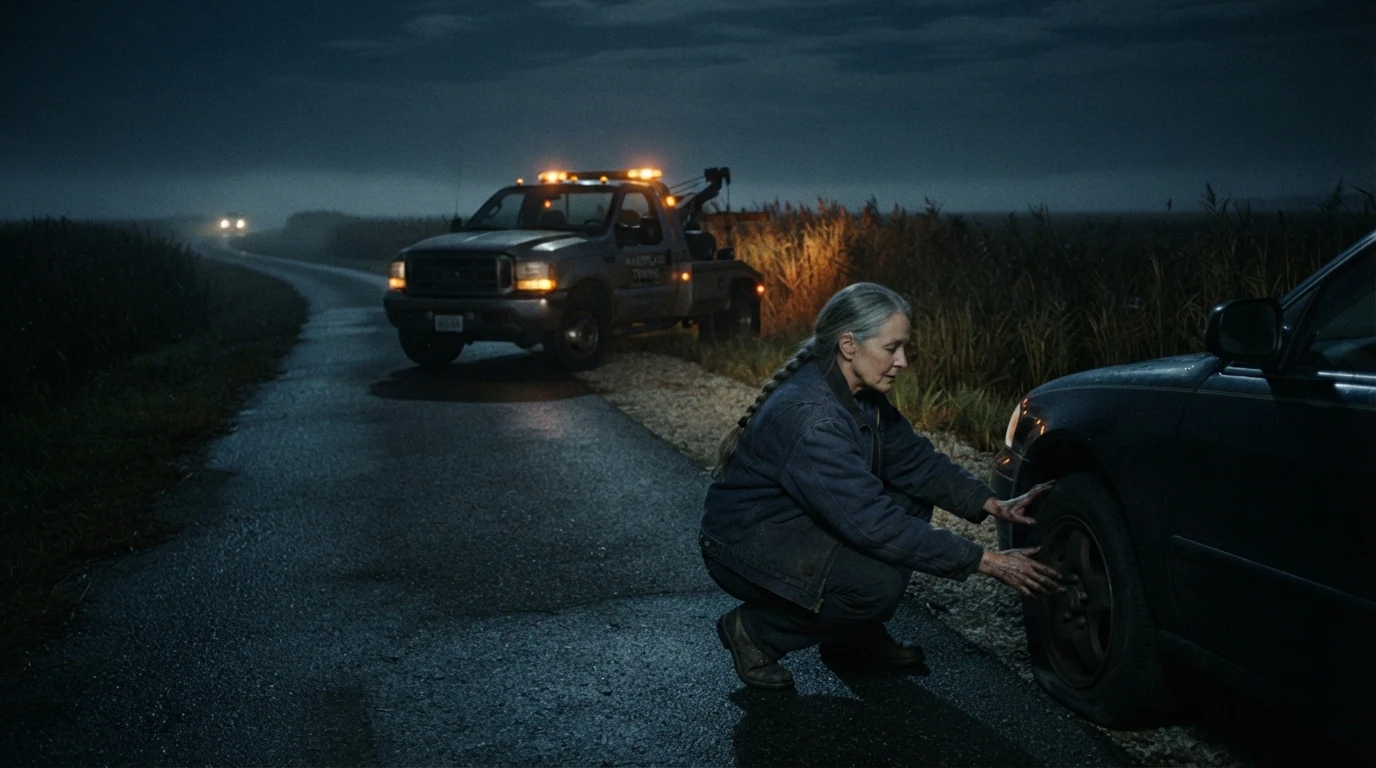
The prompt keeps the spec's order: truck, then Margo, then headlights far down the road behind her, which builds the foreground-to-background reveal. Long gray braid and grease-black knuckles make her a character, not a stock figure.
Open FlashBoardsExtreme close-up film still, 85mm lens, shallow depth of field. A weathered thumb with grease-black knuckles beside a clean, straight knife slit in a black truck tire. Orange hazard light across the rubber. Out-of-focus wet night road and two small headlight glows behind. Anamorphic widescreen, high contrast.
This is the shot implied by A clean slit. Knife-straight. Extreme close-up and 85mm make it an insert; the blurred headlights keep the threat in frame. If your line can't become a prompt this precise, the reader won't picture it either.
Open FlashBoardsCamera: slow, steady push in toward the crouching woman at eye level, about half a meter over the shot. Action: the orange hazard lights are already pulsing on the reeds and mist drifts over the marsh. She runs her thumb along the tire, then stops and holds still. At the end, far down the road behind her, the white headlights switch off.Pulsing hazards and drifting mist make the shot alive from the first frame. The action follows the spec beat by beat and uses only what is already in the start frame.
Open FlashBoardsCommon mistakes
- A spec paragraph pasted as-is gives a generic scene; list the visible elements in the order the line reveals them.
- Background details drift; say far down the road behind her to keep a reveal in depth.
- Details slide to medium shots unless you state extreme close-up and a long lens.
Keep the reference frames, prompts and every generated take side by side — images and video in one canvas.
FAQ
5 questionsWhat is a spec script?
A screenplay written without a contract or payment, on the writer's own initiative. The writer hopes to sell or option it, or uses it as a writing sample to find representation and assignments. It follows standard format and leaves out scene numbers and camera directions so it reads quickly.
What is the difference between a spec script and a shooting script?
A spec script is written for buyers, agents and contest readers, so it stays clean. A shooting script is the production version: scenes numbered and locked, revisions on colored pages, camera directions often added. A spec becomes a shooting script only once the project heads into production.
Should a spec script include camera directions?
Generally no. CLOSE ON, PAN or DOLLY IN tell the director and DP how to do their job and slow the reader down. Imply the shot instead: give a detail its own line to suggest an insert, and order each paragraph the way the audience should discover it.
How long should a spec script be?
Most feature specs run about 90–115 pages; few readers welcome anything past 120. A one-hour TV pilot is typically 50–65 pages and a half-hour comedy about 25–35. Length signals discipline, so trimming a bloated draft usually helps.
Do spec scripts ever sell?
Yes, though most don't. Good Will Hunting and True Romance started as scripts nobody hired their writers to write. Even an unsold spec does its job if it lands the writer an agent, a manager or a paid rewrite.
Related terms
5- Shooting ScriptScreenwriting
A shooting script is the production version of a screenplay: scenes are numbered, locked and often annotated with shots, so it can drive the schedule, the shot list and the storyboard.
- ScreenplayScreenwriting
A screenplay is the written blueprint of a film in a fixed format — scene headings, action lines, character names, dialogue and transitions — where one page roughly equals one minute of screen time.
- LoglineScreenwriting
A logline sums up a film in one or two sentences: the protagonist, their goal, the obstacle and what's at stake — the hook that sells the script and, today, the seed for an AI storyboard.
- ScreenwriterScreenwriting
A screenwriter writes the screenplay — story, structure, scenes and dialogue in screenplay format — either on spec or on assignment, and often through many rewrites before and during production.
- Development HellFilmmaking Process & Crew
Development hell is the limbo in which a film project stays in development for years — rewritten, recast and reshuffled between directors and executives — without getting a greenlight to shoot.
Further reading
- Syd Field, Screenplay: The Foundations of Screenwriting
- David Trottier, The Screenwriter's Bible