 FlashBoards Learn
- Learn
- Screenwriting
- Screenplay
Screenwriting · Film language
Screenplay
Also called: script, screenplay format, film script
A screenplay is the written blueprint of a film, set in a fixed format: scene headings, action lines, character names, dialogue and transitions in 12-point Courier. The format exists for timing and production — one page runs about a minute on screen, so every department can read, schedule and budget the film from the same pages.
- What it does
- Turns a story into scenes, actions and lines that every department can read, time and schedule.
- Use it when
- Writing any film meant to be made or sold, from a short to a feature.
- Watch out
- Camera directions, thoughts nobody can film, and dense paragraphs slow the read and break the page-per-minute rule.
- Try this prompt
Cinematic film still, night rain, a lone gas pump under a tin canopy, a silver-braided woman in her sixties fills a red pickup
What is a screenplay?
A screenplay is the document a film is made from. It tells the story only through what an audience will see and hear: places, actions, sounds and spoken words, written in present tense. It does not describe what a character thinks unless the thought shows on a face or comes out in a line, and it leaves most shot choices to the director. That constraint is the heart of screenwriting: if it can't be filmed or recorded, it doesn't belong on the page.
The same pages are read by very different people: a producer for story and budget, an actor for the part, the first assistant director for the schedule, the cinematographer and production designer for locations, light and time of day. The fixed format lets all of them find what they need in seconds.
A feature screenplay usually runs about 90 to 120 pages. An hour of television is shorter, and half-hour comedies follow their own conventions, which the TV script format guide covers. In everyday talk script and screenplay mean the same thing; strictly, script is the broader word (plays, commercials, TV) and screenplay is the one for film. The person who writes it is the screenwriter.
What are the elements of screenplay format?
Here is a short original page, written the way it would appear in screenwriting software. The indents are lost in this quote, but the order and the capitals are exactly what a reader expects:
EXT. HIGHWAY REST STOP - NIGHTRain drums on a tin canopy over a single gas pump. ODA VENN (60s, silver braid, a mechanic's jacket two sizes too big) fills a dented red pickup and watches the empty road.
Headlights sweep across her face. A white van rolls in and stops two pumps down. Its engine keeps running.
ODA/(not looking up)/Pump's broken, if you're asking.
DRIVER (O.S.)/I'm not.
CUT TO:Every line on that page is one of a small set of elements:
- Scene heading.
INT.orEXT., the location and the time of day, in capitals. It opens each scene and is what production uses to group scenes by place and time. See how to write a scene heading. - Action. The description under the heading: what we see and hear, in present tense, in short paragraphs. A character's name is in capitals the first time they appear, with a few words of description. The craft of writing it is covered in scene description.
- Character cue. The speaker's name in capitals, indented toward the center, above every speech.
- Dialogue. The spoken words, in a narrower column under the cue. What makes lines work is its own subject: writing dialogue.
- Parenthetical. A short note in brackets under the cue — (not looking up), (to Mara) — for delivery or addressee. Use a parenthetical only when the line would be misread without it.
- Extensions. Tags after the cue:
(V.O.)for voice-over,(O.S.)or(O.C.)when the speaker is off screen but present in the scene,(CONT'D)when the same character keeps talking after an action line. - Transitions.
CUT TO:,DISSOLVE TO:,MATCH CUT TO:, right-aligned;FADE IN:opens the script andFADE OUT.ends it. Modern spec scripts use them sparingly — see screenplay transitions. - Shots and subheadings.
INSERT,CLOSE ON,BACK TO SCENE,INTERCUT,MONTAGE,SERIES OF SHOTS. For phone calls, cross-cutting and time compression; rare in a spec script.
How to format a screenplay: font, margins and page layout
The numbers below are the common US industry standard. Screenwriting software (Final Draft, Fade In, WriterDuet, Highland, or any editor that reads plain-text Fountain markup) sets them automatically, but know what a correct page looks like.
- Paper and font. US Letter (8.5 × 11 in), 12-point Courier or a close cousin such as Courier Prime. A monospaced font puts ten characters in every inch, which is what keeps the page-per-minute estimate stable.
- Page margins. About 1.5 in on the left (room for binding brads), about 1 in on the right, top and bottom.
- Element positions, measured from the left edge of the paper: action at 1.5 in; dialogue at about 2.5 in, in a column roughly 3.5 in wide; parentheticals at about 3.1 in; character cues at about 3.7 in; transitions right-aligned to the right margin.
- Spacing. Single-spaced inside an element, one blank line between elements, and one blank line before each new scene heading. Never leave a scene heading alone at the bottom of a page.
- Page numbers. Top right, followed by a period. The first page of the script is not numbered.
- Title page. Title centered in capitals, Written by and the writer's name below it, contact details in the lower left. No art, no quotes, no cast wish lists.
- What to leave out of a draft for readers. Scene numbers, revision colors and
(CONTINUED)marks belong to the shooting script, not to the draft you send out.
One habit makes a page read faster than any margin setting: keep action paragraphs to one to four lines. A paragraph break tells the reader's eye that a new image has started.
Why does one page equal one minute?
Because the format fixes everything that could change density — font, margins, column widths, spacing — a page of screenplay holds a fairly constant amount of story, and on average that plays in about a minute. It is an average, not a law. A page of rapid-fire dialogue can be over in forty seconds; a single line like they fight their way across the bridge can take three minutes of screen time and a week of shooting.
Production still relies on the estimate. In a script breakdown, each scene is measured in eighths of a page, and the schedule adds up eighths per shooting day. Two lines of action that really need a stunt team are a scheduling trap, so experienced writers let page length reflect the size of the moment.
For a cinematographer this is the useful part of the format. Short action paragraphs often read like an unnumbered shot list. In the sample page, Headlights sweep across her face is already a close-up with a moving light source, and stops two pumps down sets the geography for a wide shot. A screenplay without a single camera direction can still tell the director and DP where the images are.
Screenplay examples worth studying by genre
The fastest way to learn the format is to read produced screenplays next to the films: read one scene, watch it, then compare what the page specified with what the director added.
Crime and drama
The Godfather (1972), screenplay by Mario Puzo and Francis Ford Coppola from Puzo's novel, opens with a long wedding that has to introduce a large family without confusing anyone. It is a model for keeping an ensemble readable: who enters, who speaks, and whose point of view the scene follows.
Thriller
No Country for Old Men (2007), written for the screen by Joel and Ethan Coen from Cormac McCarthy's novel, carries long stretches with almost no dialogue. Study how the tension lives in the action lines — short, concrete, present-tense sentences that tell the reader exactly what the camera would hold on.
Comedy
The Royal Tenenbaums (2001), by Wes Anderson and Owen Wilson, is built as chapters with a narrator. It shows voice-over and chapter titles working as structure, and how a comic tone can live in precise, deadpan description.
Romance and adaptation
Brokeback Mountain (2005), by Larry McMurtry and Diana Ossana from Annie Proulx's short story, expands a few pages of prose into a feature. It shows what a screenplay adds — scenes, silences, years passing — to a short source. Harry Potter and the Sorcerer's Stone (2001), by Steve Kloves, faces the opposite problem: compressing a long novel and describing magic in action lines without writing a visual-effects manual.
Stage to screen
Comparing the play text of Hamlet with Kenneth Branagh's Hamlet (1996), which kept the full text, shows how a camera changes the way the same words land.
Where the format came from
Early films such as A Trip to the Moon (1902) and The Great Train Robbery (1903) were planned as short sequences of scenes rather than written as screenplays in today's sense. As films grew longer and studios began shooting out of order, planning documents grew into detailed scene-by-scene scripts, and the page layout used today settled into the standard the whole industry reads.
Screenplay vs. treatment vs. shooting script
These three documents describe the same film at different stages.
- Film treatment. Prose, usually a few pages to a few dozen, telling the whole story scene by scene in present tense, with little or no dialogue. It sells or tests the story before the screenplay exists.
- Screenplay. The full film in screenplay format: every scene, every line of dialogue. A screenplay written on the writer's own initiative to sell is a spec script, and it stays clean — few camera directions, no scene numbers.
- Shooting script. The production version of the screenplay: scenes numbered and locked, changes tracked on colored revision pages, and often shot notes added by the director. It drives the schedule, the shot list and the storyboard.
The usual order runs from a logline to a script outline, a treatment, several screenplay drafts, and finally the shooting script.
From screenplay page to storyboard
Once a scene is on the page, the next question is what it looks like. In FlashBoards, paste the scene as a note on the film's board, split the action into its paragraphs, and generate one frame per paragraph next to the text that produced it. The scene heading gives you place and time of day, the character introduction gives you a consistent description to reuse in every prompt, and each paragraph break gives you a new panel. Rewrites stay on the same board, so you can see whether a new draft still reads as images.
That becomes the first pass of a storyboard and a test of the writing: a paragraph that can't become a frame usually describes a thought, not an action. The recipes below take the rest-stop page through that process.
How to create a screenplay with AI
3 promptsAn image model can't read screenplay format, but it can read what the format encodes: the scene heading sets place and light, the character introduction sets the person, and each action paragraph is one image. Nano Banana 2 Lite turns the first paragraph of the sample page into a start frame, GPT Image 2.5 lays the whole page out as storyboard panels, and MiniMax H3 Max Turbo plays the action lines as a shot. Keep the page and every take side by side on one FlashBoards board.
Cinematic film still, night, heavy rain. A small highway rest stop with a single gas pump under a corrugated tin canopy lit by one buzzing fluorescent tube. Medium wide shot, 35mm lens, eye level. A woman in her sixties with a long silver braid, deep laugh lines and an oversized olive mechanic's jacket fills a dented red pickup truck, her face turned toward a dark empty two-lane road on the right of frame. Rain streaks through the light, wet asphalt reflecting cold green-white light, deep black surroundings, film grain, muted colors.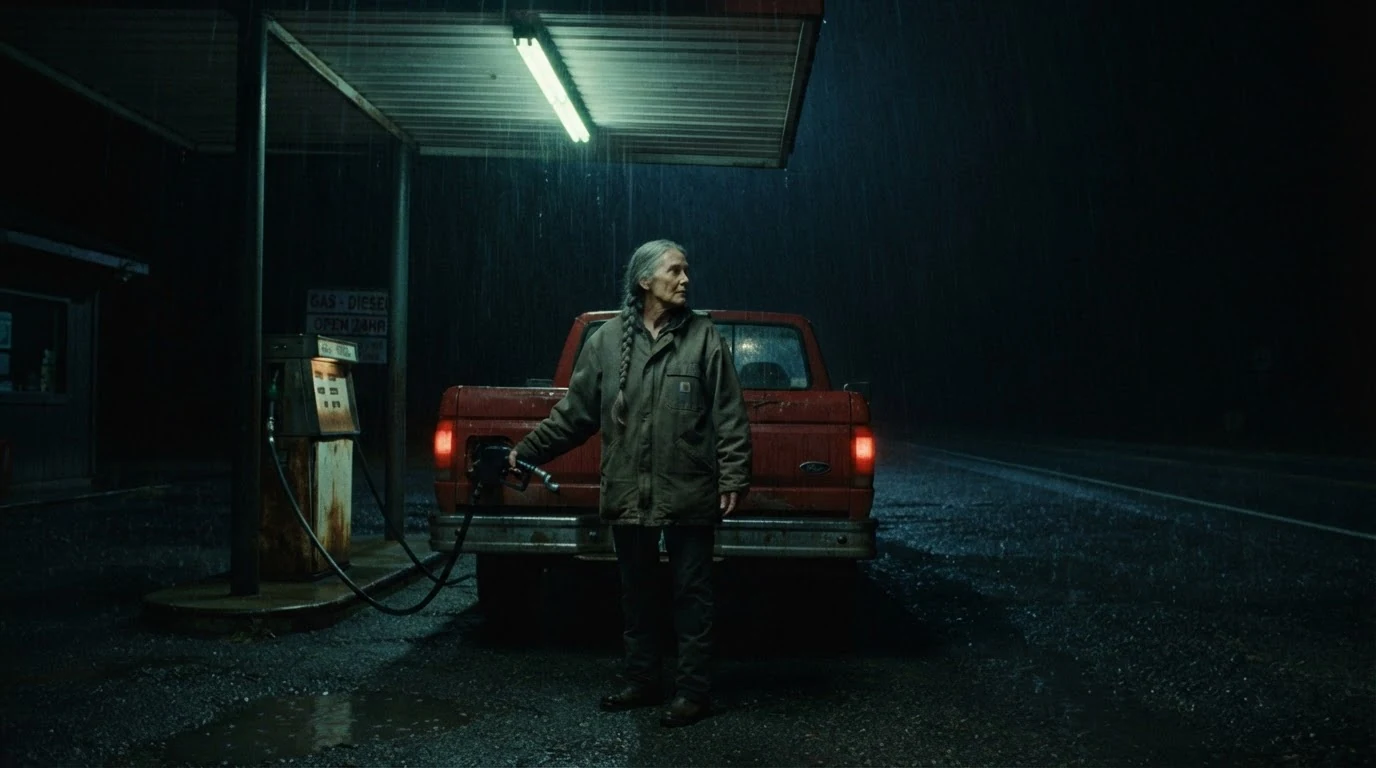
The prompt is the page translated line by line: EXT. ... NIGHT becomes night, heavy rain, the location becomes the tin canopy and single pump, and Oda's introduction — age, silver braid, oversized mechanic's jacket — becomes a person the model can repeat later. Turning her face toward the empty road on the right leaves room in frame for the van that arrives in the next paragraph.
Open FlashBoardsStoryboard sheet, four panels in a 2x2 grid with thin black borders, loose pencil and gray marker style with one color accent, the red pickup truck. The same woman in every panel: sixties, long silver braid, oversized mechanic's jacket. Panel 1: wide shot, a lone gas pump under a tin canopy at night in heavy rain, the woman filling a red pickup. Panel 2: close-up, headlights sweep across her face, rain on her cheek. Panel 3: wide shot from behind the pump, a white van pulls in and stops two pumps away, exhaust rising from it. Panel 4: medium close-up, she keeps her eyes on the pump nozzle, mouth slightly open as she speaks.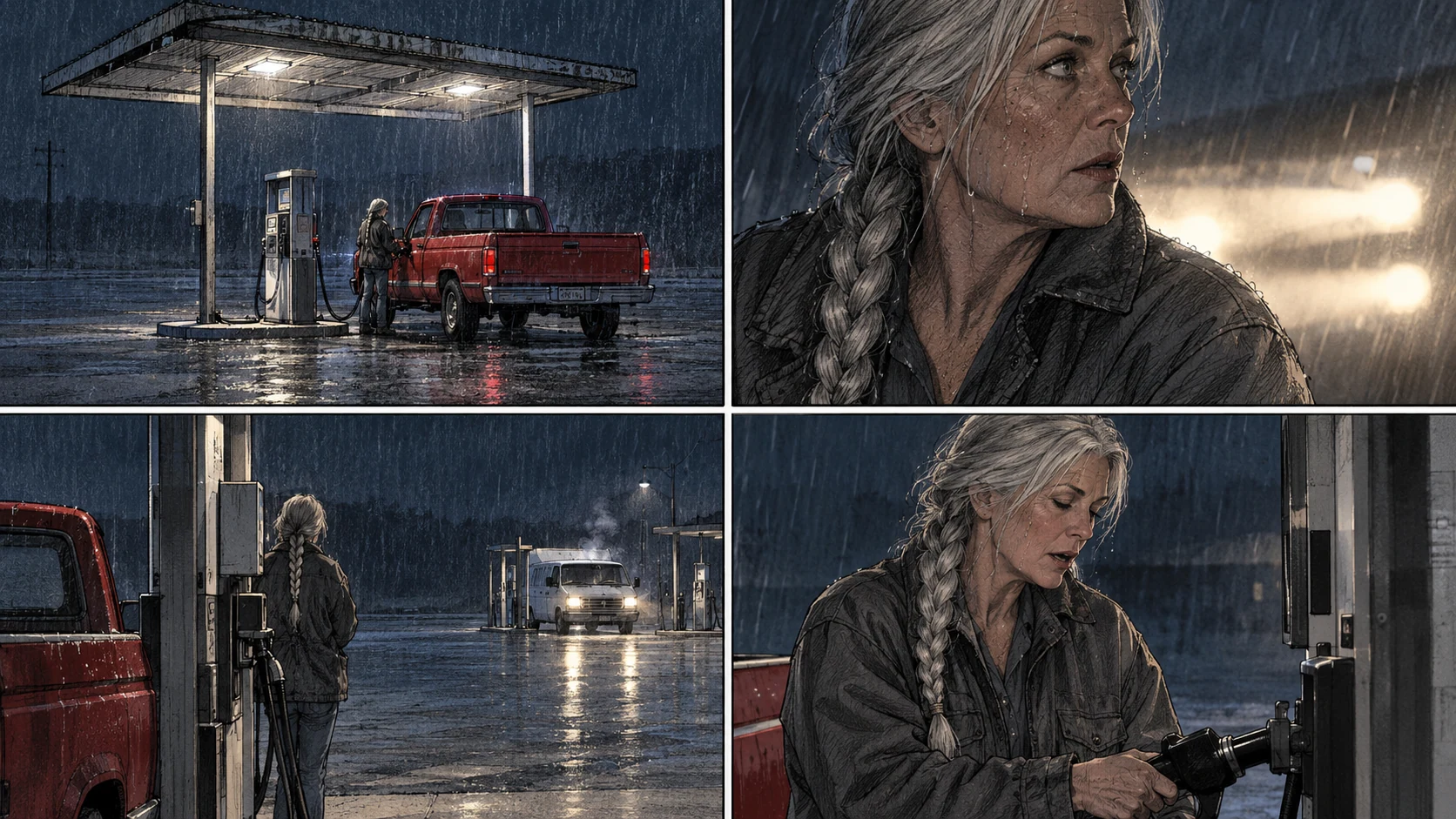
Storyboard sheet and 2x2 grid produce a planning document instead of one picture, and the four panels follow the four beats of the page: establishing the place, the headlights, the van's arrival, her line. Repeating her description and keeping the red truck as the one color accent holds continuity across panels.
Open FlashBoardsCamera: locked-off tripod shot at eye level, holding the frame for the whole shot. Action: rain is already falling hard through the fluorescent light and the fuel nozzle hums in the woman's hand. Bright headlights sweep in from the right edge of frame and slide across her face; she squints but keeps filling the truck. In the middle, a white van rolls into frame from the right and stops two pumps away, its exhaust rising in the cold air. At the end she glances at the van once, then looks back down at the pump.Rain and the humming nozzle in the first sentence make the shot alive from the first frame. The action follows the page's paragraphs in order, and the van rolls into frame from the right, which tells the model where the new element comes from.
Open FlashBoardsCommon mistakes
- Pasting screenplay text as the prompt. Capitals,
EXT.and character cues get rendered as lettering or ignored. Rewrite the heading as light and place, and the introduction as a physical description. - Dialogue in the prompt. Quoted lines invite speech bubbles and captions. Describe the visible act instead: mouth slightly open as she speaks.
- The character changes between frames. Reuse the same three or four features from the character's introduction in every prompt, word for word.
- Adding what the page doesn't say. Models fill empty space with invented signs, cars and people. Name what is in the frame — dark empty road, deep black surroundings — so there is nothing left to invent.
- A still-looking video. Start the video prompt with motion that is already happening, and follow the action paragraphs in order rather than summarizing the scene.
Keep the reference frames, prompts and every generated take side by side — images and video in one canvas.
FAQ
5 questionsHow do you format a screenplay?
Use 12-point Courier on US Letter paper with a 1.5-inch left margin and 1-inch margins elsewhere. Start each scene with a capitalized scene heading (INT. or EXT., location, time of day), follow it with present-tense action, and set dialogue under a centered character name in capitals. Add parentheticals and transitions only when needed. Screenwriting software applies all of these settings automatically.
How many pages is a screenplay?
A feature screenplay usually runs about 90 to 120 pages, since one page plays for roughly one minute. Comedies and horror films often sit near the lower end, while epics and dramas can run longer. Scripts for television are shorter and follow their own conventions. For a first spec script, staying under about 110 pages makes readers more willing to start it.
What is the difference between a script and a screenplay?
In everyday use the words are interchangeable. Strictly, a script is any written text for a performance, including stage plays, commercials and television episodes, while a screenplay is a script written for a film in screenplay format. A shooting script is a later production version of the screenplay, with scene numbers and revisions.
Where can I find screenplay examples to read?
Studios often publish their screenplays online during awards season, and many classic screenplays are available as books. Read a produced screenplay alongside the film, one scene at a time, and compare what the page describes with what ended up on screen. Pick examples in the genre you are writing, because pacing and page density vary a lot between genres.
Can you include camera directions in a screenplay?
You can, but in a spec script they should be rare. Directions like CLOSE ON or ANGLE ON slow the read and step into the director's job. Most writers suggest shots through how they write action: a short paragraph about one detail reads as a close-up without saying so. Camera notes are more common in a shooting script or when the writer is also directing.
Related terms
8- Film TreatmentScreenwriting
A treatment is a prose document, usually 2–10 pages written in present tense, that tells the whole story of a planned film scene by scene and conveys its tone before the screenplay is written.
- Shooting ScriptScreenwriting
A shooting script is the production version of a screenplay: scenes are numbered, locked and often annotated with shots, so it can drive the schedule, the shot list and the storyboard.
- Scene HeadingScreenwriting
A scene heading, or slugline, opens every scene in capitals: INT. or EXT., the location and the time of day — the line that production breaks down and a storyboard starts from.
- Scene DescriptionScreenwriting
Scene description, or action lines, is the prose under a scene heading that tells what we see and hear, in present tense and in short visual paragraphs that read like shots.
- ParentheticalScreenwriting
A parenthetical is a brief note in brackets under a character's name that tells how a line is said or to whom, used sparingly so it doesn't direct the actor.
- Spec ScriptScreenwriting
A spec script is a screenplay written without a contract, on the writer's own initiative, to be sold or used as a writing sample; it avoids camera directions and reads as cleanly as possible.
- ScreenwriterScreenwriting
A screenwriter writes the screenplay — story, structure, scenes and dialogue in screenplay format — either on spec or on assignment, and often through many rewrites before and during production.
- ScreenwritingScreenwriting
Screenwriting is the craft of writing a film or series for the screen: turning an idea into structure, scenes and dialogue that can be shot, where everything the audience learns must be seen or heard.
Further reading
Syd Field, Screenplay: The Foundations of Screenwriting (1979). David Trottier, The Screenwriter's Bible. Christopher Riley, The Hollywood Standard.