 FlashBoards Learn
- Learn
- Screenwriting
- Shooting Script
Screenwriting · Film language
Shooting Script
Also called: production script, locked script
A shooting script is the production version of a screenplay: every scene is numbered, the pages are locked, and changes arrive as colored revision pages. It is the edition the whole crew works from, and it drives the breakdown, schedule, shot list and storyboard, so everyone means the same thing by scene 27.
- What it does
- Turns a finished screenplay into a fixed reference that every department, schedule and slate can point to by number.
- Use it when
- Prep starts: the draft is approved and people begin breaking it down, budgeting and planning shots.
- Watch out
- Never renumber scenes or pages after lock; add 12A, mark OMITTED and issue colored revisions instead.
- Try this prompt
Wide film still, 24mm, night diner booth, woman with shaved head and burgundy work jacket facing a young man in a yellow raincoat, rain on the window, neon light
What is a shooting script?
A shooting script, also called a production script or, once frozen, a locked script, is the draft of a screenplay that a production actually films. The words may barely differ from the writer's last draft; what changes is the job. It stops being something to read and becomes a reference system: the first AD breaks it down, the director and DP plan coverage from it, the script supervisor tracks it on set, and footage reaches the editor labeled with its scene numbers.
In screenwriting the writer delivers the draft; the production office, often a script coordinator, numbers the scenes, locks the pages and issues revisions. Some directors also call their marked-up personal copy "the shooting script", and published script books use the term for the version as filmed.
Shooting script vs. screenplay: what changes?
| | Spec or draft screenplay | Shooting script | |---|---|---| | Scene numbers | None | In both margins, fixed | | Camera directions | Kept to a minimum | Allowed; inserts and angles often added | | Page numbers | Reflow freely | Locked; new pages become 31A, 31B | | Changes | New draft | Colored revision pages, asterisks in the margin | | Page header | Title page only | Revision color and date on every changed page | | Reader | Agents, producers, cast | Every department on the crew |
The contrast is sharpest with a spec script, written for someone deciding whether to buy it: no scene numbers, few camera directions, nothing that interrupts the read. A shooting script reverses the priority: stable addresses for a whole crew matter more than a smooth read.
What goes into a shooting script?
- Scene numbers. Each scene heading gets a number in both margins, tying the scene to the breakdown, call sheet, slate and edit.
- Locked pages. After lock, page breaks never move. Overflow goes onto an A-page (31A), a new scene between 12 and 13 becomes 12A, and a cut scene stays as OMITTED so later numbers don't shift.
- Revision pages. Changes go out as colored revision pages: a common sequence runs white, blue, pink, yellow, green, goldenrod, with an asterisk beside each changed line and the color and date in the header.
- CONTINUEDs. (CONTINUED) and CONTINUED: mark a scene that breaks across pages.
- Shot callouts (optional). INSERT, ANGLE ON, CLOSE ON appear more often than in a spec, especially when the writer directs.
Shooting script example
A page from a fictional film after one round of revisions:
```text BLUE REVISION - 03/14 31.
26A OMITTED 26A
27 INT. HARBOR DINER - NIGHT 27
Rain sheets down the front window. MARA (40s, shaved head, silver hoop in one ear, burgundy work jacket) slides into a booth across from TEO (early 20s, curly red hair, yellow raincoat).
INSERT - THE TABLE
A brown envelope, soaked at one corner. *
MARA You opened it. ```
The header marks a blue page from March 14. The asterisk flags the envelope line as new. Scene 26A was added earlier and later cut, so it survives as OMITTED and 27 stays where every department has it.
How does a draft become a shooting script?
- Lock the draft. The approved version goes out on dated white pages.
- Number the scenes. Screenwriting software numbers scenes, locks pages and turns on revision marks in a few commands.
- Break it down. The first AD runs a script breakdown, measuring scenes in eighths of a page and tagging cast, props and locations for the schedule.
- Plan the shots. The director and DP turn each scene into setups, 27A, 27B, 27C, in the shot list and storyboard. The scene number prefixes every slate.
- Revise in color. Later changes are revision pages, never a renumbered draft.
In FlashBoards this maps onto one board: a cluster per scene number holding the script excerpt, reference frames and panels 27A–27D. When blue pages change scene 27, you update that cluster only.
How to create a shooting script with AI
3 promptsA shooting script already speaks in shots: the scene heading gives place and light, the character notes give faces, the callouts give framing. Here Nano Banana 2 Lite makes setup 27A from the example, GPT Image 2.5 lays scene 27 out as numbered panels, and MiniMax H3 Max Turbo plays 27A as a shot. Keep the page and every take on one FlashBoards board.
Wide film still, 24mm lens, seated eye height, a narrow night diner. A booth by a rain-streaked window: left, a woman in her forties with a shaved head, silver hoop earring and burgundy work jacket; right, a young man with curly red hair, freckles and a wet yellow raincoat. A brown envelope on the table between them. Red neon on the wet glass, warm tungsten lamps, empty counter stools in the foreground, film grain.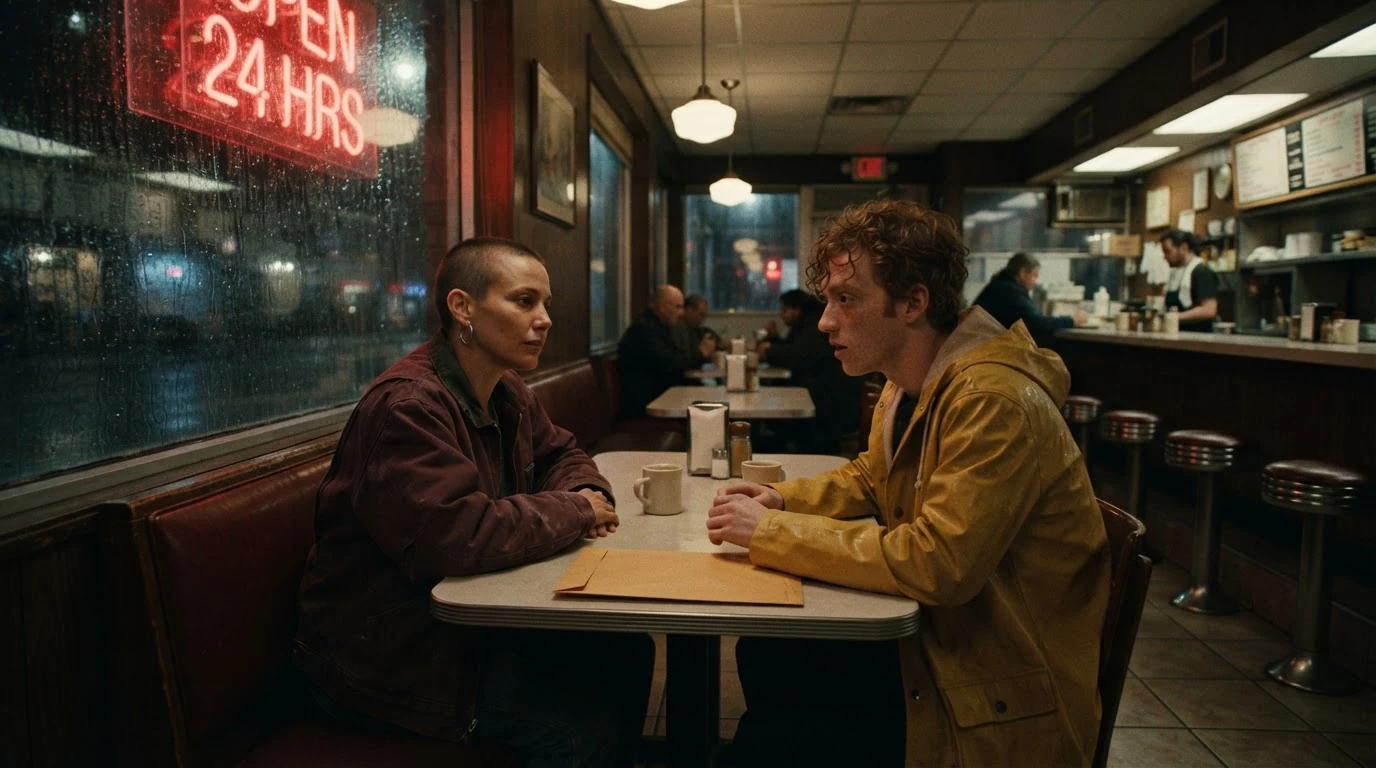
The slugline becomes night diner, rain-streaked window and neon; the character notes become specific faces. 24mm and stools in the foreground make it the wide master that 27A usually is.
Open FlashBoardsStoryboard sheet, four panels in a 2x2 grid, pencil and gray marker, corner labels 27A, 27B, 27C, 27D. Same two characters throughout: a woman in her forties with a shaved head, silver hoop earring and burgundy work jacket, the only color accent; a young man with curly red hair and a yellow raincoat. 27A: wide shot of a diner booth by a rainy window. 27B: over her shoulder onto him. 27C: top-down insert of a soaked brown envelope. 27D: close-up of the woman.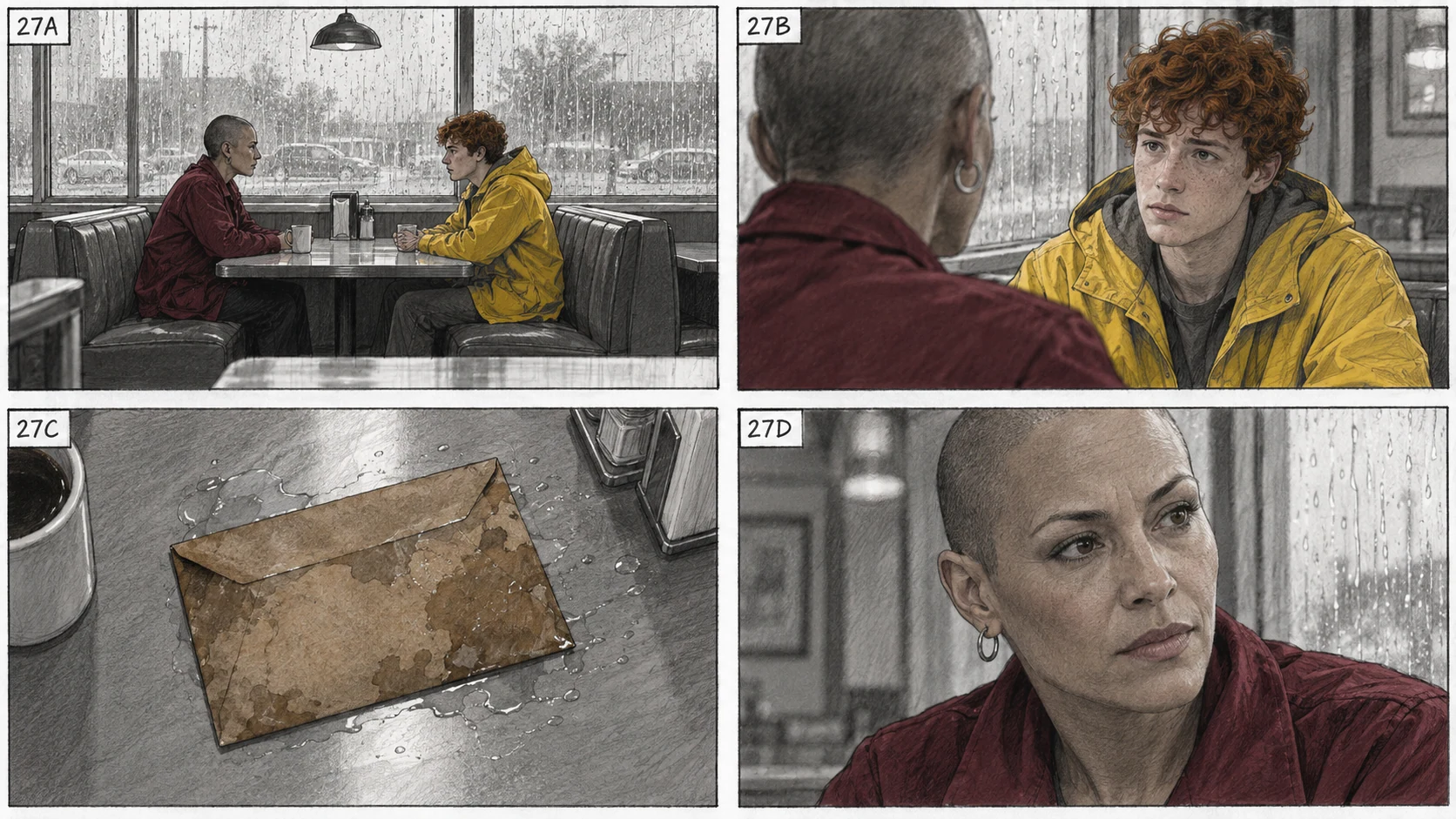
Labels 27A–27D copy the script's numbering, so the sheet slots into a shot list. Repeating the characters' features keeps them consistent.
Open FlashBoardsCamera: slow dolly forward along the counter toward the booth, eye level, moving about one meter over the shot. Action: rain is already running down the window and the neon flickers on the wet glass. The woman slides the brown envelope across the table toward the young man. He looks down at it, then up at her. At the end she leans back against the booth and folds her arms.Running rain and flickering neon keep the shot alive from frame one; the action uses only what the start frame holds.
Open FlashBoardsCommon mistakes
- Pasting the script page as a prompt. Sluglines and asterisks get drawn as text; translate into place, light, people, framing.
- Garbled panel labels. Keep them short (27A, 27B).
- Faces drift between setups. Repeat age, hair and wardrobe in every prompt.
- A frozen video. Open with motion already happening and keep to one beat.
Keep the reference frames, prompts and every generated take side by side — images and video in one canvas.
FAQ
5 questionsWhat is the difference between a shooting script and a screenplay?
A screenplay is the story in script format. A shooting script is the same screenplay prepared for production: scenes numbered, pages locked, changes issued as colored revision pages with asterisks, sometimes with shot callouts. The screenplay is written to be read; the shooting script lets every department reference the same scene and page.
Who writes the shooting script?
The screenwriter writes the words, often with rewrites requested by the director and producers. The production office, typically a script coordinator, turns the approved draft into a shooting script by numbering scenes, locking pages and distributing revisions.
Does a spec script have scene numbers?
No. Scene numbers are added only when a film goes into production. A spec script is read by agents, producers and contest judges, so it stays clean, without numbers, revision marks or heavy camera directions. Numbering a spec is a common amateur tell.
What does a locked script mean?
A locked script is a shooting script whose scene numbers and page breaks are frozen. After lock, a new scene gets a letter (12A), a cut scene stays as OMITTED, and overflowing text goes onto an A-page. This keeps the schedule, call sheets and slates valid while the text itself keeps changing through colored revisions.
Where can I find a shooting script example?
Published script books often print a film's shooting script with scene numbers intact, and studios release many scripts during awards season. Look for numbers in both margins, revision headers and OMITTED scenes, then compare with an earlier draft of the same film.
Related terms
5- Spec ScriptScreenwriting
A spec script is a screenplay written without a contract, on the writer's own initiative, to be sold or used as a writing sample; it avoids camera directions and reads as cleanly as possible.
- ScreenplayScreenwriting
A screenplay is the written blueprint of a film in a fixed format — scene headings, action lines, character names, dialogue and transitions — where one page roughly equals one minute of screen time.
- Shot ListFilmmaking Process & Crew
A shot list is a scene-by-scene table of every planned setup — shot size, angle, movement, lens, action and notes — that tells the crew exactly what to capture and in what order on the day.
- StoryboardFilmmaking Process & Crew
A storyboard is a sequence of drawn or generated panels, one per planned shot, showing framing, action and camera movement with notes — a visual draft of the film before anything is shot.
- Script BreakdownFilmmaking Process & Crew
A script breakdown goes through the screenplay scene by scene and tags every production element — cast, extras, props, wardrobe, vehicles, effects, locations — so it can be budgeted and scheduled.
Further reading
Christopher Riley, The Hollywood Standard. David Trottier, The Screenwriter's Bible.