 FlashBoards Learn
- Learn
- Filmmaking Process & Crew
- Lookbook
Filmmaking Process & Crew · Film language
Lookbook
Also called: film lookbook, director's lookbook, visual treatment, pitch deck
A film lookbook is a short, curated document of reference images, key frames, color palettes and a few lines of text that shows how one specific film will look and feel. Directors use it to pitch the project to producers and financiers, and to align the DP, production designer and costume designer on a single visual plan.
- What it does
- Turns a director's private picture of the film into pages that a producer, a financier or a head of department can see and react to.
- Use it when
- Pitching a project, hiring a DP or designer, or locking the look in pre-production before tests and storyboards.
- Watch out
- Forty borrowed stills from ten famous films read as a collage of other movies, not a plan for yours.
- Try this prompt
Lookbook key frame, 2.39:1 film still, a ferry deckhand in an orange oilskin jacket on a wet steel deck at night, sodium lights, sleet, teal shadows, 35mm grain
What is a film lookbook?
A lookbook answers one question before a single frame is shot: what will this movie look like? It is usually a PDF or slide deck of 10 to 30 pages built from reference stills, photographs, paintings, color swatches, location scouts and, more and more, generated key frames, each page with a sentence or two explaining the choice.
It sits in the filmmaking process between the script and the shoot. The film treatment tells the story in prose; the lookbook shows its surface: light, color, texture, framing, faces, places. People call it a director's lookbook, a visual treatment or, when it is attached to a financing pitch, part of the pitch deck. The names overlap, but the job stays the same: make a look that exists only in the director's head concrete enough to discuss, approve and budget.
A good lookbook is specific to one film. It does not say "moody and cinematic"; it says "night exteriors lit only by practical sodium lamps, faces half in shadow, one red object per scene" and puts three pictures next to that sentence.
Why directors make a lookbook
A lookbook has two audiences, and it usually exists in two versions.
The pitch version goes to producers, financiers, funds, studios and cast. It sells confidence. A reader who has not finished the script can flip through 15 pages and understand the genre, the scale and the tone, and see that the director knows exactly what film they are making. Paired with a TV pitch or a feature pitch meeting, it often decides whether the script gets read at all. For a first feature, a lookbook plus a proof of concept film is often the strongest package a director can bring.
The working version goes to the crew in pre-production. The cinematographer, the production designer, the costume designer and the colorist read the same pages, so when the director says "cold," everyone pictures the same cold. It prevents the most expensive kind of misunderstanding: departments each doing good work in different directions. It also becomes a reference on set when a decision comes up fast: which lamp, which wall color, how dark is too dark.
Looks that audiences recognize instantly are exactly the kind of thing a lookbook exists to pin down: the saturated primaries of La La Land (2016), the symmetrical pastel storybook worlds of Wes Anderson, the hard neon night of Drive (2011), the lurid reds and blues of Suspiria (1977), the bleached, dusty West Texas of No Country for Old Men (2007), the gray New England winter of Manchester by the Sea (2016). Each can be summed up in a handful of rules and a handful of pictures, which is exactly what a lookbook page does.
What goes in a director's lookbook
There is no official format, but most feature lookbooks cover the same ground in roughly this order:
- Title page and logline. One strong key image, the title, one sentence of story. The image should already be in the look.
- Tone statement. Three to six sentences from the director on what the film should feel like and why. Written, not bulleted.
- Visual rules. The core of the book: 4 to 8 rules, each with 2 to 4 images. For example: "Handheld only when the protagonist loses control"; "Interiors warm, exteriors cold"; "We never see the sky in the first act."
- Color. The color palette as swatches plus frames, including what colors are banned and where the one accent color appears.
- Camera and format. Aspect ratio, lens family, camera movement, contrast and grain. Keep it to what changes the image; the gear list belongs to the DP's own prep.
- Characters. A face and wardrobe reference for each lead, with notes for costume design: silhouette, material, how the look changes across the story.
- Locations and worlds. Scout photos or references for each main setting, with the light it should have and the time of day.
- Key scenes. Two to five set pieces imagined as frames, often in sequence. This is where a lookbook starts to overlap with the storyboard.
- Comparable titles. Optional in a pitch version: two or three films the project sits near in tone or audience.
Length follows the reader. A pitch lookbook for a busy executive works at 10 to 15 pages; a working lookbook for heads of department can run 30 or more, with a section per department.
How to make a film lookbook, step by step
1. Start wide with a mood board. Collect everything that feels right without judging it: stills, photos, paintings, textures, album covers, your own phone pictures. A mood board is the raw pile; the lookbook is what survives the edit.
2. Find the rules in the pile. Lay the images side by side and look for what repeats: the same color temperature, the same distance from faces, the same kind of darkness. Write each pattern down as one sentence. Those sentences become your visual rules.
3. Cut hard. Keep 2 to 4 images per rule. Drop anything that fits the mood but breaks a rule, and drop images that only look good because they are famous. A single film should never dominate the book; if half the pages come from one movie, the reader sees that movie, not yours.
4. Replace references with your own frames. Borrowed stills show the direction; frames made for your project show the film itself. Location scouts, costume tests, camera tests and generated key frames with your characters in your places all count. The closer the book gets to looking like your film, the stronger it is.
5. Write short. Every page gets a title and one or two sentences. Explain why ("the palette drains as she loses the case"), not just what ("blue tones").
6. Design it plainly. Black or white pages, one typeface, generous margins, images large. The layout should never compete with the images.
7. Tailor the version. Cut technical pages for the pitch; add them back, with department notes, for the crew.
In FlashBoards the whole process can live on one board: the loose mood-board pile on the left, the chosen references grouped by rule in the middle, and generated key frames for your own characters and locations next to each group, with the rule written as a note above it. When the board reads clearly, export or screenshot each group as a lookbook page.
Lookbook example: five pages for one film
Here is how the core pages might read for an invented feature, Night Ferry, a quiet crime drama set on a car ferry crossing a northern strait in winter.
- Page 1, key image. A deckhand in an orange oilskin jacket alone on the wet car deck at night, sleet in the sodium lights. Title below it. Logline: A ferry deckhand finds a car that nobody drives off.
- Page 2, tone. "The ferry is the only warm, lit place for fifty miles, and it is still cold. The film should feel like a night shift: tired, repetitive, and suddenly very alert."
- Page 3, light and color. "Only two light sources: sodium orange on deck, fluorescent green-white below. Shadows go teal. The one saturated red is the life ring, and later the car." Swatches: steel blue, teal, sodium orange, one red.
- Page 4, camera. "2.39:1. Mostly 40mm at shoulder height, locked off or on a slow dolly. Handheld only in the final act, once she opens the car. Heavy grain, lifted blacks."
- Page 5, character. A face and wardrobe reference: woman in her thirties, cropped bleached hair, a small gap between her front teeth, a worn orange oilskin over a gray wool sweater. Notes on how the jacket gets dirtier as the story goes.
Notice what each page does: a rule, a reason, and pictures that prove the rule is achievable. The AI recipes below generate the key frame for page 1, a spread for the working version and a short moving reference.
Lookbook vs. mood board vs. show look
The three are stages of the same idea, getting more precise and more binding at each step.
- Mood board: loose, private, exploratory. Anything goes; contradictions are fine. It answers what does this film feel like to me?
- Lookbook: edited, written, presentable. Every image supports a stated rule, and outsiders can read it without the director in the room. It answers what will this film look like, and why?
- Show look: technical and locked. On a series or a long project, the show look documents contrast, color rendering, LUTs and grading references so every episode and every department matches. It answers exactly how do we reproduce this image?
In practice a project moves left to right: the mood board feeds the lookbook, the lookbook guides camera tests, and the tests produce the show look. A pitch deck, by contrast, is a business document: it may contain the lookbook's best pages, but it also carries the budget range, team, comparable titles and financing plan.
How to create a lookbook with AI
3 promptsA lookbook is exactly the kind of document image models are good at: they let you replace borrowed stills with frames of your characters in your locations before a single camera test. The recipes below build the Night Ferry pages from the example above. Keep references, generations and the written rules together on one FlashBoards board, and compare takes side by side before a frame earns its page.
Lookbook key frame, anamorphic 2.39:1 film still, 40mm lens at shoulder height. A woman in her thirties with cropped bleached hair and a small gap between her front teeth, wearing a worn orange oilskin jacket over a gray wool sweater, stands alone on the wet steel car deck of a ferry at night. Sodium-orange deck lamps overhead, sleet falling through the light, teal shadows, one red life ring on the railing behind her. Lifted blacks, heavy 35mm film grain, muted colors.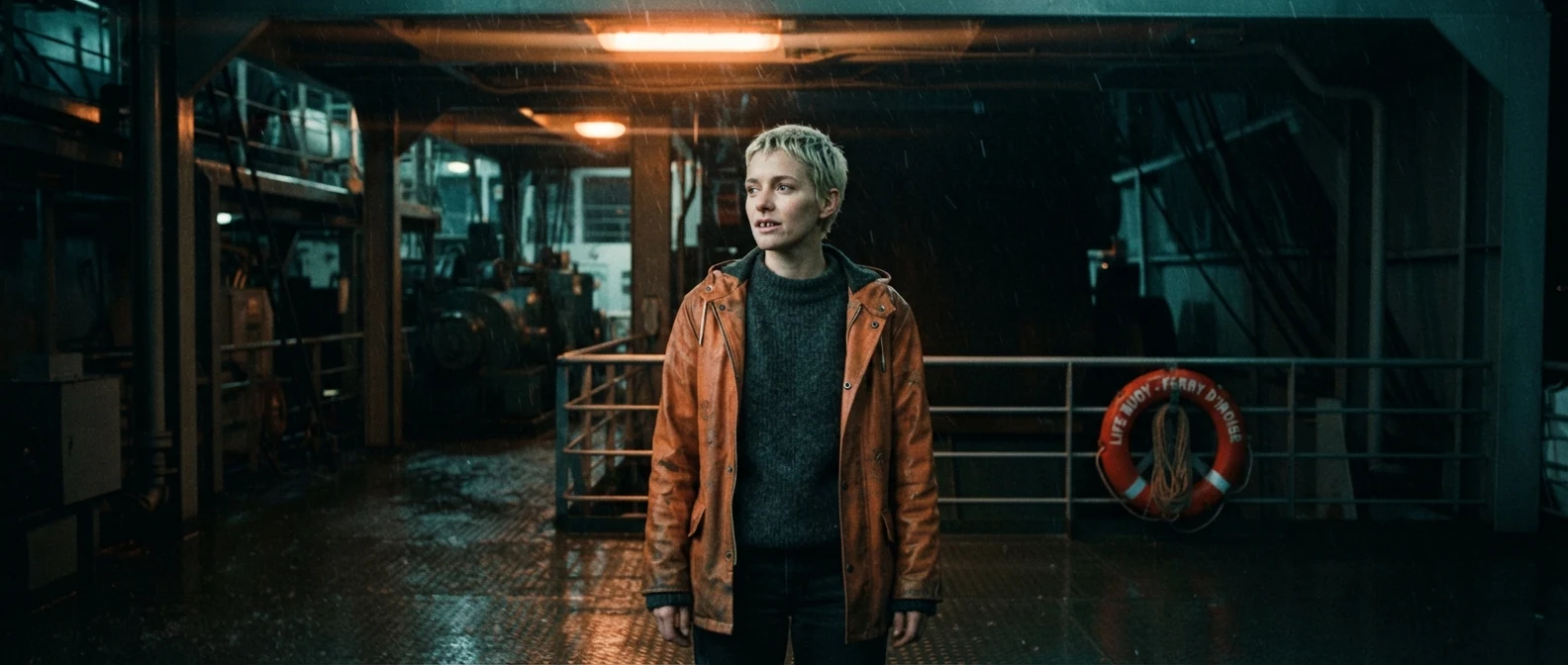
Every lookbook rule from page 3 and 4 is written as a visible fact: sodium-orange deck lamps, teal shadows, the single red life ring, 40mm at shoulder height, heavy grain, lifted blacks. The character carries three specific features so she can be repeated in every later frame.
Open FlashBoardsA film lookbook page spread on a plain black background. Left half: one large wide film still of a car ferry crossing a dark strait at night, its deck lights glowing sodium orange, sleet in the air. Right half: a grid of four smaller film stills in the same grade: a fluorescent green-white corridor below deck, an orange oilskin jacket hanging on a hook, a red life ring on a wet railing, a car with fogged windows alone on an empty deck. Below the grid, a row of four flat color swatches: steel blue, teal, sodium orange, deep red. Small white serif title at top left: NIGHT FERRY.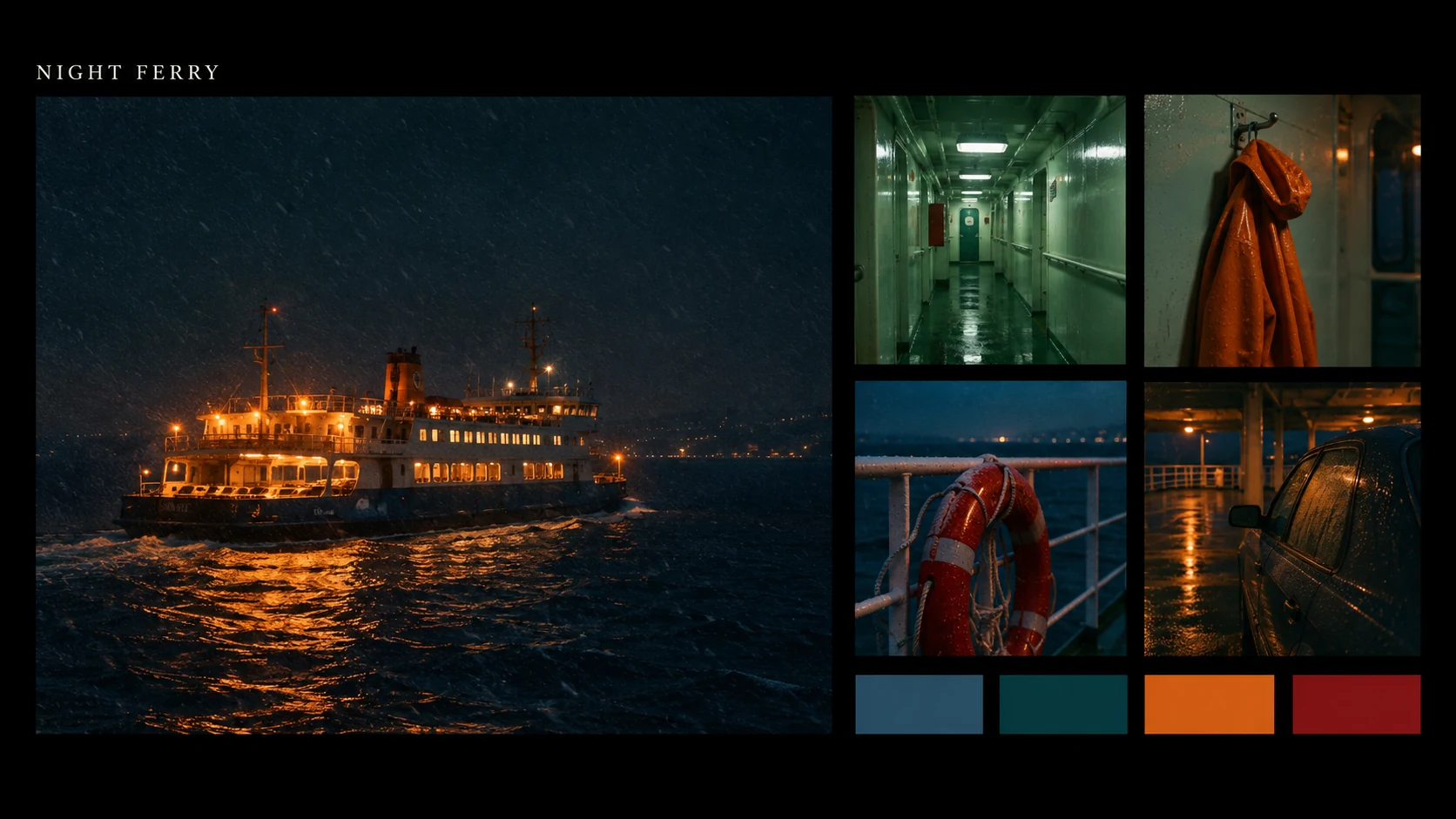
Lookbook page spread, grid of four smaller film stills and row of four flat color swatches produce the page itself, not a single image. Naming one grade for all stills and listing the swatch colors keeps the spread consistent; the title is kept to two words so the lettering stays clean.
Open FlashBoardsCamera: slow dolly-in from the wide framing toward the woman, steady and smooth, ending in a medium shot at shoulder height. Action: sleet is already streaming diagonally through the orange lamp light and the deck glistens with running water. The woman pulls the collar of her orange oilskin jacket up against the wind and turns her head toward the red life ring on the railing. At the end she holds still, looking past the ring into the dark, while the sleet keeps falling.Streaming sleet in the first sentence makes the shot alive from frame one; the slow dolly-in is the move the lookbook allows for this act. Every object in the action already exists in recipe 1, so the model has nothing to invent.
Open FlashBoardsCommon mistakes
- Palette drift. Each generation grades itself differently. Repeat the same light sources and color names in every prompt of the book, word for word.
- The glossy default. Models drift toward clean, bright, high-contrast images. Name the texture you want: lifted blacks, heavy film grain, muted colors.
- Drifting faces. Restate the same three physical features in every frame of a character, and keep the wardrobe description identical.
- Garbled page text. Long titles and captions come out as fake lettering. Generate the image, then set your own text in the layout.
- Over-dressed frames. An empty deck fills up with extra people and cars. Describe what is there: "stands alone on an empty deck."
Keep the reference frames, prompts and every generated take side by side — images and video in one canvas.
FAQ
6 questionsWhat is a lookbook in film?
A film lookbook is a curated set of reference images, key frames, color palettes and short notes that shows how a specific film will look and feel. Directors use it to pitch a project to producers and financiers and to give the DP, production designer and costume designer one shared visual plan before shooting.
How long should a film lookbook be?
A pitch lookbook usually works best at 10 to 15 pages, short enough to read in a few minutes. A working lookbook for heads of department can run 30 pages or more, with sections for camera, color, costume and locations. Cut any page that repeats a point another page already makes.
What is the difference between a lookbook and a pitch deck?
A lookbook is about the image: tone, color, light, framing, characters and places. A pitch deck is a business document that may include the lookbook's strongest pages but adds the logline, team, budget range, comparable titles, audience and financing plan. For a director's pitch meeting, the lookbook often carries the creative half of the deck.
Can I use stills from other movies in my lookbook?
Using stills from other films as private references in a pitch or crew lookbook is common practice, but the images still belong to their owners, so don't publish them or use them in marketing. The strongest lookbooks lean less on famous stills over time and replace them with scouts, tests and key frames made for the project.
Can you make a film lookbook with AI?
Yes. Image models are useful for generating key frames of your own characters and locations in the look you describe, which is often more convincing than borrowed stills. Write the visual rules first, repeat them in every prompt, keep character descriptions consistent and generate several takes per page, then keep only the frames that match the rules.
Who makes the lookbook, the director or the DP?
The pitch lookbook is usually the director's document, sometimes assembled with a producer or designer. Once the cinematographer and production designer are hired, the working lookbook becomes shared: the DP adds lighting and lens references, the designer adds sets and color, the costume designer adds wardrobe, and the director keeps final say.
Related terms
6- Mood BoardFilmmaking Process & Crew
A mood board is a loose collage of images, colors, textures and frames that captures the emotional tone of a project before its look is locked — a starting point for a lookbook, storyboard or AI generation.
- StoryboardFilmmaking Process & Crew
A storyboard is a sequence of drawn or generated panels, one per planned shot, showing framing, action and camera movement with notes — a visual draft of the film before anything is shot.
- Color PaletteColor
A film's color palette is the limited set of colors that dominates its images — in sets, costumes, light and grade — chosen to give the film a coherent look and emotional temperature.
- TV PitchFilmmaking Process & Crew
A TV pitch is a short verbal or deck presentation of a series idea — logline, world, characters, pilot story and season engines — aimed at getting producers or a network to buy or develop it.
- Film TreatmentScreenwriting
A treatment is a prose document, usually 2–10 pages written in present tense, that tells the whole story of a planned film scene by scene and conveys its tone before the screenplay is written.
- Pre-ProductionFilmmaking Process & Crew
Pre-production is the planning phase between greenlight and the first shoot day: casting, crewing, location scouting, design, storyboards and shot lists, breakdown, schedule and budget are locked here.