 FlashBoards Learn
- Learn
- Camera Movement
- Gimbal Shot
Camera Movement · Film language
Gimbal Shot
Also called: 3-axis gimbal, camera stabilizer, gimbal stabilizer
A gimbal shot is filmed with a motorized three-axis stabilizer that holds the camera level while the operator walks, runs or hands the rig off to a car or cable. The result is a floating, Steadicam-like glide that lets the audience move through space with a character, without the jolts of handheld.
- What it does
- Floats the camera through space so the viewer travels with the subject, smoothly and level.
- Use it when
- You need to follow, lead or circle someone on foot through real space, fast and with a small crew.
- Watch out
- A gimbal cancels rotation, not footsteps: vertical bob still shows on long lenses.
- Try this prompt
Smooth gliding follow shot, camera at shoulder height 1.5 m behind a walker, 24mm, level horizon, constant distance
What is a gimbal shot?
In film, a gimbal is not just any pivot. It is an electronic stabilizer: three brushless motors hold the camera on the pan, tilt and roll axes, and a motion sensor tells them hundreds of times a second how to cancel the operator's wobble. The horizon stays level while the body moves underneath.
On screen a gimbal shot reads as a glide through a street, hallway or crowd, with none of the shake of a handheld shot. Since the early 2010s it has become one of the most common tools of camera movement.
Why do filmmakers use gimbal shots?
Because the frame stays calm, the viewer stops noticing the camera and reads the space instead: the crowd, the depth of a street, the geography of a chase. Operators use it to follow a character from behind, lead them walking backward, circle them or link spaces in one take; the clips below (the jog in Still Alice, the sprint in Limitless, the orbit in Doctor Strange) show those moves, made on Steadicam, dolly and vehicle rigs. It also buys speed: a gimbal rigs in minutes, fits into cars and elevators and can be handed to a vehicle mount mid-shot.
How to shoot a gimbal shot
- Balance first, with the final lens, filter and focus motor attached; rebalance after every lens change.
- Go wide. 18–35mm hides the vertical bob a gimbal can't remove; at 50mm and up every footstep shows. Stay 1–2 m from the actor.
- Walk soft: knees bent, heel to toe, upper body still. For long takes add a spring arm and vest or a Z-axis stabilizer.
- Pick a mode: pan follow for tracking, pan-and-tilt follow for stairs, lock for sideways truck moves.
- Split the job on bigger shoots: one operator walks, a second frames remotely, a focus puller works wirelessly.
Common gimbal moves
- Follow and lead: behind or ahead of the subject at shoulder height, the workhorse of the tracking shot.
- Orbit: a half or full circle around a standing subject.
- Low mode: the camera hangs 20–50 cm above the floor.
- Handoff: from hand to car, bike or cable without a cut; an FPV drone shot takes the idea into the air.
- Dolly substitute: a slow straight glide, the light cousin of a dolly shot.
Gimbal vs. Steadicam
A Steadicam is mechanical: a balanced sled on a spring arm and vest. It absorbs footstep bounce beautifully and carries heavy cameras, but needs a trained operator and long setup. A gimbal is electronic: motors hold the horizon perfectly, it is light, quick and easy to hand off, but alone it doesn't absorb up-and-down motion. Many crews mount a gimbal on a Steadicam arm to get both. Choose handheld when you want the audience nervous, a gimbal when you want them carried.
Gimbal Shot in motion
9 clipsThese shots were made on Steadicam, dolly and vehicle rigs, but they are exactly the moves a gimbal operator is hired for today. Watch the level horizon and the steady distance to the subject while the background streams past.
How to create a gimbal shot with AI
3 promptsDescribe the look of the move, not the gear: height, distance, lens, level horizon, steady pace. Nano Banana 2 Lite builds the start frame, GPT Image 2.5 a low-mode leading take, and MiniMax H3 Max Turbo animates the glide. Keep clips and takes on one FlashBoards board to compare them side by side.
Cinematic film still, medium shot from behind at shoulder height, camera 1.5 m behind her, 24mm lens, level horizon: a tall woman in her late thirties with a shaved head, a silver hoop earring and an oversized mustard-yellow raincoat walks away down a narrow wet night-market alley; steaming food stalls on both sides, string lights overhead, reflections on wet cobbles, a lit archway at the far end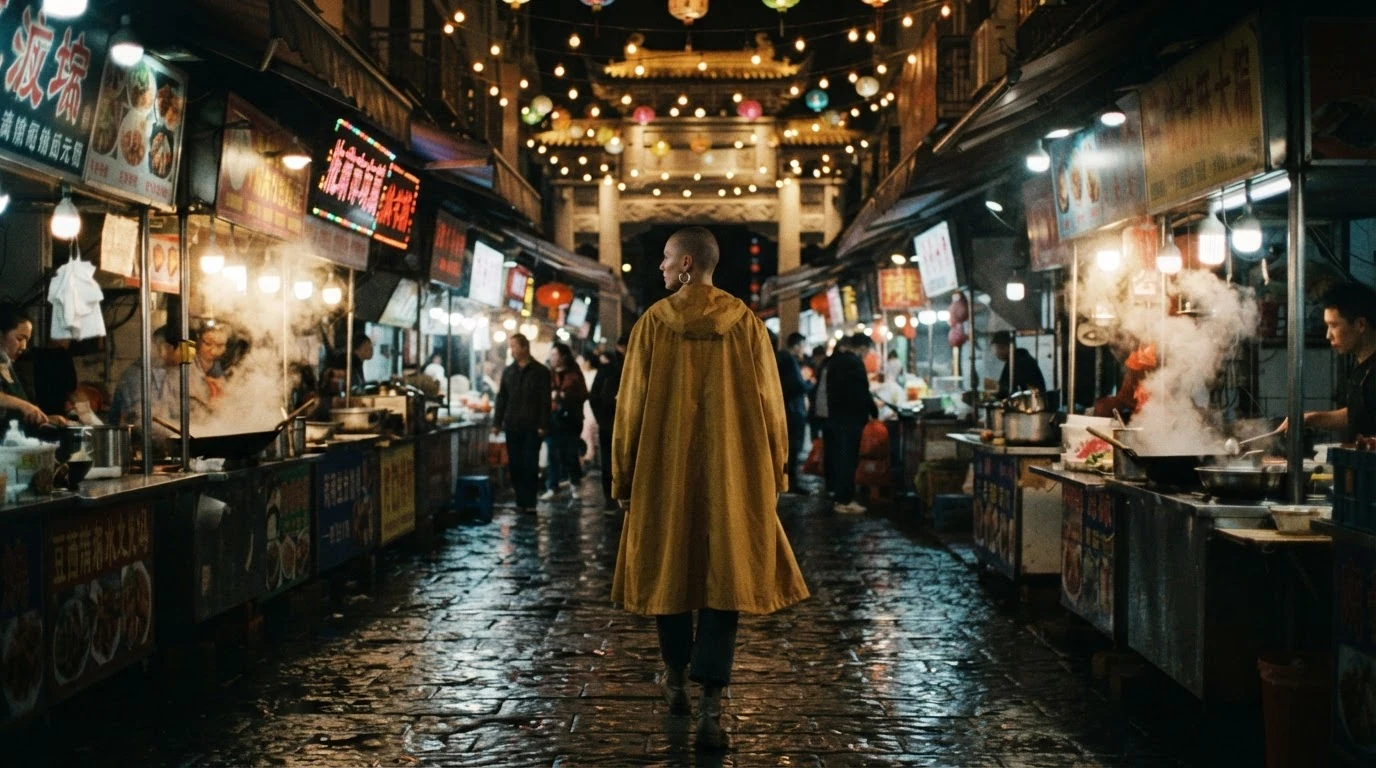
From behind at shoulder height, 1.5 m and 24mm set up the classic follow. The lit archway gives the move a destination; stalls and lights will show parallax once the camera travels.
Open FlashBoardsWide cinematic frame, camera 40 cm above the ground, 18mm lens, leading shot: a wiry runner in his sixties with a braided white beard, a teal windbreaker and orange running shoes jogs straight toward the lens along a wooden harbor pier at dawn; moored fishing boats and lamp posts receding behind him, pink sky, level horizon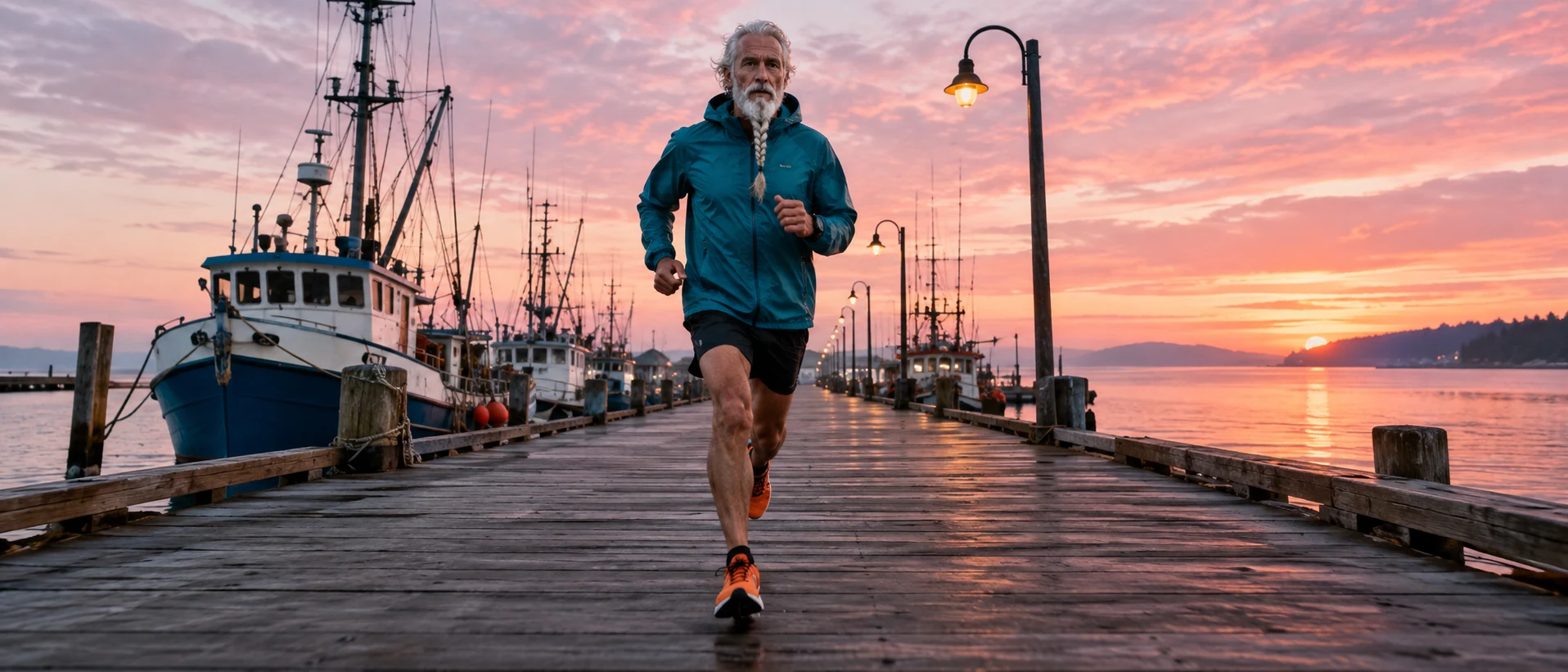
40 cm above the ground recreates low mode; jogs straight toward the lens sets up a backward lead. The 18mm stretches the pier's lines so any travel reads strongly.
Open FlashBoardsCamera: a smooth gliding follow shot at shoulder height, moving forward at walking pace, keeping a constant 1.5 m behind the woman in the yellow raincoat; the horizon stays level and the motion floats steadily, drifting slightly to her right halfway through. Action: she is already walking down the wet alley as the shot begins, steam drifting across the frame. In the middle she glances at a stall on the right. At the end she walks on toward the lit archway.Smooth gliding, constant 1.5 m and horizon stays level describe what a gimbal delivers, keeping out shake and slow push-ins. The drift right adds parallax, and she moves from the first frame.
Open FlashBoardsCommon mistakes
- The rig appears in frame. The word gimbal can draw the device; describe the view instead.
- Shake creeps in. Running with invites wobble; add smooth gliding and level horizon.
- The camera stays put. State pace and a constant distance behind.
- Invented space. Keep the path short and name only what the start frame shows.
- A frozen start. Put the subject in motion in the first words of
Action:.
Keep the reference frames, prompts and every generated take side by side — images and video in one canvas.
FAQ
4 questionsWhat is a gimbal in film?
A gimbal is a motorized stabilizer that holds a camera on three axes. Sensors detect every wobble of the operator's hands and motors cancel it, keeping the horizon level and the lens on target. It lets a small crew make smooth walking, running and vehicle shots that once needed a Steadicam, dolly or car rig.
What does a 3-axis gimbal do?
It stabilizes rotation around pan (left-right), tilt (up-down) and roll (tipping the horizon), each with its own motor. It does not stabilize movement through space, so the bounce of footsteps still needs soft walking, a wide lens or an extra spring arm or Z-axis stabilizer.
Is a gimbal the same as a Steadicam?
No. A Steadicam is mechanical, a balanced sled on a spring arm and vest, and absorbs footstep bounce very well. A gimbal is electronic, using motors to hold angle and horizon. Gimbals are lighter and faster to rig; a Steadicam carries heavier cameras through long walking takes more smoothly.
Can AI video models create a gimbal-style shot?
Yes, if you describe the result rather than the equipment: camera height, distance to the subject, lens, level horizon and a steady walking pace, with the subject already moving in the start frame. In FlashBoards, generate the frame with Nano Banana 2 Lite and animate it with MiniMax H3 Max Turbo.
Related terms
5- Steadicam ShotCamera Movement
A Steadicam shot is filmed with a body-worn stabiliser — vest, spring-loaded arm and balanced sled — that lets the operator walk, run and climb stairs while the camera glides; it made long moving takes like Rocky's steps run and The Shining's corridors possible.
- Handheld ShotCamera Movement
A handheld shot is filmed with the camera held in the operator's hands or on the shoulder, without a stabiliser, so its natural sway and jolts make the scene feel immediate, documentary-like or anxious.
- Tracking ShotCamera Movement
A tracking shot moves the camera through space with a moving subject — on a dolly, Steadicam, vehicle or drone — following, leading or flanking it so the audience travels with the action.
- FPV Drone ShotCamera Movement
An FPV shot is flown with a small, agile drone piloted through video goggles, letting the camera dive, weave and thread through gaps, doorways and crowds in one continuous rollercoaster-like move.
- Camera MovementCamera Movement
Camera movement is any change of the camera's position or direction during a shot — pans, tilts, dollies, cranes, handheld and more — used to guide attention, reveal space and set the emotional rhythm of a scene.
Further reading
Blain Brown, Cinematography: Theory and Practice (Routledge). American Cinematographer Manual (ASC Press), camera support chapters. Jerry Holway and Laurie Hayball, The Steadicam Operator's Handbook (Focal Press).