 FlashBoards Learn
- Learn
- Camera Movement
- Steadicam Shot
Camera Movement · Film language
Steadicam Shot
Also called: Steadicam, stabilizer vest shot, floating camera
A Steadicam shot is filmed with a body-worn stabilizer (a vest, a spring-loaded arm and a balanced sled) that lets the operator walk, run and climb stairs while the camera glides. The viewer feels carried by a weightless observer: smoother than handheld, and free to go anywhere a dolly track cannot.
- What it does
- Lets the camera walk with the characters through real space in one smooth, floating move.
- Use it when
- You need to follow or lead someone through doors, stairs, crowds or several rooms without cutting.
- Watch out
- A float with no purpose reads as a showreel; the move needs a destination and a reason to keep going.
- Try this prompt
Steadicam follow shot from behind at chest height, gliding at walking pace, level horizon, 27mm, deep focus down a long corridor
What is a Steadicam shot?
A Steadicam shot is any shot made with a Steadicam or a rig built on the same principle: the camera rides on a body-worn stabilizer instead of on a tripod, a dolly or the operator's shoulder. It is a type of camera movement, and the rig has four parts:
- The vest spreads the load across the operator's hips and shoulders.
- The arm is a jointed, spring-loaded arm that carries the weight and absorbs the up-and-down shock of each footstep.
- The sled is a vertical post with the camera on top and the monitor and batteries at the bottom as counterweight.
- The gimbal, a free-turning bearing at the sled's balance point, connects sled and arm. The operator steers with light fingertip pressure on the gimbal handle, never by gripping the camera.
Because the sled is balanced around its own center of gravity and isolated from the body by the arm, it keeps its orientation while the operator moves underneath it. Footsteps and turns are filtered out, leaving a camera that seems to hover at chest height.
The system was invented by the cameraman Garrett Brown in the mid-1970s and reached features in 1976, with Bound for Glory and Rocky, whose run up the steps of the Philadelphia Museum of Art Brown operated himself. Four years later he operated on The Shining (1980), where the camera glides after Danny's tricycle through the hotel corridors, close to the floor. Note what the rig is not: a Steadicam is not a kind of dolly shot. A dolly rolls on wheels or track; a Steadicam is worn, so it can follow a character through a doorway, over rough ground or up stairs, where no track can go.
Crews also call it a stabilizer vest shot or a floating camera.
Why do filmmakers use a Steadicam?
A Steadicam puts the audience on foot inside the scene. The camera goes where a person could walk, at a person's height and pace, but without the nervous jolts of a handheld shot. That combination gives it a few effects that are hard to get any other way.
Following someone into a world. The classic Steadicam move trails a character from behind and lets the space open around them as they go. The Copacabana shot in Goodfellas (1990) follows a couple from the street, through a side door, down corridors and through the kitchen to a table set up at the front of the room, all in one take, and the unbroken path is the whole point: this is how easily doors open for Henry Hill. The walk from the dressing room to the ring in Raging Bull (1980) works the same way, putting you at the fighter's back as the noise builds.
Unease through smoothness. In The Shining the Steadicam's glide becomes sinister. The camera moves too steadily for a human, low behind the tricycle, and the corridors seem to pull the boy forward.
Long takes on location. Because the rig needs no track, a single operator can cross terrain and interiors in one move. The Dunkirk beach sequence in Atonement (2007) is a roughly five-minute Steadicam take through soldiers, horses and wreckage, and Russian Ark (2002) went further: the entire film is one continuous Steadicam shot through the Hermitage Museum.
Leading instead of following. Walking backward ahead of an actor gives you a moving frontal shot, the engine of the walk-and-talk. Faces stay in a steady medium shot while the background streams past.
In every case the Steadicam is a kind of tracking shot, one with a body and no rails, used when a scene should flow through several spaces instead of being cut into them.
How to shoot a Steadicam shot
A Steadicam shot is designed like a dance route, and it is only as good as its rehearsal. The camera operator is usually a specialist who owns and balances the rig, and the cinematographer plans the move with them and the director.
Rig and balance. A loaded cinema rig (camera, lens, wireless focus motor, monitor, batteries, sled and arm) often weighs 50 to 80 pounds (about 23 to 36 kg), carried on the hips. The operator trims the sled so that, held horizontal and released, it swings back to vertical in about two to three seconds (the drop time). Too bottom-heavy and it pendulums on every stop; too neutral and it is hard to keep level.
Lenses. Most Steadicam work lives between 18mm and 35mm. A wide-angle lens hides small errors in height and pan, keeps the subject readable at arm's length and gives strong parallax as walls and doorframes slide past. Past 50mm, every drift becomes visible, so long lenses are the exception.
Height and distance. The default is chest to eye height, a meter or two from the actor. For very low work the rig is flipped into low mode, with the camera hanging beneath the sled a few inches off the floor. Agree on a working distance and hold it; unmotivated changes feel unsteady even when the image is smooth.
Focus. The focus puller is off the rig, pulling wirelessly from a monitor. Rehearse with marks on the floor at every key position, and stop down to f/4 or f/5.6 on wide lenses if the move is unpredictable.
Blocking and route. Walk the path with the actors first. Plan where the move starts and ends, and where it pauses. Good blocking gives the camera reasons to turn: a door opening, a new character, a sound from another room. Clear cables from the path, and have a grip guide the operator when walking backward.
Lighting. Long moves see close to 360 degrees of the set, so light from above, through windows and with practicals in shot.
Smooth stabilized movement: the Steadicam look
In current usage, Steadicam also names a look, not just a rig: free-flowing camera travel without rails that is far steadier than handheld. Much of what audiences call a Steadicam shot today is made with a gimbal, a stabilized vehicle arm or a mix of rigs handed off between operators. 1917 (2019) is built largely from this kind of handover, with the camera passing between stabilized rigs so that the move never breaks.
Whatever the rig, smooth stabilized movement has a recognizable signature:
- A level horizon. The frame does not roll with the operator's steps or turns.
- No footfall bounce. Vertical shocks are gone; only a slow rise and fall remains.
- Float and inertia. Starts and stops are slightly soft, and the frame drifts a little before settling, like something with mass hanging in air.
- Freedom of path. The camera turns corners, passes through doors and changes height, which a dolly on track cannot do.
The drift is a feature: that organic inertia separates it from the mechanically perfect glide of a remote head. When a camera without a clear subject uses the float to explore a space on its own, it becomes a wandering camera.
Steadicam vs. gimbal: which should you use?
Both let you walk with the camera, and on screen they can look almost identical. The difference is in how they stabilize and what that means on set.
- How it works. A Steadicam is mechanical: balance, inertia and a spring arm. A gimbal uses motors and sensors on three axes to hold the camera level. Many productions now combine the two, hanging a gimbal head on a Steadicam arm.
- Vertical motion. A Steadicam arm soaks up footsteps. A handheld gimbal cancels rotation well but passes some bounce through unless the operator walks very carefully or adds a spring arm or vest.
- Weight and cost. A full Steadicam is heavy, expensive and usually comes with its own operator. Gimbals range from small handheld units to cinema-sized heads, are cheaper and can be passed to a car, cable or crane mid-shot.
- Feel. Steadicam movement has inertia and a slight organic drift. A gimbal can be locked to perfect levels and exact angles, which reads cleaner and sometimes more mechanical.
Choose a Steadicam for long, complex walking takes with heavy cinema cameras, and a gimbal for lighter setups, fast handoffs and tight budgets. Neither replaces a dolly for exact, repeatable moves.
Steadicam Shot in motion
11 clipsWatch the horizon and the floor. In each clip the camera walks through real space, through doors, down stairs, into crowds, yet the frame never jolts with the operator's steps. Notice how often the move follows a character from behind and lets a new room open up around them.
How to create a Steadicam shot with AI
3 promptsVideo models tend to either push in slowly on a still frame or add a handheld wobble, so a Steadicam move has to be described as a path: where the camera starts, who it follows, how far behind, at what height and where it ends. Nano Banana 2 Lite draws the start frame from behind the subject with the destination already visible, GPT Image 2.5 tries a leading variation, and MiniMax H3 Max Turbo animates the first frame into the walk. In FlashBoards, keep the film clips, frames and takes on one board and compare the moves side by side.
Cinematic film still, Steadicam follow shot from behind at chest height: a waitress in her late twenties with a copper-red buzz cut, a small gold hoop in her left ear, a white shirt and a long black apron walks away from the camera down a narrow restaurant kitchen corridor, carrying a tray with two plates at shoulder level; steel shelves and hanging pans on both sides, at the far end a pair of open swinging doors reveal a warm candlelit dining room with round tables; camera about two meters behind her, level horizon, 27mm lens, deep focus, warm tungsten practicals, 35mm film grain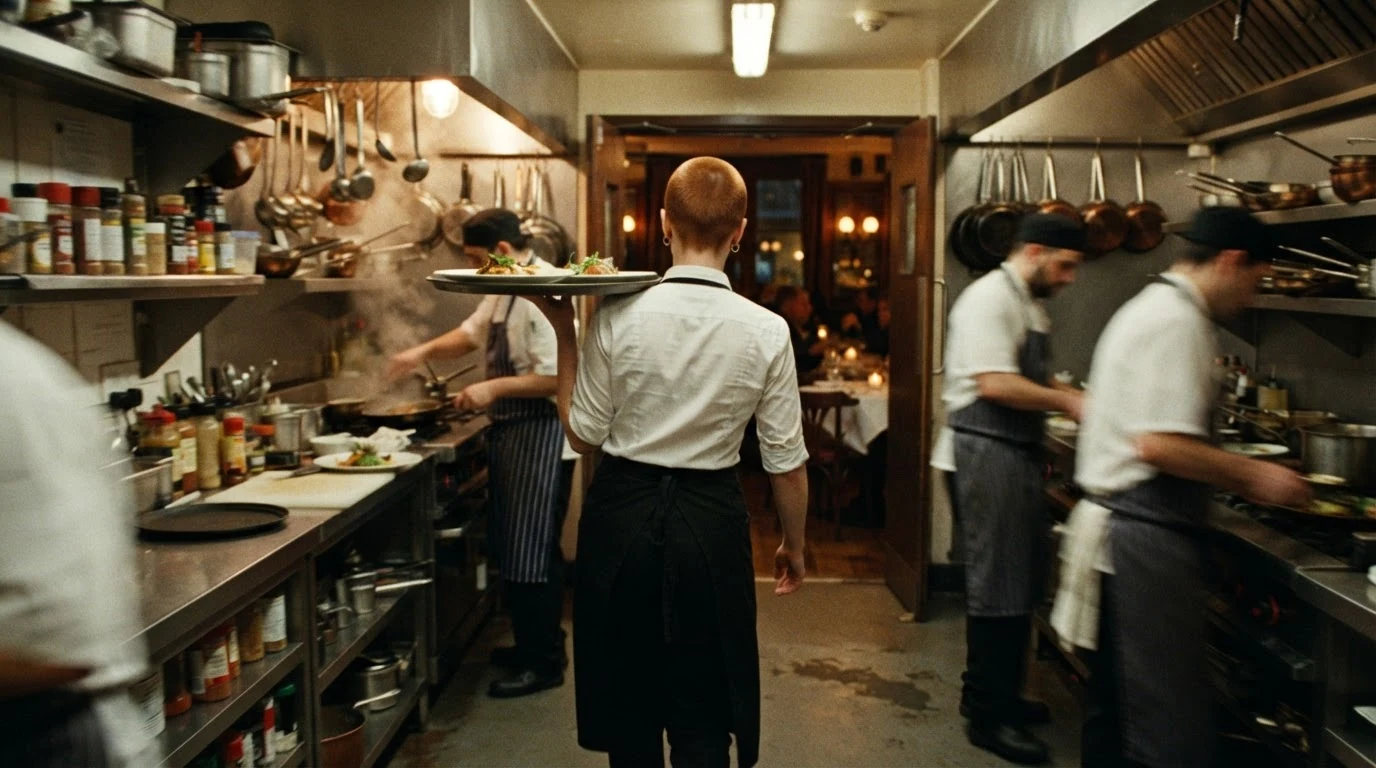
Steadicam follow shot from behind at chest height sets the classic position, and camera about two meters behind her fixes the working distance the video will hold. Open swinging doors reveal a candlelit dining room puts the destination in the first frame, so the move has somewhere to go and the video model does not have to invent it. 27mm and deep focus keep the corridor walls and the far room sharp for strong parallax, and the waitress's specific features keep her clearly fictional.
Open FlashBoardsCinematic film still, Steadicam leading shot walking backward ahead of the subject: a boxer in his thirties with a shaved head, a crooked nose, a faded swallow tattoo on his neck and a dark red satin robe walks toward the camera down a concrete arena tunnel, two trainers in grey sweatshirts at his shoulders; bright white ring lights and a hazy crowd glow at the far end of the tunnel behind them, overhead caged lamps passing above, chest-height camera, perfectly level horizon, 32mm lens, anamorphic widescreen, slight haze, cold concrete and warm skin tones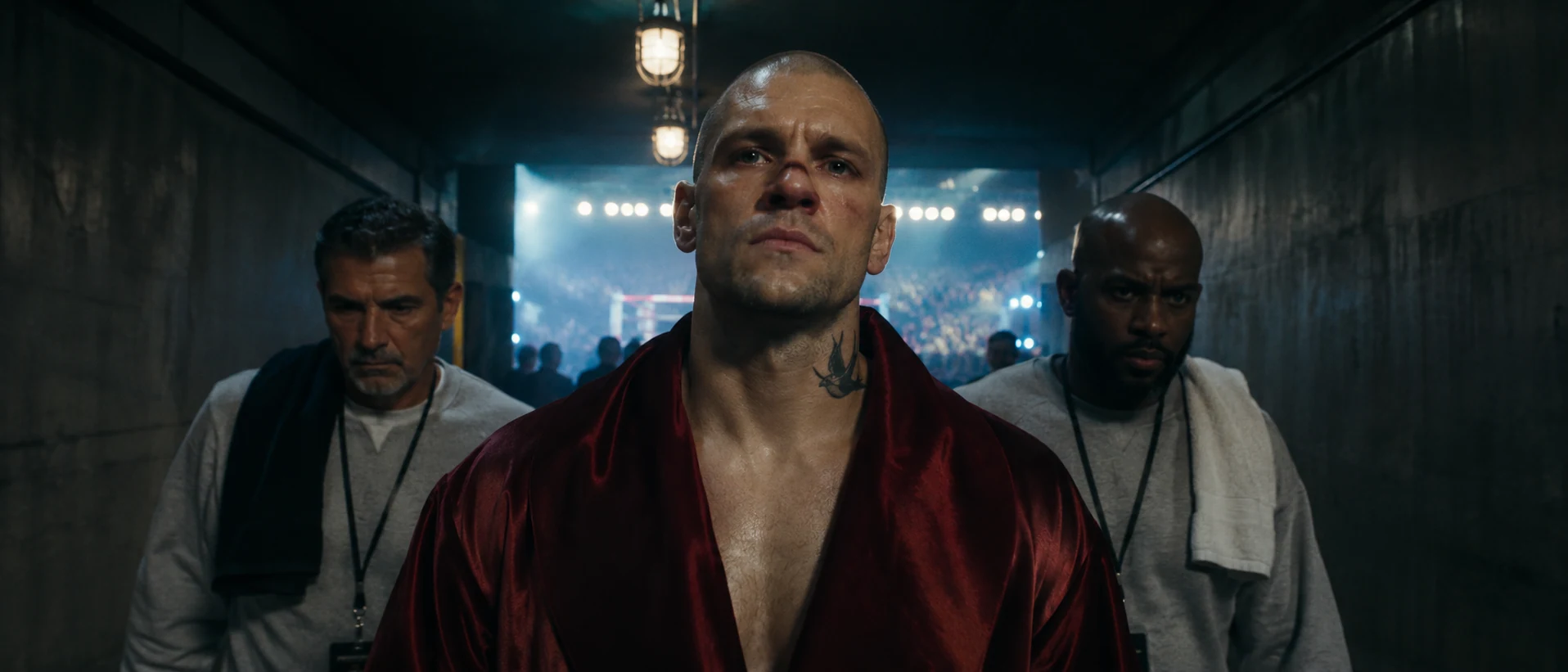
A second take that reverses the direction: walking backward ahead of the subject is the leading version of the Steadicam move, the one used for entrances and walk-and-talks. Overhead caged lamps passing above and the tunnel's converging walls give the still a sense of travel, and perfectly level horizon separates it from a handheld look. The wide 21:9 frame leaves room for the trainers and the glow of the arena behind them.
Open FlashBoardsCamera: smooth Steadicam follow, gliding forward behind the waitress at her walking pace for the whole shot, holding about two meters behind her at chest height, horizon perfectly level, no footstep bounce, a slight floating drift. As she passes through the swinging doors the camera follows her through and drifts a little to the right, revealing the candlelit dining room. Action: she is already walking briskly down the kitchen corridor with the tray raised as the shot begins. In the middle she pushes through the swinging doors with her shoulder. At the end she steps into the dining room and turns toward a round table on the left, the camera settling behind her.Gliding forward behind the waitress at her walking pace and holding about two meters behind her make the camera travel through space instead of zooming, and horizon perfectly level, no footstep bounce, a slight floating drift defines the Steadicam signature against both handheld and a robotic push. She is already moving in the first beat, so the shot is alive from frame one. Everything named in the prompt (corridor, doors, dining room, round tables) is already in the start frame, so the model reveals it rather than inventing new background.
Open FlashBoardsCommon mistakes
- It turns into a slow push-in. If the prompt only says Steadicam, the model often creeps toward a frozen frame. Give the subject motion from the first beat and tell the camera to travel with them at their pace.
- It becomes handheld. Words like following closely or tracking can bring back shake. State horizon perfectly level, no footstep bounce and describe the float.
- The distance drifts. Without a number the camera closes in or falls behind. Fix it: holding about two meters behind her.
- The model invents a destination. If the next room is not in the start frame, the model draws whatever it likes. Put the doorway and what lies beyond it in the image recipe.
- Faces and hands warp on turns. Long, curving moves with the subject turning toward the lens stress the model. Keep clips to 6–10 seconds and one or two direction changes.
Keep the reference frames, prompts and every generated take side by side — images and video in one canvas.
FAQ
6 questionsWhat is a Steadicam?
A Steadicam is a body-worn camera stabilizer. The operator wears a vest attached to a spring-loaded arm, which carries a balanced sled with the camera on top and the monitor and batteries below. The arm absorbs footsteps and the balanced sled resists tilting, so the operator can walk, run or climb stairs while the shot stays smooth and level.
Who invented the Steadicam and when was it first used?
The Steadicam was invented by the cameraman Garrett Brown in the mid-1970s. It reached feature films in 1976, in Bound for Glory and Rocky, where Brown operated the run up the museum steps. He also operated on The Shining (1980), whose gliding corridor shots made the rig famous. It earned him an Academy technical award.
What is the difference between a Steadicam and a gimbal?
A Steadicam stabilizes mechanically, with balance, inertia and a spring arm worn on a vest. A gimbal uses motors and sensors to hold the camera level on three axes. The Steadicam absorbs footsteps better and carries heavy cinema cameras for long takes. A gimbal is lighter, cheaper and easier to hand off to cars or cranes, but passes more vertical bounce.
Is a Steadicam shot the same as a tracking shot?
A Steadicam shot is one way to make a tracking shot. A tracking shot is any shot where the camera travels with the action, on a dolly, a vehicle, a drone or a Steadicam. The Steadicam version is the one that can pass through doors, climb stairs and turn tight corners, because the camera is carried by a walking operator rather than rolling on a track.
What are some famous Steadicam shots?
Well-known examples include the run up the steps in Rocky (1976), the tricycle rides through the hotel corridors in The Shining (1980), the Copacabana entrance in Goodfellas (1990), the Dunkirk beach take in Atonement (2007) and Russian Ark (2002), a whole feature filmed as a single continuous Steadicam shot through the Hermitage Museum.
How heavy is a Steadicam?
A professional Steadicam loaded with a cinema camera, lens, focus motor, monitor and batteries often weighs 50 to 80 pounds, about 23 to 36 kg. The vest transfers most of that weight to the operator's hips, and the arm carries it, so operators can work through long takes. Lighter rigs for small cameras exist, but still need careful balancing.
Related terms
6- GimbalCamera Movement
A gimbal is a motorised three-axis stabiliser that keeps the camera level while the operator walks, runs or hands it off to a car or crane, giving Steadicam-smooth moves with a lighter, cheaper rig.
- Handheld ShotCamera Movement
A handheld shot is filmed with the camera held in the operator's hands or on the shoulder, without a stabiliser, so its natural sway and jolts make the scene feel immediate, documentary-like or anxious.
- Dolly ShotCamera Movement
A dolly shot is filmed with the camera on a wheeled dolly, usually on track, so it can glide smoothly toward, away from or alongside the action; unlike a zoom, the camera really moves, so perspective and parallax change.
- Tracking ShotCamera Movement
A tracking shot moves the camera through space with a moving subject — on a dolly, Steadicam, vehicle or drone — following, leading or flanking it so the audience travels with the action.
- Camera OperatorFilmmaking Process & Crew
The camera operator physically runs the camera during takes — framing, panning, tilting and executing moves — to the design set by the cinematographer, working with the focus puller and dolly grip.
- Camera MovementCamera Movement
Camera movement is any change of the camera's position or direction during a shot — pans, tilts, dollies, cranes, handheld and more — used to guide attention, reveal space and set the emotional rhythm of a scene.
Further reading
Garrett Brown's writings and interviews on the invention and operation of the Steadicam. Blain Brown, Cinematography: Theory and Practice (Routledge). American Cinematographer coverage of Goodfellas (1990) and Atonement (2007).