 FlashBoards Learn
- Learn
- Camera Movement
- Handheld Shot
Camera Movement · Film language
Handheld Shot
Also called: hand-held, shaky cam, shoulder-mounted shot, run-and-gun
A handheld shot is filmed with the camera in the operator's hands or on their shoulder, with no stabilizer between body and lens. Every breath, step and reaction reaches the frame as sway and jolt, so the audience feels present in the scene: immediate, documentary-like, and in the right hands, anxious or intimate.
- What it does
- Puts a human body behind the lens, so the scene feels observed live rather than staged.
- Use it when
- You want urgency, intimacy, chaos or a documentary texture, or the space is too tight for a dolly.
- Watch out
- Shake without motivation reads as sloppy; decide how much movement the scene earns and keep it consistent.
- Try this prompt
handheld shoulder-mounted camera, subtle irregular sway, operator reacting a beat late, 28mm, documentary realism
What is a handheld shot?
A handheld shot is any shot where the operator carries the camera without a mechanical support that isolates it from their body — no tripod, no dolly, no stabilizing arm. The camera sits on the shoulder, is braced against the chest, or is held out in two hands. It belongs to the family of camera movement, but unlike a pan or a dolly it is less a single move than a texture that sits on top of every move the operator makes.
That texture has three sources. The operator's breathing and heartbeat produce a slow float even when they stand still. Their footsteps add a vertical bounce when they walk. And their reactions — turning to a sound, finding a face, losing it — add pans and tilts that arrive a fraction late, the way a person's attention does. The audience reads all of this as the presence of someone in the room.
Handheld is not the same as "shaky". A skilled operator can hold a close-up almost still, and the tiny drift that remains is what makes it feel alive.
Why do filmmakers use handheld camera?
Authenticity. Audiences learned what real events look like from news and documentary footage, which is almost always handheld. The lightweight 16mm cameras of the early 1960s made cinéma vérité and documentary filmmaking mobile, and fiction borrowed the look to borrow the credibility. When Raoul Coutard shot Breathless (1960) handheld on the streets of Paris, the French New Wave made that roughness a statement against studio polish.
Urgency and chaos. In the Omaha Beach landing of Saving Private Ryan (1998), Janusz Kamiński's camera is knocked around at soldier height, splashed and deafened with the men, and a narrowed shutter angle makes every jolt stutter. The camera does not explain the battle; it survives it.
Intimacy. Handheld is not only for violence. On a quiet close-up, a breathing camera feels like a person leaning in. Eternal Sunshine of the Spotless Mind (2004), shot by Ellen Kuras, uses loose handheld to keep its couple fragile and unguarded, and the Dogme 95 films made handheld a rule so that actors, not setups, would lead the scene.
Subjectivity. Because it moves like a body, handheld is the natural language of the POV shot and of found-footage horror, where the camera literally belongs to a character.
Speed. No track, no leveling, no reset: in cars, stairwells and small rooms handheld is often the only rig that fits.
How to shoot a handheld shot
Rig and weight. A balanced shoulder rig is the core tool: camera over the shoulder, weight centered over the spine, handles out in front. A very light camera is harder to hold still, so operators often add weight. For long days an Easyrig — a vest with a bungee arm that carries the camera's weight — keeps the handheld feel while saving the operator's back.
Lens. Shake scales with focal length. On a wide-angle lens (18–35 mm on Super 35) the same sway barely registers; at 85 mm it becomes a lurch. Most handheld work lives between 24 and 50 mm.
Body technique. Knees soft, elbows tucked against the ribs, weight low. Walk heel-to-toe with bent knees to smooth the bounce. Breathe out slowly before a critical frame. Use the eyepiece against the face as a third point of contact.
Blocking and motivation. Decide what moves the camera. The best handheld reacts to the scene: it pans to a voice, drifts toward the person who is losing control, pulls back when someone pushes past. Rehearse the geography, then let the operator find the frames. Keep the amount of movement consistent within a scene; cutting from calm to wild coverage of the same moment feels like an error, not a choice.
Shutter and exposure. At a standard 180° shutter (see the 180-degree shutter rule) shake produces soft motion blur. A narrower shutter (45–90°) crisps each frame and gives the staccato combat look; a wider one smears movement into a dreamier drift.
Shaky cam: how much movement is too much?
Shaky cam is handheld made deliberately rough. Think of steadiness as a scale:
- Locked off — tripod, no movement at all.
- Breathing — handheld held still; a slow float you feel more than see.
- Controlled handheld — the operator walks and reframes, the horizon stays mostly level.
- Aggressive — fast reframes, bumps, the horizon tipping into a Dutch angle, subjects slipping out of frame. Action and war.
- Violent shake — impacts, the camera knocked or thrown, often boosted in post. Explosions, crashes, panic.
Sam Raimi's crew on The Evil Dead (1981) called their rig the "shaky cam": a camera bolted to a plank and carried at speed by two people to create the rushing point of view of an unseen force. The Coen brothers, early Raimi collaborators, borrowed the rushing low camera for Raising Arizona (1987). The result is fast and low rather than jittery — the modern meaning of shaky cam as frantic jitter came later.
Shake has a cost. Wild camera combined with fast cutting makes action hard to follow, and some viewers get motion sick. Two rules keep it readable: keep one stable element in each shot (a face, a horizon, a doorway) and let the shake peak at moments of impact instead of running flat-out through the scene. Shake added in post lacks the operator's reactions and looks like the whole image wobbling.
Handheld vs. Steadicam vs. gimbal
All three put the camera in the operator's hands and let it go where a dolly cannot. The difference is what happens to the operator's body movement.
- Handheld passes it straight to the frame. You get sway, bounce and human reactions. It feels like someone is there.
- Steadicam — a vest, a spring-loaded arm and a balanced sled — absorbs the steps and lets the camera glide. It feels like a presence floating through the space: the corridors of The Shining (1980) are the classic case. The operator can still add intent, but the frame has no jolts.
- Gimbal — a motorized three-axis head — keeps the horizon level electronically. It is lighter and cheaper than Steadicam and can be handed off to a car or a crane, but the move can feel mechanical, with a characteristic float and an unnaturally level horizon.
Choose by meaning, not by convenience. If the scene should feel witnessed by a person, go handheld. If it should feel like a smooth, continuous tracking shot through space, use Steadicam or a gimbal. A common hybrid is a Steadicam or gimbal operated loosely, so the move breathes without bouncing.
Handheld Shot in motion

11 clipsLook for the operator in each clip: late reframes, the bounce of footsteps, a horizon rolling off level, faces lost behind a shoulder and found again. The intensity runs from a landing craft to a slow drift over dark water.
How to create a handheld shot with AI
3 promptsVideo models default to smooth, gimbal-like motion, and the word "handheld" alone often produces only a gentle float. Describe the operator instead: where they stand, how they move, how much the frame sways and what they react to. Nano Banana 2 Lite draws a start frame with handheld traces, GPT Image 2.5 tries the aggressive end of the scale, and MiniMax H3 Max Turbo animates the first frame, the recipe that matters most here. In FlashBoards, keep the reference frames next to your generations on one board and compare takes side by side.
Cinematic film still, handheld shoulder-mounted camera at eye level in a cramped hospital corridor at night: a nurse in her thirties with close-cropped bleached hair, a small scar through her left eyebrow and teal scrubs strides toward the camera, turning her head sharply to look back over her shoulder; the horizon tilted about 5 degrees, slight motion blur on her swinging hand and on the frame edges, her face sharp, the out-of-focus shoulder of an orderly in a grey sweater in the left foreground, flickering fluorescent overhead light, 28mm lens, documentary realism, 35mm film grain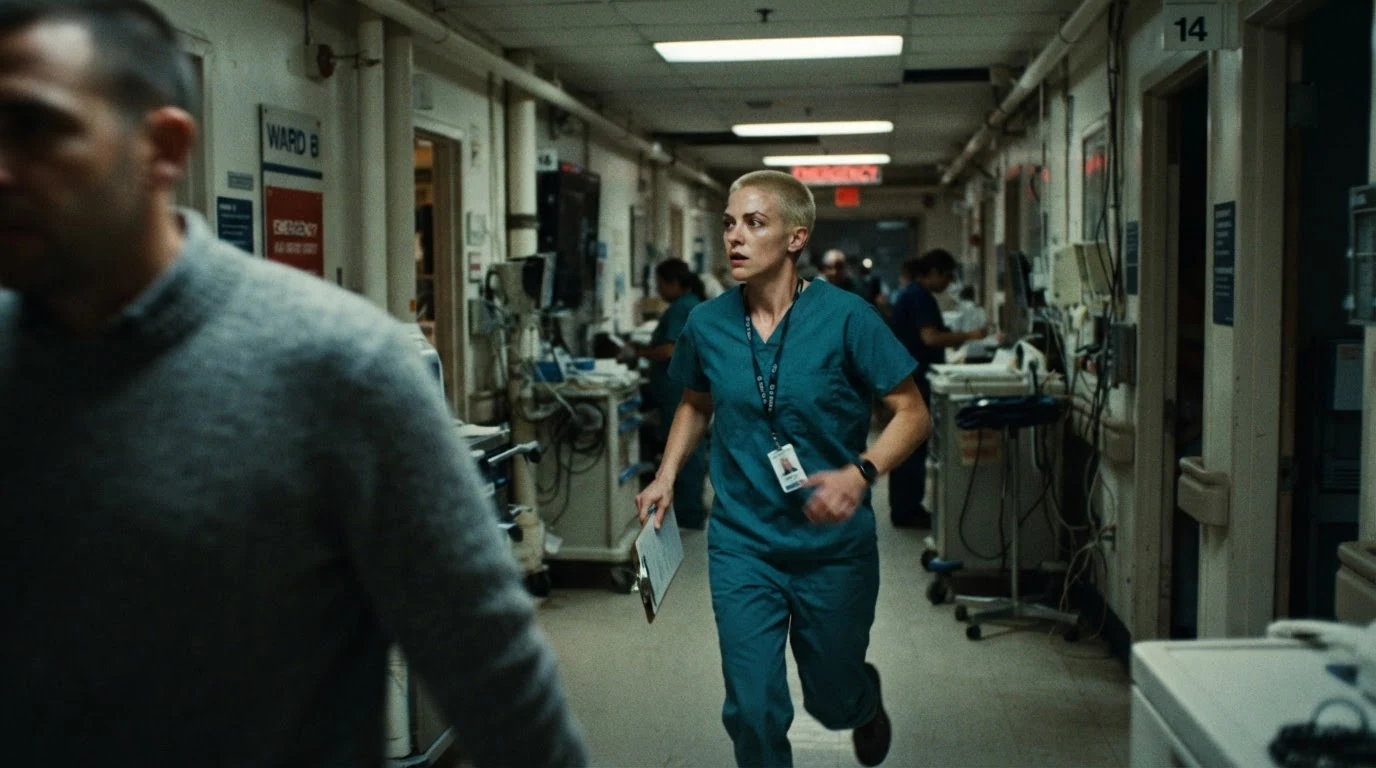
A still can only imply handheld, so the prompt lists its traces: horizon tilted about 5 degrees, motion blur on the hand but a sharp face, and a foreground shoulder that puts the camera inside the space. The nurse is mid-stride and mid-turn, which gives the video recipe motion to pick up from the first frame, and her specific features keep her clearly fictional.
Open FlashBoardsCinematic film still, violent handheld camera on the deck of a small fishing trawler in a night storm: two deckhands haul a heavy net over the rail, a broad-shouldered man in his forties with a red beard and orange oilskins in the foreground, a younger man with a shaved head and a silver ring in one ear behind him; the horizon tipped 15 degrees, sea spray and water droplets on the lens, motion blur on the net and the men's arms, a single deck floodlight, 24mm lens, anamorphic widescreen, desaturated blue-green palette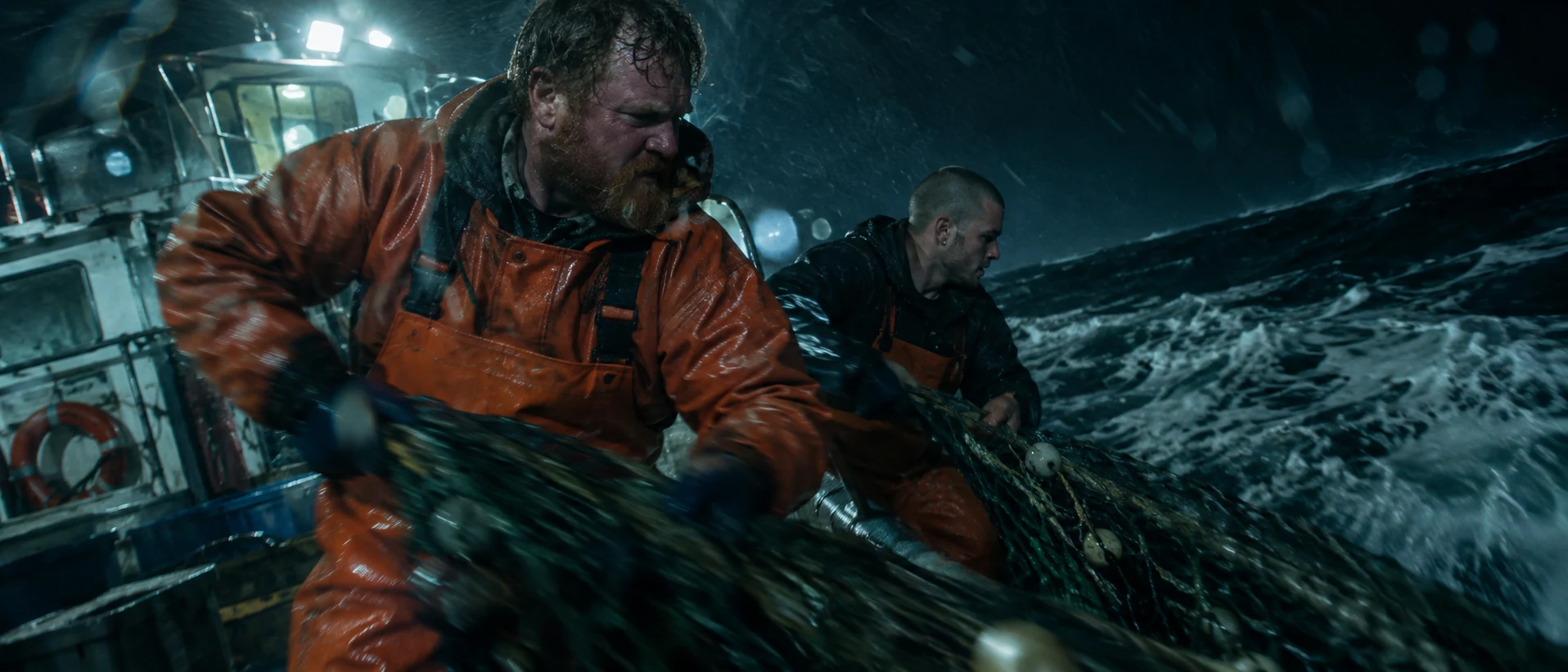
A second take from the aggressive end of the scale. Horizon tipped 15 degrees and water droplets on the lens are the strongest still-image cues that a person is holding the camera in the weather, and 24mm keeps the lurch readable instead of chaotic. Keep the blur on the arms and the net, not the faces.
Open FlashBoardsCamera: handheld, shoulder-mounted, walking backward ahead of the nurse at her pace for the whole shot, with a soft bounce on every step and a small irregular sway; it stays at eye level and keeps her in a medium close-up, the horizon drifting a few degrees off level and back. When she turns her head, the camera lags a beat, then reframes to find her face again. Action: the nurse is already striding toward the camera as the shot begins, her hand swinging, looking back over her shoulder. In the middle she faces forward again and her pace quickens. At the end she brushes past the orderly's grey shoulder in the foreground, and the camera jostles as she passes.Walking backward ahead of the nurse at her pace anchors the camera in space, so the model moves a camera rather than wobbling the picture. Soft bounce on every step and small irregular sway set the amplitude, and lags a beat, then reframes is the human reaction that makes handheld feel operated. She is moving in the first frame, so the shot is alive at once, and everything named (corridor, orderly, shoulder) is already in the start frame.
Open FlashBoardsCommon mistakes
- It comes out as a gimbal glide. Write shoulder-mounted handheld and describe the operator's steps and reactions, not just shaky.
- The whole image wobbles like a post effect. Real handheld has parallax and reframing. Anchor the camera in space (walking backward ahead of her at arm's length) so the model moves a camera, not the picture.
- Too much shake melts faces. Heavy jitter can warp features and hands. Lower the amplitude, keep clips to 5–8 seconds and ask for her face stays sharp.
- Constant, even shake. Models apply one intensity throughout. Put the peak in the
Action:beats (the camera jostles as she passes) and keep the rest calmer. - The camera drifts off the subject. State what the operator keeps in frame and what they react to.
- The video starts frozen. Without motion in the first beat the model slowly pushes in on a still frame. Start
Action:with the subject already moving.
Keep the reference frames, prompts and every generated take side by side — images and video in one canvas.
FAQ
6 questionsWhat is a handheld shot in film?
A handheld shot is filmed with the camera held in the operator's hands or on their shoulder, without a tripod, dolly or stabilizer. The operator's breathing, steps and reactions reach the frame as sway, bounce and late reframes, which makes the scene feel observed by a real person. It is used for realism, urgency, intimacy and point-of-view shots, and in places too tight for bigger rigs.
What is shaky cam?
Shaky cam is handheld camerawork with deliberately strong, visible instability: bumps, jolts and tipping horizons used to create panic, chaos or impact. The term started with Sam Raimi's plank-mounted rig on The Evil Dead (1981), which was actually fast and low rather than jittery. Today it usually means aggressive handheld in action, war and found-footage horror.
What is the difference between handheld and Steadicam?
Both are carried by an operator, but a Steadicam uses a vest, a spring-loaded arm and a balanced sled to absorb footsteps, so the camera glides smoothly through space. Handheld passes every movement of the body to the frame. Steadicam feels like a floating presence; handheld feels like a person standing in the scene, reacting to it as it happens.
Why do directors use handheld camera?
Directors choose handheld to make a scene feel real and unrehearsed, to put the audience inside chaos such as a fight or a battle, to create intimacy on quiet close-ups, or to show a character's point of view. It is also practical: no track or leveling is needed, so the crew can follow actors through cars, stairwells and small rooms and shoot long, loose takes.
How do you keep a handheld shot steady?
Use a balanced shoulder rig or an Easyrig, add weight to a light camera, and choose a wider lens, since shake grows with focal length. Keep knees soft and elbows tucked, walk heel-to-toe, press the eyepiece to your face and breathe out slowly on critical frames. Lean on walls between moves. Stabilization in post can help, but it crops the image and can warp it.
How do I make AI video look handheld?
Describe the operator, not only the style: shoulder-mounted handheld, walking backward ahead of her, soft bounce on every step, small irregular sway, the camera lags when she turns, then reframes. Give a lens (24–35 mm), start the action already moving and put any big jolt in a specific beat. Without these details most video models fall back to a smooth, gimbal-like glide.
Related terms
7- Steadicam ShotCamera Movement
A Steadicam shot is filmed with a body-worn stabiliser — vest, spring-loaded arm and balanced sled — that lets the operator walk, run and climb stairs while the camera glides; it made long moving takes like Rocky's steps run and The Shining's corridors possible.
- GimbalCamera Movement
A gimbal is a motorised three-axis stabiliser that keeps the camera level while the operator walks, runs or hands it off to a car or crane, giving Steadicam-smooth moves with a lighter, cheaper rig.
- Cinéma VéritéFilm Movements & Styles
Cinéma vérité is a 1960s documentary approach, born with Jean Rouch and Edgar Morin's Chronicle of a Summer, in which lightweight sync-sound cameras record real life and the filmmaker openly provokes and takes part in it.
- Dogme 95Film Movements & Styles
Dogme 95 is the Danish movement launched by Lars von Trier and Thomas Vinterberg with a 'Vow of Chastity': handheld camera, real locations, no added lighting or non-diegetic music, no genre tricks — Festen and The Idiots are its first films.
- Documentary FilmmakingFilmmaking Process & Crew
Documentary filmmaking records real people and events rather than staged fiction, built from observation, interviews, archival footage and narration, and shaped into a story in the edit.
- POV ShotCamera Angles
A POV shot shows exactly what a character sees by placing the camera at their eyes — usually right after a shot of them looking — so the audience shares their perspective, including movement, obstruction or distortion.
- Camera MovementCamera Movement
Camera movement is any change of the camera's position or direction during a shot — pans, tilts, dollies, cranes, handheld and more — used to guide attention, reveal space and set the emotional rhythm of a scene.
Further reading
Blain Brown, Cinematography: Theory and Practice (Routledge). American Cinematographer coverage of Saving Private Ryan (1998). Garrett Brown's writings on the history of the Steadicam.