 FlashBoards Learn
- Learn
- Camera Movement
- Tracking Shot
Camera Movement · Film language
Tracking Shot
Also called: follow shot, travelling shot, leading shot, walk-and-talk shot
A tracking shot moves the camera through space together with a moving subject, following behind, leading ahead or flanking alongside, on a dolly, Steadicam, gimbal, car or drone. The audience stops watching the action from a fixed seat and travels with it, sharing the character's pace, direction and momentum.
- What it does
- Keeps a moving subject anchored in frame while the world streams past, so the viewer travels with the action.
- Use it when
- The journey matters: a walk into danger, a chase, a conversation on the move, a character entering a new world.
- Watch out
- If the camera only pivots to follow, it is a pan; a tracking shot has to travel.
- Try this prompt
Tracking shot following behind a woman in a yellow raincoat walking down a lantern-lit market alley, camera moves forward at her pace 2 m behind, 8 seconds, smooth, one continuous take
What is a tracking shot?
A tracking shot is a moving shot defined by its relationship to a moving subject: the camera travels because the subject travels. The name comes from the dolly track it was first laid on, but today the rig is secondary.
Three basic positions change what the audience feels:
- Following from behind: we see what the character walks toward, but not their face.
- Leading from ahead, with the camera moving backward: we see the face and the determination in it.
- Flanking alongside: a profile view with the background streaming past, often built as a truck shot.
Other names you will hear: follow shot, travelling shot (common in British and European usage) and, for dialogue on the move, the walk-and-talk. All of them belong to the family of camera movements.
Why do filmmakers use tracking shots?
A cut asks the audience to rebuild space; a tracking shot lets them walk through it.
- Immersion. The space feels lived in rather than presented. Kubrick's trench walk in Paths of Glory (1957) makes the audience share the officer's inspection of exhausted men.
- Status and access. In Goodfellas (1990) the Steadicam follows Henry Hill through the back door, the kitchen and into the Copacabana, and the unbroken path itself shows that doors open for him.
- Pressure. A camera glued behind a character, as in Gus Van Sant's Elephant (2003) or Son of Saul (2015), limits what we see and makes every corner a threat.
- Momentum. Tracking alongside a runner or a vehicle turns speed into something felt, which is why chases lean on it (see car chase staging).
- Dialogue with energy. The walk-and-talk, a staple of The West Wing, keeps exposition moving.
How to shoot a tracking shot
Choose the rig by terrain and speed. A dolly on track gives the most precise, repeatable move on flat ground. A Steadicam or gimbal handles stairs, doorways and long distances. A camera car or motorcycle covers vehicles and runners. A drone or an FPV drone takes over across landscapes. A handheld shot sacrifices smoothness for urgency.
Fix the distance. Decide the framing and hold it: for a medium shot of a walking actor, roughly 1.5–3 m. A constant distance also keeps focus manageable.
Pick a lens that shows the world. 24–40mm is the usual range: wide enough to feel the environment slide past, long enough that faces do not distort. Longer lenses flatten the background and hide the speed.
Match speed to the actor. The performer sets the pace; the operator or dolly grip anticipates starts, stops and turns. Rehearse with floor marks.
Plan the route like choreography. Draw the path on an overhead plan alongside the actors' blocking: where extras cross, where doors open, where the camera turns.
Light for 360 degrees. A moving camera sees more of the set. Light with practicals and overhead fixtures, and give sound radio mics or a boom path.
Walking towards camera: the leading shot
When a character walks toward the lens while the camera moves backward ahead of them, you get the leading shot. It shows the face, the eyes and the intent, so it is the default for walk-and-talk dialogue and for characters striding into confrontation.
Movement toward camera also works with a locked-off frame: the subject grows as they approach, which reads as a threat or an arrival. Once the camera retreats at the actor's pace, the size stays constant and the effect shifts from approach to accompaniment.
On set, the operator walks backward, usually with a spotter's hand on the belt, or a dolly pulls back on track. Keep the distance steady and halt when the actor does.
Walking away from camera: the follow shot
Following a character from behind withholds the face and hands the audience the character's direction of travel. We see what they walk toward at the same moment they do, which builds suspense and a strong sense of subjectivity without becoming a true point-of-view shot. In The Wrestler (2008), the camera repeatedly trails Mickey Rourke's back through corridors and into the ring.
Keep the back of the head and shoulders in the lower part of the frame with space above, so the destination has room. A slightly wider lens exaggerates how the space opens ahead. Withhold the face long enough and the turn becomes an event.
A variant starts with the character walking into depth past a static camera; the viewer is left behind, which can mean farewell, isolation or the end of a scene.
Long tracking shots and oners
A long tracking shot sustains the move for minutes, turning a whole scene into one continuous take. The classic openers are Touch of Evil (1958), a crane shot that follows a car carrying a planted bomb through a border town, and The Player (1992), which opens with a long take that openly nods to it. Russian Ark (2002) moves through the Hermitage in a single unbroken take; Children of Men (2006) put long takes inside action; and 1917 (2019) was designed to play as one continuous shot.
A oner needs more rehearsal than coverage. Every extra, door and light cue is timed to the camera's path. When a film only appears continuous, stitches are hidden in dark doorways, passing foreground objects or a whip pan.
Tracking shot vs. truck shot
A truck shot names a direction: the camera slides sideways, parallel to the scene. A tracking shot names a relationship: the camera travels with a moving subject, in any direction.
The two overlap when the camera flanks a walking or running character from the side; that shot is both a truck and a track. They split apart elsewhere. A truck can glide along a static scene, such as a row of faces at a table, with nothing to follow, and a tracking shot can move forward or backward with no sideways component at all. If the subject is the reason the camera moves, call it tracking; if the lateral direction is the point, call it a truck.
Tracking shot vs. dolly shot
A dolly shot is named after the support and, in everyday use, the move toward or away from the subject, a push in or a pull back, which works just as well on a subject who never moves. A tracking shot requires movement to follow, and it can be made on any rig.
So a dolly rolling backward ahead of a walking actor is both: a tracking shot executed on a dolly. A slow push in on someone sitting still is only a dolly shot; a Steadicam following a runner through a forest is only a tracking shot.
Neither is a pan. Panning with a moving subject pivots the camera from one spot, so the angle on the subject changes and the background sweeps past as a blur. Tracking keeps the camera's relationship to the subject constant while the location changes.
Tracking Shot in motion


11 clipsWatch the subject and the background at the same time. In a tracking shot the character's size and place in the frame stay nearly constant while the location streams past; if they shrink or grow, the camera is not keeping pace. The clips show follows from behind, leading shots with the camera retreating, flanking moves alongside and a follow at boot height.
How to create a tracking shot with AI
3 promptsFor tracking shots the video model has to move the camera and the subject at the same speed, which is exactly where it slips: the subject shrinks away, balloons toward the lens, or the camera stays put and pans. Fix the relationship in the start frame (behind, ahead or alongside, at what distance) and repeat it in the video prompt. Below, Nano Banana 2 Lite builds a follow-shot start frame, GPT Image 2.5 a flanking variation, and MiniMax H3 Max Turbo animates the follow. Keep the start frames, takes and notes on one FlashBoards board to compare which take holds the subject steadiest.
Cinematic film still, camera behind a young woman at shoulder height on a 28mm lens: she walks away from camera down a narrow, wet night-market alley, the back of her head and shoulders in the lower third of the frame. She has a short copper-red bob, a yellow vinyl raincoat and a green canvas backpack. Food stalls with steaming pots and hanging red paper lanterns recede on both sides toward a bright far end; a few passers-by in dark jackets walk ahead of her. Light haze, reflections on the wet pavement, 35mm film grain.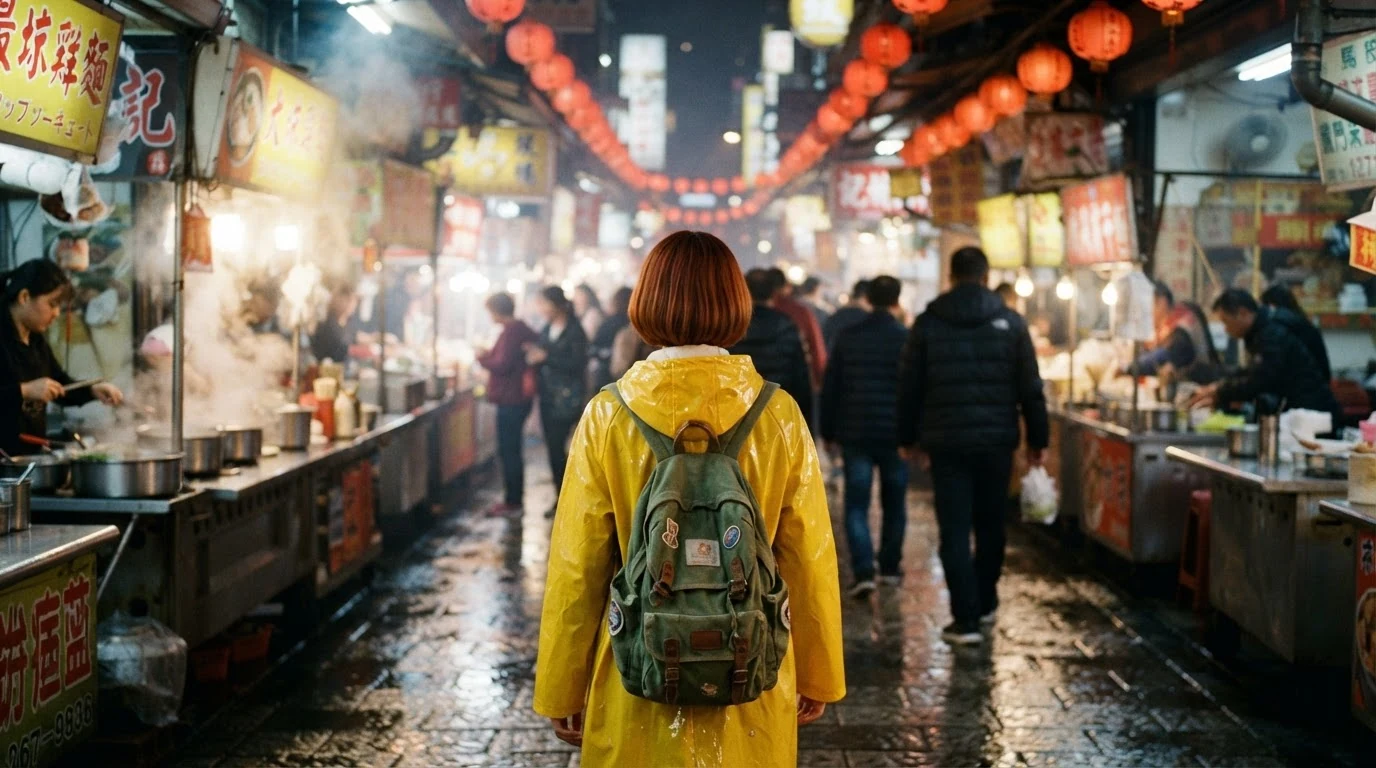
Camera behind at shoulder height plus back of her head in the lower third locks the follow-shot geometry, and the lanterns receding to a bright far end give the video model a vanishing point to travel toward.
Open FlashBoardsCinematic film still, side view from a camera car traveling beside a teenage boy with curly black hair, a gap-toothed grin and an oversized orange windbreaker as he rides a bicycle fast along a seaside road at golden hour. 50mm lens, full shot with him centered and sharp; white guardrail posts in the foreground streaked with motion blur, the sea and a green headland crisp behind him. Warm low sun, long shadows, 35mm film grain.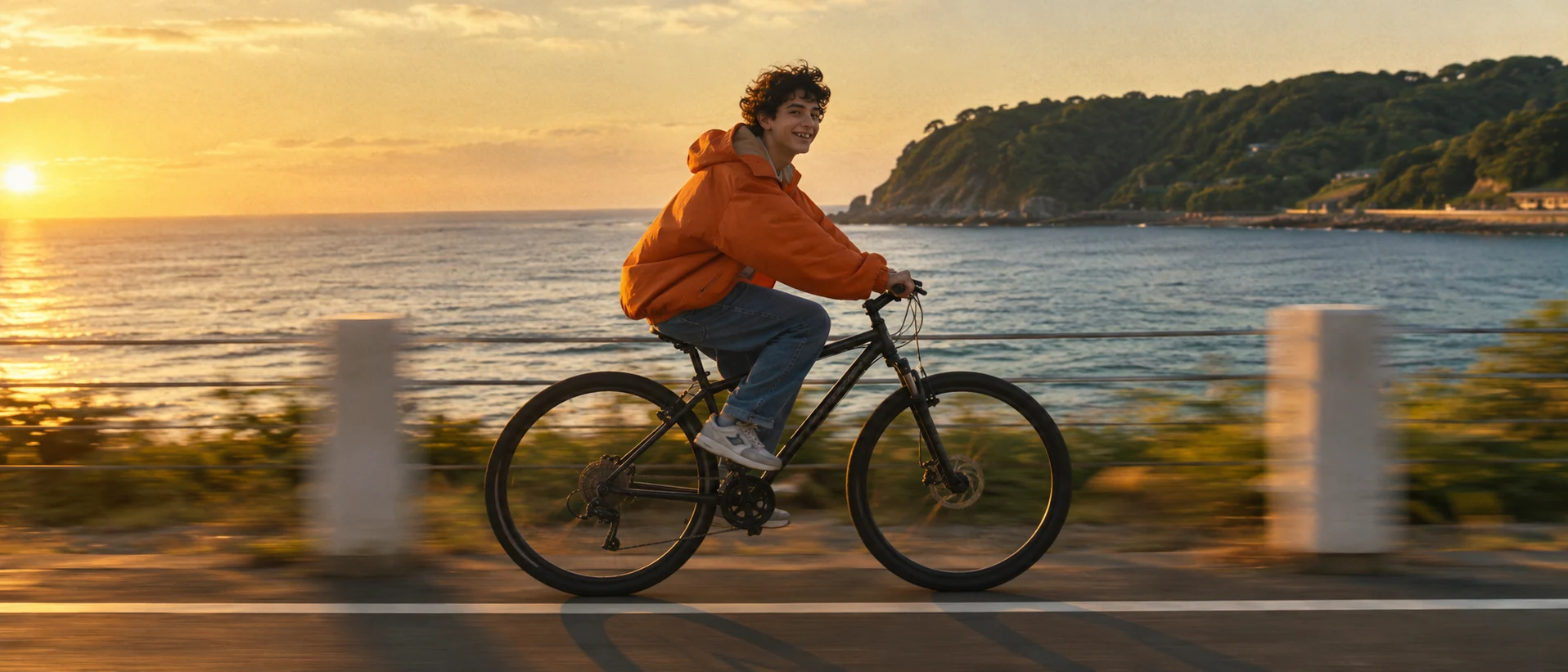
A second take in the flanking position. From a camera car traveling beside him asks for a track rather than a pan, and blurred foreground posts against a sharp, slow background are how a still shows that the camera is moving at the subject's speed.
Open FlashBoardsCamera: a smooth Steadicam follow shot moving forward down the alley at exactly her walking speed, staying about two meters behind her at shoulder height for the whole shot, so she stays the same size in the lower third of the frame. Action: she is already walking briskly as the shot begins, raincoat swinging and her steps splashing through the shallow puddles. In the middle she passes the steaming stalls and the red lanterns slide past on both sides. At the end she weaves around a passer-by in a dark jacket and keeps walking toward the bright far end of the alley, still facing away from the camera.At exactly her walking speed and about two meters behind define the relationship, so she neither shrinks away nor fills the frame. She is mid-stride in the first frame, so the shot is alive at once, and still facing away from the camera keeps her from turning to the lens. Everything named already exists in the start frame.
Open FlashBoardsCommon mistakes
- The camera stays put. The subject walks away while the frame just pans. State the camera's position (behind, ahead, alongside) and that it moves at the subject's speed.
- Drifting distance. The subject shrinks or balloons. Add a fixed distance (two meters behind) and stays the same size in frame.
- Direction mix-ups. Walks toward camera with no camera instruction produces a static approach. For a leading shot write the camera moves backward ahead of them.
- Sliding feet. Walking can look like skating; ask for a natural gait.
- Faces turning to the lens. In a follow, say the character keeps facing away from the camera.
- A frozen start. If the subject is standing in the start frame, MiniMax H3 Max Turbo eases in slowly. Show them mid-stride and start
Action:with the movement. - Long takes falling apart. Backgrounds morph over long durations. Generate 6–10 second segments and join them in the edit through a foreground wipe or a doorway.
Keep the reference frames, prompts and every generated take side by side — images and video in one canvas.
FAQ
6 questionsWhat is a tracking shot in film?
A tracking shot is a shot in which the camera physically travels with a moving subject, following behind, leading ahead or moving alongside. It can be filmed on a dolly, Steadicam, gimbal, vehicle or drone. Because the camera keeps pace, the subject stays anchored in frame while the environment moves past, putting the audience inside the journey.
What is a long tracking shot?
A long tracking shot sustains a moving camera for an extended stretch, often a whole scene without a cut. Famous examples include the opening of Touch of Evil (1958), the Copacabana entrance in Goodfellas (1990), Russian Ark (2002), shot as one continuous take, and 1917 (2019), designed to look like a single shot.
Is a tracking shot the same as a dolly shot?
Not quite. A dolly shot is named after the wheeled support and usually means moving toward or away from the subject, which can be completely still. A tracking shot means following a moving subject on any rig. A dolly rolling ahead of a walking actor is both; a slow push in on a seated character is only a dolly shot.
What is the difference between a tracking shot and a pan?
In a pan the camera stays in one spot and rotates horizontally, so the angle on a moving subject keeps changing and the background sweeps past. In a tracking shot the camera travels with the subject, keeping a constant relationship to them while the location changes around both. Panning follows with the eyes; tracking follows with the whole body.
What equipment do you need for a tracking shot?
Anything that moves the camera smoothly at the subject's speed. Dolly and track give precise, repeatable moves on flat ground; Steadicam and gimbals handle stairs and long walks; camera cars and arms cover vehicles; drones cover landscapes. On a low budget, a gimbal or a wheelchair on a smooth floor can produce a convincing walking-speed track.
What is a follow shot?
A follow shot is a tracking shot in which the camera moves behind or beside a character or vehicle to keep it the anchor of the frame. From behind it hides the face and shares the character's direction of travel, which builds suspense and subjectivity. The term is used interchangeably with tracking shot.
Related terms
7- Truck ShotCamera Movement
A truck shot slides the whole camera sideways, parallel to the scene, on a dolly, slider or vehicle; nearby objects sweep past faster than distant ones, giving strong parallax and a sense of travelling along the action.
- Dolly ShotCamera Movement
A dolly shot is filmed with the camera on a wheeled dolly, usually on track, so it can glide smoothly toward, away from or alongside the action; unlike a zoom, the camera really moves, so perspective and parallax change.
- PanCamera Movement
A pan swivels the camera horizontally from a fixed position — left or right around its vertical axis — to follow action, connect two points in space or reveal a scene bit by bit.
- Steadicam ShotCamera Movement
A Steadicam shot is filmed with a body-worn stabiliser — vest, spring-loaded arm and balanced sled — that lets the operator walk, run and climb stairs while the camera glides; it made long moving takes like Rocky's steps run and The Shining's corridors possible.
- GimbalCamera Movement
A gimbal is a motorised three-axis stabiliser that keeps the camera level while the operator walks, runs or hands it off to a car or crane, giving Steadicam-smooth moves with a lighter, cheaper rig.
- Car Chase SceneDirecting & Staging
A car chase is staged as a map of routes, speeds and obstacles: the director keeps screen direction and the distance between pursuer and pursued readable while stunt drivers, camera cars and editing build velocity.
- Camera MovementCamera Movement
Camera movement is any change of the camera's position or direction during a shot — pans, tilts, dollies, cranes, handheld and more — used to guide attention, reveal space and set the emotional rhythm of a scene.
Further reading
Blain Brown, Cinematography: Theory and Practice (Focal Press). Steven D. Katz, Film Directing Shot by Shot (Michael Wiese Productions).