 FlashBoards Learn
- Learn
- Camera Movement
- FPV Drone Shot
Camera Movement · Film language
FPV Drone Shot
Also called: FPV shot, cinewhoop shot, first-person view drone, FPV fly-through
An FPV drone shot is flown with a small, agile drone that a pilot steers through video goggles, so the camera can dive, bank and thread through doorways, gaps and crowds in one continuous move. It turns a place into a ride: the viewer feels speed, proximity and the route itself.
- What it does
- Carries the camera through a space at speed, close to surfaces and through gaps no other rig can pass.
- Use it when
- You want one unbroken route through a location, a chase that stays glued to a vehicle, or a rush of kinetic energy.
- Watch out
- Speed without a route is noise; plan the path, the gaps and the landing frame before the pilot takes off.
- Try this prompt
First-person flying camera skimming 1 meter above a wet cobbled alley at dusk, banking left through an open stone archway, 14mm lens, motion blur, 8 seconds
What is an FPV drone shot?
FPV stands for first-person view. The pilot wears goggles that show a live, low-latency feed from a small camera on the drone and flies it by hand, usually in manual (acro) mode, with no GPS hold and no automatic leveling. A second, higher-quality camera on the same frame records the image you see in the film.
The name describes how the drone is flown, not what the shot means. An FPV shot is not a character's point of view, and it is not simply a view from a drone. It is defined by the flight path: the camera plunges down a building facade, skims a meter above a road, rolls through a window, slides under a bridge and comes out the other side without a cut. A conventional camera drone, built to hover and glide, can't do that; a helicopter can't get within meters of a wall; a Steadicam can't leave the ground.
Three things mark the look on screen:
- Continuous travel. The camera almost never stops. Speed changes, direction changes, but the shot flows as one route.
- Proximity. Walls, branches, rails and people pass within a meter or two of the lens, so parallax is extreme and the sense of speed is huge.
- Banking. Because a multirotor tilts to turn, the horizon rolls with every curve, the same way it does from the cockpit of a plane or on a rollercoaster.
FPV is part of the wider family of camera movement, and it borrows from several relatives: the route of a tracking shot, the height changes of a crane, the portal trick of a pass-through shot.
Why do filmmakers use FPV shots?
The effect on the viewer is physical. A long lens tells you something is fast; an FPV shot makes your stomach drop. Because the camera moves like a body with momentum, banking into turns and floating over crests, the audience rides along instead of watching from a tripod.
To map a location in one move. A single flight from the street, through the front door, down a corridor and into the room where the scene plays gives the audience the geography that would otherwise take an establishing shot and three cuts. The viral 2021 one-take through a Minneapolis bowling alley made the point for a generation of commercial directors: one unbroken route can be the whole film.
To stay glued to vehicles. A fast FPV quad can match a car, motorbike or boat and fly around it, under a trailer, over the roof and down into the driver's window. Michael Bay's Ambulance (2022) built much of its action around drone flights diving off skyscrapers and weaving through traffic around the speeding ambulance. For car chase scenes this is the most flexible camera there is, as long as screen direction stays readable.
To connect spaces. Flying through a gap, a doorway or the frame of a window is a natural transition from one world into another. FPV makes it cheap to do for real rather than as a digital stitch.
To inject energy. Music videos, sports spots and title sequences use FPV for momentum. The risk is the same: an FPV move that doesn't follow a story route feels like a showreel. Give the flight a destination: a character, a reveal, a door that matters.
Directors chased this feeling long before small drones existed. The clips below include computer-generated flights through cities, energy storms and microchips that play exactly like FPV shots today, and a 1970s tracking move through a park that skims foliage the way a cinewhoop does.
Cinewhoop, freestyle and chase: three kinds of FPV move
Not every FPV shot is a high-speed dive. Crews pick the aircraft by the move, and the three main classes look different on screen.
Cinewhoop fly-through
A cinewhoop is a small quad, typically with 2.5- to 3.5-inch propellers inside protective ducts, carrying a compact action camera. It flies slowly and steadily enough to go indoors, past people, through doorways and down stairwells, usually at walking to jogging speed. This is the tool behind real-estate tours, restaurant and hotel one-takes and the "through the whole building" music video. On screen: smooth glide, gentle banking, tight gaps, faces within a couple of meters of the lens.
Freestyle dive
A 5-inch freestyle quad has no ducts and a lot of power. It climbs a tower in seconds, flips over the top and dives down the facade, then pulls out a meter above the street. On screen: a vertical plunge, rapid rolls, the horizon turning over, huge speed changes. Use it for scale and vertigo, and use it sparingly.
Chase and cinelifter
For vehicles and for cinema-grade sensors, crews fly larger FPV rigs (often 7- to 10-inch props, sometimes eight motors) that can carry a full cinema camera. They keep pace with cars and boats at road speeds and hold a locked-on framing on the vehicle while the ground rushes past. On screen: the subject stays roughly in place while the world blurs around it, then the drone swings around the car, over it or through a gap ahead of it.
A fourth use is the portal move: the flight passes through a narrow opening that the audience didn't think a camera could fit. That is the pass-through shot, and FPV is today's easiest way to do it practically.
How to shoot an FPV drone shot
Plan the route like a stunt. Walk the path with the pilot. Mark every gap (door width, window, space between tree trunks) and the height of the camera at each point. Decide where the shot starts, where it ends and what the landing frame holds. Most FPV one-takes are rehearsed many times, and the actors hit marks as the drone passes, just as with a Steadicam oner.
Pick the aircraft for the move. Indoors or near people, a ducted cinewhoop at 20 to 40 km/h. Outdoors, over water or down buildings, a 5-inch freestyle quad. For cars and a cinema sensor, a heavy-lift rig. Flight time is short, often three to six minutes per battery on the bigger rigs, so the route has to fit.
Lens and camera. FPV cameras sit on wide lenses, roughly 14 to 20mm full-frame equivalent, often wider. The wide-angle lens exaggerates speed and keeps the image stable-looking; very wide or fisheye views add edge curvature some directors like and others straighten in post. The recording camera is tilted up 15 to 35 degrees on the frame, because the drone pitches forward to fly fast; more uptilt suits faster flights, less suits slow indoor glides.
Height and speed. The sense of speed comes from proximity, not velocity. A cinewhoop at 30 km/h one meter above a floor looks faster than a camera drone at 60 km/h thirty meters up. Fly low, pass close to walls and objects, and let foreground rush past the lens.
Frame rate and shutter. Shoot 4K at 50 or 60 fps so you can slow sections down and stabilize with room to crop. Use ND filters to keep the shutter near 180 degrees; the resulting motion blur makes fast passes read as smooth instead of stuttery.
Stabilization. Most FPV footage is stabilized in post from gyro data recorded by the camera, not by a mechanical gimbal. You keep the organic banking and lose the high-frequency shake. Decide with the director how much roll to keep: a fully leveled horizon reads like a gimbal shot; leaving the banking in reads as flight.
Light. Indoor one-takes pass through several lighting setups in one move. Light each room so exposure holds as the camera moves from daylight to interior, or plan the route to cross the change at a door, where a brief exposure shift feels natural.
Safety and rules. Props at full speed injure people. Brief the cast on the flight path, keep a spotter next to the pilot and plan an abort point. In the US, commercial flights need a Part 107 certificate, and flying on goggles requires a visual observer beside the pilot; other countries have their own rules, so check before you book the location.
Cut it well. A speed ramp on the dives and the slow passes gives the flight rhythm, and a hidden cut inside a dark doorway or a whip of the camera lets you join two flights into one apparent take.
FPV shot vs. aerial shot
An aerial shot looks at the world from above: a helicopter, plane or GPS camera drone glides high over a landscape or city and shows geography and scale. The camera is steady, the horizon is level, the moves are slow and wide. It tells the audience where they are.
An FPV shot moves through the world, not over it. It flies low, fast and close, banks into turns, passes through gaps and ends somewhere specific. It tells the audience how it feels to get there.
| | Aerial shot | FPV shot | |---|---|---| | Typical height | Tens to hundreds of meters | Centimeters to a few meters, then anywhere | | Horizon | Level | Banks and rolls with the turns | | Speed on screen | Slow, majestic | Fast, rushing foreground | | Space | Over the location | Through the location, indoors too | | Job in the story | Establish geography and scale | Carry the audience along a route |
Many films combine them: a high aerial establishes the city, then an FPV drone drops out of it and dives into the street where the scene begins.
FPV Drone Shot in motion
7 clipsWatch the foreground and the horizon. In an FPV-style move, walls, trees and buildings rush past close to the lens and the horizon rolls as the camera banks. The first four clips are from films, including computer-generated flights that play exactly like FPV shots; the last four were flown by real FPV pilots.
How to create a FPV drone shot with AI
3 promptsThe FPV feeling comes from three words the model can read: height, proximity and banking. Nano Banana 2 Lite builds a low, wide start frame with a gap to fly through, GPT Image 2.5 tries a chase variation, and MiniMax H3 Max Turbo animates the first frame into a continuous fly-through. Keep the reference clips, stills and every take on one FlashBoards board and compare flights side by side.
Cinematic film still, first-person flying camera view about 1 meter above a wet cobbled alley at dusk, 14mm ultra-wide lens, horizon banked 12 degrees to the left: a young cyclist with a shaved head, a moss-green bomber jacket and a yellow cargo bike rides away from the lens down the center of the alley, market stalls with striped awnings and hanging bulbs rushing past on both edges of the frame with motion blur, an open stone archway ahead at the end of the alley, through the arch a sunlit courtyard with a round stone fountain, warm and cool mixed light, strong perspective lines converging on the arch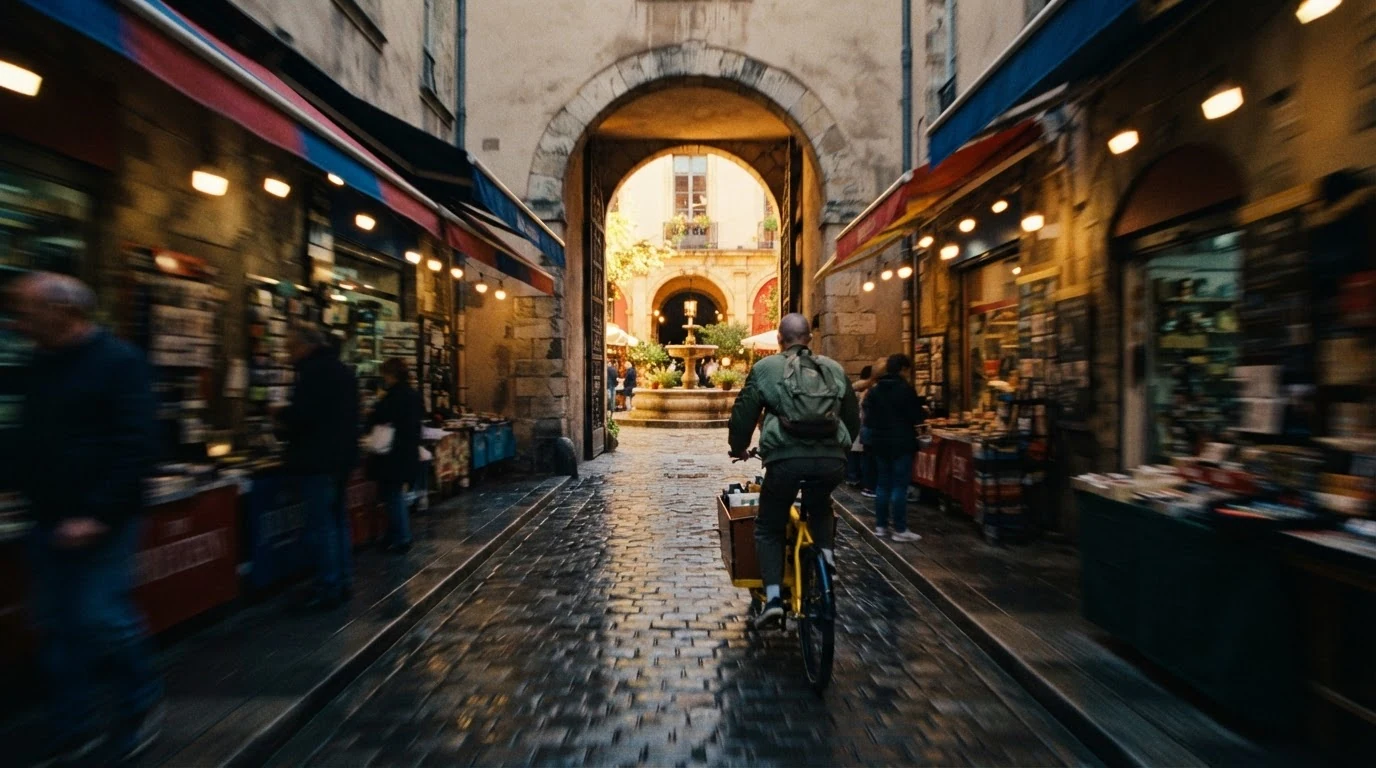
First-person flying camera view about 1 meter above sets the FPV height without the word drone, which tends to draw the aircraft itself. 14mm ultra-wide and stalls rushing past on both edges with motion blur give the proximity and speed. Horizon banked 12 degrees is the bank that separates FPV from a gimbal shot. The arch and the courtyard behind it are in frame, so the video model has a real destination instead of inventing one.
Open FlashBoardsCinematic film still, fast chase camera about 3 meters behind and 2 meters above a mud-splattered orange rally car sliding through a gravel bend on a pine forest road, camera tilted down 25 degrees, horizon banked 15 degrees to the right, 16mm wide lens, dust and gravel thrown up from the rear wheels, pine trunks streaking past the frame edges with motion blur, low afternoon sun through the trees, anamorphic widescreen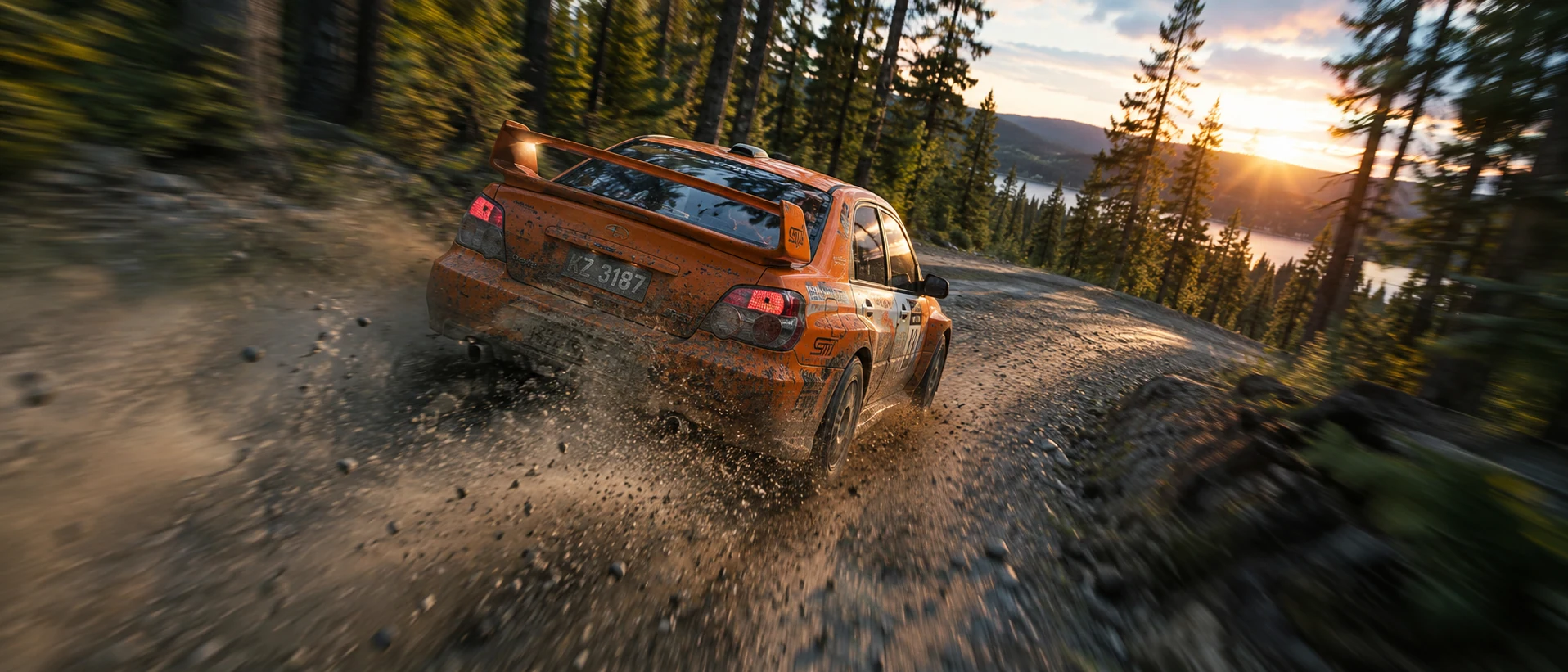
This is the chase variant. 3 meters behind and 2 meters above with a tilt down places the camera in the pocket a heavy FPV rig flies to stay locked on a car. The banked horizon and the trunks streaking past the frame edges carry speed into a still. The 21:9 frame gives the forest room on both sides, like a feature-film car sequence.
Open FlashBoardsCamera: a fast, continuous first-person flight forward, about 1 meter above the cobbles, already moving at speed from the first frame. The camera closes on the cyclist, banks right and slips past her left shoulder, levels out and shoots through the open stone archway, then rises about 3 meters into the sunlit courtyard and curves left around the round stone fountain, still moving at the end. Action: the cyclist is already pedaling hard down the alley, the striped awnings and hanging bulbs flicking past both edges of the frame. In the middle she glances up as the camera overtakes her and passes into the arch's shadow. At the end the courtyard is bright and open, water sprays from the fountain and she rolls in through the archway behind the camera.Already moving at speed from the first frame stops the model from opening on a still and creeping in. The route is spelled out step by step: close in, bank, pass, level, go through the arch, rise, curve. That order is what makes it read as an FPV flight rather than a straight push. Every place on the route (awnings, arch, courtyard, fountain) is already in the start frame, so nothing new has to be invented, and the cyclist gives the camera something to overtake.
Open FlashBoardsCommon mistakes
- The aircraft appears in the frame. The word drone often puts a quadcopter in the picture. Describe the viewpoint instead: first-person flying camera view, 1 meter above the ground.
- Too high, too calm. Without a height, models float the camera tens of meters up and you get an aerial shot. State the height in meters and put objects close to the lens on both edges.
- A level, gimbal-smooth glide. Say horizon banked 12 degrees, banks right, rolls into the turn, so the camera flies rather than slides.
- The gap turns into a cut. Video models sometimes morph or jump when the camera reaches a doorway. Keep the opening wide and visible in the start frame, and write shoots through the open archway as one continuous action.
- A slow push instead of flight. With a vague move, MiniMax H3 Max Turbo creeps forward on the still. Say already moving at speed from the first frame and give the route several beats.
- A frozen world. If only the camera moves, the scene looks like a model set. Give the people and elements something to do from the start: pedaling, spraying water, dust.
Keep the reference frames, prompts and every generated take side by side — images and video in one canvas.
FAQ
5 questionsWhat is an FPV drone shot?
An FPV drone shot is filmed by a small, agile drone that a pilot flies by hand while watching a live feed in video goggles. Because it isn't locked to GPS and can bank, flip and dive, the camera can race low over the ground, weave between obstacles and fly through doorways and gaps in one continuous move, turning a location into a ride for the viewer.
What is the difference between an FPV drone and a regular drone?
A regular camera drone hovers by itself, holds its position with GPS and carries the camera on a gimbal, so it is best at smooth, high, level aerial moves. An FPV drone is flown manually through goggles, has no automatic leveling and is far more agile. It trades stability for the ability to fly fast, low and close, bank into turns and pass through tight spaces.
What is a cinewhoop shot?
A cinewhoop shot is filmed with a small FPV drone whose propellers are enclosed in protective ducts. It flies slower and safer than a freestyle quad, so it can go indoors and pass close to people. Cinewhoops are the usual tool for FPV fly-through one-takes of restaurants, hotels, homes and venues, where the camera glides through rooms, doorways and stairwells.
How do you make an FPV fly-through look good?
Plan the route before anyone flies: the start, every gap, the heights and the final frame. Fly low and close so foreground rushes past the lens, use a wide lens, shoot at 50 or 60 fps with ND filters for natural motion blur, and stabilize from gyro data while keeping some banking. Give the flight a destination, such as a character or reveal, so it reads as story, not showreel.
Can you make an FPV drone shot with AI?
Yes. Generate a start frame that states the FPV cues: camera about a meter above the ground, ultra-wide lens, horizon banked, objects rushing past the edges and a visible gap or destination ahead. Then animate it with an image-to-video model and describe the route step by step, with the camera already moving at speed from the first frame. In FlashBoards you can keep every take on one board and compare flights.
Related terms
6- Aerial ShotCamera Shots
An aerial shot is filmed from a camera in the air — a helicopter, drone or plane — high above the scene, revealing geography, scale and movement across a landscape or city that no ground position could show.
- Pass-Through ShotCamera Movement
In a pass-through shot the camera seems to travel through a solid barrier — a window, a keyhole, a gap in a wall or even a character — carrying the viewer from one space into the next without a visible cut.
- Tracking ShotCamera Movement
A tracking shot moves the camera through space with a moving subject — on a dolly, Steadicam, vehicle or drone — following, leading or flanking it so the audience travels with the action.
- Car Chase SceneDirecting & Staging
A car chase is staged as a map of routes, speeds and obstacles: the director keeps screen direction and the distance between pursuer and pursued readable while stunt drivers, camera cars and editing build velocity.
- Wide-Angle LensLenses, Focus & Exposure
A wide-angle lens has a shorter focal length than normal: it takes in more space, exaggerates the distance between near and far, and enlarges whatever is close to the camera — from immersive interiors to unsettling, distorted close-ups.
- Camera MovementCamera Movement
Camera movement is any change of the camera's position or direction during a shot — pans, tilts, dollies, cranes, handheld and more — used to guide attention, reveal space and set the emotional rhythm of a scene.
Further reading
Blain Brown, Cinematography: Theory and Practice (Routledge). Gustavo Mercado, The Filmmaker's Eye (Focal Press). FAA, Small Unmanned Aircraft Systems (Part 107) rules.