 FlashBoards Learn
- Learn
- Camera Movement
- Pass-Through Shot
Camera Movement · Film language
Pass-Through Shot
Also called: fly-through, portal shot, pass-through / portal path
A pass-through shot is a camera move that seems to travel through a solid barrier, such as a window, a keyhole, a curtain or even a character, carrying the viewer from one space into the next without a visible cut. It turns a boundary into a doorway.
- What it does
- Carries the audience across a barrier from one space into another in what reads as a single move.
- Use it when
- You want to connect outside and inside, observer and observed, or two scenes without cutting.
- Watch out
- The barrier must be readable before you cross it, or the move plays as a plain push-in.
- Try this prompt
Camera glides from a rainy street through an open lit window into a warm kitchen, one continuous move, 24mm lens
What is a pass-through shot?
A pass-through shot is defined by a threshold. The camera starts on one side of something that should stop it and ends on the other, and the audience never sees the join. It is also called a fly-through or portal shot.
The barrier can be really open (a raised sash, parted curtains, a doorway) or impossible (a closed pane, a keyhole, a wall), in which case a hidden cut or a digital stitch does the work. Underneath, it is usually a push-in on a dolly, crane, cable rig or drone, one of the showiest moves in camera movement.
Why do filmmakers use pass-through shots?
To break into private space. Crossing a window line makes the viewer an intruder. The opening of Psycho (1960) travels across Phoenix and slips under a hotel window blind, the cut hidden in its shadow.
To connect scenes. In Citizen Kane (1941) the camera climbs over a nightclub roof, through its sign and down through a rain-streaked skylight, the join disguised by rain and lightning.
To show an impossible camera. Panic Room (2002) glides through a whole house in one computer-assisted move, even through the handle of a coffee pot, mapping the building's geography.
How to shoot a pass-through shot
Open the barrier for real. Remove the glass, build a wild wall on hinges or leave a curtain gap of about 60 cm, opened by grips just out of frame.
Pick a rig that fits the gap. A remote head on a crane or telescoping arm reaches through a window from outside; a small ducted drone threads doorways (see the FPV drone shot). For a keyhole or mail slot, use a probe lens or a macro insert.
Lens, focus, light. An 18 to 28mm lens keeps the frame edges and the room beyond readable. Plan a focus pull from the threshold to the subject, and balance exposure so the interior doesn't blow out.
Hiding the cut: wipes and digital stitches
When the barrier can't open, shoot two takes and join them inside it: take A pushes up until the glass or wall fills the frame, take B starts in the same darkness and pulls clear on the far side. Match lens, speed and direction; a door frame, pillar or passing body hides the join. These are the tools of a seamless transition, but there the goal is to hide an edit; here the journey through the barrier is the point.
Pass-through shot vs. infinite dolly
A pass-through crosses one barrier and arrives somewhere specific. An infinite dolly chains push-ins through door after door, so forward motion itself becomes the subject. If the shot lands on a character or room that matters, it's a pass-through; if it could keep going forever, it's an infinite dolly.
Pass-Through Shot in motion


9 clipsWatch the threshold: a window frame, curtains, a door jamb or a person frames the view, then slides off the edges as the camera crosses.
How to create a pass-through shot with AI
3 promptsVideo models cross a barrier only when the start frame shows the opening and what lies beyond it. Nano Banana 2 Lite builds that frame outside a window, GPT Image 2.5 tries a keyhole take, and MiniMax H3 Max Turbo animates the crossing. Keep the clips, stills and every take on one FlashBoards board to compare them.
Cinematic film still at night, camera outside a second-floor apartment window 1.5 meters from the sill, 24mm lens at sill height, the lower sash raised wide open, thin white curtains stirring at both sides, red brick wall framing the edges. Through the opening a warm lamp-lit kitchen: a woman in her sixties with cropped silver hair, round tortoiseshell glasses and a mustard cardigan pours tea at a wooden table. Cool blue night outside, warm amber inside.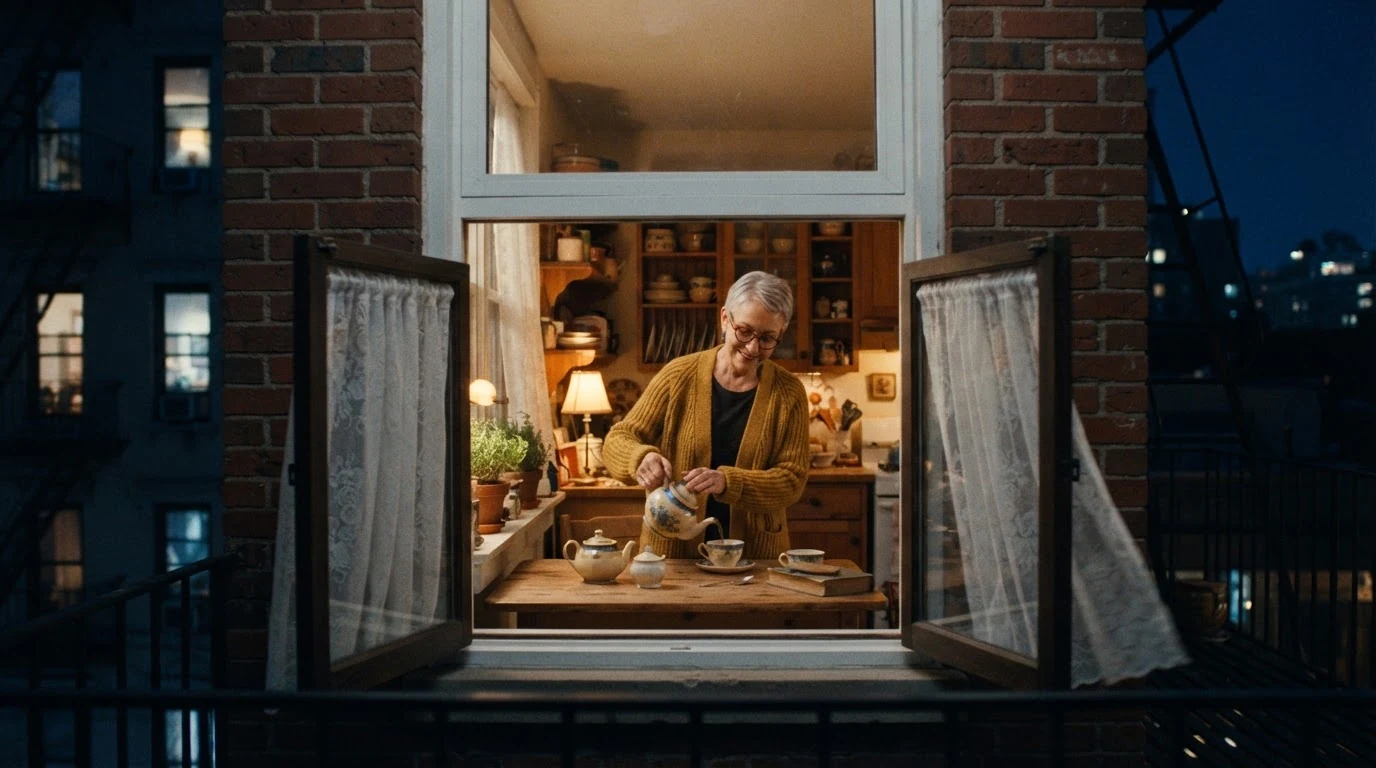
Camera outside the window, sash raised wide open and brick wall framing the edges build the frame the camera will cross. The kitchen and the woman are visible through the gap, so the video model has a real destination.
Open FlashBoardsCinematic film still, extreme close shot through an old iron keyhole in a dark oak door, the keyhole sharp and black-edged in the center, 100mm macro lens. Through the keyhole, in focus, a bright library where a young man with a short red beard and a navy waistcoat reads a letter by a green desk lamp. Anamorphic widescreen, deep shadow, one bright opening.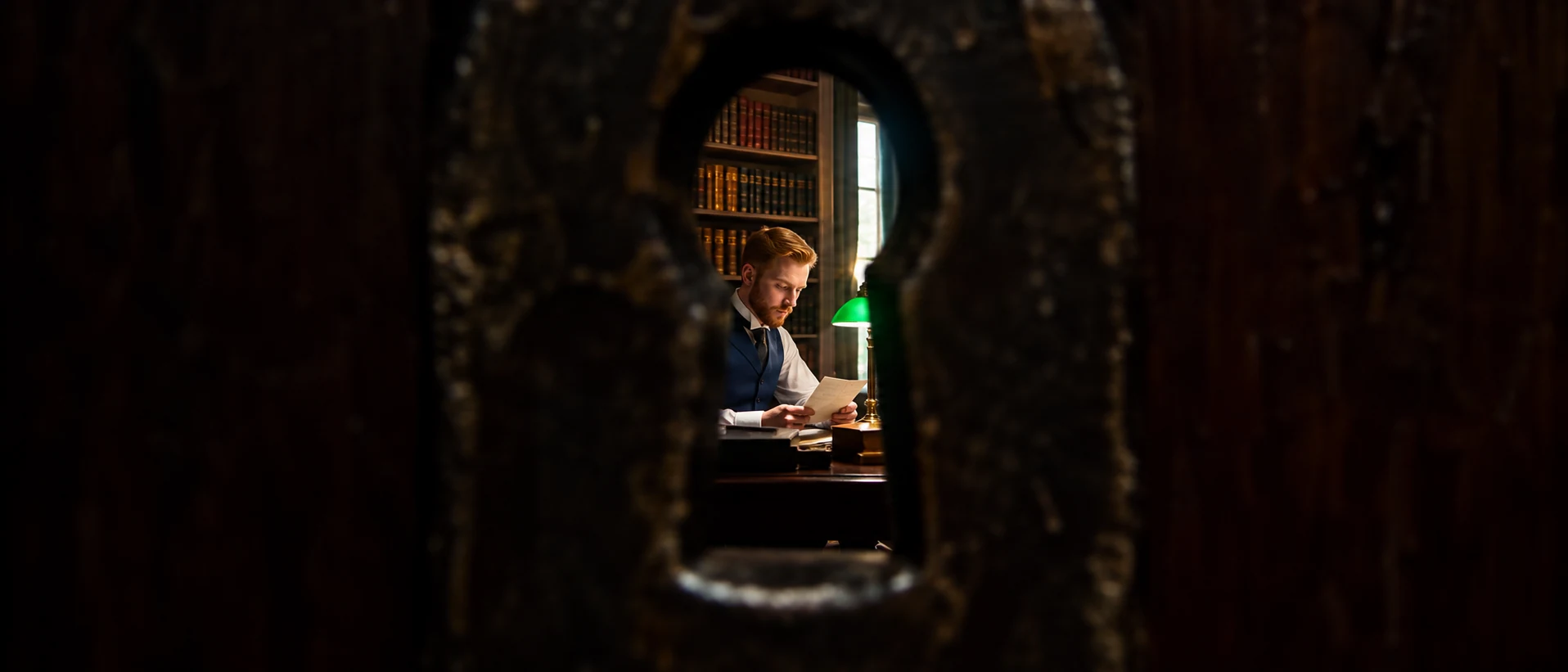
100mm macro gives the probe-lens look. Sharp and black-edged in the center keeps the barrier readable, and through the keyhole, in focus stops the model from blurring the room the camera is heading for.
Open FlashBoardsCamera: already gliding forward at walking pace from the first frame, the camera moves straight to the open window, passes through the gap under the raised sash between the curtains in one continuous move, crosses the sill and slows to a stop at a medium shot of the woman at the table. Action: the curtains ripple in the breeze from the start. As the camera enters, the woman keeps pouring tea. At the end she sets the teapot down and looks up toward the window.Already gliding forward from the first frame prevents a slow creep on a still. Passes through the gap in one continuous move names the crossing; slows to a stop at a medium shot gives it a destination.
Open FlashBoardsCommon mistakes
- The camera stops at the glass. Say the window is open, sash raised and write passes through the gap as one action.
- A jump instead of a crossing. Keep the opening large in the start frame.
- An invented room. Show the interior through the opening, or the model makes one up.
- A flat push-in. Put brick or curtains close to the lens so the edges slide away.
Keep the reference frames, prompts and every generated take side by side — images and video in one canvas.
FAQ
4 questionsWhat is a pass-through shot in film?
It is a camera move that appears to travel through a barrier, such as a window, curtain, keyhole, wall or person, into the space beyond without a visible cut. It is done through a real opening, with a cut hidden inside the barrier, or with a digital stitch between two matched takes.
How do you make the camera pass through an object?
Either open the object for real (remove the glass, hinge the wall, part the curtains) and move through, or shoot two takes: one pushing in until the object fills the frame, one pulling away on the far side. Match lens, speed and direction, then join them where the frame goes dark.
Is a fly-through the same as a pass-through shot?
Mostly. Fly-through usually describes a drone or CG camera traveling through a space at speed. A pass-through focuses on the moment of crossing a barrier. Many FPV drone shots include one when they thread a doorway, a window or a gap between trees.
What is the difference between a pass-through shot and a seamless transition?
A seamless transition hides an edit inside matching motion or a dark wipe. A pass-through is about the journey: the audience is meant to notice that the camera went through the window or keyhole, even if a hidden cut helped.
Related terms
5- FPV Drone ShotCamera Movement
An FPV shot is flown with a small, agile drone piloted through video goggles, letting the camera dive, weave and thread through gaps, doorways and crowds in one continuous rollercoaster-like move.
- Macro ShotLenses, Focus & Exposure
A macro shot uses a macro lens, extension tubes or diopters to focus extremely close and fill the frame with tiny details — the iris of an eye, a match head catching fire, an insect — at life size or larger.
- Seamless TransitionEditing
A seamless transition hides the cut inside matching motion, a camera move, a dark object crossing the lens or a shared shape, so two shots play as one continuous action.
- Film TransitionsEditing
Transitions are the ways one shot or scene gives way to the next — the plain cut, dissolve, fade, wipe, match cut and hidden or stylised moves like whip and mask transitions.
- Camera MovementCamera Movement
Camera movement is any change of the camera's position or direction during a shot — pans, tilts, dollies, cranes, handheld and more — used to guide attention, reveal space and set the emotional rhythm of a scene.
Further reading
Blain Brown, Cinematography: Theory and Practice, chapters on camera movement and rigging. Steven D. Katz, Film Directing Shot by Shot, on moving-camera staging.