 FlashBoards Learn
- Learn
- Cameras & Capture
- Forced Perspective
Cameras & Capture · Film language
Forced Perspective
Also called: forced perspective shot
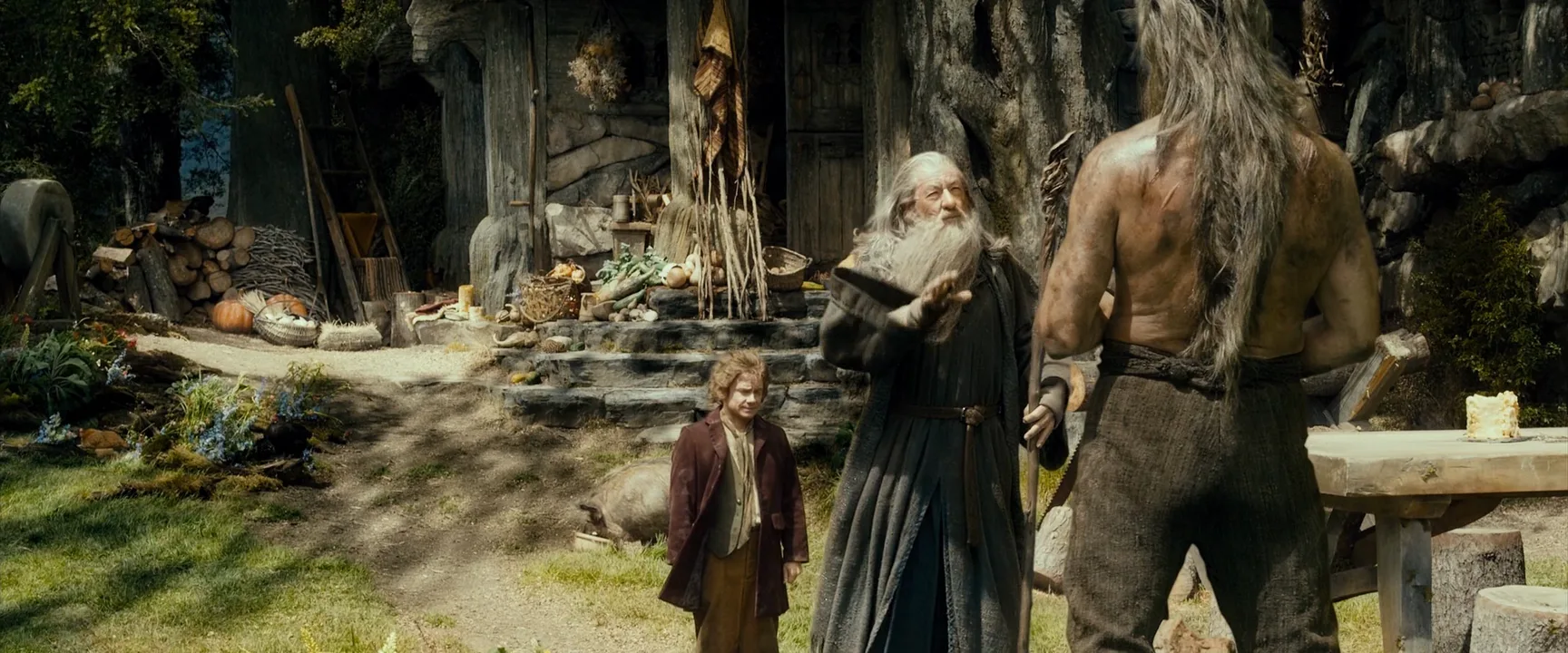
Forced perspective is an in-camera illusion: actors, sets or models are placed at carefully chosen distances from the lens so they read as bigger, smaller, nearer or farther than they are. Because the camera sees only size on the frame, not distance, the viewer accepts a giant beside a hobbit.
- What it does
- Turns distance into apparent size: whatever is closer to the lens looks bigger, whatever is farther looks smaller.
- Use it when
- Two characters of the same height must read as giant and tiny, or a small set or model has to pass for a full-size place.
- Watch out
- Any camera move, soft focus or mismatched light reveals the gap between the planes and the trick collapses.
- Try this prompt
Locked-off wide shot, forced perspective: a huge bearded man at a farmhouse table beside a tiny woman at its far end, both razor sharp, deep focus
What is forced perspective?
On a flat frame, apparent size depends on two things only: real size and distance from the lens. Double the distance and a person fills half the frame height. Forced perspective hides the depth cues, so the audience reads distance as size.
Architects used the trick long before cinema; film locks the viewpoint to one lens, which makes it far more reliable. Among camera and capture techniques it is a core practical effect: made on set, with actors playing against each other.
Why do filmmakers use forced perspective?
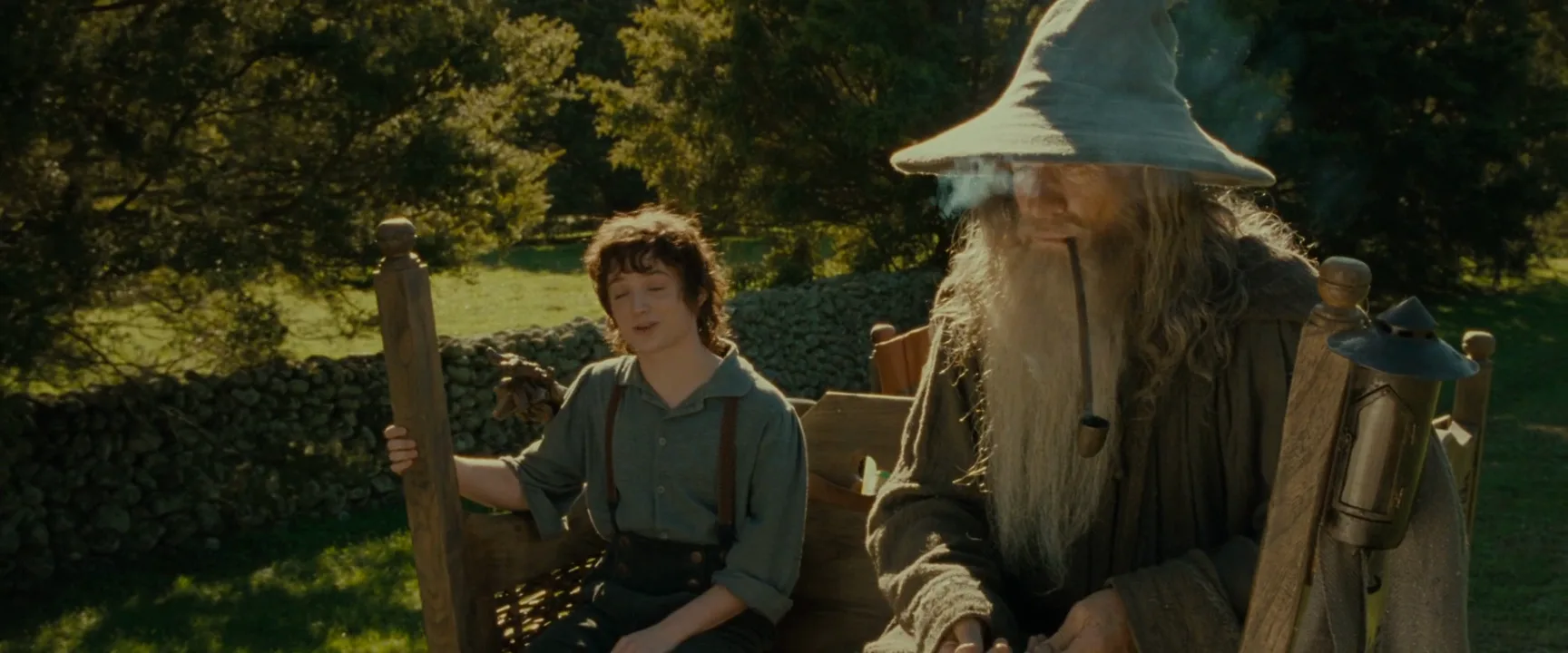
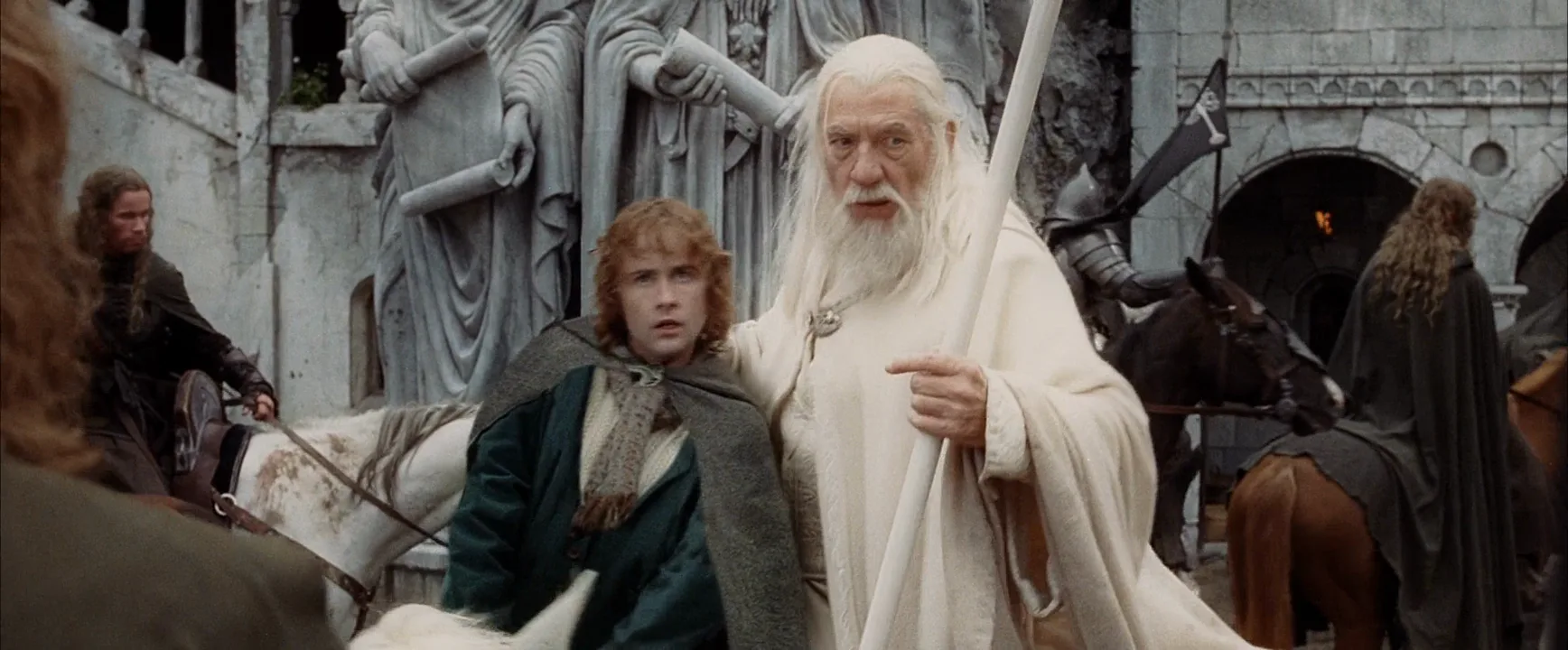
To make scale feel physical. In The Lord of the Rings trilogy (2001–2003), hobbit actors sat farther from the lens on sets built in two depths. Both actors share one space and one sun.
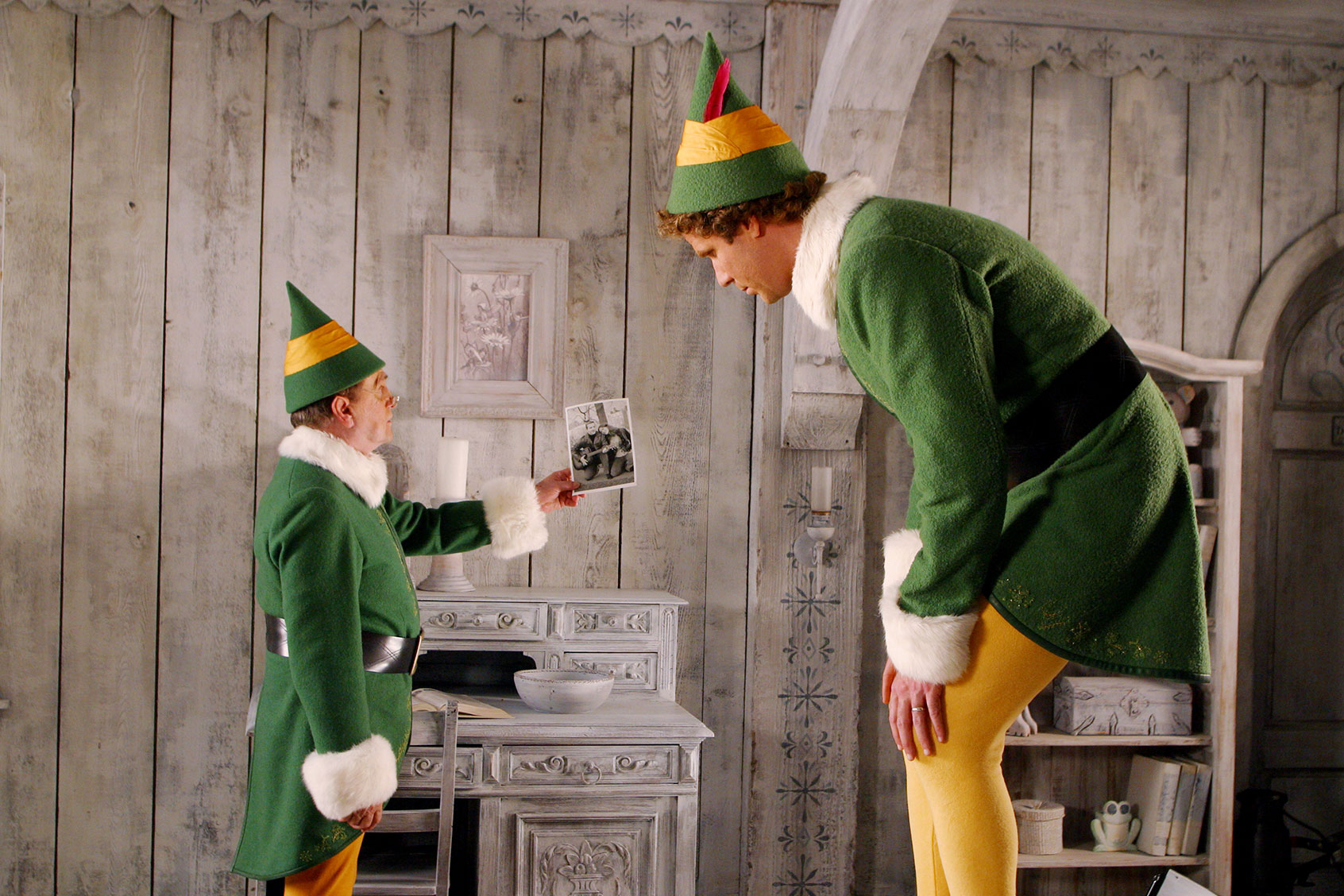
To keep comedy in camera. Elf (2003) staged Buddy among the elves in camera rather than compositing, which gives the North Pole its handmade charm.
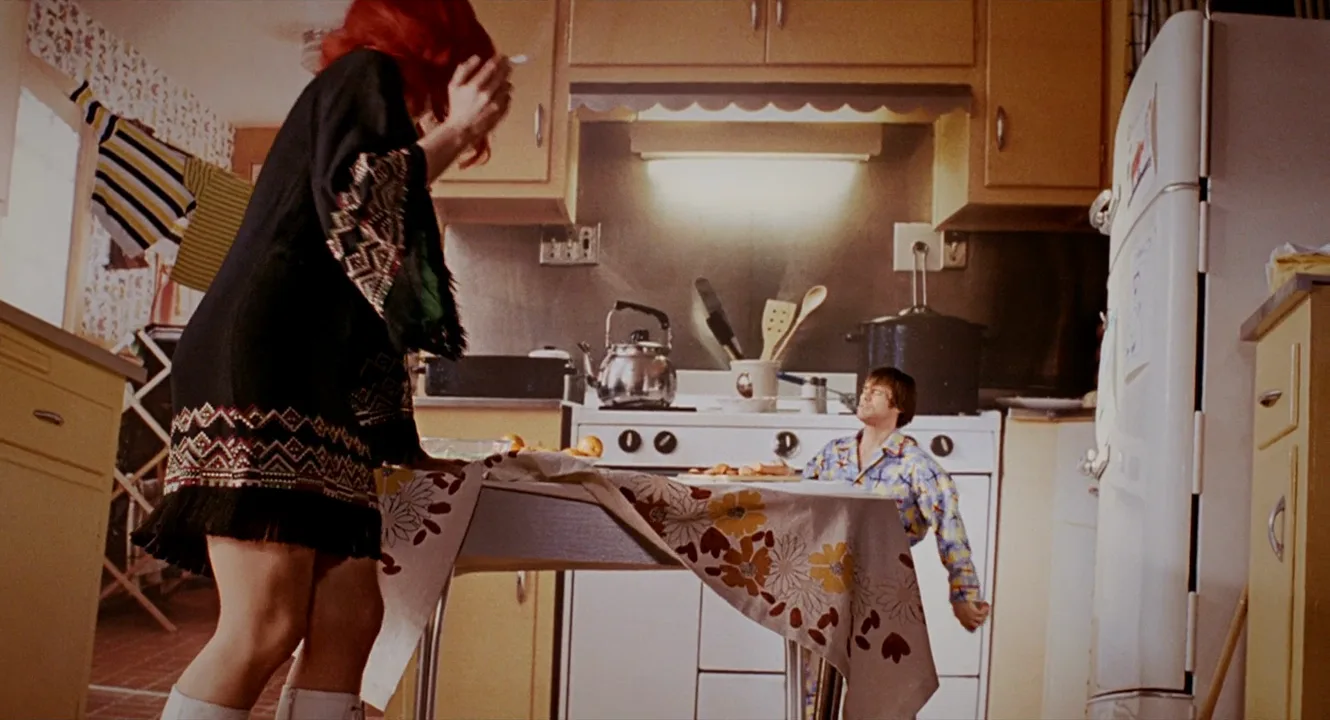
To shrink an adult into a child. Eternal Sunshine of the Spotless Mind (2004) uses oversized furniture and distance to turn Joel into a small boy inside his own memory.
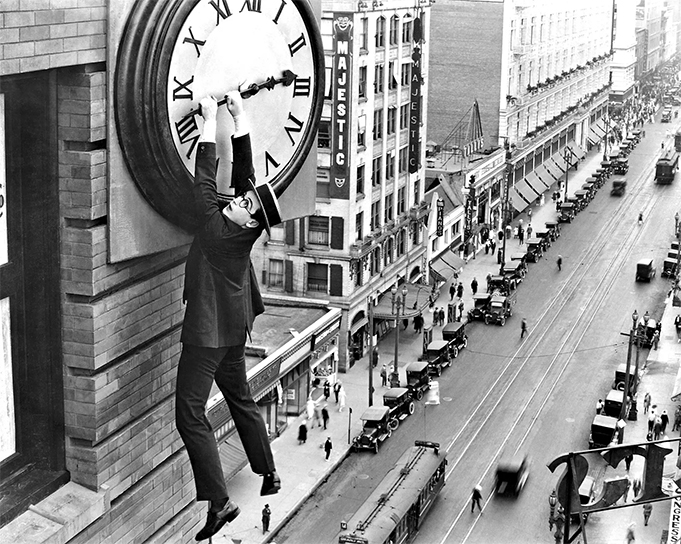
To fake height. Safety Last! (1923) built its clock set on a rooftop, angled so the street seems to drop straight below.
How to shoot a forced perspective shot
- Do the distance math. For half size, put the far actor twice as far from the lens as the near one: 2 m and 4 m. For one-third size, three times as far.
- Hold everything in focus. A soft far plane reads as far away. Stop down to f/8–f/16 on an 18–35 mm lens for deep focus. A wide-angle lens exaggerates the size difference.
- Lock the camera. Any move creates parallax between the planes.
- Build the join. Split the prop where the planes meet: a table in two sections at different depths, with an edge that hides the seam. Keep the camera near the height of the join.
- Cheat the eyelines. Give each actor a mark for the other's on-screen position.
- Match the light. Same direction, hardness and color on both planes, with consistent shadows.
- Watch the background. Plan the depth layering so nothing at true scale walks through.
Can the camera move in a forced perspective shot?
Traditionally no: parallax breaks the illusion as soon as the camera travels. The Fellowship of the Ring (2001) solved it by moving the far part of the set on a motorized platform synced to a computer-controlled camera.
Forced perspective vs. tilt-shift
Both lie about scale. Forced perspective uses distance and placement, with everything sharp so depth cannot be read. Tilt-shift uses focus: a thin sharp band across a high view makes a full-size town read as a model, shrinking the whole world.
Forced Perspective examples in film
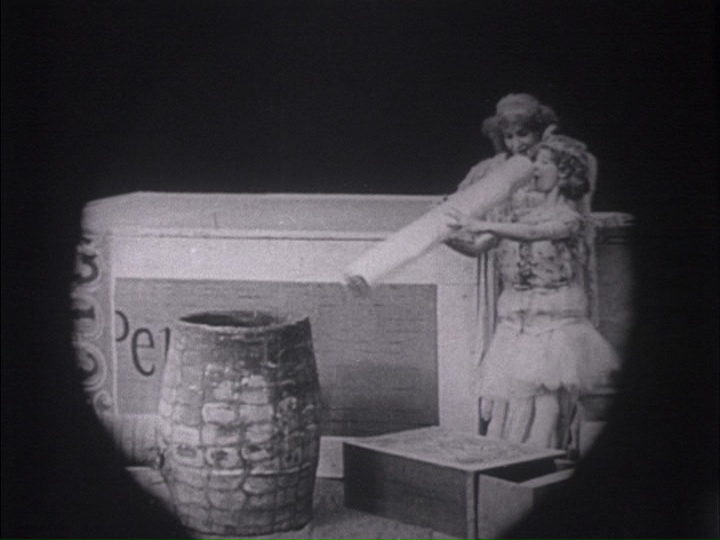
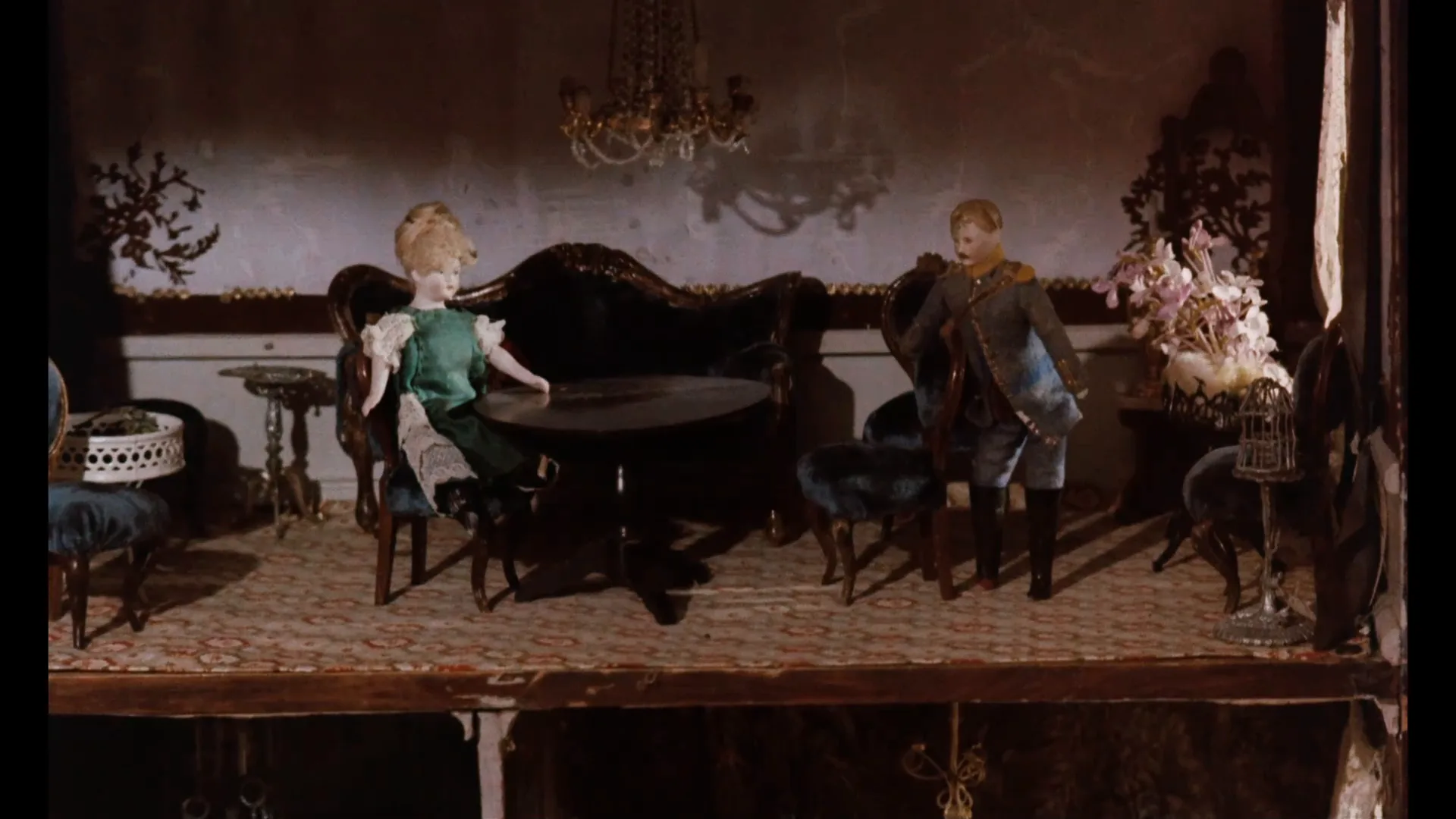
8 framesFrames where distance does the work of size.
How to create a forced perspective with AI
4 promptsImage models draw giants that look like costumes or composites. Name the real mechanics instead: people at different distances, deep focus, a locked-off wide lens, a prop hiding the join. Compare takes on one FlashBoards board. The fourth prompt re-shoots a real film shot from a text description alone, and the original plays next to the result so you can compare.
Forced perspective film still, locked-off wide shot, 24mm lens at f/11, camera at seated eye height. A long farmhouse table runs away from camera. At the near end a broad-shouldered man in his fifties with a shaved head, a copper-red beard in two braids and a cream fisherman's sweater holds a huge teapot, filling the left half of frame like a giant. Eight meters away, seated in the centre of frame at the far end of the same table with its whole length of bare wood between them, a slim woman in her thirties with a short black bob, freckles and a yellow raincoat faces him and looks doll-sized, no taller than his teapot, and lifts a tiny cup toward him. Deep focus, both faces razor sharp, warm window light from the right.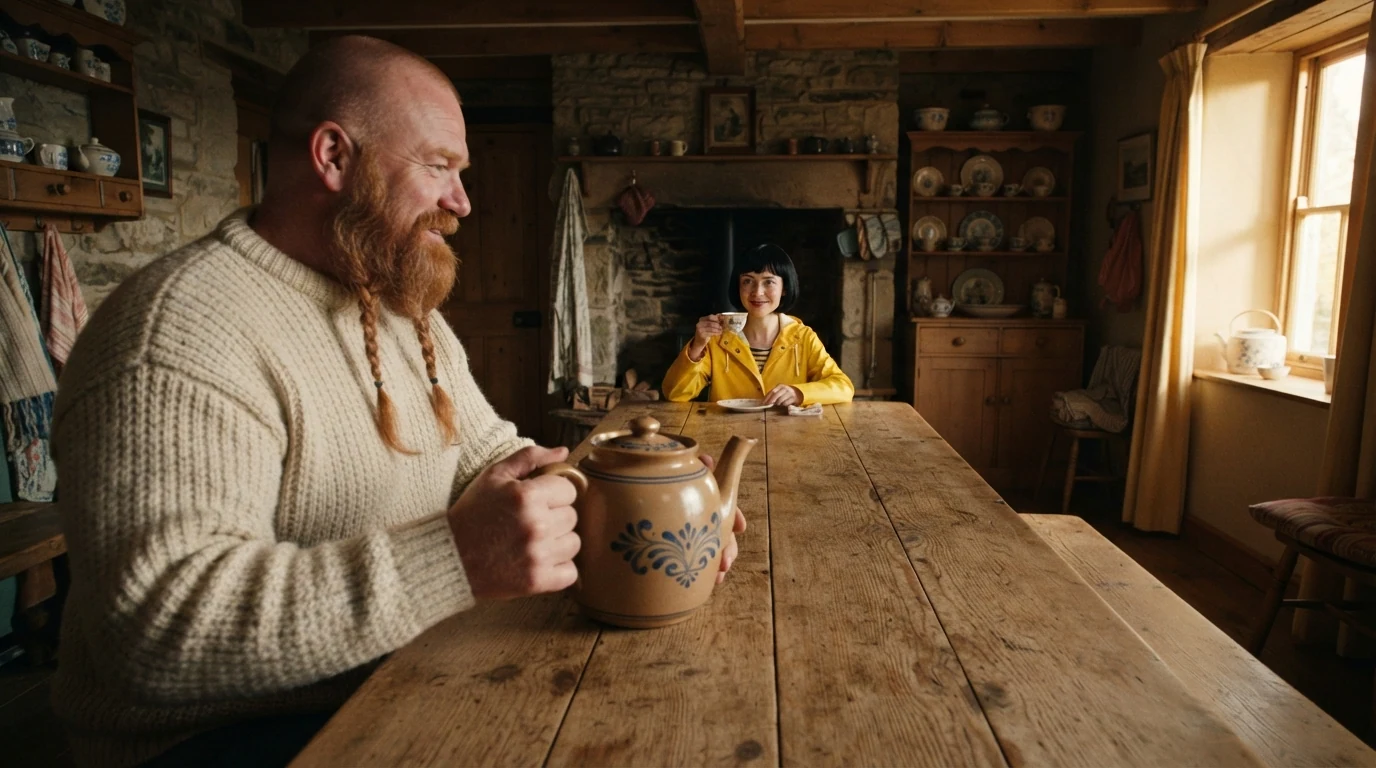
"f/11" and "deep focus, both faces razor sharp" hide the distance; "the same table" masks the gap; one light direction sells one space.
Open FlashBoardsCinematic forced perspective shot in a sunny meadow, static wide frame, 28mm lens, sharp to the horizon. In the right foreground a kneeling girl of about ten with curly auburn hair and a green cardigan holds her open palm flat. Forty meters behind her, on a low stone wall, a lean old man with a white goatee, round spectacles and a long brown coat stands with arms spread, lined up so he appears to stand on her palm. Low sun from the left, matching long shadows.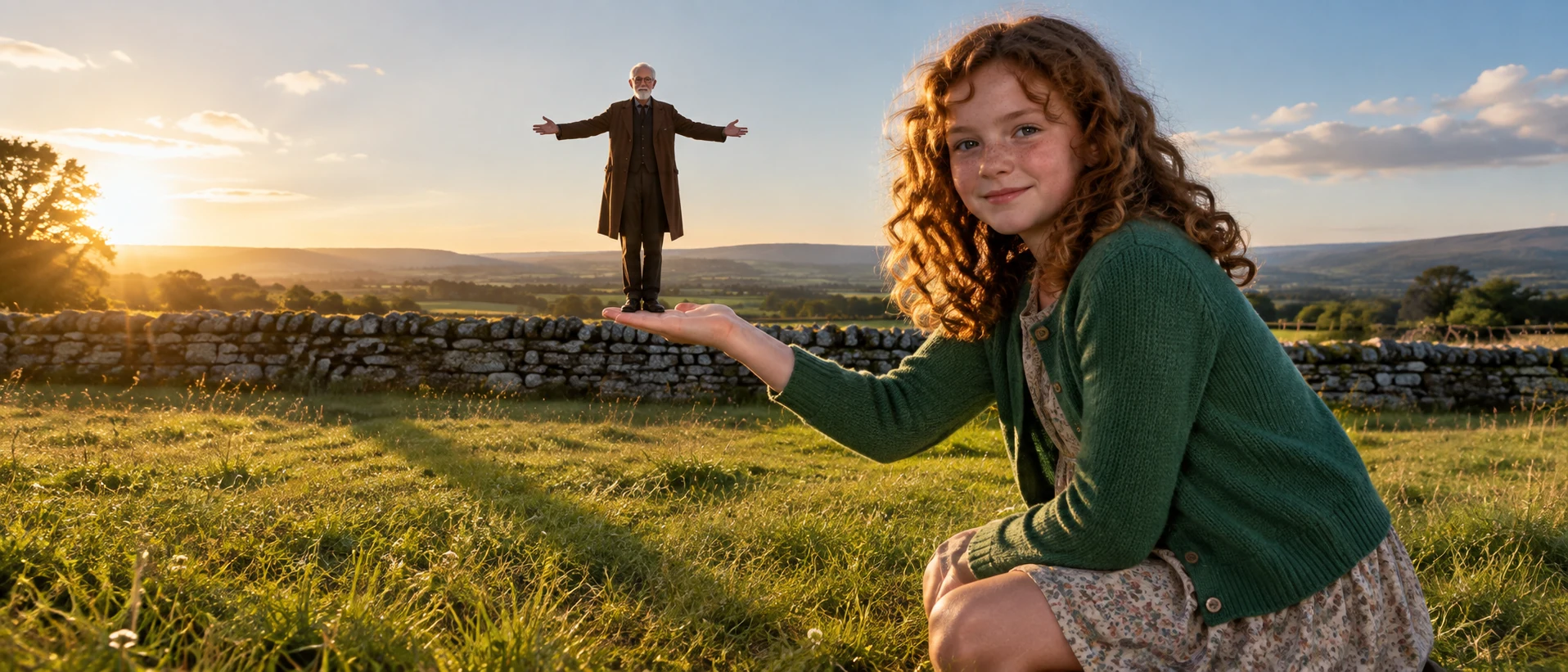
Now the far figure becomes tiny. "Lined up so he appears to stand on her palm" describes the placement; "matching long shadows" keeps one light on both planes.
Open FlashBoardsCamera: locked off on a tripod, framing stays exactly the same, both ends of the table stay sharp. Action: from the first moment the bearded man is already pouring a steady stream of tea from the huge teapot while the small woman at the far end raises her tiny cup toward him. He sets the teapot down and laughs; she sips and nods. Both stay seated in their places."Locked off" protects the illusion; "already pouring" makes the shot alive from frame one; "stay seated in their places" keeps the planes from drifting.
Open FlashBoards{
"output": "Full-screen live-action scene from The Lord of the Rings: The Fellowship of the Ring (2001) from its very first frame: one continuous shot with no cuts. 35mm film look, bright late-morning summer sun from behind and upper left of the travellers, golden rim light on hair, hat brim and shoulders, dappled leaf shadows, deep green meadow, a long dry-stone wall and dark trees behind. Forced perspective: the two travellers seem to share one wooden cart bench, but the passenger's half of the bench is built farther back from the lens, so the young man on the left reads about half the size of the old man on the right while both stay sharp.",
"characters": {
"S1": {
"name": "Gandalf, played by Ian McKellen",
"look": "very tall old man, long flowing grey beard to his chest, long grey hair, wide-brimmed tall pointed grey hat, heavy grey wool robe and cloak, a long thin wooden pipe clenched in his teeth, big weathered hands",
"voice": "deep, warm, amused, a little dry"
},
"S2": {
"name": "Frodo, played by Elijah Wood",
"look": "slight young man with adult proportions, pale smooth face, bright eyes, thick curly dark-brown hair, pale sage-green collarless shirt with rolled sleeves, dark brown braces, dark trousers",
"voice": "light, bright, affectionate"
}
},
"shots": [
{
"shot": 1,
"camera": "follow shot travelling backward ahead of the cart at the cart's pace, a slow steady dolly out, so the framing holds while the meadow and wall glide past behind; slightly low eye level, medium lens, frontal wide two-shot from the waist up; deep focus with both faces equally sharp; the carved wooden backrest runs unbroken behind both and hides that S2's seat sits a full meter deeper, farther from the lens; a tall carved bench post stands at the left edge of frame and another post with a small brass lantern at the right edge",
"action": [
"BEGINNING: alive from the first frame, the cart already rolling toward camera; S1 sits right of centre, big and close, his hat brim near the top edge, the pipe hanging from his mouth, both hands low in his lap holding the leather reins, eyes on the road ahead past the left side of camera; S2 sits in the left third, small beside him, his head only level with S1's chest, his right hand gripping the carved post at the left edge, his left hand resting in his lap, face turned up to S1 with a small smile; S1 starts talking around the pipe.",
"THEN: S1 keeps his eyes on the road and his hands on the reins; S2 keeps looking up at him, listening, the smile growing; the bench sways gently and both bodies rock together.",
"THEN: S2 answers, smiling up at S1, eyebrows lifting; S1 draws on the pipe and blows out a big cloud of white smoke that drifts to the right and back over his hat brim.",
"THEN: through the fading smoke S1 answers with a faint smile, still facing the road; S2 grins.",
"END: S2 turns his face forward toward the road and says his last words, his right hand still on the post; the cart rolls into the shade of the trees and the frame dims; S1 still holds the reins, pipe in his teeth, S2 still half his size, both sharp."
],
"dialogue": [
{
"speaker": "S1",
"on_screen": true,
"when": "from the first frame",
"delivery": "amused, conversational, speaking around the pipe",
"line": "<d>[English] I hear it's going to be a party of special magnificence.</d>"
},
{
"speaker": "S2",
"on_screen": true,
"when": "right after S1 finishes, while looking up at him",
"delivery": "fond, teasing",
"line": "<d>[English] You know Bilbo. He's got the whole piece in an uproar.</d>"
},
{
"speaker": "S1",
"on_screen": true,
"when": "after the smoke cloud, as it fades",
"delivery": "dry, pleased",
"line": "<d>[English] Well, that should please him.</d>"
},
{
"speaker": "S2",
"on_screen": true,
"when": "at the end, as he turns his face to the road",
"delivery": "cheerful",
"line": "<d>[English] Half the Shire's been invited.</d>"
}
]
}
],
"sound": {
"ambience": "cart wheels rolling on a dirt lane, steady hoofbeats of the horse ahead of the cart, creak of the wooden bench, birdsong across the meadow",
"speech": "exactly these spoken phrases, each said once, in this order",
"never_spoken": "no narration and no voice-over: the descriptions, performance notes and step words of this prompt are never spoken aloud",
"music": "a film score under the scene, always below the voices: a light pastoral tune on tin whistle over soft warm strings",
"subtitles": "none"
}
}Remakes the cart shot from The Lord of the Rings: The Fellowship of the Ring (2001), dir. Peter Jackson, DP Andrew Lesnie: the backward-travelling two-shot, Frodo small on the left and Gandalf big on the right, the pipe smoke and the four spoken lines carried over.
The trick sits in camera: the backrest hides that S2's seat sits a full meter deeper, so Frodo reads half Gandalf's size on one bench. Travelling backward at the cart's pace holds the framing, and the four lines come verbatim from the film.
Common mistakes
- Shallow focus. A blurred far actor reads as far. Write "deep focus, both faces razor sharp".
- A fantasy giant or a child. Describe ordinary adults at different depths of one object.
- Two lights. Name one light source.
- Camera drift. Say the camera stays locked off.
- Eyelines. Say who looks at whom.
Keep the reference frames, prompts and every generated take side by side — images and video in one canvas.
FAQ
4 questionsWhat is forced perspective in film?
Forced perspective is an in-camera illusion. Actors or objects are placed at chosen distances from the lens so that, on the flat frame, they look larger or smaller than they are. With deep focus and a locked camera, two people of the same height read as a giant and a tiny figure.
What are famous forced perspective examples in movies?
The Lord of the Rings trilogy staged hobbit and wizard scenes on sets built in two depths. Elf (2003), Eternal Sunshine of the Spotless Mind (2004) and Safety Last! (1923) used it for comedy, memory and a fake skyscraper drop.
How did The Lord of the Rings use forced perspective?
Props and sets were built in two parts at different distances from the camera, with the hobbit actors on the farther part. For some moving shots, part of the set rode a motorized platform synced to a computer-controlled camera.
Is forced perspective a practical effect or CGI?
It is a practical, in-camera effect: the illusion exists on set and in the lens, not in post. Productions sometimes paint out a seam digitally, but the size relationship is captured live, with the actors performing together.
Related terms
4- Tilt-ShiftLenses, Focus & Exposure
A tilt-shift lens can tilt its plane of focus relative to the sensor; tilted to leave only a thin, angled band sharp across a high-angle view of a city or landscape, it makes real places look like toy models.
- Practical EffectsPost-Production & VFX
Practical effects are created physically on set — animatronics, prosthetic makeup, miniatures, pyrotechnics, rain and wind machines — and captured by the camera rather than generated with CGI in post.
- Wide-Angle LensLenses, Focus & Exposure
A wide-angle lens has a shorter focal length than normal: it takes in more space, exaggerates the distance between near and far, and enlarges whatever is close to the camera — from immersive interiors to unsettling, distorted close-ups.
- Depth LayeringComposition & Framing
Depth layering builds a shot in distinct planes — foreground, midground and background — each holding something meaningful, so the flat screen gains volume and several actions or ideas can be read at once.
Further reading
Raymond Fielding, The Technique of Special Effects Cinematography (Focal Press): in-camera scale effects and miniatures. The appendices of The Lord of the Rings: The Fellowship of the Ring extended edition, on the production's forced-perspective sets.