 FlashBoards Learn
- Learn
- Lenses, Focus & Exposure
- Tilt-Shift
Lenses, Focus & Exposure · Film language
Tilt-Shift
Also called: tilt-shift lens, miniature effect, tilt shift effect
A tilt-shift lens can tilt its plane of focus away from the sensor and shift the image sideways without moving the camera. Tilted against a high-angle view of a city, it leaves only a thin, slanted band sharp, and the brain reads the real street as a toy model on a table.
- What it does
- Moves the plane of sharp focus off the parallel, so a thin band or a long slanted surface is sharp and the rest falls away.
- Use it when
- You want a real place to look like a scale model, or need focus along a road or table, or straight verticals on a building.
- Watch out
- The miniature illusion needs height: shot at eye level, the blurred band just looks like a soft, badly focused frame.
- Try this prompt
Tilt-shift miniature photo of a busy town square seen from a rooftop, thin sharp band across the middle, heavy blur above and below, bright sun, toy colors
What is a tilt-shift lens?
Most camera lenses sit parallel to the sensor, so the zone of sharp focus is a flat slab parallel to it too. A tilt-shift lens breaks that with two movements.
Tilt angles the lens against the sensor, and the plane of focus swings with it (the Scheimpflug principle: sensor, lens and focus planes meet along one line). Tilted toward the ground, the focus plane can lie along a road, sharp from near to far even at a wide aperture. Tilted the other way, it cuts steeply through the scene and leaves only a narrow band sharp.
Shift slides the lens parallel to the sensor, reframing without pointing the camera, so the verticals of a tall building stay straight.
The miniature look is one use of tilt, not the definition of the lens.
Why does tilt-shift make things look miniature?
We judge scale from blur. Photograph a model train from a few centimeters and depth of field is paper-thin: one strip is crisp, everything else melts. A real town seen from 100 m should be sharp front to back.
Reverse tilt at f/2.8 fakes the first situation inside the second, so the eye concludes the houses are small. It is extreme shallow depth of field placed where it cannot naturally occur.
A high-angle view looking down 30 to 60 degrees, hard sun like a lamp over a model and saturated colors all strengthen the illusion.
Why filmmakers use tilt-shift
To shrink the world. Game Night (2018) shows its suburb like pieces on a game board, a visual joke for a film about a game that gets out of hand. In The Social Network (2010), David Fincher and cinematographer Jeff Cronenweth shot the Henley rowing race with tilt-shift optics, so the regatta plays like a tiny, detached spectacle.
To imply an observer. A model town suggests a giant looking down: fate, surveillance, a story being played with.
To lay focus along a surface. Tilted forward, the lens holds a long table or road sharp without stopping down.
To keep architecture straight. Shift keeps the camera level while framing a tall facade.
How to shoot a tilt-shift miniature shot
- Height. Work from a rooftop, bridge, hillside or crane 20 to 100 m above the action, looking down. Eye level almost never reads as a model. Drone cameras rarely tilt, so drone footage usually gets the band in post.
- Lens. Stills tilt-shift lenses from 17 to 135 mm are often rehoused for cinema. A 24 to 45 mm lens tilted 4 to 8 degrees against the scene at f/2.8 to f/4 gives a band a block or two deep. Put it on the action: the bus, the crossing, the one walker.
- Speed. Toys move fast and jerkily. Undercrank to 6 to 12 fps or shoot a time-lapse, camera locked off so the band stays put.
- Light and grade. Hard sun, clear air, strong color; add saturation and contrast.
- Faking it. A gradient blur mask, sharp in a strip and ramping to heavy blur above and below, works on footage where the top of the frame is farther away than the bottom.
Tilt-shift vs. forced perspective
Forced perspective plays with distance: an actor near the lens towers over one far away, a model close to camera stands in for a castle. Everything can be sharp; the trick is placement.
Tilt-shift plays with focus. Nothing moves, the street stays full size, and the blur alone tells the brain the whole visible world is small, the way a real diorama looks when shot up close.
Tilt-Shift in motion




8 clipsWatch where the sharp band sits and how everything above and below it melts away. Cars, bathers and machines inside that strip look like toys on a tabletop, and the high, downward view is what sells the scale.




How to create a tilt-shift with AI
3 promptsImage models know the miniature look but need its parts spelled out: height, a named band of focus, heavy blur above and below. Build a start frame, try a second take, then animate the first, keeping every take side by side on one FlashBoards board.
Tilt-shift miniature effect photo of a coastal old town seen from a hillside high above, looking down at 45 degrees: terracotta roofs, a small harbor with white boats, a curving road with a red bus and small cars. Only a thin horizontal band across the middle is razor sharp, on the road and the bus; the top and bottom thirds fall into heavy smooth blur, like a macro photo of a scale model. Hard midday sun, saturated toy-like colors.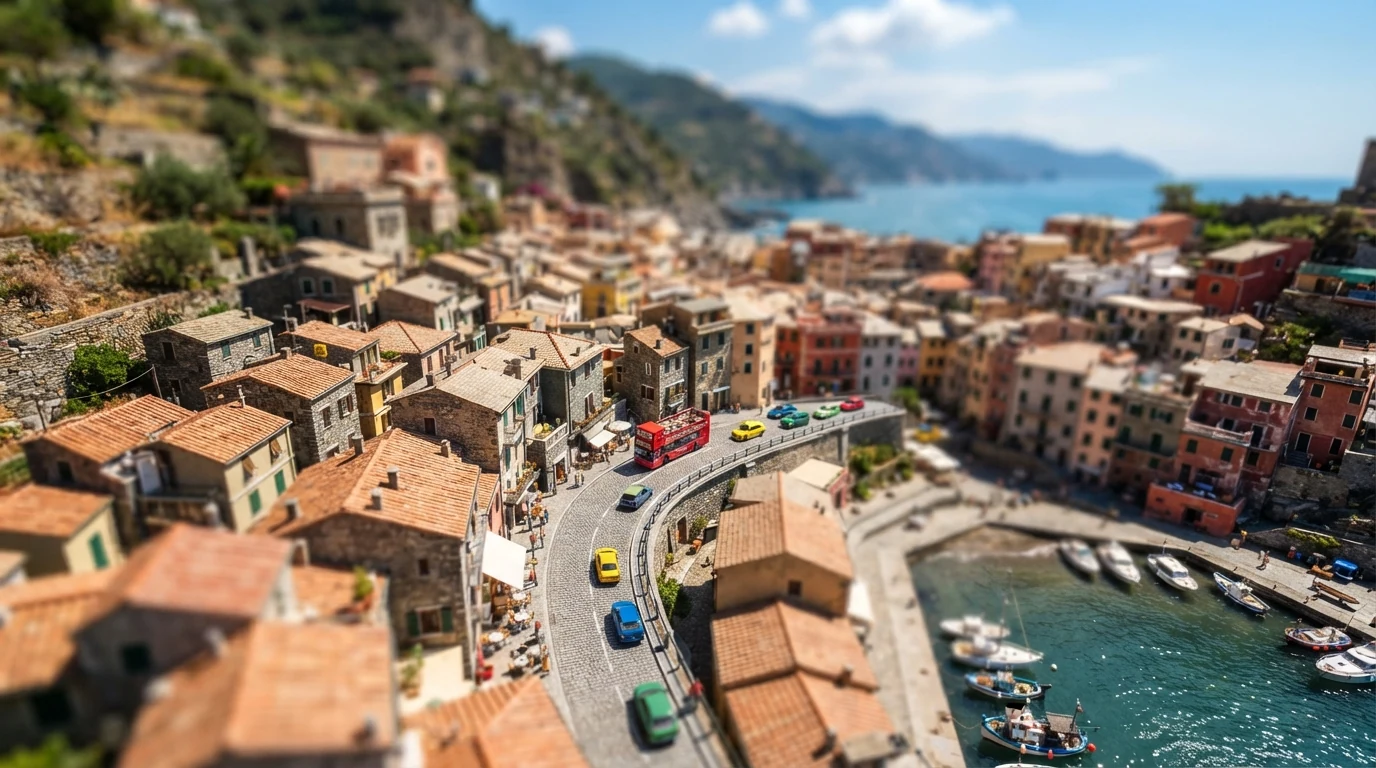
"High above, looking down at 45 degrees" gives the tabletop angle; "thin horizontal band" plus "heavy smooth blur" in named thirds places the focus; "macro photo of a scale model" names the look being copied.
Open FlashBoardsWide tilt-shift photograph of a railway freight yard from a high footbridge, looking down: rows of colorful containers, three orange locomotives, a crane, tiny workers in yellow vests. A narrow band of sharp focus runs diagonally from lower left to upper right along the main track; everything above and below it is heavily blurred. Low afternoon sun, long crisp shadows, vivid colors, like a model railway layout.
The band now runs diagonally along the track, showing that tilt can follow a line in the scene; tiny workers inside it give the eye a scale cue to misread.
Open FlashBoardsCamera: locked-off and static high above the town for the whole shot; the sharp band stays fixed across the middle of the frame. Action: from the first moment the red bus is already driving fast along the curving road while small cars scurry in both directions with quick, jerky motion like wind-up toys. The bus rounds the bend through the sharp band as white boats drift in the harbor, then exits right."Locked-off and static" keeps the band from sliding; "already driving fast" makes the shot alive from frame one; "like wind-up toys" recreates undercranked motion.
Open FlashBoardsCommon mistakes
- Blur everywhere or nowhere. Say where the band is and that the top and bottom thirds are heavily blurred.
- Eye-level framing. Without "high above, looking down" you get a street photo with soft edges.
- Real-speed traffic in video. Ask for fast, jerky, toy-like motion and a static camera.
- Plastic town. Keep "toy" in the look, not the subject: "a real town that looks like a scale model".
Keep the reference frames, prompts and every generated take side by side — images and video in one canvas.
FAQ
4 questionsWhat is a tilt-shift lens used for?
It controls the plane of focus and perspective independently of where the camera points. Shift keeps building verticals parallel; forward tilt holds a long surface sharp without stopping down; reverse tilt creates the miniature effect, where a real city looks like a scale model because only a thin band stays sharp.
What is the tilt-shift effect?
The tilt-shift effect, or miniature effect, makes a full-size scene look like a small model. A very narrow band of focus across a high-angle view, with heavy blur above and below, mimics the shallow focus of a close-up on tiny objects, so the brain reads the houses, cars and people as toys.
How do you make a miniature effect video?
Shoot from 20 to 100 m above moving traffic or crowds with the camera locked off. Use a tilt-shift lens with reverse tilt at f/2.8 to f/4, or add a gradient blur band in post. Undercrank to 6 to 12 fps or shoot a time-lapse so motion looks toy-fast, then push saturation and contrast.
Can you fake tilt-shift without the lens?
Yes. Draw a gradient mask that keeps a strip of the frame sharp and ramps to strong lens blur above and below, then raise saturation. It works best on high-angle footage where the top of the frame is farther away than the bottom, the same geometry a tilted lens exploits.
Related terms
5- Forced PerspectiveCameras & Capture
Forced perspective places actors or objects at carefully chosen distances from the camera so they appear larger, smaller, nearer or farther than they are — the in-camera trick behind giant-and-small scenes shot without digital effects.
- Shallow Depth of FieldLenses, Focus & Exposure
Shallow depth of field keeps only a thin slice of the scene sharp — often just the eyes — while everything nearer and farther dissolves into blur, isolating the subject and steering attention.
- High-Angle ShotCamera Angles
A high-angle shot looks down on the subject from above eye level, shrinking them in the frame and in status — often used to make a character seem small, vulnerable, trapped or overwhelmed.
- Aerial ShotCamera Shots
An aerial shot is filmed from a camera in the air — a helicopter, drone or plane — high above the scene, revealing geography, scale and movement across a landscape or city that no ground position could show.
- Camera LensesLenses, Focus & Exposure
A lens gathers light and focuses it onto film or a sensor; its focal length, maximum aperture and optical character decide the field of view, perspective, depth of field and texture of the image.
Further reading
Harold M. Merklinger, Focusing the View Camera (1993): the Scheimpflug and hinge rules explained for photographers.