 FlashBoards Learn
- Learn
- Post-Production & VFX
- Practical Effects
Post-Production & VFX · Film language
Practical Effects
Also called: practical FX, in-camera effects, special effects (SFX)
Practical effects are physical effects built and performed on set — prosthetic makeup, animatronics and puppets, miniatures, rain, wind and snow machines, pyrotechnics — and recorded by the camera in the take instead of generated with CGI in post. Because they share the scene's real light and space, actors can react to them and audiences read them as solid.
- What it does
- Puts the effect physically in front of the lens, so it catches the same light, lens and air as the actors.
- Use it when
- The effect is close to camera, touches an actor, or needs texture: skin, slime, water, smoke, debris.
- Watch out
- Harsh frontal light and long, steady shots expose seams, rubber and rigs; hide them with backlight, haze and cutting.
- Try this prompt
Night close-up, animatronic swamp creature with glossy latex skin rising from dark water, backlit practical rain, haze, 35mm film
What are practical effects?
A practical effect is an illusion that physically happens on set while the camera rolls. The creature is sculpted, painted and puppeteered; the rain falls from rain towers; the explosion is a real charge rigged by a licensed pyrotechnician. On a crew these are special effects (SFX), as opposed to visual effects (VFX) created in post-production.
Props, sets and set dressing are production design, not effects. A prop sword is not a practical effect; a sword rigged to spray blood on cue is.
In-camera tricks belong to the same family: forced perspective fakes scale with distance, and the stop trick makes things vanish by stopping the camera.
Types of practical effects
- Makeup effects — foam latex or silicone prosthetics, wounds, aging, creature makeup.
- Animatronics and puppets — cable-, rod- or radio-controlled heads and bodies.
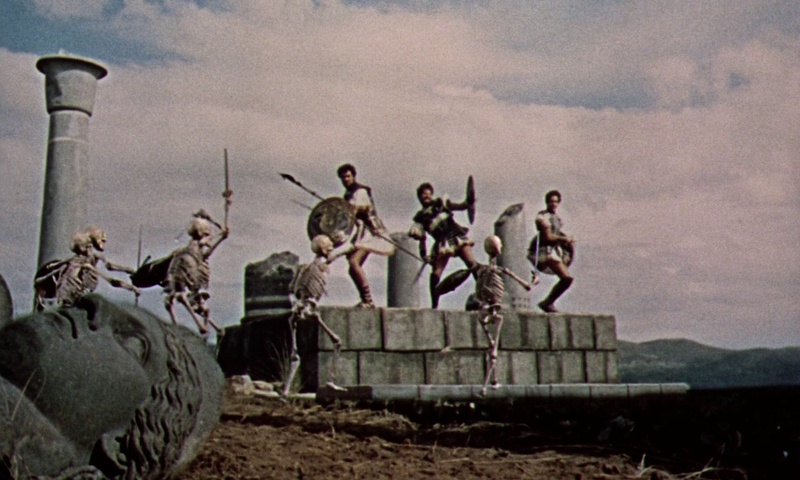
- Miniatures and stop-motion — scaled models, filmed live or animated frame by frame.
- Mechanical effects — rain, wind, snow, fog, breakaway glass, rigged collapses, tilting sets.
- Pyrotechnics — explosions, fire, sparks and squibs, run by a licensed operator.
- Stunt rigs — wires, ratchets and real vehicles.
Why do filmmakers still use practical effects?
Light and physics come free. A latex head under a practical lamp gets real highlights, shadow and focus falloff; a rain tower gives real splashes on shoulders. Nothing needs matching later.
Actors play against something. E.T. was a Carlo Rambaldi animatronic the child cast could touch in E.T. the Extra-Terrestrial (1982).
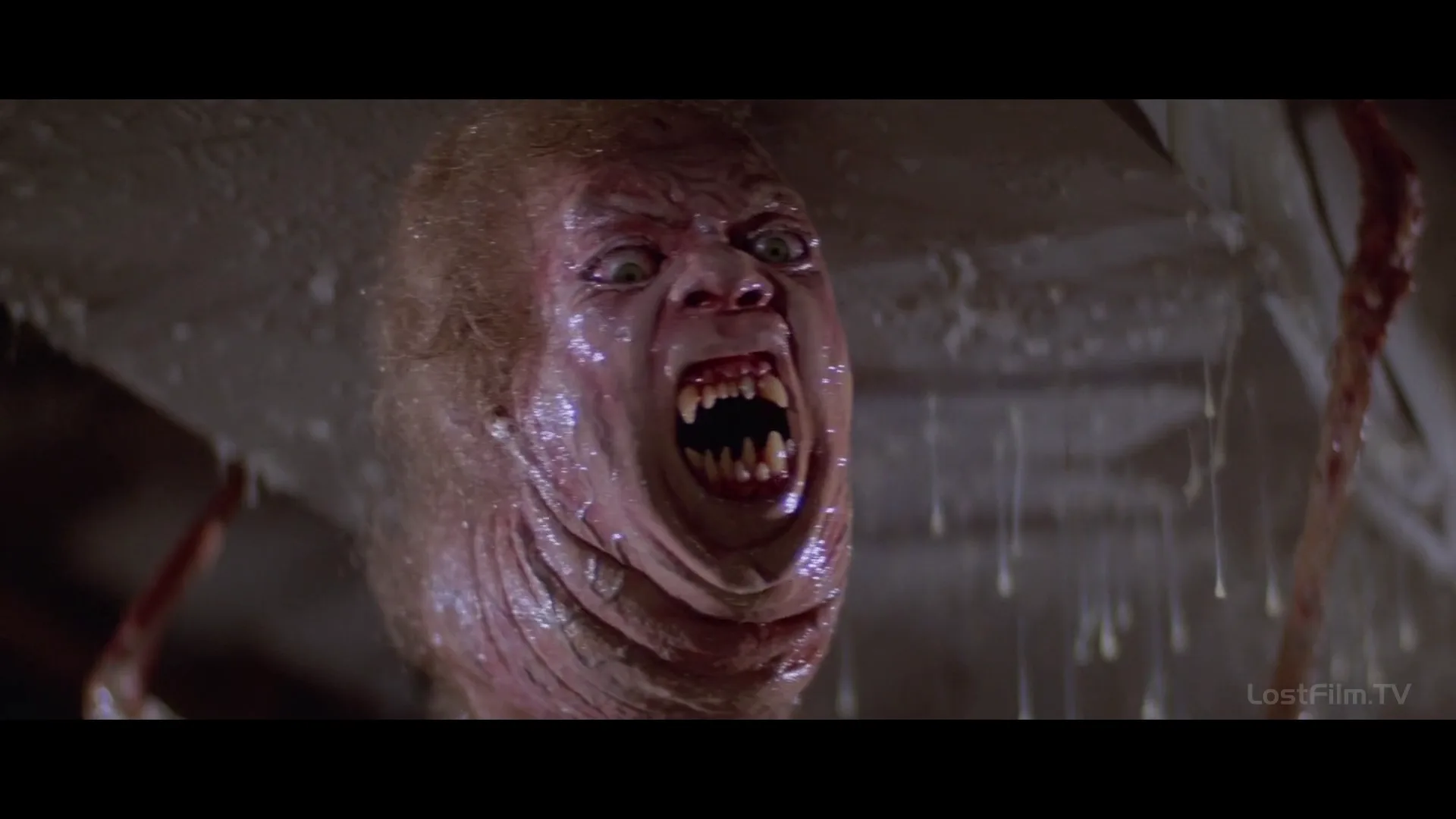
Texture ages well. Rob Bottin's creatures in The Thing (1982) and Rick Baker's brightly lit transformation in An American Werewolf in London (1981) still read as tissue and bone.
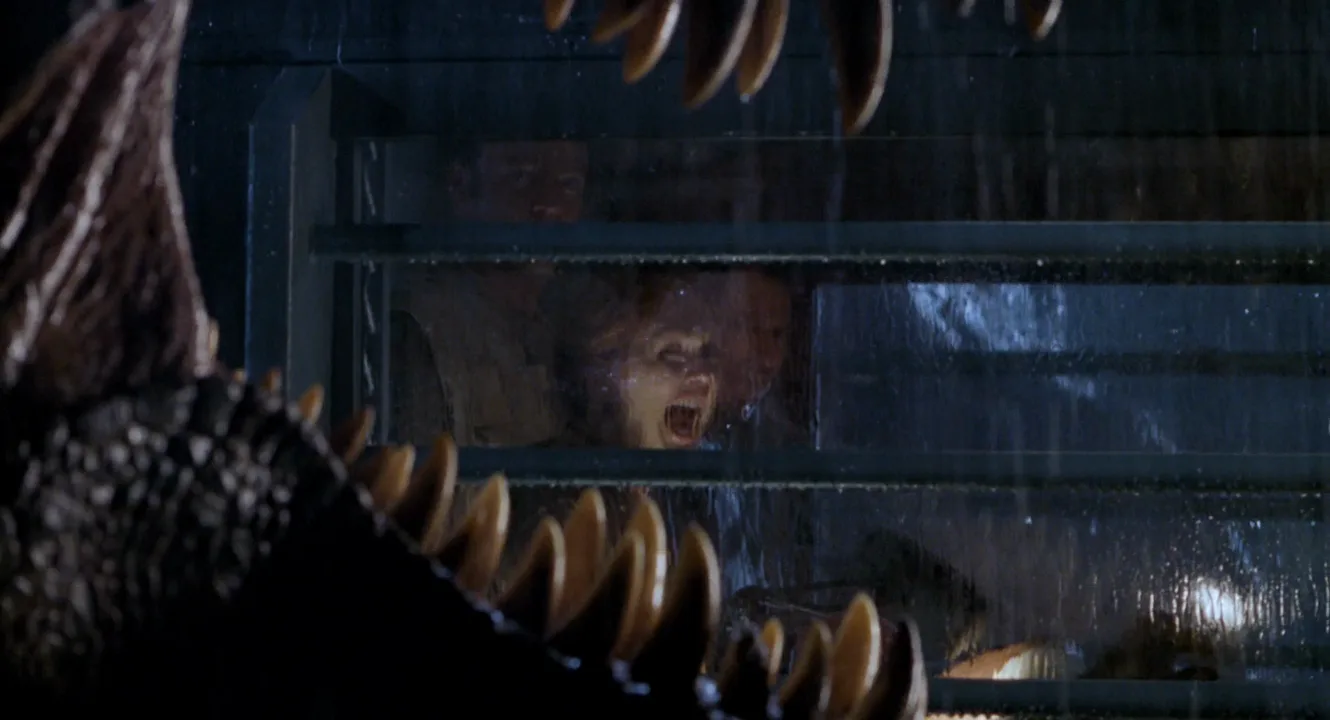
Hybrids are the norm. Jurassic Park (1993) intercut Stan Winston's full-size animatronic T. rex with computer-generated dinosaurs; Titanic (1997) combined a huge ship set in a water tank with miniatures and digital shots.
How to shoot practical effects
- Light to hide, not to show. Backlight and edge light make creatures glisten while seams stay in shadow; haze softens rubber. Avoid a flat frontal key on appliances.
- Backlight rain, smoke and snow. Rain lit from the front vanishes; put a hard source behind it, 3/4 back, and wet the ground.
- Overcrank miniatures. A common rule is frame rate = 24 × √(scale factor): a 1:4 model at 48 fps, 1:16 at 96 fps, so debris and water fall with full-scale weight — the logic of slow motion. Keep the lens at the model's "eye height" with deep focus.
- Cover one-take events. Explosions and breakaways happen once: run several cameras at different sizes and speeds.
- Safety first. Plan pyro, squibs, fire and water work with the SFX coordinator.
Practical effects vs. CGI
Practical effects win when the effect is close, touches an actor, interacts with water, dust or light, or must hold a lingering close-up. CGI wins at impossible scale and physics, crowds, and anything unsafe to build, and it can be revised after the shoot.
Most films blend them: puppet rods are painted out digitally, a miniature explosion gets digital debris. Virtual production puts a rendered background on an LED wall in camera, and background replacement swaps the environment later. Rule of thumb: build what the lens sees up close, extend digitally what it sees far away.
Practical Effects in motion
6 clipsIn these clips the effect happens during the take: a jaw that works, creatures that move under the set's own light, fire and smoke drifting through the frame. Watch how each effect shares the scene's light, haze and focus, and how short cuts keep seams and rigs off screen.
Practical Effects stills
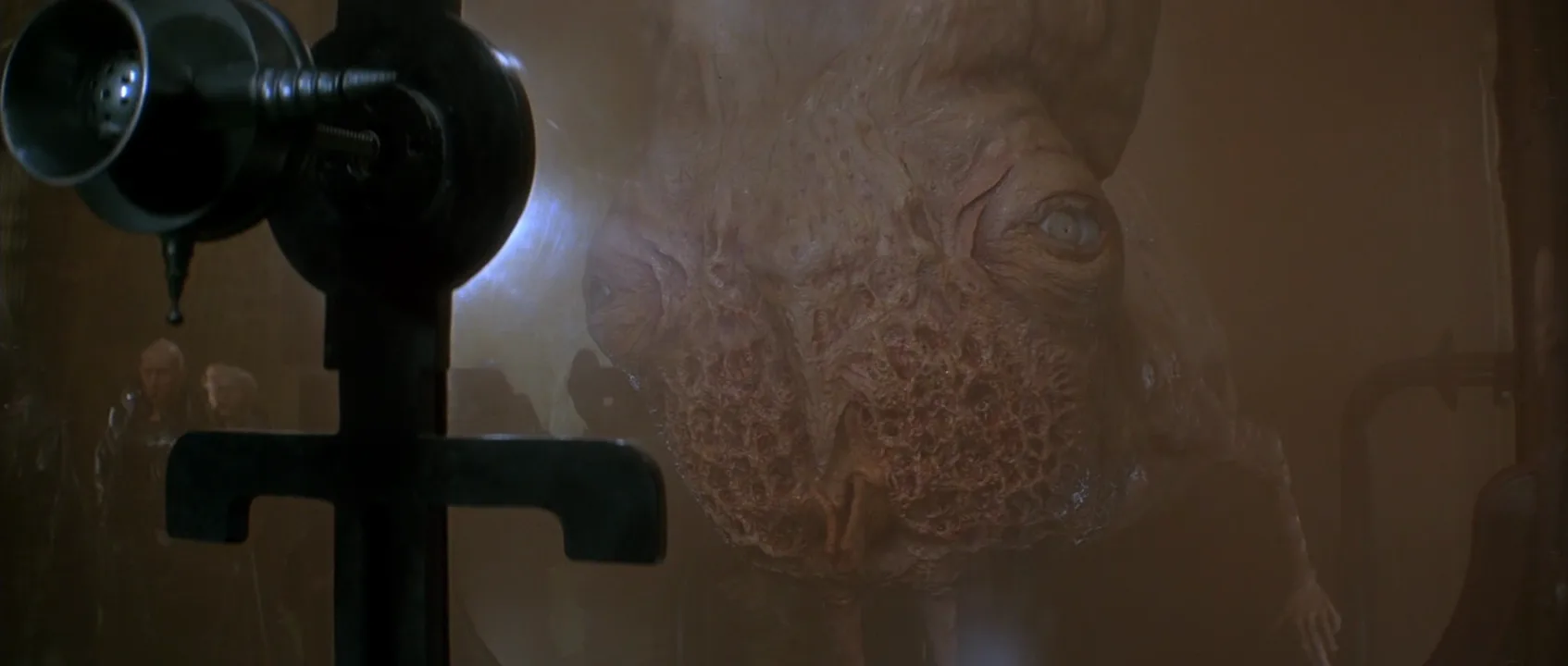
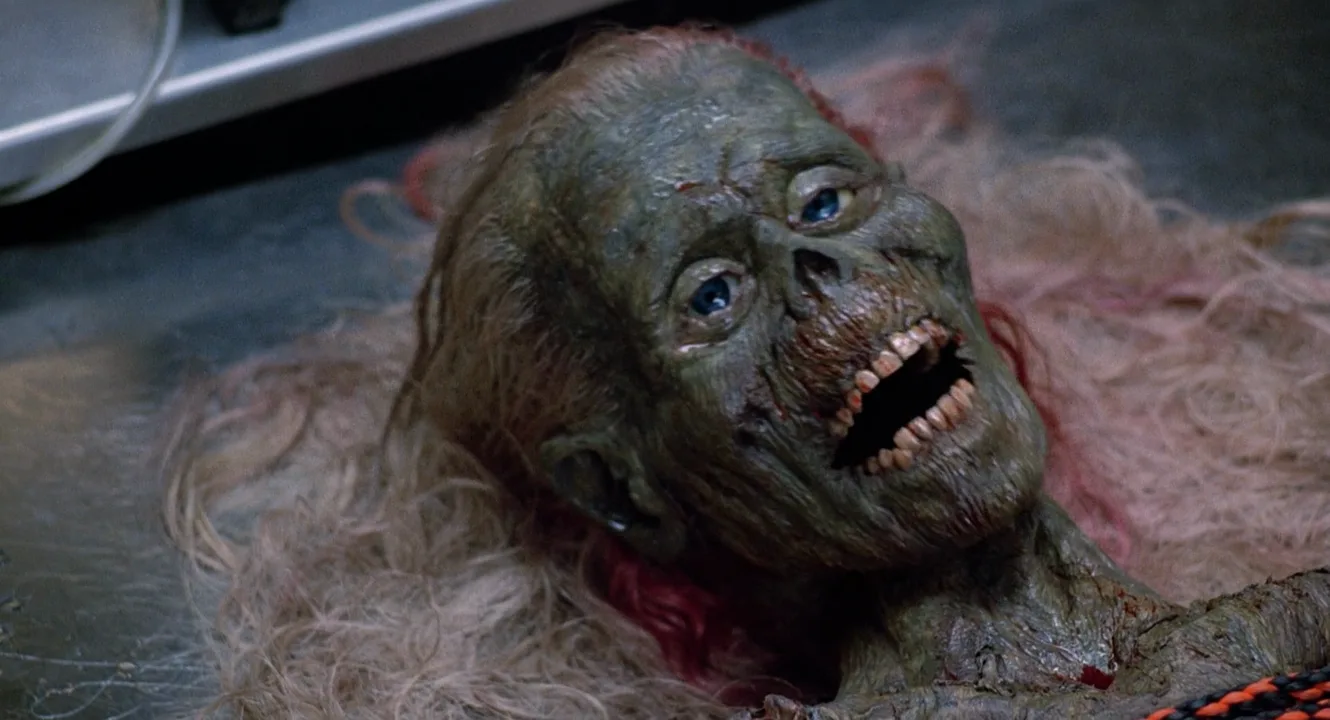
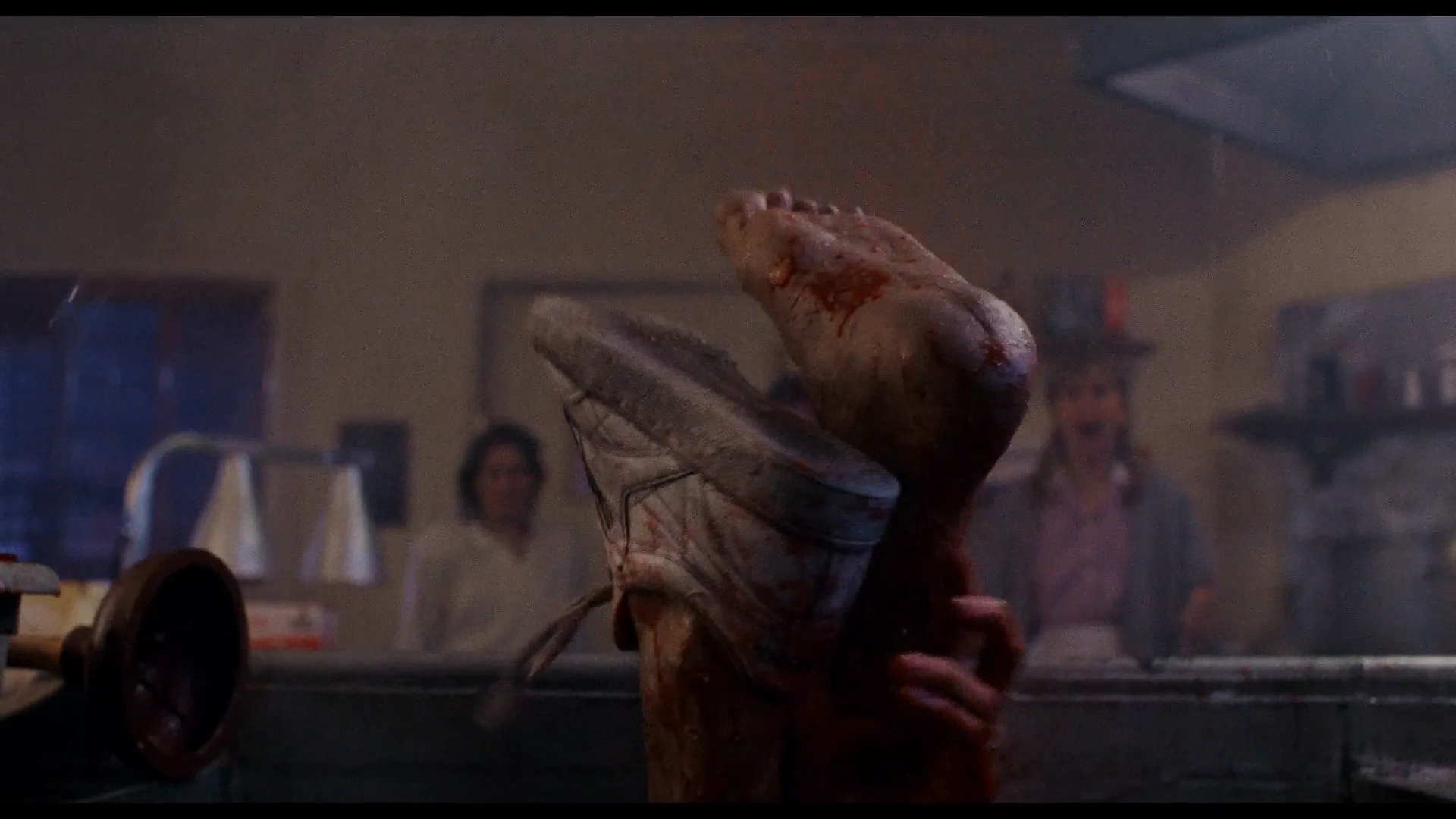
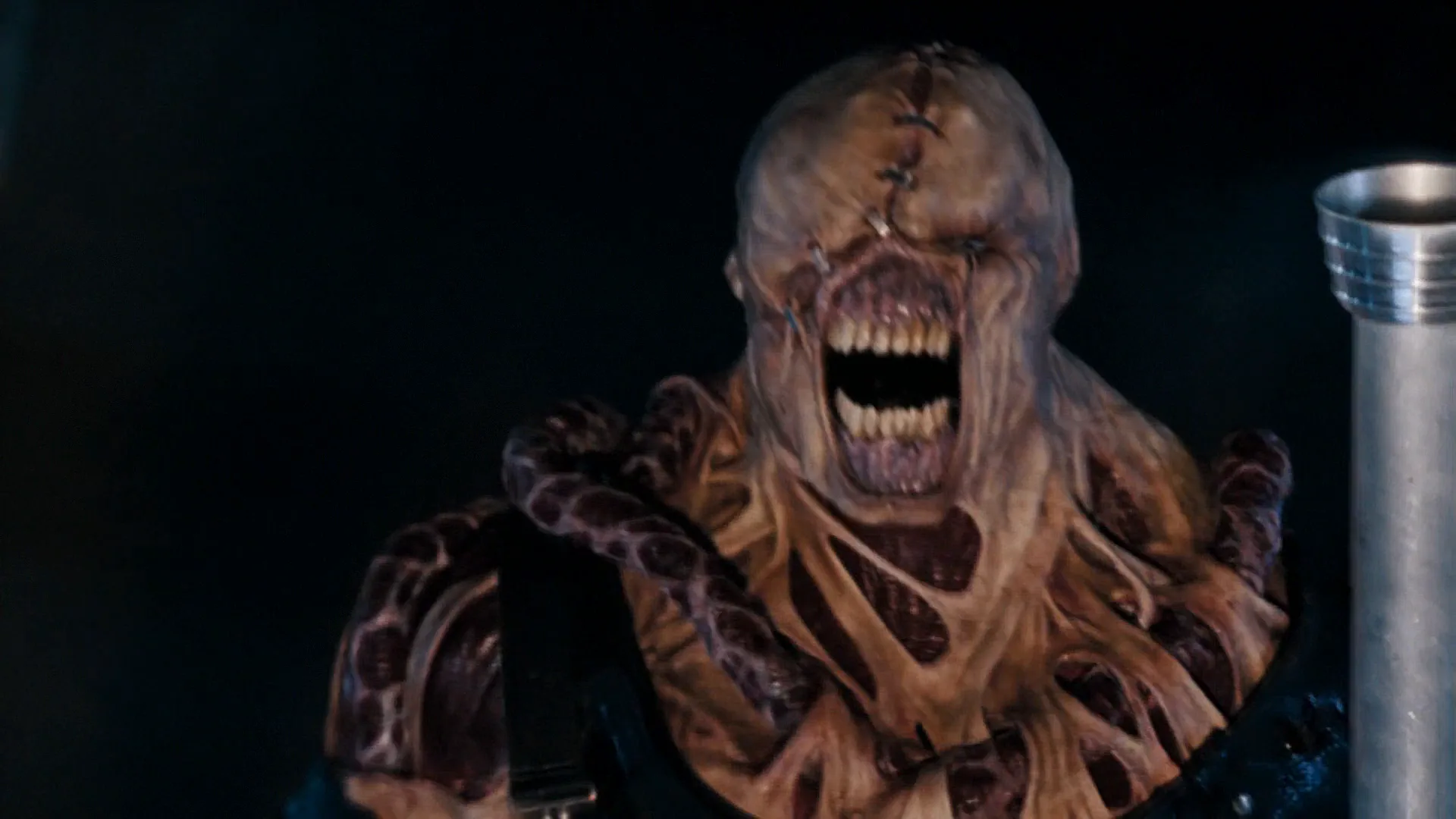
8 framesEffects sculpted, rigged or puppeteered and lit on set: creatures, makeup and stop-motion.
How to create a practical effects with AI
4 promptsModels can render the look of practical effects: latex texture, wet highlights, backlit rain, real smoke. Describe materials and on-set lighting, not just "a monster." Keep creature references and takes on one FlashBoards board to compare side by side. The fourth prompt re-shoots a real film shot from a text description alone, and the original plays next to the result so you can compare.
Night, medium wide shot, 35mm lens at waist height. An animatronic swamp creature rises from a shallow black pond: mottled green-grey foam-latex skin, glossy slime, heavy brow, milky yellow eyes with a wet shine, water streaming off its shoulders. On the bank stands a lanky woman in her thirties with a cropped silver-dyed undercut, freckles and a yellow rain slicker, aiming a flashlight at it. Heavy rain backlit by a hard white lamp behind the pond, low haze, 35mm film grain.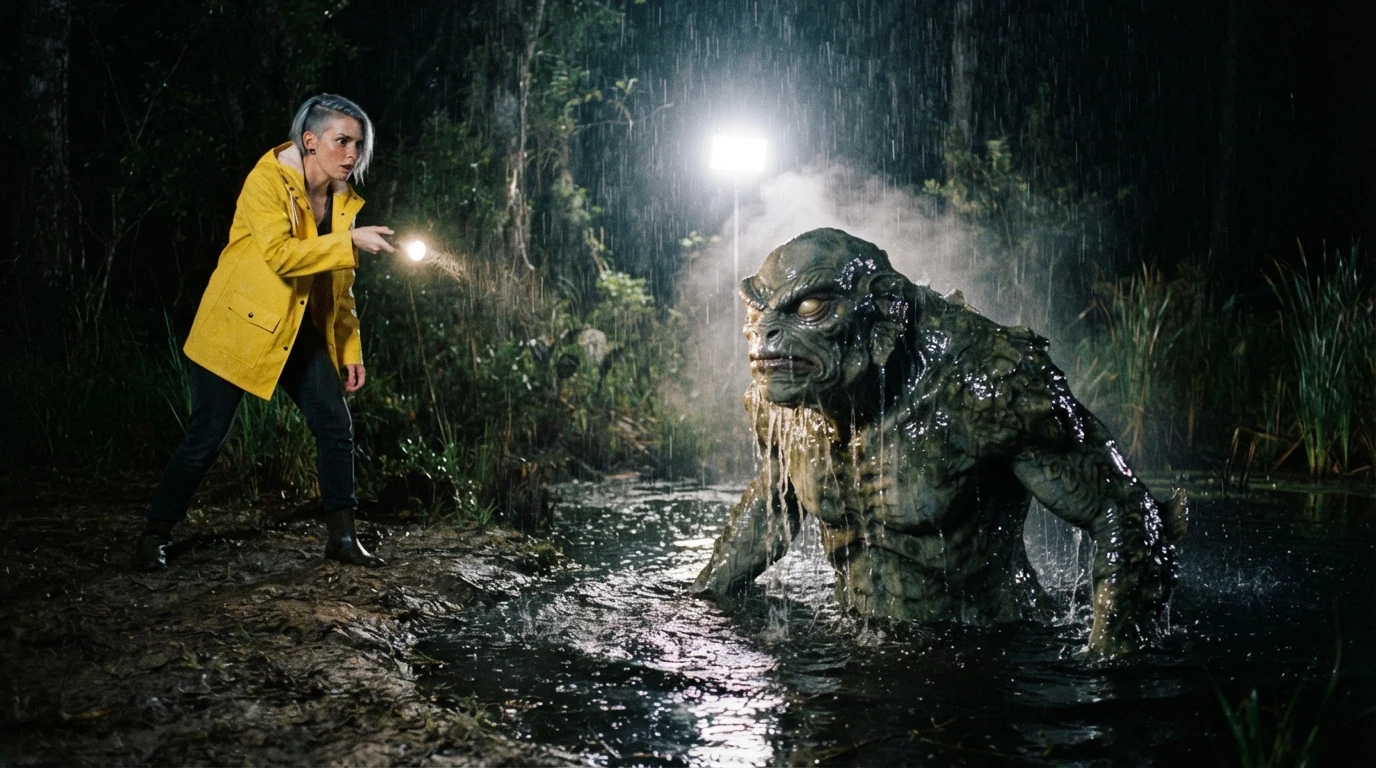
Animatronic, foam-latex, glossy slime and wet shine push toward a built creature, not a digital one. Backlit by a hard white lamp makes the rain visible.
Open FlashBoardsLow wide shot of a detailed 1:16 scale miniature harbor town at dusk, camera at the model's rooftop height, deep focus. A practical pyrotechnic explosion bursts from a wooden warehouse: orange fireball turning to black smoke, splintered planks and roof tiles flying, dust rolling across the cobbled quay, small boats rocking in real water. Fire light on wet stone, 35mm film look.
A second effect family. Rooftop height and deep focus keep the miniature reading full scale; black smoke, splintered planks and dust describe real debris.
Open FlashBoardsCamera: slow steady push in toward the creature, from the medium wide to slightly closer. Action: The creature is already rising, water pouring off its latex shoulders as rain hammers the pond. It lifts its head with stiff, mechanical movement and blinks its wet yellow eyes. The woman steps back on the bank, her flashlight beam shaking across its face. The creature slowly opens its jaw as the backlit rain keeps falling.Already rising makes the shot alive from frame one; stiff, mechanical movement keeps an animatronic feel. Everything named is already in the start frame.
Open FlashBoards{
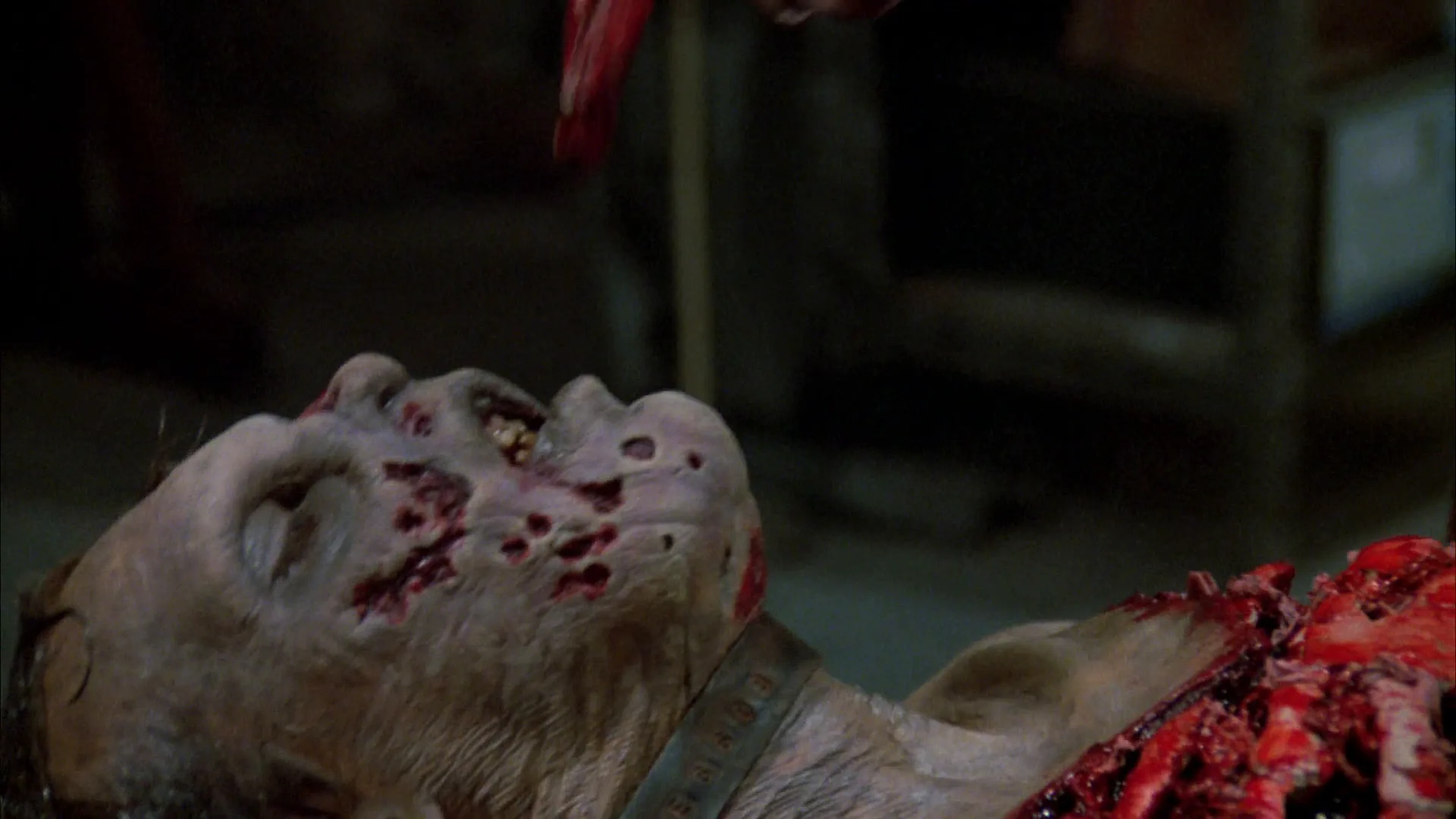
"output": "Full-screen live-action close-up from The Return of the Living Dead (1985), one continuous locked-off shot from its very first frame. A practical effects shot: the talking corpse is a physical animatronic puppet built from foam latex, cable-driven jaw, glass eyes. 1980s 35mm film grain, soft cool overhead light, muted greens, greys and pinks, a morgue lab.",
"characters": {
"S1": {
"name": "the Corpse, played by David Bond",
"look": "withered half-body of a dead woman lying on her back on a brushed steel table: shriveled grey-green latex skin in deep leathery folds, collapsed nose holes, bulging pale blue glass eyes, receded gums and long yellowed teeth, torn red fibers at the neck, long tangled platinum hair fanned out over pink insulation beneath her head",
"voice": "hoarse, dry, drawn-out rasp"
},
"S2": {
"name": "Ernie, played by Don Calfa",
"look": "never seen, off screen",
"voice": "older man, soft German accent, quiet"
}
},
"shots": [
{
"shot": 1,
"camera": "static, locked on a tripod, no movement and no zoom; close-up looking down at a three-quarter angle on the head and shoulders, the head in the centre-left of frame, a steel table edge and a grey cable along the top left corner",
"action": [
"BEGINNING: alive from the first frame, the head lies tilted toward frame left, face turned up toward the lens, lips parted just enough to show the teeth, glass eyes open and fixed upward.",
"THEN: the jaw drops open in a slow, stiff mechanical motion until the mouth is a dark hole ringed by long teeth; the head drifts a little toward frame right.",
"THEN: the jaw works open and shut in uneven, puppet-like beats while she rasps her line, the lips barely changing shape, the eyes never blinking.",
"THEN: the chin lifts and the head rolls back toward the upper right of frame, stretching the leathery neck.",
"END: the jaw gapes to its widest, the face tipped back toward the upper right, eyes still open and glassy."
],
"dialogue": [
{
"speaker": "S2",
"on_screen": false,
"when": "from the first frame, already ending, before her jaw opens",
"delivery": "quiet, off screen, the tail of his sentence",
"line": "<d>[English] It hurts to be dead.</d>"
},
{
"speaker": "S1",
"on_screen": true,
"when": "as soon as her jaw first drops, stretched out to the end of the shot",
"delivery": "slow, agonised, each word dragged out",
"line": "<d>[English] I can feel myself rot.</d>"
}
]
}
],
"sound": {
"ambience": "the hum of lab fluorescent lights, a faint creak of the jaw",
"speech": "exactly these spoken phrases, each said once, in this order",
"never_spoken": "no narration and no voice-over: the descriptions, performance notes and step words of this prompt are never spoken aloud",
"music": "a film score under the scene, always below the voices: a low mournful synthesizer drone with a slow, uneasy pulse",
"subtitles": "none"
}
}Remakes the static close-up from The Return of the Living Dead (1985) where the half-corpse on the steel table rasps "I can feel myself rot": the prompt keeps the locked-off high angle, the fanned-out hair, the fixed glass eyes, both lines of dialogue and the head rolling back at the end.
Physical animatronic puppet, foam latex, cable-driven jaw and glass eyes in output steer the model toward a built prop instead of a digital creature. The uneven, puppet-like beats of the jaw, eyes that never blink and a camera locked on a tripod keep the motion to what a rig could do, and the two corpus lines give the jaw something to say.
Common mistakes
- Creatures come out smooth and CG. Name materials: foam latex, silicone, seams, glossy slime, glass eyes.
- Rain disappears. Say where the light is: "rain backlit by a hard lamp."
- Miniatures look like toys. Avoid tilt-shift and high angles; ask for low camera height and deep focus.
- Explosions become clean fireballs. Add black smoke, debris and dust.
- Video morphs the creature. Keep its moves few and call them mechanical.
Keep the reference frames, prompts and every generated take side by side — images and video in one canvas.
FAQ
5 questionsWhat are practical effects in movies?
Effects created physically on set and captured by the camera: prosthetic makeup, animatronics, puppets, miniatures, rain and wind machines, breakaways and pyrotechnics. Classic examples are the creatures in The Thing (1982), the animatronic T. rex in Jurassic Park (1993) and E.T. in E.T. the Extra-Terrestrial (1982). Props and sets alone are production design.
Are practical effects better than CGI?
Neither is better in general. Practical effects excel close to camera, in contact with actors, and wherever texture, water or real light matter. CGI excels at huge scale, impossible physics and anything unsafe to build, and can be changed after the shoot. Most films combine both.
What is the difference between SFX and VFX?
SFX (special effects) are practical effects produced on set: makeup effects, mechanical rigs, weather, pyrotechnics, animatronics. VFX (visual effects) are created or combined in post: CGI, compositing, set extensions, wire removal. Often they meet in one shot, with an SFX element cleaned up or extended by VFX.
Are practical effects still used today?
Yes. Nearly every production uses some: rain towers, fog, breakaway glass, squibs, makeup appliances, real vehicles and stunts. Big films often pair a practical foreground element with digital work behind it, because a real object gives true light and something for actors to react to.
Is makeup a practical effect?
Everyday beauty makeup is not, but special makeup effects are. Prosthetic appliances, wounds, aging and creature makeup physically change the performer on set and are recorded in camera. Rick Baker's work on An American Werewolf in London (1981) won the first Academy Award for Best Makeup.
Related terms
6- Forced PerspectiveCameras & Capture
Forced perspective places actors or objects at carefully chosen distances from the camera so they appear larger, smaller, nearer or farther than they are — the in-camera trick behind giant-and-small scenes shot without digital effects.
- Stop TrickCameras & Capture
The stop trick (arrêt) halts the camera, changes something in front of it and resumes shooting from exactly the same position, so on screen people or objects appear, vanish or transform instantly — the founding special effect of early cinema.
- Reverse MotionCameras & Capture
Reverse motion plays action backwards — originally by running film backwards through the camera or optical printer, now by reversing clips in the edit — so smoke returns to a cigarette or, as in Tenet, time itself seems to run the other way.
- Double ExposureCameras & Capture
Double exposure records two images on the same piece of film — or blends them in post — so both show through at once, often a face merging with a landscape; in camera it was the classic way to create ghosts and visions.
- Virtual ProductionFilmmaking Process & Crew
Virtual production combines live-action shooting with real-time rendered environments — typically on LED walls driven by a game engine and synced to camera tracking — so backgrounds, light and parallax are captured in camera.
- Post-ProductionPost-Production & VFX
Post-production is everything after the shoot that turns footage into a finished film: editing, sound design and mix, music, VFX, color grading, titles and delivery masters.
Further reading
Rick Baker's work on An American Werewolf in London: Academy of Motion Picture Arts and Sciences awards database (54th Academy Awards, Best Makeup).