 FlashBoards Learn
- Learn
- Cameras & Capture
- Reverse Motion
Cameras & Capture · Film language
Reverse Motion
Also called: reverse action, reversed footage
Reverse motion plays an action backward, last frame first, so smoke slides back into a cigarette, a wall rebuilds itself or a bullet returns to the gun. Once done by running film backward through a camera or printer, it is now a clip setting in the edit. It reads as magic, rewind or time running the other way.
- What it does
- Turns time around inside a shot, so effects precede causes and gravity seems to work upward.
- Use it when
- You want magic, a rewinding memory, dream logic or a stunt that is safer filmed in reverse.
- Watch out
- Walking, speech, falling water and smoke give reversal away instantly; decide which cues should read as wrong.
- Try this prompt
Locked-off wide shot, a man hurls a fistful of red pigment powder upward, the cloud bursts and drifts down over a tiled floor
What is reverse motion in film?
Reverse motion (also reverse action or reversed footage) shows a shot's frames in the opposite order from how they were recorded. Each frame is unchanged; only the sequence flips, so every movement runs backward at the speed it was filmed.
It is one of cinema's oldest tricks. When the Lumière operators projected Demolition of a Wall (1896) backward, the rubble leapt up into a standing wall. With the stop trick it became basic early screen magic, and it still sits beside slow motion and undercranking among the ways the camera bends time.
It works because audiences know physics by heart: water falls, glass shatters outward, people walk heel first. Reverse that and the brain flags it instantly.
Why do filmmakers use reverse motion?
- Magic and comedy. A diver flies feet first out of the water onto the board.
- Dream logic. Jean Cocteau used reversed footage in Orpheus (1950) for its otherworldly magic, such as a dead man rising and gloves pulling themselves on. For the Red Room in Twin Peaks (1990), David Lynch had actors speak lines phonetically backward, then reversed the recording, so speech sounds almost natural but wrong.
- Rewinding memory. Memento (2000) opens with a reversed shot: a Polaroid fades back to blank and a bullet casing returns to the gun, announcing a nonlinear narrative told from its end.
- Time as a rule of the world. Tenet (2020) cuts reversed footage and backward-moving actors into scenes where everyone else moves forward.
- Safety. A car that must stop an inch from an actor is filmed pulling away, then reversed.
How to shoot reverse motion
On film, you cranked a camera backward, shot with the camera upside down and flipped the processed strip end for end, or reprinted the shot in reverse frame order on an optical printer, one of the classic practical effects of the photochemical era. Digitally, every editor has a reverse speed setting. The work is on set:
- Plan the ending as the opening. The last frame of the take opens the shot on screen, so hold the end pose for 1–2 seconds.
- Lock the camera unless the move is the idea: a dolly in becomes a dolly out.
- Overcrank for a slow rewind. 48–120 fps lets reversed powder, water and fabric play slower and look deliberate.
- Choose your giveaways. Falling liquid, smoke, fire and footsteps expose reversal. Show them to be felt; hide them for a stunt.
- Mark the hit. For catches and near misses, tape the landing spot and start every take there.
How do actors perform for reverse motion?
If only one character should look reversed, the actor performs backward so that, once flipped, they move naturally while the world runs against time. Reverse a forward take and learn it beat by beat; breath and the lead foot are hardest to fake. Reversing natural movement instead gives the shivery dream look of Cocteau and Lynch.
Reverse motion vs. boomerang and reverse chronology
Reverse motion plays a shot backward once, as a story beat. A boomerang loops a short clip forward and backward endlessly, a social media and title device. Reverse chronology, as in Memento, orders scenes last to first while each plays forward: it changes the order of events, not the direction of motion.
Reverse Motion in motion
7 clipsOnly the Tenet clip actually runs time backward. The others are forward chase and traffic shots chosen for their direction cues: as each plays, ask what would give it away if you reversed it, whether arrows, debris, traffic flow or a car approaching the lens.
How to create a reverse motion with AI
3 promptsVideo models play physics forward, so the reliable route is to generate the event forward on a locked camera and reverse the clip in your editor. Keep the forward take, the reversed cut and your references side by side on one FlashBoards board.
Locked-off wide shot, 35mm lens at chest height, symmetrical frame. An empty drained swimming pool with pale blue tiles, low sun raking across the floor. In the center a man in his fifties with a shaved head, a grey horseshoe mustache and a mustard corduroy jacket is mid-throw, right arm swinging up as a fistful of bright red pigment powder leaves his hand and bursts into a cloud. Crisp detail, muted colors except the red.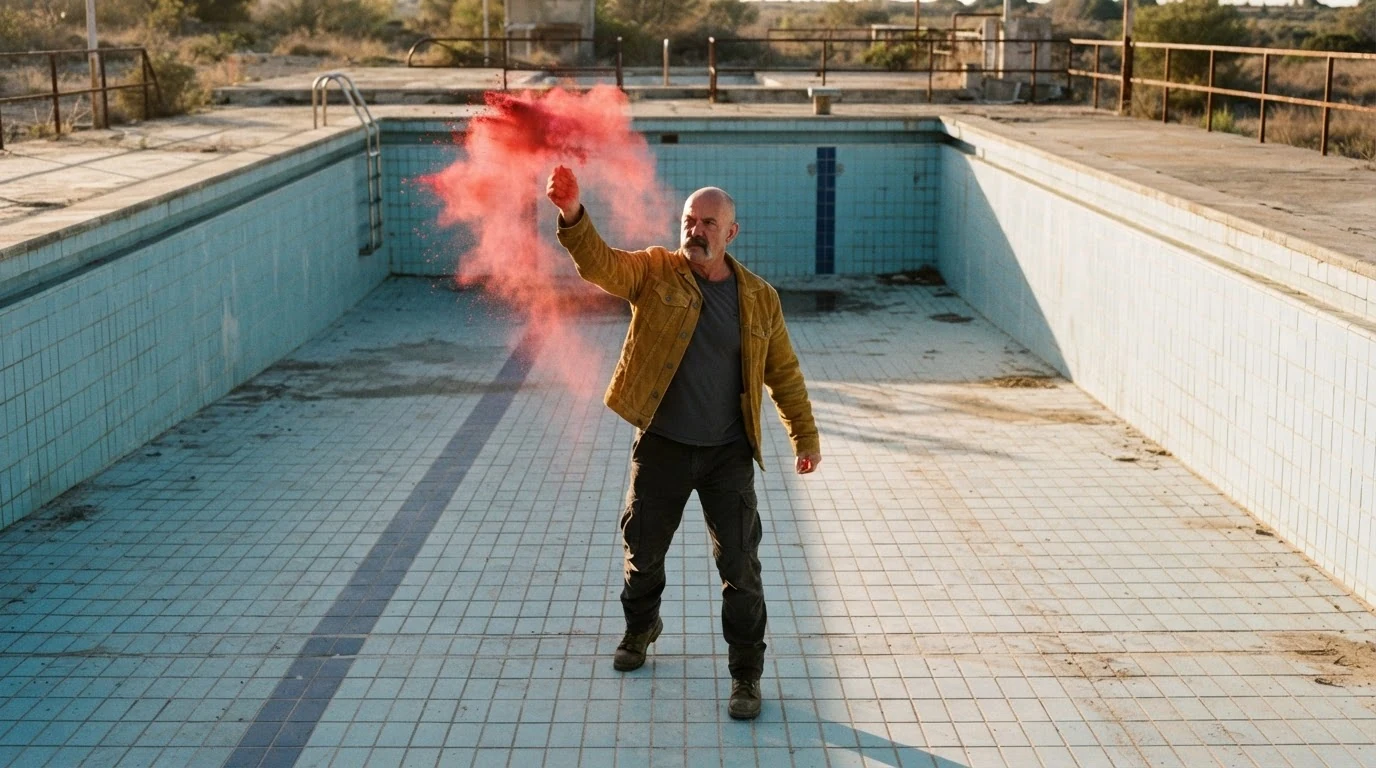
Mid-throw and bursts put the event in motion from the first frame. Locked-off keeps the background fixed, so the reversed clip reads as time running backward, not a camera move. The red powder on pale tiles is the motion tracer.
Open FlashBoardsWidescreen still that looks like reversed footage. Side-on shot at table height, 50mm lens, dim wooden kitchen. A shattered white teapot in the instant of reassembling: shards hang above the table converging toward the center, and ropes of amber tea lift off the tabletop, curving back up into the spout. Behind it sits a calm woman in her thirties with cropped copper hair and a gold hoop in her left eyebrow. Warm window light from the left.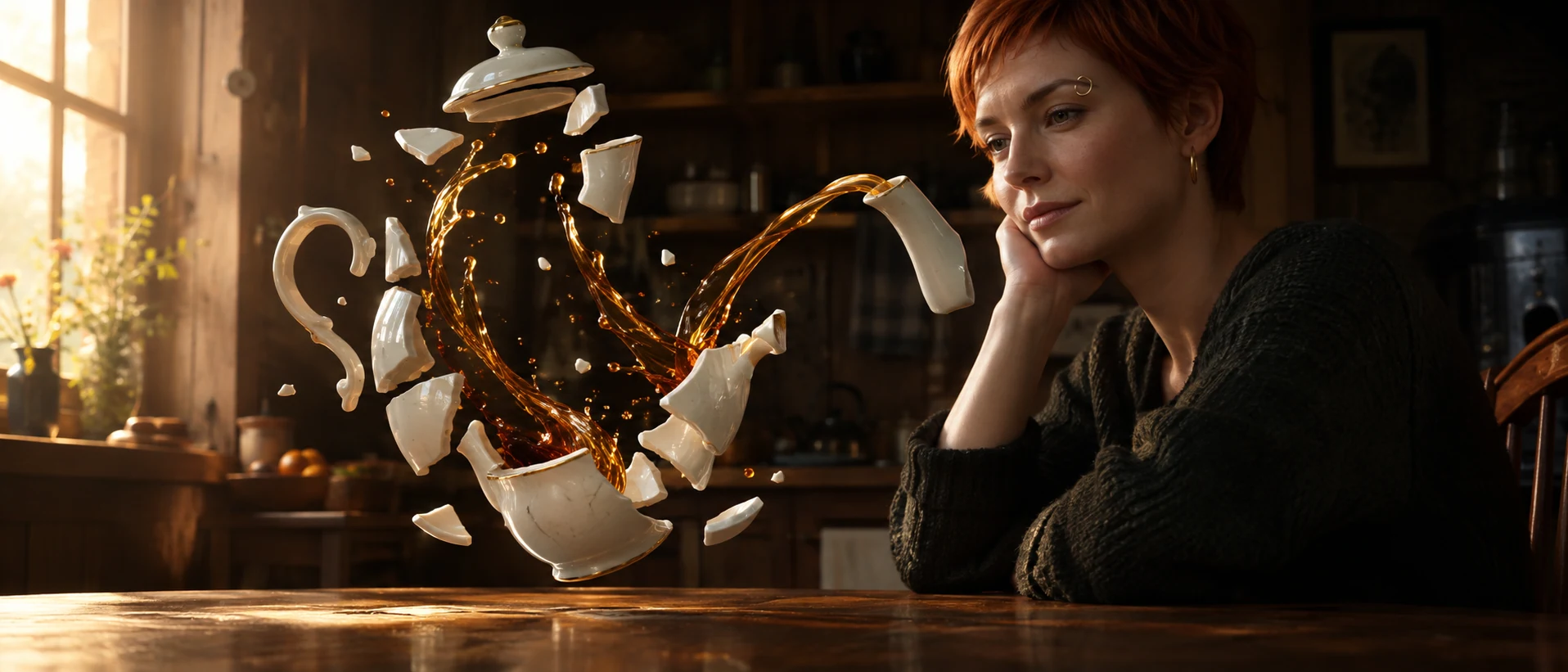
A still can only suggest reversal through physics pointing the wrong way, so the prompt names every direction: converging, lift off, back up into the spout. Her calm is the Cocteau touch.
Open FlashBoardsCamera: completely static on a tripod at chest height for the whole shot. Action: The man is already throwing as the shot begins, his arm snapping up and releasing the red powder. The powder bursts into a wide cloud above his head and hangs in the sunlight. Then it drifts slowly down over his shoulders and the blue tiles, and he lowers his arm and stands still as a thin red haze settles on the floor.The action is written forward because models render that physics convincingly. Reverse the clip and the haze rises into a cloud and shoots back into his fist. The settled ending becomes a calm opening.
Open FlashBoardsCommon mistakes
- Reverse motion or playing backward in a video prompt usually still yields forward physics. Generate forward, reverse in the edit.
- A drifting camera reverses into a strange pull-back; state static on a tripod.
- Generated walking and talking reverse badly; let powder, liquid or objects carry the effect.
- End on a settled frame, or the reversed shot starts abruptly.
Keep the reference frames, prompts and every generated take side by side — images and video in one canvas.
FAQ
4 questionsWhat is reverse motion in film?
Reverse motion plays a shot from its last frame to its first, so every movement runs the opposite way: smoke returns to a cigarette, water leaps back into a glass. Filmmakers use it for magic, comedy, dreams, rewinding memories and stunts that are safer filmed in reverse.
How do you make a reverse motion video?
Film the action forward on a locked camera, hold the final pose for a second or two, then apply the reverse speed setting in your editor. Shoot at a higher frame rate for a slower rewind. Falling water and footsteps make reversal obvious; blurred traffic hides it.
How did old films do reverse motion?
Some cameras could crank backward. Or the camera was mounted upside down and the processed film turned end for end, so the image stayed upright while the action ran in reverse. Later, optical printers copied shots in reverse frame order. The Lumières famously projected a demolished wall backward so it rebuilt itself.
Is reverse motion the same as a boomerang or rewind effect?
Not quite. Reverse motion plays a shot backward once as part of the story. A boomerang loops a short clip forward and backward repeatedly. A rewind effect imitates tape scanning back, with fast reversed footage and often tracking lines. Reverse chronology reorders scenes while each still plays forward.
Related terms
4- Stop TrickCameras & Capture
The stop trick (arrêt) halts the camera, changes something in front of it and resumes shooting from exactly the same position, so on screen people or objects appear, vanish or transform instantly — the founding special effect of early cinema.
- Slow MotionCameras & Capture
Slow motion stretches time on screen: the camera records at a higher frame rate than playback — for example 120 fps played at 24 — so action unfolds several times slower, used for spectacle, violence, grief or to reveal what the eye normally misses.
- UndercrankingCameras & Capture
Undercranking shoots at a lower frame rate than playback — for example 12 fps played at 24 — so action runs faster than life on screen, used for slapstick, frantic chases and punchier action.
- Practical EffectsPost-Production & VFX
Practical effects are created physically on set — animatronics, prosthetic makeup, miniatures, pyrotechnics, rain and wind machines — and captured by the camera rather than generated with CGI in post.
Further reading
Raymond Fielding, The Technique of Special Effects Cinematography (Focal Press), chapters on optical printing and in-camera effects. Blain Brown, Cinematography: Theory and Practice (Focal Press), sections on frame rates.