 FlashBoards Learn
- Learn
- Cameras & Capture
- Undercranking
Cameras & Capture · Film language
Undercranking
Also called: fast motion, undercrank
Undercranking means recording fewer frames per second than the film will be played at, so action runs faster than life on screen. Shoot at 12 fps, play at 24, and every movement happens twice as fast. Filmmakers use it for slapstick, frantic chases and fights that need extra snap.
Video script
Stop touching my face! Who are you people? I'm explaining undercranking.
Oh. They're the example. Filmed at twelve frames a second, played at twenty-four, they move twice as fast.
Same joke as this commercial: only the crew is sped up, so the calm one gets the laugh. That's me.
Here's a sad funeral. At one point two, it feels energetic. Past one and a half, comedy. Double: they've smelled the buffet.
Silent crews did it on purpose. The rest, shot at sixteen to twenty, just looks fast today. Your ancestors weren't that busy.
Drive at forty, film at eighteen, it plays like fifty-three. Officer, I was doing forty. The film was speeding.
The sum: twenty-four divided by your speed-up. Chases live at eighteen to twenty-two, comedy at eight to twelve.
Ask for careful moves. Doubled, careful turns into panic. See this waiter? Hang on. Why am I holding a tray?
It kills sync sound, so plan music and effects.
Frames dropped later strobe instead of smear. If you've got me on double speed, you're strobing me.
Say what streaks: long exposure on moving bodies only. A lanky waiter, ginger handlebar mustache, round wire glasses, white apron, tray of teacups. Wait.
Behind him, a purple raincoat, waving a rolled newspaper. You were dressing me for this! She's at twelve frames a second!
Scroll down! It's safer down there!
- What it does
- Speeds up action on screen, from a barely felt extra punch to cartoonish double speed.
- Use it when
- A chase, a gag, a stunt or a fight needs more energy than the real performance can give.
- Watch out
- Past about 1.5x it reads as comedy (under 1.2x it just feels energetic), and it kills sync sound.
- Try this prompt
Undercranked fast-motion look: a waiter sprints through a café alley, legs smeared into streaks, locked-off wide shot
What is undercranking in film?
Undercranking is capturing action at a lower frame rate than the playback rate. Cinema plays at 24 fps, so anything recorded below that runs fast on screen. The speed-up is simple division:
| Capture rate | Played at 24 fps | 10 s of action lasts | |---|---|---| | 22 fps | 1.1x faster | 9.2 s | | 18 fps | 1.33x faster | 7.5 s | | 12 fps | 2x faster | 5 s | | 6 fps | 4x faster | 2.5 s |
The name comes from hand-cranked cameras: turn the crank slower and fewer frames are exposed each second. Silent-era crews undercranked on purpose for gags and chases, and much of their footage also looks fast today because it was shot at 16 to 20 fps and is now shown at 24.
It is the mirror image of slow motion, which overcranks. Both are cameras and capture decisions.
Why do filmmakers use undercranking?
How much you speed action up decides the tone.
- Comedy. Double speed turns people into wind-up toys. It powered the chases of slapstick comedy in Mack Sennett's Keystone shorts and, decades later, the sped-up chases of The Benny Hill Show. Kubrick used it ironically in A Clockwork Orange (1971), racing through Alex's bedroom encounter to the William Tell Overture.
- Invisible punch. At 20 to 22 fps the eye reads better stunt work, not a trick. Hong Kong action crews long shot fights slightly undercranked so strikes land harder.
- Kinetic mayhem. George Miller sped up many shots in Mad Max: Fury Road (2015), part of why its vehicles and bodies feel so violently fast.
- Safety. A car driven at 40 mph and filmed at 18 fps plays like 53 mph, so near-misses can be performed slower.
How to shoot undercranking
1. Pick the factor. Divide 24 by the speed-up: 1.25x means 19 fps, 2x means 12 fps. Fights and chases live at 18 to 22 fps, comedy at 8 to 12.
2. Use the off-speed mode. Cinema and mirrorless cameras call it variable frame rate or S&Q: record at 12 fps, play at 24. If the camera writes a true 12 fps file, conform it to 24 in the edit.
3. Choose the shutter. The 180-degree shutter rule at 12 fps means 1/24 s per frame, twice normal blur, so fast action streaks. For crisp, hard-edged speed, narrow to 90 or 45 degrees (1/48 or 1/96 s).
4. Direct the pace. Ask for normal or slightly slower moves; doubled, careful action becomes comic panic. Lock the camera off or keep moves steady, because shake doubles too.
5. Plan sound. There is no usable sync sound; cover with music, effects or wild lines.
6. Post speed-ups look different. Dropping frames from 24 fps footage keeps 1/48 s blur, so motion strobes rather than smears.
Undercranking vs. time lapse
Both compress time, at different scales.
| | Undercranking | Time lapse | |---|---|---| | Capture | 6 to 22 fps, continuous | One frame every few seconds or minutes | | Speed-up | About 1.1x to 4x | Hundreds of times or more | | Subject | Performance: people, cars, fights | Processes: clouds, crowds, light |
Undercranking keeps a performance legible: you still follow each punch or pratfall. A related look, step printing, often starts from undercranked footage and repeats frames to smear and stutter motion.
Undercranking in motion
8 clipsWatch the people, not the set: in undercranked footage bodies twitch, dash and smear faster than any real performer can move, while walls, floors and anyone standing still hold steady. The contrast between frantic and calm is what sells the speed.

How to create a undercranking with AI
4 promptsImage models don't know how fast time runs, so describe the traces of speed: bodies streaking while the set stays sharp, under a locked-off camera. For video, put the speed factor first. On a FlashBoards board, keep reference frames beside every take. The fourth prompt re-shoots a real film shot from a text description alone, and the original plays next to the result so you can compare.
Undercranked fast-motion film still, 12 fps look, long exposure on moving bodies only. Locked-off wide shot at chest height, 28mm lens, down a narrow cobblestone café alley with round tables, wooden chairs and hanging laundry. A lanky waiter in his forties with a ginger handlebar mustache, round wire glasses and a white apron sprints toward camera left with a tray of teacups, legs and apron smeared into streaks. Behind him a stout woman in her sixties with a silver bun, purple raincoat and yellow boots chases him waving a rolled newspaper. Walls, tables and laundry stay perfectly sharp. Flat overcast daylight, saturated colors.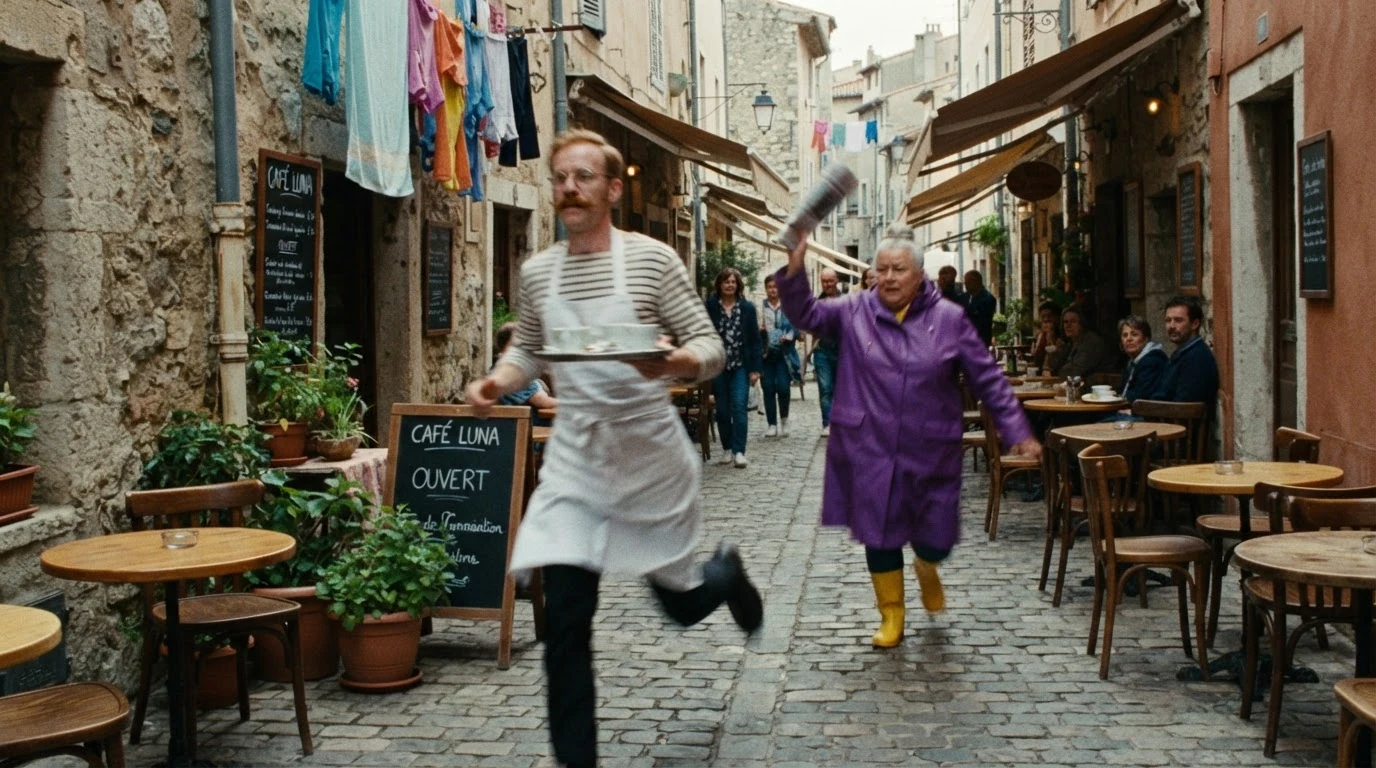
12 fps look, long exposure on moving bodies only sets the physics; walls, tables and laundry stay perfectly sharp keeps the blur on the actors. Specific features keep both characters fictional.
Open FlashBoardsAnamorphic widescreen action still, undercranked 18 fps look, frantic. Low tracking shot from a camera car at bumper height, 35mm lens, beside a rusted orange pickup racing along a desert road at dusk. The driver, a woman in her fifties with cropped white hair and brass aviator goggles, leans out of the window. Roadside posts and scrub stretch into horizontal streaks, the dust plume torn sideways, the truck body crisp. Low orange sun, dust haze.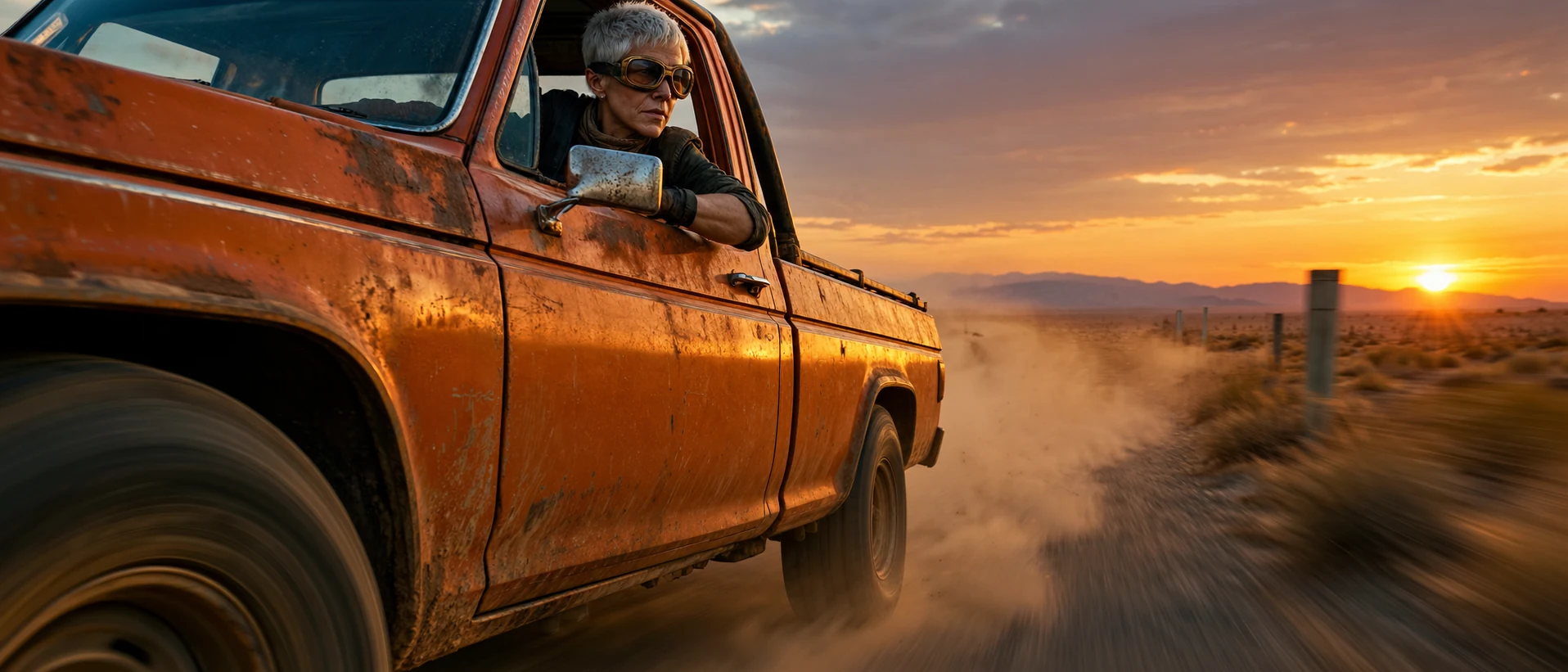
Undercranked 18 fps look moves the idea from comedy to action; posts stretch into streaks plus truck body crisp tells the model where speed lives.
Open FlashBoardsFast motion, double speed, undercranked silent-comedy look, brisk and jerky from the first frame. Camera: locked off at chest height, still for the whole shot. Action: the waiter is already sprinting, weaving between the round tables at double speed, teacups rattling on his tray. In the middle he skids around a wooden chair and the tray tips, then he catches it. The woman in the purple raincoat scurries after him, and both race out of frame left.The speed comes first, so tempo is set before action. Already sprinting keeps the shot alive from frame one, and every element named is already in recipe 1's frame.
Open FlashBoards{
"output": "Full-screen live-action fashion commercial, from its very first frame: one single continuous shot with two speeds in one frame. The model in the centre moves at normal real-time speed, calm and almost still, while the crew fussing around her run in undercranked fast motion, about eight times real speed, like film shot at a very low frame rate: they flicker in and out between frames, their arms and bodies smeared into translucent, ghostly motion-blurred streaks, there one instant and gone the next. Shot on film with fine grain, muted, slightly desaturated colour. A bright white seamless studio backdrop, soft even front light, the white falling off to pale grey toward the edges; the picture corners softly rounded and slightly darkened like a projected film gate. Palette of black, white, pale grey and warm skin tones.",
"characters": {
"S1": {
"name": "the model",
"look": "tall, slim woman in her thirties with sharp cheekbones, dark brows and minimal make-up, dark hair slicked straight back into a tight low bun; an oversized plain black blazer worn open over a black plunging bralette, bare midriff, pale grey fleece sweatpants; a black phone held in both hands",
"voice": "silence: she never speaks"
},
"S2": {
"name": "a hairstylist",
"look": "young woman with a short dark bob, black long-sleeve top, a make-up brush in one hand",
"voice": "silence: she never speaks"
},
"S3": {
"name": "a make-up artist",
"look": "woman with shoulder-length dark wavy hair, black crop top, high-waisted black trousers",
"voice": "silence: she never speaks"
},
"S4": {
"name": "a wardrobe stylist",
"look": "woman with dark hair tied back, black shirt with the sleeves pushed up",
"voice": "silence: she never speaks"
}
},
"shots": [
{
"shot": 1,
"camera": "Two speeds against a perfectly still camera: locked-off on a tripod, not a single movement for the whole shot, the framing identical from the first frame to the last; S1 stays at normal speed while the crew around her are sped up into flickering blurs. Medium shot at chest height, straight on, normal lens: S1 centred and facing the camera, framed from a little above her head down to her upper thighs, the waistband of her grey sweatpants at the bottom edge, white backdrop filling the space on both sides of her where the crew dart in and out",
"action": [
"BEGINNING: alive from the first frame, two speeds at once: S1 stands in the centre, head bowed, eyes on the phone she holds in both hands at stomach level, thumbs tapping slowly at normal speed; at the same instant a crew hand smeared into a translucent grey streak flicks at her right shoulder on the left side of frame, and a pale blurred arm whips in from the right edge and is gone.",
"THEN: S2 pops in at the left side of frame from one frame to the next, reaches across and smooths the top of S1's hair with one hand, the make-up brush held low in the other, then vanishes in a smear toward the left edge; S1 does not react, still typing at normal speed.",
"THEN: S3 darts in from the left and both her hands pat and pin S1's blazer at the shoulder in a jittery flurry, then she jumps away; S1 slowly lifts her eyes from the phone and looks calmly into the lens, then lowers them again.",
"THEN: S4 whips in from the right side of frame, her arm sweeping in a blurred arc over the top of S1's head like a ghost, gone the next instant; a hand with a fluffy powder brush dabs at S1's cheek and flicks away.",
"THEN: for a beat S1 stands alone against the white backdrop, lifts her chin slightly and gazes at the lens, calm and unhurried.",
"THEN: the crew rush back from both sides at once, S4 on the right raising a small brush to S1's hairline, S3 on the left brushing down her shoulder, both at frantic sped-up speed; S1 turns only her eyes toward the right side of frame and gives the stylist a slow, unimpressed side glance.",
"END: the fussing keeps flickering on to the very last frame, hands and arms popping in and out and smearing into streaks on both sides of her, while S1 lowers her head back to the phone, calm and almost still at normal speed, the camera and the white backdrop unchanged."
],
"voice": "silence: nobody speaks in this shot, no voice at all",
"dialogue": []
}
],
"sound": {
"ambience": "quiet studio room tone; quick rustle of fabric, rapid soft taps and dabs of brushes, the patter of hurried steps on the studio floor",
"speech": "no words in this video; the only human sounds are breaths and movement",
"never_spoken": "no narration and no voice-over: the descriptions, performance notes and step words of this prompt are never spoken aloud",
"music": "a score under the commercial, always below the other sounds: a light, pulsing electronic track with a crisp ticking beat",
"subtitles": "none"
}
}Remakes the Aritzia – Sweatfleece commercial from the article's examples: the locked-off medium shot on white seamless, the model thumbing her phone at normal speed in an open black blazer, and the crew's hands and arms flickering in from both sides as sped-up streaks, with her calm look into the lens and a sidelong glance.
Two speeds live in one frame only if the prompt keeps saying so. output opens with the split: the model at normal real-time speed, calm and almost still, the crew about eight times real speed, smeared into translucent, ghostly motion-blurred streaks. camera repeats it against a tripod that never moves, and every action beat pairs a sped-up crew flurry with her slow glance or thumb tap. The first take kept her still and the crew flickering; asking for heavier blur crowded the frame.
Common mistakes
- Real-time speed. Video models default to natural pacing. Open with fast motion, double speed.
- Blur everywhere. Say what stays sharp (walls, set) and what streaks (legs, arms).
- Time lapse instead. Time passing brings racing clouds. Describe people acting fast, not time flowing.
- Comic speed lines. Use photographic words: long exposure, motion smear, 12 fps look.
Keep the reference frames, prompts and every generated take side by side — images and video in one canvas.
FAQ
4 questionsWhat is undercranking in film?
Undercranking is recording at a lower frame rate than playback, for example 12 fps for a 24 fps film, so action plays back faster than it happened. At 12 fps it runs double speed. It is used for slapstick chases and gags and, at 20 to 22 fps, to give fights and car stunts extra punch.
What frame rate is undercranking?
Anything below the playback rate. For a 24 fps project, 18 to 22 fps gives a subtle 1.1x to 1.33x speed-up, 12 fps doubles the speed, and 6 fps runs four times faster. Divide 24 by the capture rate to get the on-screen speed factor.
Is undercranking the same as fast motion?
Undercranking is one way to make fast motion, at the camera. Fast motion can also be made in the edit by dropping frames from normal footage. Undercranked frames carry longer exposures and more motion blur; frames dropped in post keep normal blur and look choppier.
Why do old silent films look sped up?
Silent cameras were usually hand-cranked at roughly 16 to 20 frames per second, and speeds varied. Played at today's 24 fps, that footage runs faster than life. Some comedies were also deliberately undercranked, so the speed mixes intent with a mismatch between capture and projection.
Related terms
4- Time LapseCameras & Capture
A time lapse captures frames at long intervals — one every few seconds or minutes — and plays them at normal speed, so clouds race, cities pulse and flowers open in seconds.
- Slow MotionCameras & Capture
Slow motion stretches time on screen: the camera records at a higher frame rate than playback — for example 120 fps played at 24 — so action unfolds several times slower, used for spectacle, violence, grief or to reveal what the eye normally misses.
- Step PrintingPost-Production & VFX
Step printing repeats each frame several times (often from footage shot at a low frame rate), producing smeared, stuttering motion — the signature look of Chungking Express.
- Slapstick ComedyGenres
Slapstick is physical comedy of exaggerated violence without real harm — pratfalls, chases, pies in the face — perfected in silent films by Chaplin, Keaton and Lloyd.
Further reading
Kevin Brownlow, The Parade's Gone By... (1968), on silent-era camera speeds and comedy. American Cinematographer Manual (ASC Press), sections on frame rates, off-speed shooting and shutter angle.