 FlashBoards Learn
- Learn
- Composition & Framing
- Leading Lines
Composition & Framing · Film language
Leading Lines
Also called: lead-in lines, converging lines
Leading lines are lines inside the frame — roads, rails, corridors, fences, ceiling lights, shadows — that carry the viewer’s gaze toward the subject or deeper into the space. They tell the audience where to look without a cut or a camera move, and they turn a flat image into a room you can walk into.
- What it does
- Steers the eye to the subject and pulls the frame into depth.
- Use it when
- A small figure must read instantly in a big space, or a journey, trap or destination needs a shape.
- Watch out
- Lines that point out of the frame or away from the subject pull attention off it.
- Try this prompt
Symmetrical one-point perspective, long hospital corridor, ceiling lights converging on a nurse at the far end, 24mm lens, cinematic still
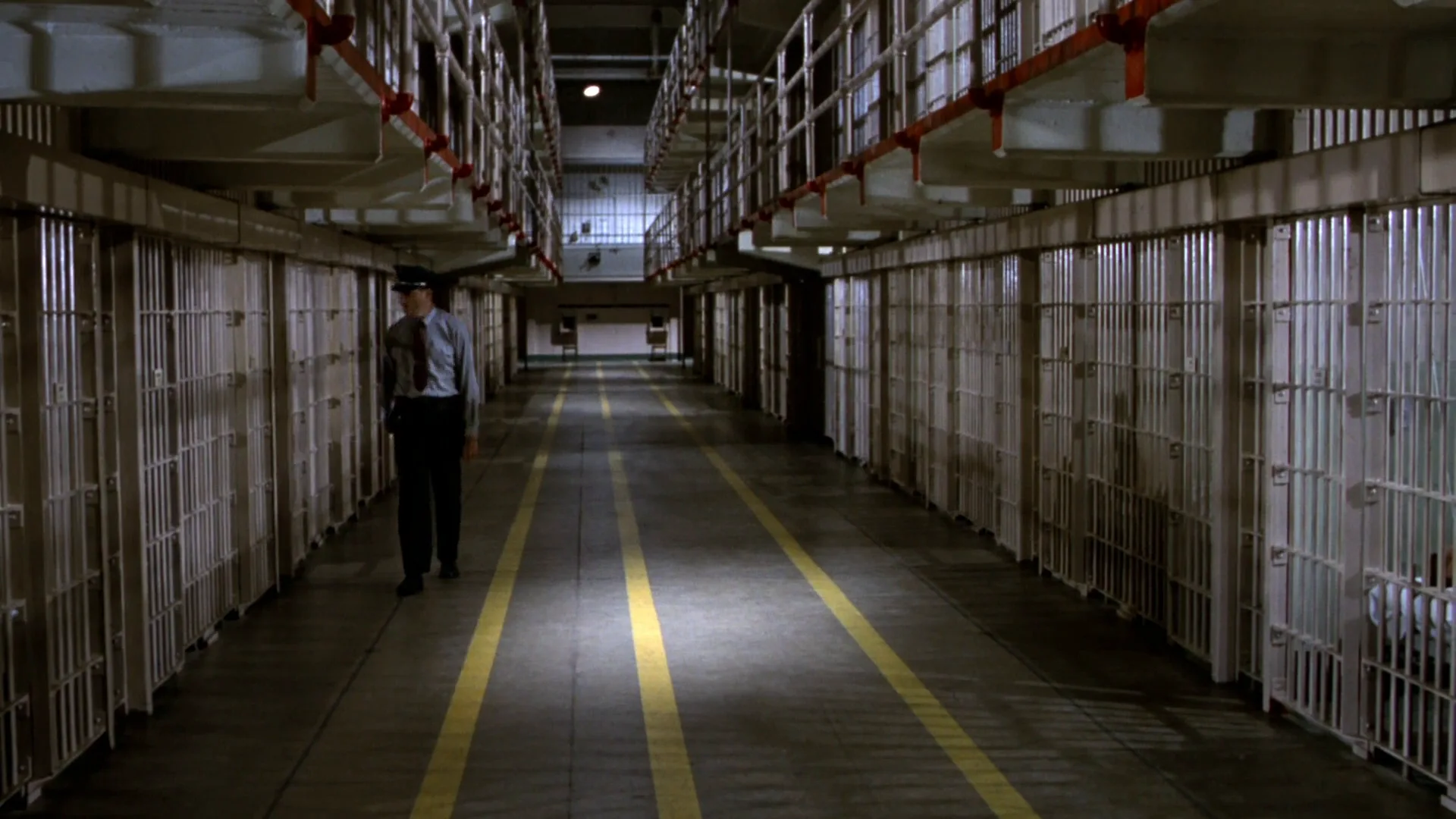
What are leading lines in film?
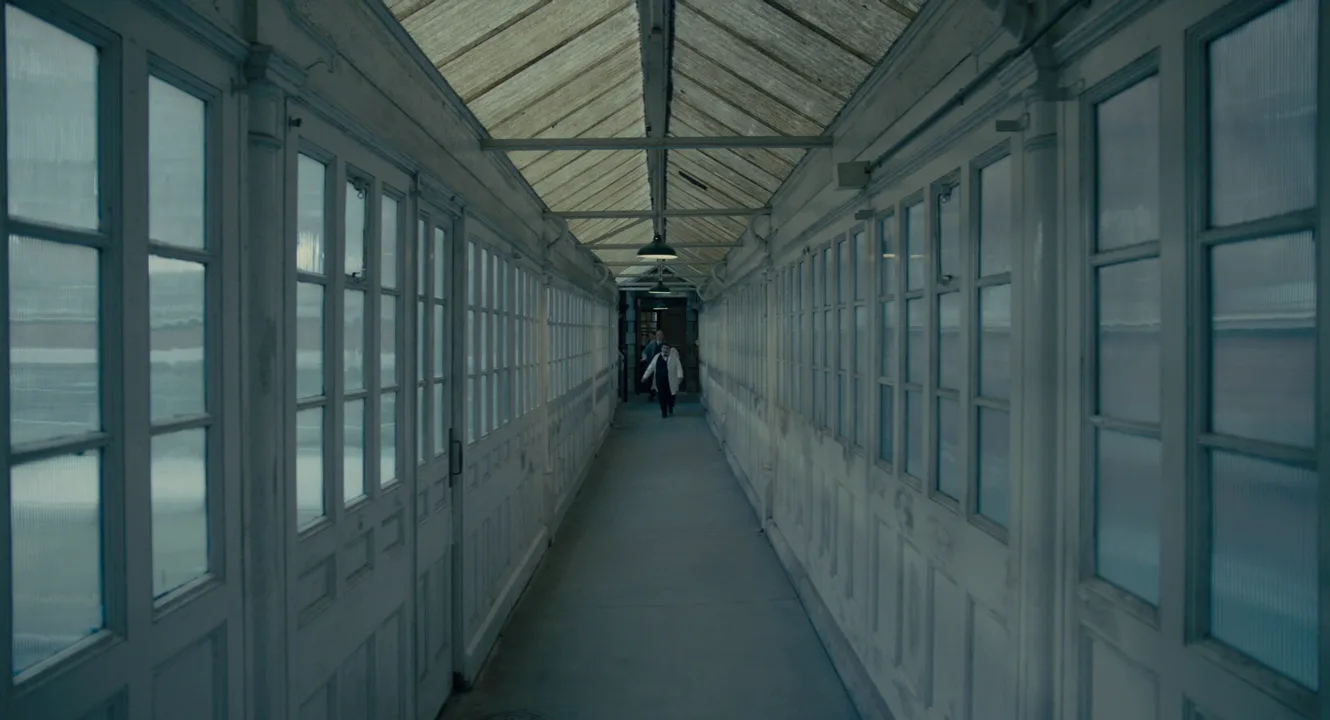
A leading line is any edge, stripe or row of objects the eye can follow — and the eye stops where the line ends, so whatever sits there gets looked at. In film composition the lines are architectural (corridors, stairs, rails), natural (roads, rivers, dunes) or made of light (ceiling tubes, sun shafts, shadows).
Parallel lines that recede from the camera meet at a vanishing point. Put the subject on that point and every line becomes an arrow aimed at them.
Why do filmmakers use leading lines?
To find the subject fast. Converging lines make a tiny figure read instantly in a huge frame — a core tool for directing the viewer’s eye.
To build depth. Lines running from the frame edge to the horizon connect the planes of depth layering into one path.
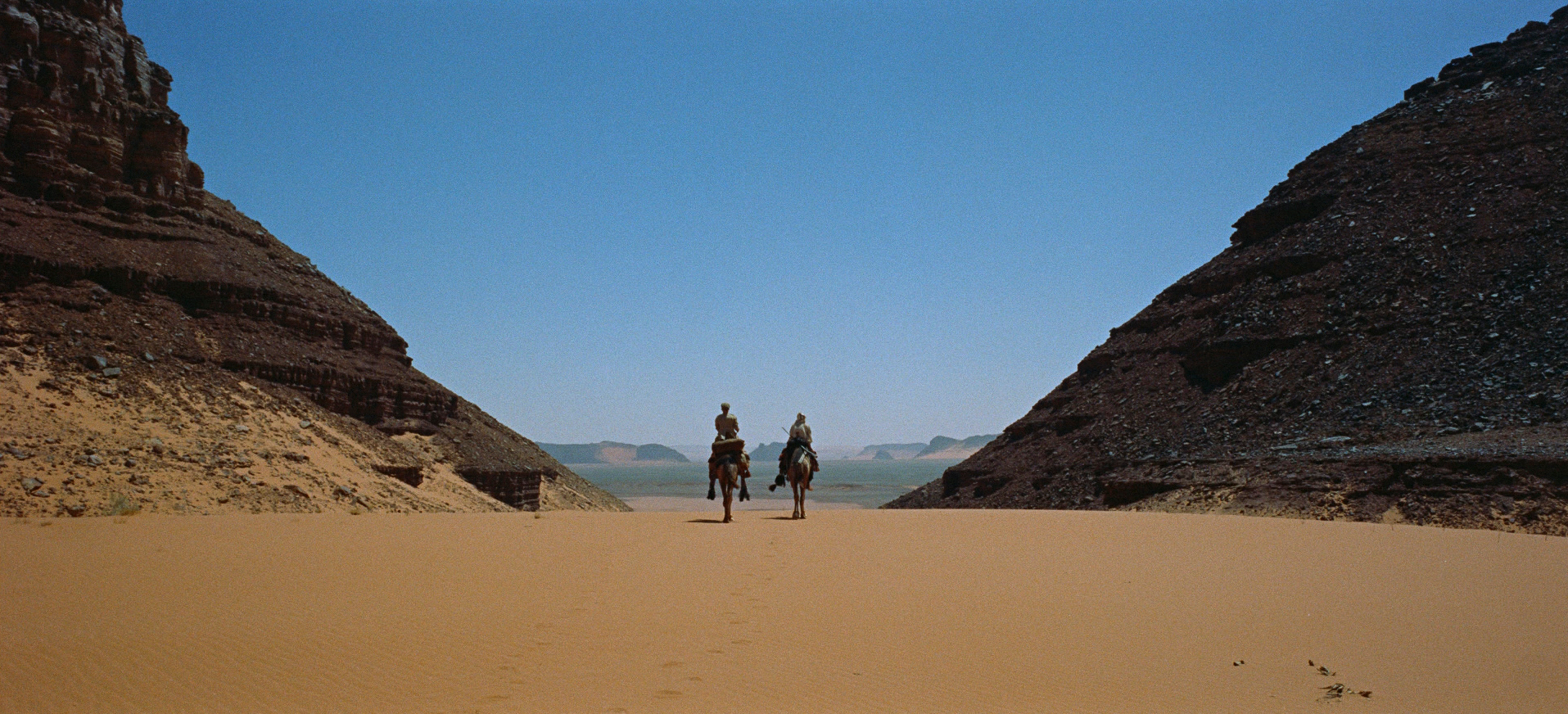
To give the scene a meaning. A road to the horizon reads as journey or escape; a corridor with no exits reads as a trap. Kubrick’s centered hotel corridors in The Shining (1980) close in on the characters; in Lawrence of Arabia (1962) canyon walls lead to riders the size of a fingernail.
To set the energy. Straight, centered lines feel ordered and inevitable, often paired with symmetry; slanted lines feel restless; curves slow the eye down.
Types of leading lines
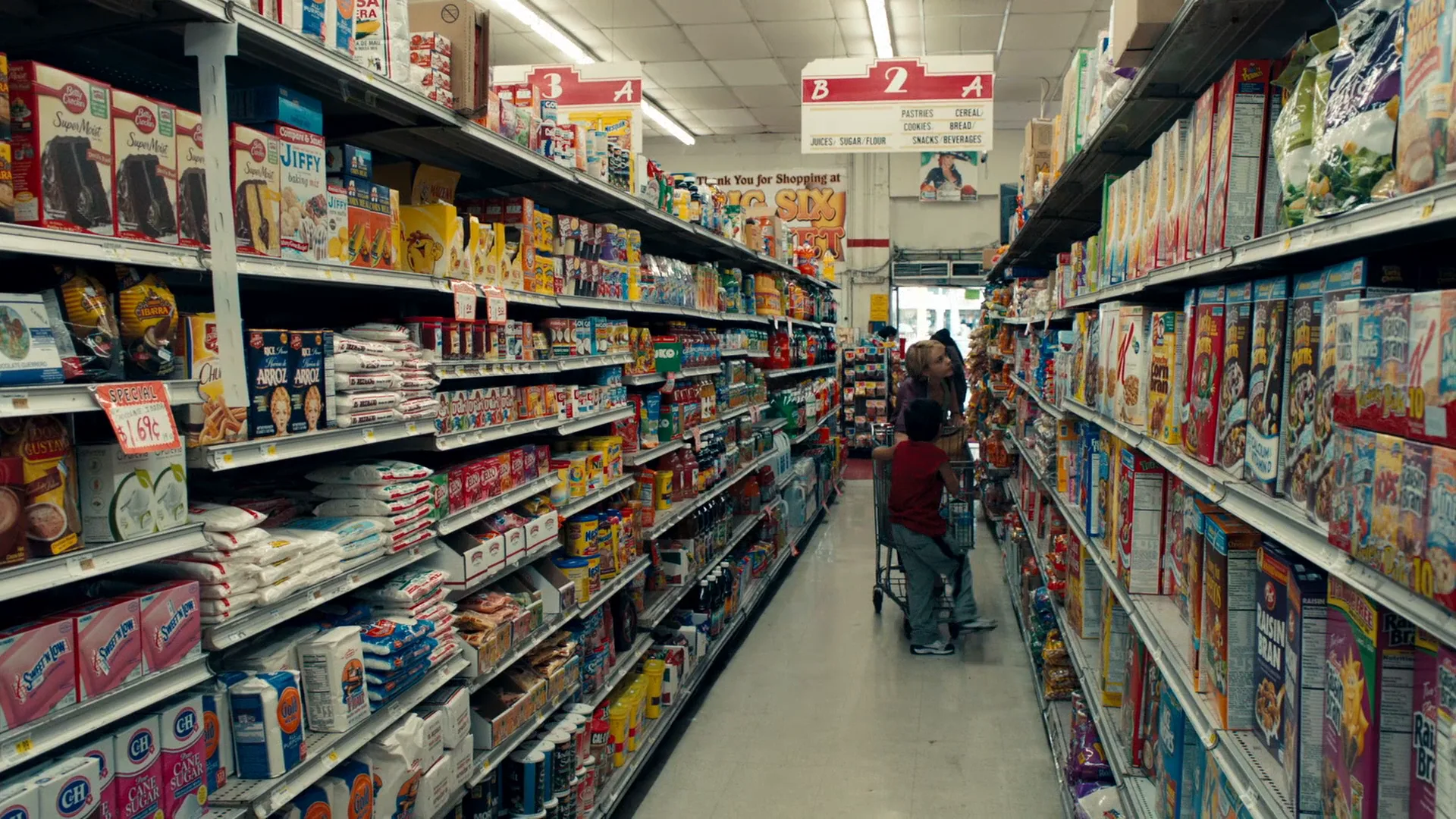
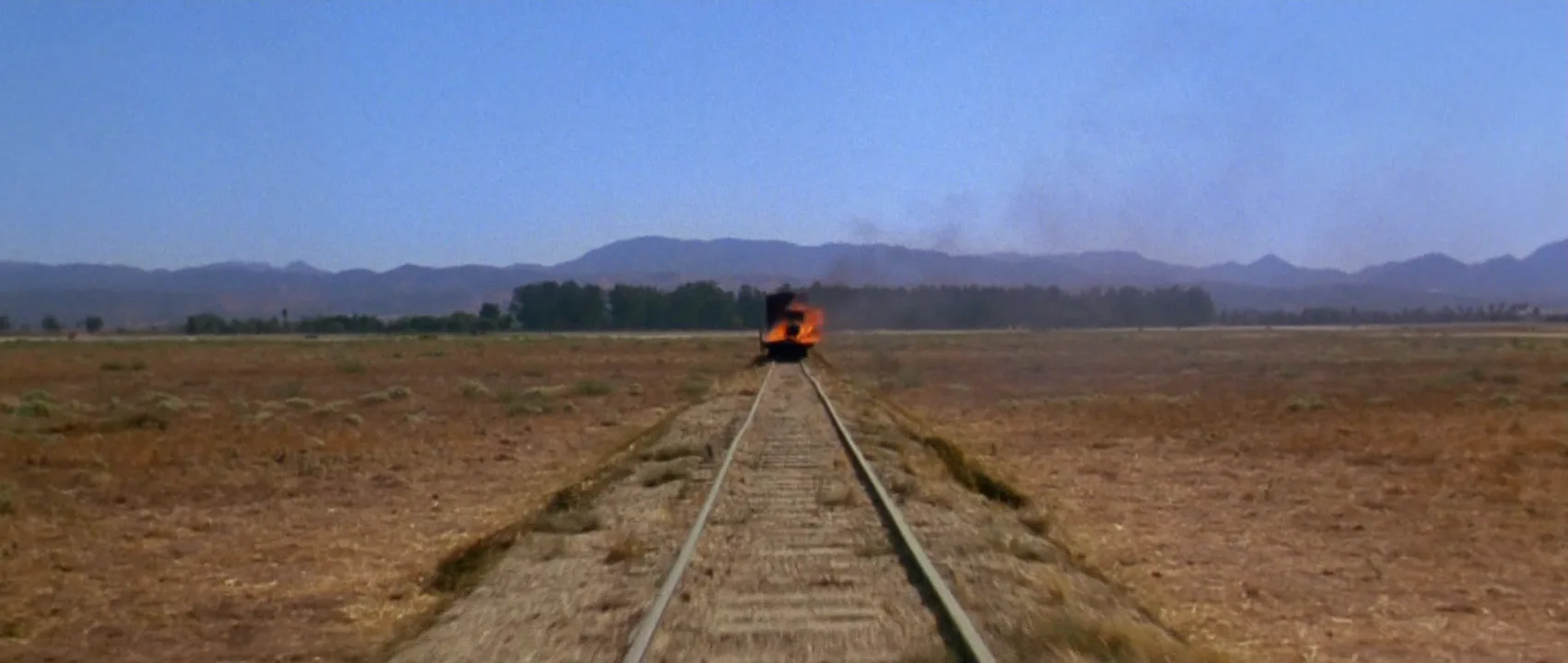
- Converging lines (one-point perspective): corridors, tunnels, rails, aisles meeting at one point. The most forceful type.
- Diagonal lines: one strong slant from a corner, adding tension — see diagonal composition.
- Curved and S-lines: winding roads, spiral stairs, rivers. The eye travels slower and takes in more space.
- Implied lines: an eyeline, a pointing arm or a row of turned heads leads the eye just as surely.
How to shoot leading lines
Find the vanishing point first, then put the actor on it or walk them toward it — centered for power, on a third for a looser frame.
Go wide and close. An 18–28mm lens (Super 35) stretches perspective so lines rush to the vanishing point; 85mm and longer compress them into flat stripes. Start the line at the frame edge or a corner so it pulls the eye in from outside.
Pick the height. Knee height or lower makes floor lines, rails and road markings dominant; eye level balances floor and ceiling in a corridor; a high angle turns roads into graphic stripes.
Light the destination. Make the far end the brightest area with practicals or a window, and stop down (f/5.6–f/11) so it stays sharp. A tracking shot along the line keeps the vanishing point steady while the walls stream past.
Leading lines vs. diagonal composition
Leading lines describe a function: any line that carries the eye to the subject, at any angle. Diagonal composition describes a structure: the frame built on one dominant slant for energy. A staircase rising from a corner to a figure is both; a centered corridor is leading but not diagonal. Ask whether the line ends on what the audience should see — if it does, it’s leading.
Leading Lines examples in film
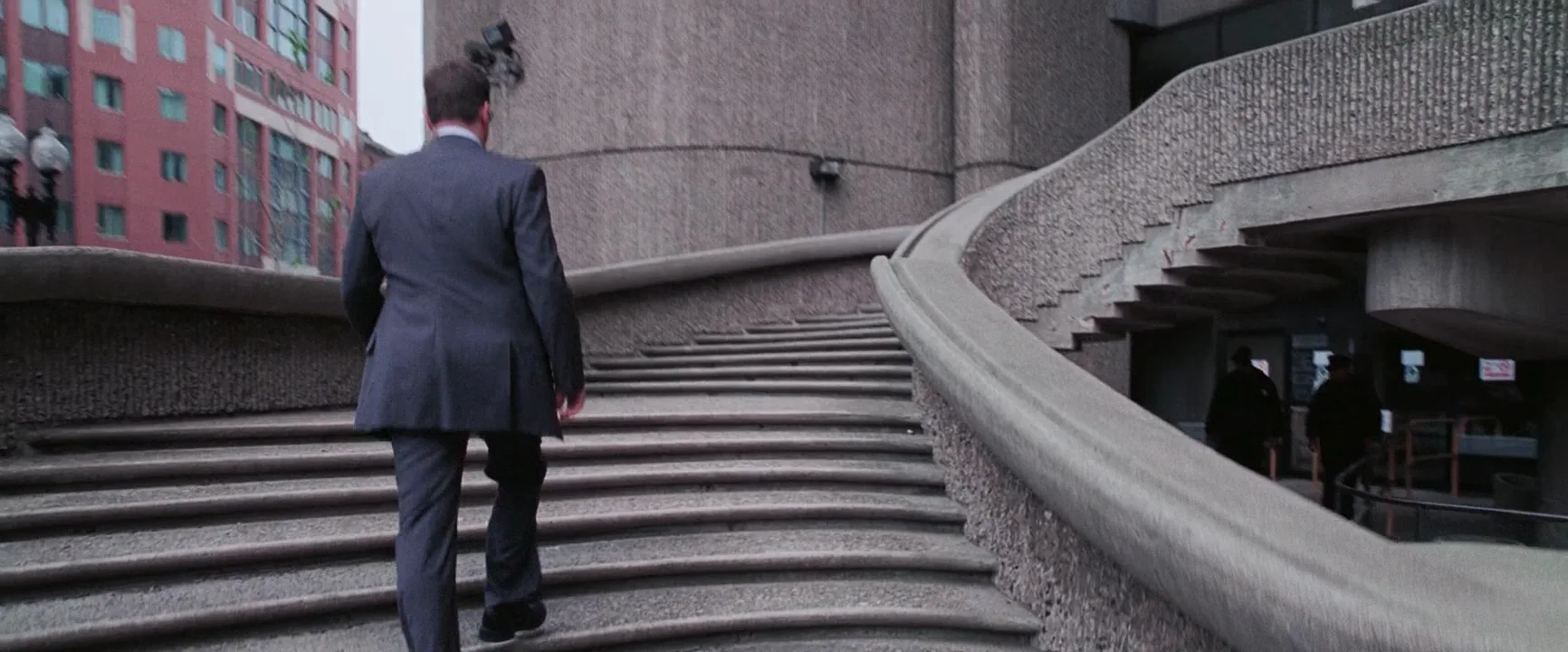
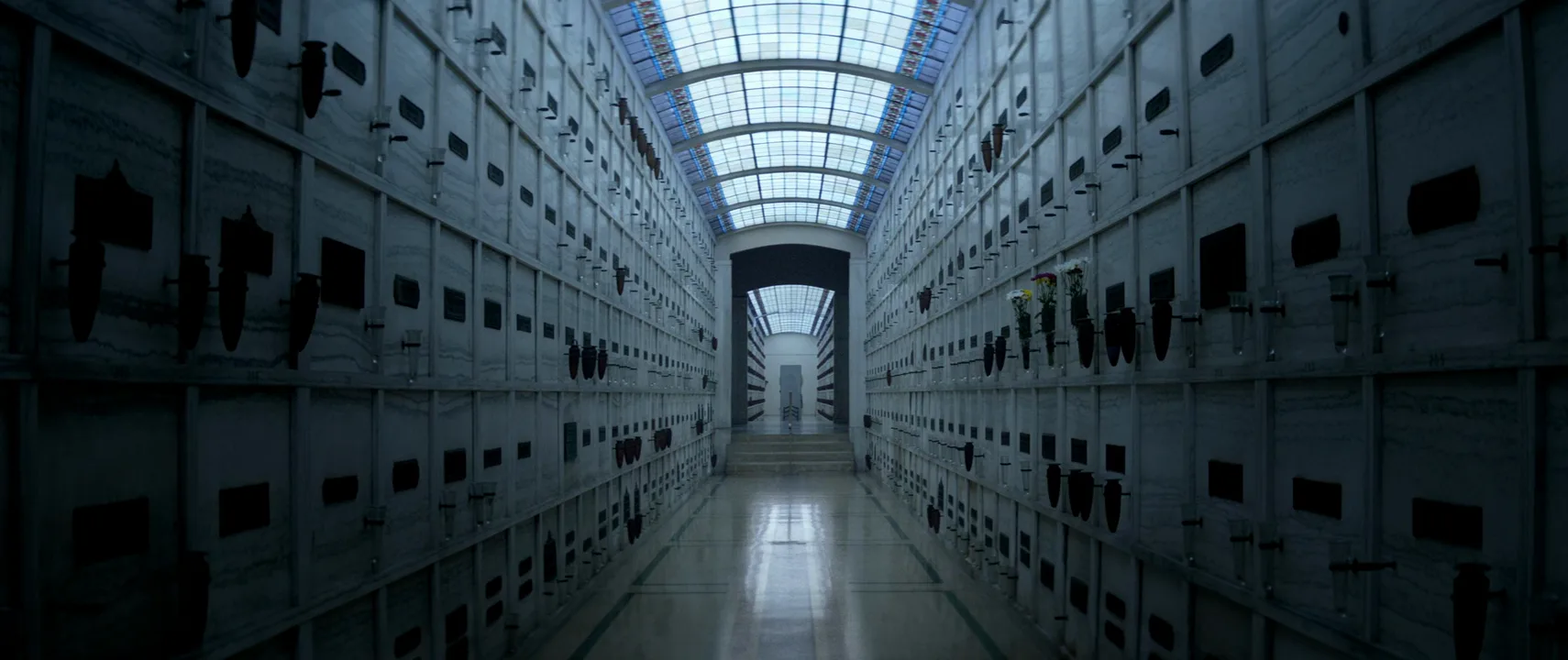
8 framesLook for where each line starts and what sits where the lines meet.
How to create a leading lines with AI
4 promptsModels draw perspective loosely: name the line, where it starts and what it ends on. Nano Banana 2 Lite makes the start frame, GPT Image 2.5 a ground-level second take, and MiniMax H3 Max Turbo animates frame one. Keep references and takes on one FlashBoards board to compare where the lines meet. The fourth prompt re-shoots a real film shot from a text description alone, and the original plays next to the result so you can compare.
Symmetrical one-point perspective, camera at eye height on the center line of a long wooden pier stretching into a grey sea, 24mm lens: plank boards, iron railings and a row of lamp posts all converge on a tall woman with a cropped silver-dyed bob and freckles in a mustard raincoat, walking away halfway down the pier, waves throwing spray over the left railing, low fog at the far end, overcast light brightest at the vanishing point, cinematic film still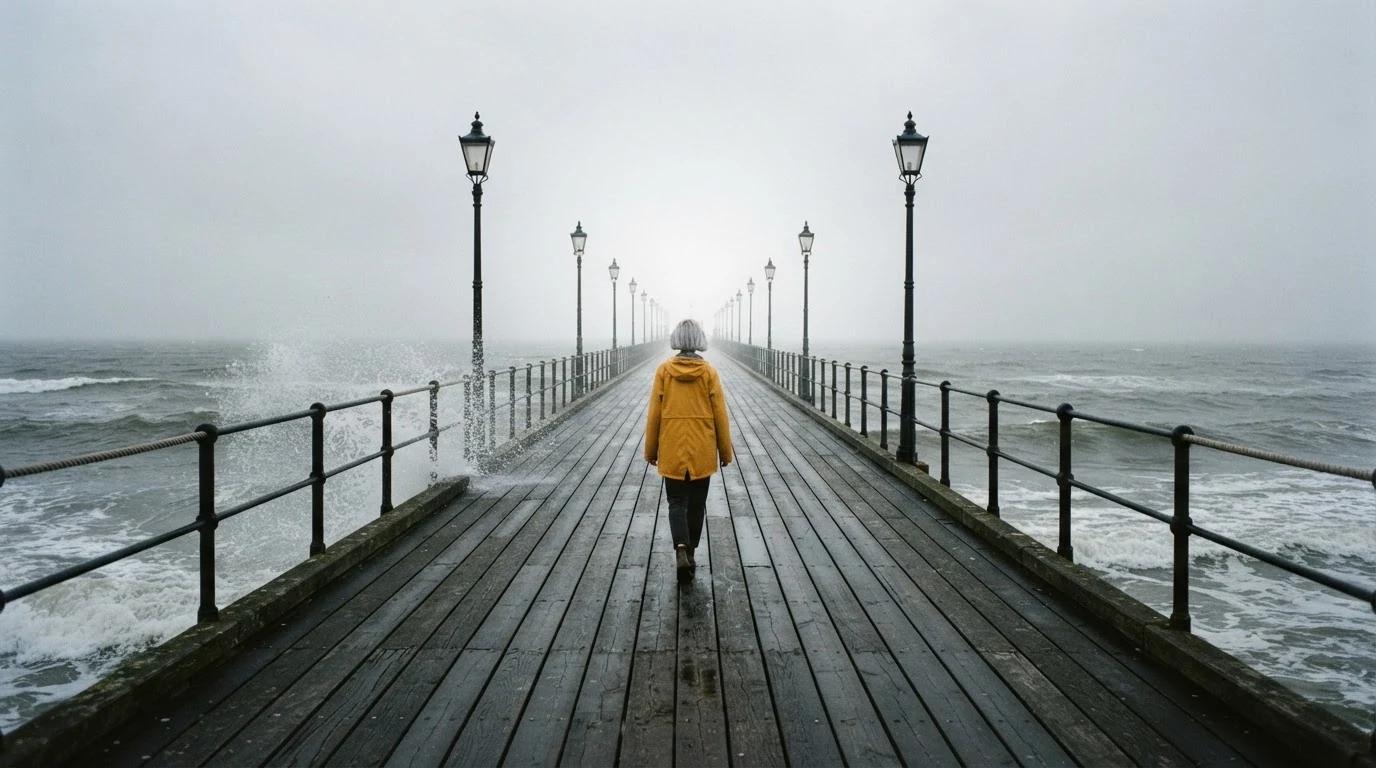
“One-point perspective” and “on the center line” lock the geometry; three sets of lines “all converge on” her, and the only saturated color and brightest sky sit at the same point. Her walk and the spray give the video motion from frame one.
Open FlashBoardsCamera on the ground between railway rails, 18mm lens, looking straight down the track: rails and sleepers start at the bottom corners and run across a flat ochre desert to the horizon, far down the track a wiry old man with a long white braid and patched denim jacket walks away along the sleepers, a tiny figure in the center where the rails meet, telegraph poles shrinking in a row on the right, low orange sun, long shadows, cinematic widescreen still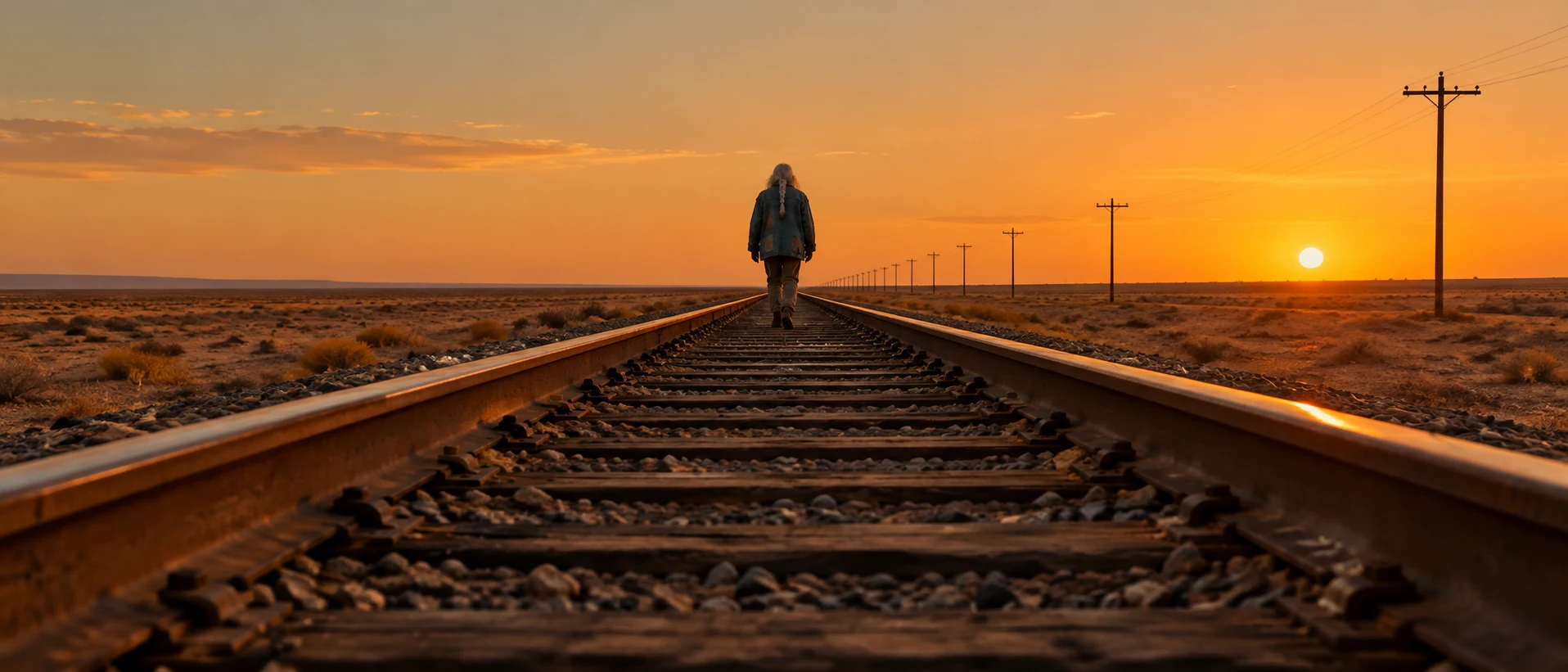
“Start at the bottom corners” makes the lines begin at the frame edge, where they pull hardest; 18mm sharpens the V and 21:9 leaves the figure readable only through the lines.
Open FlashBoardsCamera: dollies forward slowly along the center line of the pier for the whole shot, at eye height, vanishing point held in the center, railings and lamp posts streaming past both edges. Action: the woman in the mustard raincoat is already walking away and waves are already breaking over the left railing. She keeps walking toward the fog as lamp posts slide past. At the end she stops and rests one hand on the railing, facing the sea.A forward dolly on the center line keeps the meeting point still while the walls move, so the lines work in every frame. Motion starts immediately, and the prompt names only what is already in the frame.
Open FlashBoards{
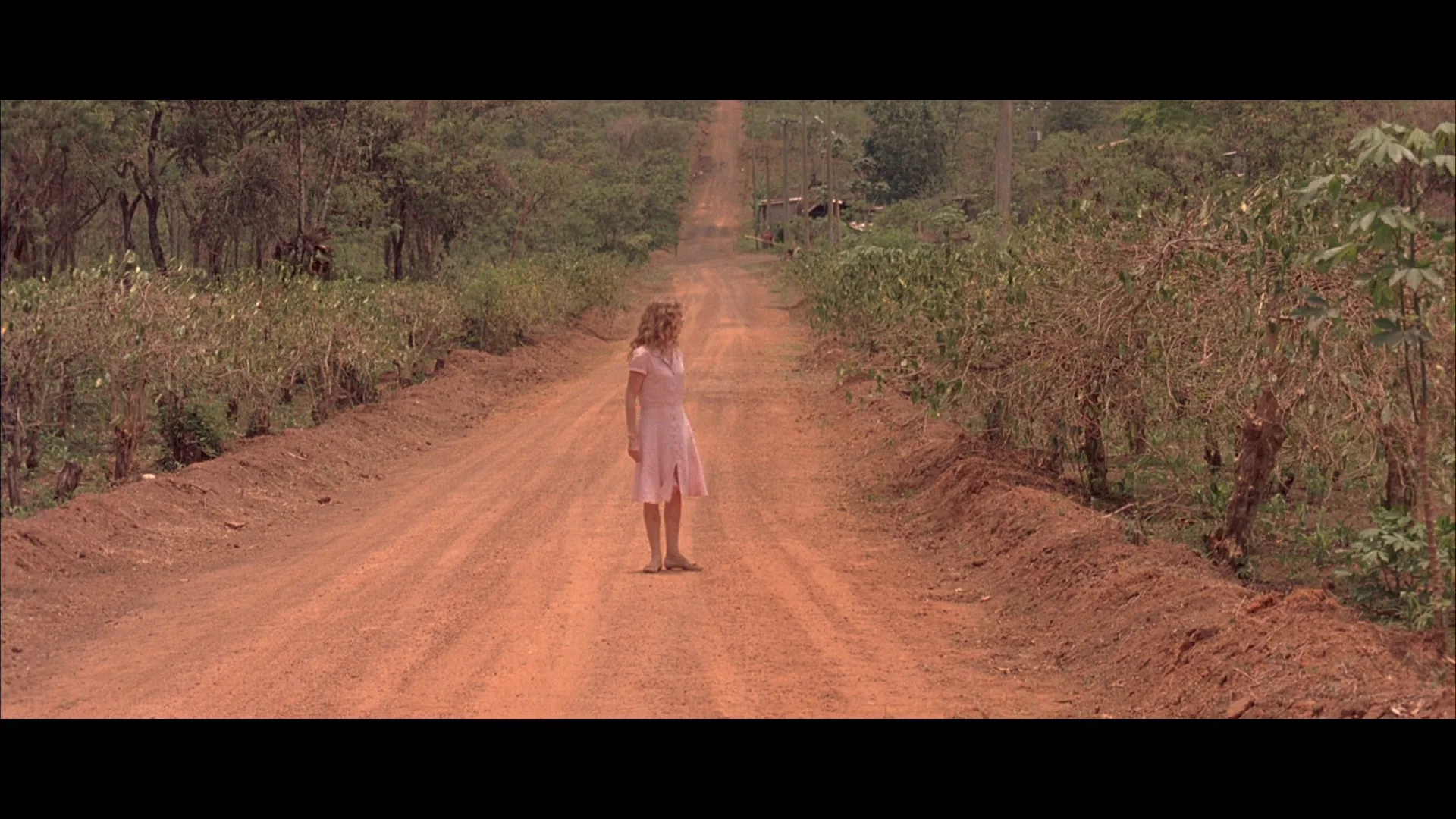
"output": "Full-screen live-action shot from White Material (2010), one continuous take with no cuts, alive from its very first frame. Scope widescreen 2.39:1, 35mm film grain, hazy overcast tropical midday, soft diffuse light with only a faint shadow under the feet, warm faded palette: brick-red laterite road, olive-green bush, dusty-rose pink dress. A long straight red dirt road runs from the bottom edge, full frame width, straight up the centre of the picture and climbs a gentle slope, narrowing to a thin red ribbon that reaches the top edge of the frame; green trees and bush fill the whole top of the frame on both sides. Its raised red earth banks and the two rows of scrubby bushes along them converge to that far point at top centre, like a funnel.",
"characters": {
"S1": {
"name": "Maria Vial, played by Isabelle Huppert",
"look": "slender woman, small in the wide frame (her height about a third of the frame height), loose shoulder-length wavy strawberry-blonde hair, short-sleeved knee-length dusty-rose pink button-front cotton dress, flat pale slip-on shoes, nothing in her hands",
"voice": "silence: she never speaks"
}
},
"shots": [
{
"shot": 1,
"camera": "locked-off static wide shot for the whole take, camera slightly above head height looking up the road, lens on the road's centre line, normal lens; the camera never moves, pans or zooms",
"voice": "silence: nobody speaks in this shot, no voice at all",
"action": [
"BEGINNING: alive from the first frame, S1 stands alone in the middle of the road, her feet a third of the way up the frame, just left of centre, small in the wide frame with plenty of red road around her, her body in profile turned toward screen left, looking off toward the left-hand bush, both arms hanging still at her sides.",
"THEN: a gust of wind lifts the hem of her skirt and flutters it toward screen left; her hair stirs; she stays planted, hands still.",
"THEN: she turns her head, then her whole body, to face the camera and stands square to it, gazing past the lens toward screen right, the hand on screen right curled loosely by her thigh, the wind pushing the skirt against her knees.",
"THEN: she turns further to her left into profile facing screen right and looks up the road, hesitating.",
"THEN: she turns her back to the camera and starts walking slowly straight up the middle of the road, away from the camera, arms loose, skirt swinging, hair blowing.",
"END: she keeps walking up the centre line toward the vanishing point, a little smaller in frame, the converging road edges and bush rows framing her from both sides; the frame stays locked."
],
"dialogue": []
}
],
"sound": {
"ambience": "hot still countryside: dry wind through the bush, insects buzzing, her soft footsteps on dusty earth",
"speech": "no words in this video; the only human sounds are breaths and movement",
"never_spoken": "no narration and no voice-over: the descriptions, performance notes and step words of this prompt are never spoken aloud",
"music": "a film score under the scene, always below the voices: a sparse, uneasy score of low sustained strings over a slow, repeating bass pulse",
"subtitles": "none"
}
}Remakes the static red-road shot from White Material (2010), dir. Claire Denis, DP Yves Cape: Maria Vial (Isabelle Huppert) stands on the road, turns toward camera, then walks away up it, and the prompt keeps the locked frame and the converging road edges.
The frame is locked, so the road does the directing: output builds the funnel (the road climbs to a thin ribbon at top centre, banks and bush rows converging on it), and the BEGINNING step puts Maria on that line. The THEN steps copy her real beats: profile, wind, a look toward camera, then the walk up the road into the point where the lines meet. Nobody speaks in the original, so the shot is marked silent and only the score plays.
Common mistakes
- Lines that don’t meet: roads bend or end in a wall. Say “all converge on the figure at the far end.”
- Subject off the line: state the position — “halfway down the pier,” “a tiny figure in the center where the rails meet.”
- Flat perspective: add a wide lens and camera position (“24mm, on the center line”).
- Video drift: name the direction and what stays fixed — “vanishing point held in the center.”
Keep the reference frames, prompts and every generated take side by side — images and video in one canvas.
FAQ
4 questionsWhat are leading lines in film?
Leading lines are lines in the frame — roads, rails, corridors, fences, rows of lights, shadows — that guide the viewer’s eye toward the subject or deeper into the image. Filmmakers place the actor where the lines end or converge, so the audience finds them instantly even in a wide shot, and the flat screen gains depth.
What is an example of leading lines in a movie?
The hotel corridors in Stanley Kubrick’s The Shining (1980) are a classic: walls, carpet and ceiling converge on a centered vanishing point where the characters stand. In Lawrence of Arabia (1962) canyon walls lead to tiny riders. Railway tracks, straight roads and prison corridors are the most common film examples.
What is the difference between leading lines and converging lines?
Converging lines are one type of leading line: parallel lines, like rails or corridor walls, that appear to meet at a vanishing point. Leading lines is the broader term for any line that guides the eye, including a single diagonal, a curved road or an implied line such as an eyeline.
Which lens is best for leading lines?
A wide lens, roughly 18–28mm on Super 35, exaggerates perspective so parallel lines rush toward the vanishing point and the space feels deeper. Long lenses compress the same lines into flat stripes. Put the camera close to where the line starts and keep the far end in focus.
Related terms
4- Diagonal CompositionComposition & Framing
Diagonal composition organizes the frame along a strong slanted line — a staircase, road, body or shaft of light — that pulls the eye from corner to corner and adds energy, tension or movement even with a level horizon.
- Depth LayeringComposition & Framing
Depth layering builds a shot in distinct planes — foreground, midground and background — each holding something meaningful, so the flat screen gains volume and several actions or ideas can be read at once.
- Directing the Viewer's EyeComposition & Framing
Directing the eye is the toolkit — contrast, focus, color, lines, movement, faces and placement — that filmmakers use to decide what the audience looks at first, and in what order, within a shot.
- SymmetryComposition & Framing
Symmetry arranges the frame so its left and right halves mirror each other around a central axis — architecture, props and actors in matched positions — creating order, formality and sometimes an uncanny, controlled world.
Further reading
Bruce Block, The Visual Story (on line, space and direction in the frame). Gustavo Mercado, The Filmmaker’s Eye (chapter on composition and perspective).