 FlashBoards Learn
- Learn
- Composition & Framing
- Symmetrical Composition
Composition & Framing · Film language
Symmetrical Composition
Also called: symmetrical composition, symmetrical framing, symmetrical balance
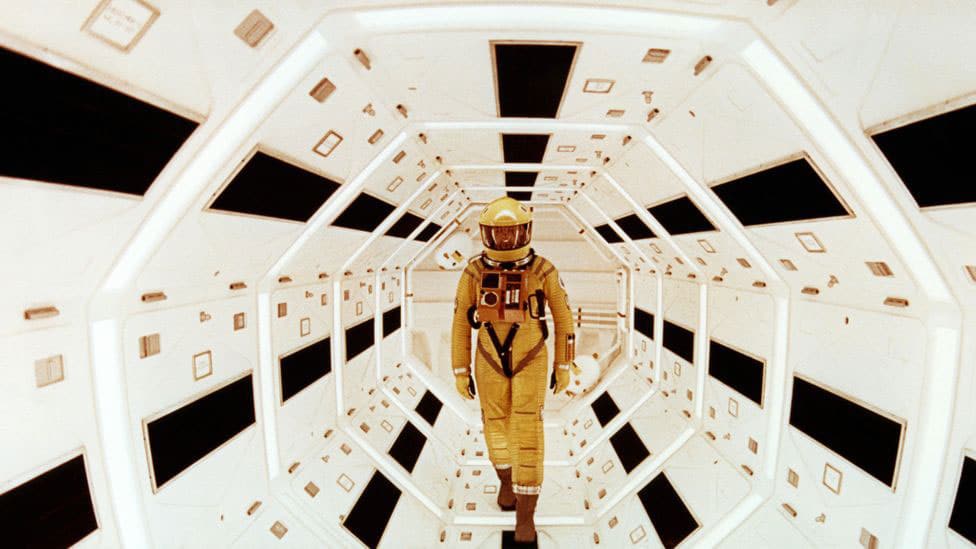
Symmetrical composition arranges a shot so its left and right halves mirror each other around a central axis: walls, doors, props and actors placed in matched pairs. The viewer reads it instantly as order and control. It can feel formal, calm or ceremonial, or, when the world looks too perfect, quietly uncanny, as in Kubrick's corridors and Wes Anderson's hotels.
- What it does
- Mirrors the left and right halves of the frame around a center line, so the shot reads as ordered, formal and controlled.
- Use it when
- You show institutions, rituals, power, confinement or an artificial world, or mark a key arrival or threshold.
- Watch out
- A camera even slightly off the axis ruins the mirror, and symmetry in every scene turns a film into a set of postcards.
- Try this prompt
perfectly symmetrical one-point perspective, camera centered on the corridor axis at eye level, identical doors mirrored on both walls, figure dead center
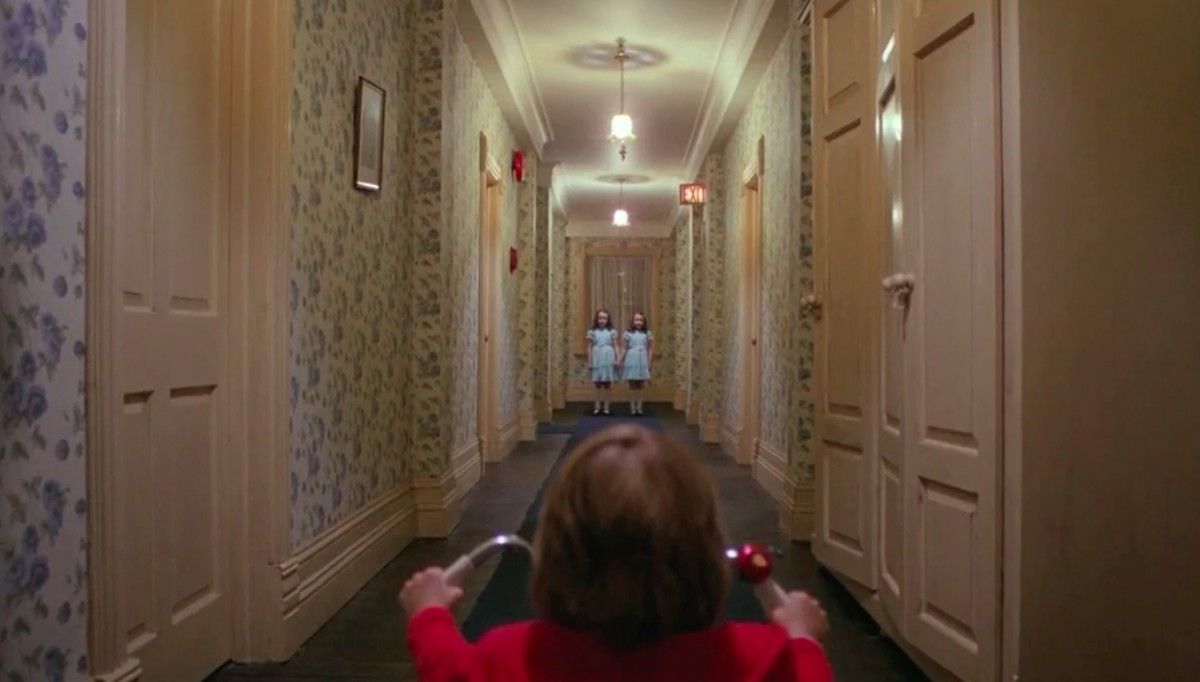
What is symmetrical composition?
Symmetrical composition (also called symmetrical framing or symmetrical balance) puts the camera on the central axis of a scene, so whatever sits on the left side of the frame is repeated on the right. Draw a vertical line through the middle and the two halves read as reflections: a door answers a door, a lamp answers a lamp, one actor answers another.
On screen, symmetry is rarely exact. Faces are not symmetrical and actors drift a foot to one side. What the audience registers is the structure: a set organized around a center line, a camera square to it, and visual weight spread evenly across both halves. That makes symmetry the most rigid form of visual balance.
A symmetrical shot usually rests on three things:
- A central axis. The camera sits on the midline of the set: the middle of a corridor, the aisle of a church, the center of a table.
- Matched elements. Architecture, furniture, lights or people repeat on both sides. Rows of identical objects add a repeated pattern that makes the mirroring stronger.
- A frontal camera. The lens looks straight down the axis, level, with no pan or tilt. Often the result is a head-on shot, with converging lines meeting at one vanishing point.
It is one of the few tools of film composition that viewers notice consciously. People who never think about framing still recognize a Wes Anderson shot.
Why do filmmakers use symmetrical shots?
Symmetry is loud. Most shots are composed off center, often along the rule of thirds, because asymmetry feels natural and lets the eye travel. A mirrored frame breaks that rhythm and tells the viewer that someone arranged this world on purpose.
Order, power and ceremony. Palaces, courtrooms, churches and parade grounds are built symmetrically to project authority, and a camera on their center line inherits it. A ruler framed dead center between guards becomes the image of an institution rather than a person.
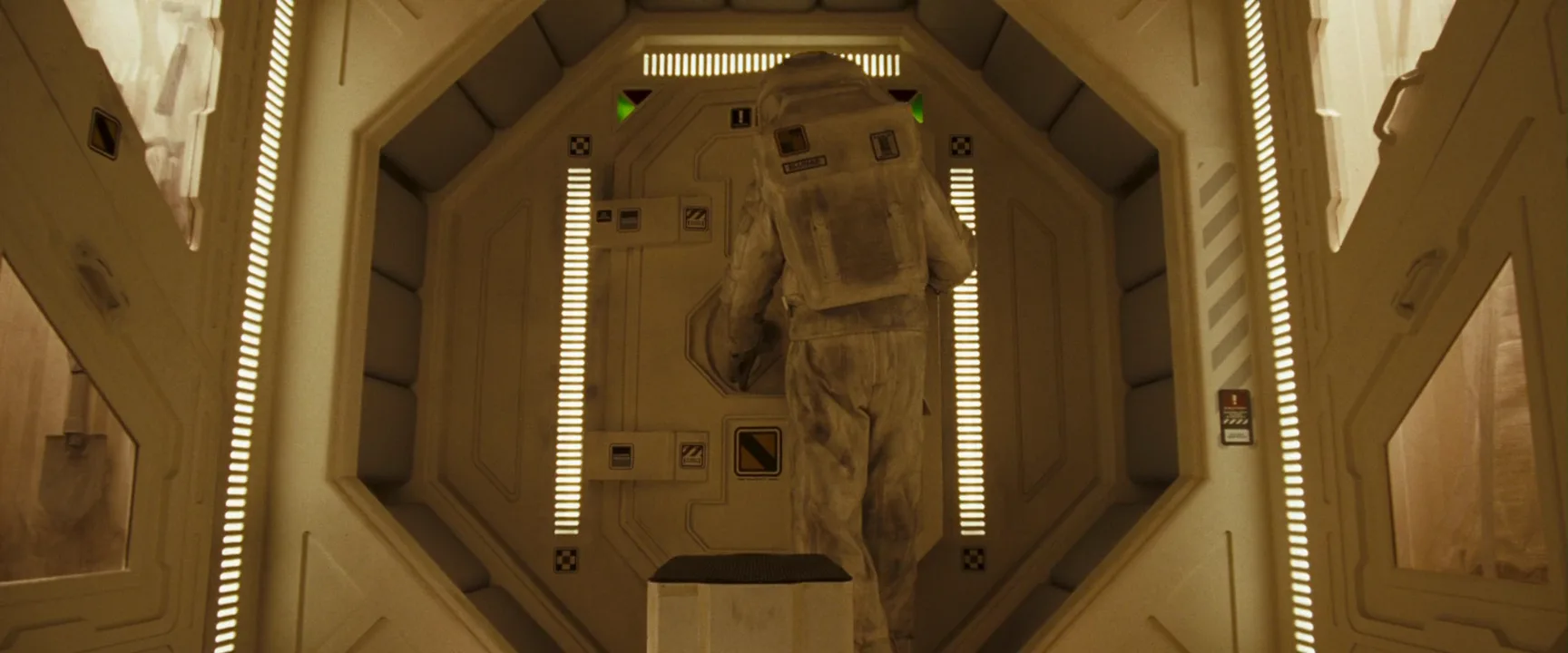
Control and unease. Stanley Kubrick returned to symmetrical, one-point perspective in 2001: A Space Odyssey (1968), A Clockwork Orange (1971), The Shining (1980) and Full Metal Jacket (1987). His frames feel engineered, and the characters inside them look trapped by the architecture. When a world is this orderly, the smallest intrusion into it feels like a threat.
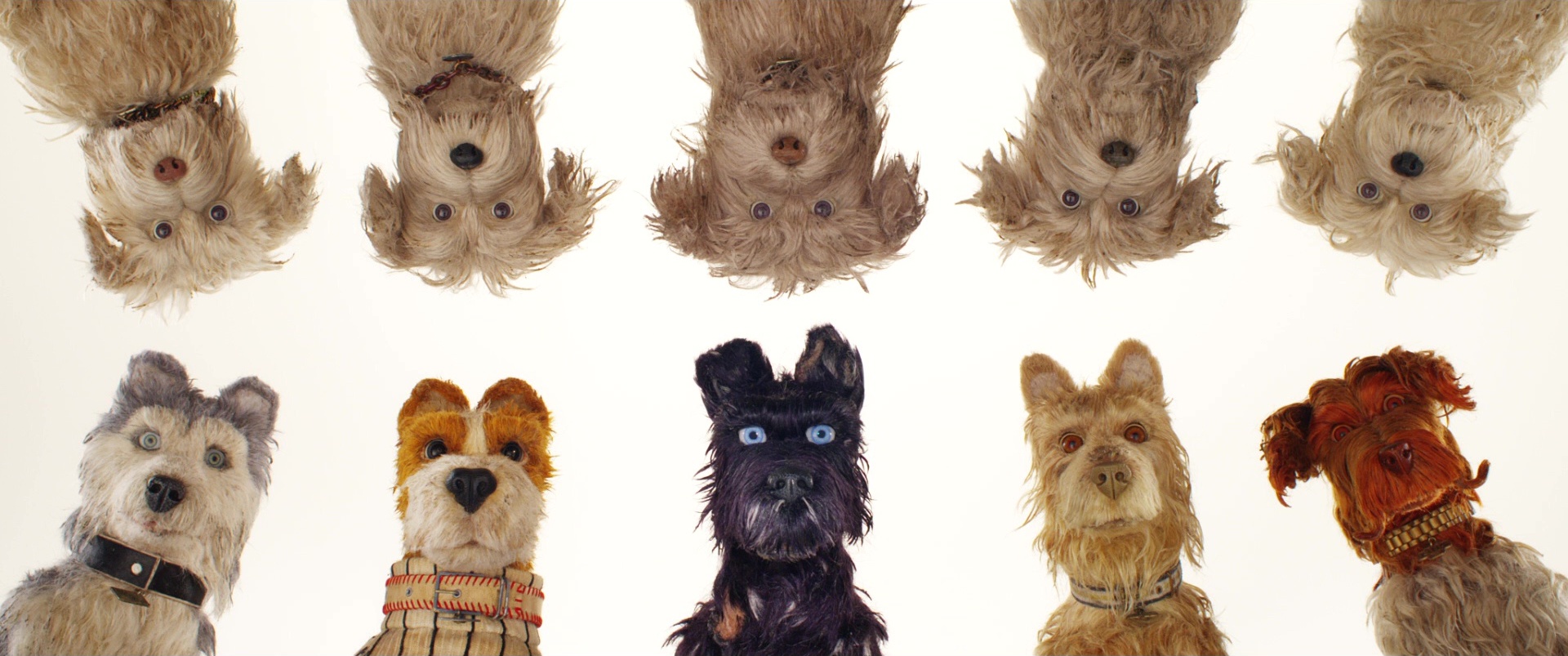
Artifice and comedy. Wes Anderson frames rooms, trains and hotels flat and centered, like dioramas. The symmetry makes his worlds feel handmade and slightly unreal, and it sets up deadpan comedy: characters stand in their assigned places, and any disorder plays as a joke against the design. In The Grand Budapest Hotel (2014) the aspect ratio also changes with each time period, so the geometry itself dates the story.
Isolation and confrontation. A single small figure at the exact center of a large symmetrical space looks alone and exposed: the space is balanced, the person is not. A centered actor looking into a lens on the axis speaks straight to the audience, without the comfort of a three-quarter angle.
Because symmetry draws attention to itself, most directors save it for key beats, such as an arrival or a verdict, and frame loosely around it.
Types of symmetric composition
Mirroring left to right is the classic case, but a frame can be symmetric in several ways.
Bilateral (vertical-axis) symmetry
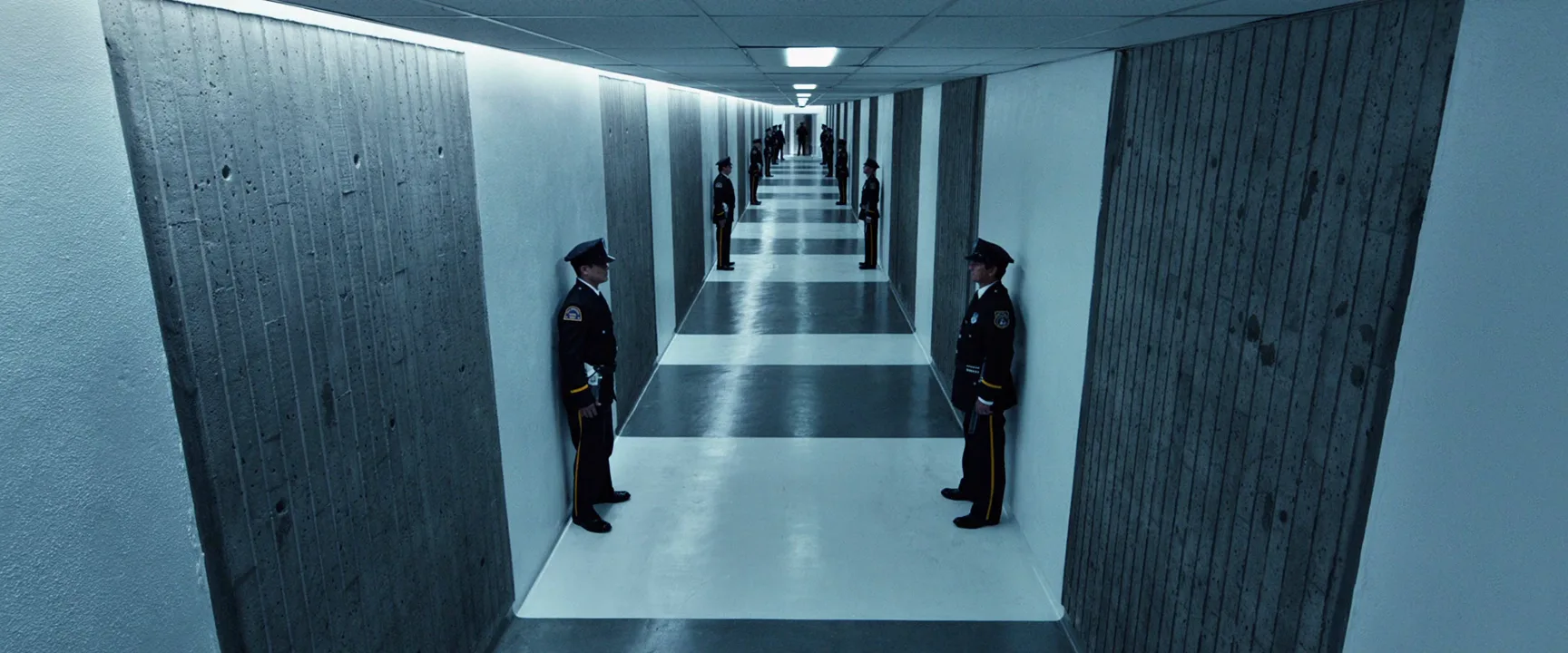
The left half reflects the right across a vertical center line. Corridors, aisles, staircases and banquet tables produce it naturally. Add a central vanishing point and you get one-point perspective, where leading lines from both walls converge on the subject: the Kubrick corridor.
Horizontal-axis symmetry
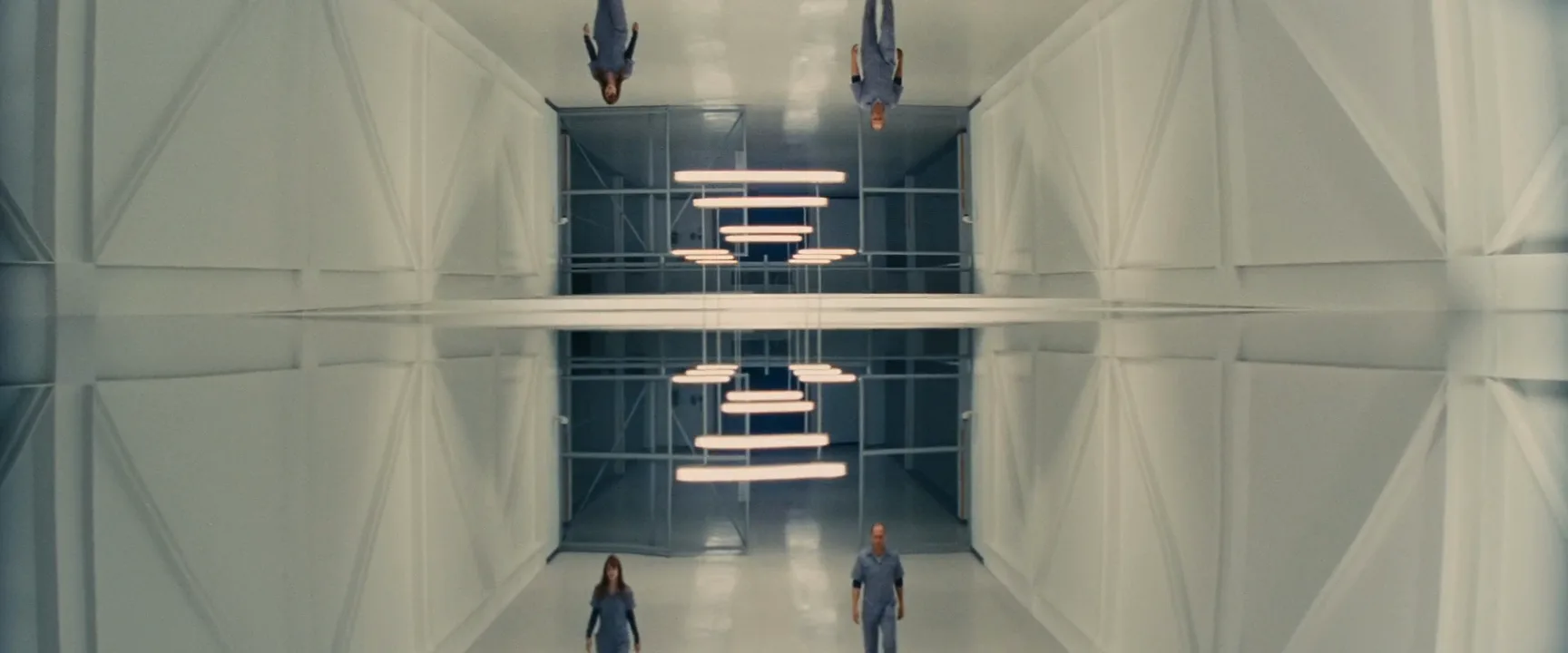
The top half reflects the bottom, through water, a polished floor, glass or a literal mirror shot. Reflections double the subject and can feel dreamlike, since the viewer is not sure which half is real.
Radial symmetry
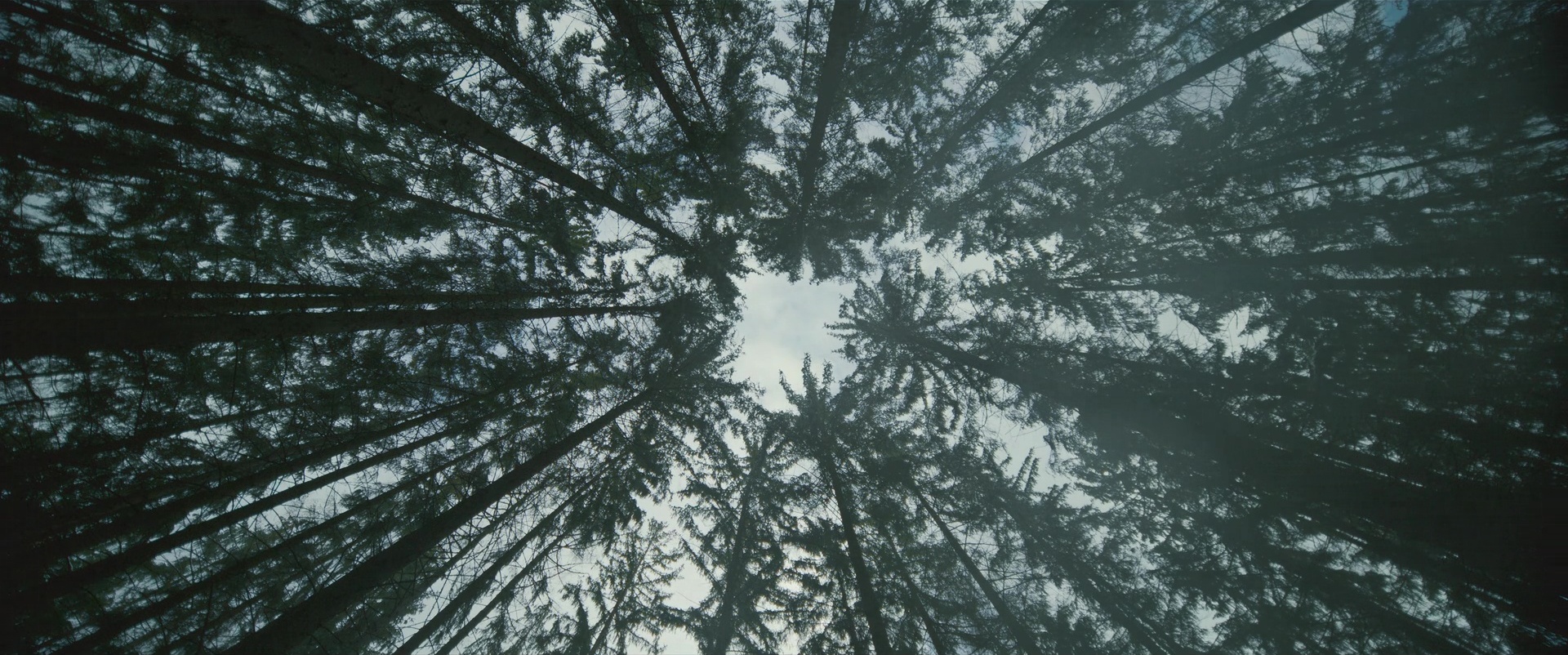
Elements radiate from a center point: a ring of trees seen from below, a spiral staircase from the top, a round table from above. An overhead shot finds radial symmetry most easily, because it removes perspective and turns the scene into a pattern.
Near symmetry
The frame is built symmetrically, but one element breaks the mirror: an actor slightly off center, a lamp on one side, one door left open. It is more common on screen than perfect symmetry, and often more interesting, because the break becomes the focus.
Planimetric (frontal) symmetry
The camera faces a back wall squarely, so the background runs parallel to the frame and characters line up across it like figures on a stage. It overlaps with the tableau shot, where a whole group is posed as one picture.
How to shoot a symmetrical shot
Symmetry is geometry, and small errors show. A few centimeters off the axis and the walls converge unevenly; one degree of pan and the vanishing point slides off center.
Find or build the axis. Choose a location with a real center line (corridor, aisle, road, bridge, doorway) or dress the set so furniture and lamps repeat on both sides. Measure from both walls and tape the center on the floor.
Put the camera on the line. Set the tripod or dolly track on that mark and level the head. Verticals should stay vertical, and the lines of the far wall should run parallel to the frame edges. Turn on the monitor's center cross: the vanishing point belongs on it.
Pick the lens for the space.
- Wide, 14–25mm (a wide-angle lens): exaggerates the convergence of walls and makes corridors feel endless. Keep it level, or verticals lean inward.
- Normal, 32–50mm: calmer perspective for frontal tableaux and centered dialogue.
- Long, 85mm and up: flattens depth and stacks columns, windows or rows of people into a pattern.
Choose the height. For one-point perspective, a lens at roughly half the ceiling height makes floor and ceiling mirror each other. Eye level, around 1.5–1.7 m, keeps a centered face frontal.
Block on the axis. Put the key subject on the center line and secondary actors in matched pairs. Two people in conversation can face each other in profile from mirrored positions.
Light both sides evenly. A hard key from one side breaks symmetry as fast as a misplaced chair. Use matched practicals or a toplight centered over the axis.
Hold still or move along the axis. A static shot holds symmetry best. A straight dolly in or out along the center line, or a pedestal move, keeps both halves mirrored; pans and arcs break them.
Mind the aspect ratio. Wide formats (2.39:1) leave room for flanking elements; narrow ones (1.37:1) stress centered verticals.
When a symmetrical shot works, and when to break it
A symmetrical shot is only as good as its reason. In every scene it turns a film into postcards; on the right beat it lands like a stamp.
It works when the story is about order, rules or confinement, when a character arrives somewhere significant, when the audience should feel watched or trapped, or when the world is meant to look artificial.
Avoid it when the moment needs intimacy or chaos: handheld arguments, chases, quiet talk up close. Symmetry holds the viewer at a distance.
Break it on purpose. A mirrored room with one chair knocked over, a line of identical figures with one facing the other way, a centered character who steps out of frame: the eye goes straight to whatever breaks the pattern. Build the mirror first, then decide what disrupts it.
Use a frame within the frame. Doors, windows and arches are symmetrical themselves; a frame within a frame reinforces the axis and adds depth in front of it.
Plan the reverse. If the master is centered, the reverse from the other end of the axis usually has to be centered too, or the geometry of the scene falls apart in the edit.
Symmetry vs. center framing
The two are easy to confuse, because a symmetrical shot usually has its subject in the middle. The difference is what happens around the subject.
Center framing is about placement: the subject sits on the vertical center line, and that alone gives it dominance. The background can be completely asymmetrical.
Symmetry is about the whole frame: the two halves mirror each other, whether or not there is a single subject, as in a top-down banquet table or a row of identical doors.
| | Center framing | Symmetrical composition | |---|---|---| | What is centered | The subject | The whole design | | Background | Anything | Mirrored left and right | | Typical effect | Dominance, confrontation | Order, formality, control, unease | | Camera | Any angle | Square to the set, on its axis |
A face in the middle of a cluttered room is centered; the same face at the end of a corridor of identical doors is symmetrical. And where other kinds of balance offset unequal weights, symmetry balances by repetition, which is why it feels so deliberate.
Symmetrical Composition examples in film
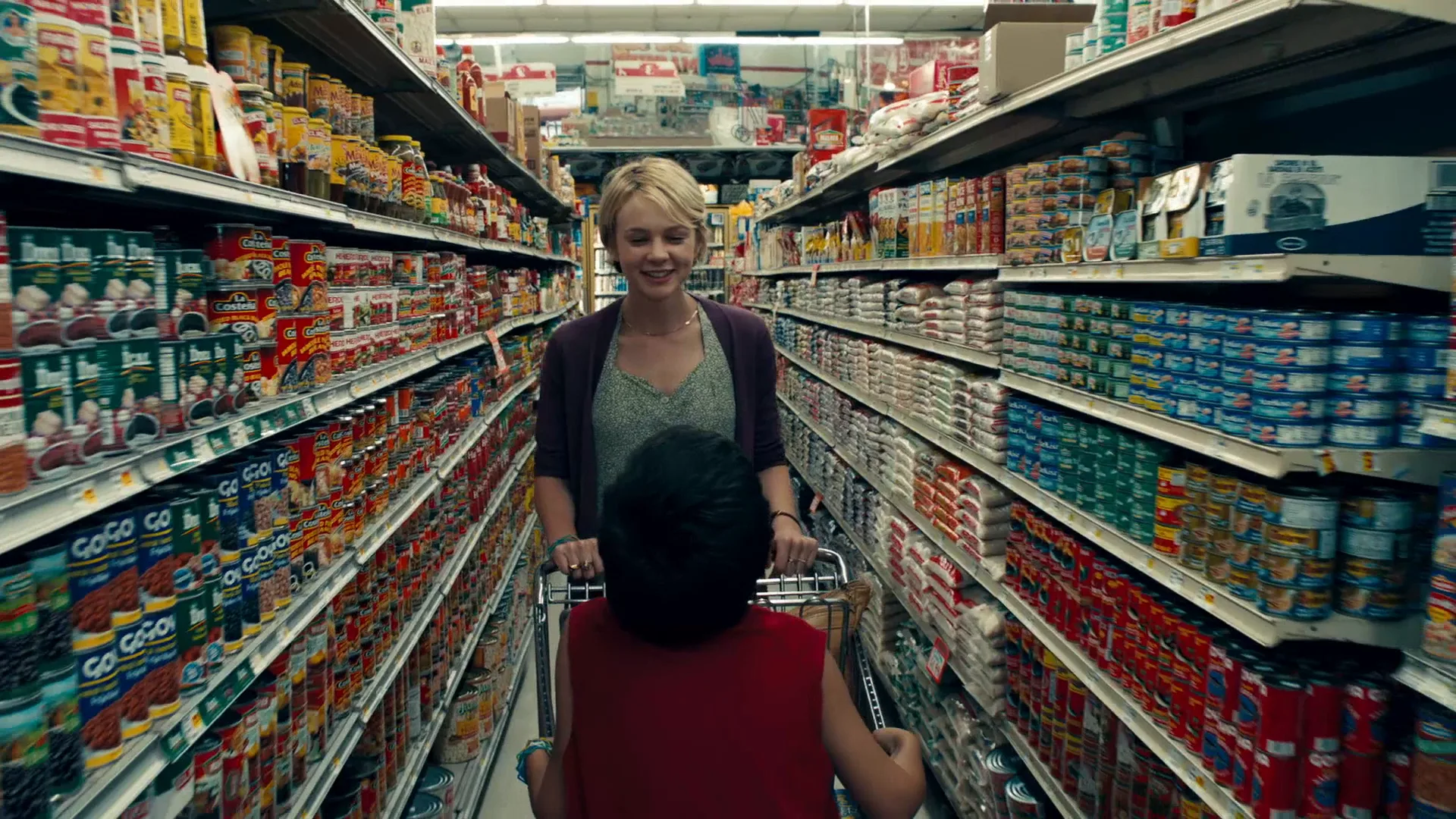
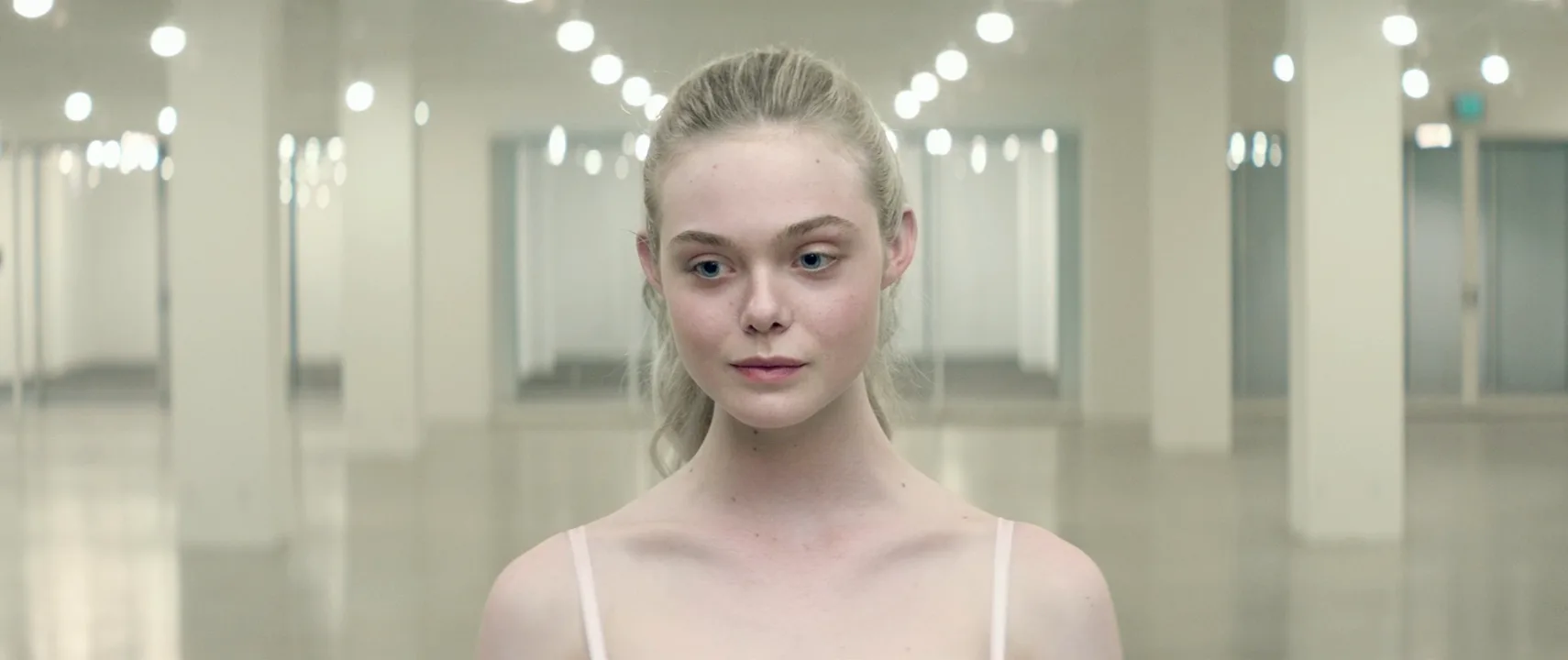
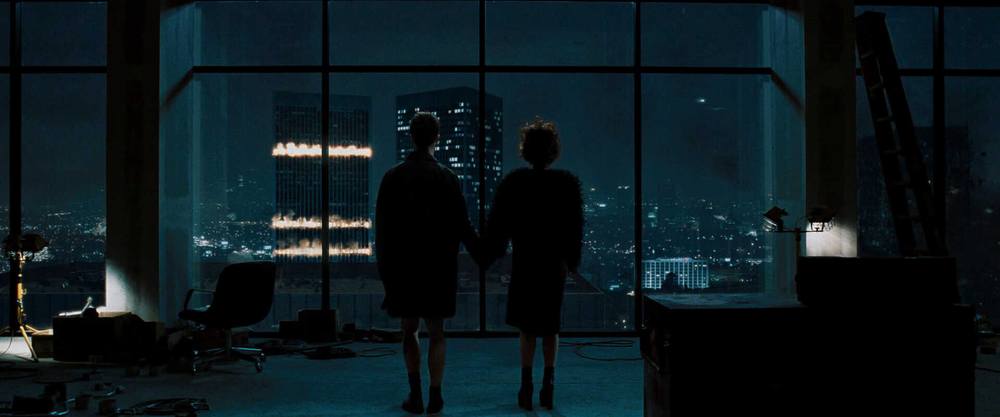
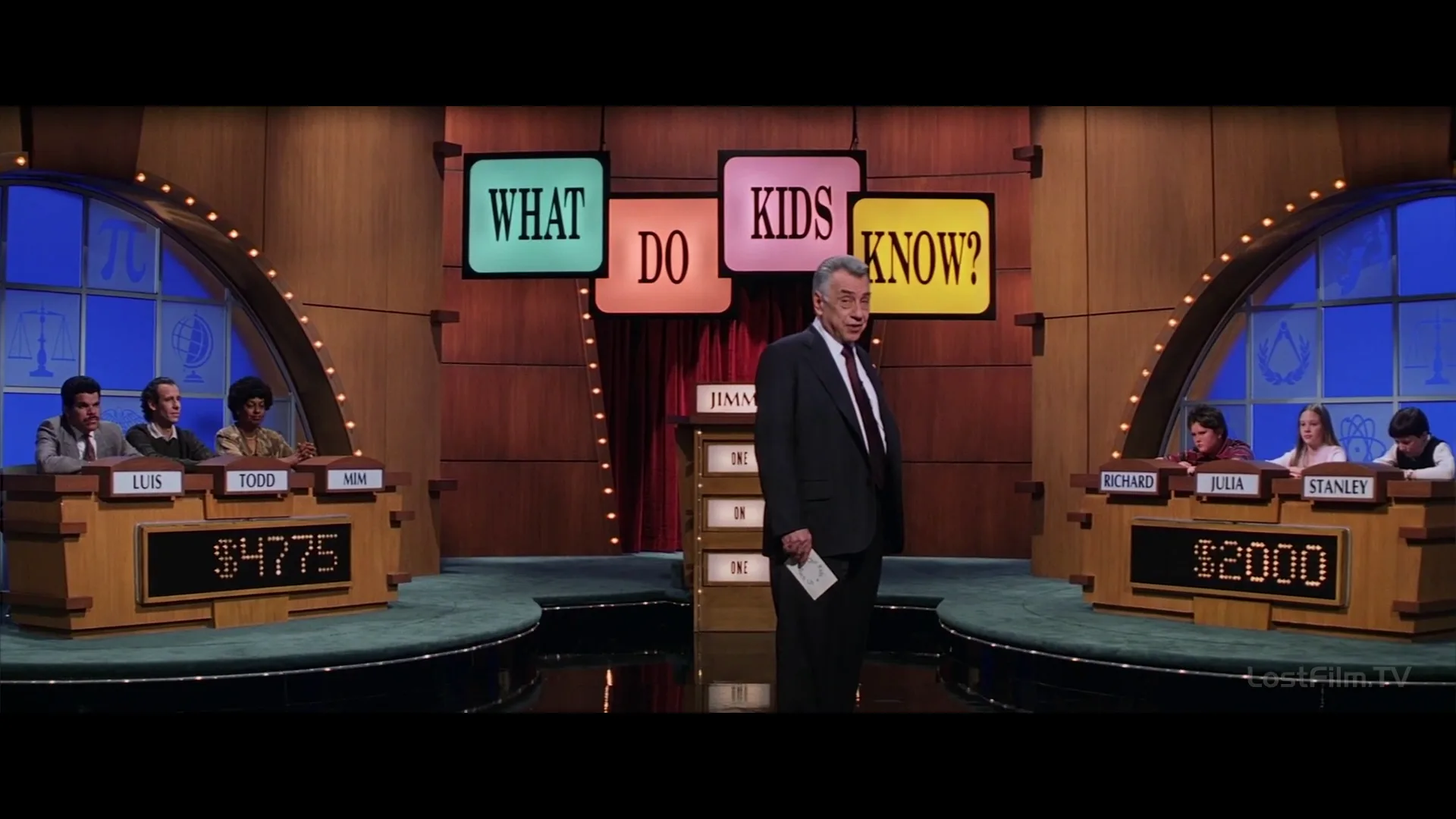
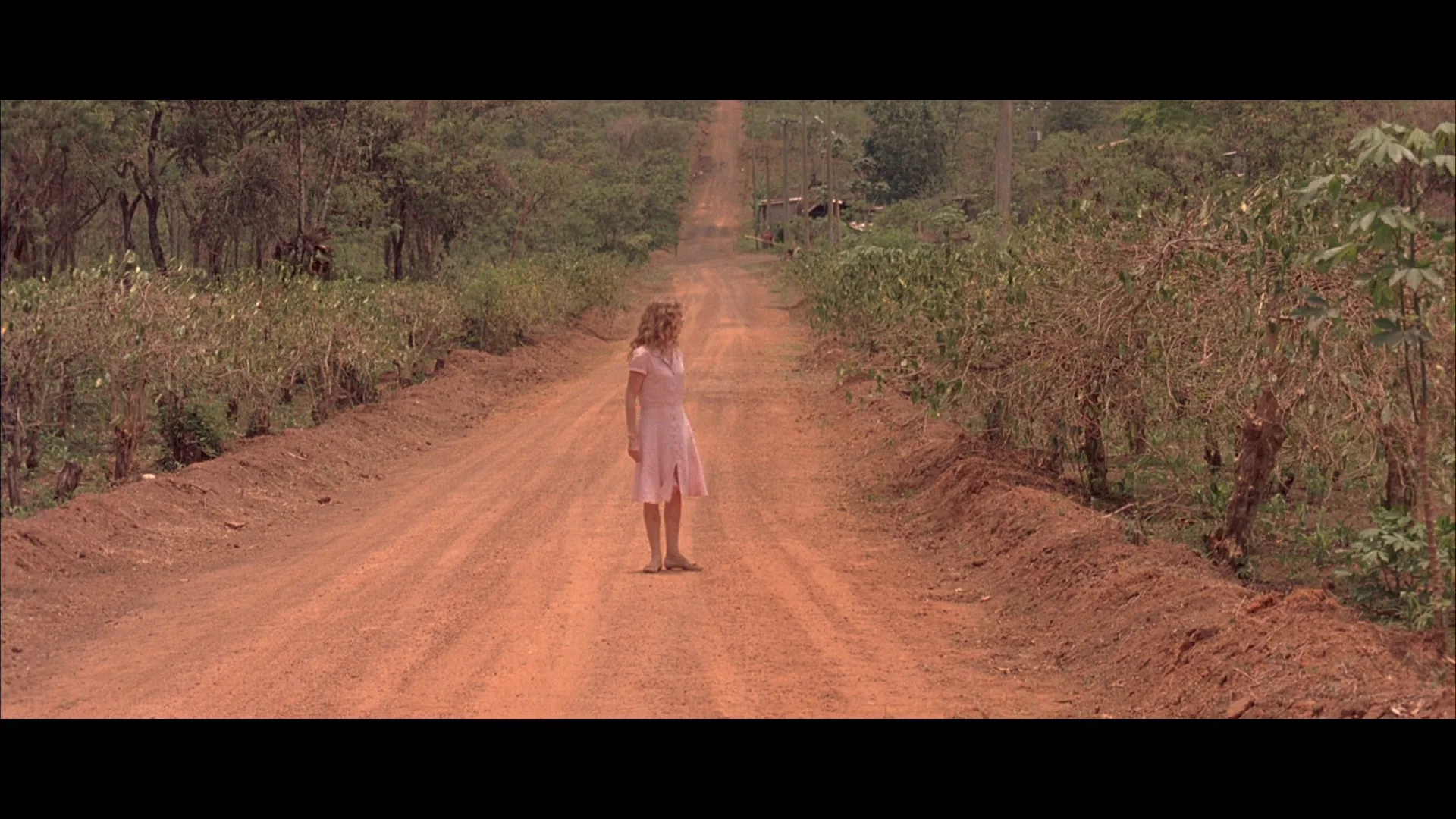
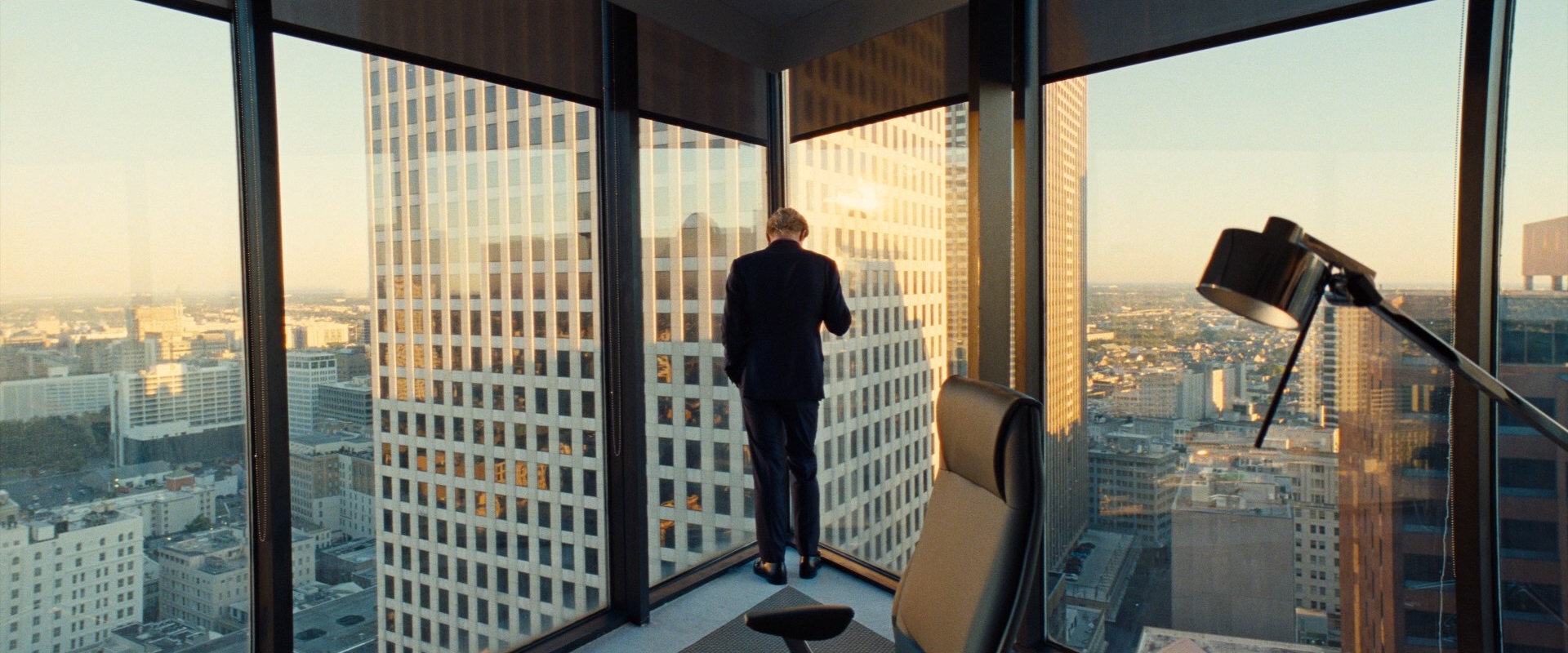
16 framesFrames built around a center line: corridors, halls, tables and roads mirrored left to right, plus reflections, radial patterns and near-symmetrical frames where one element breaks the mirror.
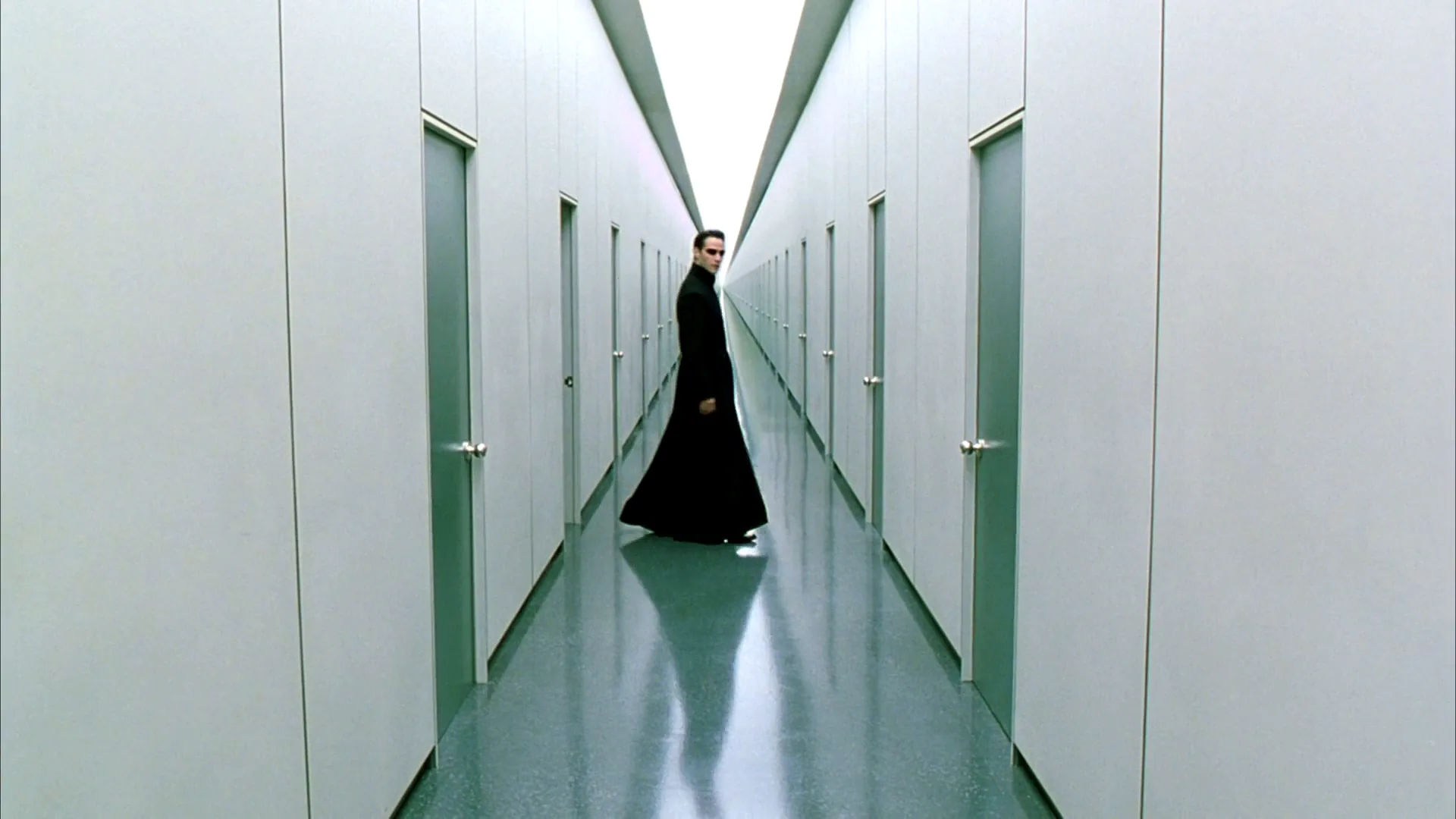
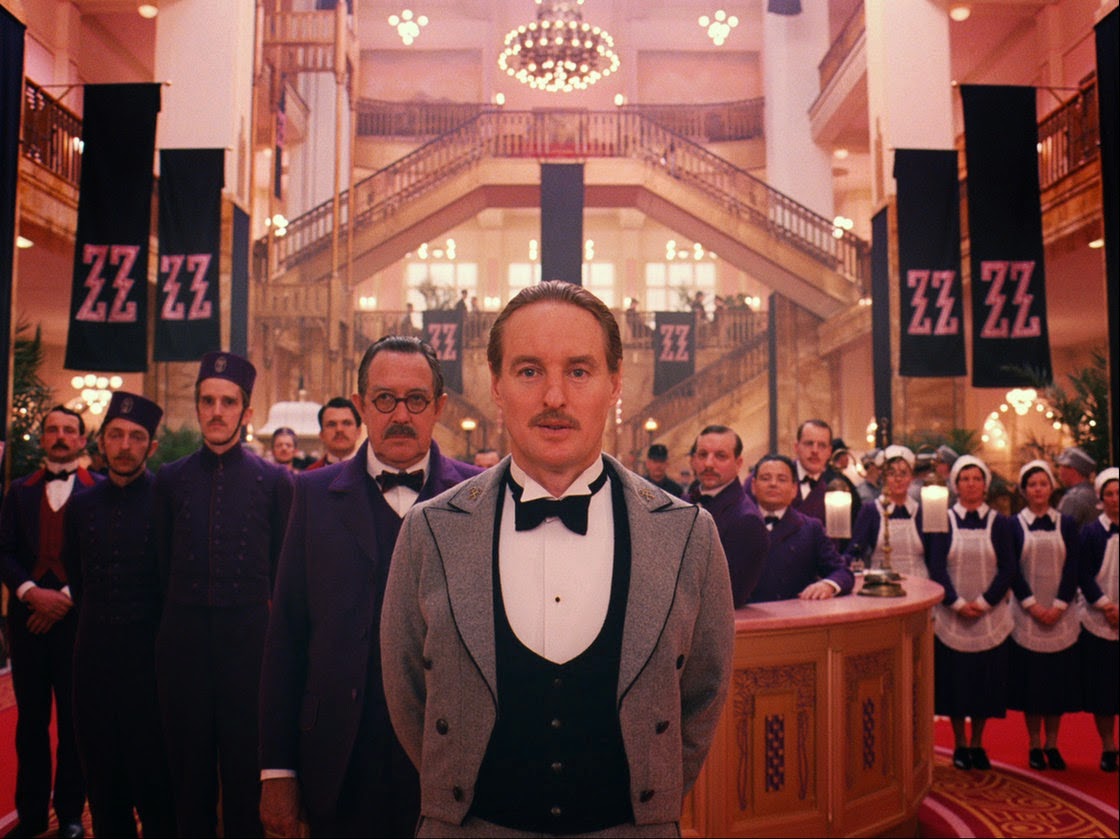
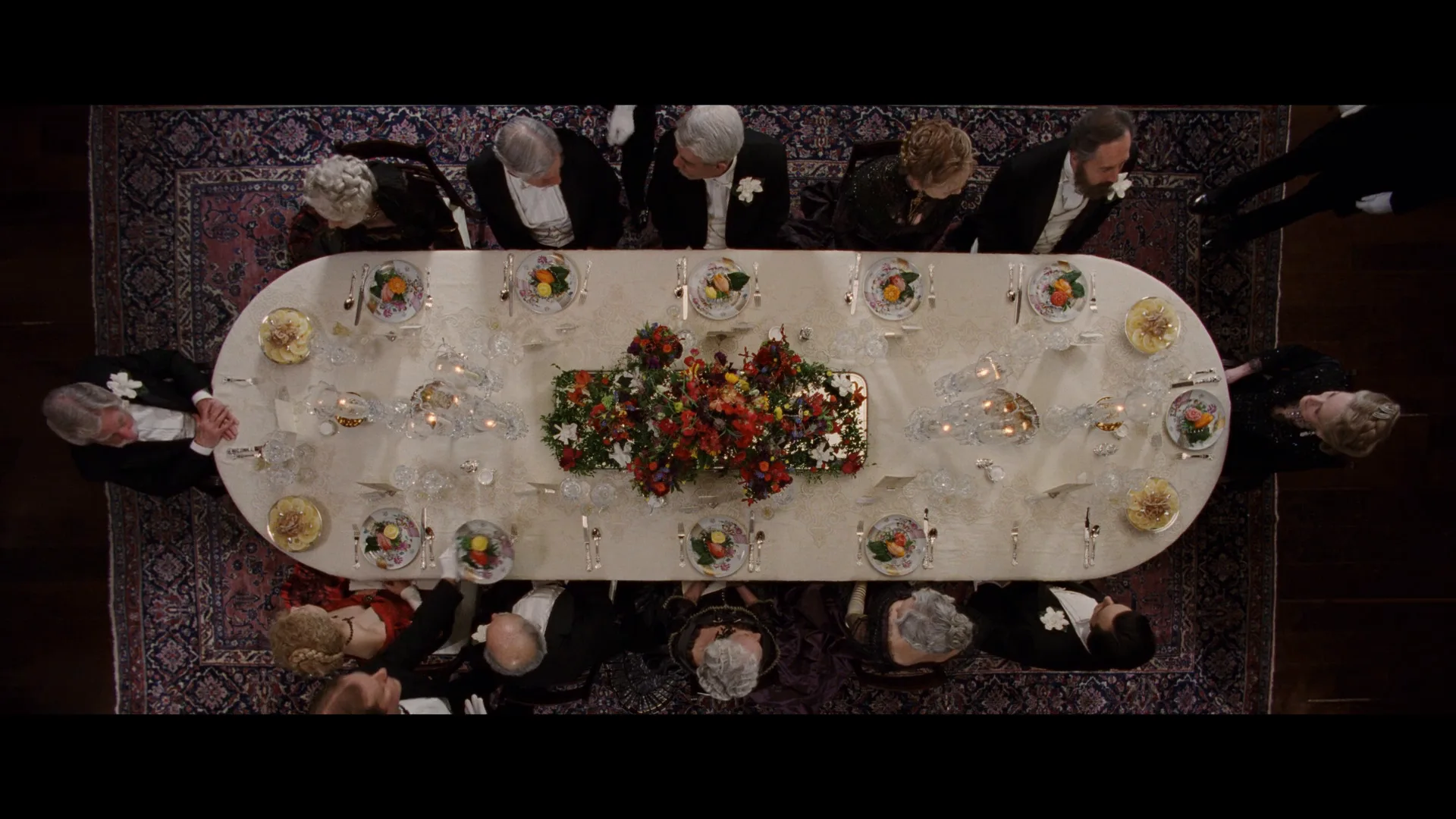
How to create a symmetrical composition with AI
4 promptsImage and video models drift toward off-center, three-quarter compositions, so describe symmetry as geometry: where the camera stands, what repeats on each side and where the vanishing point sits. In FlashBoards, build the start frame with Nano Banana 2 Lite, try a flatter second take with GPT Image 2.5, then animate the frame whose axis holds best with MiniMax H3 Max Turbo, with the reference frames pinned beside the takes on the same board. The fourth prompt re-shoots a real film shot from a text description alone, and the original plays next to the result so you can compare.
Perfectly symmetrical one-point perspective film still, camera placed exactly on the center line of a long old hotel corridor, eye level, 24mm lens, identical cream doors and brass wall sconces mirrored on the left and right walls, patterned burgundy carpet running straight to a vanishing point at the center of the frame, a young woman with a copper-red bob, freckles and a mustard wool coat standing dead center six meters from the camera, facing the lens, warm tungsten light even on both walls, calm uncanny mood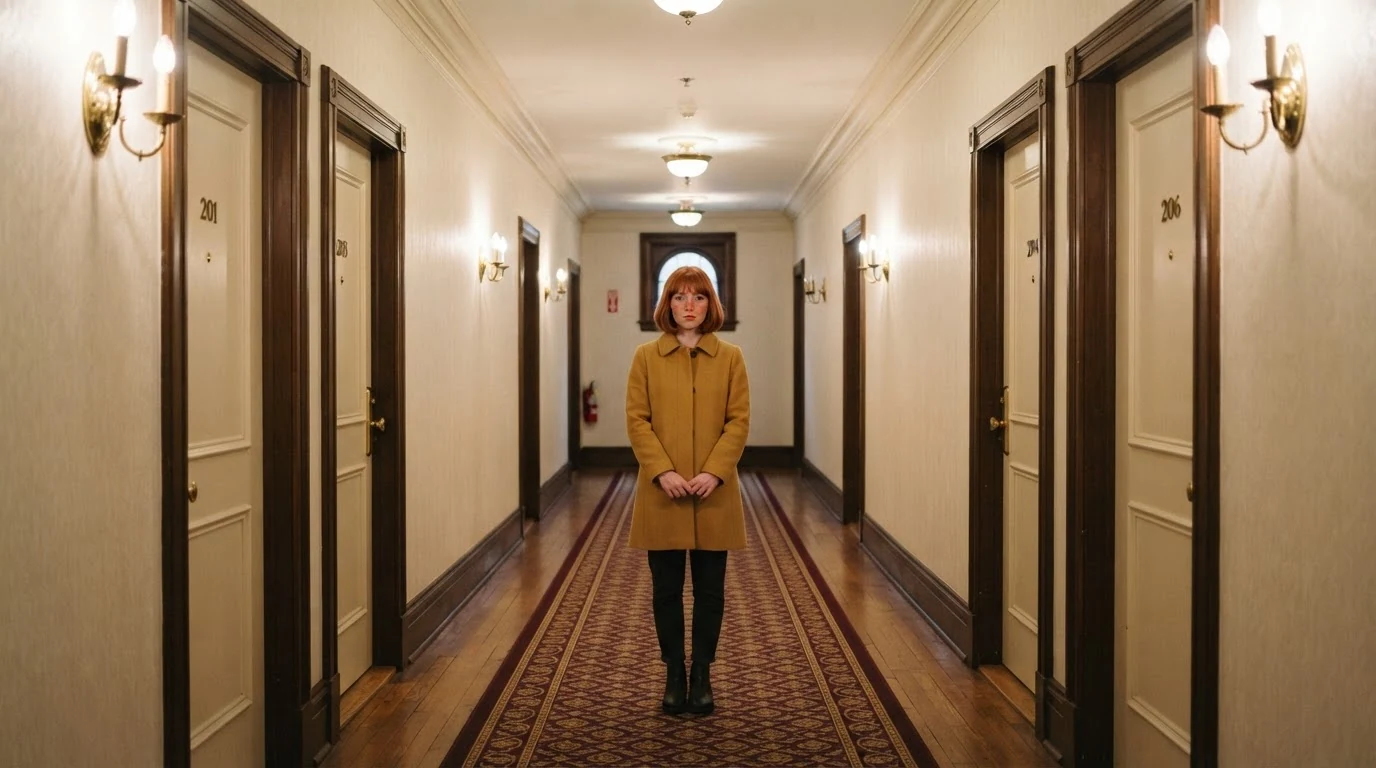
"Camera placed exactly on the center line" and "vanishing point at the center of the frame" fix the geometry; "mirrored on the left and right walls" makes the sides match, and "dead center, facing the lens" keeps the figure off the thirds. "Light even on both walls" prevents a one-sided key. This is the start frame for the video recipe.
Open FlashBoardsFlat frontal symmetrical tableau, camera square to the back wall at chest height, 40mm lens, a small-town fire station interior painted pale mint green, two identical red fire engines parked side by side facing the camera, matching coiled hoses and helmets hung on the left and right walls, a round clock centered above, an older firefighter with a white handlebar mustache and round wire glasses standing exactly between the engines with his hands behind his back, soft even overhead light, pastel storybook color, deadpan mood
A planimetric take instead of a deep one. "Camera square to the back wall" keeps the background parallel to the frame, and paired objects (two identical engines, matching hoses on each wall) give the model something concrete to mirror. The centered clock and the man "exactly between the engines" lock the axis; 4:3 stresses the vertical.
Open FlashBoardsCamera: dollies slowly backward along the exact center line of the corridor at walking pace, level, keeping the vanishing point locked at the center of the frame for the whole shot. Action: from the first frame the woman in the mustard coat is already walking straight toward the camera down the middle of the carpet, arms at her sides. In the middle the brass sconces on both walls dim and brighten together. At the end she stops in the center of the corridor, looks directly into the lens, and the doors on both sides stay perfectly mirrored behind her.The symmetry is already in recipe 1's frame, so the prompt's job is to keep it. "Along the exact center line" and "vanishing point locked at the center" stop the camera drifting into a diagonal, and a backward dolly preserves the mirror. "Already walking" makes the shot alive from the first frame, and sconces dimming "together" add motion that stays symmetrical.
Open FlashBoards{
"output": "Full-screen live-action 35mm film footage from Drive (2011), alive from its very first frame: one continuous shot, no cuts. A long supermarket aisle in warm fluorescent daylight, shelves of cans and boxes in saturated reds, greens and blues mirrored on the left and right, perfectly symmetrical one-point perspective with the vanishing point at the center of the frame, soft teal-and-amber grade, fine grain.",
"characters": {
"S1": {
"name": "a young mother",
"look": "slim woman in her twenties, short platinum-blonde hair, sage-green top under an open dark purple cardigan",
"voice": "soft, warm, playful"
},
"S2": {
"name": "her young son",
"look": "small boy with short dark curly hair in a red t-shirt, seated in the cart's child seat, back of his head to the camera",
"voice": "small child's voice"
},
"S3": {
"name": "Driver, played by Ryan Gosling",
"look": "never seen, walking just behind the camera",
"voice": "quiet, low, calm"
}
},
"shots": [
{
"shot": 1,
"camera": "eye level, medium wide, camera on the exact center line of the aisle dollying backward at walking pace ahead of the cart, following it, the vanishing point locked at the center for the whole shot",
"action": [
"BEGINNING: alive from the first frame, the woman walks straight toward the camera down the middle of the aisle pushing a shopping cart with both hands on the handle, the boy sits in the front of the cart facing her with his back to the lens, filling the lower center of the frame",
"THEN: she keeps walking at an even pace on the center line, looking past the camera at someone just behind it, a small smile starting",
"THEN: she smiles more openly and her lips move as she speaks, the boy's head tilts slightly up toward her",
"END: still walking toward the camera on the center line, both hands on the cart, smiling, shelves on both sides streaming past in matched rows"
],
"dialogue": [
{
"speaker": "S3",
"on_screen": false,
"when": "from the first frame",
"delivery": "quiet, curious",
"line": "<d>[English] Hey, tell me one thing.</d>"
},
{
"speaker": "S1 and S2",
"on_screen": false,
"when": "right after that line, near the end",
"delivery": "playful, overlapping, the child first then the mother",
"line": "<d>[English] - I love you. - I love you.</d>"
}
]
}
],
"sound": {
"ambience": "supermarket hum, cart wheels rolling, faint footsteps",
"speech": "exactly these spoken phrases, each said once, in this order",
"never_spoken": "no narration and no voice-over: the descriptions, performance notes and step words of this prompt are never spoken aloud",
"music": "a film score under the scene, always below the voices: soft dreamy synth pads with a gentle warm pulse",
"subtitles": "none"
}
}Remakes the supermarket-aisle shot from Drive (2011), carrying over the backward dolly on the center line, the cart on the axis and the original's two lines of dialogue.
The prompt puts the camera "on the exact center line" and has it dolly backward ahead of the cart, so the mirrored shelves stream past in matched rows while the vanishing point stays locked. The woman and the cart hold the axis, and the only lines are the corpus dialogue, heard off-screen.
Open FlashBoardsCommon mistakes
- Rule-of-thirds reflex. Models slide the subject to one side. Say "dead center" or "exactly between" and name what flanks it on each side.
- Two-point perspective. The camera ends up angled and one wall shows more than the other. Write "camera placed exactly on the center line" and put the vanishing point at the center.
- Sides that don't match. A door on the left becomes a window on the right. Describe the pairs explicitly.
- Kaleidoscope effect. "Symmetrical" alone can produce a digitally mirrored image with a doubled face. Describe a real place and let the set carry the symmetry.
- One-sided light. Ask for matched practicals or even overhead light.
- Drift in video. The model may pan or arc off the axis. Keep moves on the center line (dolly in or out, pedestal) and say the vanishing point stays centered for the whole shot.
Keep the reference frames, prompts and every generated take side by side — images and video in one canvas.
FAQ
5 questionsWhat is symmetrical composition in film?
Symmetrical composition frames a shot so the left and right halves mirror each other around a central vertical line. The camera sits on the axis of the set, and architecture, props and actors are placed in matched positions on both sides. The result feels ordered, formal and controlled, and when the world looks too perfect, uncanny.
Why does Wes Anderson use symmetry?
Wes Anderson frames rooms, trains and hotels flat and centered so his worlds look handmade, like dioramas or storybook illustrations. The symmetry signals artifice, keeps the audience at a slight distance and sets up deadpan comedy: characters stand in assigned places, and any disorder reads as a joke against the design. It has also become his instantly recognizable signature.
Why did Kubrick use one-point perspective and symmetry?
In 2001: A Space Odyssey, A Clockwork Orange and The Shining, Kubrick's symmetrical one-point frames make spaces look engineered and characters look trapped inside them. Long corridors pull the eye to a single vanishing point, so the architecture seems to control the people in it, and any intrusion into that order feels more threatening.
What is the difference between symmetry and center framing?
Center framing is about where the subject sits: on the vertical center line, while the background can be anything. Symmetry is about the whole frame: the left and right halves mirror each other, with or without a single subject. A symmetrical shot with one main figure is also center-framed, but a centered face in a cluttered room is not symmetrical.
How do you make an AI image perfectly symmetrical?
Describe the geometry rather than relying on the word "symmetrical". State that the camera is placed exactly on the center line, that the vanishing point sits at the center of the frame, and what repeats on each side. Put the subject "dead center", ask for even light on both sides, and describe a real location so the model does not mirror the image digitally.
Related terms
4- Center FramingComposition & Framing
Center framing puts the subject on the vertical center line of the frame, giving it instant dominance and a formal, confrontational or claustrophobic feel; unlike symmetry, the two sides need not mirror each other.
- Visual BalanceComposition & Framing
Visual balance is how visual weight — size, brightness, color, faces, movement — is distributed across the frame; it can be symmetrical or asymmetrical and makes a shot feel stable, or deliberately tipped and uneasy.
- Tableau ShotComposition & Framing
A tableau is a static, carefully arranged frame in which characters are posed in the set like figures in a painting, usually wide and frontal, so the whole composition reads as one picture.
- Leading LinesComposition & Framing
Leading lines are lines in the frame — roads, rails, corridors, fences, architecture, beams of light — that carry the viewer's gaze toward the subject or deeper into the space.
Further reading
Bruce Block, The Visual Story, 2nd ed. (Focal Press, 2008) — chapters on space and line. Rudolf Arnheim, Art and Visual Perception (1954) — chapter on balance. Blain Brown, Cinematography: Theory and Practice, 3rd ed. (Routledge, 2016).