 FlashBoards Learn
- Learn
- Directing & Staging
- Fight Scene
Directing & Staging · Film language
Fight Scene
Also called: fight choreography, action scene, screen combat
A fight scene is choreography, camera and editing designed as one piece. The fighters' moves, the lens, the angles and the cuts share a single job: keep the space clear, make every attack and reaction readable, and set a rhythm of blows and pauses that tells the audience who is winning and what it costs.
- What it does
- Turns physical conflict into story: the audience feels who is winning, who is hurt and what changes with each exchange.
- Use it when
- A conflict can no longer be settled with words and the outcome should change a character or the plot.
- Watch out
- Fast cuts and a shaking camera cannot rescue an unclear map; if viewers lose track of positions, they stop caring.
- Try this prompt
Wide shot, 24mm at waist height, two fighters facing each other in profile in a wet parking garage at night, one mid-punch, the other leaning back
What is a fight scene?
On paper a fight is one line: they fight, she wins. On set it becomes three layers built together.
- Choreography. The moves themselves, designed by the fight choreographer and the stunt coordinator: strikes, blocks, throws, falls, the use of props and walls.
- Camera. Where the lens stands for each piece of the fight, how wide it sees and whether it moves. The same punch can look like a miss, a graze or a knockout depending on the angle.
- Editing. Where each shot starts and stops, which reaction the audience sees, how long a pause lasts before the next attack.
The unit of a fight is the beat: an attack, a defense or a hit, and a reaction. Beats group into phrases of three to eight moves, and phrases are separated by resets, moments where the fighters step apart, breathe and change tactics. That structure is what lets an audience follow a fight the way they follow dialogue: each phrase is a line, each reset is a pause before the answer.
A fight scene is not only swords and lightsabers. Bar brawls, boxing matches and a struggle for a gun in a kitchen follow the same logic. It sits in the directing toolkit next to the car chase scene: both are action staged as a readable map.
What makes a good fight scene?
Clear geography. Before the first blow, the audience needs to know where the fighters stand, where the exits are and what the room contains. A wide or master shot at the top of the fight, or at every major change of position, sets that map. Keeping each fighter on a consistent side of the frame, as the 180-degree rule demands, keeps the map stable through the cuts.
A story inside the fight. Good fights have a shape: one side dominates, the other adapts, the balance shifts, something is lost. In Oldboy (2003), Park Chan-wook plays the corridor fight as one sideways tracking shot, so exhaustion becomes the drama: the hero is visibly running out of strength while the crowd keeps coming.
Character in the style. How someone fights says who they are. A trained fighter is economical; an amateur swings wide and grabs whatever is near. Jackie Chan built a whole screen persona on improvised props and on pain the audience can see; John Wick (2014) gives its hero efficient, repeatable moves that read as professionalism.
Consequence. Fighters who get hit should carry it: a limp, a slower guard, a longer pause before the next phrase. Fights where nobody tires or bleeds feel weightless no matter how fast they are.
Rhythm. Two minutes at full speed numbs the viewer. The strongest fights alternate bursts and holds.
How to shoot a fight scene
1. Break the script into beats. Write down what each phrase must accomplish in story terms: he gains the upper hand, she loses the knife, he realizes he can't win. The choreography is designed to deliver those turns, not the other way round.
2. Let the stunt team build a previs. Most professional fights are designed as a rehearsal video first: the stunt team performs and films the choreography on a phone or a small camera, often already cut together. The director and DP review it, change angles and pacing, and the previs becomes the shot list.
3. Rehearse at speed, shoot in pieces. Actors and stunt performers learn the moves at half speed, then build up. On the day, a long fight is usually filmed as short sections of three to six moves, each covered from several setups, rather than as one continuous take.
4. Sell the hit with the lens axis. Screen punches miss by a safe margin. The camera hides that gap by standing behind the attacker or behind the receiver, so the fist and the face line up along the lens. From the side, the same punch shows daylight between knuckles and jaw. A timed reaction and the sound effect do the rest.
5. Choose lenses by what the shot must prove. A 24–35mm lens close to the action gives energy and keeps bodies and room together; it is honest about distances, so the choreography has to be precise. Longer lenses of 75mm and up compress space and make near misses read as contact, but they also flatten movement toward and away from camera.
6. Frame rate and shutter. A narrow shutter angle gives crisp, staccato motion (the look of many war and action films), while a standard 180-degree shutter keeps natural blur. Some Hong Kong productions run the camera slightly slower than playback speed so the action looks faster on screen. Save high-speed slow motion for one or two moments that matter.
7. Protect everyone. Mats under falls, breakaway furniture and glass, rubber or aluminum weapons, clear signals to stop. Safety is the stunt coordinator's call, and no shot is worth an injury.
Fight scene camera angles and shot sizes
Each shot size has a job in a fight.
- Wide shot. Geography, full bodies, footwork, the relationship between fighters and the room. Martial arts cinema favors it because it proves the performers are doing the moves themselves.
- Medium shot. The workhorse for exchanges: both fighters from the waist or knees up, fists and faces readable in the same frame.
- Close-up. The face after a hit, eyes deciding the next move, a hand reaching for a weapon. A reaction shot often tells the audience more about a blow than the blow itself.
- Insert. A foot sliding in blood, a knife hand being twisted, a key object within reach.
- Low angle. Makes the dominant fighter tower; a camera near the floor catches falls and throws coming toward the lens.
- High or overhead angle. Shows a crowded fight as a pattern: who is surrounded, where the gaps are.
- POV and over-the-shoulder. Put the audience inside the exchange, with punches coming at the lens.
Locked-off, handheld or moving? A static or smoothly tracking camera lets the choreography speak; the viewer sees skill. A handheld shot adds chaos and makes the audience feel off balance, which suits desperate, messy fights, but only when the operator knows the choreography and still frames the key beats. Long takes versus cutting. An unbroken shot proves the moves are real and builds exhaustion; the corridor fight in Oldboy (2003) and the stitched stairwell fight in Atomic Blonde (2017) rely on it. Fast cutting creates impact and hides limits of the performers, but past a point it destroys geography, the most common complaint about modern action scenes.
Editing a fight: impact, reaction and rhythm
Cut on the action. Most fight edits happen in the middle of a movement: the punch starts in one shot and lands in the next. This match on action hides the cut inside the motion and adds a jolt of energy. Trimming a frame or two from the swing makes it feel faster than it was performed.
Show the reaction. An attack without a visible reaction reads as a miss. The editor chooses which of the two faces carries each beat; alternating them tells the audience whose fight it is at that moment.
Repeat the big hit. Hong Kong action cinema sometimes shows one major impact twice, from two angles, back to back.
Let it breathe. Resets, stares and heavy breathing are part of the rhythm. Removing them all turns a fight into noise.
Sound finishes the job. Screen punches are near silent on set. The body hits, cloth swishes and breath are built in post by the foley team and sound designers, and the audience feels a hit largely through what it hears. Editors cut with temporary hit sounds, because rhythm cannot be judged in silence.
Fight choreography vs. fight scene staging
The two terms are often used as synonyms, but they cover different ground.
Fight choreography is the sequence of moves performed by the fighters: which strike, which block, which fall, in what order and at what speed. It is designed by the fight choreographer or stunt coordinator and could, in theory, be performed on a bare stage.
Fight scene staging is the director's layer on top: where the fight happens in the set, how the fighters use the space, where the camera stands for each phrase, how the lighting reveals or hides the action, how the edit paces it and how the whole thing is made safe to shoot. It is the fight version of blocking.
Great choreography can be ruined by staging (the wrong angle shows every miss; too many cuts hide the skill), and modest choreography can be made thrilling by staging that gives it a clear shape. The same split exists in musicals, where dance choreography and the camera are designed together; the best fight choreographers, such as Yuen Woo-ping, think about both at once.
Fight Scene in motion
9 clipsThese clips are fights as they play: watch where the camera stands, how long each shot holds, and whether you can still tell who attacks and who reacts. The wide frames prove the moves are real; the close cuts land the hits.
How to create a fight scene with AI
4 promptsWith AI you direct a fight the same way you would on set: fix the geography in the first frame, then describe a short phrase of beats, not a whole brawl. Generate the start frame with Nano Banana 2 Lite, try a second angle with GPT Image 2.5, then animate the first frame with MiniMax H3 Max Turbo. Keeping references, takes and notes on one FlashBoards board lets you compare angles side by side before you commit. The fourth prompt re-shoots a real film shot from a text description alone, and the original plays next to the result so you can compare.
Cinematic wide shot of a fist fight in an empty underground parking garage at night, 24mm lens at waist height. Frame left: a woman in her thirties with a shaved head, a long pale scar across her left forearm and a grey zip-up tracksuit, throwing a right hook. Frame right: a heavyset man in his fifties with a thick ginger beard and a faded red bomber jacket, leaning back away from the punch. Both fighters full body, facing each other in profile, about one arm's length apart. Concrete pillars and yellow parking lines recede behind them, sodium-vapor ceiling lights, wet floor with orange reflections, gritty 35mm film grain.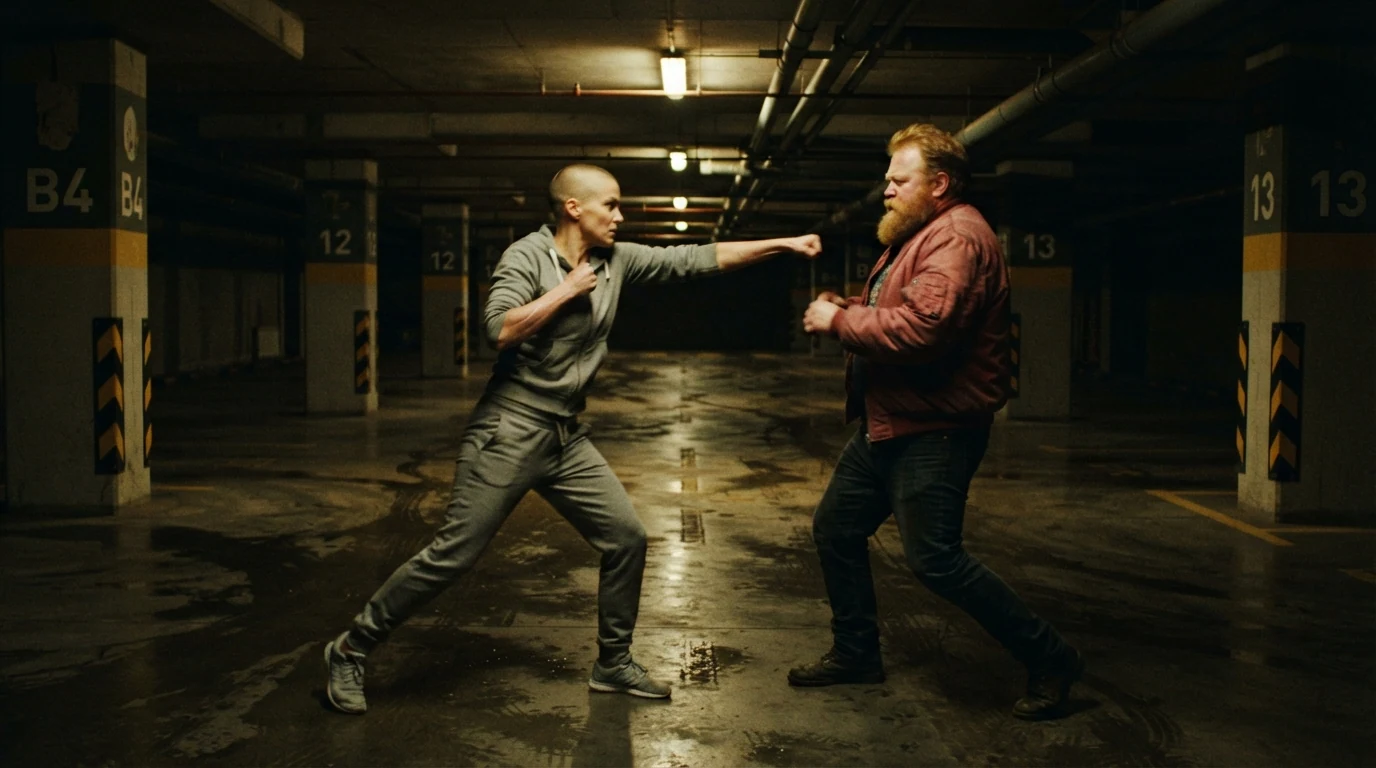
Wide shot, full body and facing each other in profile establish geography and keep the model from posing both people toward the camera. Naming frame left and frame right locks screen direction for the video. One arm's length apart gives the choreography room to move, and 24mm at waist height keeps bodies and room together.
Open FlashBoardsAnamorphic 21:9 film still, over-the-shoulder shot from behind the attacker's right shoulder, 75mm lens at chest height, in a dim boxing gym. Foreground, soft and out of focus: the shoulder and blue hand-wrapped fist of a wiry young man with curly copper hair, arm fully extended toward the lens axis. In focus: a tall broad-shouldered man with a salt-and-pepper beard and a black sparring headguard, head snapping sideways from the jab, sweat spraying off his face, caught in a hard white backlight. Dark gym, a ring rope crossing the upper frame, crisp motion, shallow depth of field.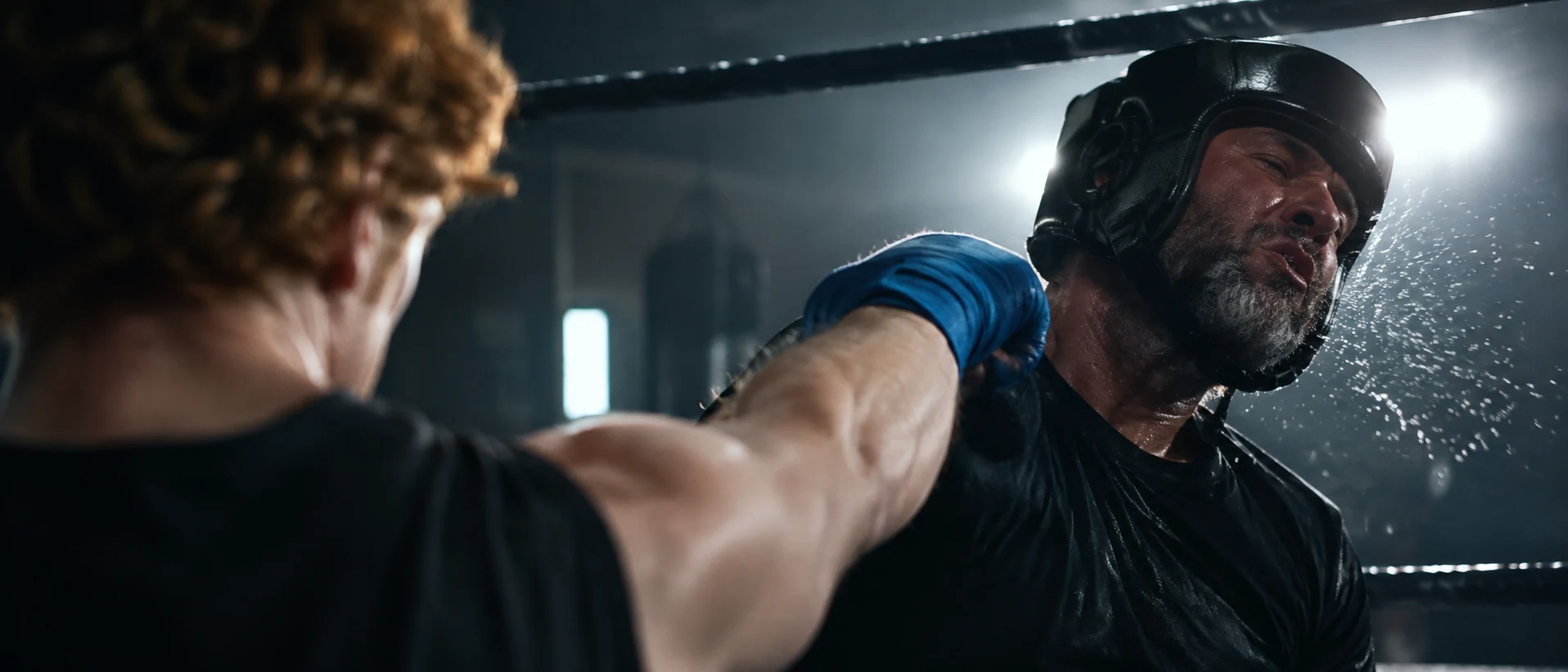
This is the angle that sells a hit. Over-the-shoulder from behind the attacker and arm extended toward the lens axis line up fist and face so contact reads, and the 75mm compression hides the gap. Head snapping sideways and sweat spraying put the reaction in the frame, and the backlight makes the spray visible.
Open FlashBoardsCamera: handheld at waist height, already moving, drifting slowly to the left around the two fighters while keeping both of them full body in frame, with small natural shake. Action: The woman's right hook swings through and the bearded man leans back so it misses his chin. He grabs her sleeve with both hands and shoves her backward into a concrete pillar. She ducks under his next punch, slips to his side and drives her elbow into his ribs. He staggers two steps back across the wet floor, splashing the puddles, and raises his fists again as she squares up to face him, both breathing hard.The prompt starts mid-swing, so the shot is alive from the first frame instead of slowly pushing in on a still. The action is one short phrase of four beats, each with a clear attacker and reaction, which the model can follow. Keeping both of them full body in frame protects geography, and the ending (both squared up again) gives the phrase a reset instead of trailing into random flailing.
Open FlashBoards{
"output": "Full-screen live-action scene from Star Trek: Generations (1994) from its very first frame: one continuous handheld shot. Grainy 1990s 35mm, a dim starship room with dark teal-green walls, one diagonal strip of cold blue fluorescent light behind the men at screen right, warm low key light on the faces from the left, deep shadows, a crowd pressing in.",
"characters": {
"S1": {
"name": "Dr. Tolian Soran, played by Malcolm McDowell",
"look": "man in his fifties, swept-back white hair, a fresh cut on his forehead with a thin red streak down across his brow to his cheek, black high-collared tunic",
"voice": "hoarse, desperate shouting"
},
"S2": {
"name": "a Journalist on board",
"look": "stocky man in his thirties, short brown hair, pale grey-green jacket with a high collar",
"voice": "none in this shot, only strained breaths"
},
"S3": {
"name": "an officer seen only as his arm",
"look": "red uniform jacket sleeve with a ribbed white inner cuff and a band of small gold studs, a bare clenched fist",
"voice": "none"
},
"V1": {
"name": "an unseen man off screen",
"look": "not visible",
"voice": "low, puzzled male voice"
},
"V2": {
"name": "a second unseen man off screen",
"look": "not visible",
"voice": "quiet, shaken male voice"
}
},
"shots": [
{
"shot": 1,
"camera": "handheld medium close-up at eye level, normal lens, unsteady and jolting with each blow, following S1's head; at the end it tilts down after him as he collapses to the lower left",
"action": [
"BEGINNING: alive from the first frame, S1 in the centre-left of the frame, head turned slightly to screen right, eyes squeezed, mouth wide open shouting; several hands grip his shoulders; a bare hand at screen right presses on his cheek; a dark-haired man in a dark jacket watches from the far left in soft focus.",
"THEN: S3's fist in the red sleeve rises from the lower right foreground to S1's jaw while S2 pushes in from the right edge, teeth bared, his hands on S1's chest.",
"THEN: the fist drives into S1's jaw from screen right; S1's head snaps back and up toward the upper left, mouth gaping, eyes rolling up; the camera jolts with the blow.",
"THEN: S1's head drops forward, eyes half closed, brow knotted in pain; the fist pulls back to the lower right and slams into his jaw a second time.",
"THEN: a third short hook comes from the lower right and lands; the red sleeve sweeps across the right half of the frame.",
"THEN: S1 goes limp, head lolling back to screen left, eyes closing, mouth slack; one of S2's hands is spread on S1's shoulder, S2's grimacing face pressed close at screen right, eyes on S1.",
"END: S1 sinks down toward the lower left corner onto a teal padded bench, the camera tilting down after him, until S2's grey-green shoulder and back fill the right side of the frame and S1's face is almost out of frame at the bottom left."
],
"dialogue": [
{
"speaker": "S1",
"on_screen": true,
"when": "from the first frame, while he struggles, before the first punch lands",
"delivery": "shouted, pleading, breaking",
"line": "<d>[English] Let me go back. Let me go back. Please!</d>"
},
{
"speaker": "V1",
"on_screen": false,
"when": "after the third blow, as S1 goes limp",
"delivery": "stunned, low, from off screen",
"line": "<d>[English] What was he talking about?</d>"
},
{
"speaker": "V2",
"on_screen": false,
"when": "right after, as S1 sinks out of frame",
"delivery": "quiet, shaken, from off screen",
"line": "<d>[English] I have no idea.</d>"
}
]
}
],
"sound": {
"ambience": "a scuffle of bodies and clothing, grunts and strained breaths, three dull punch thuds, a low starship hum",
"speech": "exactly these spoken phrases, each said once, in this order",
"never_spoken": "no narration and no voice-over: the descriptions, performance notes and step words of this prompt are never spoken aloud",
"music": "a film score under the scene, always below the voices: urgent low strings with brass stabs over a pounding pulse",
"subtitles": "none"
}
}Remakes the handheld close-up from Star Trek: Generations (1994) in which a red-sleeved fist knocks out Dr. Tolian Soran; the prompt carried over his verbatim plea, the three blows from lower right, the diagonal blue light and the collapse to the lower left.
The action list tracks one fist by screen side: it always enters from the lower right foreground, so all three blows travel along the same line toward the lens and the reader never loses geography. Each blow is paired with its reaction (head snaps back and up toward the upper left, head drops forward, goes limp), and the END step hands the frame to the journalist's back as Soran sinks out, the same exit the original uses.
Open FlashBoardsCommon mistakes
- Posing instead of fighting. Image models like to turn both fighters toward the camera. Write facing each other in profile and name which side of the frame each stands on.
- Merged bodies at contact. Where fists meet faces, limbs fuse or duplicate. Keep a visible gap in the start frame (one arm's length apart, leaning back from the punch) and let the video make contact.
- Too many moves. A prompt with ten strikes becomes blurred flailing. Describe three or four beats, each as attack and reaction.
- Faces drifting mid-fight. Give each fighter two or three fixed physical features (hair, scar, clothing color) and repeat them in the video prompt.
- Smeared motion. Heavy blur hides the choreography. Ask for crisp motion or place blur only on the swinging fist, and keep the camera move slow when the action is fast.
Keep the reference frames, prompts and every generated take side by side — images and video in one canvas.
FAQ
5 questionsHow do you shoot a fight scene?
Break the fight into story beats, let the stunt team design and film a previs of the choreography, then rehearse it until the actors can perform it at speed safely. Shoot in short sections of a few moves, each from several angles: a wide for geography, mediums for exchanges, close-ups for reactions. Place the camera on the line of each punch so near misses read as hits, and add the impact with reactions and sound.
What are the best camera angles for a fight scene?
Start with a wide shot that shows both fighters and the room, then cover exchanges in medium shots where fists and faces share the frame. Use angles along the line of a strike, behind the attacker or behind the receiver, to sell contact. Low angles make a fighter dominant and catch falls; overhead angles clarify fights with many people. Close-ups belong to reactions and decisions, not to every punch.
What is fight scene choreography?
Fight choreography is the designed sequence of moves in a screen fight: strikes, blocks, throws, falls and the use of props, organized into short phrases with resets between them. It is created by a fight choreographer or stunt coordinator to serve the story and the characters' skills, rehearsed with the actors and stunt performers, and then staged for the camera together with the director and cinematographer.
What are some of the best fight scenes in movies?
Frequently cited examples include the corridor fight in Oldboy (2003), filmed as one sideways tracking shot; the martial arts sequences of The Raid (2011) and The Raid 2 (2014); the stairwell fight in Atomic Blonde (2017), built to play as a single take; the bathroom fight in Mission: Impossible – Fallout (2018); and the fights Yuen Woo-ping choreographed for Crouching Tiger, Hidden Dragon (2000).
How do actors avoid getting hurt in fight scenes?
Punches are thrown to miss by a safe distance and hidden by camera placement, while the receiver sells the impact with a timed reaction. Falls land on mats or pads, furniture and glass are breakaway, and weapons are made of rubber, foam or aluminum. Stunt performers double for dangerous moves, and the stunt coordinator rehearses every sequence, sets signals to stop and has final say on safety.
Related terms
6- Dance ChoreographyDirecting & Staging
Dance choreography on screen is built together with the camera: movement, framing and cutting are designed as one piece so the body, the rhythm and the emotion of the scene read in every shot.
- Stunt PerformerActing & Casting
A stunt performer executes dangerous physical action on camera — falls, fights, car hits, fire burns — often doubling for an actor under the stunt coordinator's direction.
- Stunt CoordinatorFilmmaking Process & Crew
The stunt coordinator designs and supervises every stunt and fight — choreography, rigging, pads, doubles — and is responsible for the safety of performers and crew.
- Match on ActionEditing
Match on action cuts in the middle of a movement — a door opening, a punch, a glass raised — and continues it in the next shot from another angle, so the cut hides inside the motion.
- Handheld ShotCamera Movement
A handheld shot is filmed with the camera held in the operator's hands or on the shoulder, without a stabiliser, so its natural sway and jolts make the scene feel immediate, documentary-like or anxious.
- Car Chase SceneDirecting & Staging
A car chase is staged as a map of routes, speeds and obstacles: the director keeps screen direction and the distance between pursuer and pursued readable while stunt drivers, camera cars and editing build velocity.
Further reading
Jackie Chan with Jeff Yang, I Am Jackie Chan: My Life in Action (1998). Bruce Block, The Visual Story (2nd ed., 2008), chapters on movement and rhythm.